
Egypt
Egypt holds the longest story of any country, from pyramids five thousand years old to a river that still feeds its people. The Nile runs through all of it.
The country is a narrow ribbon of green inside a desert, and almost everything in Egypt happens within a few kilometres of the river. Cairo, the largest city in Africa, sits where the Nile divides into its delta, and the pyramids of Giza rise on the plateau just west of the city, close enough to see from the rooftops. South of Cairo the valley narrows to a strip of fields between cliffs, with Luxor and Aswan strung along it, and beyond the valley the deserts stretch to Libya in the west and the Red Sea in the east. Egypt rewards the traveller who follows the river south, because the monuments grow older and the landscape grows quieter with every day on the water.
Quick Facts
- Position: northeast Africa, with the Sinai Peninsula in Asia
- Land area: 1,002,450 square kilometres
- Residents: about 107 million inside Egypt, CAPMAS, November 2024
- Capital: Cairo, at the head of the Nile Delta
- Longest river: the Nile, about 6,650 kilometres
- Official language: Arabic
- Money: Egyptian pound
- Local time: UTC plus 2 hours
- World Heritage properties: 7, six cultural and one natural
- Largest city: Cairo, the largest city in Africa
Geography of Egypt
Egypt covers about 1,002,450 square kilometres in the northeast corner of Africa, and it is a transcontinental country, because the Sinai Peninsula east of the Suez Canal lies in Asia. The Mediterranean Sea borders the north, the Red Sea borders the east, Libya lies to the west and Sudan to the south, and the Gaza Strip and Israel touch the northeast corner. Most of the land is desert, and the population lives almost entirely along the Nile and its delta, in a strip that covers less than 5 percent of the country. About 95 percent of Egyptians live in that strip, which makes the Nile valley one of the most densely settled landscapes on Earth.
The Nile enters Egypt at Aswan in the south and flows north for about 1,500 kilometres inside the country before dividing into the delta. The river is about 6,650 kilometres long in total, from its sources in East Africa to the Mediterranean, and it is the longest river in the world. Before the Aswan High Dam was completed in 1970, the river flooded every year and laid down the silt that made the fields fertile, and the farming calendar followed the flood.
The dam stopped the annual flood and created Lake Nasser, one of the largest artificial lakes in the world, behind it in the south. The dam also gave Egypt electricity and year-round irrigation, and it changed the river from a seasonal force into a managed one.
The Nile Delta is one of the largest deltas in the world, covering about 22,000 square kilometres, with two main branches, the Damietta in the east and the Rosetta in the west. The delta is the most fertile land in Egypt, growing rice, cotton and vegetables, and it holds the cities of Alexandria, Tanta and Mansoura. Alexandria, the largest port in Egypt, stands on the western edge of the delta on the Mediterranean, and it was founded by Alexander the Great in 331 BC. East of the Nile valley lies the Eastern Desert, a rocky plateau between the river and the Red Sea, and west of the valley lies the Western Desert, a vast sand sea that covers about two-thirds of Egypt and holds the oases of Siwa, Bahariya and the White Desert.
The Red Sea coast of Egypt runs for hundreds of kilometres along the east, and its reefs draw divers to Hurghada and Sharm el-Sheikh, while the Sinai Peninsula holds the mountains around Saint Catherine and the resorts of the Gulf of Aqaba. The highest point in Egypt is Mount Catherine in Sinai, at 2,629 metres, and the monastery of Saint Catherine stands at its foot. The climate is desert dry for most of the country, with hot summers and mild winters, and rain is rare except on the Mediterranean coast. The Nile is the reason Egypt exists as a settled country at all, and every map of Egypt is really a map of the river and the narrow green line it draws through the sand.
The seven World Heritage properties of Egypt follow the river and the coasts. Memphis and its necropolis, which includes the pyramids of Giza, lies just west of Cairo, and Historic Cairo covers the old city itself. Ancient Thebes stands at Luxor, about 700 kilometres south of Cairo, and the Nubian Monuments run along the river south of Aswan.
Abu Mena lies in the desert west of Alexandria, the Saint Catherine Area covers the mountains of southern Sinai, and Wadi Al-Hitan lies in the Fayoum depression southwest of Cairo. Together the seven properties cover the whole length of the country, from the Mediterranean to the Sudanese border, and a traveller who visits all of them has followed the Nile from end to end.

A beach in the north coast in Egypt — CC BY-SA 4
History of Egypt
Egyptian history begins with the unification of the Two Lands, Upper and Lower Egypt, around 3100 BC, and the Old Kingdom that followed built the pyramids of Giza in the third millennium BC. The Great Pyramid of Khufu, raised to 146.6 metres when it was new, was the tallest building in the world for more than 3,800 years, and it is the only one of the Seven Wonders of the ancient world still standing. The Old Kingdom collapsed into a period of division, and the Middle Kingdom and then the New Kingdom rebuilt the state, with Thebes as its religious capital and the pharaohs of the Eighteenth Dynasty, including Hatshepsut, Thutmose III and Akhenaten, extending Egyptian power into Nubia and the Levant. The New Kingdom ended in decline, and Egypt passed through Libyan, Nubian, Assyrian and Persian rule before Alexander the Great arrived in 332 BC.
Alexander founded Alexandria, and his general Ptolemy founded a dynasty that ruled Egypt for three centuries, with the city becoming a centre of learning that held the great library. Rome annexed Egypt in 30 BC after the death of Cleopatra, and the country became the granary of the Roman Empire, shipping grain to Rome for centuries. Christianity spread in Egypt in the first centuries of the new era, and the Coptic Church, founded by tradition on the preaching of Saint Mark, still survives today.
The Arab conquest of 641 brought Islam, and the city of Fustat was founded in 642, followed by the Fatimid city of Cairo in 969, with the Al-Azhar mosque founded in 970. The Mamluks ruled from the thirteenth century, the Ottomans took Egypt in 1517, and the country remained an Ottoman province until the nineteenth century.
Muhammad Ali, an Albanian officer who took power in 1805, founded the dynasty that ruled Egypt until 1952, and he built a modern army, factories and the first railways. His successors dug the Suez Canal, which opened in 1869 and joined the Mediterranean to the Red Sea, and the debt from the canal led to British occupation in 1882. Egypt became formally independent in 1922, though British troops stayed until after the Second World War, and the revolution of 1952 ended the monarchy and brought Gamal Abdel Nasser to power.
Nasser nationalised the Suez Canal in 1956 and built the Aswan High Dam with Soviet help, and the dam was completed in 1970. The dam threatened the monuments of Nubia with flooding, and UNESCO ran an international campaign from 1960 to 1980 to move the temples, including Abu Simbel, which was cut into blocks and rebuilt on higher ground.
Modern Egypt has grown fast, from about 20 million people in 1950 to about 107 million inside the country in November 2024, according to the national statistics agency CAPMAS, while the United Nations estimate for 2024, which counts Egyptians abroad as well, is about 116.5 million. The country remains a republic, and tourism is one of its largest industries, with the pyramids, the Nile cruise and the Red Sea resorts drawing millions of visitors in a normal year. The Grand Egyptian Museum, which opened fully on 1 November 2025 on the edge of the Giza Plateau, about 2 kilometres from the pyramids, now holds the complete Tutankhamun collection together for the first time since the tomb was found in 1922. The museum is the newest chapter in a history that began five thousand years ago, and it shows that Egypt is still adding to its own story.
A second country after Egypt usually means a change of climate, and the Indian Ocean islands give exactly that, with reef water after the desert river. Madagascar and Mauritius both connect through the Gulf hubs, while Morocco offers a second North African history in the medina of Marrakech.
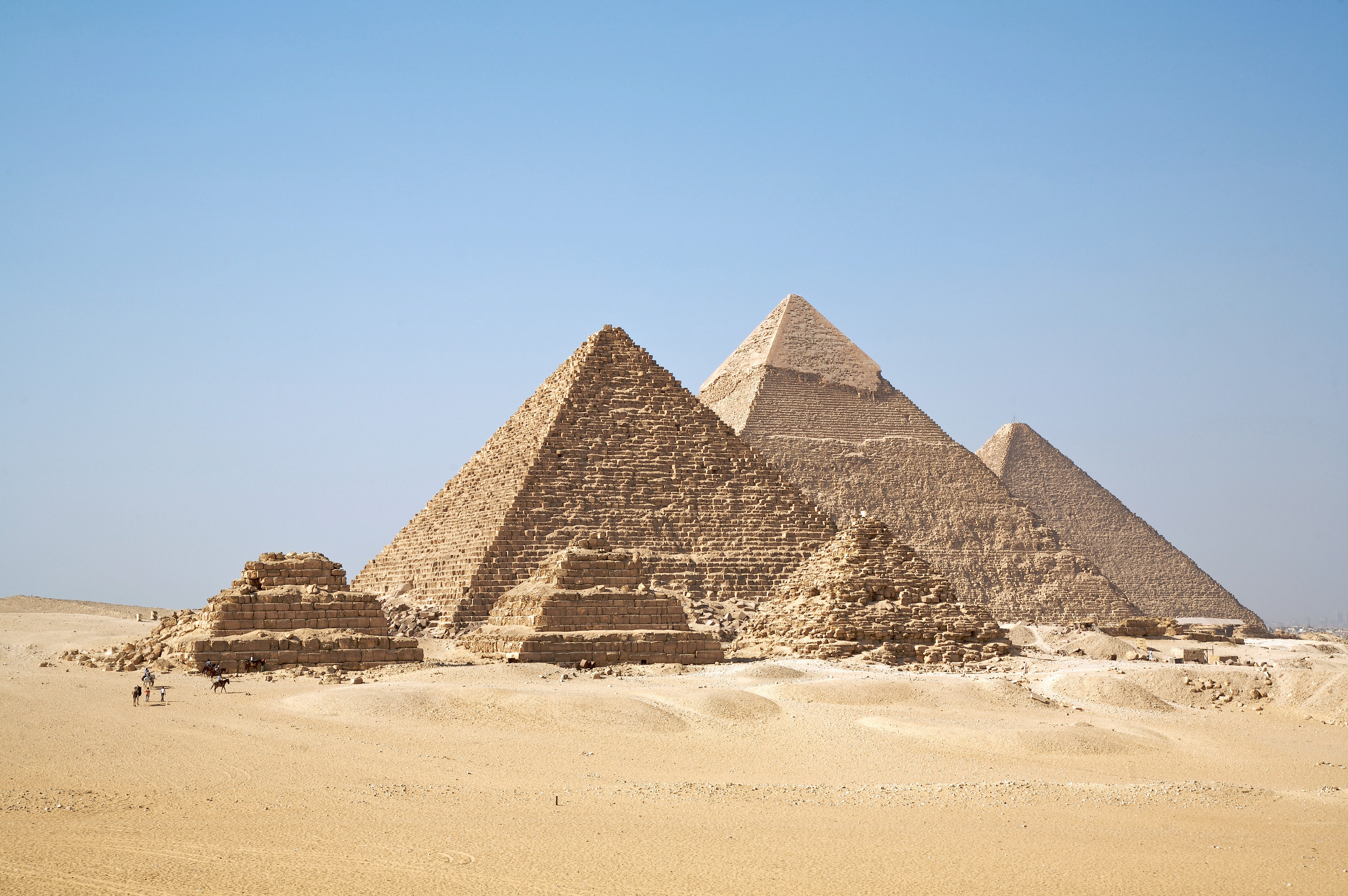
All Giza Pyramids in one shot — CC BY-SA 2
Travel to Egypt
Most visitors arrive at Cairo International Airport, and the city is the base for the pyramids of Giza, the Egyptian Museum on Tahrir Square and the Grand Egyptian Museum at Giza. The pyramids lie about 12.2 kilometres straight-line southwest of central Cairo, and the drive takes about half an hour in normal traffic, though the road can be slow in the evening. The Grand Egyptian Museum stands about 2 kilometres from the pyramids, and the two sites pair naturally in a single day, with the museum in the morning and the plateau in the late afternoon, when the light is best. Cairo itself needs at least two days, for the old city, the Citadel and the markets of Khan el-Khalili, and the city rewards travellers who walk the old streets rather than staying in the modern districts.
The classic journey in Egypt is the Nile cruise from Luxor to Aswan, which takes three to four nights and stops at the temples of Edfu and Kom Ombo on the way. Luxor holds the temples of Karnak and Luxor on the east bank and the Valley of the Kings on the west bank, and it is the city with the most monuments in the smallest area. Aswan, at the southern end of the cruise, holds the Philae temple and the Aswan High Dam, and the day trip from Aswan to Abu Simbel, about 280 kilometres to the south by road, is one of the most valued experiences in Egypt. The temples of Abu Simbel were moved in the UNESCO campaign of the 1960s, and twice a year, on 22 February and 22 October, the sun shines directly into the inner sanctuary.
The best months to visit Egypt are October to April, when the days are warm and the nights are cool, and the summer months from June to August are very hot, especially in Luxor and Aswan, where daytime temperatures pass 40 degrees. The Red Sea resorts are warm all year, and the winter is the best time for the Nile valley, because the heat is manageable and the crowds are thinner than in the peak weeks around Christmas. Ramadan changes the rhythm of the country, with shorter hours in the day and lively nights after sunset, and travellers should respect the fast in public places. The Egyptian pound is the currency, and cash is useful in markets and small towns, though cards are accepted in hotels and larger restaurants.
Safety is the question most first-time visitors ask, and the main tourist areas of Egypt, including Cairo, Giza, Luxor, Aswan, Hurghada and Sharm el-Sheikh, are heavily guarded and receive millions of visitors each year without incident. Travellers should read the latest travel advice from their own foreign ministry before the trip, because the advice is updated regularly, and the usual guidance is to travel with a local guide, to avoid moving alone at night in remote areas and to dress modestly outside the resorts. A guide is also a practical help rather than a formality, because the sites are large, the history is dense and the queues move faster with someone who knows the routines.
Notable Places in Egypt
- Giza pyramids. The pyramid fields of Giza hold the three great pyramids of Khufu, Khafre and Menkaure, the Sphinx and the smaller pyramids of the queens, on a plateau west of Cairo. The Great Pyramid of Khufu, 146.6 metres high when it was new, is the largest pyramid in Egypt and the only surviving wonder of the ancient world. The whole complex is part of the Memphis World Heritage property, and the Grand Egyptian Museum stands about 2 kilometres away.
- Karnak Temple. Karnak is the largest temple complex in Egypt, on the east bank of the Nile at Luxor, and it was built and extended over two thousand years. The Hypostyle Hall measures 102 metres by 53 metres and holds 134 columns, and the scale of the hall is the reason most visitors remember Karnak above all other temples. The temple is part of Ancient Thebes, and an avenue of sphinxes now joins it to Luxor Temple in the centre of the modern city.
- Valley of the Kings. The valley on the west bank at Luxor holds the tombs of the New Kingdom pharaohs, including the tomb of Tutankhamun, found intact by Howard Carter in 1922. The tombs open in rotation to protect the paintings, and the standard ticket covers three tombs, with the tomb of Tutankhamun on a separate ticket. The morning is the best time to visit the west bank, before the heat builds.
- Abu Simbel. The two temples of Abu Simbel stand on the shore of Lake Nasser, about 280 kilometres south of Aswan by road, and Ramesses II had them carved into the cliff around 1264 BC. The temples were cut into blocks and moved to higher ground in the UNESCO campaign of 1964 to 1968, and twice a year, on 22 February and 22 October, the sun shines into the inner sanctuary. Abu Simbel is part of the Nubian Monuments property, and the day trip from Aswan is one of the great journeys in Egypt.
- Philae Temple. The temple of Philae stands on the island of Agilkia near Aswan, and it was dedicated to the goddess Isis, whose cult survived here into the ninth century of the new era. The temple was moved stone by stone to the island when the Aswan High Dam raised the water level, and it is reached by boat from the shore. Philae is part of the Nubian Monuments property, and the evening sound and light show is the best time to see it.
- Alexandria. Alexandria is the largest port in Egypt, on the western edge of the Nile Delta, and it was founded by Alexander the Great in 331 BC. The city holds the Citadel of Qaitbay, built on the site of the ancient lighthouse, and the modern Library of Alexandria, which recalls the great library of the Ptolemies. Alexandria is cooler than Cairo in summer, and it suits travellers who want the sea after the desert.
- Saint Catherine Monastery. The monastery stands at the foot of Mount Catherine in southern Sinai, and it was founded in the sixth century, which makes it the oldest Christian monastery still in use for its original purpose. The monastery holds a library of ancient manuscripts and the chapel of the Burning Bush, and it is reached by road from Sharm el-Sheikh or Dahab. The monastery is the centre of the Saint Catherine World Heritage property, which covers 60,100 hectares of mountains and desert.
- Wadi Al-Hitan. Wadi Al-Hitan, the Valley of the Whales, lies in the Fayoum depression about 150 kilometres southwest of Cairo, and it holds the fossils of ancient whales that lived about 40 million years ago, when the area was sea. The site is the only natural World Heritage property in Egypt, and it shows the evolution of whales from land animals to sea animals in the skeletons laid out in the desert. The valley is reached by road from Cairo through the Fayoum oasis, and the desert road is part of the experience.
Frequently Asked Questions
How many World Heritage properties does Egypt have?
Egypt has seven World Heritage properties: six cultural and one natural. The cultural properties are Memphis, Ancient Thebes, the Nubian Monuments, Historic Cairo, Abu Mena and the Saint Catherine Area, and the natural property is Wadi Al-Hitan.
When is the best time to visit Egypt?
October to April is the best time, when the days are warm and the nights are cool in the Nile valley. The summer months from June to August are very hot in Luxor and Aswan, while the Red Sea resorts are warm all year.
How long does a Nile cruise take?
A cruise from Luxor to Aswan takes three to four nights, with stops at the temples of Edfu and Kom Ombo on the way. The cruise is the classic way to see the valley, because the temples line the river and the boat moves slowly between them.
How far is Giza from central Cairo?
The pyramids of Giza lie about 12.2 kilometres straight-line southwest of central Cairo, and the drive takes about half an hour in normal traffic. The Grand Egyptian Museum stands about 2 kilometres from the pyramids, so the two sites pair naturally in a single day.
Can I visit Abu Simbel in a day from Aswan?
Yes. The temples stand on Lake Nasser, and the trip from Aswan crosses desert before dawn. Book the earliest departure to avoid the crowds.
Is Egypt safe for visitors?
The main tourist areas are heavily guarded and receive millions of visitors each year. Read your foreign ministry’s latest advice before travelling.
Verified
The seven properties below are the complete World Heritage list for Egypt, checked against UNESCO records on 23 November 2026.
- Memphis and its Necropolis. The pyramid fields from Giza to Dahshur form this property, which UNESCO inscribed in 1979 under criteria (i)(iii)(vi). The Great Pyramid of Khufu, 146.6 metres high when new, stands on the Giza plateau about 12.2 kilometres straight-line from central Cairo, and the property holds more than 38 pyramids and 9,000 rock-cut tombs. Details: whc.unesco.org/en/list/86/
- Ancient Thebes with its Necropolis. The temples of Karnak and Luxor and the tombs of the west bank form this property, which UNESCO inscribed in 1979 under criteria (i)(iii)(vi). The Hypostyle Hall at Karnak measures 102 metres by 53 metres and holds 134 columns, and the property covers 7,390 hectares with a buffer of 444 hectares. Details: whc.unesco.org/en/list/87/
- Nubian Monuments from Abu Simbel to Philae. Ten components along the Nile form this property, which UNESCO inscribed in 1979 under criteria (i)(iii)(vi). The temples were moved in the UNESCO campaign of 1960 to 1980, when the Aswan High Dam raised the water, and the property covers 374.48 hectares. Details: whc.unesco.org/en/list/88/
- Historic Cairo. The Fatimid city founded in 969, with the older settlement of Fustat from 642 and the Al-Azhar mosque from 970, forms this property, which UNESCO inscribed in 1979 under criteria (i)(v)(vi). The old city holds the Citadel, the Sultan Hassan mosque and the Khan el-Khalili market, and it is one of the oldest Islamic cities in the world. Details: whc.unesco.org/en/list/89/
- Abu Mena. The pilgrimage centre of Saint Mena, active from the fifth to the seventh centuries, forms this property, which UNESCO inscribed in 1979 under criterion (iv) only. Rising groundwater put the site on the List of World Heritage in Danger in 2001, and a drainage system built in 2021 steadied the ruins, so the Committee removed the property from the Danger List on 9 July 2025. Details: whc.unesco.org/en/list/90/
- Saint Catherine Area. The monastery founded in the sixth century, the oldest Christian monastery still in use for its original purpose, forms this property with the mountains around it, which UNESCO inscribed in 2002 under criteria (i)(iii)(iv)(vi). The property covers 60,100 hectares in southern Sinai. Details: whc.unesco.org/en/list/954/
- Wadi Al-Hitan. The Valley of the Whales, with the fossils of ancient whales from about 40 million years ago, forms the only natural property in Egypt, which UNESCO inscribed in 2005 under criterion (viii) only. The site lies in the Wadi El-Rayan Protected Area in the Fayoum depression. Details: whc.unesco.org/en/list/1186/
Sources
- UNESCO, “Egypt — World Heritage Convention”: whc.unesco.org/en/statesparties/eg/ — checked 23 November 2026.
- UNESCO, “Memphis and its Necropolis – the Pyramid Fields from Giza to Dahshur”: whc.unesco.org/en/list/86/ — checked 23 November 2026.
- UNESCO, “Ancient Thebes with its Necropolis”: whc.unesco.org/en/list/87/ — checked 23 November 2026.
- UNESCO, “Nubian Monuments from Abu Simbel to Philae”: whc.unesco.org/en/list/88/ — checked 23 November 2026.
- UNESCO, “Historic Cairo”: whc.unesco.org/en/list/89/ — checked 23 November 2026.
- UNESCO, “Abu Mena”: whc.unesco.org/en/list/90/ — checked 23 November 2026.
- UNESCO, “Saint Catherine Area”: whc.unesco.org/en/list/954/ — checked 23 November 2026.
- UNESCO, “Wadi Al-Hitan (Whale Valley)”: whc.unesco.org/en/list/1186/ — checked 23 November 2026.
- UNESCO, “Three sites on the African continent removed from the List of World Heritage in Danger”, 9 July 2025: whc.unesco.org/en/news/2793/ — checked 23 November 2026.
- CAPMAS, November 2024: population of Egypt 107 million inside the country; United Nations, World Population Prospects 2024: 116,538,258.
- Registry TheTerraAtlas, TA-L2-egypt: Q79, coordinates 27.0, 29.0.
Unverified
- Visitor numbers for the Grand Egyptian Museum since its full opening, because the museum has published no consolidated annual figure yet.
- The exact number of tombs open in the Valley of the Kings on any given day, because the rotation changes and is announced at the site.
- The population of the Cairo metropolitan area, because sources give figures from 20 to 22 million and no new official census figure settles it.
Illustrations
- Hero: A view of Egypt. Free image: https://upload.wikimedia.org/wikipedia/commons/4/41/Balloon_over_Luxor_-_Egypt_denoised.jpg — CC BY-SA 3.0.
- In body, egypt: A beach in the north coast in Egypt. Free image: https://upload.wikimedia.org/wikipedia/commons/1/18/North_Coast%2C_Egypt.jpg — CC BY-SA 4.
- In body, egypt: All Giza Pyramids in one shot. Free image: https://upload.wikimedia.org/wikipedia/commons/a/af/All_Gizah_Pyramids.jpg — CC BY-SA 2.