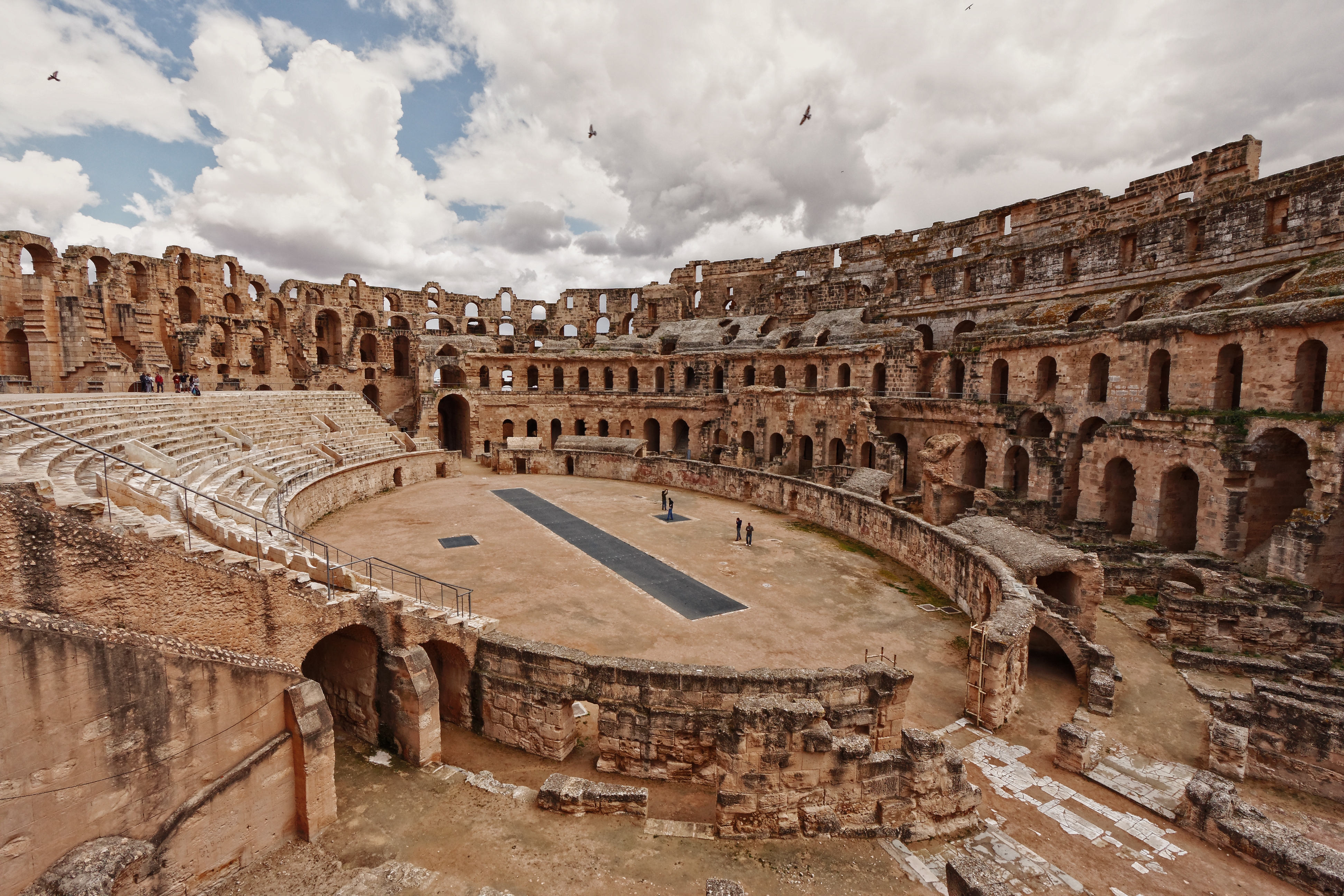
El Jem — Town of the Giant Roman Amphitheatre in Tunisia
El Jem is a small town in central Tunisia, famous for its giant Roman amphitheatre. The amphitheatre has stood in the town since about 238 AD.
El Jem, also written El Djem, is a town in Mahdia Governorate, in central Tunisia, on the eastern coastal plain of the country. The highlight of El Jem is the Roman amphitheatre, built around 238 AD, with room for about 35,000 spectators, the third largest Roman amphitheatre in the world. The amphitheatre is a World Heritage property of UNESCO since 1979, and it rises from the flat plain in the middle of the town.
The name El Jem comes from the Roman city of Thysdrus, which was a centre for the production and export of olive oil in Roman North Africa. In the early third century, Thysdrus rivalled Hadrumetum, the modern Sousse, to become the second city of Roman North Africa, after Carthage. Today El Jem is a quiet town, with a market, cafes and an archaeological museum, and most visitors come here in the day from Sousse or Tunis to see the amphitheatre.
Quick Facts
- Town: El Jem, in Mahdia Governorate, central Tunisia, on the eastern coastal plain.
- Position: About 60 km south of Sousse, 200 km south of Tunis and 50 km north of Sfax.
- Fame: The Roman amphitheatre, built around 238 AD, the third largest in the world.
- Road: The highway joining Sousse with Sfax runs through the town, and the railway station stands beside the amphitheatre.
- Museum: The archaeological museum, opened in 1970, stands about 500 m from the amphitheatre.
- Heritage: The Amphitheatre of El Jem is a World Heritage property, ref 38, listed in 1979, criteria (iv) and (vi).
- Best months: Spring, March to May, and autumn, September to November, when the sky is cool and the light is good for photographs.
- Nearest World Heritage: The Amphitheatre of El Jem itself, ref 38, stands in the town; the nearest separate property is the Medina of Sousse, ref 498, about 59 km away in a straight line.
- World Heritage status: The amphitheatre in the town IS a World Heritage property, ref 38, inscribed 1979 under criteria (iv) and (vi).
Geography of El Jem
El Jem lies on the eastern coastal plain of Tunisia, in a flat land with olive groves and farmland around it. The town stands about 15 km from the Mediterranean coast to the east, and a short drive from the large cities of Tunisia. The position makes El Jem a convenient stop on the coastal road from Tunis down to Sfax, and a popular day trip from Sousse, the largest tourist city nearby.
The land around El Jem is a low plain, with fertile soil fed by small rivers that run from the west down to the sea. The region has been famous for olive oil since Roman times, and the olive groves still ring the town today. The amphitheatre of El Jem stands high in the middle of the town, and it can be seen from far away on the road in, and it is the landmark for every visitor. The modern town has grown up around the amphitheatre, with low houses and small streets.
The climate of El Jem is Mediterranean, with a hot dry summer and a mild winter with more rain. In summer, daytime temperatures usually run from 30 to 35 degrees Celsius, while in winter they run from about 12 to 18 degrees, and rain falls mainly from November to March, while summer is almost rainless. The plain around the town holds the heat of the day, and the stone of the amphitheatre stays warm long after sunset. Visit the amphitheatre in the early morning or the late afternoon, when the sun is not too strong and the light on the stone arches is at its best.
El Jem joins the rest of Tunisia by road and by rail. The highway joining Sousse with Sfax runs through the town, and El Jem railway station stands right beside the amphitheatre, with trains running between Tunis, Sousse and Sfax many times a day. Visitors from Sousse can reach El Jem by bus, by shared taxi or by train in about one hour, and from Tunis in about three hours. Day tours from Sousse and Tunis to El Jem often combine the town with Sousse or Kairouan.
The modern town grew up around the amphitheatre, with low houses and small streets. The amphitheatre is the landmark of the town, and its arcades rise above the roofs. El Jem is a quiet town, far from the crowds of the coastal resorts, and the walk around the centre takes about one hour.
The olive groves around El Jem are part of the story of the town, because the wealth of Thysdrus came from olive oil, and the groves still cover the plain around the town. The olive oil of the El Jem region is of high quality, and visitors should buy local olive oil, because the region has been famous for olive oil since Roman times. The market is busiest in the morning, when the local people come to shop, and the cafes around the market are the best place to sit and look at the amphitheatre from afar.
The plain around El Jem is flat and open, and the amphitheatre can be seen from the road long before the town is reached. The monument stands free on the plain, with no hill behind it, and its three levels of arcades rise above the low houses of the town. The view from the upper tiers of the amphitheatre runs over the town and the olive groves to the horizon, and it shows why the Roman builders chose this flat ground for so large a building.
El Jem stands in the Sahel, the coastal plain of central Tunisia, a flat land of olive groves and farmland that runs from Sousse in the north to Sfax in the south. The plain is open, with few hills, and the amphitheatre rises from it as the landmark of the whole region, seen from the road long before the town is reached. The sea lies about 15 km to the east, and the breeze from the Mediterranean softens the summer heat of the plain.

Panoramic view of the city of El Jam from the upper levels of the amphitheater — CC BY-SA 4
History of El Jem
The history of El Jem begins with the city of Thysdrus, a settlement of the Punic and Berber peoples, which later became a Roman town after the Punic Wars. Thysdrus grew strong in the first and second centuries AD, thanks to the production and export of olive oil to the whole Roman Empire. The city became the olive oil centre of the Roman provinces of Africa and Byzacena, and this wealth is reflected in the size of the amphitheatre. In the early third century, when the amphitheatre was built, Thysdrus rivalled Hadrumetum to become the second city of Roman North Africa, after Carthage.
The amphitheatre of El Jem was built around 238 AD, under the governor Gordian, who was later proclaimed emperor at Thysdrus in March 238. This was the third amphitheatre built at Thysdrus, after two smaller ones before it that stood on a low hill nearby. The new amphitheatre was built on flat ground, north of the ancient city, in the shape of an ellipse, with three levels of arcades. The building may never have been fully finished, because the revolt of Gordian failed quickly and the city fell into hard times.
In the centuries that followed, the amphitheatre of El Jem was used as a fortress during the attacks of the Vandals and the Arabs, and the walls of the amphitheatre protected the local people in many sieges. By the 17th century, the walls of the amphitheatre were broken open in local conflicts, when local rulers cut through the walls to take stone for building. Even with the damage, the amphitheatre kept most of its structure, with three of the four original levels of arcades still standing, making it the best preserved Roman amphitheatre in North Africa.
In 1979, UNESCO listed the Amphitheatre of El Jem as a World Heritage property, with cultural criteria (iv) and (vi), recognising the architecture and the role of the building in the history of Roman Africa. After the listing, the amphitheatre was restored and protected under the heritage law of Tunisia, with a buffer area around it to limit new building. The archaeological museum of El Jem was built near the amphitheatre, showing the beautiful Roman mosaics dug up in the region. Today the amphitheatre is also the place of the El Jem International Symphony Festival each year, with concerts held in the ancient space of the amphitheatre.
The ancient city of Thysdrus lay around the amphitheatre, and its wealth came from the olive oil that was shipped across the Roman Empire. The villas of the city held the mosaics that now fill the museum, and the public baths and houses show a town that rivalled the great cities of Roman Africa. Digs since 1973 have found the first amphitheatre of Thysdrus, much smaller than the present one, together with many mosaics and other objects. The city faded after the revolt of Gordian failed, and the amphitheatre stood as a fortress in the centuries that followed.
A symphonic music festival has filled the arena each summer since 1985, when the first concerts were held in the amphitheatre. The festival brings orchestras from Tunisia and abroad to play in the ancient space, and it has become the largest cultural event of the town. The concerts run in July and August, on selected evenings, and the audience sits on the stone tiers under the night sky.
The archaeological museum of El Jem opened in 1970, in a building raised on the foundations of a Roman house, and it was renovated in 2002. The museum shows the mosaics dug up from the villas of Thysdrus, dating from the second to the fifth centuries, with images of myths, hunting and daily life. Behind the museum stands the House of Africa, a Roman villa from about 170 AD, with its mosaics of Africa and Rome still in place. The museum gives the amphitheatre its human side, showing how the rich families of Thysdrus lived.
Travel to El Jem
The amphitheatre of El Jem is the main sight and the reason most visitors come to the town. Visitors can walk around the amphitheatre, climb to the upper tiers and look over the whole town and the olive groves from above. Inside the amphitheatre, the underground passages below the arena are still almost intact, where the gladiators and wild animals waited before they came out to the arena.
The amphitheatre is elliptical, with a long axis of 148 m and a short axis of 122 m, an arena 65 m long and 39 m wide, and a height of 36 m. Three levels of arcades of the facade still stand, with columns in the Corinthian and composite styles. Visitors should allow at least two hours to explore the amphitheatre, including a walk around the tiers, a visit to the underground passages and photographs from different angles.
The early morning is the best time, when the light falls on the amphitheatre and there are few visitors, while the late afternoon is the best time for sunset photographs. Tickets are sold at the main entrance, and visitors should check the opening hours before going, because the hours can change by season. A local guide can tell the history of the amphitheatre and the gladiator fights that once took place here.
The archaeological museum of El Jem stands about 500 m from the amphitheatre, in a building opened in 1970 and renovated in 2002. The museum holds the mosaics dug up from the villas of Thysdrus, and it also shows pottery, bronze and statues from the ancient city. Visitors should combine the museum with the amphitheatre in the same morning, because the two places lie very close together, and the museum gives the visit its human side.
The El Jem International Symphony Festival is the largest cultural event of the town, held each year in the amphitheatre, with classical concerts. The festival draws symphony orchestras from all over the world, and the audience sits on the ancient steps of the amphitheatre to enjoy the music under the night sky. Visitors who want to attend the festival should book tickets many weeks ahead, because the number of seats is limited and the festival is usually full.
The modern town of El Jem has a market, cafes and souvenir shops around the amphitheatre, and it is the best place to buy souvenirs. The shops sell pottery, carpets and leather goods at prices that can be bargained, and the market also sells crafts and local olive oil. Rest at the roadside cafes with mint tea and pastries after seeing the amphitheatre and the museum, and walk around the town in about one hour to see the small shops and the daily life of the local people.
El Jem can be visited in a day from Sousse, because the town lies about 60 km away, and a day tour usually covers the amphitheatre, the museum and the market. Leave Sousse early in the morning to have time to see the amphitheatre and the museum, and return to Sousse in the afternoon. Visitors should start in the early morning, when the light is good and the amphitheatre is quiet, and should bring a hat and sun cream, because the amphitheatre has little shade.

Hypogeum of the Amphitheatre of El Jem , an archeological site in the city of El Djem , Tunisia — CC BY-SA 4
Notable Places in El Jem
Amphitheatre of El Jem
The Amphitheatre of El Jem is the most striking building of the town, 148 m long and 122 m wide, with room for about 35,000 spectators. This is the third largest Roman amphitheatre in the world, after the Colosseum in Rome and the amphitheatre at Capua, and also the best preserved in North Africa. The amphitheatre was built around 238 AD, under the governor Gordian, and UNESCO listed it as a World Heritage property in 1979. Climb to the upper tiers in the early morning, when the light is best and there are few visitors.
Archaeological Museum of El Jem
The Archaeological Museum of El Jem stands about 500 m from the amphitheatre, and it holds the most beautiful collection of Roman mosaics in Tunisia. The mosaics come from the villas around Thysdrus, with images of myths, hunting scenes and daily life of the Romans, and the museum has modern display space and good light to see them. Allow at least one hour for the museum, and go with a guide to understand the mosaics better.
Ancient City of Thysdrus
The ancient city of Thysdrus lies around the amphitheatre of El Jem, with the remains of Roman villas, public baths and other buildings. Walk around the archaeological area in the morning, when the light is clear, and look at the foundations of the Roman buildings and imagine the ancient city that once stood here. Bring a hat, because the area has little shade, and allow an hour for the walk and the museum.
El Jem Market
El Jem Market stands near the amphitheatre, selling crafts, pottery, olive oil and other local products. The market is the best place to buy souvenirs, with shops selling pottery, carpets and leather goods at prices that can be bargained. Buy the local olive oil, because the El Jem region has been famous for high quality olive oil since Roman times. The market is open each day, but it is busiest in the morning, when the local people come to shop.
Sousse
Sousse, about 60 km north of El Jem, is the largest tourist city nearby, with a medina, a museum and beaches on the Mediterranean coast. The Medina of Sousse is itself a World Heritage property, ref 498, listed in 1988. Most visitors to El Jem stay in Sousse and visit El Jem in the day, and the two places complement each other: Sousse is a busy coastal city, while El Jem is a quiet town with a single great monument. Spend a day in Sousse as well, with the medina in the morning and the beach in the afternoon.
Kairouan
Kairouan, about 70 km away in a straight line, is the ancient Islamic city of Tunisia and a World Heritage property, ref 499, listed in 1988. The city has the Great Mosque, the medina and the Aghlabid basins, and it is one of the holiest cities of Islam. Many day tours combine El Jem with Kairouan in the same day, because the two places lie close together. Visit Kairouan in the morning, when the light is good for the mosque and the medina, and allow half a day for the city.
Frequently Asked Questions
How large is the amphitheatre of El Jem?
The amphitheatre is 148 m by 122 m, with an arena 65 m by 39 m and room for about 35,000 spectators.
When did UNESCO list the amphitheatre of El Jem?
UNESCO listed the amphitheatre in 1979, as ref 38, with criteria (iv) and (vi).
How long is the trip from Sousse to El Jem?
The trip from Sousse is about 60 km south, taking about one hour by car or train.
What is there in El Jem besides the amphitheatre?
Besides the amphitheatre, El Jem has an archaeological museum, the ruins of Thysdrus and a local market.
When is the best time to visit El Jem?
Spring, March to May, and autumn, September to November, when the sky is cool and the light is good.
Are there day tours from Sousse to El Jem?
Yes, many day tours run from Sousse to El Jem, often combined with Kairouan in the same day.
Verified
- El Jem is a town in Mahdia Governorate, central Tunisia; at coordinates 35.30 degrees north and 10.7167 degrees east; with 21,544 people in the 2014 census — Wikipedia, checked 23 November 2026.
- The amphitheatre of El Jem was built around 238 AD; it is 148 m long and 122 m wide; the arena is 65 m long and 39 m wide; the height is 36 m; the capacity is about 35,000 spectators — UNESCO, checked 23 November 2026.
- The amphitheatre of El Jem is the third largest Roman amphitheatre in the world, after the Colosseum in Rome and the amphitheatre at Capua; it is the third amphitheatre built at Thysdrus — Wikipedia, checked 23 November 2026.
- UNESCO listed the Amphitheatre of El Jem as a World Heritage property in 1979, ref 38, criteria (iv) and (vi); the property covers 1.37 ha, with a buffer zone of 26.42 ha — UNESCO, checked 23 November 2026.
- Thysdrus was a centre for the production and export of olive oil in Roman North Africa; Gordian I was proclaimed emperor at Thysdrus in March 238 — Wikipedia, checked 23 November 2026.
- El Jem is about 60 km south of Sousse, about 200 km south of Tunis and about 50 km north of Sfax; the archaeological museum stands about 500 m from the amphitheatre — Wikipedia, checked 23 November 2026.
- The nearest separate World Heritage property to El Jem is the Medina of Sousse, ref 498, listed in 1988, about 59.1 km away in a straight line; Kairouan, ref 499, is about 70.2 km away — haversine from live coordinates, checked 27 November 2026.
- The amphitheatre that stands in the town of El Jem IS ref 38, inscribed 1979 under criteria (iv) and (vi) — UNESCO, checked 23 November 2026.
- The registry Q-ID Q291012 is El Djem, a Tunisian town, at coordinates 35.30 degrees north and 10.7167 degrees east — Wikidata API, checked 23 November 2026.
Sources
- Amphitheatre of El Jem, UNESCO ref 38 (https://whc.unesco.org/en/list/38/) — ref 38, 1979, criteria (iv)(vi); checked 23 November 2026.
- Wikipedia, “El Djem” (https://en.wikipedia.org/wiki/El_Djem) — town, population, history; checked 23 November 2026.
- Wikipedia, “Amphitheatre of El Jem” (https://en.wikipedia.org/wiki/Amphitheatre_of_El_Jem) — amphitheatre, size; checked 23 November 2026.
- Medina of Sousse, UNESCO ref 498 (https://whc.unesco.org/en/list/498/) — listed 1988; checked 27 November 2026.
- Wikidata, Q291012 (https://www.wikidata.org/wiki/Q291012) — El Djem town, coordinates; checked 23 November 2026.
Unverified
-
Sources differ on the first year of the El Jem International Symphony Festival: most give 1985, while some give 1986; this article uses 1985 following Wikipedia and heritage.world.
-
The amphitheatre of El Jem may never have been fully finished, and this article notes that idea as a theory from archaeological sources.
- The exact capacity of the amphitheatre is estimated by sources from 27,000 to 45,000 people; this article uses 35,000 people following UNESCO and notes the range here.
- Opening hours and ticket prices for the amphitheatre and the museum change by season and were not checked directly on the official website, so travellers should check before visiting.
Illustrations
- Hero: A view of El Jem. Free image: https://upload.wikimedia.org/wikipedia/commons/e/ee/Amphitheater_at_El_Djem.jpg — CC BY-SA 3.0.
- In body, jem: Panoramic view of the city of El Jam from the upper levels of the amphitheater. Free image: https://upload.wikimedia.org/wikipedia/commons/b/b3/El_Jem_panorama_01.jpg — CC BY-SA 4.
- In body, museum: Hypogeum of the Amphitheatre of El Jem , an archeological site in the city of El Djem , Tunisia . Free image: https://upload.wikimedia.org/wikipedia/commons/e/e8/Anfiteatro%2C_El_Jem%2C_T%C3%BAnez%2C_2016-09-04%2C_DD_35-37_HDR.jpg — CC BY-SA 4.