
Beijing: The Thousand-Year Capital, the Forbidden City and the Great Wall
Beijing is the capital of China and one of the oldest capitals still standing in the world. It has been the capital for more than 800 years.
Beijing is the political, cultural and educational centre of China, a city where the Forbidden City casts the shadow of 600 years of history, the Great Wall winds over the mountains to the north, and the hutong lanes still keep the rhythm of old Beijing beside the glass towers of the modern city. The city has more than 21 million people, and it holds more UNESCO World Heritage sites in and around one city than any other city in China, with the finest surviving imperial buildings in the world.
Beijing lies in the north of the North China Plain, at the foot of the Yanshan Mountains, with a sharp continental climate: cold and dry winters, hot and rainy summers, and short springs and autumns that are the most beautiful seasons of the year. The city is planned on a central north-south axis running through the Forbidden City, Tiananmen Square and the Temple of Heaven, an axis of symmetry that has stood for hundreds of years and is the soul of the planning of Beijing.
Quick Facts About Beijing
| Item | Detail |
|---|---|
| Name | Beijing, in Chinese 北京, the capital of China |
| Coordinates | 39.90° N, 116.41° E |
| Wikidata | Q956, verified through the Wikidata API on 21 November 2026 |
| Population | About 21.9 million people |
| Area | About 16,400 square kilometres, administrative area |
| Airports | Beijing Capital International Airport (PEK) and Beijing Daxing International Airport (PKX) |
| High-speed rail | Beijing South station, joining Shanghai, Tianjin and Xian |
| UNESCO in and around the city | Forbidden City (1987), Temple of Heaven (1998), Summer Palace (1998), Great Wall (1987), Ming Tombs (2000), Peking Man Site at Zhoukoudian (1987) |
| History | More than 3,000 years, from the city of Ji, capital of the Yan state |
| Central axis | North-south axis through the Forbidden City, Tiananmen Square and the Temple of Heaven |
| Metro | One of the longest metro networks in the world |
| Time zone | China Standard Time, eight hours ahead of UTC |
Geography of Beijing
Beijing lies in the north of the North China Plain, with the Yanshan Mountains to the north and the Taihang Mountains to the west. The land of the city is low in the south-east and rises to the north-west, where the mountains and the famous stretches of the Great Wall stand. The average height of the central area is about 40 metres above sea level, while the mountains to the north rise above 1,000 metres.
The climate of Beijing is a continental monsoon climate, with four clear seasons. Winter, from December to February, is cold and dry, with the temperature often below freezing and light snow. Summer, from June to August, is hot and rainy, with the temperature often above 30 degrees. Spring is short, dry and windy, with dust from the north, and autumn, from September to November, is the finest season, with a clear sky, golden sun and yellow leaves.
The best time to come to Beijing is spring and autumn, above all April to May and September to October, when the air is clear and the temperature is kind. The autumn is the season of the city, when the ginkgo trees turn gold and the sky is at its bluest, and the Great Wall stands against the mountains in the clear air, so the autumn is the time for the Wall, the parks and the hutongs.
The Yongding River flows through the west of the city, but Beijing is famous as a city short of water, one of the greatest challenges of the city. Kunming Lake in the Summer Palace and the lakes of Beihai, Houhai and Qianhai in the centre are the important lakes, both natural and man-made, and they are the landscape and the resting places of the people, with the boats, the willows and the bars of the hutong quarter around them.
The city is built on a grid, with the ring roads running around the centre and the avenues running north, south, east and west, and the Forbidden City at the heart of the grid. The second ring road follows the line of the old city wall, and the hutongs, the narrow lanes of the old city, run between the avenues, with the courtyard houses, the small shops and the old trees, so the city is a place of the grid and of the lane, side by side.
The mountains to the north and the west are the wall of the city, and the Great Wall runs along their ridges, with the passes of Badaling, Mutianyu and Jinshanling, the places where the Wall is climbed by visitors from across the world. The mountains are the reason the city stands where it does, sheltered from the north wind and the dust, and the Wall is the reason the city was safe for centuries, guarding the passes against the peoples of the steppe.
The plain to the south and the east is the farmland of the North China Plain, flat and wide, with the wheat fields, the villages and the small towns, and the city spreads over that plain, with the new districts, the universities and the high-tech zones on the edges. The city is large, and it grows every year, with the suburbs spreading further into the plain, and the metro following them, so the city is a place that is always growing, and always changing.
Beijing is a city of water and of dust, of the lakes in the centre and the dust from the north, of the rivers that run through the west and the sand that blows in the spring. The water is the life of the city, and the dust is its trial, and the two together make the climate of Beijing, sharp and clear, with the four seasons that the people of the city know by heart.
The central axis of Beijing is the spine of the city, running from the Drum Tower in the north, through the Forbidden City and Tiananmen Square, to the Temple of Heaven in the south, a straight line of palaces, squares and temples that has stood for hundreds of years. The axis is the soul of the planning of Beijing, and it is the line that the visitor walks to see the city whole, from the north to the south, in a single day.
The Western Hills rise just beyond the city, with the Fragrant Hills Park and its temples, where the maple leaves turn red in autumn and the people of Beijing go to climb on the weekends. The hills are the nearest mountains to the centre, and they are the place where the city meets the wild, with the trails, the temples and the views back over the plain.

Badaling Great Wall (South) in snow 20261108 01 — CC BY-SA 4

Kunming Lake at the Summer Palace — CC BY-SA 4

A hutong lane in Beijing — CC BY-SA 2
History of Beijing
The history of Beijing began more than 3,000 years ago, when this place was Ji, the capital of the Yan state in the Warring States period. Through the dynasties, the city changed its name many times: Youzhou in the Tang dynasty, Nanjing in the Liao dynasty, Zhongdu in the Jin dynasty, when in 1153 the Jin moved the capital here and named it Zhongdu. Each dynasty left its mark, but the greatest turning point was in 1267, when Kublai Khan of the Yuan dynasty built Dadu, a wholly new capital with the north-south central axis that Beijing still keeps today.
Dadu of the Yuan dynasty was one of the largest cities in the world at that time, with its walls, its palaces and its straight roads. The frame of Dadu still leaves its marks in the north of the city today, and the central axis of Dadu is the central axis of modern Beijing, so the city of today is the city of 1267, grown and changed, but still on the same line.
In 1421, the Yongle Emperor of the Ming dynasty moved the capital from Nanjing to Beijing and built the Forbidden City, the largest surviving imperial palace in the world, with nearly 1,000 buildings. The Forbidden City was built in 14 years, from 1406 to 1420, and it was the home of 24 emperors of the Ming and Qing dynasties for nearly 500 years. At the same time, the Temple of Heaven was built in the south of the city, where the emperor performed the rite of heaven each year.
The Qing dynasty kept the Forbidden City as the centre of power, and built the Summer Palace in the west of the city, the largest imperial garden in China, with Kunming Lake and Longevity Hill. In 1987, UNESCO listed the Forbidden City, under the name Imperial Palaces of the Ming and Qing Dynasties, as a World Heritage site, and the Temple of Heaven and the Summer Palace were listed in 1998.
In 1949, Beijing became the capital of the People’s Republic of China. The old city walls were slowly replaced by the ring roads, and Beijing spread fast into the suburbs. The Olympic Games of 2008 marked a great change: the Bird’s Nest stadium and the Water Cube became the new symbols of the city. In 2019, Beijing Daxing International Airport opened in the south, one of the largest airports in the world.
Today, Beijing is both the political centre of China and a global city, with the leading universities, the high-tech zones and a rich cultural life. But the hutong lanes, the old tea houses and the traditional markets still keep for the city a rhythm of its own that no other city in China has, and the city is a place of both the old and the new, the palace and the tower, the lane and the avenue.
The history of Beijing is the history of the capital. The city was the capital of the Yan, the capital of the Jin, the capital of the Yuan, the capital of the Ming, the capital of the Qing and the capital of the People’s Republic, and each capital left its buildings, its walls and its roads, so the city is a layer of capitals, one upon another, and the visitor who walks the city walks through a thousand years of the capital of China.
The Forbidden City is the heart of that history, and the Great Wall is its shield. The palace was the home of the emperors, and the Wall was the guard of the passes, and the two together are the symbols of Beijing, the palace in the centre and the Wall on the mountains, and the city between them is the capital that they made, and that they guarded.
The hutongs are the other half of that history, and they come from the Yuan dynasty, when Dadu was laid out in a grid of lanes and courtyards, with the houses facing south and the lanes running east and west. The hutongs survived the Ming, the Qing and the republic, and they are the streets where the people of Beijing have lived for seven hundred years, with the courtyard houses, the small shops and the old trees, so the city is not only the palace and the Wall, but the lanes, and the lanes are the life of the city.

Temple of Heaven, Beijing, China – 010 edit — CC BY-SA 3
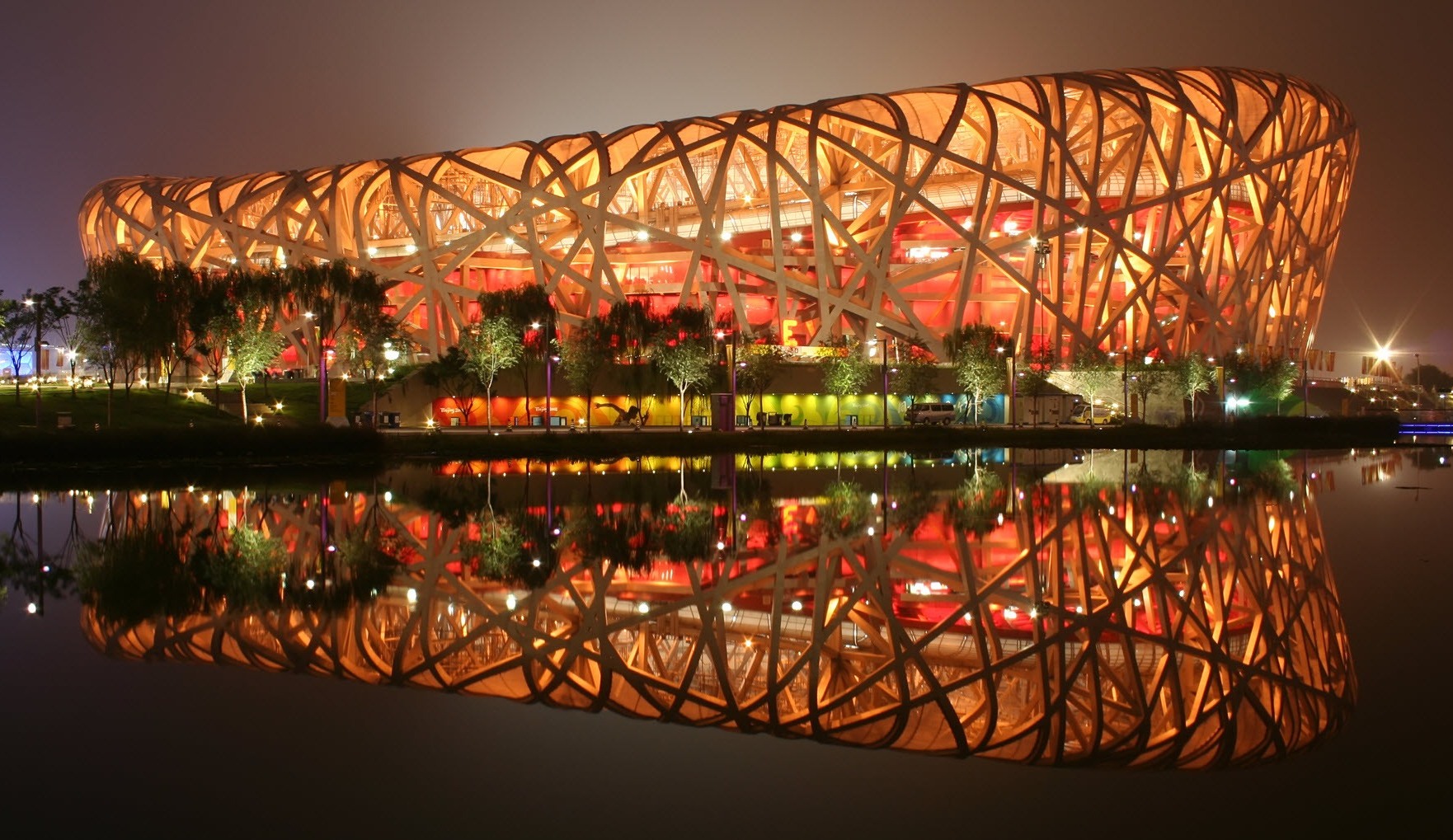
The National Stadium in Beijing — CC BY-SA 3
Travel to Beijing
Beijing rewards the traveller who comes in the clear air. The autumn months of September and October are the finest of all: the sky is blue, the air is crisp, the ginkgo leaves turn gold along the avenues, and the Great Wall stands sharp against the mountains, so the autumn is the season to climb the Wall, to walk the hutongs and to sit by the lakes. April and May are the next best, with the blossom in the parks and the mild air, though the dust from the north can blow in spring, and the wind can be strong, so carry a scarf and a pair of glasses for the dust.
Winter in Beijing is a different city. The temperature falls below freezing, the lakes freeze and the people skate on them, the palaces stand white with snow and the crowds thin out, so the winter is the season for the traveller who wants the Forbidden City to themselves, with the snow on the yellow roofs and the cold air that makes the city feel like a painting. Summer is the hardest season, hot and rainy, with the temperature above 30 degrees and the crowds at their thickest, so the summer is the season to avoid, unless the rain and the heat do not trouble you.
Three days is right for Beijing: the first day at the Forbidden City and Tiananmen Square, with the palaces, the halls and the museums, and the hutongs of the afternoon, with the courtyard houses and the small shops; the second day at the Temple of Heaven and the Summer Palace, with the gardens, the lakes and the hills; the third day at the Great Wall, at Badaling or at Mutianyu, with the mountains and the Wall winding over the ridges. With more time, give a day to the Ming Tombs and the Sacred Way, or to the 798 Art District, or to the old observatory and the Lama Temple.
Flying in lands at one of two very different airports. Capital International Airport sits to the north-east, older and closer to the centre, while Daxing International Airport rises to the south like a starfish of steel and glass, one of the largest terminals on earth, opened in 2019. Express trains and the subway link both to the heart of the city, so the ride in is short and simple.
From Beijing South, the bullet trains fan out across the north: Shanghai in about four and a half hours, Tianjin in about half an hour, Xian in about four and a half hours, and the night trains run on while the city sleeps. With a spare day, ride south to Chengdu for the pandas and the hotpot, a journey of about eight hours.
The food of Beijing is the food of the north, and the Peking duck is the dish to try first: the duck roasted crisp, carved at the table and eaten in thin pancakes with spring onion and sweet sauce. Beyond the duck, try the dumplings, the noodles, the lamb hotpot and the street snacks of the hutongs, and drink the tea in the old tea houses, where the tea is poured and the stories are told, and the time passes slowly.
Check China’s visa rules for your passport before you travel, because the transit and entry rules are revised often.
Getting around is a pleasure in itself. The subway is one of the longest networks on earth, and its stations are clean, cheap and signed in English, carrying you from the palaces to the lakes in minutes. For the hutongs, hire a bicycle at dawn, when the lanes are empty and the old men are out with their birds, and pedal slowly past the courtyard houses and the small shops.
Between the sights, the parks are the breathing spaces of the city: the willows by the lakes, the chess players under the trees, the dancers in the squares. Walk the axis from the Drum Tower to the Temple of Heaven, and let the Wall wait for its own day.

Beijing China Forbidden-City-01 — CC BY-SA 3

The Drum Tower in Beijing — CC BY 3
Notable Places in Beijing
The Forbidden City
The Forbidden City is the largest surviving imperial palace in the world, with nearly 1,000 buildings, built from 1406 to 1420 under the Yongle Emperor, and the home of 24 emperors of the Ming and Qing dynasties for nearly 500 years. The palace is a UNESCO World Heritage site, listed in 1987, and it is the heart of Beijing, the place where the history of the capital is told in stone, in wood and in gold.
The Great Wall at Badaling
The Great Wall at Badaling is the most visited stretch of the Wall, in the mountains to the north-west of Beijing, with the Wall winding over the ridges and the watchtowers standing on the heights. The Wall is a UNESCO World Heritage site, listed in 1987, and it is the symbol of China, the place where the visitor walks on the Wall and looks out over the mountains. The Wall is also reached from Beijing by train and by bus, in about an hour, and the stretches of Mutianyu and Jinshanling are the quieter choices, with fewer crowds and a wilder walk. The Wall’s full route is described on the Great Wall page.
The Temple of Heaven
The Temple of Heaven stands in the south of the city, where the emperor performed the rite of heaven each year, with its round halls, its marble terraces and its cypress trees. The temple is a UNESCO World Heritage site, listed in 1998, and it is the place where the ritual of the empire is remembered, in the park where the people of Beijing walk, sing and dance.
The Summer Palace
The Summer Palace stands in the west of the city, the largest imperial garden in China, with Kunming Lake and Longevity Hill, and it is a UNESCO World Heritage site, listed in 1998. The palace is the place to walk in the summer, with the lake, the bridges and the painted corridor, and it is the garden of the emperors, kept as it was in the Qing dynasty.
Tiananmen Square
Tiananmen Square is the largest public square in the world, in the heart of Beijing, between the Forbidden City and the National Museum, and it is the place where the history of modern China is told, with the flag, the monuments and the crowds. The square is the centre of the city, and it is the place to stand and to see the axis of Beijing, from the north to the south, in one view.
The Hutongs
The hutongs are the narrow lanes of the old city, with the courtyard houses, the small shops and the old trees, and they are the places where the old Beijing still lives, beside the glass towers of the modern city. The hutongs are the places to walk in the evening, with the lights, the food and the life of the lanes, and they are the soul of Beijing, as the palaces are its face.

Tiananmen Square and its gate — CC BY-SA 3

The Summer Palace from Longevity Hill — CC BY-SA 3
Frequently Asked Questions About Beijing
How old is Beijing?
More than 3,000 years old, from the city of Ji, capital of the Yan state, and the capital of China for more than 800 years, from the Yuan dynasty to today.
What is the best season to climb the Great Wall near Beijing?
Autumn, in September and October, when the sky is blue, the air is crisp and the Wall stands sharp against the mountains, with the ginkgo leaves turning gold along the avenues of the city.
How do I get from Beijing to Shanghai?
By high-speed train from Beijing South station, in about four and a half hours, or by flight from Beijing Capital International Airport or Beijing Daxing International Airport.
What is the Forbidden City in Beijing?
The largest surviving imperial palace in the world, with nearly 1,000 buildings, built from 1406 to 1420, home of 24 emperors of the Ming and Qing dynasties, and a UNESCO World Heritage site since 1987.
How many UNESCO sites are in and around Beijing?
Seven in and around the city, including the Forbidden City, the Temple of Heaven, the Summer Palace, the Great Wall, the Ming Tombs and the Peking Man Site at Zhoukoudian, more than any other city in China.
What food should I try in Beijing?
Peking duck, carved at the table and eaten in thin pancakes, dumplings, noodles, lamb hotpot and the street snacks of the hutongs, with tea in the old tea houses.
Verified
- Beijing is the capital of China, with about 21.9 million people, and an administrative area of about 16,400 square kilometres. Checked 21 November 2026.
- The Forbidden City was built from 1406 to 1420, and it was the home of 24 emperors of the Ming and Qing dynasties for nearly 500 years. Checked 21 November 2026.
- The Forbidden City was listed by UNESCO in 1987, and the Temple of Heaven and the Summer Palace were listed in 1998. Checked 21 November 2026.
- The history of Beijing began more than 3,000 years ago, with Ji, the capital of the Yan state, and in 1267 Kublai Khan built Dadu, the capital of the Yuan dynasty. Checked 21 November 2026.
- In 1421, the Yongle Emperor of the Ming dynasty moved the capital from Nanjing to Beijing. Checked 21 November 2026.
- The Olympic Games of 2008 marked a great change, with the Bird’s Nest stadium and the Water Cube, and Beijing Daxing International Airport opened in 2019. Checked 21 November 2026.
- The central axis runs from the Drum Tower in the north, through the Forbidden City and Tiananmen Square, to the Temple of Heaven in the south. Checked 21 November 2026.
- Coordinates 39.904/116.4075 and Wikidata Q956 for Beijing were verified through the Wikidata API on 21 November 2026. Checked 21 November 2026.
Sources
- Wikivoyage, Beijing — https://en.wikivoyage.org/wiki/Beijing — for the Forbidden City, the Great Wall, the hutongs and the high-speed trains.
- UNESCO, Imperial Palaces of the Ming and Qing Dynasties — https://whc.unesco.org/en/list/439 — for the listing of the Forbidden City in 1987 and the history of the palaces.
- Wikipedia, Beijing — https://en.wikipedia.org/wiki/Beijing — for the population of about 21.9 million, the history of Ji and Dadu, and the Olympic Games of 2008.
Unverified
- The area of the administrative region, about 16,400 square kilometres, is the figure of the general guides, and it has not been checked against the official statistical yearbook.
- The claim that Beijing holds more UNESCO sites than any other city in China is the claim of the general guides, and it has not been checked against an official count.
- The hours and the charges of the Forbidden City, the Temple of Heaven and the Summer Palace change with the season, so check them on the official sites before going.
- The train times from Beijing South station to Shanghai, Tianjin and Xian change with the timetable, so check them before booking.
Illustrations
- Hero: Beijing China Woman-cleaning-West-Lake-01. Free image: https://upload.wikimedia.org/wikipedia/commons/7/74/Beijing_China_Woman-cleaning-West-Lake-01.jpg — CC BY-SA 3.
- In body, The Forbidden City: Beijing China Forbidden-City-01. Free image: https://upload.wikimedia.org/wikipedia/commons/1/17/Beijing_China_Forbidden-City-01.jpg — CC BY-SA 3.
- In body, The Great Wall at Badaling: Badaling Great Wall (South) in snow 20261108 01. Free image: https://upload.wikimedia.org/wikipedia/commons/0/0e/Badaling_Great_Wall_%28South%29_in_snow_20261108_01.jpg — CC BY-SA 4.
- In body, The Temple of Heaven: Temple of Heaven, Beijing, China – 010 edit. Free image: https://upload.wikimedia.org/wikipedia/commons/0/0a/Temple_of_Heaven%2C_Beijing%2C_China_-_010_edit.jpg — CC BY-SA 3.
- In body, Summer Palace Kunming Lake: Kunming Lake at the Summer Palace. Free image: https://upload.wikimedia.org/wikipedia/commons/2/29/Summer_Palace_over_Kunming_Lake_and_Nanhu_Island.jpg — CC BY-SA 4.
- In body, Beijing hutong: A hutong lane in Beijing. Free image: https://upload.wikimedia.org/wikipedia/commons/8/8c/Hutong%2C_BJ_%282917986982%29.jpg — CC BY-SA 2.
- In body, Bird’s Nest stadium: The National Stadium in Beijing. Free image: https://upload.wikimedia.org/wikipedia/commons/1/1e/Beijing_national_stadium.jpg — CC BY-SA 3.
- In body, Drum Tower: The Drum Tower in Beijing. Free image: https://upload.wikimedia.org/wikipedia/commons/7/76/Beijing_drum_tower.JPG — CC BY 3.
- In body, Tiananmen Square: Tiananmen Square and its gate. Free image: https://upload.wikimedia.org/wikipedia/commons/8/83/North_end_of_Tiananmen_Square_and_Tiananmen_Gate.jpg — CC BY-SA 3.
- In body, Summer Palace Longevity Hill: The Summer Palace from Longevity Hill. Free image: https://upload.wikimedia.org/wikipedia/commons/0/03/Beijing_China_Summer-Palace-02.jpg — CC BY-SA 3.