
Hong Kong — A Harbour City Between Mountains and Sea
Hong Kong is a Special Administrative Region of China, and it is also one of the most crowded and energetic places in Asia. Glass towers rise beside green hills, old temples and fishing villages, and the deep natural harbour of Victoria Harbour still shapes everything the city does. This guide covers the territory as a whole: its geography, its history from fishing villages to British colony to handover, its food and festivals, and the practical facts a first-time visitor needs.
Quick Facts About Hong Kong
| Fact | Detail |
|---|---|
| Official name | Hong Kong Special Administrative Region of the People’s Republic of China |
| Chinese name | 香港特別行政區 |
| Status | Special Administrative Region of China, established 1 July 1997 |
| Administrative centre | Central, Hong Kong Island |
| Area | About 1,108 sq km (land 1,073 sq km, water 35 sq km, CIA World Factbook); land area about 1,105.7 sq km per the Hong Kong government |
| Population | About 7.5 million (7,527,500 in mid-2025, Census and Statistics Department) |
| Official languages | Chinese (Cantonese) and English |
| Currency | Hong Kong dollar (HKD) |
| Time zone | UTC+8, no daylight saving |
| Highest point | Tai Mo Shan, 957 m |
| Territory | Hong Kong Island, Kowloon Peninsula, the New Territories, and more than 260 islands |
| Wikidata | Q8646 |
| Coordinates | 22.278333° N, 114.158611° E |
The territory holds about 7.5 million people on roughly 1,105.7 square kilometres of land, and more than 75 percent of that land remains undeveloped. Cantonese and English are the two official languages, the Hong Kong dollar is the currency, and the city is known across the region as a financial, trading and shipping centre. The numbers alone do not explain the place. The explanation lies in the harbour, the hills, and the way a small territory learned to live vertically.
Geography: Hong Kong and Its Harbour
Hong Kong sits on the southern coast of China, at the eastern mouth of the Pearl River, bordering Guangdong province and the city of Shenzhen to the north and facing the South China Sea to the south. The territory has three main parts: Hong Kong Island in the south, the Kowloon Peninsula in the middle, and the large New Territories in the north, together with more than 260 islands, of which Lantau is the largest. Victoria Harbour lies between Hong Kong Island and Kowloon, a deep natural harbour that once served as the trading gateway of the region and now serves as the visual centre of the city.
The terrain here is mostly hilly, with very little flat land, so most people live in coastal areas and valleys while forests and country parks cover most of the territory. The highest peak is Tai Mo Shan at 957 metres, near the geographic centre of the New Territories. Tai Mo Shan is an extinct volcano from the Jurassic period and the coldest place in Hong Kong, where frost sometimes appears in winter. Other high peaks are Lantau Peak at 934 metres and Sunset Peak at 869 metres, both inside protected country parks.
The territory has a humid subtropical climate, with hot, wet summers and cooler, drier winters. Summer often brings tropical storms from the South China Sea, while autumn from October to early December is usually the most pleasant season, with temperatures around 20 to 26 degrees Celsius and little rain. That autumn window is the time most visitors remember fondly, because the air clears, the hills turn sharp against the sky, and the harbour takes on the blue that postcards promise.
Rivers here are short and small, and fresh water comes mainly from reservoirs such as Shing Mun and Plover Cove, together with water imported from the Dongjiang River in Guangdong. The coastline is long and full of bays, with beaches on the southern side of Hong Kong Island such as Repulse Bay and Shek O, and outlying islands such as Cheung Chau and Lamma, where life moves far more slowly than in the centre of the city. That contrast is part of the geography. A ferry ride of half an hour can carry a traveller from a financial district to a village where no cars are allowed.
The harbour deserves attention of its own, because Hong Kong would not exist without it. Victoria Harbour is deep, sheltered and wide enough for large ships, and it gave the territory its first reason to matter: a safe anchorage on the China coast where trade could gather. The Star Ferry has crossed it since the nineteenth century, and the evening light show known as A Symphony of Lights now plays across the skylines on both shores. The harbour is also the reason the city grew upward rather than outward.
With hills behind and water in front, the only direction left was up.

The panorama of Victoria Harbour from the Peak shows the harbour and the skyline of Hong Kong — CC BY-SA 4
History of Hong Kong
Before Hong Kong became a British colony, the area was part of Xin’an County in Guangdong province, with fishing villages, salt fields and coastal military posts. The name Hong Kong means fragrant harbour, and it is linked to the trade in incense and salt in the area. Archaeological remains such as rock carvings at Big Wave Bay and on Lantau Island show that people lived here in prehistoric times, and the Tin Hau temples along the coast reflect the life of fishing communities who depended on the sea.
The great turning point came in the nineteenth century, when Britain seized Hong Kong Island during the First Opium War. Under the Treaty of Nanking, signed on 29 August 1842, the Qing dynasty ceded Hong Kong Island to Britain in perpetuity, and the island became a Crown colony in 1843. The Convention of Peking, signed on 18 October 1860, ceded the Kowloon Peninsula south of Boundary Street to Britain, and in 1898 Britain leased the New Territories for 99 years, from 1 July 1898 to 1997. Those three acts, spread over more than fifty years, assembled the territory that exists today.
Under British rule, Hong Kong grew from a small port into a major trading and financial centre, with Victoria Harbour as the junction between China, Southeast Asia and the wider world. The city received wave after wave of migrants from mainland China, especially in the middle decades of the twentieth century. The territory was occupied by Japan from December 1941 to August 1945 during the Second World War, before Britain returned to administer it. The occupation left deep scars, and the post-war decades brought rapid rebuilding, industrial growth, and then a shift toward finance and services.
The Joint Declaration between China and Britain, signed on 19 December 1984, set the foundation for the handover, under the principle of one country, two systems and a commitment to keep the social and economic system unchanged for 50 years. The handover took place at midnight on 1 July 1997, when the territory became a Special Administrative Region of China, with the Basic Law as its constitutional document. Since then, Hong Kong has kept its own legal system, its own currency, its own customs territory, and its own membership in many international trade organisations.
In recent decades, Hong Kong has remained an international financial centre, with the Hong Kong Stock Exchange, large banks and a busy container port, while also developing its culture, creativity and tourism. At the same time, the city faces the familiar pressures of a dense metropolis, such as high housing prices and tight living space. Those pressures are visible in the towers themselves, where apartments are small, offices are stacked high, and public space is shared with unusual intensity.
Timeline of Hong Kong
| Year | Event |
|---|---|
| Prehistory to 19th century | Fishing villages, salt fields and military posts in Xin’an County, Guangdong |
| 26 January 1841 | Britain seizes Hong Kong Island during the First Opium War |
| 29 August 1842 | Treaty of Nanking: Qing dynasty cedes Hong Kong Island to Britain |
| 1843 | Hong Kong becomes a British Crown colony |
| 18 October 1860 | Convention of Peking: Kowloon Peninsula ceded to Britain |
| 1888 | Peak Tram begins running up to Victoria Peak |
| 9 June 1898 | Convention for the Extension of Hong Kong Territory: Britain leases the New Territories for 99 years |
| 1941–1945 | Japanese occupation during the Second World War |
| 19 December 1984 | Sino-British Joint Declaration on the handover |
| 1 July 1997 | Hong Kong becomes a Special Administrative Region of China |
| 2005 | Hong Kong Disneyland opens on Lantau Island |
| 2011 | Hong Kong Geopark recognised as a UNESCO Global Geopark |
| 2018 | Hong Kong–Zhuhai–Macao Bridge opens to traffic |
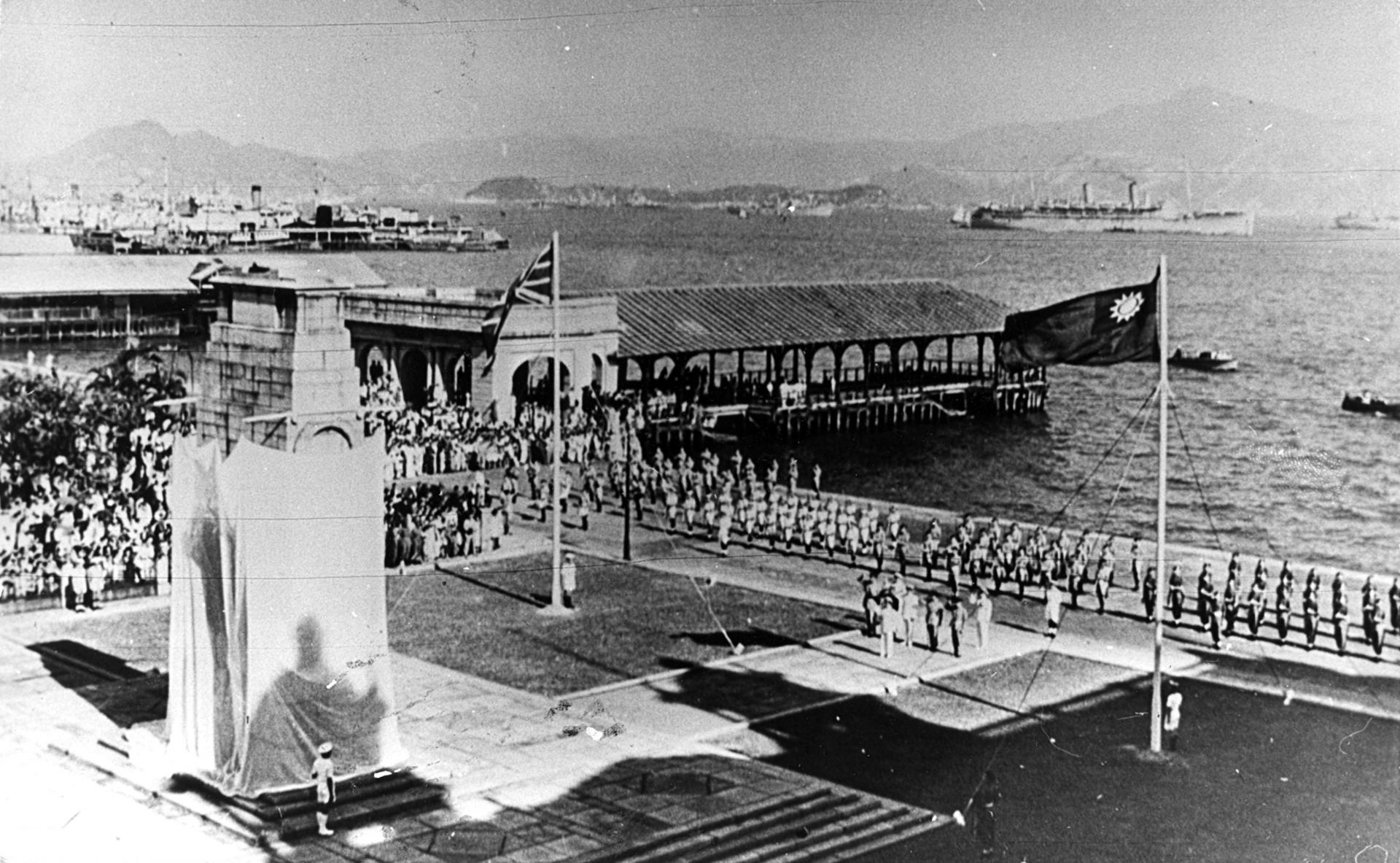
The Cenotaph in Hong Kong recalls the historic liberation of the city in 1945 — Public domain
UNESCO in Hong Kong
Hong Kong has no UNESCO World Heritage Site. That conclusion was checked on 18 November 2026 on the official UNESCO page for China, where neither the inscribed list nor the tentative list contains any site in Hong Kong. Hong Kong is not itself a party to the World Heritage Convention, so any nomination would have to be submitted through China, and no such nomination has been made. Visitors who arrive expecting a World Heritage plaque will not find one, and that absence is itself a useful fact about the territory.
The point is easy to confuse, because Hong Kong does hold a different UNESCO title. The Hong Kong UNESCO Global Geopark was recognised in 2011, and it lies in the eastern and north-eastern New Territories, with two main areas: the Sai Kung volcanic rock region, with hexagonal rock columns, and the sedimentary rock region of the north-east New Territories, which preserves hundreds of millions of years of geological history. A Global Geopark belongs to a different UNESCO programme from the World Heritage List, so the geopark should not be called a World Heritage Site.
The territory also protects heritage under local law, with more than 120 Declared Monuments, including ancient rock carvings, temples, historic houses and military posts. Those monuments are protected under Hong Kong law, not under the UNESCO World Heritage Convention. The distinction matters for travellers who care about heritage, because it explains why the most famous historic places in Hong Kong carry local protection rather than an international listing.
Travel in Hong Kong
How Many Days
Allow at least three full days for the territory. One day suits Hong Kong Island and Victoria Peak, one day suits Kowloon and its markets, and one day suits Lantau Island with the Big Buddha and the fishing village of Tai O. Travellers with extra time should add a day for Cheung Chau Island or for hiking in Sai Kung and on Tai Mo Shan. A shorter visit can still work, but it will feel rushed, because the territory rewards slow movement between its very different districts.
The order of the days matters less than the balance between them. A trip that stays only in Central and Tsim Sha Tsui will miss the islands, the villages and the country parks, and a trip that rushes through all three in two days will miss the food and the evening atmosphere. Three days is the minimum that lets a visitor see the harbour city, the markets and the quieter side of the territory without spending the whole trip in transit.
Getting Around
The international airport stands on Chek Lap Kok Island, connected to the centre by the Airport Express train to Hong Kong Station and Kowloon Station, together with buses and taxis. The MTR metro system covers Hong Kong Island, Kowloon and the New Territories, and it is the fastest way to move around the city. The Octopus card works on the MTR, buses, ferries and many shops, and it can be bought and topped up at the airport and at MTR stations.
The Star Ferry connects Hong Kong Island with Kowloon, the tram known as the ding ding suits slow sightseeing on Hong Kong Island, and the Peak Tram has carried passengers from Central up to Victoria Peak since 1888. Ferries also serve the outlying islands, and the ride to Cheung Chau or Lamma is part of the experience rather than a mere transfer. Travellers who continue through Southeast Asia often fly onward to Manila or to Phuket, where the pace, the food and the coastline change completely. Walking is practical in Central and Tsim Sha Tsui, although the hills are steep and the summer humidity is heavy.
Money, Language and Safety
The Hong Kong dollar is the official currency, pegged to the United States dollar. Credit cards are widely accepted in hotels, large restaurants and shopping malls, but small eateries, markets and taxis often take cash or Octopus only. Cantonese is the everyday language, English is the second official language and is widely used in business, hotels and tourist areas, and signs, menus and transport information usually appear in both Chinese and English. People in Hong Kong queue in an orderly way and avoid speaking loudly on public transport.
The territory is generally safe for visitors, with low street crime, although pickpockets operate in crowded markets and tourist areas. The typhoon season from May to October can disrupt transport, so travellers should follow warnings from the Hong Kong Observatory. Check visa rules on the website of the Hong Kong Immigration Department before travelling, because requirements change and Vietnamese citizens, for example, need a visa in advance.
Highlights of Hong Kong
Victoria Peak (The Peak) — The highest point on Hong Kong Island at 552 metres, famous for its panoramic view over Victoria Harbour, the Kowloon skyline and distant islands. The Peak Tram has run from Central to the summit since 1888.
Victoria Harbour and the Star Ferry — The deep natural harbour between Hong Kong Island and Kowloon, crossed by the Star Ferry since the nineteenth century. In the evening, the light show A Symphony of Lights plays across the skylines on both shores.
Avenue of Stars and Tsim Sha Tsui — A waterfront promenade in Kowloon with the finest view of the Hong Kong Island skyline, near the Hong Kong Museum of Art and the Hong Kong Cultural Centre.
Tai Kwun — A restored complex of a former prison, police station and court in Central, now a centre for art and culture, with exhibitions, performances and restaurants.
Tian Tan Buddha and Po Lin Monastery — A large bronze Buddha on Lantau Island, 34 metres high including its lotus base, reached by the Ngong Ping 360 cable car from Tung Chung.
Tai O fishing village — An old fishing village on Lantau Island, with stilt houses over the water, a dried seafood market, and boat trips to see pink dolphins, one of the last traditional fishing villages in the territory.
Hong Kong Disneyland — A theme park opened in 2005 on Lantau Island, with the Castle of Magical Dreams and themed areas for families.
Ocean Park Hong Kong — A marine and amusement park opened in 1977 on the southern side of Hong Kong Island, with an aquarium, giant pandas and thrill rides.
Hong Kong UNESCO Global Geopark — The Sai Kung area, with hexagonal volcanic rock columns on High Island and the Ninepin Islands, and the sedimentary rock region of the north-east New Territories.
Cheung Chau Island — A small island with no cars, famous for the Cheung Chau Bun Festival, beaches, seafood and an old waterfront street, reached by ferry from Central.
Food and Festivals in Hong Kong
Food here blends traditional Cantonese cooking, British influence and many international cuisines, creating one of the richest street food and restaurant scenes in Asia. Dim sum is the most iconic meal: small bamboo baskets of prawn dumplings, siu mai, char siu buns and rice rolls, usually eaten in the morning and at midday in teahouses where diners choose from trolleys or order from a menu. Many long-established dim sum restaurants in Central and Kowloon keep the traditional style, with hot tea and a noisy, lively atmosphere.
Wonton noodles, with springy egg noodles, clear broth and prawn and pork wontons, are a familiar dish in small noodle shops, while roast goose and char siu are famous roasted meats, usually eaten with white rice. Fish balls and egg waffles are two street snacks that many visitors seek out, together with milk tea and the pineapple bun with butter, dishes tied to the Hong Kong-style teahouses known as cha chaan teng. Those teahouses serve food quickly at modest prices, with a menu that mixes Cantonese dishes and Western items such as spaghetti, toast and lemon tea.
The city also holds many Michelin-starred restaurants, from high-end dim sum to traditional Cantonese dining, and food streets in Mong Kok, Sham Shui Po and Causeway Bay reward a slow evening walk. Visitors should try fresh seafood in fishing villages such as Sai Kung and Cheung Chau, where waterfront restaurants serve the catch of the day. Travellers who enjoy the food cultures of other Asian cities will find a useful contrast in Bangkok and Taipei, where night markets and street stalls play a similar central role.
Lunar New Year is the largest festival of the year in Hong Kong, with flower markets, parades, fireworks over Victoria Harbour and New Year visits to Wong Tai Sin Temple. People shop for peach blossom, orchids and kumquat trees at the Victoria Park flower market, and give red packets to children. The Cheung Chau Bun Festival, held in April or May by the lunar calendar on Cheung Chau Island, features parades, lion dances and a midnight bun tower climbing contest that draws thousands of visitors to the island.
The Dragon Boat Festival falls in May or June, with dragon boat races on the water and sticky rice dumplings, while the Mid-Autumn Festival in September or October brings families together for mooncakes and moon viewing, with a lantern festival in Victoria Park. The Tin Hau Festival honours the sea goddess Tin Hau, protector of fishermen, with parades and lion dances at Tin Hau temples along the coast. Dates by the lunar calendar change each year, so visitors should check the official calendar before travelling.
FAQ About Hong Kong
Is Hong Kong a country?
No. Hong Kong is a Special Administrative Region of China, established on 1 July 1997, with its own legal system, currency and customs territory under the principle of one country, two systems. Hong Kong has its own passport and its own membership in many international trade organisations, but it is not a sovereign country.
Does Hong Kong have a UNESCO World Heritage Site?
No. The UNESCO lists for China, checked on 18 November 2026, contain no site in Hong Kong. Hong Kong does have the Hong Kong UNESCO Global Geopark, recognised in 2011, but that belongs to a different UNESCO programme and is not a World Heritage Site.
How many days should I spend in the territory?
At least three full days: one day for Hong Kong Island and Victoria Peak, one day for Kowloon and its markets, and one day for Lantau Island with the Big Buddha and Tai O village. Travellers with more time should add a day for Cheung Chau Island or for hiking in Sai Kung and on Tai Mo Shan.
What is the best season to visit the territory?
October to early December is the best season, with clear skies, little rain and temperatures around 20 to 26 degrees Celsius. March to May is also pleasant, although fog and drizzle are common. Summer is hot and humid with typhoons, so travellers should watch the weather forecast.
Do Vietnamese citizens need a visa for Hong Kong?
Yes, Vietnamese citizens need to apply for a visa before travelling to Hong Kong. Check the current rules on the website of the Hong Kong Immigration Department before travelling, because visa policy can change and passports should remain valid for at least six months after the planned departure date.
What is the easiest way to get around Hong Kong?
The MTR metro is the fastest way to move around, used together with an Octopus card for the MTR, buses, ferries and many shops. The Star Ferry links Hong Kong Island with Kowloon, the ding ding tram suits slow sightseeing on the island, and the Airport Express connects the airport with the city centre.
Verified
All population, area, date and UNESCO figures in this article were checked on 20 November 2026 against the sources listed below. The population of 7,527,500 in mid-2025, the land area of about 1,105.7 square kilometres, the handover date of 1 July 1997, the Treaty of Nanking date of 29 August 1842, the Convention of Peking date of 18 October 1860, the 99-year New Territories lease of 9 June 1898, and the absence of any World Heritage Site in Hong Kong are all confirmed in those sources. The coordinates 22.278333° N, 114.158611° E and the Wikidata identifier Q8646 come from the TheTerraAtlas registry entry for this entity.
Sources
- Hong Kong Economic and Trade Office in Brussels, information about the Special Administrative Region — https://www.hketobrussels.gov.hk/hong-kong/information-about-hong-kong/special-administrative-region
- Census and Statistics Department, Hong Kong, mid-2025 population via China Daily Asia, 15 August 2025 — https://www.chinadailyasia.com/hk/article/617925
- CIA World Factbook, Hong Kong — https://theworldfactbook.org/country/hong-kong.html
- UNESCO World Heritage Centre, States Parties: China, checked 18 November 2026 — https://whc.unesco.org/en/statesparties/cn
- Discover Hong Kong, official tourism site — https://www.discoverhongkong.com
- Vietnamese reference article, facts only, checked 18 November 2026 — ~/workspace/theterraatlas-articles/hong-kong.vi.md
Not Yet Verified
- The population figures differ slightly between sources: the Census and Statistics Department records 7,527,500 people in mid-2025, while the CIA estimates 7,305,556 people for 2025. This article uses the Census and Statistics Department figure for population and the CIA figure for total area.
- The area figures differ slightly between sources: the CIA records 1,108 square kilometres, while the Hong Kong government records 1,105.7 square kilometres of land. The difference comes from measurement methods and land reclamation.
- Ticket prices for the Peak Tram, Ngong Ping 360, Hong Kong Disneyland and Ocean Park were not checked on the official website of each attraction, so this article gives no ticket price.
- Exact dates of lunar calendar festivals such as the Cheung Chau Bun Festival, the Dragon Boat Festival and the Mid-Autumn Festival change each year, so check the official calendar before travelling.
- Visa rules for Vietnamese citizens should be checked on the website of the Hong Kong Immigration Department before travelling, because the rules can change.
- The exact number of Declared Monuments in Hong Kong as of November 2026 was not matched against the full list on the website of the Antiquities and Monuments Office, so this article gives only the figure of more than 120.
Illustrations
- Hero: View of Hong Kong. Free image: https://upload.wikimedia.org/wikipedia/commons/4/41/Hong_Kong_Skyline_Panorama_-_Dec_2008.jpg — CC BY-SA 3.0.
- In body, harbour: The panorama of Victoria Harbour from the Peak shows the harbour and the skyline of Hong Kong Free image: https://upload.wikimedia.org/wikipedia/commons/8/87/Panorama_of_Hong_Kong_Harbour_from_The_Peak_dllu.jpg — CC BY-SA 4.
- In body, monument: The Cenotaph in Hong Kong recalls the historic liberation of the city in 1945 Free image: https://upload.wikimedia.org/wikipedia/commons/a/a2/1945_liberation_of_Hong_Kong_at_Cenotaph.jpg — Public domain.