
Hava Mahal
Hava Mahal is a five-storey palace of pink sandstone in the old city of Jaipur. Its 953 small windows let the royal ladies watch the street unseen.
Hava Mahal, usually spelled Hawa Mahal and meaning Palace of Winds, is one of the most recognisable buildings in India: a five-storey facade of pink sandstone with 953 small latticed windows, rising in the old city of Jaipur like a giant honeycomb or the crown of the god Krishna. It was built in 1799 for the ladies of the royal household, so that they could watch the street festivals without being seen, and today Hava Mahal is the symbol of Jaipur, the Pink City, and the first stop for most visitors to Rajasthan. This guide explains what Hava Mahal is, why it was built, how its windows cool it, and how to visit it.
Quick Facts
| Item | Detail |
|---|---|
| Location | Hawa Mahal Road, Badi Choupad, old city of Jaipur, Rajasthan, India |
| Coordinates | 26.924° N, 75.82672° E |
| Name | Hava Mahal, usually spelled Hawa Mahal; “Palace of Winds” |
| Built | 1799, by Maharaja Sawai Pratap Singh; architect Lal Chand Ustad |
| Architecture | 5 storeys, 953 small windows (jharokha), pink and red sandstone, about 15 m high |
| Part of | An extension of the City Palace complex |
| Ticket | 100 INR for Indian visitors, 600 INR for foreign visitors, from 1 January 2026 |
| Hours | Opens daily at 9:00; closing time varies, check on the day |
| UNESCO | Not a World Heritage site in its own right; Jaipur was listed as a heritage city in 2019 |
| Wikidata | Q836531 |
Hava Mahal stands at Badi Choupad, the great crossroads of the old city of Jaipur, facing the rooftop cafes where visitors sit to look at the palace facade. The facade faces east, so it takes the morning sun, and photographs of Hava Mahal are at their best early in the morning, when the pink sandstone glows. Behind the facade, which is thin like a screen, the palace holds only a few small rooms joined by ramps, with no stairs, and a small museum on the ground floor.
Jaipur is the capital of Rajasthan, founded in 1727 by Maharaja Sawai Jai Singh II and laid out on a grid with wide streets. In 1876 the whole city was painted pink to welcome the Prince of Wales, later King Edward VII, and the name Pink City was born. Hava Mahal is part of the City Palace complex, at the centre of the old city, near Johari Bazaar and Badi Choupad.
Geography of Hava Mahal
Hava Mahal stands at the centre of the old city of Jaipur, in Rajasthan, in the north-west of India, about 280 km south-west of Delhi and about 240 km west of Agra. Jaipur stands on a plateau at about 430 m, with a dry and hot climate: the summer, from April to June, often passes 40 degrees, the winter, from December to February, is cool at about 15 to 25 degrees, and the monsoon rain falls mainly from July to September.
The old city of Jaipur is ringed by a wall with seven gates, and Hava Mahal stands on the main axis of the old city, between the City Palace and the markets. From Hava Mahal, the City Palace, Jantar Mantar, the 18th-century observatory and a UNESCO site, and Johari Bazaar, famous for jewellery and cloth, are all a few minutes on foot. The other sights of Jaipur, Amber Fort about 11 km to the north, Jal Mahal, the palace in the lake, and Jaigarh Fort, are all day trips from the old city.
The facade of Hava Mahal faces east, and that direction decides the best time to see it. In the morning the sun strikes the pink sandstone directly, and the colour glows. In the late afternoon the sun moves to the west, the facade darkens, and the rooftop cafes opposite become the place to watch the sunset. The palace stands on Badi Choupad, a wide crossroads, so the facade can be seen whole from the street, which is rare in the narrow lanes of the old city.
The ground under Jaipur is dry and high, and the city was planned on a grid, so the streets around Hava Mahal are wide and straight by the standards of an Indian old city. The palace’s position, at the meeting point of the City Palace, the markets and the main road, is the reason it became the symbol of the city: it is the building that every visitor passes, whether they come to shop, to see the palace or to watch a festival.
The old city of Jaipur was laid out on a grid, with wide streets and a wall with seven gates, and Hava Mahal stands on the main axis of that grid. The plan was drawn by the founder, Sawai Jai Singh II, and it is still easy to read: the City Palace at the centre, the markets along the main roads, and the great crossroads of Badi Choupad where Hava Mahal stands. The grid makes the old city easier to walk than most Indian old cities, and the palace is the landmark that orients every walk.
Badi Choupad, the crossroads at the foot of Hava Mahal, is one of the widest open spaces in the old city. The facade can be seen whole from the street, which is rare in the narrow lanes of the old city, and the rooftop cafes opposite exist because of that open view. The crossroads is also a market: stalls sell cloth, jewellery, souvenirs and street food, and the area is crowded in the evening, when the shops light up and the palace facade darkens.
To the north of the old city, the land rises towards Amber Fort, about 11 km away, and the hills around Amber hold Jaigarh Fort and the old capital before Jaipur was founded. The plateau of Jaipur, at about 430 m, gives the city its dry air and its wide skies, and the pink sandstone of the city comes from the same land. The old city, the forts on the hills and the lake palace of Jal Mahal belong to one landscape, and Hava Mahal stands at the centre of it.

A view of Hawa Mahal, Jaipur, Rajasthan — CC BY-SA 3
History of Hava Mahal
A viewing platform for the ladies of the court
Hava Mahal was built in 1799 by Maharaja Sawai Pratap Singh, about 70 years after his grandfather, Maharaja Sawai Jai Singh II, founded the city of Jaipur. The palace was designed by the architect Lal Chand Ustad, as an extension of the City Palace, for the ladies of the royal household alone. The palace was not a residence and not a temple: it was a place from which to watch the city.
Under the purdah custom of the Rajput court, the ladies of the royal household could not appear in public. Hava Mahal solved this with 953 small windows, called jharokha, fitted with fine stone lattice: from inside, the ladies could watch the festivals, the processions and the street life below without anyone seeing them. At the same time, the hundreds of small windows create a Venturi effect, as the wind passes through the openings and cools the inside of the palace, like a natural air-conditioning system in the hot Rajasthan summer. The name Palace of Winds comes from this effect.
The crown of Krishna
The five-storey facade of Hava Mahal was designed to look like the crown of the god Krishna, whom Maharaja Sawai Pratap Singh worshipped. The five storeys narrow as they rise, with the top storey the smallest, forming a softly curved pyramid. The pink and red sandstone is the characteristic material of Jaipur, the same colour as the whole city, and the facade’s colour is the reason the palace is photographed so often.
Inside, Hava Mahal is far simpler than its splendid outside: small rooms, narrow corridors and ramps in place of stairs, a design that suited the movement of the ladies in traditional dress. The ground floor today holds a small museum with objects about the history of the palace and the Jaipur court. On the top storey, visitors look out over the old city of Jaipur, with its pink roofs and Badi Choupad below.
Hava Mahal was restored many times in the 20th and 21st centuries, including a large restoration in the 2000s. In 2019 Jaipur was listed by UNESCO as a World Heritage city, and Hava Mahal is one of the characteristic buildings of that heritage city, although the palace itself holds no UNESCO listing of its own. The restoration work has kept the sandstone facade standing in the middle of a busy crossroads, where traffic, dust and heat wear at the stone every day.
The restoration of Hava Mahal in the 2000s, and the small museum on the ground floor, turned the palace from a royal viewing platform into a public monument. The museum displays objects about the history of the palace and the Jaipur court, and it gives visitors the story of the building before they climb the ramps. The palace’s place in the City Palace complex is part of that story: Hava Mahal was never a separate palace, but an extension of the royal household, built so that the ladies of the court could take part in the life of the city without leaving the palace.
Timeline
- 1727: Maharaja Sawai Jai Singh II founds the city of Jaipur.
- 1799: Maharaja Sawai Pratap Singh builds Hava Mahal; the architect is Lal Chand Ustad.
- 1876: Jaipur is painted pink to welcome the Prince of Wales, and the name Pink City is born.
- 20th century: Hava Mahal is restored many times and opens to visitors.
- 2019: Jaipur is listed by UNESCO as a World Heritage city.
- 1 January 2026: The Rajasthan government revises the ticket prices for monuments, including Hava Mahal.
Travel in Hava Mahal
The best time to visit Jaipur is from November to February, when the weather is cool at 15 to 25 degrees, dry and good for walking in the old city. March is also fine, but it grows hotter, and April to June is the hottest season, with temperatures often above 40 degrees, so avoid sightseeing outdoors at midday. The monsoon, from July to September, cools the heat but can flood parts of the old city.
Hava Mahal is at its best early in the morning: the facade faces east and takes the sun, the pink sandstone glows, and Badi Choupad is not yet crowded. Arrive before 9:00 to queue for a ticket or book online through the OBMS portal of Rajasthan Tourism, then look at the facade from the opposite side before going inside. In the late afternoon the light moves to the west, the facade darkens, and the rooftop cafes opposite are the place to watch the sunset.
The ticket for Hava Mahal, under the revision by the Rajasthan government from 1 January 2026, is 100 INR for Indian visitors and 600 INR for foreign visitors, with a discount for students who show a card. Confirm the current price at the gate, because the list can change. Tickets are sold at the counter and online through the OBMS portal of Rajasthan Tourism. A combined Jaipur ticket, covering several monuments of the city, is also available.
Inside Hava Mahal, visitors follow the ramps up through each storey, past small rooms with latticed windows looking down on the street. The ground floor holds the small museum, and the upper storeys hold empty rooms with finely carved lattice window frames, which are the main place for photographs. Allow about one to one and a half hours for the visit inside; most visitors spend longer outside, looking at the facade from the street and from the cafes opposite.
Looking at Hava Mahal from outside
For many visitors, the most memorable experience of Hava Mahal is not inside but opposite: the rooftop cafes along Hawa Mahal Road give a straight view of the 953-window facade, especially beautiful in the morning when the sun strikes the pink stone. These cafes are busy at peak hours, so come early or book a table ahead in the tourist season. Badi Choupad, right at the foot of the palace, is part of the experience too: stalls sell cloth, jewellery, souvenirs and street food, and the area is very crowded in the evening, so keep belongings safe and agree prices before buying.
Hava Mahal sits in the walkable part of the old city, so combine the visit with the City Palace, Jantar Mantar and Johari Bazaar in the same morning or the same day. From Delhi, take a train or a bus for about five to six hours to Jaipur; Jaipur airport has domestic flights from Delhi, Mumbai and other large cities. From the airport to the old city takes about 30 to 40 minutes by taxi. Inside the old city, walking, tuk-tuk or cycle rickshaw is easiest, because large cars move with difficulty in the narrow streets.
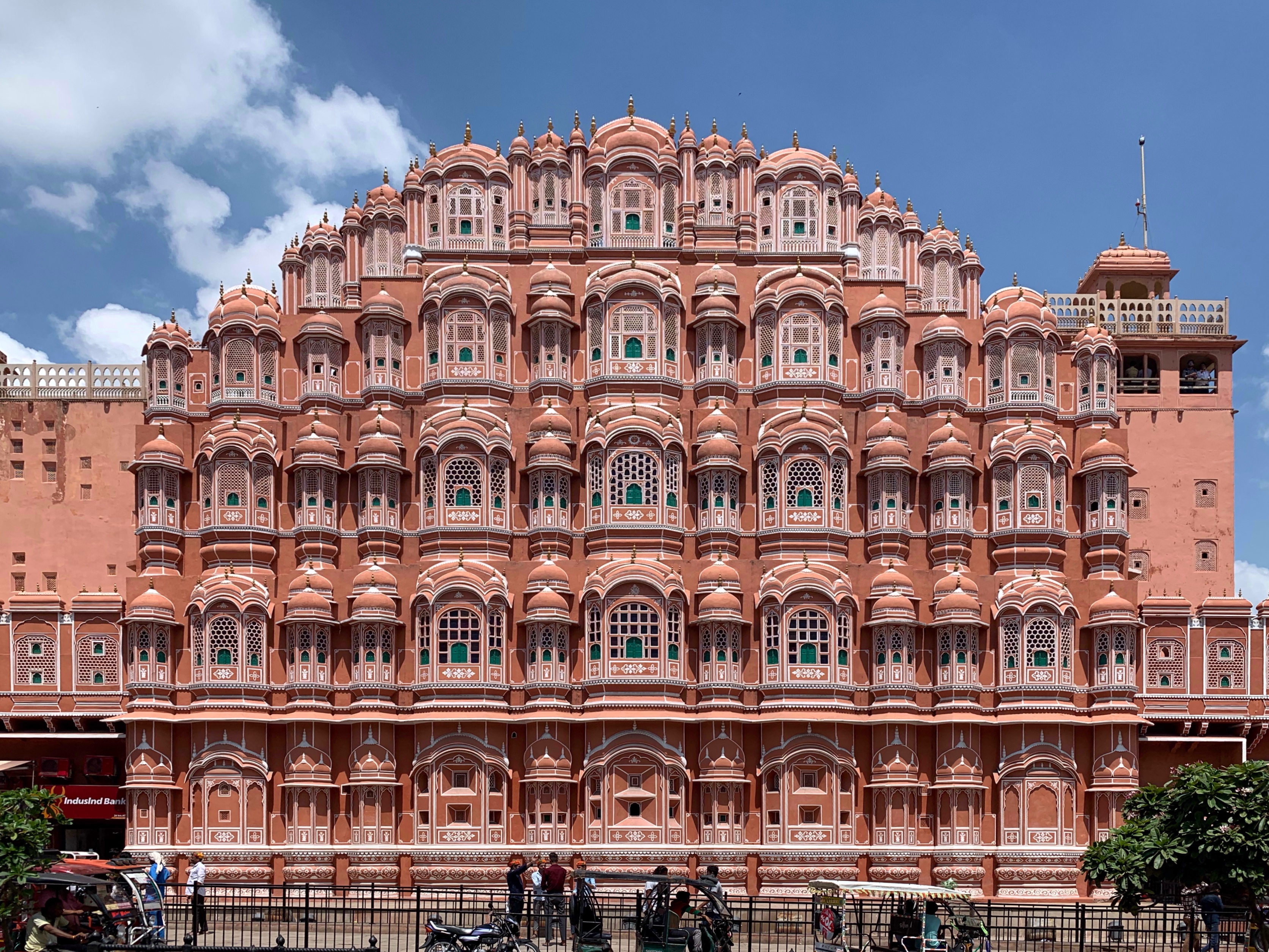
The east facade of Hawa Mahal in Jaipur — CC BY-SA 4
Highlights of Hava Mahal
The highlights of Hava Mahal are the five-storey facade with its 953 windows, the ramps and viewing rooms inside, and the small museum on the ground floor. The facade, of pink and red sandstone, with finely carved lattice jharokha windows, narrowing towards the top like the crown of Krishna, is one of the most photographed facades in India. The ramps and viewing rooms show that Hava Mahal was built to be used, not only to be looked at: the royal ladies walked the ramps, stopped at the lattice windows and watched the street festivals without being seen.
The small museum on the ground floor displays objects about the history of the palace, the Jaipur court and Rajput architecture, a short stop that helps visitors understand the building before climbing the ramps. The City Palace stands right beside Hava Mahal, a complex of courtyards, museums and collections of weapons and royal dress. Jantar Mantar, a few minutes on foot, is a giant stone observatory built in 1734 under Sawai Jai Singh II, a UNESCO World Heritage site with the largest stone sundial in the world. Amber Fort, about 11 km north of the old city, holds the Sheesh Mahal, the Palace of Mirrors, and looks over Maota Lake, and it is the most popular half-day trip from Jaipur.
Frequently Asked Questions
Where is Hava Mahal?
On Hawa Mahal Road, Badi Choupad, in the old city of Jaipur, Rajasthan, India, facing the rooftop cafes and near the City Palace and Jantar Mantar.
When was Hava Mahal built?
In 1799, by Maharaja Sawai Pratap Singh, the grandson of the founder of Jaipur. The architect was Lal Chand Ustad.
Why does Hava Mahal have 953 windows?
So that the ladies of the royal household could watch the street festivals without being seen, under the purdah custom, and so that the wind passing through the windows would cool the palace, which is the origin of the name Palace of Winds.
How much is the ticket for Hava Mahal?
Under the revision from 1 January 2026, the ticket is 100 INR for Indian visitors and 600 INR for foreign visitors. Ask at the gate for the current list, since prices are revised from time to time.
Is Hava Mahal a UNESCO World Heritage site?
No, the palace itself holds no UNESCO listing of its own. But Jaipur was listed by UNESCO as a heritage city in 2019, and Hava Mahal is one of the characteristic buildings of that city.
What is the Wikidata code for Hava Mahal?
Q836531, for Hava Mahal, a palace in Jaipur, Rajasthan, India, at 26.924° N, 75.82672° E.
Verified
Checked 20 November 2026. The figures in this article, from the 1799 building and the 953 windows to the 2019 listing of Jaipur and the ticket prices from 1 January 2026, were matched against the sources below, and the spelling note records that the registry keyword file gives “hava mahal” while the standard spelling is “hawa mahal”.
Sources
- Hava Mahal built 1799 by Maharaja Sawai Pratap Singh, architect Lal Chand Ustad, 5 storeys, 953 small windows (jharokha), pink and red sandstone, crown of Krishna, built for the ladies of the royal household under purdah, wind cooling effect: https://en.wikipedia.org/wiki/Hawa_Mahal
- Ticket prices from 1/1/2026: 100 INR for Indian visitors, 600 INR for foreign visitors, student discount; combined Jaipur ticket; online booking through the OBMS portal of Rajasthan Tourism; from 2026 travel guides matched against the Rajasthan government notice
- Jaipur founded 1727 by Sawai Jai Singh II, painted pink in 1876 to welcome the Prince of Wales, UNESCO listed the city in 2019: https://en.wikipedia.org/wiki/Jaipur
- India on the UNESCO list of States Parties: https://whc.unesco.org/en/statesparties/in
- Coordinates 26.924° N, 75.82672° E, Wikidata Q836531: Wikidata API, checked 20 November 2026
- Taj Mahal, Sheesh Mahal, Kathmandu and Lahore: TheTerraAtlas registry, checked 20 November 2026
- Keywords: batch8-en-keywords.json, TA-L4-hawa-mahal, checked 20 November 2026; the registry keyword file records “hava mahal” as the main keyword and notes that the standard spelling “hawa mahal” did not appear in that measurement round
Not Yet Verified
- Opening hours: 2026 guides give different closing times, 9:00-17:00, 9:00-18:30 or 9:00-16:30; this article gives only the 9:00 opening and daily opening, and says to check the closing time on the day.
- The ticket prices of 100 and 600 INR follow the revision from 1/1/2026 as reported by 2026 travel guides matched against the Rajasthan government notice; the OBMS portal was not read directly in this round, so check the price list at the gate before going.
- The height of the palace, about 15 m, follows travel guides; some sources give other figures.
- The combined Jaipur ticket and the student discount change with each revision; check at the ticket counter.
- The name of the architect, Lal Chand Ustad, follows Wikipedia; some sources give Lal Chand Ustad or Lal Chand.
Illustrations
- Hero: Hava Mahal is a five-storey palace of pink sandstone in the old city of Jaipur. Free image: https://upload.wikimedia.org/wikipedia/commons/7/7e/Hava_mahal%2C_Jaipur%2C_India.jpg — CC BY-SA 4.0.
- In body, view: A view of Hawa Mahal, Jaipur, Rajasthan. Free image: https://upload.wikimedia.org/wikipedia/commons/c/cb/A_view_of_Hawa_Mahal%2C_Jaipur%2C_Rajasthan.JPG — CC BY-SA 3.
- In body, view: The east facade of Hawa Mahal in Jaipur. Free image: https://upload.wikimedia.org/wikipedia/commons/4/41/East_facade_Hawa_Mahal_Jaipur_from_ground_level_%28July_2022%29_-_img_01.jpg — CC BY-SA 4.