
Haifa: The Bahá’í Gardens, Mount Carmel and Israel’s Northern Port
Tel Aviv to Haifa is a short ride north along the Mediterranean coast. Haifa greets you with terraced gardens and sea air.
Haifa is the third largest city in Israel, after Jerusalem and Tel Aviv, and it is the main port and the administrative and industrial centre of the north of the country. The city lies on the Mediterranean coast, spread from Haifa Bay up the northern slope of Mount Carmel, and it holds the Bahá’í World Centre, with its terraced gardens that are famous around the world. The Tel Aviv to Haifa journey is one of the easiest trips in Israel, and it brings travellers from the beaches of Tel Aviv to a city where mountain and sea meet.
Haifa is unlike the other two large cities of Israel. Jerusalem is a city of religious history, Tel Aviv is a city of beaches and nightlife, and Haifa is a city where the mountain meets the sea, with terraced gardens looking out over the bay and technology institutes standing beside monasteries hundreds of years old. A Tel Aviv to Haifa day trip shows that contrast in a single day, and a longer stay lets the city open up slowly, from the port at the bottom to the university on the top of Carmel.
Quick Facts
| Item | Detail |
|---|---|
| Name | Haifa |
| Hebrew and Arabic names | Haifa, Haifa |
| Position | Mediterranean coast, northern Israel, on the northern slope of Mount Carmel, about 90 km north of Tel Aviv |
| Type | Third largest city in Israel, capital of Haifa District, main port of northern Israel |
| Area | 63.7 square kilometres |
| Population | About 297,000 people in 2024 |
| Languages | Hebrew and Arabic, English widely used in tourism |
| Currency | Israeli shekel, ILS |
| Time zone | UTC+2, UTC+3 in summer |
| Coordinates | 32.819 north, 34.999 east |
| Wikidata | Q41621, classified as a city |
| UNESCO | Bahá’í Holy Places in Haifa and Western Galilee, listed in 2008, reference 1220 |
| Highlights | Bahá’í Gardens and the Shrine of the Báb, German Colony, Stella Maris Monastery, Carmelit |
| Best months | April to June and September to November, warm and dry |
Geography of Haifa
Haifa lies in northern Israel, where the Carmel range reaches the Mediterranean Sea. The city spreads across three clear levels of ground: the port and the old town at sea level, the central Hadar district halfway up the slope, and the residential areas and universities on the top of Carmel. The Tel Aviv to Haifa road runs along the coastal plain and then climbs into the city, and the change in height is felt at once, as the sea drops away below and the bay opens out to the north.
Haifa Bay is a curved, crescent-shaped bay that shelters the deep-water port of the city. To the north-east of the bay lies the coastal plain, and to the south-east lie the Jezreel Valley and the Kishon River, the river that is joined to Mount Carmel in the Bible. The port is the reason Haifa exists as a large city: it is the main harbour of northern Israel, and its quays, cranes and warehouses fill the flat land at the foot of the mountain.
Mount Carmel itself is the backbone of Haifa. The mountain runs south-east from the sea, and its northern slope carries the whole city, from the port to the university. The upper slopes are green with pine trees and gardens, and the air on top of Carmel is cooler than the air at the port. The Tel Aviv to Haifa train approaches the city along the coast, and the first sight of Haifa for many travellers is the mountain rising above the bay, with the golden dome of the Shrine of the Báb shining on its slope.
Haifa has a typical Mediterranean climate, with hot dry summers and mild rainy winters. Summer temperatures often reach 29 to 33 degrees, while winter days are usually between 13 and 18 degrees. Rain falls mainly from November to March, and from June to September there is almost no rain at all. The best months for walking are April to June and September to November, when the heat is softer and the air is clear.
The city covers 63.7 square kilometres, and its population of about 297,000 people in 2024 makes it the third largest city in Israel. Hebrew and Arabic are both spoken in Haifa, and English is widely used in tourism, in the hotels, in the restaurants and at the sights. The city is a mix of Jewish and Arab neighbourhoods, of old stone houses and new towers, and that mix is part of what makes Haifa feel different from Tel Aviv.
Three levels of one city
The three levels of Haifa each have their own character, and the Carmelit funicular joins them. At the bottom, the port and the old town hold the railway station, the cruise terminal and the busy streets of the lower city. In the middle, Hadar holds the shops, the markets and the older apartment blocks of the city centre. On the top, the neighbourhoods of Carmel hold the university, the hotels with a view, and the quiet streets under the pine trees.
The Bahá’í Gardens run down the slope between the top and the middle, nineteen terraces of green that link the Shrine of the Báb to the German Colony below. From the Louis Promenade at the top, the view takes in the whole bay, the port, and the city spread below. A Tel Aviv to Haifa visitor who starts at the top and walks down through the gardens sees the city in the right order, from the mountain to the sea.
The bay and the mountain
Haifa Bay curves around the north of the city, and its beaches, Carmel Beach and Dado Beach, run along the south-western shore. The sand is long and open, and the beaches are the place for swimming in summer and for walking at sunset. The bay is also a working bay, with ships at anchor and the port in constant use, so the view from the beaches mixes holiday calm with the movement of a harbour.
The Kishon River, which flows into the bay from the Jezreel Valley, is a small river with a large place in the Bible, and its valley is the flat land behind the city. To the south-east of Haifa, the Carmel range continues towards the hills of the Galilee, and the road inland leads to Nazareth and the Sea of Galilee. Haifa is thus a crossroads as well as a port: the coast road north to Lebanon, the road east to the Galilee, and the road south to Tel Aviv all meet here.
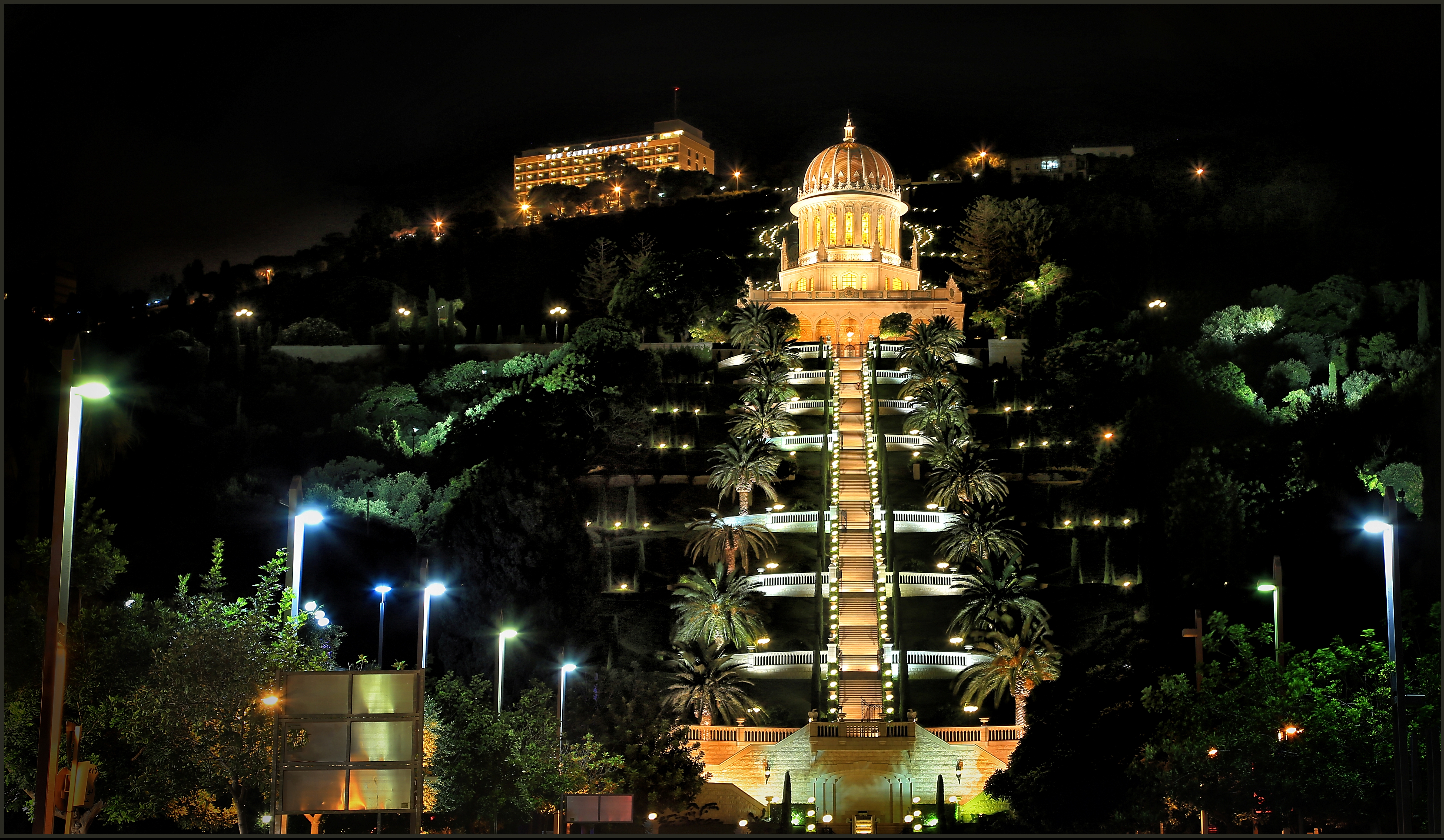
Bahai Garden in Haifa Israel — CC BY-SA 4
History of Haifa
From Tell Abu Hawam to ancient Haifa
The area of Haifa has been inhabited since the Late Bronze Age. The oldest known settlement in the region is Tell Abu Hawam, a small port city founded in the fourteenth century before the common era, on the shore of the bay. In the third century, Haifa was known as a centre for the production of dye, and the name of the city appears in ancient Jewish texts. The sea was always the reason for settlement here, and the bay was always the shelter.
From the eleventh to the eighteenth century, the centre of Haifa lay at a site now called Haifa el-Atika, about 5 kilometres north-west of Tell Abu Hawam. In 1265 the Mamluks captured Haifa and destroyed the fortifications of the city, and the place sank back into a small coastal town. For centuries Haifa was a minor port, overshadowed by Acre to the north, and its history was the history of whoever held the coast.
The Carmelite order and the holy mountain
Mount Carmel has deep religious meaning from ancient times. In the Bible, Mount Carmel is joined to the story of the prophet Elijah, and a cave on the top of the mountain is traditionally said to be the place where Elijah hid. In the middle of the twelfth century, a community of hermits founded the Carmelite order on the slope of the mountain, taking its name from Carmel itself.
The Stella Maris Monastery, the world headquarters of the Carmelite order, was completed in 1836, and it stands on the top of the mountain above the sea. The cave of Elijah below it is a place of pilgrimage shared by three religions, with inscriptions carved from the fifth and sixth centuries. The monastery and the cave are among the oldest layers of Haifa, and they give the city a spiritual weight that has nothing to do with its port.
Zahir al-Umar and the birth of modern Haifa
The modern city of Haifa began with Zahir al-Umar, the ruler of the Galilee, who moved the city to its present site in 1761 and built it up as a port. The German Templers arrived in the late nineteenth century and built the German Colony at the foot of Carmel, a quarter of stone houses along Ben Gurion Boulevard that still stands today. The Templers brought crafts, farming and trade, and their quarter became the most handsome street in the city.
The British captured Haifa on 23 September 1918, and under the British Mandate the city grew fast. The Technion, the institute of technology, laid its foundation stone in 1912 and opened its doors in 1924, making Haifa a centre of learning as well as a port. The deep-water port opened on 31 October 1933, and it turned Haifa into the main harbour of the Mandate, with oil, goods and immigrants passing through its quays.
1948 and the Haifa of today
In 1948, with the founding of the State of Israel, Haifa became a city of the new state, and its population changed rapidly as people arrived and others left. The Carmelit funicular opened in 1959, joining the port to the neighbourhoods on top of Carmel with six stations, and it remains a symbol of the city. The University of Haifa was founded on the top of the mountain, and the high-technology park of Matam grew at the southern edge of the city, making Haifa a centre of research and industry.
The Bahá’í Gardens, nineteen terraces running down the slope of Carmel, were opened on 22 May 2001, and in 2008 the Bahá’í Holy Places in Haifa and Western Galilee were listed as a World Heritage site. The gardens turned the slope of Carmel into the image of Haifa that the world knows, and they are now the first sight on every Tel Aviv to Haifa trip. Today Haifa is a city of about 297,000 people, a port, a university city and a technology centre, and it remains the capital of the north of Israel.
Timeline
| Year | Event |
|---|---|
| 14th century BCE | Tell Abu Hawam founded, the oldest known settlement in the Haifa area |
| 3rd century | Haifa known as a centre for dye production |
| Mid-12th century | Hermits found the Carmelite order on Mount Carmel |
| 1265 | Mamluks capture Haifa and destroy its fortifications |
| 1761 | Zahir al-Umar moves Haifa to its present site |
| 1836 | Stella Maris Monastery completed on Mount Carmel |
| Late 19th century | German Templers build the German Colony |
| 1912 | Foundation stone of the Technion laid |
| 23 September 1918 | British forces capture Haifa |
| 1924 | Technion opens |
| 31 October 1933 | Deep-water port of Haifa opens |
| 1948 | Haifa becomes part of the State of Israel |
| 1959 | Carmelit funicular opens with six stations |
| 22 May 2001 | Bahá’í Gardens opened on Mount Carmel |
| 2008 | Bahá’í Holy Places in Haifa and Western Galilee listed as a World Heritage site |

Baha’i Garden, Haifa — CC BY-SA 2
Tel Aviv to Haifa by Train and Road
Tel Aviv to Haifa by train
The Tel Aviv to Haifa train is the easiest way to make the trip, and it is the choice of most visitors. Trains run often through the day from the Tel Aviv stations north along the coast, and the Tel Aviv to Haifa train ride takes about an hour, with the sea on one side for much of the way. The Tel Aviv to Haifa train arrives at Haifa Hof HaCarmel or Haifa Central station, and from either station the Carmelit or a bus climbs the mountain. Check the timetable before you go, because the Tel Aviv to Haifa train times change by day, and the Friday and Saturday service is limited.
Tel Aviv to Haifa by road
The Tel Aviv to Haifa drive follows the coastal highway north for about 90 kilometres, and it takes a little over an hour when the traffic is light. The Tel Aviv to Haifa road is a fast motorway, and the drive is straightforward, with the sea on the left and the Carmel range rising ahead as you approach the city. Buses also run the Tel Aviv to Haifa route through the day, and they are cheaper than the train, though slower in traffic. A Tel Aviv to Haifa day trip by car gives the freedom to stop at Caesarea on the way, an ancient port city halfway between the two cities.
Tel Aviv to Haifa day trips
A Tel Aviv to Haifa day trip is one of the most popular outings from Tel Aviv, and it works well because the city is compact. A Tel Aviv to Haifa day trip usually starts at the Bahá’í Gardens, continues down through the German Colony, and ends with the Stella Maris Monastery and the view from the Louis Promenade. A guided Haifa tour from Tel Aviv adds a guide who explains the history of the gardens and the mountain, and a Haifa tour from Tel Aviv often includes the port and the Wadi Nisnas quarter as well. Travellers who prefer to walk can join a free walking tour of Haifa, which usually starts in the German Colony and covers the gardens from below.
In Haifa: the gardens, the monastery and the beach
The Bahá’í Gardens are the first sight in Haifa, nineteen terraces running down Mount Carmel, about 225 metres high and nearly a kilometre long, with the Shrine of the Báb and its golden dome in the middle. The gardens are free to enter, open daily from 9 in the morning to 5 in the afternoon, and the shrine itself is open from 9 to 12. A guided walk down the terraces takes about 50 minutes and covers 750 steps, and it runs from Tuesday to Sunday, so book ahead. The view from the top, at the Louis Promenade, takes in the whole bay and is the best panorama in the city.
The German Colony, the Templer quarter of the late nineteenth century, runs along Ben Gurion Boulevard at the foot of the gardens, with stone houses, restaurants and cafes. It is the best place in Haifa for a long lunch, and it is also the starting point for a Haifa walking tour. The Stella Maris Monastery, completed in 1836, stands on the top of Carmel, with the cave of Elijah below it, and a cable car runs down from the monastery to the Bat Galim promenade. Carmel Beach and Dado Beach are the places to swim in summer, and the Wadi Nisnas quarter, the old Arab neighbourhood, holds a market, bakeries and famous hummus shops.
Tel Aviv to Haifa and beyond
A Tel Aviv to Haifa trip can be extended in several directions. Nazareth and the Sea of Galilee lie inland to the east, and the Dead Sea is a longer drive to the south-east. Acre, the old crusader port, is a short ride north along the coast, and its old city is a World Heritage site in its own right.
Many travellers use a Tel Aviv to Haifa day trip as the start of a longer tour of the north, staying a night in Haifa and continuing to the Galilee the next day. The Tel Aviv to Haifa route is thus more than a single trip: it is the doorway to the whole north of Israel.
Notable Places
The Bahá’í Gardens and the Shrine of the Báb
The Bahá’í Gardens are nineteen terraced gardens on Mount Carmel, with the Shrine of the Báb and its golden dome at the centre, and they have been a World Heritage site since 2008. The gardens are free to enter, and the guided walk down the terraces takes about 50 minutes and covers 750 steps. The view from the Louis Promenade at the top is the finest panorama of Haifa Bay and the city.
The German Colony
The German Colony is the Templer quarter of the late nineteenth century, along Ben Gurion Boulevard at the foot of the Bahá’í Gardens. Its stone houses now hold restaurants and cafes, and the street is the best place in Haifa for an evening meal. A free walking tour of Haifa often starts here, and the view up the boulevard to the golden dome is the classic photograph of the city.
Stella Maris Monastery
The Stella Maris Monastery, completed in 1836, is the world headquarters of the Carmelite order, founded on Mount Carmel in the twelfth century. The monastery stands above the sea, and the cave of Elijah below it is a place of pilgrimage shared by three religions. A cable car runs from the monastery down to the Bat Galim promenade, and the ride is one of the best short trips in Haifa.
The Louis Promenade
The Louis Promenade is the viewpoint at the top of the Bahá’í Gardens, and it offers the best panorama of Haifa Bay and the city below. From here the whole shape of Haifa is clear: the port at the bottom, the Hadar district in the middle, and the gardens running down the slope. Come at sunset, when the light turns the bay gold and the dome of the shrine glows.
Carmel Beach and Dado Beach
Carmel Beach and Dado Beach are the long sandy beaches of Haifa, good for swimming in summer and for walking at sunset. The beaches sit at the south-western edge of the city, with the mountain behind them and the open sea in front. They are the place to end a day that began with a Tel Aviv to Haifa morning train, and they are far quieter than the beaches of Tel Aviv.
Wadi Nisnas
Wadi Nisnas is the old Arab quarter of Haifa, with a market, bakeries and famous hummus shops, and it keeps a different rhythm from the rest of the city. The quarter is small and walkable, and its food is the best reason to come: warm bread, fresh hummus and sweets from the old bakeries. A Haifa walking tour through Wadi Nisnas shows the mixed life of the city at street level.
Frequently Asked Questions
How do I travel from Tel Aviv to Haifa?
The Tel Aviv to Haifa train is the easiest way, with frequent trains through the day and a ride of about an hour along the coast. The Tel Aviv to Haifa drive takes a little over an hour on the coastal highway when traffic is light, and buses also run the Tel Aviv to Haifa route through the day. From the Haifa stations, the Carmelit or a bus climbs the mountain to the gardens and the upper neighbourhoods.
Is a Tel Aviv to Haifa day trip worth it?
Yes. A Tel Aviv to Haifa day trip works well because Haifa is compact: one day covers the Bahá’í Gardens, the German Colony, the Stella Maris Monastery and the view from the Louis Promenade. A guided Haifa tour from Tel Aviv adds the history of the gardens and the mountain, and a free walking tour of Haifa is a good low-cost way to see the German Colony and the gardens from below.
What is the Bahá’í Gardens in Haifa?
The Bahá’í Gardens are nineteen terraced gardens on Mount Carmel, about 225 metres high and nearly a kilometre long, with the Shrine of the Báb and its golden dome at the centre. The gardens opened on 22 May 2001, they are free to enter, and they are part of the Bahá’í Holy Places in Haifa and Western Galilee, listed as a World Heritage site in 2008 under reference 1220.
How long should I spend in Haifa?
One to two days is enough for a first visit to Haifa: one day for the Bahá’í Gardens, the German Colony and the Stella Maris Monastery, and half a day for the beaches and the neighbourhoods. A Tel Aviv to Haifa day trip covers the main sights, but a night in Haifa lets you see the gardens at sunset and the city without rushing.
When is the best time to visit Haifa?
April to June and September to November are the best months to visit Haifa, when the weather is warm and dry and the walking is comfortable. Summer is hot and dry, with temperatures often reaching 29 to 33 degrees, while winter brings rain from November to March and daytime temperatures of about 13 to 18 degrees.
Is there a free walking tour in Haifa?
Yes. A free walking tour of Haifa usually starts in the German Colony and covers the gardens from below, the old stone houses and the stories of the Templers. The tours are led by local guides, they run on set days, and it is wise to check the meeting point and the schedule in advance, because times change with the season.
Verified
- The facts in this article were checked on 20 November 2026 against the verified Vietnamese article for Haifa and the sources it cites.
- Haifa is the third largest city in Israel, after Jerusalem and Tel Aviv, with about 297,000 people in 2024, an area of 63.7 square kilometres, and its place on the northern slope of Mount Carmel about 90 kilometres north of Tel Aviv.
- The Bahá’í Gardens have nineteen terraces, stand about 225 metres high and run nearly a kilometre long, and they were opened on 22 May 2001, with free entry, open daily from 9 in the morning to 5 in the afternoon, and the shrine open from 9 to 12.
- The Bahá’í Holy Places in Haifa and Western Galilee were listed as a World Heritage site in 2008, reference 1220, criteria (iii) and (vi), with 26 buildings at 11 locations and an area of 62.58 hectares.
- Tell Abu Hawam was founded in the fourteenth century before the common era, the Mamluks captured Haifa in 1265, and Zahir al-Umar moved the city to its present site in 1761.
- The Stella Maris Monastery was completed in 1836, the Carmelite order was founded in the twelfth century, and the cave of Elijah below the monastery is a place of pilgrimage for three religions.
- The Technion laid its foundation stone in 1912 and opened in 1924, the British captured Haifa on 23 September 1918, the deep-water port opened on 31 October 1933, and the Carmelit opened in 1959 with six stations.
- The Wikidata item Q41621 is classified as a city, with coordinates 32.819167/34.999167 that match the registry.
- The English keyword group for this article was extracted on 20 November 2026 from the file theterraatlas-gom-nhom-en-asia-gap-2-3362.xlsx: 8 rows, 6 counted, with the main keyword “tel aviv to haifa” and long keywords including “day trips from haifa”, “free walking tour haifa”, “haifa tour”, “haifa tour from tel aviv” and “haifa walking tour”.
Sources
- Haifa as the third largest city in Israel, its population of about 297,000 in 2024, its area of 63.7 square kilometres, Tell Abu Hawam in the fourteenth century BCE, the deep-water port, the Carmelit, the Technion and Matam: Wikipedia — https://en.wikipedia.org/wiki/Haifa
- The Bahá’í Holy Places in Haifa and Western Galilee, listed in 2008, criteria (iii) and (vi), reference 1220, 26 buildings at 11 locations, 62.58 hectares: UNESCO — https://whc.unesco.org/en/list/1220/
- The Bahá’í Gardens, nineteen terraces, 225 metres high, nearly a kilometre long, opened on 22 May 2001, open daily 9 to 17, the shrine 9 to 12, free entry, the terrace walk of 50 minutes and 750 steps, Tuesday to Sunday, book ahead: Bahá’í World Centre — https://ganbahai.org.il/visit-us-haifa/
- The history of Haifa, Zahir al-Umar moving the city in 1761, the British capture on 23 September 1918, the Technion foundation stone in 1912 and opening in 1924, the port opening on 31 October 1933, the Carmelit opening in 1959: Jewish Virtual Library — https://jewishvirtuallibrary.org/history-and-overview-of-haifa
- The Stella Maris Monastery completed in 1836, the Carmelite order founded in the twelfth century, and the cave of Elijah: Wikipedia — https://en.wikipedia.org/wiki/Mount_Carmel
- The Wikidata item Q41621 and the coordinates 32.819167/34.999167: Wikidata — https://www.wikidata.org
- The city at the other end of the journey, and the quarter to compare with the German Colony: Tel Aviv and the holy city to the south: Jerusalem, and the salt sea to the south-east: Dead Sea
Unverified
- The population of the Haifa metropolitan area — sources give about 600,000 people for the urban area, but the boundaries of the city and the metropolitan area are defined differently between sources, so this article uses only the population inside the city boundary.
- The exact founding year of the University of Haifa — sources differ on the year of founding and the year of official recognition, so this article gives no year.
- The current fares of the Stella Maris to Bat Galim cable car and of the Carmelit — fares change over time, so check the price at the place before going.
- The current timetable of the Tel Aviv to Haifa train — the ride takes about an hour according to travel sources, but the timetable changes by day, so check the schedule before going.
- Israel allows many nationalities to enter without a visa for short visits, but the rules depend on your passport, so confirm the current entry requirements on the official site before you book, and check the current travel advice for Israel before you travel.
Illustrations
- Hero: View of Haifa. Free image: https://upload.wikimedia.org/wikipedia/commons/d/dd/The_Hanging_Gardens_of_Haifa%2C_Israel_%2850099173503%29_%28cropped%29.jpg — CC BY 2.
- In body, garden: Baha’i Garden, Haifa. Free image: https://upload.wikimedia.org/wikipedia/commons/b/bd/Baha%27i_Garden%2C_Haifa_%283756370163%29.jpg — CC BY-SA 2.
- In body, garden: Bahai Garden in Haifa Israel. Free image: https://upload.wikimedia.org/wikipedia/commons/0/0c/Bahai_Garden_in_Haifa_Israel.jpg — CC BY-SA 4.