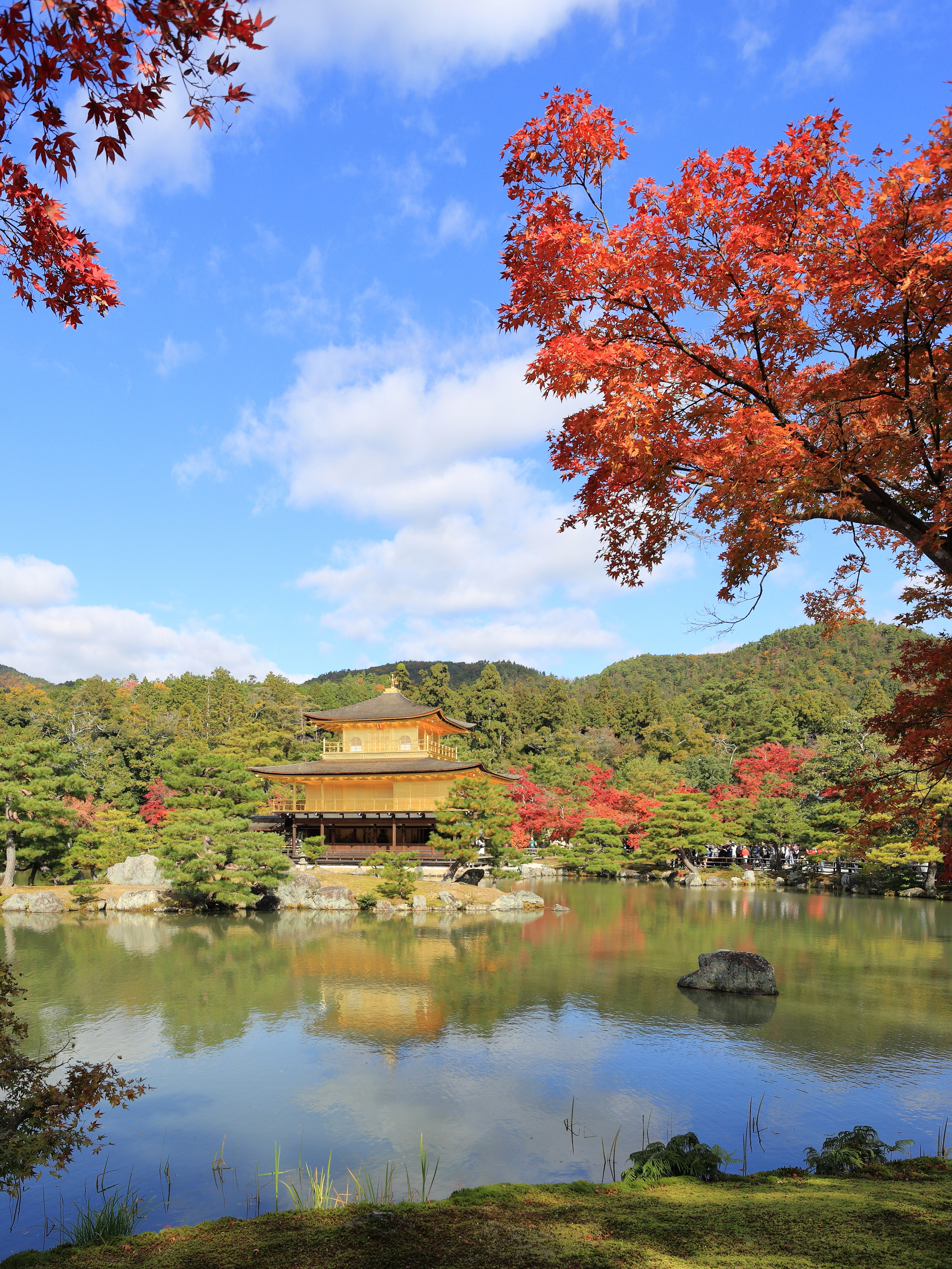
Kinkaku-ji: The Golden Pavilion of Kyoto Above the Mirror Pond
Kinkaku-ji is the Golden Pavilion of Kyoto, a three-storey hall leafed in gold. Its reflection fills the Mirror Pond below.
Kinkaku-ji stands in the north-west of Kyoto, at 1 Kinkakuji-cho, in Kita Ward, and it is the most photographed temple in Japan. The pavilion is three storeys tall, and its top two storeys are covered in gold leaf, so that the building shines in the sun and glows in the rain. The pavilion stands on the edge of the Mirror Pond, Kyoko-chi, and its reflection in the water is the image of Kyoto that the world knows.
The official name of the temple is Rokuon-ji, the Temple of the Deer Garden, and Kinkaku-ji is the name of the pavilion, not of the temple. The pavilion was built as the villa of the shogun Ashikaga Yoshimitsu, in 1397, and it became a Zen temple in 1408, after his death. The pavilion burned in 1950, and it was rebuilt in 1955, and it was re-gilded in 1986 and 1987, and it stands today as the golden heart of Kyoto.
Quick Facts About Kinkaku-ji
| Fact | Detail |
|---|---|
| Name | Kinkaku-ji (金閣寺), the Golden Pavilion; official temple name Rokuon-ji (鹿苑寺) |
| Place | 1 Kinkakuji-cho, Kita Ward, Kyoto, Japan |
| Built | Villa of Ashikaga Yoshimitsu from 1397; Golden Pavilion completed about 1398; Zen temple from 1408 |
| Rebuilt | Burned 2 July 1950; rebuilding completed 1955; re-gilded 1986–1987 |
| Height | About 12.5 m, three storeys in three styles |
| Hours | 9:00–17:00 daily, all year (official temple site) |
| Tickets | Adults and high school students 500 yen; elementary and junior high students 300 yen (official temple site) |
| Highlights | Golden Pavilion; Mirror Pond (Kyoko-chi); Zen garden; Sekkatei teahouse |
| UNESCO | Component 688-013 Rokuon-ji of the Historic Monuments of Ancient Kyoto, inscribed 1994, criteria (ii) and (iv) |
| Wikidata | Q270983 |
| Coordinates | 35.0395° N, 135.7285° E |
Geography of Kinkaku-ji
The Pavilion and the Mirror Pond
Kinkaku-ji stands in the north-west of Kyoto, in Kita Ward, at the foot of the hills that ring the city. The temple grounds are a garden, and the garden is built around the Mirror Pond, Kyoko-chi, a large pond whose islands, pines and stones are arranged in the style of the Zen garden. The Golden Pavilion stands on the edge of the pond, on a small promontory, so that its reflection fills the water, and the visitor who walks the path around the pond sees the pavilion from every side.
The pavilion is three storeys tall, and each storey is built in a different style. The first storey is built in the style of the palaces of the Heian period, with white walls and wooden pillars, and it is called the Chamber of Dharma Waters. The second storey is built in the style of the samurai houses, with gold leaf on its walls, and it is called the Tower of Sound Waves.
The third storey is built in the style of a Chinese Zen hall, with gold leaf inside and out, and it is called the Cupola of the Ultimate. The three storeys together are 12.5 metres tall, and the golden phoenix on the roof is the crown of the building.
The Mirror Pond is the setting of the pavilion, and its islands, its pines and its stones are the garden. The pond is large, and its islands are shaped like the islands of the Japanese garden, with pines that have been pruned for centuries. The stones of the pond are placed to catch the light, and the water is dark, so that the reflection of the pavilion is sharp. The path around the pond is the path of the visitor, and it leads from the gate, past the pavilion, through the garden, to the teahouse and the exit.
The gold of the pavilion is gold leaf, and it was laid again in 1986 and 1987, when the pavilion was re-gilded. About 20 kilograms of gold leaf were used, and the leaf covers the top two storeys, inside and out, so that the building shines from every side. The gold is the reason the pavilion is called the Golden Pavilion, and it is the reason the temple is famous, and it is the reason the visitor comes. The pavilion in the rain is the most beautiful, when the gold is dark and the pond is broken by the rain.
The Garden and the Hills
The garden of Kinkaku-ji is a Zen garden, and it is the oldest part of the temple. The garden was laid out in the time of Yoshimitsu, and its pond, its islands and its pines are the garden of the shogun’s villa. The garden is a stroll garden, and the visitor walks it in a single circuit, from the gate, past the pavilion, through the pines, to the teahouse, and the walk takes about half an hour. The garden is quiet, and its paths are gravel, and its trees are old, and the visitor who walks it walks through the Kyoto of the fourteenth century.
The hills behind the temple are the hills of north-west Kyoto, and they rise above the garden, with their pines and their temples. The temple of Ryoan-ji, famous for its rock garden, lies near Kinkaku-ji, and the walk between the two takes about twenty minutes, through the lanes of the district. The two temples are the pair of north-west Kyoto, and the visitor who sees both in one morning sees the golden pavilion and the rock garden, the two faces of Zen in Kyoto.
The Sekkatei teahouse stands in the garden of Kinkaku-ji, and it is a small house of tea, built in the style of the tea masters. The teahouse is not open to the public, and its interior can be seen only from the path, but its garden, its fence and its gate are the quiet heart of the temple. The teahouse is the place where the shogun took tea, and its name, the Evening Glow Hut, is the name of the light that falls on the garden in the evening. The teahouse is the reason the garden is a garden of tea, and not only a garden of the pavilion.
The district around Kinkaku-ji is a district of temples, and its lanes hold the houses, the shops and the schools of north-west Kyoto. The bus to the temple, the 59 and the 102, stops at Kinkakuji-michi, and the walk from the stop to the gate takes a few minutes, past the shops that sell souvenirs and the restaurants that serve the visitors. The car park of the temple holds 250 cars, and it is the largest car park of the temples of Kyoto. The temple is the centre of its district, and the district is the temple’s neighbourhood.
The Seasons of the Pavilion
The seasons of Kinkaku-ji are the seasons of Kyoto, and the pavilion changes with them. In spring, the cherry blossom comes to the garden, and the pink of the blossom frames the gold of the pavilion, and the pond is scattered with petals. In summer, the garden is green, and the pines are dark, and the pavilion shines in the sun, and the pond is still.
In autumn, the maples turn red and gold, and the garden is at its most beautiful, and the pavilion stands in a frame of fire. In winter, the snow falls on the roof, and the gold is white at the edges, and the pavilion is at its quietest.
The best season for Kinkaku-ji is autumn, when the maples are red and the light is low, and the second-best is spring, when the cherry blossom is out and the garden is pink. The summer is hot, and the crowds are large, and the visitor in summer should come early, before the heat and the crowds. The winter is cold, and the garden is quiet, and the snow, when it falls, is the rarest sight of the temple. The pavilion is beautiful in every season, and the visitor who comes in any season will see it, but the visitor who comes in autumn will see it at its best.

A picture of the Kinkaku-ji in February 2024 — CC BY-SA 4

The Golden Pavilion reflected in the Mirror Pond (Kyoko-chi) — lumoplank, CC0

The rock garden of Ryoan-ji, Kyoto — BMR & MAM, CC BY-SA 2

The Sekkatei teahouse garden, Kinkaku-ji — そらみみ, CC BY-SA 3
History of Kinkaku-ji
The Villa of the Shogun Ashikaga Yoshimitsu
The history of Kinkaku-ji begins with the shogun Ashikaga Yoshimitsu, the third shogun of the Ashikaga, who ruled Japan from 1368 to 1394. Yoshimitsu was the most powerful man in Japan, and he built his power on the trade with China, on the arts and on the Zen temples of Kyoto. In 1397, he bought the villa of Kitayama-dono, in the north-west of Kyoto, and he rebuilt it as his retirement palace, a place of gardens, pavilions and tea houses, where he could live as a monk and as a ruler at once.
The Golden Pavilion was completed in about 1398, and it was the centre of the villa. The pavilion was built as a place of rest and of display, and its gold leaf was the sign of Yoshimitsu’s wealth and of his devotion. The villa held other buildings, a palace, a temple, a garden and a teahouse, and the pavilion was the finest of them, the building that the shogun showed to his guests. The villa was the Kitayama culture, the culture of the shogun’s court, and its art, its gardens and its tea were the highest art of Japan.
Yoshimitsu died in 1408, and his villa became a Zen temple, as he had wished. The temple was given the name Rokuon-ji, the Temple of the Deer Garden, after the posthumous name of Yoshimitsu, Rokuon-in. The pavilion became the relic hall of the temple, holding the ashes of the shogun and the statue of the Buddha, and the villa became the temple, and the garden became the garden of the monks. The change from villa to temple is the change that made Kinkaku-ji a temple, and the pavilion has been a temple ever since.
War, Fire and the Rebirth
The Onin War, which began in 1467, destroyed much of Kyoto, and the villa of Kitayama-dono was burned, except for the Golden Pavilion. The war lasted ten years, and the city was ruined, and the temples of Kyoto were burned, but the pavilion survived, and it stood alone in the garden, the last building of the villa. The survival of the pavilion is the reason the temple is famous, and its gold, which survived the fire, is the symbol of the temple’s endurance.
The pavilion stood for five centuries after the war, and it was repaired, re-gilded and restored, and it became the emblem of Kyoto. The temple was the temple of the shogun, and its pavilion was the pavilion of the shogun, and the visitors who came to Kyoto came to see it. The pavilion was painted, photographed and written about, and its image spread across the world, and the temple became the image of Japan.
On 2 July 1950, the pavilion burned to the ground. A young monk, Hayashi Yoken, set fire to it, and the building, with its gold leaf and its wooden frame, burned in a single night. The fire destroyed the pavilion, the statue of the Buddha and the ashes of Yoshimitsu, and the loss was felt across Japan. The arsonist was tried, and he was found to be mentally ill, and the fire became the subject of the novel “The Temple of the Golden Pavilion” by Yukio Mishima, published in 1956, which made the fire famous around the world.
The rebuilding of the pavilion was completed in 1955, five years after the fire, and the new pavilion was built to the same design, with the same three storeys, the same gold leaf and the same phoenix on the roof. The rebuilding was the rebirth of the temple, and the pavilion that stands today is the pavilion of 1955, not the pavilion of 1398. The re-gilding of 1986 and 1987 laid new gold leaf, about 20 kilograms of it, on the top two storeys, and the pavilion today shines as it did in the time of Yoshimitsu.
World Heritage and the Temple Today
Kinkaku-ji was inscribed on the UNESCO World Heritage List in 1994, as component 688-013 Rokuon-ji of the Historic Monuments of Ancient Kyoto. The property holds 17 components, and it was inscribed under criteria (ii) and (iv), for the influence of Kyoto on Japanese architecture and for the ensemble of its temples. The area of the Rokuon-ji component is 9.3 hectares, and it covers the temple grounds, the garden and the pond. The listing is the recognition of the temple’s place in the history of Japan, and it is the reason the temple is protected.
The temple today is the most visited temple in Kyoto, and its visitors come from every country. The temple is open from 9:00 to 17:00 every day, all year, and its tickets are 500 yen for adults and high school students, and 300 yen for elementary and junior high students, according to the official site of the temple. The visitor walks the garden in a single circuit, and the pavilion is seen from the path, and the temple does not allow entry to the pavilion itself. The visit takes about an hour, and the garden, the pond and the teahouse are the rest of the visit.
The temple is not to be confused with Ginkaku-ji, the Silver Pavilion, which stands in the east of Kyoto. Ginkaku-ji was built by the shogun Ashikaga Yoshimasa, the grandson of Yoshimitsu, and it was never covered in silver, despite its name. The two pavilions are the pair of Kyoto, the gold and the silver, and they are different temples, in different parts of the city, built by different shoguns. The visitor who confuses them will miss the point, because the gold of Kinkaku-ji is real, and the silver of Ginkaku-ji is a name only.
Timeline of Kinkaku-ji
Yoshimitsu bought the villa of Kitayama-dono in 1397, and the Golden Pavilion was completed in about 1398. Yoshimitsu died in 1408, and the villa became the Zen temple of Rokuon-ji. The Onin War began in 1467, and the villa was burned, except for the pavilion. The pavilion stood for five centuries, and it was repaired and re-gilded, and it became the emblem of Kyoto.
On 2 July 1950, the pavilion burned, set alight by the monk Hayashi Yoken. The rebuilding was completed in 1955, and the novel “The Temple of the Golden Pavilion” by Yukio Mishima was published in 1956. The pavilion was re-gilded in 1986 and 1987, with about 20 kilograms of gold leaf. The temple was inscribed on the UNESCO World Heritage List in 1994, as component 688-013 of the Historic Monuments of Ancient Kyoto.

A picture of the golden pavilion at the Kinkaku-ji in 2024, with its structure mirrored on the water — CC BY-SA 4

Ginkaku-ji, the Silver Pavilion, Kyoto — Carlquist, Sherwin John, 1930-2021, CC BY 4

The golden phoenix on the roof of Kinkaku-ji — lumoplank, CC0
Travel to Kinkaku-ji
How to Reach Kinkaku-ji
Kinkaku-ji is reached by bus from Kyoto Station, and the buses 59 and 102 stop at Kinkakuji-michi, a few minutes’ walk from the gate. The bus from the station takes about 40 minutes, depending on the traffic, and the visitor should check the timetable before going, because the time has not been checked against the official timetable of the city. The temple can also be reached by taxi, and the drive from the station takes about 30 minutes. The temple car park takes 250 cars, the largest of any temple car park in Kyoto.
Come at 9:00, when the gate opens, and the garden belongs to the early visitors. The pavilion catches the first sun, the pond is undisturbed, and the tour groups have not yet arrived, so the circuit can be walked without waiting. Afternoon light turns the garden gold, but the gates shut at 17:00, so a late arrival should allow a full hour before closing. Midday brings the largest crowds to the pond path, and the quietest hours are the first and the last.
Hours and Tickets
Kinkaku-ji is open from 9:00 to 17:00 every day, all year, according to the official site of the temple. The tickets are 500 yen for adults and high school students, and 300 yen for elementary and junior high students, according to the same site. The visitor should check the official site before going, because the hours and the prices can change, and the temple is closed on no fixed day. The ticket is bought at the gate, and the visitor walks the garden in a single circuit, from the gate, past the pavilion, through the garden, to the exit.
The visit to Kinkaku-ji takes about an hour, and the visitor should allow a full morning if Ryoan-ji is added. The pavilion itself cannot be entered, and it is seen from the path around the pond, so the visit is a walk, not a tour of the interior. The visitor should walk slowly, because the garden is the visit, and the pavilion is the sight. The path is gravel, and it is not steep, but it is uneven, and the visitor with limited mobility should allow extra time.
Seeing the Pavilion and Photographing It
The pavilion is seen from the path around the Mirror Pond, and the best viewpoint is the first one, where the pavilion and its reflection fill the view. The visitor should take the photograph there, in the morning light, when the gold is bright and the pond is still. The second viewpoint, from the far side of the pond, shows the pavilion through the pines, and it is the quieter photograph. The third viewpoint, from the garden, shows the pavilion above the trees, and it is the photograph of the temple in its landscape.
The photograph of Kinkaku-ji is the photograph of Kyoto, and it is taken by every visitor, but the visitor who waits will take a better one. The crowds gather at the first viewpoint, and the patient visitor who waits for a gap in the crowd will take the photograph without strangers in it. The pavilion in the rain is the most beautiful, when the gold is dark and the pond is broken by the rain, and the visitor who comes in the rain will have the garden almost to themselves. The flash should not be used, because the pavilion is outdoors and the flash adds nothing.
Fitting Kinkaku-ji into a Kyoto Day
Kinkaku-ji fits into a morning of north-west Kyoto, and the visitor should pair it with Ryoan-ji, which lies near the temple. The walk between the two takes about twenty minutes, through the lanes of the district, and the two together make a morning of Zen in Kyoto: the golden pavilion and the rock garden, the two faces of the Zen temple. The visitor should allow an hour for Kinkaku-ji, and an hour for Ryoan-ji, and the morning for the walk between them.
The afternoon can be spent in Arashiyama, to the west, or in the centre of Kyoto, and the evening can be spent in the lanes of the old town. The temple is a morning place, and the visitor who comes early will see it at its best, and will leave before the crowds. The garden, the pond and the teahouse are the rest of the visit, and the visitor who walks them slowly will have seen the temple in full.
The visitor with a second day can walk the Philosopher’s Walk in the east of Kyoto, a canal path lined with cherry trees.

Kinkaku-ji among the autumn maples — KimonBerlin, CC BY-SA 2

Kinkaku-ji in snow — Manish Prabhune, CC BY 4
Notable Places in Kinkaku-ji
The Golden Pavilion is the first place of Kinkaku-ji, and it is the reason to come. The pavilion is three storeys tall, and its top two storeys are covered in gold leaf, and its roof carries a golden phoenix. The pavilion was completed in about 1398, burned in 1950, rebuilt in 1955 and re-gilded in 1986 and 1987. The pavilion cannot be entered, and it is seen from the path around the pond, and its reflection in the water is the image of Kyoto.
The Mirror Pond is the second place, and it is the setting of the pavilion. The pond is large, and its islands, its pines and its stones are arranged in the style of the Zen garden, and the path around it is the path of the visitor. The pond is called Kyoko-chi, the Mirror Pond, because it mirrors the pavilion, and the reflection in the water is the photograph of the temple. The pond is the garden, and the pavilion is its centre.
The Zen garden is the third place, and it is the oldest part of the temple. Yoshimitsu’s gardeners laid out the pond, the islands and the pines, and the garden is the garden of the shogun’s villa. The garden is a stroll garden, and the visitor walks it in a single circuit, from the gate, past the pavilion, through the pines, to the teahouse. The garden is quiet, and its paths are gravel, and its trees are old.
The Sekkatei teahouse is the fourth place, and it is the small house of tea in the garden. The teahouse is built in the style of the tea masters, and its name, the Evening Glow Hut, is the name of the light that falls on the garden in the evening. Visitors cannot enter the teahouse, and its rooms are seen only from the path, but its garden, its fence and its gate are the quiet heart of the temple.
The hills behind the temple are the fifth place, and they are the setting of Kinkaku-ji. The hills rise above the garden, with their pines and their temples, and the temple of Ryoan-ji lies near Kinkaku-ji, a walk of about twenty minutes through the lanes. The two temples are the pair of north-west Kyoto, and the visitor who sees both in one morning sees the golden pavilion and the rock garden.

The Zen garden of Kinkaku-ji — Hyppolyte de Saint-Rambert, CC BY 4

The garden of Kinkaku-ji, Kyoto — Wikimedia Commons contributor, Public domain
Frequently Asked Questions
Where is Kinkaku-ji?
Kinkaku-ji stands at 1 Kinkakuji-cho, in Kita Ward, in the north-west of Kyoto, Japan, at the foot of the hills that ring the city. The temple is reached by the buses 59 and 102 from Kyoto Station, which stop at Kinkakuji-michi, a few minutes’ walk from the gate. The car park of the temple holds 250 cars, and the temple is open from 9:00 to 17:00 every day.
What is the difference between Kinkaku-ji and Ginkaku-ji?
Kinkaku-ji is the Golden Pavilion, in the north-west of Kyoto, built by the shogun Ashikaga Yoshimitsu, and its top two storeys are covered in real gold leaf. Ginkaku-ji is the Silver Pavilion, in the east of Kyoto, built by his grandson Yoshimasa, and it was never covered in silver, despite its name. The two are different temples, in different parts of the city, built by different shoguns, and they should not be confused.
When was Kinkaku-ji built?
The villa of Kitayama-dono was bought by Ashikaga Yoshimitsu in 1397, and the Golden Pavilion was completed in about 1398. In 1408 Yoshimitsu died, and his villa became Rokuon-ji, the Zen temple. The pavilion burned on 2 July 1950, and the rebuilding was completed in 1955, and the pavilion was re-gilded in 1986 and 1987.
How much does it cost to visit Kinkaku-ji?
The tickets are 500 yen for adults and high school students, and 300 yen for elementary and junior high students, according to the official site of the temple, checked on 18 November 2026. The temple is open from 9:00 to 17:00 every day, all year. The visitor should check the official site before going, because the hours and the prices can change.
Is Kinkaku-ji a UNESCO site?
Kinkaku-ji is a component of the UNESCO World Heritage property “Historic Monuments of Ancient Kyoto”, inscribed in 1994, under criteria (ii) and (iv). The component is 688-013 Rokuon-ji, one of 17 components of the property, with an area of 9.3 hectares. The temple’s official name is Rokuon-ji, and Kinkaku-ji is the name of the Golden Pavilion.
How long should I spend at Kinkaku-ji?
About an hour is enough for the garden circuit, the pavilion and the pond, and a full morning is needed if Ryoan-ji is added. The visitor should come early, when the gate opens at 9:00, and walk the garden slowly, because the garden is the visit and the pavilion is the sight. The best seasons are autumn, for the red maples, and spring, for the cherry blossom.
Verified
- The purchase of the villa in 1397, the completion of the pavilion in about 1398, the conversion to a Zen temple in 1408, the fire of 2 July 1950, the rebuilding in 1955 and the re-gilding of 1986–1987 with about 20 kilograms of gold leaf were checked against the temple guides and the encyclopaedia entry on 21 November 2026.
- The hours 9:00–17:00, the tickets of 500 yen and 300 yen, the address 1 Kinkakuji-cho, Kita-ku, the buses 59 and 102 to Kinkakuji-michi and the car park of 250 spaces were read on the official site of the temple, shokoku-ji.jp, on 21 November 2026.
- The UNESCO listing of the Historic Monuments of Ancient Kyoto in 1994, criteria (ii) and (iv), the component 688-013 Rokuon-ji, the 17 components and the area of 9.3 hectares were read on the UNESCO World Heritage List on 21 November 2026.
- The coordinates 35.0395° N, 135.7285° E and the Wikidata code Q270983 were checked against the Wikidata API on 21 November 2026 and match the registry.
- The distinction between Kinkaku-ji, the Golden Pavilion of Yoshimitsu, and Ginkaku-ji, the Silver Pavilion of Yoshimasa, which was never covered in silver, was checked on 21 November 2026.
Sources
- UNESCO, Historic Monuments of Ancient Kyoto — https://whc.unesco.org/en/list/688/
- Kinkaku-ji official site (Shokoku-ji) — https://www.shokoku-ji.jp/en/kinkakuji/
- Kinkaku-ji access and tickets — https://www.shokoku-ji.jp/en/kinkakuji/access/
- Wikidata, Kinkaku-ji (Q270983) — https://www.wikidata.org/wiki/Q270983
Unverified
- The bus time from Kyoto Station to Kinkakuji-michi has not been checked against the official timetable of the city, and this article gives no time; the visitor should check the timetable before going.
- The walk of about twenty minutes from Kinkaku-ji to Ryoan-ji comes from the travel guides and has not been measured; this article records it as a guide figure.
- The listing of Kinkaku-ji as a Special Historic Site and a Special Place of Scenic Beauty of Japan comes from the general guides and has not been checked against the records of the Agency for Cultural Affairs of Japan.
- The detail of the buildings of the Kitayama villa that were destroyed in the Onin War, with only the pavilion surviving, comes from the general guides and has not been checked against the archaeological records of the temple.
- The volume figures in the registry do not match the largest keyword in the keyword files, and that difference has been reported for the volume audit; this article gives no volume figure.
Illustrations
- Hero: View of Kinkaku-ji. Free image: https://upload.wikimedia.org/wikipedia/commons/d/d8/Kinkaku-ji_in_November_2016_-02.jpg — CC BY-SA 4.0.
- In body, Kinkaku-ji: A picture of the Kinkaku-ji in February 2024. Free image: https://upload.wikimedia.org/wikipedia/commons/e/e6/Golden_Pavilion_Kinkaku-ji_2024.jpg — CC BY-SA 4.
- In body, Kinkaku-ji: A picture of the golden pavilion at the Kinkaku-ji in 2024, with its structure mirrored on the water. Free image: https://upload.wikimedia.org/wikipedia/commons/0/0f/Golden_Pavilion_Kinkaku-ji_water_mirror_2024.jpg — CC BY-SA 4.
- In body, Mirror Pond islands: The Golden Pavilion reflected in the Mirror Pond (Kyoko-chi). Free image: https://upload.wikimedia.org/wikipedia/commons/a/a6/Kinkaku-ji%2C_Ginkaku-ji_and_Daitoku-ji_-_KyotoTemples400.jpg — CC0.
- In body, Ryoan-ji rock garden: The rock garden of Ryoan-ji, Kyoto. Free image: https://upload.wikimedia.org/wikipedia/commons/0/01/Japan_-Kyoto–Ryoan_Ji%28Zen_garden%29_%2813802224105%29.jpg — CC BY-SA 2.
- In body, Sekkatei teahouse: The Sekkatei teahouse garden, Kinkaku-ji. Free image: https://upload.wikimedia.org/wikipedia/commons/7/7b/Fuji-shaped_Chozubachi_in_front_of_Sekkatei_in_Rokuonji_Temple.JPG — CC BY-SA 3.
- In body, Ginkaku-ji Silver Pavilion: Ginkaku-ji, the Silver Pavilion, Kyoto. Free image: https://upload.wikimedia.org/wikipedia/commons/3/3d/%28Ginkaku-ji_Temple_buildings_in_Kyoto.Japan%29–DPLA-_7049cede90be3d82d2e95f06d540bf60.jpg — CC BY 4.
- In body, Golden Pavilion phoenix: The golden phoenix on the roof of Kinkaku-ji. Free image: https://upload.wikimedia.org/wikipedia/commons/8/81/Kinkaku-ji%2C_Ginkaku-ji_and_Daitoku-ji_-_KyotoTemples401.jpg — CC0.
- In body, Kinkaku-ji Zen garden: The Zen garden of Kinkaku-ji. Free image: https://upload.wikimedia.org/wikipedia/commons/a/ac/Rokuon-ji_%28Kita-ku_Kyoto%29_Kinkaku-ji_Garden_hdsr_S5_01.jpg — CC BY 4.
- In body, Kinkaku-ji garden path: The garden of Kinkaku-ji, Kyoto. Free image: https://upload.wikimedia.org/wikipedia/commons/2/27/Kinkakuji_Garden_LACMA_M.91.377.19.jpg — Public domain.
- In body, Kinkaku-ji in autumn: Kinkaku-ji among the autumn maples. Free image: https://upload.wikimedia.org/wikipedia/commons/7/75/Kinkaku-ji_2008-11-25_%283263466647%29.jpg — CC BY-SA 2.
- In body, Kinkaku-ji in snow: Kinkaku-ji in snow. Free image: https://upload.wikimedia.org/wikipedia/commons/4/44/Kinkakuji_Pond_Frozen.jpg — CC BY 4.