
Osaka: The Merchant City of Kansai and the Food Capital of Japan
Osaka is the merchant city of Kansai and the food capital of Japan. Its castle, canals and street stalls draw hungry travellers from everywhere.
The city stands on Osaka Bay in the Kansai region of Honshu, and it has been a trading port since the days when it was called Naniwa, one of the earliest capitals of the country. Merchants ran the city for centuries while samurai ruled elsewhere, and the saying that Osaka people spend their money on food is older than the neon of Dotonbori. About 2.82 million people live in the city itself, and the wider Keihanshin region with Kyoto and Kobe holds more than 19 million. This guide covers the flat land of the bay, a history that runs from ancient Naniwa to Universal Studios, and how to eat and travel your way through the city.
Quick Facts About Osaka
| Item | Detail |
|---|---|
| Name | Osaka |
| Status | Capital of Osaka Prefecture; third largest city in Japan |
| Location | Kansai region, Honshu island, on Osaka Bay |
| Coordinates | 34.6937° N, 135.5021° E |
| Population | 2,816,247 people (estimate, 1 October 2025) |
| Area | 225.21 square kilometres |
| Population density | About 12,505 people per square kilometre |
| Metropolitan region | Keihanshin, more than 19 million people |
| Language | Japanese; the Osaka dialect is famous for its humour |
| Time zone | Japan Standard Time, UTC+9 |
| Currency | Japanese yen (JPY) |
| Nickname | Tenka no Daidokoro, the Kitchen of the Nation |
| Airport | Kansai International Airport, on an island in the bay |
| Wikidata | Q35765, coordinates 34.6937/135.5021 |
Geography of Osaka
Osaka lies on a flat coastal plain where the Yodo River meets Osaka Bay, and the land is so level that the city grew outward in every direction without hills to stop it. The bay opens to the southwest, and the port districts of the west hold the aquarium, the ferris wheel and the theme park that face the water. The Dotonbori canal cuts through the southern entertainment district, and its banks are lined with the giant signs of crab restaurants, octopus-ball stalls and drugstores that light up the water at night. The Umeda district in the north holds the main railway station and the office towers, while the Tennoji district in the south holds the zoo, the old temple quarter and the tallest building in the country.
The city is a place of waterways. Rivers and canals once carried rice, timber and goods from the whole country into the warehouses of the merchant city, and the bridges over them gave the districts their names. The flat ground made the city easy to walk and easy to flood, and the river walls and the harbour works are part of the city’s engineering history.
Mount Ikoma rises to the east beyond the city boundary, and on a clear day the mountains of the Kii Peninsula show across the bay to the south. The plain continues north toward Kyoto and east toward Nara, so the city sits at the centre of the Kansai region rather than at its edge.
The climate is warm and humid, with hot summers and mild winters. The rainy season arrives in June, and July and August bring heat and humidity that send people toward the bay breeze and the air-conditioned arcades. Autumn is clear and pleasant, with the ginkgo trees of the boulevards turning gold in late November, and winter is short and mostly dry, with snow rare on the plain. Cherry blossom opens in late March, and the castle park holds one of the largest blossom crowds in the region, with thousands of trees in flower at once.
The city is dense, and the density is part of its character. The shopping arcades run for kilometres under cover, the underground malls beneath Umeda Station form a second city below the streets, and the food stalls of Kuromon Market have fed the kitchens of the city for generations. The population density of about 12,505 people per square kilometre is among the highest of any large city in the country, yet the neighbourhoods keep a local feel, and the dialect, the comedy theatres and the street food give the city a warmth that visitors notice at once.
The Yodo River, which runs north of the city, is the river that joins the old capital of Kyoto to the bay, and its waters carried the timber, the rice and the passengers of the region for centuries. The rivers of the plain, the Yodo, the Yamato and the Aji, split the city into districts, and the bridges over them are the landmarks of the old town. The bay itself has been reshaped by the city: Kansai International Airport stands on an artificial island in the bay, and Yumeshima, another island in the bay, held the World Expo of 2025, the second Expo that the city has hosted. The port, the rivers and the islands are the geography of a city that has always lived by the water.
The city is the centre of a region, not an island. The plain continues north to Kyoto, east to Nara, and south to the holy mountain of Koyasan, and the trains from the city reach all three in less than an hour. The mountains of the Kii Peninsula rise to the south across the bay, and the Awaji Island, at the mouth of the bay, guards the passage to the Inland Sea. The city is the hub from which the whole of western Japan is reached, and its station is the crossroads of the region.

Little egret (Taken at Keitakuen .) — CC BY-SA 4
History of Osaka
Osaka began as Naniwa, a port and capital in the ancient period, when the court sat here and ships from China and Korea unloaded at the harbour. The city lost the capital to Nara and then to Kyoto, but it kept its port and its merchants, and by the Edo period it was known as Tenka no Daidokoro, the Kitchen of the Nation, because the rice, sake and goods of the whole country passed through its warehouses. The merchants of Osaka grew rich while the samurai of Edo grew indebted to them, and the city developed a culture of food, theatre and humour that looked down on the formality of the capital.
The castle dominates the city’s history. Toyotomi Hideyoshi, the unifier who rose from a foot soldier to rule the country, began building Osaka Castle in 1583 on the site of a destroyed temple fortress, and the castle became the largest fortress of its age. After Hideyoshi’s death the castle was destroyed in the summer siege of 1615, and the Tokugawa shoguns rebuilt it in the 1620s as a symbol of their own power.
The main keep burned after a lightning strike in 1665, and the castle stood without a keep for more than two centuries. The present keep, built of reinforced concrete in 1931 with money raised by public subscription, was restored in 1995 to 1997 and now holds a museum of the city’s history.
The modern city grew around the castle, the canals and the railway. The port opened to foreign trade after the Meiji Restoration, the textile mills and factories of the industrial age spread along the bay, and the city became the commercial engine of western Japan. The war brought heavy bombing to the port and factory districts, and the post-war decades brought the subway, the ring road and the towers of Umeda.
Universal Studios Japan opened on the bay in 2001, and Kansai International Airport, built on an artificial island in the bay, opened in 1994 as the gateway to the region. The city hosted the World Expo in 1970, and the Tower of the Sun still stands in the Expo park north of the city.
The merchant culture of the city produced its own theatre. Bunraku, the puppet theatre of Osaka, was born in the city, and its puppeteers, its chanters and its shamisen players still perform in the National Bunraku Theatre. The comedy theatres of Namba, where the manzai duos perform their rapid-fire routines, keep the reputation of the city as the home of Japanese humour, and the dialect of the city, with its flat tones and its direct manner, is the language of the comedy stage. The city hosted the World Expo in 1970, the first held in Asia, and the Tower of the Sun, with its strange face, still stands in the Expo park north of the city as the symbol of that optimistic age.
The port of the Meiji age brought the world to the city. The foreign settlement, the warehouses and the shipyards of the bay grew with the trade, and the textile mills of the region made the city the Manchester of the East, as the writers of the age called it. The city became the commercial engine of western Japan, and its merchants, its bankers and its factory owners built the towers, the department stores and the stations that still stand. The war brought heavy bombing to the port and the factory districts, and the post-war decades brought the subway, the ring road and the towers of Umeda, rebuilding the city on the same streets.
Travel to Osaka
Kansai International Airport sits on an island in the bay, and express trains reach the city centre in about an hour. The shinkansen from Tokyo takes under three hours to Shin-Osaka Station, and the city is the natural base for day trips to Kyoto, Nara and Kobe, all less than an hour away by train. The subway and the JR loop line circle the city, and the stations of Umeda, Namba and Tennoji are the hubs from which everything spreads. The city is flat, so cycling and walking work well between the districts, and the covered arcades make the rain easy to ignore.
Two days cover the castle, Dotonbori and the bay, and a third day suits a trip to the aquarium or a slower walk through the old temple quarter. Spring brings cherry blossom to the castle park, and autumn brings clear days and gold leaves to the boulevards, while summer is hot and crowded with festivals. The city is famous for its food, and the first evening should be spent in Dotonbori, where takoyaki octopus balls, okonomiyaki pancakes and kushikatsu skewers are cooked in front of the customer. Kuromon Market, known as the kitchen of Osaka, opens early and sells the fish, fruit and pickles that supply the restaurants.
The city is cheaper than Tokyo for hotels, and the business hotels near the stations offer good value. Cash still matters at the market stalls and the small counters of Dotonbori, and the ATMs in convenience stores accept foreign cards. The local dialect is part of the welcome: shopkeepers joke with customers, and the comedy theatres of Namba keep the city’s reputation as the home of Japanese humour. The city is safe at night, and the canal district stays busy late, with the neon reflecting on the water until the last trains leave.
The best way to see the city is from the water and from the air. The river cruises of the Dotonbori canal pass under the neon signs and the bridges of the entertainment district, and the harbour cruises of the bay circle the port and the aquarium. The underground malls of Umeda, which run for kilometres beneath the station, are a second city below the streets, and the covered arcades of the old town, which run for kilometres above ground, keep the rain off the shoppers. The city is made for walking, and the flat ground, the arcades and the stations make it easy to cross in a day.
Notable Places in Osaka
Osaka Castle
Osaka Castle stands in a park of about 105.6 hectares in the east of the city, and its keep rises 55 metres above the stone walls and moats. Hideyoshi began the fortress in 1583, the Tokugawa rebuilt it in the 1620s, and the present keep dates from 1931. The park holds about 3,000 cherry trees, and the blossom season turns the castle grounds into the most crowded picnic spot in Kansai.
Dotonbori
The canal district of Dotonbori is the heart of the city’s nightlife, with giant signs, street food stalls and restaurants along the water. The canal was dug in the Edo period, and the district grew into the theatre and eating quarter of the city. The Glico running man sign above the canal is one of the most photographed sights in the country.
Kuromon Market
Kuromon Market has fed the city for generations, and its covered lanes hold about 150 shops selling fish, meat, fruit, pickles and kitchen tools. Chefs buy here in the morning, and visitors eat their way along the stalls, tasting the produce that gives the city its reputation for food.
Umeda Sky Building
The Umeda Sky Building, completed in 1993, is two towers joined by a floating garden observatory at the top, 173 metres above the city. The observatory looks across the whole plain to the bay and the mountains, and the basement holds a street of old-style restaurants.
Osaka Aquarium Kaiyukan
The aquarium in the bay district is one of the largest in the world, and its central tank holds a whale shark among the fish of the Pacific. The building sits beside the Tempozan ferris wheel and the harbour, and the district around it holds the market halls and the old port warehouses.
Universal Studios Japan
Universal Studios Japan opened on the bay in 2001 and holds film-themed rides and shows, including the Wizarding World of Harry Potter. The park is one of the most visited theme parks in Asia, and it draws families from across the country and from Korea and China.
Shitenno-ji Temple
Shitenno-ji is one of the oldest temples in the country, founded in the sixth century by Prince Shotoku, and its five-storey pagoda and golden hall stand in the Tennoji district. The temple was rebuilt many times after fires and war, and its flea market on the 21st of each month draws crowds of bargain hunters.
Shinsekai and Tsutenkaku Tower
Shinsekai, the new world district of the south, was built in 1912 with a tower modelled on the Eiffel Tower and a Luna Park that is long gone. The Tsutenkaku Tower still stands at its centre, and the streets around it hold the kushikatsu restaurants and the cheap eateries that keep the old working-class flavour of the city.
Tennoji and Abeno Harukas
Tennoji, in the south of the city, holds the zoo, the old temple quarter and the Abeno Harukas tower, which opened in 2014 at 300 metres and was the tallest building in the country until 2023. The tower holds a department store, an art museum and an observation deck that looks across the whole plain to the bay.
Sumiyoshi Taisha Shrine
Sumiyoshi Taisha, in the south of the city, is one of the oldest shrines in the country, founded in the third century, and its vermilion bridge over the pond is one of the most photographed sights of the city. The shrine is the head of the Sumiyoshi shrines of the country, and its festivals draw the people of the south.
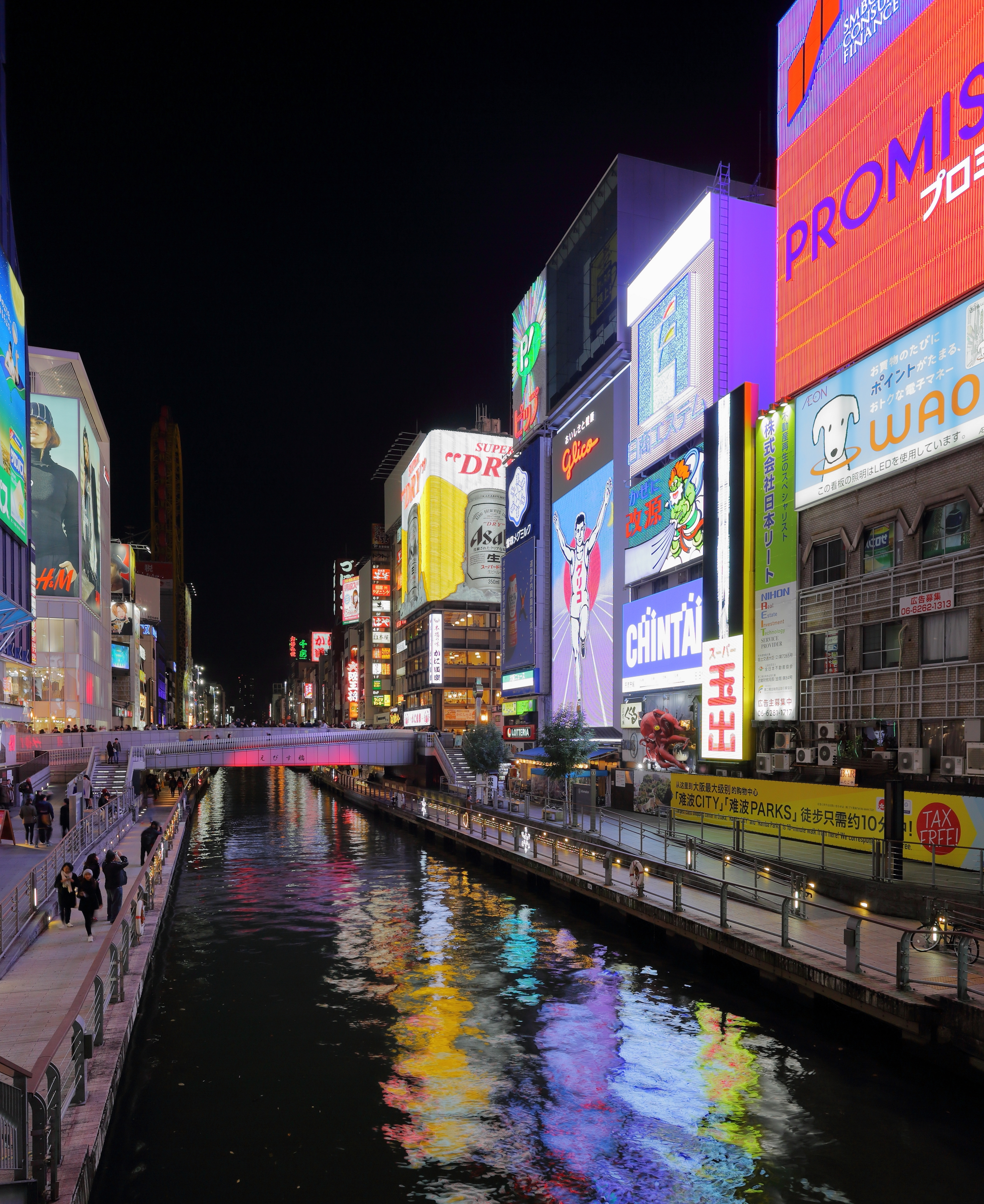
Wall of signboards at Ebisu Bridge on the Dōtonbori Canal, Osaka , Japan — CC BY-SA 4
Frequently Asked Questions About Osaka
Why is Osaka called the food capital of Japan?
Merchants ran the city for centuries while the country sent its rice and produce through its warehouses, earning it the name Tenka no Daidokoro, the Kitchen of the Nation. The street food of Dotonbori and Kuromon Market keeps that reputation alive today.
When is the best time to visit Osaka?
Late March brings cherry blossom to the castle park, and November brings clear skies and gold ginkgo leaves. Summer is hot and humid but full of festivals, while winter is mild and the crowds are thinner.
How do I get to Osaka from Tokyo?
The bullet train takes under three hours from Tokyo Station to Shin-Osaka Station. Flights from Haneda to Kansai International Airport take about an hour, plus the train into the city.
How many days do I need in Osaka?
Two days cover the castle, Dotonbori, the markets and the bay. A third day suits the aquarium or a day trip to Nara or Kobe, both less than an hour away by train.
Is Osaka Castle worth visiting?
The castle keep holds a museum of the city’s history, and the park around it is one of the best places in Kansai for cherry blossom. The stone walls and moats are impressive even for visitors who skip the museum.
What should I eat in Osaka?
Try takoyaki octopus balls, okonomiyaki pancakes cooked on a hot plate, and kushikatsu skewers dipped in sauce. Kuromon Market is the place to taste the fish and produce that supply the city’s kitchens.
Verified
- Osaka has a population of 2,816,247 people by the estimate of 1 October 2025, an area of 225.21 square kilometres, and a density of about 12,505 people per square kilometre. Checked 21 November 2026.
- The Keihanshin metropolitan region holds more than 19 million people, and Osaka is the third largest city in Japan after the 23 wards of Tokyo and Yokohama. Checked 21 November 2026.
- Osaka was known in the Edo period as Tenka no Daidokoro, the Kitchen of the Nation, and it began as the ancient port and capital of Naniwa. Checked 21 November 2026.
- Toyotomi Hideyoshi began Osaka Castle in 1583, the castle was destroyed in the summer siege of 1615, the Tokugawa rebuilt it in the 1620s, the keep burned after a lightning strike in 1665, and the present keep was built of reinforced concrete in 1931 and restored in 1995 to 1997. Checked 21 November 2026.
- Universal Studios Japan opened in 2001, and Kansai International Airport opened on an artificial island in the bay in 1994. Checked 21 November 2026.
- Osaka Castle Park covers about 105.6 hectares and holds about 3,000 cherry trees, and the castle keep is 55 metres tall. Checked 21 November 2026.
- The city hosted the World Expo in 1970, and the Tower of the Sun still stands in the Expo park north of the city. Checked 21 November 2026.
- Coordinates 34.6937/135.5021 and Wikidata Q35765 for Osaka were verified through the Wikidata API on 21 November 2026. Checked 21 November 2026.
Sources
- Wikipedia, Osaka — https://en.wikipedia.org/wiki/Osaka — for population, area, density, the Keihanshin region, the castle timeline and Universal Studios Japan.
- Japan Guide, Osaka Castle — https://www.japan-guide.com/e/e4005.html — for the castle history from 1583 to the restoration of 1995 to 1997.
- Osaka Convention and Tourism Bureau — https://www.osaka-info.jp/en/ — for Dotonbori, Kuromon Market and the bay district.
- Japan National Tourism Organization — https://www.japan.travel/en/destinations/kansai/osaka/ — for visitor information on districts, transport and seasons.
- Wikipedia, Kansai International Airport — https://en.wikipedia.org/wiki/Kansai_International_Airport — for the airport opening in 1994 on an artificial island.
Unverified
- Admission prices and opening hours for Osaka Castle, the aquarium and Universal Studios Japan were not checked against their official sites in this round, so no prices or hours are given.
- The year the Dotonbori canal was dug is often given as 1612, but it was not checked against a primary source in this round, so this article gives no year.
- The number of shops in Kuromon Market is given here as about 150, following the market’s own guides, and the count changes as shops open and close.
- Train times between Osaka and Kyoto, Nara and Kobe are given only as less than an hour, since the exact time depends on the service chosen.
Illustrations
- Hero: View of Osaka. Free image: https://upload.wikimedia.org/wikipedia/commons/9/98/Osaka_Japan_from_Kuchu_Teien_%28Floating_Garden%29_atop_Umeda_Sky_building_by_Don_Ramey_Logan.jpg — CC BY 4.0.
- In body, Osaka: Wall of signboards at Ebisu Bridge on the Dōtonbori Canal, Osaka , Japan. Free image: https://upload.wikimedia.org/wikipedia/commons/4/47/Dotonbori%2C_Osaka%2C_at_night%2C_November_2016.jpg — CC BY-SA 4.
- In body, Osaka: Little egret (Taken at Keitakuen .). Free image: https://upload.wikimedia.org/wikipedia/commons/4/44/Egretta_garzetta%2C_Keitakuen%2C_Osaka_II.jpg — CC BY-SA 4.