
Sapporo Clock Tower: The Oldest Building in the Snow City
Sapporo Clock Tower is the oldest building still standing in Sapporo. Its Boston clock has rung the hours since 12 August 1881.
The Clock Tower is smaller than many visitors expect, and some travellers joke that it is one of the most disappointing sights in Japan. Turn a corner in central Sapporo, between the office towers, and a modest two-storey wooden house appears, painted white with a red roof. Yet the Clock Tower is the oldest building in Sapporo, and the oldest clock tower in Japan, and inside it lies the story of a young farm school, American advisers, and a clock from Boston that has never stopped.
Quick Facts About the Sapporo Clock Tower
| Item | Detail |
|---|---|
| Name | Sapporo Clock Tower, in Japanese 札幌市時計台; officially the former Drill Hall of Sapporo Agricultural College |
| Location | Kita 1-jo Nishi 2-chome, Chuo Ward, Sapporo, Hokkaido, Japan |
| Coordinates | 43.0626° N, 141.3537° E |
| Completed | 16 October 1878, as the drill hall of Sapporo Agricultural College |
| Clock began | 12 August 1881, a clock by E. Howard and Company of Boston, United States |
| Architecture | Two-storey wooden house, American balloon-frame construction |
| Heritage | Important Cultural Property of Japan, 1970; Mechanical Engineering Heritage No. 32, 2009 |
| Hours | 8:45–17:10, last entry 17:00; closed on the fourth Monday of the month and at the year end |
| Admission | 200 yen for adults, free for high school pupils and younger |
| Time zone | Japan Standard Time, nine hours ahead of UTC |
| Money | Japanese yen |
| Wikidata | Q1140619, coordinates 43.0626/141.3537 |
Geography of the Sapporo Clock Tower
The Clock Tower stands at Kita 1-jo Nishi 2-chome, in the Chuo Ward, in the very centre of Sapporo, only a block north of Odori Park. The walk from the south exit of JR Sapporo Station takes about ten minutes to the south, and the walk from Odori subway station takes about five minutes. The wooden house sits among the modern offices and hotels, a white house from the 19th century standing between the glass and steel of the 21st.
Sapporo is the largest city on the island of Hokkaido, and it was planned from the start on a grid, with wide avenues and numbered blocks, so finding the way here is easier than in the old cities of Japan. The Clock Tower stands on the main axis that joins Sapporo Station to Odori Park, and almost every visitor who walks through the centre passes it. The tower is small, yet its place on the axis makes it the symbol of the city.
In winter, snow covers the red roof of the Clock Tower, and the image is one of the most familiar postcards of Sapporo. In summer, the small yard before the tower turns green, and visitors rest there after a walk in Odori Park. The building is modest, but its position in the middle of the city makes it irreplaceable, and the snow and the green give it a different face in every season.
Odori Park lies just south of the Clock Tower, a park more than a kilometre long that runs through the centre of Sapporo. The park holds the Snow Festival in February, when the whole park becomes a world of ice and snow, and the lilac festival in May, when the flowers open along the paths. The Clock Tower and the park belong together, because the walk from the station to the park passes the tower, and the tower is the gate of the park.
The climate of Sapporo shapes the Clock Tower more than any other building in this batch, because the city is the snow city of Japan. Winter brings deep snow and cold air, and the tower in the snow is the classic picture of Hokkaido, while summer brings clear skies and mild sun, and the white wood and red roof stand out against the blue. The tower is open through the year, and each season gives it a different photograph.
The streets around the Clock Tower are the streets of the modern centre, with offices, hotels and shops on every side, and the tower is the only wooden house among them. The contrast is the point of the place, because the tower shows what Sapporo looked like before the towers rose, and the towers show what the city became. A visitor who stands before the Clock Tower stands between two centuries of the same city.
The Clock Tower is a base for the centre of Sapporo, because its neighbours are the sights a visitor wants next. The television tower stands at the eastern end of Odori Park, with an observation deck over the city, and the old Hokkaido government building in red brick, the Akarenga, stands near the park. A walk from the station to the park passes the tower, the park, the television tower and the red brick building, and the whole centre fits into a single morning.
The grid of Sapporo makes the Clock Tower easy to find, because the avenues run straight and the blocks are numbered, and the tower stands on the first street north of the park. In February the Snow Festival fills Odori Park with snow sculptures, and the tower in the snow is the postcard of the festival, while in May the lilac festival fills the same park with flowers. A day trip from the tower can reach the hot springs of Jozankei, in the valley south of the city, where the snow of Sapporo melts into the baths.
History of the Sapporo Clock Tower
The history of the Clock Tower begins with a new city on a northern island, in the year 1868. The Meiji government chose Sapporo as the administrative centre of Hokkaido, an island that was then thinly settled and wild, and it invited American advisers to open the land. One of the first things the advisers did was to found Sapporo Agricultural College, which opened in 1876 and became the ancestor of Hokkaido University today.
The first vice-principal of the college was William Smith Clark, an educator from Massachusetts, and his short stay left a lasting mark. Clark spent less than a year in Sapporo, yet he proposed the drill hall where students would train in military drill and gymnastics, and his farewell words, Boys, be ambitious, are still remembered in the history of the college and the city. His successor, William Wheeler, sketched the design of the hall, and the chief engineer of the Hokkaido Development Commission, Kiko Adachi, designed the building and supervised its construction.
The drill hall was completed on 16 October 1878, and it was built by the balloon-frame method common in the American Midwest of the time. The ground floor held a laboratory and a specimen room, and the second floor held a wide hall for drill, ceremony and assembly. At first the roof carried only a small bell tower, and the building was a hall for training, not a place to tell the time.
Everything changed when Governor Kiyotaka Kuroda proposed fitting a large clock to the building, and in October 1878 Wheeler ordered a tower clock movement from E. Howard and Company in Boston. When the movement reached Sapporo in 1879, it proved too large for the old bell tower, so a larger clock tower had to be built in its place. The four-faced clock was finally installed in July 1881, and on 12 August 1881 its bells rang for the first time over the sky of Sapporo.
The clock of the Clock Tower is a pendulum-driven mechanical movement, serial number 738 from the Howard company, and it still runs on its original mechanism after more than 140 years. The clock is wound by hand twice a week, and its bells strike the hours, 156 strokes a day in total, and the people of Sapporo have heard those bells through generations. The Emperor Meiji visited Sapporo in 1881 and came to see the new tower, and the visit marked the tower as a place of the city.
The official name of the building is not Clock Tower at all, and the name the city uses is the one the clock gave it. The building is the former Drill Hall of Sapporo Agricultural College, a hall for drill and gymnastics, and the clock was only added three years after the hall was built. From the day the bells rang in 1881, the whole city called the building the Clock Tower, and the new name has stayed ever since.
In 1970 the building was recognised as an Important Cultural Property of Japan, and the clock movement was recognised as a part of it. In 2009 the Japan Society of Mechanical Engineers recognised the clock movement as Mechanical Engineering Heritage No. 32, and the honour marked the machine as well as the house. Today the Clock Tower is the oldest building in Sapporo and the oldest clock tower in Japan, and both titles rest on the same small wooden house.
Inside the Clock Tower today is a small museum about the history of Sapporo Agricultural College and the making of the city. The ground floor shows documents about the college, about Clark and about the first generations of students, and the second floor is the old hall, restored to the layout of the ceremony of 1899, when the first three students of the college received their doctorates. The second floor also shows a Howard tower clock made in 1928, from the same company as the clock on the tower, still running for visitors to watch its mechanism.

The Sapporo Campus of Hokkaido University in snow — CC BY 4
Travel to the Sapporo Clock Tower
The best time for the Clock Tower is the even hour, when the bells strike, and a visitor should stand before the tower at noon, when the bells ring twelve times. Winter is the finest season, when the tower stands in white snow and the Snow Festival fills Odori Park in February, and summer is the clearest season, when the white wood and red roof shine against the blue sky. The tower is small, and the bells are its event, so the hour matters more than the day.
Thirty to sixty minutes is enough for the Clock Tower, and the visit divides into two parts. Many visitors only stand outside to take a photograph and walk on, and that is a fair visit if time is short. Yet a ticket inside shows another Sapporo: the old photographs, the letters of Meiji-era students, and the clock movement more than a century old still ticking overhead. The second floor, with its wide wooden hall and light through the windows, is the quietest place in the noisy centre.
The hours of the Clock Tower run from 8:45 to 17:10, with last entry at 17:00, and admission costs 200 yen for adults and nothing for high school pupils and younger. The tower closes on the fourth Monday of the month, or the next day if Monday is a holiday, and from 29 December to 3 January. The hours and the closing days can change with maintenance, so the official site of the tower is the place to check before a visit. A combined ticket with the nearby Sapporo TV Tower costs about 100 yen less than the two tickets bought separately.
The way to the Clock Tower is the walk from JR Sapporo Station, about ten minutes south along Tokeidai-dori, or from Odori subway station, about five minutes. The tower stands on the walking line that joins the station to Odori Park, so it fits easily into a walk through the centre: begin at the station, stop at the Clock Tower, continue to Odori Park, the TV Tower and the old red brick government building. The whole route is walked, and the tower is its first stop.
The practical side of the Clock Tower is the side of its size, because the building is small and the museum is small. The ground floor holds the documents and the photographs, and the second floor holds the hall and the 1928 clock, and the visit is finished in an hour. A visitor who wants the tower at its best should come at noon for the bells, or in the snow of February for the photograph, and the tower rewards the visitor who times the visit.
Eating near the Clock Tower means the centre of Sapporo, and the streets around the tower hold restaurants and cafes of every kind. The soup curry of Sapporo, the ramen of the city and the seafood of Hokkaido are all sold within a few minutes of the tower, and the park nearby holds food stalls during the festivals. The tower itself serves no food, and the centre feeds the visitor who stops there.
Photography at the Clock Tower is the photography of the small house against the tall city, and the best shot comes from the yard before the tower, looking up at the white wood and the red roof. The snow of winter gives the tower its postcard, and the green of summer gives it its calm, and the bells at noon give the photograph its sound. The tower is the picture of Sapporo, and its smallness is the picture.
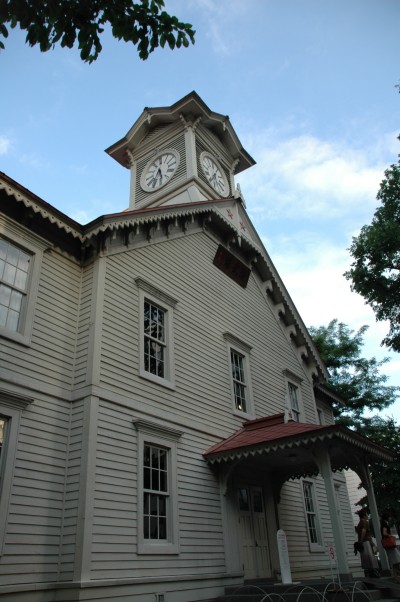
the Sapporo Clock Tower in Hokkaido — Public domain
Notable Places in the Sapporo Clock Tower
The Howard Clock of 1881
The Howard clock of 1881 is the heart of the Clock Tower, a pendulum-driven mechanical movement by E. Howard and Company of Boston, serial number 738. The clock still runs on its original mechanism, wound by hand twice a week, and its bells strike 156 times a day. The clock is the oldest working tower clock in Japan, and it is the reason the building has its name.
The Second-Floor Hall
The second-floor hall is the old drill and ceremony hall of the college, restored to the layout of the ceremony of 1899, when the first three students received their doctorates. The hall holds a wide wooden floor and tall windows that look over the street, and the light through the windows makes it the quietest room in the centre of Sapporo. The hall is the memory of the college, and its wood is its voice.
The First-Floor Museum
The first-floor museum holds the documents of Sapporo Agricultural College, of William Smith Clark and his words, Boys, be ambitious, and of the first generations of students. The museum tells the story of the college and the making of the city, through photographs, letters and records. The museum is the history of the Clock Tower, and its papers are its proof.
The Howard Clock of 1928
The Howard clock of 1928 is a tower clock movement from the same Boston company, displayed and running on the second floor for visitors to watch. The clock shows the mechanism at work, with its gears and its pendulum in motion, and it is the working lesson of the tower. The clock is the younger brother of the clock above, and it ticks beside the hall.
The White Wooden Front and Red Roof
The white wooden front and red roof of the Clock Tower are the rare American balloon-frame architecture left from the Meiji era, and the front is the photographed face of Sapporo. The house is two storeys high, modest beside the office towers, and its colours mark it from a street away. The front is the symbol of the city, and its wood is its age.
Odori Park
Odori Park is the park more than a kilometre long just south of the Clock Tower, and it holds the Snow Festival in February and the lilac festival in May. The park is the green centre of Sapporo, and the walk from the tower to the park takes a minute. The park is the neighbour of the Clock Tower, and its festivals are its seasons.
The Sapporo TV Tower
The Sapporo TV Tower stands at the eastern end of Odori Park, with an observation deck over the city, and it is the tall neighbour of the small Clock Tower. A combined ticket with the Clock Tower costs about 100 yen less than the two tickets apart, and the pair shows the city from the ground and from the air. The TV Tower is the height of Sapporo, and the Clock Tower is its age.
The Old Hokkaido Government Building
The old Hokkaido government building, the Akarenga, stands near Odori Park in red brick, and it is another Meiji-era monument worth visiting with the Clock Tower. The building holds the history of the government of Hokkaido, and its red brick is the contrast to the white wood of the tower. The Akarenga is the government of the old city, and the Clock Tower is its college.

the Sapporo Clock Tower — CC0

Odori Park in Sapporo — CC BY 4

The Sapporo TV Tower over Odori Park — CC BY-SA 3

The Former Hokkaido Government Office Building, the Red Brick Office — CC BY 4

The Sapporo Snow Festival in Odori Park — CC BY 2.5

The Clock Tower at night in winter snow — CC BY 4

The clock face of the Sapporo Clock Tower — CC BY-SA 3
Frequently Asked Questions About the Sapporo Clock Tower
When was the Sapporo Clock Tower built?
The building was completed on 16 October 1878 as the drill hall of Sapporo Agricultural College, the ancestor of Hokkaido University. The clock was added later and began to run on 12 August 1881.
Why is a drill hall called a clock tower?
At first the roof held only a small bell tower. In 1878 Governor Kuroda Kiyotaka proposed a large clock, and the movement from E. Howard and Company in Boston arrived in 1879 but was too large, so the tower was rebuilt. From the day the bells rang in 1881, the city called the building the Clock Tower.
Is the Sapporo Clock Tower the oldest clock tower in Japan?
Yes. It is the oldest clock tower still standing in Japan, and the oldest building still standing in Sapporo, recognised as an Important Cultural Property since 1970.
How much is admission to the Sapporo Clock Tower?
Admission costs 200 yen for adults and is free for high school pupils and younger. Check the current price on the official site before a visit.
What are the hours of the Sapporo Clock Tower?
The Clock Tower usually opens from 8:45 to 17:10, with last entry at 17:00, and closes on the fourth Monday of the month and from 29 December to 3 January. The schedule can change, so check the official site.
How long does a visit to the Clock Tower take, and is it worth going inside?
Thirty to sixty minutes is enough. A photograph outside is fine, but inside you see the museum of Sapporo Agricultural College, the second-floor hall restored to 1899, and a clock movement more than 140 years old still running.
Verified
- The Sapporo Clock Tower was completed on 16 October 1878 as the drill hall of Sapporo Agricultural College, the ancestor of Hokkaido University. Checked 21 November 2026.
- The clock of the Clock Tower was ordered in October 1878 from E. Howard and Company of Boston, arrived in 1879 too large for the old bell tower, and began to run on 12 August 1881. Checked 21 November 2026.
- The clock is a pendulum-driven mechanical movement, serial number 738, still running on its original mechanism, wound by hand twice a week, striking 156 times a day. Checked 21 November 2026.
- Sapporo Agricultural College opened in 1876, and William Smith Clark was its first vice-principal. Checked 21 November 2026.
- The Clock Tower was recognised as an Important Cultural Property of Japan in 1970, and its clock movement was recognised as Mechanical Engineering Heritage No. 32 in 2009. Checked 21 November 2026.
- The Clock Tower opens from 8:45 to 17:10, with last entry at 17:00, and charges 200 yen for adults. Checked 21 November 2026.
- The Clock Tower is the oldest building still standing in Sapporo and the oldest clock tower in Japan. Checked 21 November 2026.
- Coordinates 43.0626/141.3537 and Wikidata Q1140619 for the Sapporo Clock Tower were verified through the Wikidata API on 21 November 2026. Checked 21 November 2026.
Sources
- Wikipedia, Sapporo Clock Tower — https://en.wikipedia.org/wiki/Sapporo_Clock_Tower — for the building, the clock and the history.
- Sapporo Clock Tower, official site — http://sapporoshi-tokeidai.jp/ — for the tower, its hours and its admission.
- Sapporo Station, Sapporo Clock Tower — https://www.sapporostation.com/sapporo-clock-tower-sapporo-tokeidai/ — for the completion date, the clock and the heritage listings.
- Japan National Tourism Organization, Sapporo — https://www.japan.travel/en/ — for travel information on Sapporo and Odori Park.
- Trip to Japan, Sapporo Clock Tower — https://www.triptojapan.com/places/sapporo-clock-tower/OT-8ch3vQYKmvfTuNOwYiw — for the college, the clock and the visit.
Unverified
- Ticket prices and opening hours on the official site of the Clock Tower could not be read directly, since the official site uses much JavaScript, so the article uses figures from several independent travel sources that agree with each other.
- The claim that the building was moved about 100 metres in 1906 when the streets were widened appears in only one aggregate source and could not be checked, so the article gives no detail on it.
- The combined ticket with the Sapporo TV Tower, said to cost about 100 yen less than the two tickets apart, rests on a single travel source and could not be checked on the official sites of the two towers.
- The words Boys, be ambitious, attributed to William Smith Clark, are recorded in many sources, yet the article does not quote them from an original document.
- The exact number of bell strokes per day, 156, is given by aggregate sources, and the article records it as the figure those sources give.
Illustrations
- Hero: the Sapporo Clock Tower. Free image: https://upload.wikimedia.org/wikipedia/commons/4/42/Sapporo-Clock-Tower-2018.jpg — CC BY-SA 4.
- In body, the tower: the Sapporo Clock Tower. Free image: https://upload.wikimedia.org/wikipedia/commons/e/ea/Sapporo_Clock_Tower_130.JPG — CC0.
- In body, the tower: the Sapporo Clock Tower in Hokkaido. Free image: https://upload.wikimedia.org/wikipedia/commons/6/6b/Sapporo_Clock_Tower_Hokkaido_Japan.jpg — Public domain.
- In body, Odori Park: Odori Park in Sapporo. Free image: https://upload.wikimedia.org/wikipedia/commons/0/0a/20240923_Sapporo_Odori_Park.jpg — ノボホショコロトソ, CC BY 4.
- In body, The Sapporo TV Tower: The Sapporo TV Tower over Odori Park. Free image: https://upload.wikimedia.org/wikipedia/commons/3/3a/Sapporo_TV_Tower_and_Odori_park.JPG — Qiuqizhenghong, CC BY-SA 3.
- In body, The Old Hokkaido Government Building: The Former Hokkaido Government Office Building, the Red Brick Office. Free image: https://upload.wikimedia.org/wikipedia/commons/0/09/Former_Hokkaido_Government_Office_Building_%28Red_Brick_Office%29.jpg — MIKI Yoshihito, CC BY 4.
- In body, The Sapporo Snow Festival: The Sapporo Snow Festival in Odori Park. Free image: https://upload.wikimedia.org/wikipedia/commons/4/4a/Odori_Park_Sapporo_Snow_Festival_2007.JPG — Eckhard Pecher, CC BY 2.5.
- In body, Hokkaido University: The Sapporo Campus of Hokkaido University in snow. Free image: https://upload.wikimedia.org/wikipedia/commons/1/18/Snow_in_Sapporo_Campus%2C_Hokkaido_University_07.jpg — ノボホショコロトソ, CC BY 4.
- In body, The White Wooden Front and Red Roof: The Clock Tower at night in winter snow. Free image: https://upload.wikimedia.org/wikipedia/commons/c/ce/Sapporo_Clock_Tower_%E6%9C%AD%E5%B9%8C%E5%B8%82%E6%99%82%E8%A8%88%E5%8F%B0_01.jpg — ノボホショコロトソ, CC BY 4.
- In body, The Howard Clock of 1881: The clock face of the Sapporo Clock Tower. Free image: https://upload.wikimedia.org/wikipedia/commons/a/a6/Sapporo_Tokeidai.JPG — aokomoriuta, CC BY-SA 3.