
Ananda Temple, Bagan
The Ananda Temple is the most beautiful temple of Bagan, in central Myanmar. It stands east of Old Bagan, near Tharabar Gate, on the Ayeyarwady plain.
The Ananda Temple was built in about 1090 to 1105, under King Kyansittha of the Pagan dynasty, and it is one of the largest and best-preserved temples of Bagan. The Ananda Temple is 51 m high, with a central square block 53 m on each side and a total length of 88 m, and it holds four standing Buddhas, each 9.5 m high, facing the four directions. The people of Myanmar say that the tallest temple is Thatbyinnyu, the largest is Dhammayangyi, and the most beautiful is Ananda, and the Ananda Temple is the temple that visitors remember best.
Quick Facts
| Item | Detail |
|---|---|
| Name | Ananda Temple (in Burmese, Ananda Pahto) |
| Location | East of Old Bagan, near the Tharabar Gate, Mandalay Region, central Myanmar, beside the Ayeyarwady River |
| Type | Buddhist temple of the Pagan dynasty |
| Built | About 1090 to 1105, under King Kyansittha (reigned 1084 to 1112/13) |
| Height | 51 m; central square block 53 m on each side; total length 88 m |
| Coordinates | 21.1709 N, 94.8677 E |
| Wikidata | Q485727, Ananda Temple, a Buddhist temple in Myanmar |
| UNESCO | Part of Bagan, listed in 2019, reference 1588, criteria (iii), (iv) and (vi) |
| Highlights | Four standing Buddhas, 554 Jataka glazed tiles, the Ananda festival, the gilded spire |
| Best season | October to February, the cool dry months |
| Currency | Myanmar kyat (MMK) |
| Time zone | UTC+6:30 |
The Ananda Temple stands on the plain of Bagan, in the dry zone of central Myanmar, where the Ayeyarwady River bends around the old capital. The plain is flat and dry, with scrub, palms and fields, and it holds more than 2,000 temples, stupas and monasteries, spread across the land between the river and the hills. The Ananda Temple is one of the great temples of the plain, and its gilded spire can be seen from far across the fields.
The temple stands east of Old Bagan, near the Tharabar Gate, the old gate of the city, and it is reached by a road from the town of Nyaung-U. The Ananda Temple is a place of worship as well as a monument, and it is one of the few temples of Bagan that is still in daily use, with monks, worshippers and festivals through the year. The temple is the centre of the religious life of Bagan, and its festival, at the full moon of Pyatho, draws thousands of people to the plain.
Geography
The Ananda Temple stands on the plain of Bagan, in the dry zone of central Myanmar, where the Ayeyarwady River runs from north to south. The plain is flat, and the land is dry and dusty, with scrub, palms and fields of sesame and beans, and the river is the green line that runs through it. The Ananda Temple is built on the plain, east of Old Bagan, and its spire rises above the trees, so that it can be seen from the river and from the roads of the plain.
Bagan lies in the rain shadow of the Rakhine mountains, and it is one of the driest places in Myanmar, with little rain and long, hot summers. The dry season, from October to February, is the best time to visit the Ananda Temple, with cool mornings and clear skies, and the temple is at its best in the early morning, when the light is low and the plain is quiet. The hot season, from March to May, brings temperatures above 40 degrees, and the plain is harsh then, with dust and heat, while the rains, from May to October, bring green to the fields and clouds to the sky.
The Ananda Temple is built of brick, covered with stucco, and its form is a square, with a central block and four porches, one on each side. The central block is 53 m on each side, and the total length of the temple is 88 m, and the spire rises 51 m above the plain. The four porches open to the four directions, and each porch holds a standing Buddha, so that the temple is a place of worship from every side. The walls of the Ananda Temple are lined with niches and with glazed tiles, and the roof is a series of terraces that rise to the spire.
The plain around the Ananda Temple is dotted with other temples, and the temple is part of a landscape of more than 2,000 monuments. The nearest great temples are Thatbyinnyu, the tallest temple of Bagan, and Dhammayangyi, the largest, and the three together are the great temples of the plain. The Ananda Temple is the most beautiful of the three, and it is the one that the people of Bagan love best, because it is a living temple, with monks and worshippers and festivals, and not only a ruin.
The light of the plain is the light that the builders of the temple worked with. In the morning the sun rises over the river, and the brick of the temple turns gold, and the spire catches the first light. At midday the plain is white and harsh, and the temple is a place of shade, with its dark corridors and cool halls.
In the evening the sun sets over the river, and the plain turns red, and the spire stands dark against the sky. The temple was built to be seen in that light, and it is still best seen at the two ends of the day.

The Ananda Temple in Bagan, Myanmar — CC BY-SA 4
History
The Ananda Temple was built in about 1090 to 1105, under King Kyansittha, who reigned from 1084 to 1112/13, and who was one of the great kings of the Pagan dynasty. Kyansittha was a builder of temples, and he built the Ananda Temple as a monument to the Theravada Buddhism that he had made the religion of his kingdom. The temple was built in the early years of the Pagan empire, when Bagan was the capital of a kingdom that ruled the whole of the Ayeyarwady valley, and the Ananda Temple was one of the first great temples of that empire.
The legend of the Ananda Temple tells of eight monks who came to Bagan from the Nandamula cave, in the Himalayas, and who described the cave to King Kyansittha. The king was so moved by their account that he built the Ananda Temple as a copy of the cave, with a cool, dark interior and a central image of the Buddha. The legend is a story, not a history, but it is the story that the people of Bagan tell about the temple, and it is the reason the Ananda Temple is called the cave temple.
The Ananda Temple holds four standing Buddhas, each 9.5 m high, on a pedestal 2.4 m high, facing the four directions. Kakusandha faces north, Konagamana faces east, Kassapa faces south, and Gautama faces west, and the four Buddhas are the Buddhas of the present age, who have come to teach the world. The Buddhas of the north and the south are the original images, carved in the 12th century, while the Buddhas of the east and the west were remade in later centuries. The faces of the Buddhas change with the light: from a distance the face of the Buddha seems to smile, and from close up it seems solemn, and the change is the work of the carvers, who shaped the faces to be seen from below.
The walls of the Ananda Temple are lined with 554 glazed tiles, each one showing a scene from the Jataka tales, the stories of the former lives of the Buddha. The tiles run in rows along the corridors, and they are a picture book of the Buddhist world, with kings, animals, merchants and monks in every tile. The tiles are among the finest of Bagan, and they are the reason the Ananda Temple is a place of learning as well as worship.
The Ananda Temple was damaged by an earthquake in 1975, and it was damaged again by the earthquake of 2016, which harmed more than 400 structures in Bagan. The temple was restored after both earthquakes, and its spire was regilded, and the Ananda Temple stands today as one of the best-preserved temples of Bagan. In March 2025 an earthquake struck central Myanmar, and the temples of Bagan were checked, and the Htilominlo and Shwezigon temples were found to have no structural damage.
In 2019 UNESCO listed Bagan as a World Heritage site, on 6 July 2019, at the 43rd session, reference 1588, criteria (iii), (iv) and (vi), and the Ananda Temple was listed as part of that property, with no reference of its own. The listing covers eight components, with 3,595 recorded monuments, over 5,005 ha, and the Ananda Temple is one of the great monuments of the property. The listing is a recognition of Bagan as a sacred landscape of Theravada Buddhism, and the Ananda Temple is the most beautiful temple in that landscape.
Timeline
- 1084 to 1112/13: the reign of King Kyansittha, who builds the Ananda Temple.
- About 1090 to 1105: the Ananda Temple is built, east of Old Bagan.
- 12th century: the Buddhas of the north and the south are carved, and the Jataka tiles are set in the walls.
- 13th century: the building of temples in Bagan reaches its peak, and the plain holds thousands of monuments.
- 1975: an earthquake damages the Ananda Temple.
- 2016: an earthquake damages more than 400 structures in Bagan, including the Ananda Temple.
- 6 July 2019: UNESCO lists Bagan as a World Heritage site, reference 1588, with the Ananda Temple as part of the property.
- March 2025: an earthquake strikes central Myanmar, and the temples of Bagan are checked for damage.
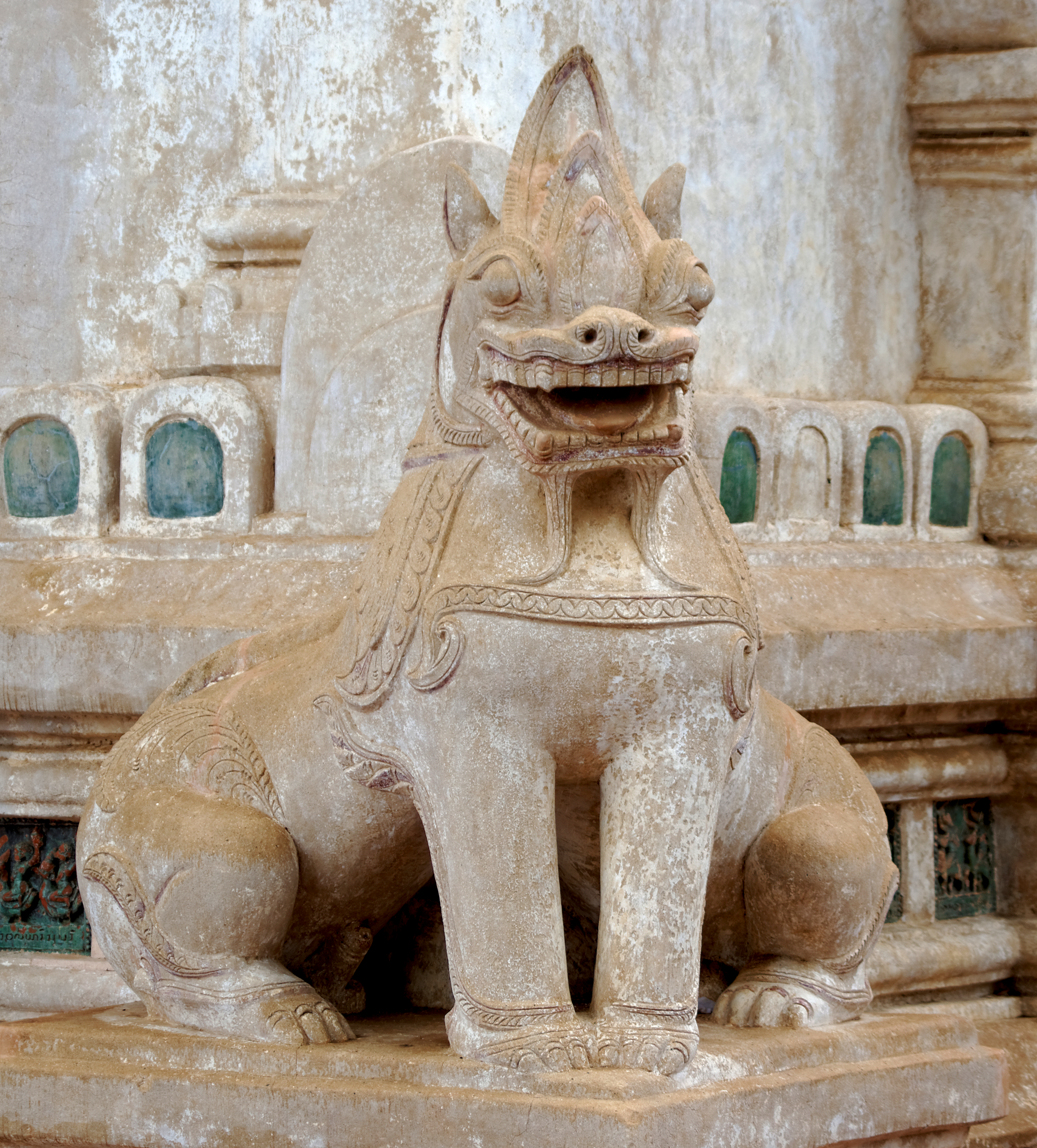
A chinthe sculpture at the Ananda Temple in Bagan, Myanmar — CC BY-SA 4
Travel
Plan the Ananda Temple for the dry-season window that opens in October and closes in February. Dawn is the hour to be there, with the plain still and the brick catching the first sun, and dusk is the second good hour, when the gold light returns. From March the heat builds past 40 degrees and the plain turns harsh, and from May the monsoon greens the fields and clouds the sky, so the temple is quieter then but the paths are soft.
The Ananda Temple is reached by road from Nyaung-U, the town beside Bagan, and by bicycle, horse cart or car across the plain. Most visitors fly first to Yangon, the gateway city of Myanmar, and then on to Bagan. The temple is open through the day, and it is a place of worship, so dress modestly, remove your shoes before entering, and keep quiet in the halls. The four Buddhas are the heart of the visit, and the corridors with the Jataka tiles are the second great sight, and the terraces of the roof give a view across the plain.
The great festival of Bagan falls on the full moon of Pyatho, in December to January, at the Ananda Temple. For three days about a thousand monks chant, and the plain fills with pilgrims, food stalls, music and markets, so the temple is at its loudest and most crowded then. The festival is the best time to see the Ananda Temple as a living temple, and it is also the busiest time, so come early in the morning if you want to see the temple quietly.
The plain of Bagan is large, and the Ananda Temple is one stop on a day of temples. Combine it with Thatbyinnyu, the tallest temple, and Dhammayangyi, the largest, and with the sunset over the plain, which is one of the great sights of Myanmar. The town of Nyaung-U holds the hotels and restaurants of Bagan, and the plain is best seen by bicycle, with the temples spread across the fields.
Notable Places
The four standing Buddhas are the great sight of the Ananda Temple, one in each porch, looking out to the four points of the compass. Kakusandha looks north, Konagamana east, Kassapa south and Gautama west, each figure 9.5 m tall on a 2.4 m base. The northern and southern figures are the 12th-century originals, and their carved faces seem to smile from afar and grow solemn as you draw near.
The 554 Jataka tiles of the Ananda Temple run in rows along the corridors, and they show the stories of the former lives of the Buddha, with kings, animals, merchants and monks in every tile. The tiles are glazed, with green, yellow and brown colours, and they are among the finest of Bagan. The corridors of the Ananda Temple are dark and cool, and the tiles are the light in them, and a slow walk along the corridors is the best way to see the temple.
The spire of the Ananda Temple rises 51 m above the plain, and it is gilded, so that it catches the sun and can be seen from far across the fields. The spire is the crown of the temple, and it is the reason the Ananda Temple is the most beautiful temple of Bagan. The terraces of the roof rise to the spire, and they give a view across the plain, to the other temples and to the Ayeyarwady River.
Bagan is the plain that holds the Ananda Temple, and Myanmar is the country of the Pagan kings. The Ananda Temple is the most beautiful temple of Bagan, and it is the temple that visitors remember best, because it is a living temple, with monks and worshippers and festivals, and not only a ruin.
Frequently Asked Questions
When was the Ananda Temple built?
The Ananda Temple was built in about 1090 to 1105, under King Kyansittha, who reigned from 1084 to 1112/13. It is one of the first great temples of the Pagan dynasty, and it is one of the largest and best-preserved temples of Bagan.
What are the four Buddhas of the Ananda Temple?
The four Buddhas stand in the porches of the Ananda Temple, each one 9.5 m high on a 2.4 m pedestal, facing the four directions. Kakusandha faces north, Konagamana faces east, Kassapa faces south, and Gautama faces west. The Buddhas of the north and the south are the original images, carved in the 12th century.
Is the Ananda Temple a UNESCO World Heritage site?
The Ananda Temple has no UNESCO title of its own, but it is part of Bagan, listed by UNESCO on 6 July 2019, reference 1588, criteria (iii), (iv) and (vi). The listing covers eight components, with 3,595 recorded monuments, and the Ananda Temple is one of the great monuments of the property.
When is the Ananda Temple festival?
The festival of the Ananda Temple is held at the full moon of Pyatho, in December to January, and it is the great festival of Bagan. About a thousand monks chant for three days, and thousands of people come to the plain, with food, music and markets, and the temple is crowded and loud.
What are the Jataka tiles of the Ananda Temple?
The Ananda Temple holds 554 glazed tiles, each one showing a scene from the Jataka tales, the stories of the former lives of the Buddha. The tiles run in rows along the corridors of the temple, and they are among the finest of Bagan.
When is the best time to visit the Ananda Temple?
October to February is the season to choose, when the plain is dry, the mornings are cool and the sky stays clear for the balloons. The heat peaks from March to May, past 40 degrees, and the monsoon months from May to October bring rain and green fields instead of crowds.
Verified
- Ananda Temple facts in this article were checked on 20 November 2026 against the verified Vietnamese article for the Ananda Temple and the official UNESCO list page for Bagan, reference 1588, at https://whc.unesco.org/en/list/1588/, which records the serial property of eight components, with 3,595 recorded monuments, and the listing under criteria (iii), (iv) and (vi).
- The Ananda Temple was built in about 1090 to 1105 under King Kyansittha, who reigned from 1084 to 1112/13, and it is 51 m high, with a central square block 53 m on each side and a total length of 88 m, as recorded in the verified Vietnamese article for the Ananda Temple.
- The Ananda Temple holds four standing Buddhas, each 9.5 m high, on a pedestal 2.4 m high, with Kakusandha facing north, Konagamana facing east, Kassapa facing south, and Gautama facing west, and it holds 554 Jataka glazed tiles, as recorded in the verified Vietnamese article for the Ananda Temple.
- Bagan was listed by UNESCO on 6 July 2019, at the 43rd session, reference 1588, criteria (iii), (iv) and (vi), over 5,005 ha, and the earthquake of 2016 damaged more than 400 structures in Bagan, as recorded in the verified Vietnamese article for the Ananda Temple.
- The Wikidata record Q485727 gives Ananda Temple, with coordinates 21.170903 and 94.867713, matching the registry.
Sources
- UNESCO, Bagan, official list page: https://whc.unesco.org/en/list/1588/
- Wikipedia, Ananda Temple: https://en.wikipedia.org/wiki/Ananda_Temple
- TheTerraAtlas Vietnamese article for the Ananda Temple (ananda-temple.vi.md), facts verified in that article with sources and check dates.
Unverified
- The legend of the eight monks and the Nandamula cave is a story told about the Ananda Temple, not a proven history, and it is given here as a legend.
- The exact years of the building of the Ananda Temple, about 1090 to 1105, follow the sources cited in the Vietnamese article, and other sources give 1105 alone.
- The claim that the faces of the Buddhas change with the light, seeming to smile from a distance and solemn from close up, is a traditional account of the carving, not a measured fact.
- The earthquake of March 2025 in central Myanmar, and the finding that the Htilominlo and Shwezigon temples had no structural damage, follow the sources cited in the Vietnamese article.
- The registry records this entity with no UNESCO title of its own; whether the registry should mark it as part of the Bagan property is a question for the fix queue, not a fact stated in this article.
Illustrations
- Hero: Ananda Temple, Bagan. Free image: https://upload.wikimedia.org/wikipedia/commons/4/4a/20160801_Ananda_Temple_Bagan_Myanmar_6687.jpg — CC BY-SA 4.0.
- In body, chinthe sculpture: A chinthe sculpture at the Ananda Temple in Bagan, Myanmar. Free image: https://upload.wikimedia.org/wikipedia/commons/a/ae/20160731_Ananda_Temple_Bagan_Myanmar_6282.jpg — CC BY-SA 4.
- In body, ananda Temple: The Ananda Temple in Bagan, Myanmar. Free image: https://upload.wikimedia.org/wikipedia/commons/a/af/20160801_Ananda_Temple_Bagan_Myanmar_6682.jpg — CC BY-SA 4.