
Maya Bay Phi Phi Island: A Sheltered Cove on Ko Phi Phi Leh
Maya Bay Phi Phi Island is a sheltered cove on Ko Phi Phi Leh in southern Thailand. Its white sand and tall cliffs draw boats from across the Andaman Sea.
Quick Facts: Maya Bay Phi Phi Island
- Location: Ko Phi Phi Leh, in the Phi Phi Islands, Krabi Province, southern Thailand.
- Coordinates: 7.67688° N, 98.76617° E.
- Wikidata: Q13024284.
- Setting: A bay enclosed by limestone cliffs on the uninhabited island of Ko Phi Phi Leh.
- National park: Hat Noppharat Thara–Mu Ko Phi Phi National Park.
- Parent islands: Phi Phi Islands.
- Province: Krabi.
- Country: Thailand.
- Famous film: “The Beach” (2000), directed by Danny Boyle, filmed at Maya Bay in 1999.
- Swimming: Not allowed in the bay under current rules.
- Seasonal closure: Closed from 1 August to 30 September each year.
- Focus keyword: maya bay phi phi island.
Geography of Maya Bay Phi Phi Island
A Cove Enclosed by Limestone
Maya Bay Phi Phi Island sits on the western side of Ko Phi Phi Leh, the smaller and uninhabited of the two main Phi Phi Islands. The bay curves between steep limestone cliffs that rise directly from the water, leaving only a narrow opening to the Andaman Sea. That enclosure gives the water its calm surface on most days, and it gives the beach its sense of shelter from the open sea beyond the cliffs.
The sand is pale and fine, and the water shifts from turquoise near the shore to deeper blue further out. Coral reefs lie beneath the surface, and the bay’s shelter has allowed marine life to recover in recent years. The cliffs themselves are covered in places with vegetation that clings to the rock, and their shadows move across the sand as the sun travels. Visitors who arrive in the morning see the cliffs lit from one side, while afternoon light fills the bay more evenly.
The length of the beach is often estimated at about 250 metres, and the cliffs are often described as rising close to 100 metres, but neither figure has been checked against an official survey for this article. The impression of scale does not depend on exact numbers: the cliffs feel tall because they rise without a break from the water’s edge, and the beach feels small because the cliffs close around it. That sense of enclosure is the bay’s defining geographic feature, and it explains why photographs of Maya Bay Phi Phi Island look so different from photographs of open beaches.
Ko Phi Phi Leh and the Phi Phi Islands
Ko Phi Phi Leh lies a short boat ride south of Ko Phi Phi Leh’s inhabited neighbour, Ko Phi Phi Don, where most visitors sleep and eat. The two islands belong to the same archipelago, and they share the same limestone geology that shapes the whole coast of Krabi Province. The islands rose from the sea as limestone formations, and the sea then carved them into cliffs, caves and coves over a long period. Maya Bay Phi Phi Island is the most famous result of that carving, but it is not the only one: the coast of Ko Phi Phi Leh holds other bays and caves that boats pass on the way.
The bay’s position matters for access as well as for scenery. Boats no longer land directly in Maya Bay Phi Phi Island. Instead they land at Loh Samah Bay, on the other side of the island, and visitors walk across the island for about five minutes to reach Maya Bay.
The walk passes through vegetation and over a low rise, and the bay appears suddenly at the end of the path. That short crossing separates the arrival from the beach itself, and it gives the visit a sense of entering a protected place rather than simply stepping off a boat.
The Andaman Sea around the Phi Phi Islands is warm for most of the year, and the sea conditions change with the monsoon seasons. The dry season brings calmer water and clearer skies, while the wet season brings rougher seas and heavier rain. Boat operators adjust their schedules to the weather, and trips can be cancelled when the sea is too rough. Visitors planning a trip to Maya Bay Phi Phi Island should therefore treat the weather as part of the geography, not as a separate concern.
The Reef and the Recovery of Marine Life
The reef in Maya Bay Phi Phi Island is a living part of the bay’s geography, not only a backdrop for photographs. Coral grows in the shallow water, and fish, rays and reef sharks move through the bay. The most widely reported sign of recovery is the return of blacktip reef sharks, which were counted in a 2021 survey that recorded 161 individuals. The sharks use the shallow water as a nursery, and their presence shows that the bay’s ecosystem can recover when human pressure is reduced.
That recovery depends on the rules that now govern the bay. Swimming is not allowed, so visitors wade only up to their knees in the water. Boats do not anchor in the bay itself, and the number of visitors at any one time is limited.
These rules protect the coral and the young sharks, and they also change the character of a visit: Maya Bay Phi Phi Island is now a place to look at and walk through, rather than a place to swim and play in the water. The change disappoints some visitors, but it is the reason the reef and the sharks have returned.
Single-use plastic is banned in Thailand’s national parks, and that ban has applied in the parks since April 2022, with the formal date given as 6 April 2022. Visitors should therefore carry water in a reusable bottle and take all rubbish away with them. Sunscreen also matters here: sunscreens containing oxybenzone, octinoxate, 4MBC and butylparaben have been banned in Thailand’s national parks since 4 August 2021, with fines of up to 100,000 baht reported. Reef-safe sunscreen, or covering up with clothing, is the safer choice for both the visitor and the reef.

A coastal view of the world-famous Maya Bay on Ko Phi Phi Le island — CC BY-SA 4
History of Maya Bay Phi Phi Island
Before the Film
Long before Maya Bay Phi Phi Island became famous, Ko Phi Phi Leh was an uninhabited island known mainly to fishermen and to the people of Ko Phi Phi Don. The bay had no permanent settlement, no restaurants and no hotels, and its value lay in its fish, its shelter and its beauty rather than in tourism. The island’s caves held swiftlet nests, which were harvested for bird’s nest soup, and the surrounding sea provided fish for the communities of the archipelago. The bay itself was a quiet place, visited by boats that sheltered there rather than by crowds seeking a beach.
The Phi Phi Islands as a whole began to attract travellers in the late twentieth century, as Thailand’s southern coast opened to international tourism. Ko Phi Phi Don developed first, with guesthouses, restaurants and dive shops, while Ko Phi Phi Leh remained a day-trip destination. Maya Bay Phi Phi Island was already known to divers and boat operators, but it was one stop among several on a tour of the islands, not yet the main reason for the trip. That balance changed in a single year, when a film crew arrived.
“The Beach” and the Rush That Followed
In 1999, the film “The Beach,” directed by Danny Boyle, was filmed at Maya Bay Phi Phi Island, and the film was released in 2000. The story showed a hidden paradise beach, and the bay’s enclosed shape matched the film’s image of a secret cove almost exactly. Audiences around the world saw the white sand and the cliffs on screen, and many of them wanted to see the place for themselves. The bay’s name spread far beyond Thailand, and the number of visitors rose sharply.
By 2017, the bay was receiving nearly 5,000 visitors a day at its peak, a figure that shows how completely the film had changed the place. Boats crowded the bay, swimmers filled the water, and the beach itself was trampled by thousands of feet each day. The coral suffered, the sand eroded, and the marine life that had made the bay attractive began to disappear. The very popularity that the film created was destroying the place the film had celebrated, and the authorities faced a choice between the income from tourism and the survival of the bay.
The rush also changed Ko Phi Phi Don, where hotels, restaurants and tour operators grew to serve the crowds heading to Maya Bay Phi Phi Island. The island’s economy came to depend on the bay, and any decision to limit access would affect livelihoods across the archipelago. That tension between conservation and income has shaped every decision about the bay since, and it explains why the rules that followed were both strict and carefully negotiated.
Closure, Recovery and Reopening
On 1 June 2018, the Thai authorities closed Maya Bay Phi Phi Island to visitors. The closure was presented as a chance for the bay to recover, and the first months showed how quickly nature responds when pressure is removed. Vegetation returned to the beach, the sand stabilized, and marine life began to reappear in the shallow water. The survey in 2021 that counted 161 blacktip reef sharks gave the clearest evidence of that recovery, since the sharks had been rare during the years of heavy tourism.
The closure lasted far longer than first announced, and the bay did not reopen until 1 January 2022. When it reopened, the rules were different from before. Swimming was banned, and boats landed at Loh Samah Bay instead of in Maya Bay itself.
The number of visitors was limited to 375 people per visit, with 11 visits each day between 7 a.m. and 6 p.m., each visit lasting one hour. These figures come from aggregate sources based on National Parks Department announcements, and the park can adjust them by season, so visitors should check the current rules before travelling.
The reopening also brought a new rhythm to the bay. Visitors now arrive in timed groups, walk across the island, spend an hour on the beach, and leave by the same path. The hour passes quickly, and the limit changes the experience: instead of a long, unstructured day on the sand, the visit becomes a short, focused encounter with the place. Some visitors find the limit frustrating, while others find that it sharpens their attention, since they know they have only an hour to look, photograph and remember.
The Seasonal Closure and the Future
Maya Bay Phi Phi Island now closes each year from 1 August to 30 September, giving the bay two months of rest during the wet season. The closure follows the same logic as the long closure of 2018 to 2022: the bay recovers faster when it is left alone, and the wet season is the natural time to rest, since the sea is rougher and fewer visitors come anyway. The bay reopened on 1 October 2026 after the most recent seasonal closure, and the same pattern is expected to continue in future years.
The future of Maya Bay Phi Phi Island depends on whether the new rules can hold. The demand to visit remains high, and the pressure to admit more people, allow swimming again, or shorten the closure will return whenever the bay looks healthy. The experience of 2018 to 2022 shows what happens when that pressure wins, and the experience since 2022 shows what happens when it is resisted. The bay’s history is therefore not only a story about a film and a beach, but a test case for how Thailand manages its most famous natural places.
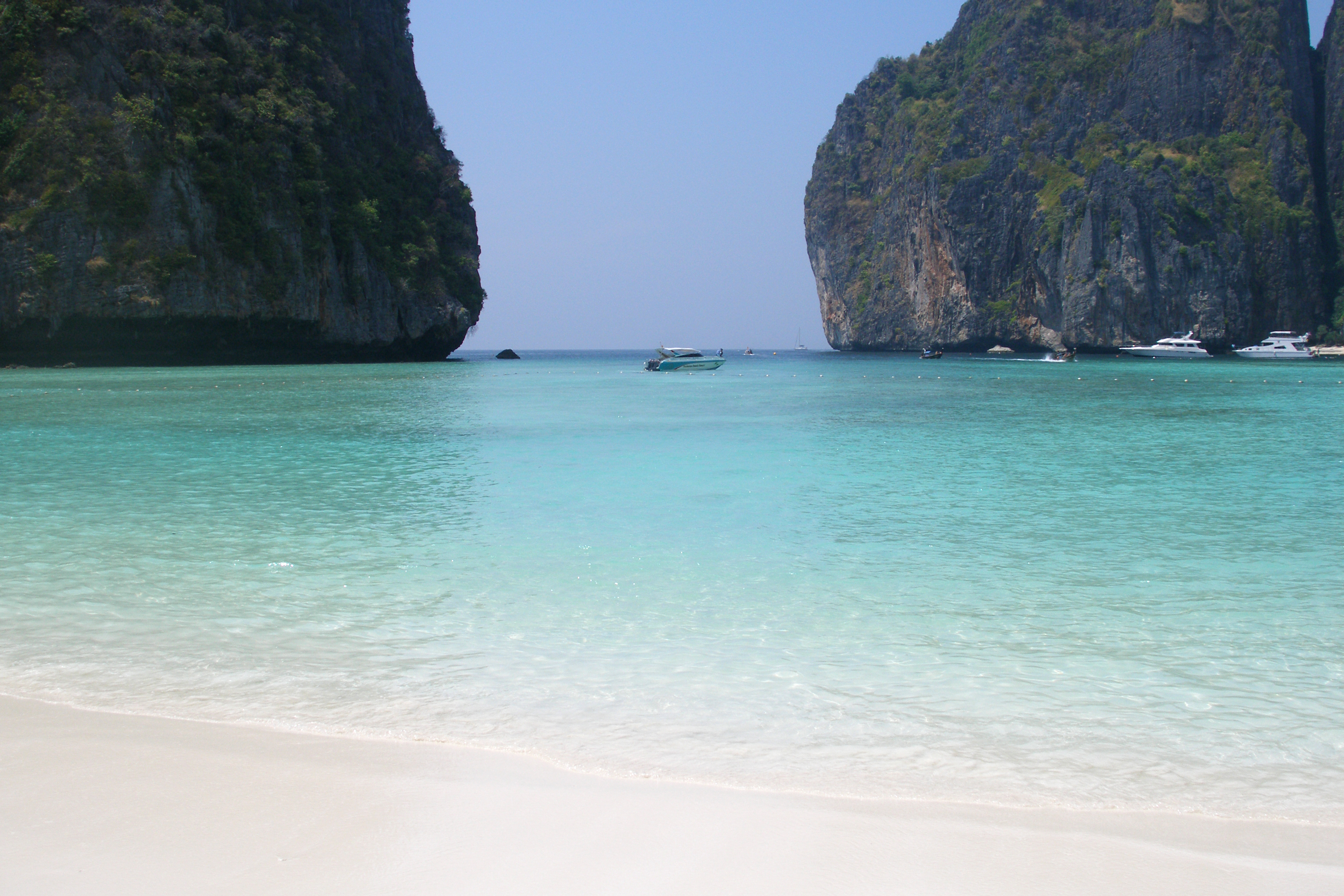
This is the lagoon featured in the film The Beach (2000) (Danny Boyle/Leonardo DiCaprio) — CC BY 4
Travel to Maya Bay Phi Phi Island
Getting There
Most visitors reach Maya Bay Phi Phi Island from Ko Phi Phi Don, Phuket or Krabi. From Phuket or Krabi, a speedboat reaches Ko Phi Phi Don in about 45 minutes to one hour, and from Ko Phi Phi Don a longtail boat or speedboat reaches Loh Samah Bay in about 20 to 30 minutes. The walk from Loh Samah Bay to Maya Bay Phi Phi Island takes about five minutes across the island. Boats do not land directly in Maya Bay, and that rule is part of the protection of the reef.
Tours from Phuket and Krabi often combine Maya Bay Phi Phi Island with other stops around Ko Phi Phi Leh, such as Pileh Lagoon and the Viking Cave, before returning to Ko Phi Phi Don or to the mainland. Early-morning tours arrive before the largest crowds, and they offer calmer water and softer light for photographs. Visitors should check the departure time, the return time and the length of the stop at Maya Bay Phi Phi Island before booking, since the one-hour limit means the timing of the tour matters.
Planning the Visit
A national park fee applies to visitors to Maya Bay Phi Phi Island, and the amount should be checked before travelling, since the fee can change and different sources give different figures. The fee is usually collected as part of a tour price or paid at the park entrance, and visitors should keep the ticket for inspection. There are no restaurants or shops on Ko Phi Phi Leh, and eating is not allowed on the beach at Maya Bay Phi Phi Island, so visitors should eat breakfast before boarding and plan lunch on Ko Phi Phi Don after the visit.
Bring water in a reusable bottle, reef-safe sunscreen, a hat and a camera, and leave single-use plastic behind. The visit lasts one hour, so there is no need for heavy bags, and light packing makes the walk across the island easier. Visitors who want to photograph the bay should aim for the morning, when the light is softer and the crowds are smaller, and they should remember that the best photographs come from the beach itself, looking out toward the opening in the cliffs.
Highlights of Maya Bay Phi Phi Island
The Beach and the Cliffs
The beach itself is the first highlight of Maya Bay Phi Phi Island, with pale sand, clear water and cliffs that close around the cove on three sides. Walking along the sand gives a sense of the bay’s scale, and standing at the water’s edge shows how the cliffs frame the view out to sea. The hour allowed for the visit is enough to walk the beach, wade to knee depth and take photographs, but not enough to linger, and that limit makes the time on the sand feel more deliberate.
Loh Samah Bay and the Walk Across the Island
The walk from Loh Samah Bay to Maya Bay Phi Phi Island is a highlight in its own right, since it crosses the narrow island and ends with a sudden view of the bay. Loh Samah Bay is a smaller cove with its own cliffs and clear water, and the boats that land there give visitors a second bay to see on the same trip. The path between the two bays passes through vegetation and over a low rise, and the change from one bay to the other shows how varied a small island can be.
The Reef Sharks
The blacktip reef sharks of Maya Bay Phi Phi Island are the bay’s most hopeful highlight, since their return shows that the reef is recovering. The sharks are most often seen in the shallow water near the shore, where the young sharks swim in the warm, sheltered water. Visitors should watch them from the sand and not approach them in the water, since swimming is banned and the sharks are protected. Seeing a shark from the beach is a reminder that the bay is a living ecosystem, not only a scenic backdrop.
The Film Location
Standing on the beach where “The Beach” was filmed gives the visit a second layer, since the bay’s fame comes from the screen as much as from its geography. The cliffs and the sand match the film’s image closely, and visitors who know the film will recognize the cove at once. The film’s legacy is mixed, since it brought the crowds that damaged the bay, but it also gave the bay the fame that now funds its protection. That tension is part of what makes Maya Bay Phi Phi Island interesting beyond its beauty.
Frequently Asked Questions
How do I get to Maya Bay Phi Phi Island from Phi Phi Don?
From Ko Phi Phi Don, take a longtail boat or speedboat tour to Loh Samah Bay, which takes about 20 to 30 minutes, then walk about five minutes across Ko Phi Phi Leh to Maya Bay Phi Phi Island. Boats do not land directly in Maya Bay, so the walk is part of every visit. Tours from Phuket and Krabi also run, usually by speedboat to Phi Phi Don first.
Can you swim at Maya Bay Phi Phi Island?
No, swimming is not allowed at Maya Bay Phi Phi Island under the current rules. Visitors may wade in the water up to their knees, but they may not swim, and this rule protects the coral reef and the young blacktip reef sharks that use the shallow water. The ban has applied since the bay reopened on 1 January 2022.
Is Maya Bay Phi Phi Island open now?
Maya Bay Phi Phi Island is open for most of the year, but it closes each year from 1 August to 30 September for the seasonal rest period. It reopened on 1 October 2026 after the most recent closure. Visitors should check the current status before booking, since the park can change the dates or the daily schedule.
How long can you stay at Maya Bay Phi Phi Island?
Each visit lasts one hour, with 11 visits each day between 7 a.m. and 6 p.m., and no more than 375 people per visit, according to aggregate sources based on National Parks Department announcements. The one-hour limit means visitors should plan their photographs and their walk along the beach in advance. The park can adjust the number of visits and the limit by season.
Where is Maya Bay Phi Phi Island?
Maya Bay Phi Phi Island is on Ko Phi Phi Leh, the uninhabited island south of Ko Phi Phi Don in the Phi Phi Islands, Krabi Province, Thailand. Its coordinates are 7.67688° N, 98.76617° E, and it lies inside Hat Noppharat Thara–Mu Ko Phi Phi National Park. The bay is reached by boat to Loh Samah Bay, followed by a short walk.
How much does it cost to visit Maya Bay Phi Phi Island?
A national park fee applies, and the amount should be checked before travelling, since fees can change and aggregate sources give figures that have not been checked against the current official fee table. The fee is usually included in a tour price or paid at the park entrance. Visitors should also budget for the boat tour from Phi Phi Don, Phuket or Krabi, and check the total price with the operator before booking.
Verified
The facts in this article were checked on 20 November 2026 against the sources listed below, with the closure, reopening, shark survey, visitor limits and film details taken from those sources rather than from memory. The daily visit figures and the seasonal closure dates come from aggregate sources based on National Parks Department announcements, and they are flagged as changeable because the park can adjust them. The beach length and cliff height are treated as estimates, not as surveyed facts, and they appear in the Not Yet Verified section for that reason. No search-volume figure appears in the body of this article, and no park fee is stated as a current fact, since the fee was not checked against the official fee table for this article.
Sources
- Thaipedia, Maya Bay guide — https://thaipedia.asia/en/travel/phuket/excursions/maya-bay/ — closure 1 June 2018, reopening 1 January 2022, nearly 5,000 visitors a day in 2017, 161 blacktip reef sharks in the 2021 survey, seasonal closure 1 August to 30 September, reopening 1 October 2026, sunscreen ban 4 August 2021.
- Thailand Wiki, Maya Bay — https://thailandwiki.com/experiences/maya-bay — film “The Beach” (2000), directed by Danny Boyle, filmed 1999, Hat Noppharat Thara–Mu Ko Phi Phi National Park, Ko Phi Phi Leh.
- Beach Verdict, Maya Bay — https://beachverdict.com/beaches/thailand/maya-bay — 11 visits a day, 7 a.m. to 6 p.m., one hour per visit, 375 people per visit, Loh Samah Bay landing, single-use plastic ban 6 April 2022.
- Phi Phi Island Tour from Phuket, Maya Bay rules — https://phiphiislandtourfromphuket.com/maya-bay-rules/ — visit rules and landing arrangements.
- Wikidata, Q13024284 — https://www.wikidata.org/wiki/Q13024284 — Maya Bay, bay in Thailand, coordinates 7.67688, 98.76617.
- Vietnamese reference article, facts only, checked 17 November 2026.
Not Yet Verified
- National park fee for foreign adults and children: aggregate sources from April 2023 give figures that were not checked against the current official fee table; check the fee before travelling.
- Beach length of about 250 metres and cliff height of close to 100 metres: estimates from aggregate sources, not checked against an official survey.
- Daily visit figures of 11 visits and 375 people per visit: figures from aggregate sources based on National Parks Department announcements; the park can adjust them by season, so check the current rules before travelling.
- Sunscreen ban details and the fine of up to 100,000 baht: the list of banned ingredients and the fine come from aggregate sources; use reef-safe sunscreen to be safe.
Illustrations
- Hero: View of Maya Bay Phi Phi Island. Free image: https://upload.wikimedia.org/wikipedia/commons/a/a7/Maya_Bay_Thailand_Phi_Phi_Ley.jpg — Public domain.
- In body, Maya Bay Phi Phi Island: This is the lagoon featured in the film The Beach (2000) (Danny Boyle/Leonardo DiCaprio). Free image: https://upload.wikimedia.org/wikipedia/commons/8/88/Maya_Bay%2C_Koh_Phi_Phi%2C_Krabi%2C_Thailand.jpg — CC BY 4.
- In body, Maya Bay Phi Phi Island: A coastal view of the world-famous Maya Bay on Ko Phi Phi Le island. Free image: https://upload.wikimedia.org/wikipedia/commons/e/ea/Maya_Bay_enclosed_limestone_cliffs_and_turquoise_water_Ko_Phi_Phi_Le.jpg — CC BY-SA 4.