
Cappadocia Hot Air Balloon — A Guide to Tours, Flights, and Seasons
A Cappadocia hot air balloon flight is the region’s famous sunrise ride. This guide covers flight types, seasons, and booking.
The image is known around the world: a sky full of bright balloons drifting over a valley of stone towers at sunrise, while the first light turns the rock pink and gold. That image is the reason most visitors come to Cappadocia, and the balloon flight is the experience they remember longest. A standard flight lasts about an hour in the air, and the whole morning, from the hotel pickup before dawn to the light breakfast and the celebration after landing, takes about three to four hours.
This guide names no individual balloon company and quotes no ticket price, because prices shift with the season, the company, and the day you book. Instead it explains the kinds of flights on offer, the valleys they cross, the seasons that decide whether they fly, and how to plan a trip that survives a cancelled morning. Every section below is about the Cappadocia hot air balloon experience as a whole, not about one operator.
Quick Facts
| Item | Detail |
|---|---|
| Place | Cappadocia, Central Anatolian plateau, Nevşehir Province, Türkiye |
| Coordinates | 38.6706° N, 34.8392° E |
| Elevation | Göreme town about 1,100 m above sea level |
| Main flight centre | Göreme |
| Other centres | Ürgüp and Avanos |
| Nearest airports | Nevşehir Kapadokya Airport, about 35 km from Göreme; Kayseri Airport, about 75 km |
| Flight length | About 60–90 minutes in the air |
| Whole morning | About 3–4 hours, from pickup to landing celebration |
| Balloons on a good morning | More than 100 in the sky (estimate, varies by day) |
| UNESCO site | Göreme National Park and the Rock Sites of Cappadocia (1985, criteria i, iii, v, vii; mixed cultural–natural heritage) |
| Heritage area | 9,883.81 ha |
| Language | Turkish; English in tourism |
| Time zone | UTC+3 (Türkiye time) |
| Wikidata ID | Q217265 |
Geography of a Cappadocia Hot Air Balloon Flight: The Valleys Below the Basket
A Cappadocia hot air balloon flight is the best way to read the ground below, because the whole tour area is one volcanic plateau in Central Anatolia. Two extinct volcanoes frame it: Mount Erciyes, 3,916 metres high, to the east, and Mount Hasan, 3,253 metres high, to the west. Long ago their eruptions laid a deep bed of ash across the plateau, and that ash set into tuff, a soft stone that wind and water could carve. The carving left thousands of pillars shaped like mushrooms, cones and towers — the fairy chimneys — and the balloons lift off from the fields around Göreme at dawn to drift over them, which is why the flight path, not the road, decides what a visitor sees.
The landscape below divides into many valleys, each with its own character, and a single flight can cross several of them. The Rose Valley glows pink at sunset and rose-red at dawn, with rock that changes colour as the light moves. The Pigeon Valley holds dovecotes cut into the cliff walls, where pigeons were once kept for their droppings, used as fertiliser.
Paşabağ Valley holds the tallest and most beautiful mushroom-shaped pillars in the region, with double and triple caps that look carved rather than worn. Devrent Valley, sometimes called Imagination Valley, holds rock shapes that look like camels, seals, and other animals, and it rewards a slow look from above. Love Valley holds tall, pale pillars that rise like fingers from the valley floor, and the Red Valley holds some of the deepest colours in Cappadocia, especially in the late afternoon.
Göreme is the centre of the balloon world, a small town of only a few thousand people where most of the cave hotels stand and where most flights begin. The balloons launch from fields around the town, and the pilots steer by rising and falling into winds that blow in different directions at different heights, so no two flights follow quite the same path. Ürgüp, a little larger and more like an ordinary Turkish town, is the second centre, with its own launch fields and its own view of the valleys, while Avanos, on the river, is known for its pottery and its quieter streets. The three towns form a triangle around the valleys, and the flight you take depends on which launch field the wind favours that morning.
The elevation of more than 1,000 metres makes the air clear and dry, which suits balloons, but it also makes the weather change fast. The wind is the factor that decides whether the balloons can fly each morning, and it is also the reason the flights leave at dawn, when the air is calmest and the light is softest. In summer the air is warm even before sunrise, and the valleys below are dry and golden.
In winter the valleys can be covered in snow, and the balloons fly over a white landscape that looks like another planet, when the wind allows. The same dry air that suits the balloons has kept the frescoes in the rock churches bright for a thousand years, and it is part of the reason the region feels so clear and so still at dawn.
The ground below the flight is as much a part of the experience as the sky. The Göreme Open-Air Museum, a cluster of rock-cut churches with Byzantine frescoes, lies within the valley system the balloons cross, and the fairy chimneys around it are the most photographed rocks in Türkiye. Uçhisar Castle, a tall rock fortress at the highest point of the region, rises above the valleys and serves as a landmark for pilots and passengers alike. The underground cities, cut down as deep as 85 metres below the ground, are invisible from the air, yet they are part of the same story: a landscape that people have lived inside for more than two thousand years, cutting houses, churches, and whole cities into the rock.
Göreme itself is the natural base for a Cappadocia hot air balloon flight, because it sits in the middle of the valley system and holds most of the region’s cave hotels. The town is small, with only a few thousand people, and its hotels are cut into the same tuff as the churches, so a stay here feels like sleeping inside the landscape the balloons fly over. From the rooftops and terraces of Göreme, the balloons can be watched rising at dawn without leaving the town, and the launch fields lie a short drive away in every direction. Ürgüp and Avanos offer quieter bases, but Göreme is where the balloon morning begins, and a traveller who wants the fullest experience of a Cappadocia hot air balloon flight should stay as close to it as possible.

A hot air balloon being inflated before air trip over Cappadocia, central Turkey, as seen from inside — CC BY-SA 3
History of the Cappadocia Hot Air Balloon: From Volcanic Ash to the World’s Most Famous Sunrise
The story of a Cappadocia hot air balloon flight begins millions of years before the first balloon, with the volcanoes that built the plateau. Erciyes and Hasan erupted again and again, laying down ash that hardened into tuff, and then wind and water spent millions of years carving that tuff into the valleys and pillars that exist today. People arrived to find a rock that was soft enough to cut with hand tools and strong enough to hold a roof, and they cut houses, churches, storerooms, and stables into it. That habit of living inside the rock lasted for more than two thousand years, through Roman, Byzantine, and Seljuk times, and it left the region with a heritage that no other balloon destination in the world can match.
The rock churches of the Byzantine period are the heart of that heritage. From about the tenth century onward, monks and villagers cut churches into the fairy chimneys and painted their walls with frescoes of biblical scenes, and many of those paintings survive in bright colour today. The Göreme Open-Air Museum gathers the finest of them in one valley, and its churches are the reason UNESCO inscribed Göreme National Park and the Rock Sites of Cappadocia as a World Heritage site in 1985, recognising both the cultural and the natural value of the region.
The inscription covers 9,88D1 hectares and lists the site under criteria i, iii, v, and vii, as a mixed cultural and natural heritage. A balloon flight over the valleys is therefore a flight over a World Heritage landscape, not only over a pretty view.
The underground cities tell the other half of the region’s history. Derinkuyu, the deepest of them, descends as far as 85 metres below the ground, with rooms, stables, kitchens, and churches cut into the rock, and it could shelter thousands of people. These cities were refuges in times of invasion, and they show how completely the people of Cappadocia learned to live inside their geology. The balloon, arriving two thousand years later, is the first way of seeing that geology from above rather than from inside, and that reversal is part of its appeal: the same valleys that once hid people now open themselves to the sky.
Ballooning itself came to Cappadocia late. Commercial balloon flights began in the 1990s, when the first operators started carrying passengers over the valleys at dawn, and the region’s combination of calm morning air, clear light, and extraordinary ground made it famous quickly. Within a few seasons the morning sky filled with balloons, and the flight became the symbol of Cappadocia in travel photography around the world. Today, on a good morning, more than 100 balloons can be in the sky at once, an estimate that varies with the season and the day, and the sight of them rising together over Göreme is one of the most photographed scenes in travel.
The growth of ballooning has also changed the region. Göreme, once a small farming town, is now the tourist centre of Cappadocia, with cave hotels cut into the same rock as the churches, and the valleys around it are crossed every morning by the shadows of the balloons. The industry is regulated by Türkiye’s civil aviation authority, and flights are cancelled when the wind is too strong, which is the most important fact a visitor needs to know. The balloons are safe when the weather allows them to fly, and they do not fly when it does not, and that rule is the reason the advice in this guide is to stay at least two nights, so that a cancelled morning has a second chance.
The balloon has also become part of the region’s identity in a way that few tourist activities manage. It appears on postcards, on hotel signs, and in the name of the region itself for many visitors, who know Cappadocia first as the place of the balloons and only second as the place of the rock churches. That order is backwards historically, since the churches are a thousand years older than the balloons, but it is understandable, because the balloon is the way most visitors first see the valleys. The best trips combine the two: a flight at dawn, and then a day on the ground among the churches, the valleys, and the underground cities.
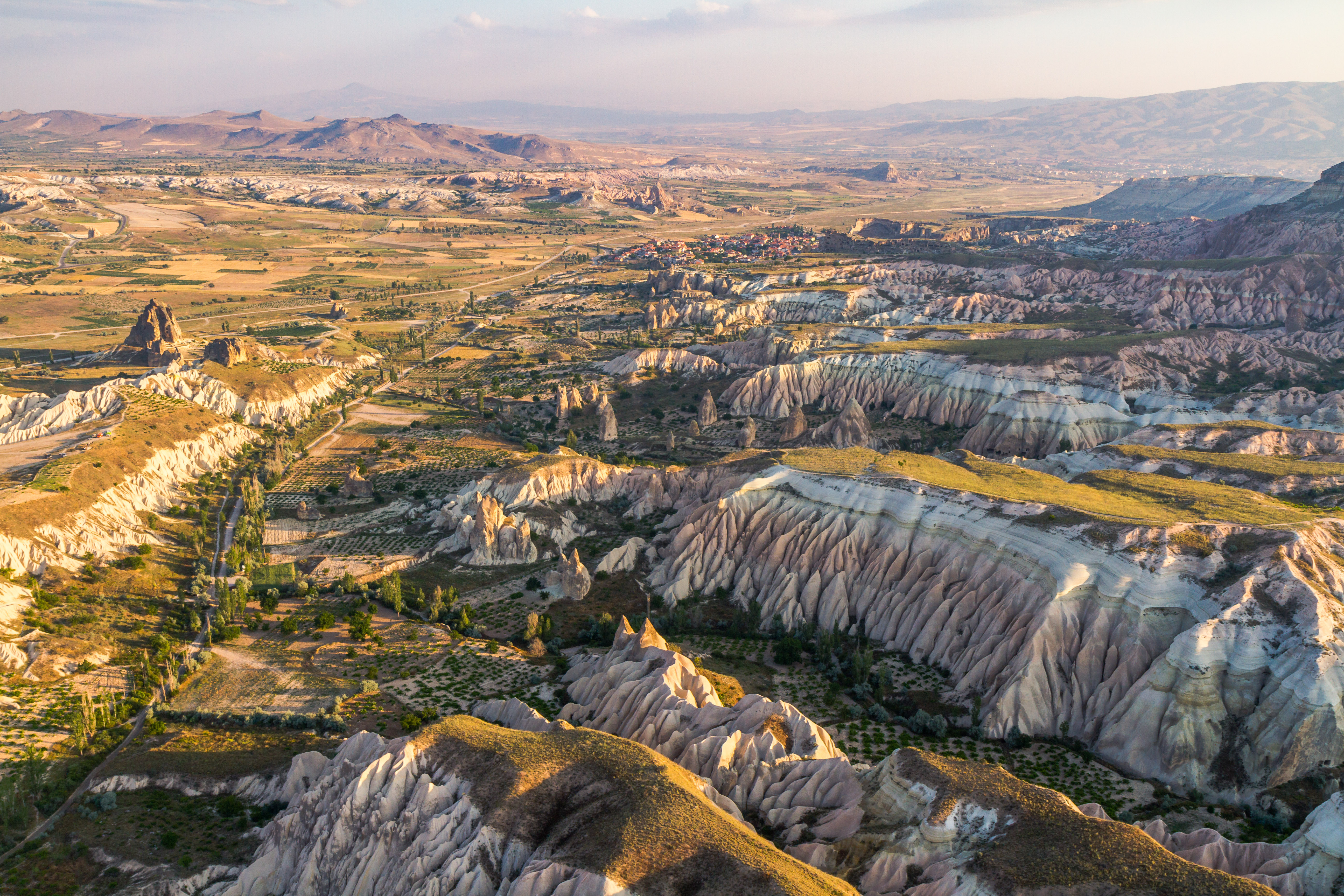
Aerial view over Cappadocia, nearby Gorëme, Turkey — CC BY-SA 4
Travel for a Cappadocia Hot Air Balloon Tour
The most practical question about a Cappadocia hot air balloon tour is when to go, and the answer is that the balloons fly all year, but the experience changes with the season. Spring and autumn bring mild temperatures, clear air, and the most reliable flying weather, and they are the most popular seasons for that reason. Summer brings hot days and warm dawns, with the valleys dry and golden, and the flights leave earliest to catch the calm air.
Winter brings cold mornings and snow on the valleys, and the flights are fewer and more often cancelled by wind, but the sight of the balloons over a white landscape is the most striking of all. There is no single best month for a Cappadocia hot air balloon flight, only the best month for the weather you want.
Choosing a flight means choosing between the standard and the longer options, and the difference is real. A standard flight lasts about 60 minutes in the air and carries a larger basket of passengers, while a longer flight of about 90 minutes flies further and higher, with a smaller basket and more time over the valleys. A third kind of flight, sometimes called a deluxe or sunrise flight, lifts off after the first wave, so that its passengers watch the other balloons rising below them as the sun comes up.
All three include the same morning pattern: a hotel pickup before dawn, a light breakfast, the flight itself, a landing celebration, and a flight certificate. Travellers who want the longest time in the air should choose the longer flight, and travellers who want the classic photograph of many balloons should choose the first wave.
Booking a Cappadocia hot air balloon flight well ahead matters, because the best mornings sell out, especially in spring and autumn. Travellers should also plan to stay in Cappadocia for at least two nights, because the wind cancels flights more often than visitors expect, and a second morning is the only real insurance against a cancelled flight. The cancellation decision is made by the pilots and the aviation authority on the morning itself, based on the wind at the launch field, and no company can promise a flight the night before. A traveller with only one morning in Cappadocia is gambling on the weather, and a traveller with two mornings has a good chance of flying.
Watching the balloons from the ground is a real alternative, and it suits travellers who do not want to fly, cannot fly for health reasons, or find their flight cancelled. The viewpoints above Göreme fill before dawn with photographers and watchers, and the sight of more than a hundred balloons rising together is almost as memorable from the ground as from the air. Some travellers watch on their first morning and fly on their second, which is the best use of two dawns in the region.
Health and safety deserve a plain word. Balloon flights are not suitable for everyone, and travellers who are pregnant, who have serious back or leg problems, or who cannot stand for an hour and climb into a basket should ask their doctor and the operator before booking. The landing can be bumpy, because a balloon lands where the wind takes it, and passengers need to hold on and follow the pilot’s instructions.
Children are usually accepted only above a minimum age and height, which varies by operator, so families should check before booking. The pilots are licensed, the balloons are inspected, and the flights are insured, but the wind remains the final authority, and a cancelled flight is a safe flight.
Getting to Cappadocia is part of the plan, because the region is far from the coast and from Istanbul. The nearest airports are Nevşehir Kapadokya Airport, about 35 kilometres from Göreme, and Kayseri Airport, about 75 kilometres away, and both are reached by domestic flights from Istanbul. Travellers can also come by overnight bus from Istanbul, which takes the night and arrives in Göreme in the morning. Once in the region, the towns are small, and most hotels arrange transfers to the launch fields, so the flight itself requires no transport of its own.
Highlights of Cappadocia Tours
The standard 60-minute flight — the classic choice
The standard flight is the most popular kind of Cappadocia hot air balloon tour, and it suits first-time visitors who want the full experience at the most accessible level. It lasts about 60 minutes in the air, carries a larger basket, and follows the morning wind across the valleys around Göreme. The flight includes a hotel pickup before dawn, a light breakfast, the flight itself, a landing celebration, and a flight certificate, and it ends before most travellers have had their second coffee.
The 90-minute flight — further, higher, longer
The longer flight suits travellers who want more time in the air and a smaller basket. It lasts about 90 minutes, flies further across the valleys, and climbs higher, giving a wider view of the plateau and its volcanoes. The basket holds fewer passengers, so the experience feels more personal, and the landing comes after the first wave of balloons has already come down. Travellers who have flown before, or who want the most complete view, should choose this flight.
The deluxe sunrise flight — watching the other balloons rise
The deluxe or sunrise flight suits photographers and romantics. It lifts off after the first wave, so its passengers watch dozens of other balloons rising below them as the sun comes up, and the photographs from this flight are the ones that fill travel magazines. The basket is smaller, the flight is longer, and the morning feels slower and more deliberate. It is the most memorable of the three kinds of Cappadocia hot air balloon tour, and it is also the one that sells out first.
Watching from the ground — the flight without flying
Watching the balloons from the ground suits travellers who do not want to fly, cannot fly, or find their flight cancelled. The viewpoints above Göreme fill before dawn, and the sight of more than a hundred balloons rising together over the valleys is almost as memorable from the ground as from the air. It costs nothing, it needs no booking, and it is the best use of a morning when the wind has grounded the balloons.
The valleys below — Rose, Pigeon, Paşabağ, and Devrent
The valleys are the reason the flight exists, and they deserve a day on the ground as well as an hour in the air. The Rose Valley glows pink at dawn, the Pigeon Valley holds dovecotes cut into the cliffs, Paşabağ holds the tallest mushroom-shaped pillars, and Devrent holds rocks shaped like animals. A walk of a few hours can pass through three or four valleys, and the view from the ground explains the view from the basket.
Göreme, Ürgüp, and Avanos — the three towns of the balloon country
Göreme is the centre of the balloon world, with the cave hotels and the launch fields. Ürgüp is larger and more like an ordinary Turkish town, with markets and local life, and Avanos, on the river, is known for its pottery. Staying in Göreme puts you closest to the launch fields, while staying in Ürgüp or Avanos gives a quieter night and a different view of the region.
Frequently Asked Questions
How long does a Cappadocia hot air balloon flight last?
A standard flight lasts about 60 minutes in the air, and a longer flight lasts about 90 minutes. The whole morning, from the hotel pickup before dawn to the light breakfast, the flight, and the landing celebration, takes about three to four hours. Travellers should plan their day around the morning, because the flight ends before most other activities begin.
What is the best month for a Cappadocia hot air balloon flight?
Spring and autumn bring the mildest temperatures and the most reliable flying weather, and they are the most popular seasons. Summer brings hot days and warm dawns, and the flights leave earliest. Winter brings snow on the valleys and the most striking views, but also more cancellations, because the wind is stronger. There is no single best month, only the best month for the weather you want.
Can I see the Cappadocia hot air balloon flight in winter?
Yes, and a winter flight over snow-covered valleys is one of the most beautiful sights in the region. Winter flights are fewer and more often cancelled by wind, so travellers should stay at least two nights to allow a second chance. Warm clothing is essential, because the morning air at more than 1,000 metres of elevation is cold before sunrise.
How do I book a Cappadocia hot air balloon tour?
Book well ahead, especially for spring and autumn, because the best mornings sell out. Choose between the standard 60-minute flight, the longer 90-minute flight, and the deluxe sunrise flight, and check what is included: the hotel pickup, the light breakfast, the licensed pilot, the passenger insurance, the landing celebration, and the flight certificate. Confirm the cancellation policy before booking, because the wind decides on the morning itself.
What happens if my Cappadocia hot air balloon flight is cancelled?
A Cappadocia hot air balloon flight is cancelled when the wind is too strong, and the decision is made by the pilots and the aviation authority on the morning itself. A cancelled flight is a safe flight, and most operators offer a refund or a rebooking for the next morning. That is why this guide advises staying in Cappadocia for at least two nights, so that a cancelled morning has a second chance.
Can I take a Cappadocia tour from Istanbul with a hot air balloon?
Yes, and the most common way to reach a Cappadocia hot air balloon flight is to fly from Istanbul to Nevşehir or Kayseri, which are about 35 and 75 kilometres from Göreme, and then take the balloon flight on the following morning. Overnight buses from Istanbul also arrive in Göreme in the morning. A tour from Istanbul that includes the balloon needs at least two days, because the flight leaves at dawn and the journey from Istanbul takes most of a day.
Verified
This guide to the Cappadocia hot air balloon was written in English on 20 November 2026 from the region’s own volcanic geography and balloon practice, not from any single tour operator or booking site. Its figures come from the Vietnamese reference article on the same subject, checked on 17 November 2026, and from the published English guide to Cappadocia: the UNESCO inscription of Göreme National Park and the Rock Sites of Cappadocia in 1985, the heritage area of 9,883.81 hectares, the criteria i, iii, v, and vii, the elevation of Göreme at about 1,100 metres, the heights of Mount Erciyes at 3,916 metres and Mount Hasan at 3,253 metres, the depth of the underground cities at as far as 85 metres, and the distances to Nevşehir Kapadokya Airport at about 35 kilometres and Kayseri Airport at about 75 kilometres. The flight descriptions follow the reference article’s account of flights lasting 60 to 90 minutes in the air, the whole morning taking three to four hours, and the advice to stay at least two nights as insurance against a wind cancellation. No company name appears in this guide by design, and no ticket price is quoted anywhere, because prices change with the season, the company, and the day of booking.
Sources
- UNESCO World Heritage Centre, Göreme National Park and the Rock Sites of Cappadocia — https://whc.unesco.org/en/list/357/
- GoTürkiye, Cappadocia — https://goturkiye.com/cappadocia
- Vietnamese reference article, facts only, checked 17 November 2026 — ~/workspace/theterraatlas-articles/cappadocia-tours.vi.md
- TheTerraAtlas, Cappadocia, Göreme, Uçhisar Castle, Rose Valley, Derinkuyu Underground City
Not Yet Verified
- The number of balloons in the sky on a good morning, given here as more than 100, is an estimate from the reference article that varies with the season and the day, so it should not be quoted as a fixed figure.
- The start of commercial ballooning in Cappadocia in the 1990s is a commonly reported milestone that has not been checked against the licensing records of Türkiye’s civil aviation authority, so this guide states it as a general period rather than a precise year.
- Ticket prices for balloon flights change sharply with the season, the company, and the day of booking, so this guide deliberately quotes no price at all, and travellers should check directly with the operator on the day they book.
- The minimum age and height for children on balloon flights vary by operator and have not been verified against a single rule, so families should confirm them with the operator before booking.
Illustrations
- Hero: View of Cappadocia Hot Air Balloon. Free image: https://upload.wikimedia.org/wikipedia/commons/f/f3/Cappadocia_March_2006.jpg — CC BY-SA 3.0.
- In body, Cappadocia Hot Air Balloon: Aerial view over Cappadocia, nearby Gorëme, Turkey. Free image: https://upload.wikimedia.org/wikipedia/commons/a/a3/Cappadocia_Aerial_View_Landscape.jpg — CC BY-SA 4.
- In body, Cappadocia Hot Air Balloon: A hot air balloon being inflated before air trip over Cappadocia, central Turkey, as seen from inside. Free image: https://upload.wikimedia.org/wikipedia/commons/8/89/Cappadocia_Balloon_Inflating_Wikimedia_Commons.JPG — CC BY-SA 3.