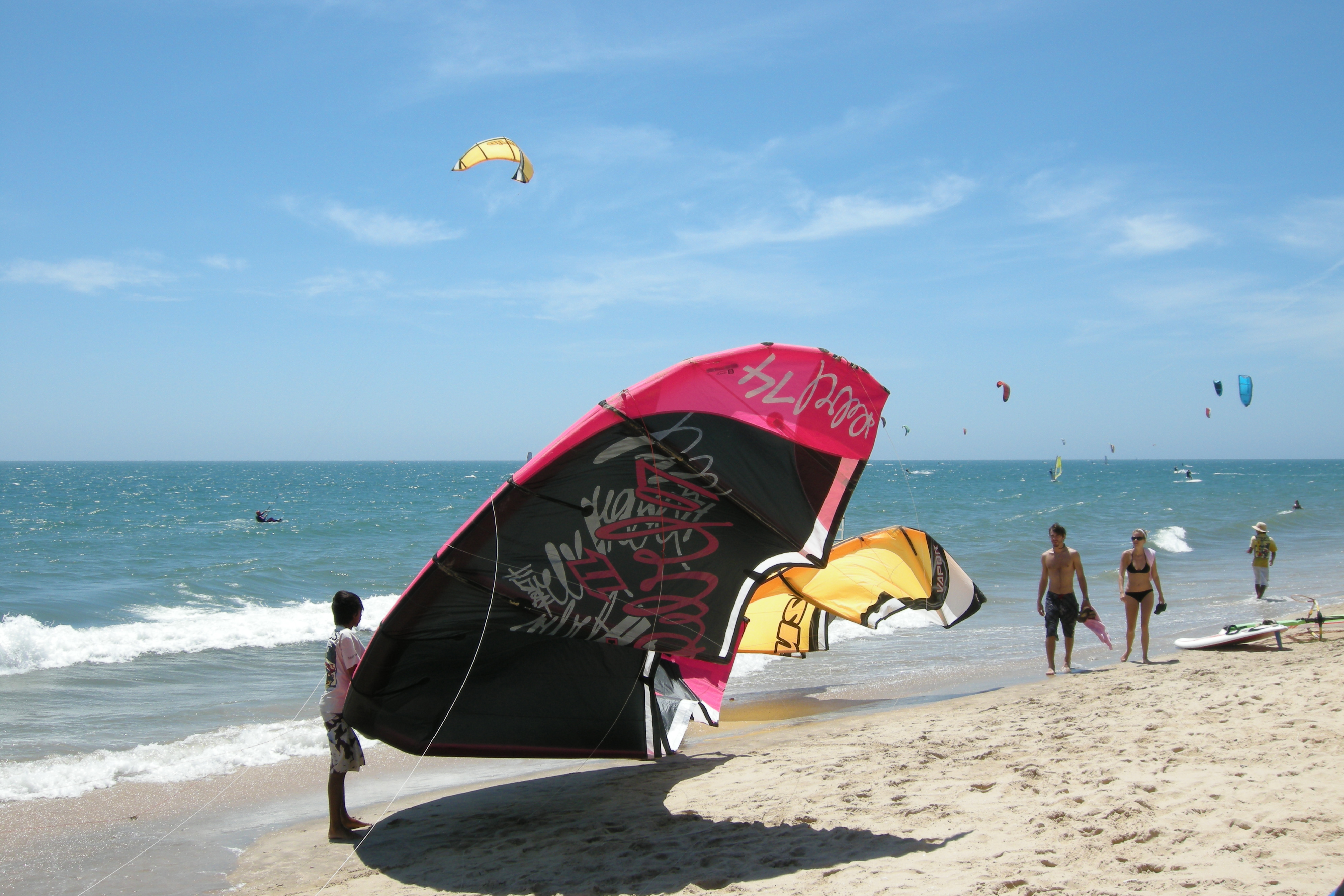
Mui Ne Tours: Three Days from Hanoi to the Sand Dunes and the Sea
Mui Ne tours take travellers from Hanoi to the sunny coast of Phan Thiet. The three-day trip pairs white sand dunes with an ancient Cham tower.
Mui Ne tours are the classic Hanoi-to-the-south beach escape, a three-day, two-night route that flies from the capital to Ho Chi Minh City and then drives east along the coast to the resort strip of Mui Ne. Travellers who search for this route usually type “tour hà nội mũi né 3 ngày 2 đêm”, and what they want is plain: a short trip with a beach, sand dunes, a fishing village and a Cham tower, without too much moving around. Typical Mui Ne tours start with a morning flight from Hanoi, reach Mui Ne by the afternoon of the first day for a swim, spend the second day at Bau Trang and the red dunes, the fishing village and Fairy Stream, and on the third day visit the Po Sah Inu Cham towers and the Phan Thiet market before flying home. This article explains the geography, the history and the practical shape of Mui Ne tours for first-time travellers.
Mui Ne is not a separate city but a coastal ward in the north-east of Phan Thiet City, where a long beach joins resort hotels to a working fishing village. Since 1 July 2025 the whole of the old Binh Thuan province has been merged with Dak Nong and Lam Dong into the new Lam Dong province, under Resolution 202/2025/QH15, so Mui Ne and Phan Thiet now belong administratively to Lam Dong, with the provincial centre at Da Lat, although the name Binh Thuan is still familiar in travel. The facts in this article were checked on 22 November 2026 against the sources listed at the end, and anything that could not be checked is kept in the Unverified section rather than stated as fact.
Quick Facts About Mui Ne Tours
| Fact | Detail |
|---|---|
| Name | Mui Ne Tours (3 days, 2 nights from Hanoi) |
| Destination | Mui Ne, Phan Thiet City, Lam Dong province (old Binh Thuan) |
| Type | Beach tour, three days and two nights from Hanoi |
| Distance from Hanoi | About 1,500 km; fly to Ho Chi Minh City, then drive about 200 km to Mui Ne |
| Travel time | Hanoi–Ho Chi Minh City flight about 2 hours; expressway drive to Mui Ne about 2.5–3 hours |
| Highlights | Bau Trang, red sand dunes, Fairy Stream, Mui Ne fishing village, Po Sah Inu Cham towers |
| Climate | Warm and sunny all year, the driest region in Vietnam; windy season November to April |
| Best time | November to April, dry skies, calm sea and cool wind |
| Wikidata | None (tour page) |
Geography of Mui Ne Tours
A Dry Coast on the South-Eastern Shore
Mui Ne lies on the south-eastern coast of Vietnam, about 200 kilometres east of Ho Chi Minh City and about 1,500 kilometres from Hanoi by air and road. The Mui Ne tourist strip runs along two coastal roads, Nguyen Dinh Chieu and Huynh Thuc Khang, which join the centre of Phan Thiet to the headland in the north-east. The coast here is a long beach of yellow sand and clear water, with moderate waves that suit swimming and water sports, and the land behind the beach is dry and sunny, with the lowest rainfall and the most sunshine hours in the country. That dryness made the great sand dunes beside the sea, a small-desert landscape that few other places in Vietnam possess, and the sea wind that blows from November to April has made Mui Ne one of the best-known windsurfing and kitesurfing spots in Asia.
The administrative change of 2025 matters for a traveller reading a map, because the old province of Binh Thuan no longer exists as a province. Under Resolution 202/2025/QH15 of the National Assembly, passed on 12 June 2025, Binh Thuan, Dak Nong and Lam Dong were merged into a new Lam Dong province, with an area of 24,233.07 square kilometres and a population of 3,872,999 people, and the administrative centre at Da Lat. Mui Ne and Phan Thiet therefore now belong to Lam Dong province, and a visitor who writes an address should use Lam Dong, even though hotels, tour operators and road signs still say Binh Thuan. The change does not alter the road, the beach or the dunes, but it does alter the province named on tickets and in official documents, and a traveller who knows it will not be confused by the two names.
The coast around Mui Ne is varied in a short distance. To the south lies Ke Ga Cape, with its old lighthouse standing on a rocky island offshore, and to the north lie the white dunes that stretch towards Phan Ri. The beach itself is long and open, with resorts along the main road and the fishing village at the headland, where hundreds of round basket boats anchor each morning.
The dunes are the most distinctive feature of the land: the white dunes at Bau Trang, about 60–65 kilometres from the centre of Phan Thiet, hold a freshwater lake between the sand, and the red dunes, about 25 kilometres east of the centre near Hon Rom, owe their deep red and orange colour to iron ore in the sand. The two dune fields face different directions and catch the light differently, so the white dunes are best at dawn and the red dunes are best in the late afternoon, when the low sun turns the sand pink and red.
The Driest Climate in Vietnam
Mui Ne is the driest part of Vietnam, with low rainfall and high sunshine all year, and that dryness is the reason the dunes exist beside a tropical sea. The wind season runs from November to April, when the north-east monsoon brings a steady sea wind that cools the coast and drives the sails of the windsurfers and kitesurfers. The sea is calmest in those months, the sky is dry, and the light is clear, which is why November to April is the best time for a Mui Ne tour.
From May to October comes the rainy season, but the rain in Mui Ne is usually short and does not last all day, and the sea is still swimmable, though the wind drops and the water can be rougher on some days. A traveller should avoid going on days when the sea is rough, because big waves make the water cloudy and swimming less safe, and should check the forecast before setting out.
The best light on the dunes follows the sun, not the clock of the tour bus. The finest moment at Bau Trang is about 5.30 in the morning, when the sun rises over the white sand and the lotus lake, and the finest moment on the red dunes is the late afternoon, when the slanting sun turns the sand rose-red. A visitor who sleeps in Mui Ne can catch both, and a visitor who only passes through in the middle of the day will see the dunes at their palest and least interesting.
The fishing village is best at dawn too, when the boats come in and the fish market opens on the beach, and the Cham towers are best in the late afternoon, when the red brick glows in the low sun. The geography of Mui Ne tours is therefore a geography of hours as much as of places, and the day’s plan should follow the light.
The road to Mui Ne has changed the geography of the trip as much as any landscape. The Dau Giay–Phan Thiet expressway, opened in 2023, cut the drive from Ho Chi Minh City to under three hours, where the same 200 kilometres once took four to five hours, and it turned Mui Ne into an easy weekend destination from the southern capital. The expressway also made the Hanoi tour neater, because the flight and the drive now fit into a single morning, and the traveller reaches the beach by the afternoon of the first day.
The train is another option, with trains stopping at Phan Thiet station, from which a taxi or bus covers about 20 kilometres into Mui Ne. The airport at Phan Thiet is still under construction, and no completion date is confirmed in this article, so the flight-plus-expressway route remains the standard way in.
The Coast from Phan Thiet to the Dunes
The Phan Thiet coast runs from the city centre in the south-west to the headland in the north-east, and the tourist strip follows it for its whole length. The resorts line the road, the fishing boats work the headland, and the dunes lie inland and to the north, so a tour moves between three kinds of ground in a single day: the resort beach, the working harbour and the desert-like dunes. The Fairy Stream, Suoi Tien, is a small stream that runs through a gorge of red and yellow sand, and a visitor walks barefoot along it between sand walls worn by the water into shapes like castles.
The Po Sah Inu towers stand on Ba Nai Hill, about 7 kilometres north-east of the centre of Phan Thiet, in the Lau Ong Hoang relic area, and from the hill a visitor can see the whole of Phan Thiet and the Mui Ne coast in the distance. The geography of the tour is compact, and that compactness is its charm: the sea, the dunes, the stream and the towers are all within a short drive of each other, and a three-day tour never has to hurry.

Mui Ne, a coastal fishing town in Vietnam — CC BY 4
History of Mui Ne Tours
The Land of the Champa Kingdom
The land of Phan Thiet and Mui Ne once belonged to the kingdom of Champa, and the clearest trace that remains today is the Po Sah Inu tower complex on Ba Nai Hill, about 7 kilometres north-east of the centre of Phan Thiet. The Cham built the towers at the end of the eighth century and the beginning of the ninth, to worship Shiva, the supreme god of Hinduism. The main tower stands about 15 metres high, built of red baked brick fitted so tightly that the mortar joints are almost invisible, a building technique that scholars still debate.
In the fifteenth century the Cham added small shrines in the complex to worship Princess Po Sah Inu, the daughter of King Para Chanh, who was loved by the people for teaching them to clear forest land, make fields and grow crops. In 1991 the Po Sah Inu towers were ranked as a national architectural and artistic relic, after an excavation and restoration that ran from 1990 to 1995.
The Cham towers are the oldest history on the Mui Ne route, and they are also the most visited, because every tour stops at them on the last day. The towers stand on a hill above the coast, and the red brick against the blue sea is the image that most visitors take home. The Cham kingdom itself faded from this coast as Vietnamese settlers moved south from the seventeenth century onwards, and the fishing village of Mui Ne grew up beside the headland that sheltered boats from the wind.
The name Mui Ne is popularly explained as the cape where boats shelter from the wind, though that is a folk explanation and no old text confirms it. The towers survived because they were built of brick and because they stood on a hill away from the town, and they are now the one place on the tour where the history is older than the beach.
The Fishing Village and the Fish Sauce Trade
Before it became a tourist destination, Mui Ne was a fishing village, and fishing is still an important part of life here. Every morning the Mui Ne fishing village holds its market right on the beach, with round basket boats carrying fresh fish from the sea, and a visitor who arrives at dawn sees fishermen sorting the catch and fish traders carrying their goods away. Phan Thiet is also famous across Vietnam for its fish sauce, a traditional craft hundreds of years old, made from anchovies fermented in wooden barrels, and the old fish sauce workshops still open their doors to visitors. The sauce is the taste of the coast, and the market is its morning face, and a tour that only shows the resorts misses the working side of Mui Ne entirely.
The change of Mui Ne into a tourist destination began in the 1990s, when the first resorts rose along Nguyen Dinh Chieu Road. The boom followed the total solar eclipse of 1995, when many international visitors came to Phan Thiet and discovered the coast, and from then on Mui Ne became one of the most familiar beach destinations in the south. The resorts grew along the road, the restaurants followed, and the fishing village kept working beside them, so the coast today is a mix of the two economies: the boats in the morning and the sun loungers in the afternoon. The windsurfers arrived with the resorts, and the kite surfers followed, and the wind that once only mattered to fishermen became the reason for a whole season of sport.
The Expressway and the New Look
The opening of the Dau Giay–Phan Thiet expressway in 2023 was the great turning point for tourism in Mui Ne, cutting the drive from Ho Chi Minh City to under three hours. Before the expressway, the same 200 kilometres often took four to five hours by car, which put many travellers off, and the coast was a long journey rather than a weekend trip. The expressway made Mui Ne a convenient weekend destination from Ho Chi Minh City, and it made the Hanoi tour neater as well, because the flight and the drive now fit into one morning.
The resorts have grown busier since, and the weekends and long holidays are crowded, so a traveller who goes at a holiday should book the tour early. The expressway also changed the shape of the coast, because the new road brought more day visitors and more traffic to the resort strip, and the quiet fishing village at the headland is now the quietest part of a busy coast, and Mui Ne tours that only show the resorts miss the working side of it.
The merger of the provinces in 2025 is the newest layer of the region’s history, and it is the one that a traveller is most likely to notice on paper rather than on the ground. The old Binh Thuan, Dak Nong and Lam Dong became a single Lam Dong province on 1 July 2025, and the new province has an area of 24,233.07 square kilometres and a population of 3,872,999 people. The name Binh Thuan survives in travel and in Mui Ne tours, in hotel names and in the fish sauce labels, and the name Lam Dong is the one on the official address. The history of Mui Ne is therefore a history of three layers: the Cham towers on the hill, the fishing village on the beach, and the resort strip on the road, and Mui Ne tours touch all three.
Timeline
| Year | Event |
|---|---|
| Late 8th – early 9th century | The Cham build the Po Sah Inu tower complex on Ba Nai Hill to worship Shiva |
| 15th century | The Cham add shrines to Princess Po Sah Inu in the tower complex |
| 17th century onwards | Vietnamese settlers open up the Phan Thiet region; the Mui Ne fishing village forms beside the sheltering headland |
| 1991 | Po Sah Inu towers ranked as a national architectural and artistic relic |
| 1990–1995 | The Po Sah Inu complex is excavated and restored |
| 1995 | A total solar eclipse brings international visitors to Phan Thiet, beginning the Mui Ne tourist era |
| 2023 | The Dau Giay–Phan Thiet expressway opens, cutting the drive from Ho Chi Minh City to under three hours |
| 1 July 2025 | Binh Thuan merges with Dak Nong and Lam Dong into the new Lam Dong province under Resolution 202/2025/QH15 |
| Today | Mui Ne is one of the busiest beach destinations in the south, with both sea and sand dunes |

Mui Ne beach, Vietnam — CC BY 4
Travel on Mui Ne Tours
A Typical Mui Ne Tours Itinerary
Hanoi–Mui Ne tours of three days and two nights usually start early on the first morning, with a flight from Hanoi to Ho Chi Minh City. After landing, the group drives along the Dau Giay–Phan Thiet expressway, reaches Mui Ne in the afternoon and checks in, and the first afternoon is given to swimming, with dinner of seafood on the seafront in the evening. The second day is the main sightseeing day, and it starts very early with a four-wheel-drive trip to Bau Trang to watch the sunrise over the white dunes.
After returning, the group visits the red dunes for sand sliding and photographs, then Fairy Stream, the small stream that runs through a gorge of red and yellow sand. The afternoon is given to the Mui Ne fishing village and the Po Sah Inu Cham towers, and the evening is free for a walk on the beach.
The third day of Mui Ne tours is usually more relaxed, with a last swim in the morning, then a visit to the Phan Thiet market to buy fish sauce and dried squid as gifts. At noon the group checks out and drives back to Ho Chi Minh City, flying back to Hanoi in the late afternoon. The whole journey from Hanoi to Mui Ne is about 1,500 kilometres, of which the drive from Ho Chi Minh City is only about 200 kilometres, and the total travelling time in one direction is about five to six hours including the wait at the airport. Mui Ne tours are compact by design, and they work because the flight, the expressway and the short distances between the sights fit into three days without a rushed day.
A traveller who books one of the Mui Ne tours should check what is included, because the four-wheel-drive trip to Bau Trang, the entrance fees and the meals vary between operators, and the prices have not been checked on any operator’s official site for this article. The jeep tour at Bau Trang usually lasts four to five hours and starts from about 4.30 in the morning, and only the local four-wheel-drive vehicles can run on the sand, so an ordinary car cannot reach the lake. Mui Ne tours travel by their own vehicle, by taxi or by rented motorbike within Mui Ne, because the sights are spread along the coast, and a traveller who wants to move freely should agree the price with the driver before setting off.
When to Go on Mui Ne Tours
Mui Ne can be visited all year because it is warm and sunny almost throughout the year, but the best time is from November to April, when the sky is dry, the sea is calm and the wind is cool. From May to October comes the rainy season, but the rain in Mui Ne is usually short and does not last all day, and the sea is still swimmable. A traveller should avoid going on days when the sea is rough, because big waves make the water cloudy and swimming less safe.
The best moment for the sunrise at Bau Trang is about 5.30 in the morning, and the red dunes are at their best in the late afternoon, when the low sun turns the sand pink and red. Anyone who goes at a holiday should book one of the Mui Ne tours early, because Mui Ne is very crowded during the long holidays, and the flights and hotels fill up fast.
The wind season, from November to April, is also the season for windsurfing and kitesurfing, and the beach in those months is full of sails. A beginner can take a lesson on the beach, and the schools there rent equipment and teach in the mornings, when the wind is steadiest. The sea in the dry season is clear and warm, and the sand is dry enough for walking, while in the wet season the sand is firmer and the dunes are greener at their edges. The choice of month changes the trip more than most travellers expect, because the same dunes look different in the dry wind and in the wet season, and the same beach is a different place in the morning and in the afternoon.
Getting There on Mui Ne Tours and What to Pack
From Hanoi to Mui Ne, the usual way is to fly to Tan Son Nhat Airport in Ho Chi Minh City, then take a limousine or the tour’s vehicle along the expressway to Phan Thiet. The flight takes about two hours, the drive takes about 2.5–3 hours, and the total travelling time for the day is about five to six hours including the wait at the airport. The train is another choice, with trains stopping at Phan Thiet station, from which a taxi or bus covers about 20 kilometres into Mui Ne. Inside Mui Ne, the traveller moves by the vehicle of Mui Ne tours, by taxi or by rented motorbike, because the sights are spread along the coast, and the trip to Bau Trang must use the local four-wheel-drive vehicles, because ordinary vehicles cannot run on the sand.
Sunscreen is the one thing that cannot be left out in Mui Ne, because the sun here is harsher than in the north, even in the early morning. Shoes that are easy to take off and light clothes make walking on the sand comfortable, and a light jacket is needed for the early morning trip to Bau Trang, when the air is still cool. A traveller should carry cash, because many small stalls in the fishing village do not accept electronic payment, and should keep valuables safe on the beach, because the wind and the sand get into everything. Mui Ne tours are short and the packing is simple, but the sun is the one thing that catches every first-time visitor by surprise.
Notable Places on Mui Ne Tours
- Bau Trang (White Dunes) — the most famous sight of Mui Ne, a freshwater lake between wide white dunes, about 60–65 km from the centre of Phan Thiet, with two parts, Bau Ong and Bau Ba, and lotus flowers covering the water in the lotus season.
- Red Sand Dunes — also called the flying dunes, about 25 km east of the centre of Phan Thiet near Hon Rom, with deep red and orange sand coloured by iron ore, changing colour with the hour and the wind, and at their best in the late afternoon.
- Fairy Stream (Suoi Tien) — a small stream running through a gorge of red and yellow sand, where visitors walk barefoot along the water between sand walls worn into shapes like castles.
- Mui Ne Fishing Village — at the north-east of the headland, where hundreds of round basket boats anchor each morning and the fish market opens right on the beach, showing the working life of Mui Ne beside the resorts.
- Po Sah Inu Cham Towers — on Ba Nai Hill, about 7 km north-east of the centre of Phan Thiet, a complex of three red-brick towers built from the late 8th to the early 9th century, the most important Champa relic of the region.
- Ke Ga Cape — south of Phan Thiet, a headland with an old lighthouse built by the French in the late 19th century, standing on a rocky island offshore, reached by fishermen’s boats when the sea is calm.
Frequently Asked Questions
How do Hanoi–Mui Ne tours of three days and two nights work?
Mui Ne tours usually start with a flight from Hanoi to Ho Chi Minh City, then a drive of about 2.5–3 hours along the expressway to Mui Ne, arriving in the afternoon of the first day. The second day visits Bau Trang, the red dunes, Fairy Stream and the fishing village, and the third day visits the Cham towers and the Phan Thiet market before the return flight.
Which province does Mui Ne belong to now?
Since 1 July 2025 the whole of the old Binh Thuan province has been merged with Dak Nong and Lam Dong into the new Lam Dong province, under Resolution 202/2025/QH15 of the National Assembly. Mui Ne and Phan Thiet therefore now belong to Lam Dong, with the provincial centre at Da Lat, though the name Binh Thuan is still familiar in travel.
When is the best time to visit Mui Ne?
November to April is the best time, when the sky is dry, the sea is calm and the wind is cool, which suits swimming and windsurfing alike. From May to October comes the rainy season, but the rain in Mui Ne is usually short and does not last all day. The sunrise at Bau Trang is best at about 5.30 in the morning, and the red dunes are best in the late afternoon.
How are Bau Trang and the red dunes different?
Bau Trang is a white dune field about 60–65 km from the centre of Phan Thiet, with a freshwater lake between the sand, famous for its sunrise over a small desert. The red dunes lie closer, only about 25 km from the centre, with deep red sand coloured by iron ore, and they are at their best in the afternoon. Both are worth visiting, but Bau Trang needs an earlier start and a longer drive.
What is special about the Po Sah Inu Cham towers?
The towers were built by the Cham from the late 8th to the early 9th century to worship Shiva, with the main tower about 15 m high, built of red baked brick fitted almost without visible mortar. In the 15th century the complex gained shrines to Princess Po Sah Inu, and in 1991 the towers were ranked as a national architectural and artistic relic.
What should I pack for Mui Ne?
Sunscreen is the most important item, because the sun in Mui Ne is very harsh, even in the early morning. Shoes that are easy to take off and light clothes make walking on the sand comfortable, and a light jacket is needed for the early morning trip to Bau Trang. Travellers should carry cash, because many small stalls in the fishing village do not accept electronic payment.
Verified
Verified 22 November 2026. The administrative merger, the tower dates, the dune distances and the expressway facts in this article were checked against the sources below. The Mui Ne tours article states the 2025 merger precisely: Binh Thuan, Dak Nong and Lam Dong merged into the new Lam Dong province on 1 July 2025 under Resolution 202/2025/QH15, with an area of 24,233.07 km² and a population of 3,872,999.
Sources
- Mui Ne as a coastal ward north-east of Phan Thiet; about 180–200 km from Ho Chi Minh City; expressway cutting the drive to under 3 hours; train to Phan Thiet station, about 20 km into Mui Ne — https://viptrip.vn/du-lich-mui-ne-2026-kinh-nghiem-di-chuyen-an-uong-resort-a-z.html
- Hanoi–Mui Ne tour by the Dau Giay–Phan Thiet expressway, day two to Bau Trang, day three back to Ho Chi Minh City — https://travel.com.vn/du-lich/NDHAN715/chi-tiet-chuong-trinh-tour.aspx
- Bau Trang about 60–65 km from the centre of Phan Thiet, with two lakes Bau Ong and Bau Ba; red dunes about 25 km east; Mui Ne about 1,500 km from Hanoi; four-wheel-drive tour about 4–5 hours, starting from 4.30 in the morning — http://www.vietnamairlines.com/mm/vi/plan-book/travel/travel-guide/doi-cat-mui-ne
- Binh Thuan, Dak Nong and Lam Dong merged into the new Lam Dong province from 1 July 2025 under Resolution 202/2025/QH15; area 24,233.07 km², population 3,872,999; administrative centre at Da Lat — https://thuvienphapluat.vn/van-ban/Bo-may-hanh-chinh/Nghi-quyet-202-2025-QH15-sap-xep-don-vi-hanh-chinh-cap-tinh-648951.aspx?tab=1
- Po Sah Inu towers built late 8th to early 9th century to worship Shiva, main tower about 15 m, about 7 km north-east of the centre of Phan Thiet, national relic in 1991, restored 1990–1995, 15th-century shrines to Princess Po Sah Inu — https://lilystravelagency.com/po-sah-inu-cham-towers-unique-culture-must-visit-in-binh-thuan/
Unverified
- Prices for a Hanoi–Mui Ne tour of three days and two nights, and entrance fees for the sights: not checked on the official site of any tour operator — check the official price list before booking, and do not use prices from aggregator sources.
- The detailed day-by-day itinerary and the exact departure time of each tour: not checked on any tour operator’s official site.
- Exact year the Ke Ga lighthouse was built: popular sources give the late 19th century, often 1899 — not checked against an official source from the maritime authority.
- The explanation that Mui Ne is named for a place where boats shelter from the wind: only a folk explanation, with no old text confirming it.
- Year of the total solar eclipse that brought visitors to Phan Thiet: popular sources give 1995 — not checked against an official astronomical source.
- Phan Thiet Airport: under construction, with completion and opening dates not confirmed officially in this article.
- Opening hours and entrance fees for the Po Sah Inu towers: not checked on the official site of the relic area.
Illustrations
- Hero: Mui Ne Tours. Free image: https://upload.wikimedia.org/wikipedia/commons/0/0b/Vietnam%2C_Mui_Ne%2C_Kites_on_the_beach.jpg — CC BY 4.
- In body, mui ne: Mui Ne, a coastal fishing town in Vietnam. Free image: https://upload.wikimedia.org/wikipedia/commons/c/c3/Vietnam%2C_Fishing_boats_in_Mui_Ne_harbor.jpg — CC BY 4.
- In body, mui ne: Mui Ne beach, Vietnam. Free image: https://upload.wikimedia.org/wikipedia/commons/e/ee/Vietnam%2C_Mui_Ne%2C_Kitesurfing.jpg — CC BY 4.