Quan Lan Tours: Three Days on an Ancient Island in Bai Tu Long Bay
Quan Lan tours run from Hanoi to a wild island in Bai Tu Long Bay. The trip lasts three days and two nights on the island.
Quan Lan tours are the journey from Hanoi to Quan Lan island, an island more than 15 kilometres long in Bai Tu Long Bay, in Van Don special zone, Quang Ninh province. Unlike crowded Ha Long, Quan Lan has kept its wildness, with white quartz-sand beaches, casuarina and tram forests, and a cluster of relics from the ancient trading port of Van Don, whose history runs for nearly nine centuries. Three days and two nights is the right time for the island, because it is long enough to walk its main beaches, to visit Quan Lan communal house and the Eo Gio headland of Got Beo, and to do it without the rush of a two-day trip. This guide explains the geography of Quan Lan tours, the history of the island and the old port, and how the three days run for a first-time traveller.
Quick Facts About Quan Lan Tours
| Fact | Detail |
|---|---|
| Name | Quan Lan tours (Hanoi–Quan Lan, 3 days 2 nights) |
| Departure | Hanoi, through Ao Tien port, Van Don, Quang Ninh, to Quan Lan island |
| Destination | Quan Lan island, Bai Tu Long Bay, Van Don special zone, Quang Ninh province, Vietnam |
| Type | Island tour, 3 days 2 nights, departing from Hanoi |
| Duration | 3 days 2 nights, staying on Quan Lan island |
| Island | More than 15 km long, running north-east to south-west, in Bai Tu Long Bay |
| Crossing | Speedboat from Ao Tien port to Quan Lan, about 45 minutes |
| Best season | April to June and early autumn; avoid the storm season about July to September |
| Highlights | Minh Chau beach, Son Hao beach, Quan Lan communal house, Eo Gio Got Beo |
| UNESCO | Not a UNESCO World Heritage property |
| Wikidata | None (tour itinerary, not a fixed place) |
Geography of Quan Lan Tours
The Island in the Bay
Quan Lan tours begin on an island that is long, narrow and wild, and the island’s shape is the tour’s first geography. Quan Lan island runs for more than 15 kilometres in a north-east to south-west line, in Bai Tu Long Bay, and its beaches are spread along its length, so the tour’s days are spent travelling the island’s length. The island’s eastern shore faces the open sea, with its long beaches, and its western shore faces the bay, with its quiet water and its fishing villages.
The island’s interior is a ridge of hills, covered in casuarina and tram forest, and the paths between the beaches climb over that ridge. The island is not a single beach, but a chain of beaches, and the tour’s three days are the time it takes to walk them all.
The bay around Quan Lan tours is Bai Tu Long Bay, the quieter neighbour of Ha Long Bay, with the same limestone karsts rising from the sea, but fewer boats and fewer crowds. The bay’s water is green and calm, and its islands are the karsts, scattered across the water like the stones of a garden. The bay’s fishing villages float on the water, and their boats work the bay’s fish, and the bay’s mornings are the fishermen’s mornings.
The bay is the tour’s setting, because the island sits in it, and the speedboat crosses it, and the tour’s boat trip sails it. The bay’s beauty is the bay’s quiet, because the bay has kept the wildness that Ha Long has lost, and the tour’s travellers come for that quiet.
The island’s beaches are the tour’s destination, and Minh Chau beach is the finest of them. Minh Chau lies about 12 kilometres from the centre of Quan Lan, and its beach runs for about 2 kilometres, with white quartz sand that is fine and bright under the sun. The sand’s quartz makes it sparkle, and the water is clear, and the beach is the island’s swimming beach, where the tour spends its afternoons.
Son Hao beach, closer to the centre, is the island’s second beach, with its own sand and its own quiet, and Robinson beach, at the island’s south, is the wildest, with its rocks and its wind. The beaches are separated by the island’s hills, and the tour’s days move between them, by the island’s roads and paths, and each beach has its own hour.
The Forests, the Villages and the Headland
The interior of Quan Lan island is a forest of casuarina and tram, and the forest is the island’s green. The casuarina trees stand in lines along the beaches, holding the sand against the wind, and the tram forest covers the hills, with its dense green and its shade. The forest’s paths are the island’s walks, and the tour’s mornings are spent on them, walking from beach to beach through the trees.
The forest is the island’s wildlife, with its birds and its insects, and its quiet is the island’s quiet, because the forest has no roads and no crowds. The tour’s walk through the forest is the island’s other half, after the beaches, and the forest’s shade is the tour’s rest from the sun.
The villages of Quan Lan island sit on the western shore, facing the bay, and their houses, their temples and their fishing boats are the island’s community. The island’s people fish the bay and farm the island’s fields, and their villages are the island’s life, with the market, the school and the communal house. Quan Lan communal house, Dinh Quan Lan, stands in the island’s centre, and it is the island’s oldest building, with its carvings and its history.
The villages’ boats are drawn up on the western shore, and their nets are dried on the sand, and the village’s mornings are the fishermen’s mornings. The tour’s visit to the villages is a visit to the island’s people, and the island’s people are the tour’s hosts.
Eo Gio Got Beo, the wind pass of Got Beo, stands at the southern tip of Quan Lan island, near the harbour, and it is the island’s viewpoint. The headland’s rocks face the open sea, and the wind blows through the pass, and the view from the rocks covers the bay, the island’s south and the open water. The headland is the tour’s walk, and the climb to it is the tour’s exercise, and the sunset from the rocks is the island’s evening picture.
The headland’s name, the wind pass, is its description, because the wind is always there, and the rocks are always wet with the sea’s spray. The geography of Quan Lan tours is the geography of a long island, a quiet bay, a green forest and a windy headland, and the tour’s three days walk all of it.
The Road from Hanoi and the Sea Crossing
Quan Lan tours begin with the road from Hanoi to Ao Tien port, in Van Don, Quang Ninh province, and the road is the tour’s first geography. The drive from Hanoi to Ao Tien takes the morning, and the road runs east through the Red River delta and then north-east to the coast, with the fields and the towns of the delta giving way to the hills of Quang Ninh. The road’s end is Ao Tien port, a new port built for the speedboats to the islands, and the port’s terminal is the tour’s hinge, where the road ends and the sea begins.
The speedboat from Ao Tien to Quan Lan takes about 45 minutes, and the crossing runs through Bai Tu Long Bay, past the karsts and the fishing villages, to the island’s harbour. The crossing is the tour’s hour on the water, and the bay’s beauty is the crossing’s reward.
The sea crossing is the tour’s weather-dependent hour, because the bay is calm in the dry season and rough in the storm season, and the speedboat does not run when the wind rises. The best season for Quan Lan tours is April to June and the early autumn, when the sea is calm and the sun is strong, and the storm season, about July to September, brings the typhoons that close the crossing. The tour’s first day ends on the island, with the late morning’s arrival and the afternoon on the beach, and the tour’s two nights are spent there, so the group has time to walk the island at leisure. The road and the sea together make the tour’s journey, and the tour’s time is the time of the boat, because the island can only be reached when the boat sails.
History of Quan Lan Tours
The Ancient Trading Port of Van Don
The history of Quan Lan island is the history of Van Don, the ancient trading port whose history runs for nearly nine centuries. Van Don was the trading port of the Ly dynasty, founded in the twelfth century, and its ships carried the goods of Vietnam, China and the wider world, through the bay and out to the sea. Quan Lan island was the port’s island, with its harbour, its warehouses and its temples, and the island’s communal house, Dinh Quan Lan, was built for the port’s people.
The port’s history is the island’s history, because the island was the port’s home, and the island’s relics are the port’s relics. The tour’s visit to the communal house is a visit to that history, and the house’s carvings are the port’s memory.
The port of Van Don flourished for centuries, and its ships traded with the ports of China, Japan and Southeast Asia, and the island’s merchants grew rich on the trade. The port’s decline came when the trade routes changed, and the island returned to fishing and farming, and the port’s history became the island’s memory. The communal house, the temples and the old harbour are the port’s remains, and the tour’s guides tell their story at the communal house, where the port’s people once gathered.
The island’s history is the history of a port that was once the gateway of a kingdom, and the tour’s three days walk through that history, from the beaches to the communal house. The port’s nine centuries are the island’s pride, and the tour’s visit honours them.
The island’s villages carry the port’s history in their names and their customs, because the island’s people are the descendants of the port’s merchants and sailors. The island’s temples honour the gods of the sea, and the island’s festivals are the festivals of the port, with the boat races and the prayers for a safe voyage. The island’s history is not the history of a single event, but the history of a place that was once a gateway and is now a quiet island, and the tour’s visit is a visit to that change. The port’s history is the tour’s second reason to travel, after the beaches, and the communal house is the tour’s history stop, as the beaches are its pleasure.
The Island’s Villages and Its Forests
The villages of Quan Lan island have a history of their own, because they have lived on the island for centuries, fishing the bay and farming the island’s fields. The villages’ houses are built of the island’s stone and wood, and their temples are the villages’ centres, and their communal house is the island’s centre. The villages’ life is the island’s life, with the fishing, the farming and the festivals, and the tour’s visit to the villages is a visit to that life.
The island’s people have kept their villages, their temples and their customs, and the tour’s travellers are their guests, welcomed for three days and sent home with the island’s memory. The villages’ history is the history of a community that has lived on an island for generations, and its continuity is the island’s continuity.
The forests of Quan Lan island have their own history, because the casuarina and tram forests were planted and protected by the island’s people, to hold the sand and to shelter the villages. The forests’ history is the history of a community that understood its island, and that planted the trees that keep the beaches. The forests’ paths are the island’s old paths, walked by the fishermen and the farmers for centuries, and the tour’s walks follow them.
The island’s history is written in its forests as well as in its temples, because the trees are the island’s defence, and the island’s people planted them. The tour’s walk through the forest is a walk through that history, and the shade is the island’s gift.
The modern history of Quan Lan tours is the history of a wild island becoming known, because the island was quiet for a long time, reached by a slow boat and known only to its own people. The new port of Ao Tien and the speedboat made it known, and the island’s guesthouses and restaurants grew around the tours. The island’s beaches became famous, and its quartz sand became a photograph, and the island’s three days became the tour’s standard. The island’s history is still the history of a small place, and its people still fish and farm, but the tours have given the island a second economy, and the island’s future will be decided by how the two economies share the island.
The Port’s Cargo
The ships that called at Van Don carried the goods of three worlds: the silk and ceramics of China, the spices of the south and the goods of Vietnam itself, bound for the markets of the region. The port’s merchants grew rich on the exchange, and their houses, their warehouses and their temples rose on Quan Lan island, where the harbour gave them shelter. The port’s taxes filled the royal treasury, and the Ly kings protected the port with soldiers and with laws, because the port was the kingdom’s window on the sea.
The Fishing Life Today
The fishing life of Quan Lan island continues today, and the boats that leave the western shore before dawn are the descendants of the port’s ships. The catch is landed on the island’s beaches, sold in the village market and served in the guesthouses, and the fishermen’s nets are dried on the sand where the merchants’ warehouses once stood. The island’s people have fished the bay for centuries, and their knowledge of its tides, its reefs and its fish is the island’s living history, kept by hand and by memory rather than by books.
Travel to Quan Lan Tours
The Three Days, Day by Day
Quan Lan tours run for three days and two nights, and the days have a settled shape. Day one begins early in Hanoi, with the coach leaving the capital in the morning and driving east to Ao Tien port, in Van Don, Quang Ninh province. The drive takes the morning, and the group reaches the port in the late morning, boards the speedboat and crosses Bai Tu Long Bay in about 45 minutes, reaching Quan Lan island around noon.
The afternoon is the island’s first beach, with a walk on the sand and a swim, and the evening is the island’s seafood dinner and the walk along the shore. The first day is a day of the road and the sea, and the island’s first night is the tour’s first night, with the bay’s quiet around the guesthouse.
Day two is the island’s full day, and it begins with the morning on Minh Chau beach, about 12 kilometres from the island’s centre, where the quartz sand is at its whitest and the water is at its clearest. The late morning is for the island’s forest, with a walk through the casuarina and tram trees, and the afternoon is for Son Hao beach and the island’s villages, with their temples and their market. The evening is the island’s second night, with the seafood dinner and the walk on the beach, and the group’s second night on the island is the tour’s luxury, because it gives the island its unhurried pace. The second day is the tour’s longest day on the island, and it is the day the travellers remember as the island’s day.
Day three begins with the morning at Eo Gio Got Beo, the wind pass at the island’s southern tip, with its rocks, its wind and its view over the bay. The late morning is for Quan Lan communal house, the island’s history, with its carvings and its story of the ancient port. The afternoon is the speedboat back to Ao Tien port, about 45 minutes, and the drive back to Hanoi, and the tour ends in the capital in the evening.
The third day is a day of the headland, the history and the return, and the tour’s shape is complete: a day to arrive, a day to explore, and a day to see the headland and the history and return. The three days are the right time for the island, because the island’s beaches are spread along its length, and the tour needs the time to walk them all.
Choosing a Tour and What to Pack
The booking that matters on Quan Lan tours is the boat. Ao Tien’s speedboats run on the weather, and a careful operator checks the forecast and warns the group when the bay looks rough. The guesthouse is the second booking, a plain room with the island’s cooking, and the group should know that the island’s comforts are simple. Ask whether the bay cruise is in the price, because the answer is different from one operator to the next.
Pack for sand, forest and wind. Sandals and swimwear serve the beaches, while shoes that grip serve the forest paths and the rocks of Got Beo. A hat and sunscreen answer the sun, a jacket answers the speedboat wind, and a water bottle answers the afternoon. Dong in small notes is the island’s money, since the shops take no cards and the cash machines wait on the mainland.
Money, Weather and the Boat
Dong pays for Quan Lan tours, and the headline price covers the coach, the speedboat, the rooms, the meals and the tickets. The island’s own spending, the snacks and the small things, wants cash in small notes, because a large note is hard to change in a village shop. Take the cash in Hanoi or at Van Don before the boat leaves, because the island has no machine of its own.
The speedboat rules the tour. It leaves Ao Tien in the morning and returns in the afternoon, and a rough sea can delay it, so the third evening should be left open. Aboard, the crew’s word is law, and the life jacket is worn when the crew asks. On the headland, the wind is strong and the rock is sharp, so the guide’s path is the one to follow.
Travellers who love the quiet of Bai Tu Long often continue to Ha Long Bay, where the same karsts rise from a busier sea, and the bay’s floating villages, such as Vung Vieng, show another way of living on the water.
Notable Places in Quan Lan Tours
Minh Chau Beach. The finest beach of Quan Lan tours, about 12 kilometres from the island’s centre, running for about 2 kilometres with white quartz sand and clear water. The beach is the island’s swimming beach, and the tour’s second-day morning.
Son Hao Beach. The second beach of Quan Lan island, closer to the centre, with its own sand and its own quiet. Son Hao is the island’s afternoon beach, and the tour’s second-day walk.
Quan Lan Communal House. The island’s oldest building, Dinh Quan Lan, in the island’s centre, with its carvings and its history of the ancient trading port of Van Don. The communal house is the tour’s history stop, on the third morning.
Eo Gio Got Beo. The wind pass at the southern tip of Quan Lan island, near the harbour, with its rocks, its wind and its view over Bai Tu Long Bay. The headland is the tour’s viewpoint, and the sunset from its rocks is the island’s evening picture.
Ao Tien Port. The new port in Van Don, Quang Ninh province, where the speedboat leaves for Quan Lan island. The port is the tour’s hinge between the road and the sea, and the crossing takes about 45 minutes.
Bai Tu Long Bay. The quiet bay around Quan Lan island, with its limestone karsts, its fishing villages and its calm green water. The bay is the tour’s setting, and the speedboat’s crossing is the tour’s hour on the water.
Frequently Asked Questions
How long do Quan Lan tours last?
Three days and two nights, with both nights on Quan Lan. The road and the boat fill the first day, the beaches fill the second, and the headland, the communal house and the road home fill the third.
How do I get to Quan Lan island?
The tour drives from Hanoi to Ao Tien port, in Van Don, Quang Ninh province, and then crosses Bai Tu Long Bay by speedboat to Quan Lan island in about 45 minutes. The island is more than 15 kilometres long, in Bai Tu Long Bay.
When is the best time for Quan Lan tours?
April to June and the early autumn give the island its calm sea and its strong sun. July to September brings the typhoons, and the speedboat stays in port, so the tour is best in the calm months.
What is Minh Chau beach on Quan Lan tours?
Minh Chau beach is the finest beach of Quan Lan island, about 12 kilometres from the island’s centre, running for about 2 kilometres with white quartz sand and clear water. The beach is the tour’s second-day morning, and the island’s swimming beach.
What is the ancient port of Van Don on Quan Lan tours?
Van Don was the trading port of the Ly dynasty, founded in the twelfth century, and Quan Lan island was the port’s island, with its harbour and its communal house. The port’s history runs for nearly nine centuries, and the communal house is its memory.
What should I pack for Quan Lan tours?
Sandals and swimwear do for the beaches, and gripping shoes do for the forest paths and Got Beo’s rocks. A hat, sunscreen and a water bottle answer the sun, and a jacket answers the speedboat wind. The island runs on small notes of Vietnamese dong, since its shops take no cards and its cash machines are on the mainland.
Verified
This Quan Lan tours guide is built on the Vietnamese article for the entity and the sources it cites, checked on 22 November 2026. They supply the three-day two-night shape, the road through Ao Tien port in Van Don, the 45-minute crossing, the island of more than 15 kilometres in Bai Tu Long Bay, the April-to-June and early-autumn season with storms about July to September, Minh Chau beach and the Got Beo headland, and the Van Don port’s history of nearly nine centuries. The tour is a route, not a fixed place, so no coordinates and no Wikidata item apply.
Sources
- Vietnam National Administration of Tourism, Quang Ninh — https://vietnam.travel/places-to-go/northern-vietnam/quang-ninh
- Wikipedia, Van Don — https://en.wikipedia.org/wiki/V%C3%A2n_%C4%90%E1%BB%93n_District
- Wikipedia, Bai Tu Long Bay — https://en.wikipedia.org/wiki/Bai_Tu_Long_Bay
- Quang Ninh Province, Quan Lan tourism — https://www.quangninh.gov.vn
Unverified
Ao Tien’s boats keep their own hours, and this guide did not check them against the port’s board, so the sailing times here are the operators’ and should be confirmed at booking. The price is set the same way, by the season, and the bay cruise is sometimes part of the tour and sometimes an addition, so the traveller should ask what the price includes.
Illustrations
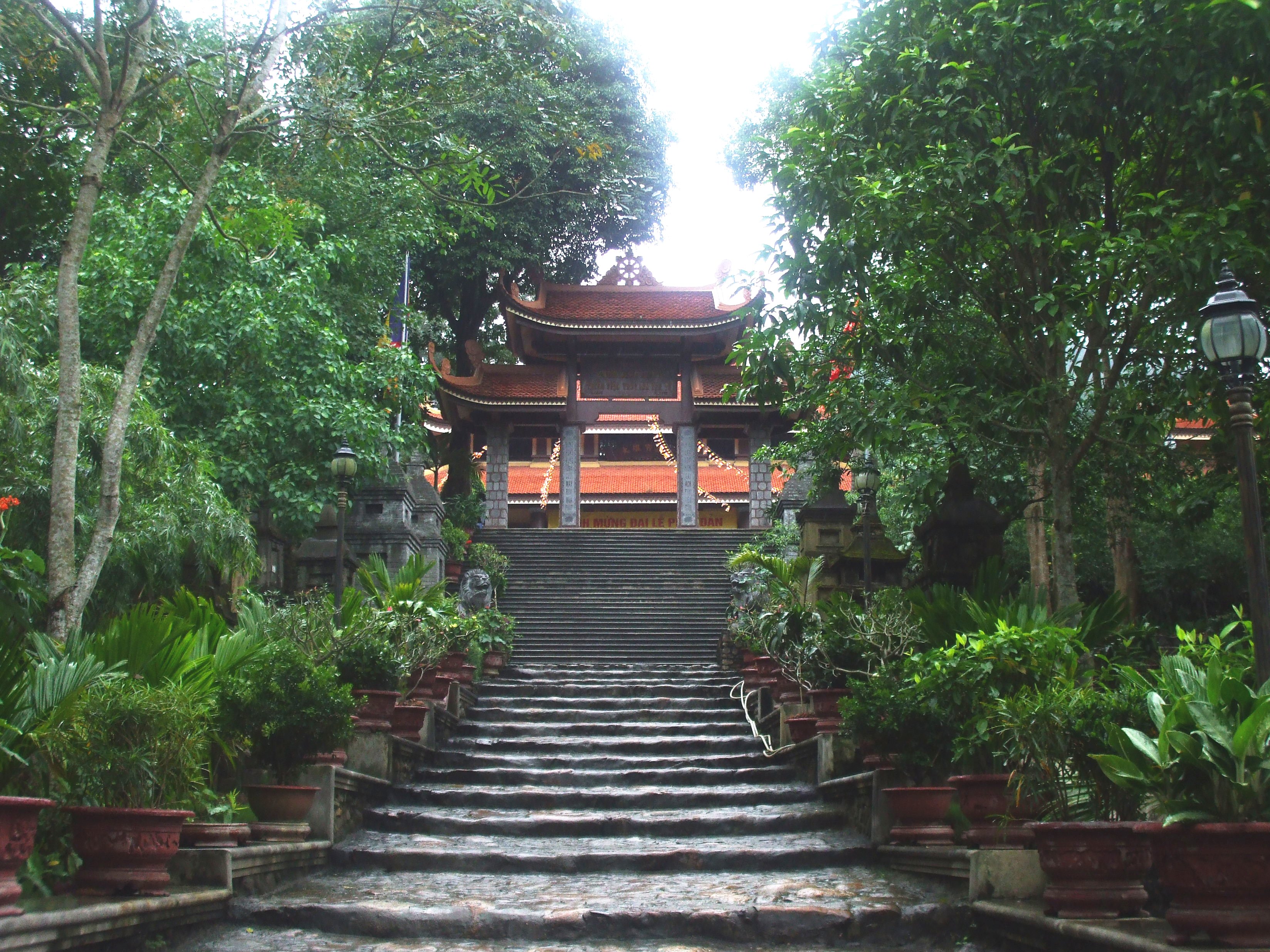
- Hero: View of Quan Lan. Free image: https://upload.wikimedia.org/wikipedia/commons/8/8d/Tam_quan_ch%C3%B9a_L%C3%A2n.jpg — Public domain.