
Old Town Hall Prague — The Tower, the Astronomical Clock and 1338
The tower of the Old Town Hall has watched over Prague since 1338. Its Astronomical Clock, fitted in 1410, still draws a crowd every hour. Old Town Hall Prague stands on the south-western corner of the Old Town Square, a Gothic and Renaissance complex that grew house by house over six centuries, and it holds the best viewpoint in the medieval city. Climb the tower in the morning, watch the clock strike at noon, and the whole of old Prague opens up below.
The square around it has been the centre of Prague since the 12th century, a market place, a festival ground and a stage for revolutions. Searches for old town hall prague usually come from travellers who want to know what the clock is, how to reach the top of the tower, and why part of the building is missing. The hall answers all three questions with its own stones: the clock is the oldest working astronomical clock of its kind, the tower has a lift, and the missing east wing is a scar left by the fighting of May 1945, deliberately never rebuilt.
Quick Facts
| Fact | Detail |
|---|---|
| Names | Staroměstská radnice; Old Town Hall; Old Town Hall Prague |
| Location | Old Town Square, Prague, Czechia |
| Coordinates | 50.08711° N, 14.42061° E |
| Founded | 1338, when King John of Luxembourg allowed the city to buy a private house |
| Tower | Built from 1338, height 69.5 m, viewing gallery with a lift |
| Astronomical Clock | Installed 1410, by Mikuláš of Kadaň and Jan Šindel |
| Key events | First Defenestration of Prague 1419; Jan Hus monument 1915; east wing burned May 1945 |
| Use today | Museum, exhibition rooms and viewing tower |
| UNESCO setting | Historic Centre of Prague, inscribed 1992, reference 616, criteria (ii), (iv) and (vi) |
| Wikidata | Q2332231 |
Geography of Old Town Hall Prague
The Square and Its Corner
Old Town Hall Prague stands on the south-western corner of the Old Town Square, the oldest and most central square in Prague, at 50.08711° N and 14.42061° E. The square is a broad open space where the medieval trade routes of the city met, and the hall occupies its most prominent position, with its facade looking out across the whole square. The tower, at 69.5 m, is one of the tallest structures in the Old Town, and from its gallery visitors see the square below, the twin spires of the Church of Our Lady before Týn, the Church of Saint Nicholas, and Prague Castle on its hill across the river. The hall’s position is the reason it became a symbol of the city: it stands where every visitor to the Old Town must pass, and where every photograph of the square begins.
The square itself is roughly rectangular, with the Týn Church on its eastern side, Saint Nicholas on the northern side, and the Town Hall on the south-western corner. It has served as the centre of Prague since the 12th century, hosting markets, festivals and political gatherings, and today it is the busiest visitor site in the city. The hall’s facade and its clock face the open space, so the Astronomical Clock can be read from anywhere on the square. That visibility was deliberate: the clock was a public instrument, telling the time and the movement of the heavens to a whole city at once.
The River, the Bridge and the Castle
The Vltava river flows about ten minutes on foot to the west of the square, and Charles Bridge crosses it to link the Old Town with Prague Castle on the far bank. From Old Town Hall Prague, a visitor can walk through medieval lanes to the bridge, cross into the Malá Strana district, and climb to the castle, following the classic walking route of Prague. The streets around the square form a pedestrian zone with little traffic, so the walk is easy and the views are unbroken. The hall therefore sits at the start of the city’s great walk, and many visitors plan their day around it: the tower and the clock in the morning, the bridge at midday, and the castle in the afternoon.
The geography of the square also explains the hall’s role as a watchtower. In the Middle Ages, the watchman in the tower looked out over the whole city, raising the alarm for fire or for an approaching enemy, and the tower became the visible sign of the Old Town’s right to govern itself. Prague was a free city within the Kingdom of Bohemia, and its town hall was the building in which that freedom was exercised. The tower still performs a version of that old role: it is the place from which the city is best understood, because it shows the layers of Prague in a single view.
The View from the Tower
The Old Town is flat, at about 200 metres above sea level, but the tower of Old Town Hall Prague rises above every roof around it, and its gallery gives a 360-degree view of the city. Below lie the red roofs of the Old Town, with the spires of the Týn Church and Saint Nicholas rising among them, and beyond them the castle with Saint Vitus Cathedral on its hill. On summer mornings, mist settles over the Vltava and the castle appears faintly through it, while in winter the square below holds the Christmas market, with its great tree and rows of wooden stalls. The view changes with the seasons, and the tower is worth climbing more than once, at different hours, for that reason alone.
The square changes character through the day. In the early morning it is quiet, with a few visitors and local residents crossing the cobbles, and the hall stands almost alone in the open space.
By midday it is crowded, with visitors gathering below the clock in the minutes before each hour, and street performers, market stalls and guided groups filling every corner. In the evening the square is lit, and the hall with its clock becomes one of the finest night scenes in Prague. That daily rhythm is part of the geography of the place: the hall is not a monument visited in isolation, but the centre of a square that lives around it.
Reaching Old Town Hall Prague
Reaching Old Town Hall Prague is straightforward. Staroměstská metro station, on line A, lies about five minutes away on foot, and trams run along the riverbank nearby. The walk from Wenceslas Square takes about ten minutes, and the walk from Charles Bridge takes about ten minutes through the old lanes.
Visitors should come early in the morning to avoid the crowds, because the Old Town Square is one of the busiest places in Europe at the height of the season. The hall stands in a pedestrian zone, so the last part of every journey is on foot, across cobbles that can be slippery in wet weather.
Climate and the Seasons
Prague has a continental temperate climate, with warm summers and cold winters, and occasional snow. The Old Town Square is at its best in spring and autumn, when the weather is mild and the crowds are thinner than in summer, but winter has its own appeal, with the Christmas market on the square and the hall lit against the dark sky. The tower and the exhibition rooms are open through the year, and the viewing gallery is a good destination in every season, since the panorama rewards a visit whatever the weather. Visitors in winter should dress warmly, because the gallery is open to the wind, and the walk across the square in January is a cold one.

Prague is on the Vltava river and is the capital and largest city of the Czech Republic as well as the historical capital of Bohemia — CC BY-SA 4
History of Old Town Hall Prague
The Founding in 1338
The story of Old Town Hall Prague began in 1338, when King John of Luxembourg allowed the city council to buy a private house and turn it into a town hall. That house, with its tower built in the same year, became the administrative centre of the Old Town, where the council met, the courts sat, and the important decisions of the city were taken. Over the following centuries the hall grew by buying the neighbouring houses one by one, until it formed a complex of buildings in several styles: Gothic, Renaissance and Baroque. Each purchase added a room, a chapel or a hall, and the building that visitors see today is the result of that slow accumulation rather than a single design.
The tower, built from 1338, is the oldest surviving part of the complex, at 69.5 m high. It was built of stone, with Gothic windows and a pointed roof, and it held the city bells and the city clock. From the tower, the watchman observed the whole city, gave warning of fire or attack, and the tower became the emblem of the Old Town’s self-government, a free city within the Kingdom of Bohemia. The tower has kept that role in the imagination of the city ever since, even though no watchman climbs it today.
The Astronomical Clock of 1410
In 1410, the Astronomical Clock known as the Orloj was installed on the southern wall of the tower, built by the clockmaker Mikuláš of Kadaň and the astronomer Jan Šindel. The clock does far more than tell the time: it shows the position of the sun, the moon and the constellations, and each hour the figures of the apostles pass through small windows above the dial. The Orloj is one of the oldest astronomical clocks in the world still in working order, and it is the most famous symbol of Prague, drawing thousands of visitors each day to watch it strike the hour. Its makers combined the astronomy of their age with the craft of the clockmaker, and the result has outlasted every other clock of its kind in the city.
The clock has been repaired and restored many times, most recently in a major restoration that renewed its details and modernised its mechanism while keeping the design of 1410. The apostles still move, the skeleton still rings its bell, and the dial still tracks the heavens as it did six centuries ago. For the people of Prague, the clock is more than a tourist attraction: it is a working piece of medieval science, and its hourly show is a small ceremony that the city performs for itself as much as for its visitors.
The Golden Age and the Defenestration
The 15th and 16th centuries were the golden age of Old Town Hall Prague. The Old Town became the commercial and political centre of Bohemia, and the hall was extended with council chambers, exhibition rooms and a chapel. In 1419, the first Defenestration of Prague took place at the hall, when Hussite supporters threw Catholic officials from its windows, an act that opened the Hussite Wars. The event showed that the hall was not only an administrative centre but a stage for the history of Bohemia, where the great conflicts of the age were acted out in its own rooms and at its own windows.
The hall’s history is therefore the history of Prague in miniature. Its chambers hosted the councils that governed a free city, its windows witnessed a revolution, and its tower watched over a city that changed rulers, religions and languages around it. The building survived because each generation found a new use for it, and because the people of Prague treated it as the physical record of their own past.
The Nineteenth Century and the Hus Monument
In the 19th century, Old Town Hall Prague was remodelled in the Neo-Gothic style, with a new facade and redecorated interiors, as part of the national revival that reshaped the city. In 1915, the monument to Jan Hus, the religious reformer burned at the stake in 1415, was raised in the middle of the Old Town Square, directly in front of the hall. The monument became a symbol of the Czech nation, and the square in front of the hall became the place where Czechs gather for great occasions, from celebrations to protests. The pairing of the hall and the monument is the most photographed view in Prague, and it ties the building to the national story of the Czech people.
The Fire of May 1945
In May 1945, during the Prague Uprising against the German occupation, the eastern wing of Old Town Hall Prague caught fire and was heavily damaged, with many historical documents and works of art lost. After the war, the eastern wing was not rebuilt: it became an open space, and visitors today can still see the marks of the fire on the walls of the building. The decision not to rebuild was deliberate, keeping the wound of the war as part of the history of the hall. The empty space is one of the most moving sights in the square, because it refuses to pretend that the damage never happened.
The Hall Today
After the war, Old Town Hall Prague was restored and turned into a museum and exhibition venue, with the tower open to visitors and the Astronomical Clock preserved and restored several times. The exhibition rooms change with the seasons, showing the history of the hall and the Old Town, the art of Bohemia and the culture of the city. Today the hall is one of the most important visitor sites in Prague, with its viewing tower, its exhibition rooms and its clock, and it remains the building from which the city is best understood.
UNESCO inscribed the Historic Centre of Prague on the World Heritage List in 1992 under reference 616 and criteria (ii), (iv) and (vi), with the Town Hall as part of the protected ensemble. Of the 17 World Heritage properties in Czechia, the Historic Centre of Prague was the first, inscribed in 1992. The hall is not a separate UNESCO property on its own, but it is one of the most characteristic buildings of the Old Town that UNESCO protects, and its tower and clock are among the features that justify the listing.
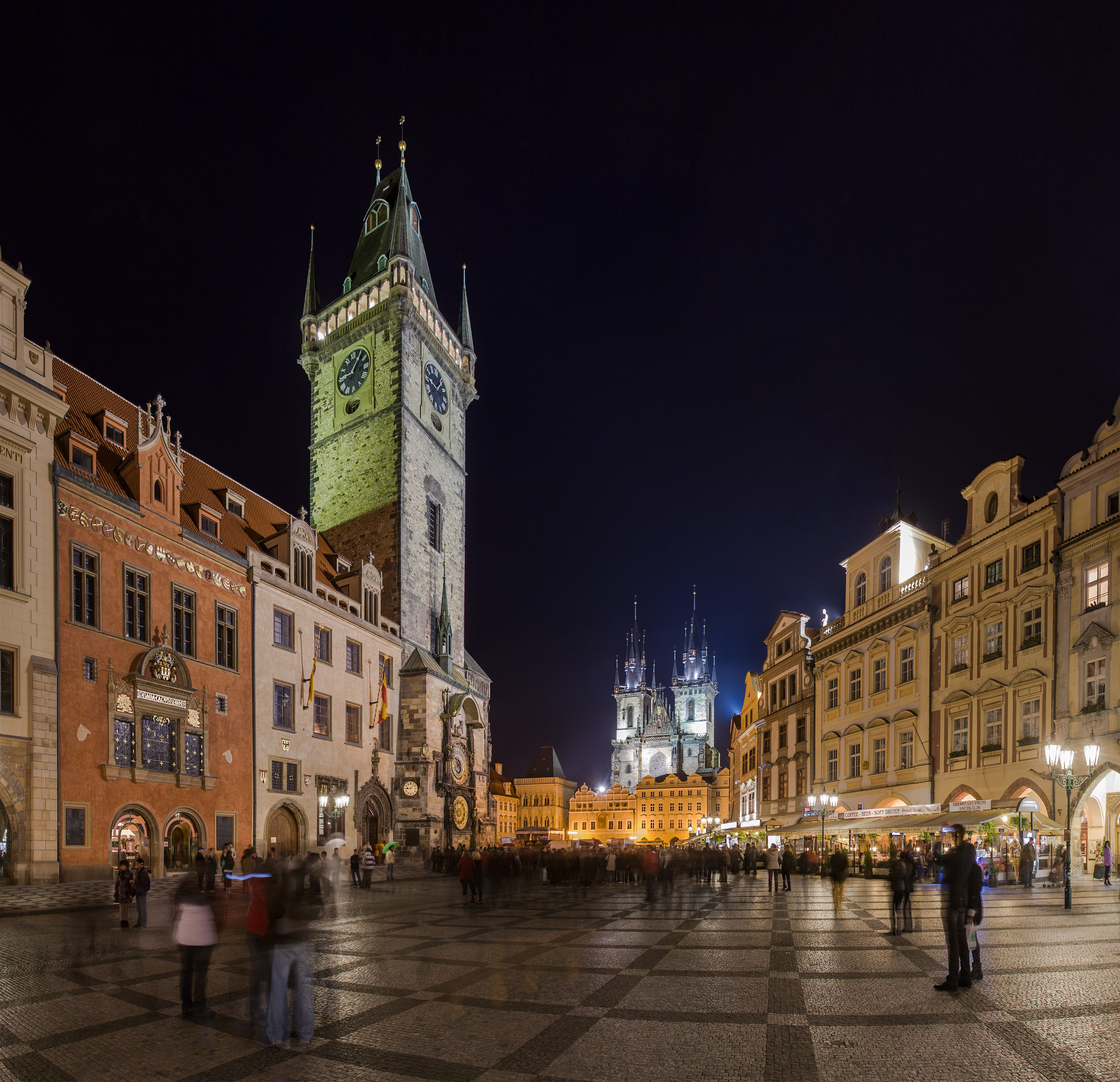
A wide view of the Old Town Square in Prague, Czech Republic — CC BY-SA 3
Travel to Old Town Hall Prague
The most important visit at Old Town Hall Prague is the viewing tower, 69.5 m high, with a lift carrying visitors to the gallery at the top. From the gallery, the whole of the Old Town Square lies below, with the Týn Church, Saint Nicholas, and Prague Castle in the distance. The tower is one of the finest viewpoints in Prague, because it stands at the centre of the Old Town, with a 360-degree view, unlike the towers on the edge of the city. Visitors should climb in the early morning or the late afternoon, when the light is best and the crowds are thinner.
The Astronomical Clock is the second great sight. Visitors should reach the square before the hour to watch the apostles move through the small windows and hear the bell. The clock strikes every hour through the day, and the square is busiest in the minutes before each hour strikes.
Stand on the southern side of the tower, where the dial is clearly visible, and arrive about ten minutes early for a good position, because the crowd gathers fast. The exact striking hours vary with the season, so check the official times on the hall’s own site before visiting.
Inside Old Town Hall Prague, visitors can see the exhibition rooms, with the history of the hall and the Old Town, and the chapel with its Gothic wall paintings. The exhibitions change with the seasons, so check the programme on the official site before travelling. Allow about one to two hours for the visit: half an hour for the tower, half an hour for the clock and the exhibitions, and the rest for walking the square. In the evening, the square is lit and the hall with its clock is one of the finest night scenes in Prague.
Ticket prices for the tower and the exhibitions change with the season, so check the latest official price list before travelling. The hall is open daily, and the tower is reached by lift, which makes the view accessible to visitors who could not climb the stairs. Combine the hall with the Týn Church across the square and with Charles Bridge, about ten minutes away on foot, for a full morning in the Old Town.
Notable Places in Old Town Hall Prague
The Tower and Its Viewing Gallery
The tower of Old Town Hall Prague is the oldest part of the complex, built from 1338 and rising 69.5 m above the square. Its viewing gallery gives the best panorama of the Old Town, with the square below, the spires of the Týn Church, and the castle on its hill. A lift carries visitors to the top, so the view is open to everyone, and the gallery is the place to begin any visit to the hall. On a clear day, the whole of old Prague lies in a single glance from this gallery.
The Astronomical Clock
The Astronomical Clock on the southern wall of the tower is the most famous feature of Old Town Hall Prague. Installed in 1410 by Mikuláš of Kadaň and Jan Šindel, it shows the time, the sun, the moon and the stars, and its apostles pass through small windows each hour. It is one of the oldest astronomical clocks in the world still working, and the crowd that gathers below it at each hour is part of the life of the square. The clock was restored most recently with its 1410 design preserved, so what visitors see today is the medieval instrument itself, not a copy.
The Church of Our Lady before Týn
The Church of Our Lady before Týn stands on the eastern side of the Old Town Square, one of the finest Gothic churches in Prague, with two towers 80 m high and an ornate facade. It was built from the 14th to the 16th centuries, and it is the burial place of the astronomer Tycho Brahe. Visitors to the hall should combine the two buildings, because together they form the classic view of the square, and the church interior rewards the short walk across the cobbles.
The Jan Hus Monument
The Jan Hus Monument stands in the middle of the Old Town Square, directly in front of Old Town Hall Prague. Raised in 1915 for the 500th anniversary of the death of Hus, the reformer burned at the stake in 1415, it is the place where Czechs gather on great occasions. From the monument, the whole square is visible at once: the hall, the Týn Church and Saint Nicholas. The monument and the hall together make the most photographed view in Prague.
Charles Bridge
Charles Bridge lies about ten minutes on foot from Old Town Hall Prague, the most famous stone bridge in the city, with 30 Baroque statues along its sides and a view towards the castle. Visitors who see the hall in the morning can walk to the bridge in the afternoon, through the old lanes, and see the whole of Prague from its span. Early morning is the best time for the bridge, when it is least crowded and the light is kindest for photographs.
Frequently Asked Questions
What is Old Town Hall Prague?
Old Town Hall Prague is the historic town hall on the Old Town Square in Prague, a Gothic and Renaissance complex with a tower 69.5 m high and the Astronomical Clock installed in 1410. The hall was founded in 1338, when King John of Luxembourg allowed the city to buy a private house as its town hall.
When was the Astronomical Clock installed?
The Astronomical Clock was installed in 1410 by the clockmaker Mikuláš of Kadaň and the astronomer Jan Šindel. It shows the time and the position of the sun, the moon and the constellations, with the apostles moving through small windows each hour, and it is one of the oldest astronomical clocks in the world still working.
How do I reach the top of the tower?
A lift carries visitors to the viewing gallery at the top of the 69.5 m tower, where the panorama covers the Old Town Square, the Týn Church and Prague Castle. Climb in the early morning or the late afternoon, when the light is best, and allow half an hour for the tower alone.
Why is the eastern wing of the hall missing?
In May 1945, during the Prague Uprising against the German occupation, the eastern wing of Old Town Hall Prague caught fire and was heavily damaged. After the war, the wing was not rebuilt, and the open space keeps the wound of the war visible as part of the history of the building.
Where is Old Town Hall Prague, and how do I get there?
Old Town Hall Prague stands on the south-western corner of the Old Town Square in the centre of Prague. Staroměstská metro station on line A is about five minutes away on foot, and the walk from Wenceslas Square or from Charles Bridge takes about ten minutes.
Does the hall hold its own UNESCO listing?
The hall belongs to a listed ensemble rather than holding a listing of its own, and that distinction matters for anyone reading the UNESCO records. The Historic Centre of Prague was inscribed in 1992 under reference 616 and criteria (ii), (iv) and (vi), and the hall stands inside that protected area as one of its most characteristic buildings.
Verified
The facts in this article rest on three records read against each other: the Wikidata entry, the English Wikipedia article on the hall, and the UNESCO listing for the Historic Centre of Prague. The Wikidata entry Q2332231 was checked through the Wikidata API on 22 November 2026, and it matches the registry on every point tested. Its instance-of values are town hall and museum, its country is Czechia, its location is Prague, and its coordinates of 50.08711° N, 14.42061° E match the registry exactly.
The founding in 1338 under King John of Luxembourg, the tower built from 1338 at 69.5 m, the Astronomical Clock installed in 1410 by Mikuláš of Kadaň and Jan Šindel, the first Defenestration of 1419, the Jan Hus monument of 1915, and the burning of the eastern wing in May 1945 all come from the English Wikipedia article on the hall, checked on 22 November 2026. UNESCO’s own listing shows the Historic Centre of Prague inscribed in 1992 under reference 616 and criteria (ii), (iv) and (vi), and Czechia holds 17 World Heritage properties, of which Prague was the first.
Sources
- Wikidata, Q2332231, Old Town Hall: instance of town hall and museum, coordinates 50.08711° N, 14.42061° E — https://www.wikidata.org/wiki/Q2332231
- Wikipedia, Old Town Hall, Prague: founded 1338, tower 69.5 m, clock 1410, Defenestration 1419, fire May 1945 — https://en.wikipedia.org/wiki/Old_Town_Hall,_Prague
- UNESCO World Heritage Centre, Historic Centre of Prague, inscribed 1992, reference 616, criteria (ii), (iv) and (vi) — https://whc.unesco.org/en/list/616/
- Prague City Tourism, official site of the Old Town Hall, for opening hours and ticket prices — https://www.prague.eu/staromestskaradnice
- TheTerraAtlas registry: Old Town Hall, parent Prague, canonical URL /en/europe/czechia/prague/old-town-hall/
Unverified
- Current ticket prices for the tower and the exhibitions — check the official price list before travelling, as prices change with the season.
- The exact striking hours of the Astronomical Clock by season — check the official times before visiting, as the hours may vary.
- The current exhibition programme inside the hall — check the official site before travelling, as the exhibitions change with the seasons.
Illustrations
- Hero: Old Town Hall Prague. Free image: https://upload.wikimedia.org/wikipedia/commons/5/5c/Old_Town_Hall_Prague_September_2016-1.jpg — CC BY-SA 4.
- In body, Old Town Hall Prague: Prague is on the Vltava river and is the capital and largest city of the Czech Republic as well as the historical capital of Bohemia. Free image: https://upload.wikimedia.org/wikipedia/commons/4/4c/Prague_Old_Town_2021_42.jpg — CC BY-SA 4.
- In body, Old Town Hall Prague: A wide view of the Old Town Square in Prague, Czech Republic. Free image: https://upload.wikimedia.org/wikipedia/commons/1/1c/Prague_Old_Town_Square%2C_Czech_Republic_-_Oct_2010.jpg — CC BY-SA 3.