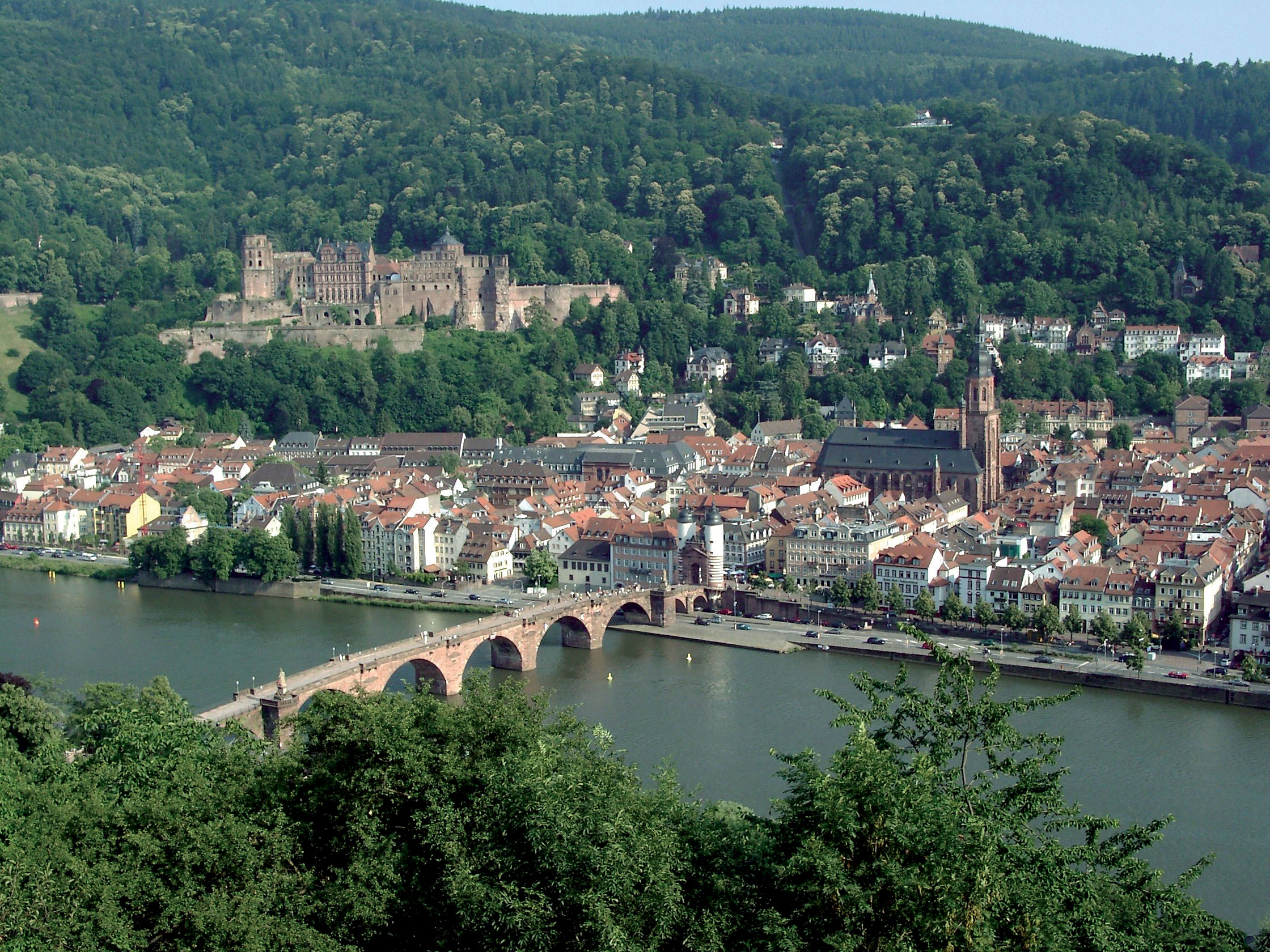
Heidelberg
Heidelberg pairs a ruined red castle with the oldest university in Germany. The Neckar River bends below, and the old town glows between wooded hills.
Heidelberg tourist attractions draw travellers who want a German city that feels like a storybook without feeling like a stage set. The ruined castle rises above a baroque old town, the river carries light between two forested hills, and students have filled the lanes for more than six centuries. Heidelberg tourist attractions work best on foot, and this article walks through the geography of the Neckar valley, the long history of the castle and the university, and the practical detail of a visit.
Quick Facts
| Fact | Detail |
|---|---|
| Location | On the Neckar River, Baden-Wurttemberg, south-west Germany |
| Coordinates | 49.4093582° N, 8.694724° E |
| Population | About 160000 people, with students forming about a quarter of the city |
| Wikidata | Q2966, a large city of Germany |
| University | Heidelberg University, founded in 1386, the oldest university in Germany |
| Landmarks | Heidelberg Castle, Old Bridge, Philosophers Walk, Church of the Holy Spirit |
| UNESCO | No World Heritage inscription, and a UNESCO City of Literature since 2014 |
| Nearest World Heritage | Speyer Cathedral, reference 168, about 21 kilometres to the south-west |
| Best base | The old town, within walking distance of the main Heidelberg tourist attractions |
Geography of Heidelberg
Heidelberg sits where the Neckar River leaves its narrow valley and enters the wide plain of the Upper Rhine. The old town fills the valley floor on the southern bank, squeezed between the river to the north and the wooded slope of the Konigstuhl to the south. The Heiligenberg rises on the northern bank, and the two hills frame the city like the sides of a gate. Heidelberg tourist attractions cluster in this narrow valley, which is why the city feels compact even though its districts spread far across the plain.
The Neckar shapes everything about Heidelberg, and the river arrives from the east through a gorge cut into the Odenwald forest. At Heidelberg the valley opens, the river slows, and the city takes the flat ground on both banks. The old town stays on the southern bank, while the northern bank holds the Neuenheim district and the Philosophers Walk above it. The river runs west from here toward Mannheim, where it joins the Rhine about twenty kilometres downstream, and that meeting of rivers has made the whole region a crossroads for trade and travel.
The Konigstuhl dominates the southern side of Heidelberg, rising to 568 metres above sea level and carrying a dense cover of beech and oak. Heidelberg Castle sits on a spur of the hill about eighty metres above the old town, high enough to command the valley and low enough to stay part of the city. The funicular climbs from the Kornmarkt through the castle station to the summit, where the view opens across the plain toward the Rhine. On clear days the haze over the plain turns the distant hills blue, and the whole Rhine-Neckar region lies visible from the terrace.
The Heiligenberg on the northern bank rises to 439 metres and carries a different history on its summit, with traces of Celtic settlement, a medieval monastery and a vast open-air theatre from the 1930s. The Philosophers Walk runs along the sunny slope below the summit, and its terraces hold gardens, villas and views back across the river to the castle. Heidelberg tourist attractions on the northern bank feel quieter than the old town, and the walk suits a slow afternoon when the light falls on the castle facade.
Heidelberg lies about 78 kilometres south of Frankfurt and about 20 kilometres east of Mannheim, inside the Rhine-Neckar metropolitan region. The city holds about 160000 people, and students form about a quarter of that number, which gives the old town a young and restless energy all year. The districts spread from the Altstadt in the centre to Bergheim and Weststadt in the west, Neuenheim and Handschuhsheim in the north, and Rohrbach and Kirchheim in the south. A newer district called Bahnstadt has grown on former railway land in the west, and it shows a different and modern face of the city.
The climate of Heidelberg is mild for Germany, sheltered by the hills and warmed by the Rhine plain. Summers bring warm days and long evenings along the river, and the beer gardens and terraces of the old town fill as soon as the sun appears. Autumn colours the forests on the Konigstuhl and the Heiligenberg, and the valley holds mist on cold mornings before the sun burns it away. Winters stay relatively gentle, with snow on the hills rather than in the streets, and spring brings blossom to the castle gardens and the paths along the Neckar.
The old town follows the river in a single long line, and the Hauptstrasse runs east to west through its heart for nearly two kilometres. Side lanes drop from the Hauptstrasse toward the river or climb toward the castle, and the squares along the way give the old town its rhythm. The Marktplatz holds the Church of the Holy Spirit and the town hall, the Kornmarkt sits below the castle funicular, and the Karlsplatz opens toward the river at the eastern end. Heidelberg tourist attractions line this single axis, so a visitor can walk from the western gate to the Old Bridge without ever losing the thread of the city.
Green space surrounds Heidelberg on every side, and the forests of the Odenwald begin where the city ends. The Neckar meadows east of the old town give walkers and cyclists a flat path along the water, and the castle gardens offer terraces above the rooftops. The river itself carries rowing boats, excursion boats and swans, and the banks serve as the promenade of the city on warm evenings. Heidelberg works as a city built into a valley rather than imposed on a plain, and the Heidelberg tourist attractions make sense only inside that valley setting.
History of Heidelberg
Heidelberg began as a settlement on the Neckar, and its name first appears in records of the twelfth century, when the counts palatine of the Rhine built a castle above the river. The castle was first mentioned in 1225, and it grew over the following centuries into the residence of the electors palatine, the princes who held one of the great electoral votes of the Holy Roman Empire. Heidelberg tourist attractions still centre on that castle, and the city below it grew in the shadow of the electors and their court. The old town took shape along the river as merchants, craftsmen and students settled under the protection of the hill.
The founding of Heidelberg University in 1386 changed the city for ever, and it remains the oldest university in Germany. The elector Ruprecht the First chartered the university, and students arrived from across Europe to study theology, law and medicine in the new institution. Heidelberg tourist attractions owe much of their character to the university, because the students filled the lanes, the taverns and the debating halls, and their traditions shaped the life of the old town. The university library, founded in 1421, is the oldest existing public library in Germany, and its collections still hold manuscripts that draw scholars from around the world.
The castle rose to its greatest splendour in the sixteenth century, when the electors rebuilt it as a palace of the German Renaissance. The Friedrichsbau, with its row of statues of the electors, and the Ottheinrichsbau, with its richly carved facade, turned the fortress into a residence fit for a prince. The Hortus Palatinus, a great terraced garden laid out for the elector Frederick the Fifth and his wife Elizabeth of Bohemia, was celebrated across Europe as the eighth wonder of the world. Heidelberg tourist attractions still carry the memory of that golden age, even though the garden survives only in fragments and the palace stands as a ruin.
Disaster struck the castle twice, and the city with it. Lightning destroyed the upper castle in 1537, and the French armies of the Nine Years War blew up the castle and burned the town in 1689 and again in 1693. The electors moved their court to Mannheim, and Heidelberg lost its role as a capital.
The townspeople rebuilt the old town in the baroque style that visitors see today, with the Church of the Holy Spirit restored, the Haus zum Ritter raised in 1592 surviving the fires, and the long Hauptstrasse lined with new facades. The castle stayed a ruin, and for a century it served as a quarry for building stone.
The nineteenth century rescued the ruin and gave Heidelberg its romantic fame. Writers and painters of the Romantic movement found beauty in the broken walls and the red sandstone glowing above the river, and the castle became a symbol of a lost and golden past. Mark Twain visited in 1878 and wrote about the city in A Tramp Abroad, and his warm account carried the name of Heidelberg to readers in America. The castle was declared a national monument, the funicular was built to carry visitors up the hill, and the ruin became the most visited sight in the region.
The twentieth century treated Heidelberg more gently than most German cities, and the old town escaped the bombing that levelled so many historic centres. The Heidelberg tourist attractions survived almost intact, and the city kept the townscape that the nineteenth century had celebrated.
The Old Bridge was destroyed by retreating German troops in 1945, and the city rebuilt it stone by stone in 1947, so the bridge that visitors cross today follows the form of the 1788 original. After the war, the American army made Heidelberg its headquarters in Europe, and the American presence shaped the city for decades until the headquarters closed in 2013. The university grew through the same years into a centre of science, with research institutes and the European Molecular Biology Laboratory on the northern bank.
Heidelberg tourist attractions gained a new honour in 2014, when UNESCO named the city a City of Literature in the Creative Cities Network. The honour recognised a literary life that runs from the Romantic poets through Mark Twain to the present day, and it sits alongside the university as a mark of the city cultural standing. The city has never held a World Heritage inscription, and its nomination of the castle and the old town was referred back by the World Heritage Committee in 2005 and deferred in 2007. The nearest inscribed property is Speyer Cathedral, about 21 kilometres to the south-west, and the contrast shows how a city can hold world fame without a World Heritage title.
The university still defines Heidelberg, with about a quarter of the residents linked to study or research, and the old town still feels like a place where learning and leisure mix. The castle ruin, the bridge, the long street and the river walk have survived war, fire and fashion, and they hold together as one of the most complete historic townscapes in Germany. Heidelberg tourist attractions tell that story in stone, and the story continues each term when new students arrive in the city.

The old town of Heidelberg and its castle seen from the Philosophenweg — CC BY-SA 4
Travel to Heidelberg
Heidelberg tourist attractions sit within a compact old town, and the train gives the easiest arrival for most visitors. Frankfurt Airport lies about 80 kilometres to the north, and direct trains and buses link the airport with Heidelberg in about an hour. Heidelberg main station stands west of the old town, and buses and trams run from the station to the Bismarckplatz and the old town gates. Day trips from Frankfurt work well, and the journey south through the Rhine plain takes less than an hour by fast train.
The old town rewards walking above all else, and the Hauptstrasse carries visitors from the Bismarckplatz in the west to the Karlstor in the east. The lanes are flat along the river, though the climb to the castle needs either the funicular or a steep path through the gardens. The funicular starts at the Kornmarkt and climbs first to the castle station and then to the summit of the Konigstuhl, and the ride itself gives views over the rooftops. Buses serve the districts outside the old town, and bicycles work well on the flat riverside paths.
Heidelberg Castle opens as the first stop among the Heidelberg tourist attractions for most visitors, and the courtyard, the great barrel and the German Pharmacy Museum fill a morning. The castle grounds stay open through the day, and the terrace gives the finest view of the old town and the river below. Tickets cover the castle courtyard and the museums, and the funicular fare is sold with the castle ticket at the valley station. This article gives no ticket prices, because prices change and the official castle site carries the current figures.
The best seasons for Heidelberg tourist attractions run from late spring to early autumn, when the river terraces fill and the castle gardens bloom. Summer brings crowds to the old town, especially at weekends, and an early start gives quieter streets and softer light for photographs. Autumn colours the forests on both hills and thins the crowds, while winter brings Christmas markets to the old town squares and a quieter mood to the lanes. Spring suits the Philosophers Walk, when the terraces bloom and the castle stands clear across the river.
Food near the Heidelberg tourist attractions runs from student taverns to fine dining, and the old town holds both within a short walk. The Hauptstrasse and its side lanes offer Swabian and Palatine dishes, with roast pork, dumplings and local wine from the Rhine plain. Cafes on the Marktplatz and the Kornmarkt serve coffee and cake with a view of the castle or the church, and the riverbank holds spots for a picnic on warm days. The university quarter keeps prices lower than the main tourist lanes, and the pubs near the old bridge stay lively into the night.
A day trip from Heidelberg can reach Speyer Cathedral in under an hour, and the Romanesque cathedral makes a strong companion to the castle. The Rhine plain also offers Mannheim, with its grid of streets and its baroque palace, and the wine villages of the Palatinate lie a short drive to the west. Within the city, a full day covers the castle, the old town, the bridge and the Philosophers Walk at a comfortable pace, while a second day allows the museums, the Heiligenberg and a boat trip on the Neckar. Heidelberg tourist attractions reward a slow pace, and the city suits a stay of two days better than a rushed afternoon.

Bus interchange at Heidelberg Station — CC BY-SA 2
Notable Places in Heidelberg
- Heidelberg Castle — the ruined red sandstone palace above the old town, first mentioned in 1225, with the Friedrichsbau, the Ottheinrichsbau, the great barrel and the German Pharmacy Museum, and the finest terrace view in the city.
- Old Bridge — the stone bridge of 1788 across the Neckar, rebuilt in 1947 after its destruction in the war, with its gate tower and the bronze monkey statue that visitors rub for luck.
- Church of the Holy Spirit — the late Gothic church on the Marktplatz, built between 1398 and 1515, with a tower that gives a view across the rooftops of the old town.
- Philosophers Walk — the sunny path on the northern bank above Neuenheim, with gardens, villas and a view back across the river to the castle that draws walkers at sunset.
- Hauptstrasse — the long pedestrian street through the old town, lined with baroque facades, shops, cafes and student taverns, and the spine of the Heidelberg tourist attractions.
- Haus zum Ritter — the ornate house of 1592 on the Hauptstrasse, one of the few buildings to survive the fires of the seventeenth century, now a hotel and a landmark of the old town.
- Konigstuhl — the 568 metre hill above the castle, reached by the historic funicular, with forest paths, a falconry centre and a wide view across the Rhine plain.
- Heiligenberg — the 439 metre hill on the northern bank, with Celtic traces, a ruined monastery and a vast open-air theatre from the 1930s above the Philosophers Walk.
- Student Prison — the old university prison that held students for minor offences from 1778 to 1914, its walls still covered with the drawings and verses of its inmates.
- Kornmarkt — the square below the castle funicular, with the Madonna column at its centre and cafes that look up toward the ruined palace.
Frequently Asked Questions
What are the main Heidelberg tourist attractions?
The main Heidelberg tourist attractions are the castle, the Old Bridge, the Church of the Holy Spirit, the Hauptstrasse and the Philosophers Walk. The castle terrace gives the finest view of the old town, and the bridge and the market square anchor the walk through the historic centre.
Is Heidelberg a UNESCO World Heritage site?
Heidelberg holds no World Heritage inscription, and the nomination of the castle and the old town was referred back in 2005 and deferred in 2007. Heidelberg is a UNESCO City of Literature since 2014, and the nearest World Heritage property is Speyer Cathedral, reference 168, about 21 kilometres away.
How long should I spend on the Heidelberg tourist attractions?
One full day covers the castle, the old town, the Old Bridge and the Philosophers Walk at a comfortable pace. A second day allows the museums, the Heiligenberg and a boat trip on the Neckar, and the city rewards a stay of two days more than a rushed afternoon.
Can I visit the Heidelberg tourist attractions on a day trip from Frankfurt?
Yes, and the journey from Frankfurt takes less than an hour by fast train, with direct buses from Frankfurt Airport as well. A day trip covers the castle and the old town, though an overnight stay gives time for the Philosophers Walk at sunset and the quieter morning streets.
What is the best way to reach Heidelberg Castle?
The historic funicular from the Kornmarkt climbs directly to the castle station and continues to the summit of the Konigstuhl. Walkers can also climb the steep path through the castle gardens, and the castle ticket is sold with the funicular fare at the valley station.
When is the best time to visit the Heidelberg tourist attractions?
Late spring to early autumn gives the warmest weather and the fullest life along the river, with the castle gardens in bloom. Autumn brings colour to the forests and thinner crowds, while winter brings Christmas markets to the old town squares.
Verified
The facts in this article were checked on 22 November 2026 against Wikidata, UNESCO and the official sites of Heidelberg and its castle. Heidelberg is recorded on Wikidata as Q2966, and that identifier matches the registry entry exactly.
Heidelberg University was founded in 1386 and is the oldest university in Germany, the castle was first mentioned in 1225, and the Old Bridge in its present form dates from 1788 and was rebuilt in 1947.
The city holds no World Heritage inscription, and the nomination of Heidelberg Castle and Old Town was referred back by the World Heritage Committee in 2005 and deferred in 2007. Heidelberg was named a UNESCO City of Literature in 2014, and the nearest inscribed property is Speyer Cathedral, reference 168, inscribed in 1981 under criterion (ii). The Konigstuhl rises to 568 metres, the Heiligenberg to 439 metres, and the city lies about 78 kilometres south of Frankfurt.
Sources
- Wikidata, Heidelberg Q2966 — https://www.wikidata.org/wiki/Q2966
- UNESCO World Heritage Centre, Speyer Cathedral, reference 168 — https://whc.unesco.org/en/list/168/
- UNESCO, decision 29 COM 8B.39 on Heidelberg Castle and Old Town — https://whc.unesco.org/en/decisions/502/
- City of Heidelberg, official portal — https://www.heidelberg.de/
- Heidelberg Castle, State Palaces and Gardens of Baden-Wurttemberg — https://www.schloss-heidelberg.de/en/castle
- Germany — the country that holds Heidelberg
- Frankfurt — the nearest major city and airport gateway to the north
- Mannheim — the Rhine city about 20 kilometres west of Heidelberg
Unverified
No ticket prices or opening hours for Heidelberg Castle, the funicular or the museums are given in this article, because those figures change and were not verified directly on the official castle site on 22 November 2026. The population figure of about 160000 is an approximate value, and the share of students at about a quarter of the population is a rounded estimate rather than a census count. The capacity of the great barrel in the castle is not stated, because published figures differ and no official figure was confirmed on the check date. The current status of the Heidelberg Castle and Old Town nomination on the German Tentative List is not stated, because the article confirms only the referral of 2005 and the deferral of 2007.
Illustrations
- Hero: Heidelberg. Free image: https://upload.wikimedia.org/wikipedia/commons/b/b4/Heidelberg_corr.jpg — CC BY-SA 3.0.
- In body, castle: The old town of Heidelberg and its castle seen from the Philosophenweg. Free image: https://upload.wikimedia.org/wikipedia/commons/3/37/K%C3%B6nigstuhl%2C_Heidelberg%2C_U-17.jpg — CC BY-SA 4.
- In body, station: Bus interchange at Heidelberg Station. Free image: https://upload.wikimedia.org/wikipedia/commons/3/33/Bus_interchange_at_Heidelberg_Station.jpg — CC BY-SA 2.