
Neuschwanstein Castle
Neuschwanstein Castle stands on a rocky hill above Hohenschwangau in Bavaria. Ludwig II built it as a private retreat, and it became a symbol of Germany. UNESCO inscribed the castle in 2025, with the other palaces of Ludwig II, under reference 1726.
Quick Facts
- Name: Neuschwanstein Castle.
- Type: Castle.
- Country: Germany.
- Coordinates: 47.5575° N, 10.7494° E.
- Location: Near Füssen, Bavaria, southern Germany, on a rocky hill above Hohenschwangau.
- Built: Begun in 1869, never fully completed.
- Builder: King Ludwig II of Bavaria.
- Style: Romantic Neo-Romanesque.
- Rooms: About 200 rooms, only part of them finished.
- UNESCO property on site: The Palaces of King Ludwig II of Bavaria, inscribed in 2025, reference 1726.
- Best season: May to October, when the weather is warm and the trails are open; winter brings snow and fewer visitors.
Neuschwanstein Castle stands about 800 m above sea level, on a steep rocky hill, with a view over Lake Alpsee, Lake Schwansee and the Bavarian Alps. The name Neuschwanstein means new swan stone, and the castle takes its name from Lohengrin, the Swan Knight in the operas of Richard Wagner, the composer whom Ludwig II admired above all others. The castle was the private home of Ludwig II, not a fortress and not a court palace, and the king built it as a romantic retreat, far from politics and the court in Munich.
Today Neuschwanstein Castle is one of the most photographed castles in Europe, with more than a million visitors each year, above all in summer and autumn. The white towers and blue roofs of the castle, set against the Alps, have made it the image of romantic Germany, and the castle inspired the Sleeping Beauty Castle of Disney, built in 1955 in California.
Geography of Neuschwanstein Castle
Neuschwanstein Castle stands in south-west Bavaria, near the border with Austria, about 120 km south-west of Munich and about 4 km east of the town of Füssen. The castle sits on a rocky hill of the Alps, with steep cliffs to the south and the west, and with pine forest around it, which gives it a natural defence and a fine view. The hill rises above the village of Hohenschwangau, where the hotels, the restaurants and the car parks for visitors stand.
Lake Alpsee lies below the castle, a clear lake with a bathing beach and a walking path, and it ranks among the most beautiful lakes in Bavaria, with a view up to Neuschwanstein Castle. Lake Schwansee, close by, is a smaller lake, with warm water and a summer bathing place for local people, and with a walking path around its shore. The two lakes sit at the foot of the castle hill, and their still water mirrors the towers in the morning light.
The Alps rise around Neuschwanstein Castle, with the Tegelberg peak, about 1,881 m high, to the east, where a cable car climbs to the summit and the ski slopes run in winter. The mountains of the Allgäu region stand around the castle, with green pastures in summer and snow on the peaks in winter, and the view from the castle takes in the lakes, the forests and the Austrian Alps. The Pöllat Gorge, behind the castle, is a deep gorge with a waterfall and the Marienbrücke bridge across it, and it draws walkers and photographers.
The climate at Neuschwanstein Castle is a mild mountain climate, with cool summers of 18 to 25 degrees Celsius and cold winters of minus 5 to 5 degrees, with snow on the peaks. May to October is the best time to visit, when the weather is warm, the trees are green and the walking paths around the castle are open. In winter the castle stands in snow, with fewer visitors, and it suits travellers who want to photograph Neuschwanstein Castle in the snow and to ski at Tegelberg.
Füssen, the town below the castle, is an old town with a pedestrian street, churches and many Bavarian restaurants, and it is the base for visitors to Neuschwanstein Castle and to Hohenschwangau Castle. The village of Hohenschwangau, just below the castle, holds Hohenschwangau Castle, where Ludwig II grew up, with many hotels, restaurants and car parks for visitors. Lake Forggensee, near Füssen, is a large man-made lake with a bathing beach and boats for hire, and it suits travellers who want to rest in summer, with a view up to the castle and the Alps.
The valley below Neuschwanstein Castle holds the village of Hohenschwangau, with its hotels and its car parks, and the smaller Hohenschwangau Castle on its own hill, where the royal family spent its summers. The Schwangau area sits at the foot of the Alps, with meadows, forests and lakes, and the walking paths from the village climb to the castle, to the Marienbrücke and to the Tegelberg. The Alps around the castle hold the border with Austria only a few kilometres to the south, and the mountains on the Austrian side, with their peaks and their valleys, form the backdrop to every view from the castle.
The Romantic Road, or Romantische Straße, is the famous tourist route of Germany, running from Würzburg to Füssen, with Neuschwanstein Castle as its final stop, and it ranks among the most loved routes in Bavaria. The road runs through medieval towns, castles and vineyards, and the castle at its end is the reward for the journey. The castle hill itself is reached on foot, by bus or by horse carriage from Hohenschwangau, and the walk up takes about 30 to 40 minutes, with a steep path and fine views.

View from Marienbrücke to Neuschwanstein Castle , Hohenschwangau , Ostallgäu , Bavaria , Germany — CC BY-SA 3
History of Neuschwanstein Castle
Ludwig II became king of Bavaria in 1864, when he was only 18 years old, and he was a king who loved art, music and architecture, with a deep love for the operas of Richard Wagner. In 1867 Ludwig II visited Wartburg Castle in Thuringia, and the idea of building a romantic castle of his own began to form, with inspiration from the Middle Ages and from German legends. The king wanted a retreat where he could live with his dreams, far from the court and the politics of Munich.
In 1868 Ludwig II bought the ruins of two medieval castles on the rocky hill near Füssen, and in 1869 the building of Neuschwanstein Castle began, with the architect Eduard Riedel and later Georg von Dollmann. The castle was built in the Neo-Romanesque style, with high towers, pointed roofs and arched windows, and the rooms were painted with murals telling German legends and the operas of Wagner. The building work ran for years, with craftsmen, painters and builders working on the hill, and the cost grew far beyond the first budget.
Ludwig II lived at Neuschwanstein Castle from 1884, when part of the castle was finished, and he stayed there for only about 172 days, because the king was declared unfit to rule and deposed in 1886. In June 1886 Ludwig II died in mysterious circumstances at Lake Starnberg, only days after his deposition, and Neuschwanstein Castle was opened to the public only weeks later. The castle was never fully finished, and the Throne Room stands without a throne, since Ludwig II died before the room was complete.
After the death of Ludwig II, Neuschwanstein Castle became one of the most famous sights in Germany, and it inspired the Sleeping Beauty Castle of Disney, built in 1955 in California. Through the twentieth century the castle was cared for and restored many times, with rooms opened to visitors, and the castle appeared in many films, books and advertisements for German tourism. The murals of the castle tell the stories of Parsifal, Lohengrin, Tristan and Isolde, the heroes of the Wagner operas that Ludwig II loved.
In 2025 Neuschwanstein Castle, with the palaces of Herrenchiemsee, Linderhof and Schachen, was inscribed by UNESCO as a World Heritage property with reference 1726, recognising the architecture and the history of the four palaces. UNESCO describes the four palaces as total works of art, built as places of seclusion under the close direction of Ludwig II, with inspiration from Wartburg Castle, the Palace of Versailles and the operas of Wagner. The property is inscribed under criterion (iv), as a varied range of styles that shows the historicism and the eclecticism of the second half of the nineteenth century.
The building of Neuschwanstein Castle cost a great deal of money, and Ludwig II borrowed heavily to finish it, with the cost running far beyond the first budget, and the debts were one of the reasons the king was deposed. Richard Wagner, the composer whom Ludwig II admired, never visited Neuschwanstein Castle, since the king built it as a retreat for himself alone, though the operas of Wagner are the main inspiration for the rooms inside. The building began in 1869, long before Wagner died in 1883, and the king and the composer met often in Munich and at Bayreuth, but never at the castle.
Ludwig II also built two other palaces, Linderhof and Herrenchiemsee, with Linderhof as the smallest palace and the place where the king lived most, and Herrenchiemsee as the largest, inspired by the Palace of Versailles in France. The three palaces, with the King’s House on Schachen, form the UNESCO property of reference 1726, and each one shows a different side of the king’s taste. Today Neuschwanstein Castle is the symbol of Bavaria and of Germany, with millions of visitors each year, and it ranks among the most photographed castles in the world.
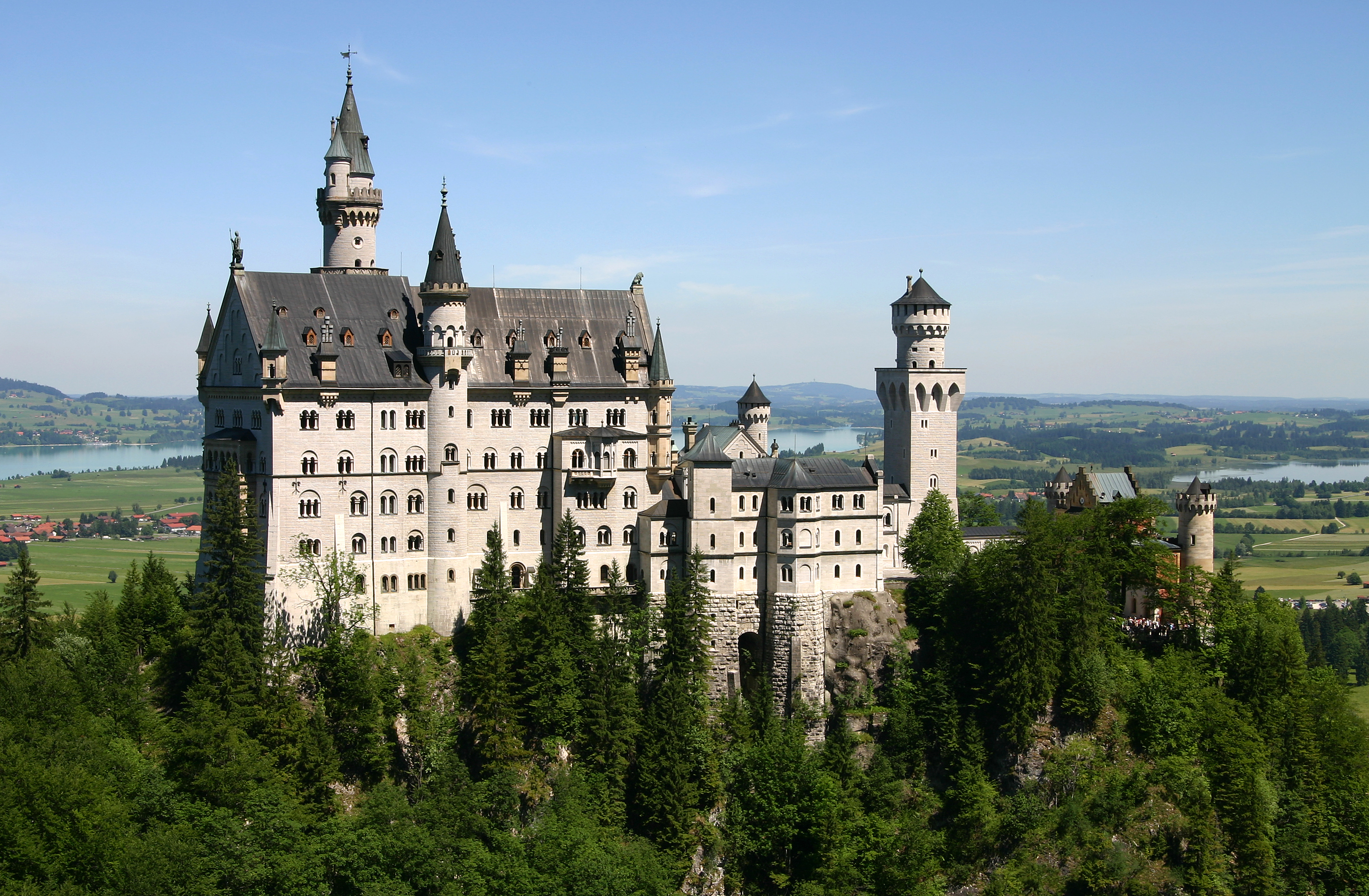
Castle Neuschwanstein at Schwangau , Bavaria , Germany — CC BY-SA 3
Travel to Neuschwanstein Castle
Neuschwanstein Castle is a sight that no traveller to Bavaria should miss, with its fairytale towers, its Alpine scenery and the old town of Füssen close by, with Hohenschwangau Castle nearby. Travellers should book tickets for the castle ahead, since the number of tickets each day is limited and they often sell out early in the high season, above all in summer and at weekends. The tickets are timed, and the visit inside the castle runs on a guided tour, with the rooms shown in order.
The walk from the village of Hohenschwangau up to Neuschwanstein Castle takes about 30 to 40 minutes, with a steep path but fine views, and travellers can also take a bus or a horse carriage up to the castle. The Marienbrücke, the bridge behind the castle, is the most famous photo spot, with a full view of Neuschwanstein Castle, Lake Alpsee and the Bavarian Alps, though the bridge is often crowded in the high season. The bridge crosses the Pöllat Gorge, and it is named after Queen Marie, the mother of Ludwig II.
Inside the castle, travellers visit the finished rooms, with the Throne Room, the Singers Hall and the bedroom of the king, with wall paintings and rich furnishings. The Throne Room is the largest and most splendid room in the castle, with a high ceiling, marble columns and paintings telling the life of Saint George and the German kings, though the throne itself was never placed there. The Singers Hall is the largest room in the castle, with paintings telling the legends of Parsifal and Lohengrin, and it was never used for a concert, since Ludwig II lived alone and held no parties.
Hohenschwangau Castle, below Neuschwanstein Castle, is where Ludwig II grew up, and it is a smaller castle but worth a visit, with the history of the Bavarian royal family. The castle was rebuilt in the nineteenth century by King Maximilian II, the father of Ludwig II, and it holds the rooms where the young king grew up with his love of art and music. The town of Füssen is the best base, with its old town, the Church of Saint Mang and many Bavarian restaurants, and with hotels and guesthouses for travellers.
In summer, travellers can walk around Lake Alpsee, take a boat on the lake and climb the Tegelberg, with a cable car to the summit and a full view over the Allgäu region. In winter, Neuschwanstein Castle stands in snow, with fewer visitors, and the Tegelberg area is a popular place for skiing, with many slopes and a ski school. Travellers to Neuschwanstein Castle should plan at least one full day, with the morning at the castle, the afternoon at the Marienbrücke and Lake Alpsee, and the evening in Füssen.
The best time to visit is May to October, when the weather is warm and the trails are open, and the autumn colours of the forests make the castle at its finest. Winter suits photographers who want the castle in snow, with the white towers against the white peaks, though the days are short and the paths can be icy. Travellers reach Füssen by train from Munich in about two hours, and the buses from Füssen run to Hohenschwangau, where the walk, the bus or the carriage climbs to the castle.
Notable Places in Neuschwanstein Castle
Throne Room is the largest and most splendid room in Neuschwanstein Castle, with a high ceiling, marble columns and wall paintings telling the life of Saint George and the German kings. The room was designed in the Byzantine style, with a mosaic floor and chandeliers, but the throne was never placed there, since Ludwig II died before the room was finished.
Singers Hall is the largest room in the castle, with wall paintings telling the legends of Parsifal and Lohengrin, two figures in the operas of Wagner that Ludwig II loved. The room was never used for a concert, since Ludwig II lived alone and held no parties, but today it ranks among the most striking rooms in the castle.
Kings Bedroom is a small but splendid room, with a carved bed, wall paintings telling the legend of Tristan and Isolde, and a private chapel for the king. The room has windows looking over Lake Alpsee and the Bavarian Alps, and it is where Ludwig II slept in his days at the castle, with wood and fine fabrics.
Marienbrücke is a steel bridge across the Pöllat Gorge, behind the castle, with a full view of Neuschwanstein Castle, and it is the most famous photo spot in Bavaria. The bridge is named after Queen Marie, the mother of Ludwig II, and it is where travellers take the classic photograph of the castle from behind, with Lake Alpsee and the Alps in the distance.
Hohenschwangau Castle is the castle where Ludwig II grew up, below Neuschwanstein Castle, with the history of the Bavarian royal family and a visit worth making. The castle was rebuilt in the nineteenth century by King Maximilian II, the father of Ludwig II, and it is where the young king grew up with his love of art and music.
Lake Alpsee is a clear lake below the castle, with a bathing beach, a walking path and boats for hire, and it suits travellers who want to rest after visiting the castle. The lake has clean clear water, with a view up to the castle and the Bavarian Alps, and it ranks among the most beautiful lakes in Bavaria, above all in summer and autumn.
Füssen is an old town in southern Bavaria, with a pedestrian street, the Church of Saint Mang and many restaurants, and it is the base for visitors to Neuschwanstein Castle and Hohenschwangau Castle. The town has a long history, with monasteries and old churches, and it ranks among the most beautiful towns in the Allgäu region, with the Alps around it.
Tegelberg is a mountain about 1,881 m high to the east of Neuschwanstein Castle, with a cable car to the summit, ski slopes in winter and walking paths in summer. From the summit, travellers can see the whole view of the castle, Lake Alpsee and the Allgäu region, and it draws visitors who love nature and sport.
Church of Saint Mang in Füssen is an old church with a Benedictine monastery, in the centre of Füssen, with Baroque architecture and a long history, and it is a cultural sight for travellers. The church was built in the eighteenth century, with a rich interior, and it is the burial place of Saint Mang, the patron saint of Füssen.
Lake Schwansee is a small lake near the castle, with warm water and a bathing beach, and it is the summer bathing place of local people and travellers, with a walking path around its shore and a view up to the castle. The lake is called the swan lake, and it ranks among the most beautiful lakes in the region, above all in summer when the water is warm and the flowers bloom along its banks.
Frequently Asked Questions
Where is Neuschwanstein Castle?
Neuschwanstein Castle stands near the town of Füssen in Bavaria, in southern Germany, on a rocky hill above the village of Hohenschwangau, about 120 km south-west of Munich. The castle looks over Lake Alpsee and the Bavarian Alps.
Who built Neuschwanstein Castle?
King Ludwig II of Bavaria built Neuschwanstein Castle from 1869, with inspiration from German legends and the operas of Richard Wagner. The king lived there from 1884 for only about 172 days before his death in 1886.
Is Neuschwanstein Castle a UNESCO property?
Yes, Neuschwanstein Castle is part of the Palaces of King Ludwig II of Bavaria, inscribed by UNESCO as a World Heritage property in 2025 with reference 1726. The property also holds Linderhof Palace, Herrenchiemsee New Palace and the Kings House on Schachen.
When is the best time to visit Neuschwanstein Castle?
May to October is the best season, when the weather is warm and the trails are open, and autumn brings fine colours to the forests around the castle. Winter brings snow and fewer visitors, and it suits photographers and skiers at Tegelberg.
How do I get from Füssen up to the castle?
The walk from the village of Hohenschwangau up to Neuschwanstein Castle takes about 30 to 40 minutes, or travellers can take a bus or a horse carriage, with a steep path but fine views. Buses run from Füssen to Hohenschwangau, and the castle tickets should be booked ahead.
What is the Marienbrücke?
The Marienbrücke is a steel bridge across the Pöllat Gorge, behind the castle, and it is the most famous photo spot in Bavaria, with a full view of Neuschwanstein Castle. The bridge is named after Queen Marie, the mother of Ludwig II.
Verified
The castle facts were checked against the Wikidata record for Neuschwanstein Castle, Q4152, a castle in Bavaria, Germany, at 47.5575° N, 10.7494° E, which matches the registry coordinates. The UNESCO facts were checked against the World Heritage listing for the Palaces of King Ludwig II of Bavaria, reference 1726, inscribed in 2025 under criterion (iv), with four components: Neuschwanstein Castle, Linderhof Palace, the Kings House on Schachen and Herrenchiemsee New Palace. The listing states that the palaces were built as private residences under the direction of King Ludwig II, who reigned from 1864 to 1886, and that the building of Neuschwanstein Castle began in 1869.
Ludwig II lived at Neuschwanstein Castle from 1884 for only about 172 days before his death in June 1886, and the castle was opened to the public weeks later. Germany holds 55 World Heritage properties, and Bavaria holds seven of them: Bamberg, Regensburg, the Würzburg Residence, the Wieskirche, the Margravial Opera House in Bayreuth, the Frontiers of the Roman Empire and the Palaces of King Ludwig II. The nearest World Heritage property outside the Ludwig palaces is the Pilgrimage Church of Wies, reference 89, about 18 km from Neuschwanstein Castle in a straight line, and Linderhof Palace, another component of reference 1726, lies about 22 km away. The check date is 23 November 2026.
Sources
- Wikidata Q4152 (Neuschwanstein Castle, castle, Bavaria, Germany) — checked 23 November 2026.
- UNESCO World Heritage Centre, The Palaces of King Ludwig II of Bavaria, reference 1726 — https://whc.unesco.org/en/list/1726/ — checked 23 November 2026.
- UNESCO World Heritage Centre, Pilgrimage Church of Wies, reference 89 — checked 23 November 2026.
Unverified
- The exact number of visitors to Neuschwanstein Castle each year changes from year to year, and the figure of more than a million visitors is a commonly cited estimate.
- The exact number of rooms in the castle varies between sources, and the figure of about 200 rooms is a commonly cited estimate.
- Bus and horse carriage timetables up to the castle change with the season, so travellers should check the latest information before travelling.
Illustrations
- Hero: View of Neuschwanstein Castle. Free image: https://upload.wikimedia.org/wikipedia/commons/e/ef/Schloss_Neuschwanstein_%2845_mm%29.jpg — CC BY 4.
- In body, Neuschwanstein Castle: Castle Neuschwanstein at Schwangau , Bavaria , Germany. Free image: https://upload.wikimedia.org/wikipedia/commons/a/ae/Castle_Neuschwanstein.jpg — CC BY-SA 3.
- In body, Neuschwanstein Castle: View from Marienbrücke to Neuschwanstein Castle , Hohenschwangau , Ostallgäu , Bavaria , Germany. Free image: https://upload.wikimedia.org/wikipedia/commons/c/cd/Neuschwanstein_Castle_07.jpg — CC BY-SA 3.