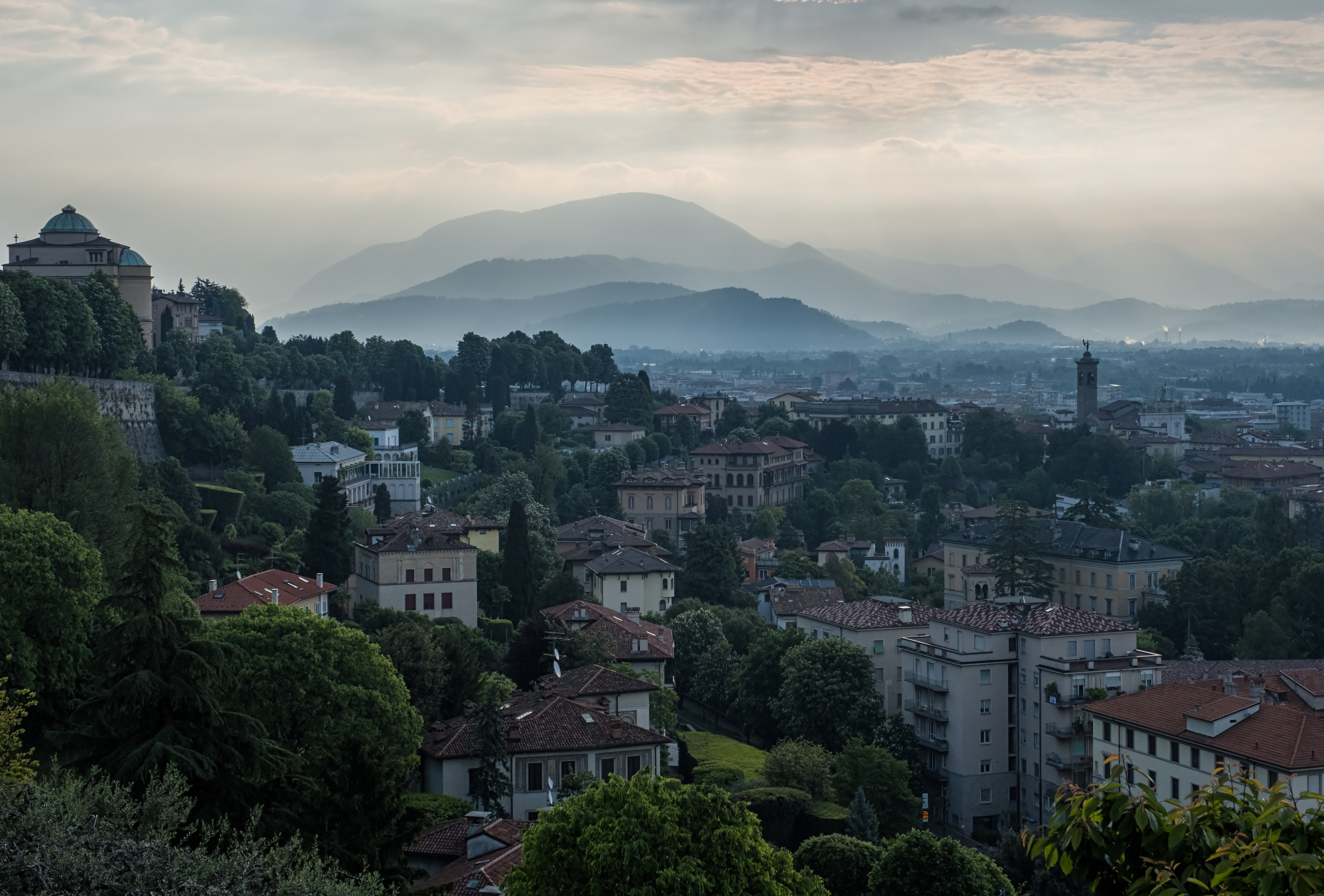
Bergamo — A Walled Hill Town and the Best Base for Northern Italy
Bergamo pairs a walled hill town with a modern city below. Day trips from Bergamo reach Milan, the lakes and Venice with ease.
Bergamo sits in Lombardy, about 50 km northeast of Milan, and it rewards travellers who stop instead of passing through. The upper town keeps its medieval streets behind Venetian walls, while the lower town offers hotels, restaurants and a railway station with trains in every direction. Many visitors land at the nearby airport intending to reach Milan, then find that Bergamo itself gives them a quieter bed and a richer first taste of Italy.
The city works best as a base, and day trips from Bergamo open the whole of northern Italy from a single hotel. A traveller can spend the morning on the walls, ride to Milan for the afternoon, and return to the hill town for dinner. The lakes, the wine country and the Renaissance cities all sit within a short train ride, and the routes below show how to use them. This article covers the geography and the history of Bergamo first, then the practical travel, the notable places and the answers travellers ask most often.
Quick Facts
- Name: Bergamo.
- Type: City in Lombardy, northern Italy.
- Setting: Southern edge of the Orobie Alps, at the meeting point of mountain and plain.
- Coordinates: Forty-five point six nine five degrees north and nine point six seven degrees east.
- Wikidata: Q628.
- Population: About 120,000 residents.
- UNESCO: Venetian walls, reference number 1533, inscribed in 2017.
- Airport: Orio al Serio, about 5 km from the centre.
- Best base for: Day trips from Bergamo to Milan, Lake Como, Lake Iseo, Verona and Venice.
- Best months: April to October, for walking weather and open lake routes.
Geography of Bergamo
Bergamo stands where the Orobie Alps meet the Po plain, in the Lombardy region of northern Italy, about 50 km northeast of Milan. The city looks north toward steep Alpine foothills and south across flat farmland that stretches toward the river Po. Two rivers frame the province, the Brembo to the west and the Serio to the east, and both cut deep valleys into the mountains behind the city. The Adda river runs further east, marking the old border with the Milanese lands and feeding the plain with water for farms and mills.
The city itself rises in two clear levels, and the contrast between them shapes every visit and every plan for day trips from Bergamo. Città Alta, the upper town, crowns a limestone hill about 300 m above the plain, and a ring of Venetian walls more than 6 km long wraps around its medieval streets. Città Bassa, the lower town, spreads across the flat ground below, where the railway station, the shopping streets and most of the modern hotels stand. A funicular railway climbs the slope between the two levels in a few minutes, and the ride itself gives a first view of red roofs, bell towers and the plain beyond.
The climate is continental, with hot summers and cold foggy winters, and the hill town often sits above the mist that covers the plain. Summer days in the lower town can feel warm and humid, while evenings in Città Alta stay cooler because of the height and the breeze from the mountains. Winter brings fog to the plain and snow to the Orobie peaks, and the ski slopes of the upper valleys open when the snow settles. Spring and autumn give the mildest weather for walking the walls and for day trips from Bergamo into the hills and along the lakes.
The valleys behind Bergamo open the way into the Alps, and they give the city its role as a gateway. The Brembana valley runs north from the city toward San Pellegrino Terme and the ski villages of Foppolo and Carona, while the Seriana valley climbs toward the resort towns of the upper Serio. Lake Iseo lies a short drive to the east, between Bergamo and Brescia, and Lake Como lies to the west beyond Lecco, where the Adda leaves the mountains. These valleys and lakes sit close enough for a morning departure and an evening return, which is why day trips from Bergamo work so well as a travel pattern.
The wider map puts Bergamo within easy reach of the great cities of northern Italy. Milan lies about 50 km to the southwest, Verona about 100 km to the east, and Venice about 250 km further east across the plain. Brescia stands halfway to Verona, and the Franciacorta wine country rolls between Bergamo and Lake Iseo. Lake Garda, the largest lake in Italy, lies further east beyond Verona.
The city therefore sits at a crossroads of plain, lake and mountain, and a traveller based here can change landscape completely within an hour.
Orio al Serio airport, known by the code BGY, lies about 5 km southeast of the city centre, on the flat land toward Milan. The airport serves low-cost flights across Europe, and many travellers land here intending to visit Milan, then discover that Bergamo itself repays a stay. Trains link the city with Milan, Lecco, Brescia and Verona, and the motorway network runs south to Milan and east toward Venice. This web of links makes the city a practical base, and day trips from Bergamo begin easily because the station, the airport bus and the funicular all sit close together in the lower town.
South of the city the plain grows rich farmland, planted with maize and wheat, while the hills to the north rise quickly into chestnut woods and pasture. The Parco dei Colli, a regional park, protects the green slopes around Città Alta, and its paths climb through woods to viewpoints and small sanctuaries. Crespi d’Adda, a planned workers village on the river Adda, lies southeast of the city and shows the industrial side of the Lombard plain.
The plain also feeds the day trips from Bergamo that follow the Adda eastward toward the Franciacorta hills and the shores of Lake Iseo. The mix of hill, plain, river and lake within a small radius gives Bergamo a geography that rewards both short walks and longer day trips from Bergamo across Lombardy.

A view of Bergamo — CC BY-SA 4
History of Bergamo
Bergamo began as a settlement of the Orobii, a Celtic people of the Alpine foothills, and Rome made it a municipium called Bergomum after the conquest of the north. Roman roads crossed the town on the way from Milan toward the Alpine passes, and the grid of the upper town still follows the Roman plan in places. The fall of Rome left the city exposed, and the Lombards made it the seat of a duchy, one of the strongholds of their kingdom in northern Italy. Frankish rule followed, and by the twelfth century Bergamo had grown into a free commune with its own government and its own ambitions.
The commune centuries brought wealth and conflict in equal measure, as Bergamo fought its neighbours and split between the Guelph and Ghibelline factions that divided Lombardy. The Visconti lords of Milan took the city in the fourteenth century and held it through wars and sieges, building fortifications on the hill and taxing the trade that passed through. In 1428 the Republic of Venice seized Bergamo, and the city stayed Venetian for almost four centuries, until 1797. Venetian rule gave Bergamo its walls, its squares and much of its civic pride, and the lion of Saint Mark still guards the old gates.
The Venetians built the great walls around Città Alta in the second half of the sixteenth century, when gunpowder had changed the art of siege warfare. The ring runs for more than 6 km, with bastions, gates and long ramparts that follow the edge of the hill, and it turned the upper town into a fortress that no army ever took by storm. Inside the walls, noble families built palaces and chapels, and the condottiero Bartolomeo Colleoni raised his chapel beside the church of Santa Maria Maggiore as a monument to his own fame. The walls still define the upper town today, and their inscription as part of a UNESCO World Heritage property in 2017 recognised four centuries of Venetian military design and the day trips from Bergamo that now begin at their gates.
The church of Santa Maria Maggiore, begun in 1137 after the townspeople vowed to build it if the Virgin saved them from plague, stands at the heart of Piazza del Duomo. The Colleoni Chapel, built between 1472 and 1476, joins it with a facade of coloured marble that counts among the finest works of the Lombard Renaissance. The composer Gaetano Donizetti was born in Bergamo in 1797, in a poor house in the upper town, and the city keeps his memory in a museum, a theatre and a music festival. His birth year also closed the Venetian age, since French armies ended the Republic in the same year and Bergamo passed into the Cisalpine Republic.
Napoleonic rule gave way to Austrian control after 1815, and Bergamo lived under Vienna for more than four decades. The Risorgimento changed that in 1859, when the city joined Piedmont-Sardinia after the war against Austria, and Bergamo entered the Kingdom of Italy when the kingdom was proclaimed in 1861. The nineteenth century also brought the railway, the funicular and the growth of Città Bassa, which spread across the plain as factories and offices multiplied. Textiles, engineering and later the airport economy made Bergamo one of the most prosperous cities of Lombardy.
The twentieth century brought two world wars, and Bergamo endured occupation and bombing before the city was freed in 1945. Post-war decades saw the lower town grow into a modern city, while the upper town kept its medieval streets and its walls, protected as a historic centre. The Accademia Carrara, founded in the late eighteenth century, grew into one of the great art collections of northern Italy. Tourism grew slowly at first, then quickened as low-cost flights filled Orio al Serio and travellers learned that the city offered more than a cheap bed near Milan.
In the spring of 2020 Bergamo became a symbol of the COVID-19 pandemic in Europe, as the province suffered one of the heaviest early outbreaks on the continent. The city mourned its dead in public ceremonies and built memorials to the victims, and the empty streets of Città Alta were shown on news broadcasts around the world. Recovery came steadily, and visitors returned to the walls, the squares and the funicular, drawn by the same hill town that had endured plague, siege and war before. The pandemic years now form the newest layer of a history that stretches from the Celts to the present, and they remind visitors that Bergamo has rebuilt itself many times.
The UNESCO inscription of 2017 closed a long campaign to protect the Venetian walls, and it placed Bergamo on the world heritage map beside Venice itself. Crespi d’Adda, the workers village on the Adda, had joined the same list in 1995, giving the province two World Heritage properties within a short drive of each other. Together they tell the story of Lombardy from Renaissance fortification to industrial paternalism, and they anchor the day trips from Bergamo that reach beyond the city walls. A traveller who walks the ramparts in the morning and visits Crespi in the afternoon sees two centuries of Lombard history in a single day.
Travel to Bergamo
Most visitors reach Bergamo by air, landing at Orio al Serio, or by train from Milan, and both routes put the traveller in the lower town first. Buses run from the airport to the railway station and the city centre, and the lower town streets lead from the station toward the funicular. The funicular climbs from Città Bassa to Città Alta in a few minutes, and a second line continues to the fortress of San Vigilio above the town. Day trips from Bergamo start best from the railway station, where trains leave regularly for Milan, Lecco, Brescia and Verona.
A first day of Bergamo sightseeing belongs to Città Alta, and the circuit begins at the top of the funicular, where Piazza Vecchia opens with its fountain, its library and its bell tower. The Campanone, the great civic tower, still rings one hundred times each evening at ten in the evening, a Venetian custom that once warned citizens to return inside the gates. Santa Maria Maggiore and the Colleoni Chapel fill the morning, with marble, frescoes and the tomb of the commander who built the chapel. The afternoon belongs to the walls, and walkers who plan day trips from Bergamo for the next day often use this walk to study the plain and pick their direction.
Città Bassa rewards a slower afternoon, with the Accademia Carrara as its centrepiece and long arcaded streets for walking and shopping. The gallery holds works by Bellini, Botticelli, Raphael and Titian, and it shows the wealth that Bergamo merchants poured into art. The lower town also holds the Donizetti museum and theatre, the botanical garden on the hill slopes, and the churches and palaces that line the main avenues. Evening in the lower town means aperitivo in the squares and dinner in the trattorias, where polenta and casoncelli, the stuffed pasta of Bergamo, lead the menu.
Milan makes the easiest of the day trips from Bergamo, with trains taking about fifty minutes to the central station. A traveller can see the cathedral, the great shopping arcade and the Sforza Castle in a full day, then return to Bergamo for a quieter evening. Lake Como offers a different day, with the train to Lecco and a boat along the eastern shore to Varenna and Bellagio. The lake towns sit close to Bergamo, and the water, the villas and the mountain backdrop make the journey feel far longer than the hour it takes.
Lake Iseo suits travellers who want a quieter lake, with the island of Monte Isola rising from its waters and the Franciacorta vineyards on its southern shore. Brescia and Verona fill a day for lovers of Roman and Renaissance towns, and both lie on the same railway line east from Bergamo. Venice needs an early start, since the journey takes about two and a half hours each way, but the reward is a full day among canals, palaces and squares. The ski villages of Foppolo and Carona and the spa town of San Pellegrino Terme offer mountain and spa days, and they round out the day trips from Bergamo across the seasons.
Staying in Bergamo suits travellers who want a base rather than a single stop, and the choice of quarter matters. Città Alta gives atmosphere, stone streets and views, but the rooms sit up the funicular and the luggage must climb with them. Città Bassa gives convenience, with the station, the buses and the airport link close at hand, and it suits early departures for day trips from Bergamo.
Spring and autumn give the best walking weather, summer brings heat to the plain and crowds to the lakes, and winter brings fog below and snow above. Three days allow one day in the city and two day trips, while a week opens the whole of Lombardy from a single hotel.

A view of Bergamo — CC BY-SA 4
Notable Places in Bergamo
Città Alta and the Venetian Walls
Città Alta holds the whole medieval city within its walls, with stone lanes, small squares and palaces that have changed little in centuries. The Venetian walls run for more than 6 km around the hill, with four historic gates, and the walk along the ramparts is free and open. San Giacomo gate, with its stone bridge and its lion of Saint Mark, makes the finest entrance, and the sunset view from the walls looks across the plain toward Milan. Many day trips from Bergamo begin with this walk, since the ramparts show the plain, the lakes and the Alps in one panorama.
Piazza Vecchia and the Campanone
Piazza Vecchia counts among the most beautiful squares in Italy, with the Contarini fountain at its centre and the Palazzo della Ragione on one side. The Campanone rises above the square, and its evening peal of one hundred strokes still marks ten in the evening, as it did under Venice. The Angelo Mai library faces the square, and the cafes under the arcades fill with locals in the late afternoon.
Santa Maria Maggiore and the Colleoni Chapel
Santa Maria Maggiore, begun in 1137, mixes Romanesque stonework with Baroque decoration inside, and its wooden choir and tapestries reward a slow visit. The Colleoni Chapel stands against its side, built between 1472 and 1476 for Bartolomeo Colleoni, with a facade of red and white marble and the tombs of the commander and his daughter inside. Together the two buildings form the architectural heart of the upper town, and they stand on the small Piazza del Duomo where the cathedral also rises.
Accademia Carrara
The Accademia Carrara, in Città Bassa, holds one of the finest painting collections in northern Italy, gathered by Count Giacomo Carrara in the eighteenth century. Bellini, Botticelli, Raphael, Titian and the Lombard masters fill its rooms, and the gallery sits beside a park and the modern art museum. A visit takes about two hours, and it pairs well with a walk through the lower town streets afterward.
Lake Iseo and Crespi d’Adda
Lake Iseo, east of Bergamo, offers the quietest of the Lombard lakes, with the car-free island of Monte Isola and fishing villages along its shores. Crespi d’Adda, on the river Adda southeast of the city, is a complete workers village built by a textile family, with houses, a church, a school and a factory in a single planned design. UNESCO listed the village in 1995, and a visit shows the industrial age of Lombardy as clearly as the walls show its Renaissance age. Both places sit close enough for unhurried day trips from Bergamo by train and bus.
Frequently Asked Questions
How many days should I spend in Bergamo?
A single full day is enough for a Bergamo visit that walks Città Alta, climbs the Campanone and circles the walls without rushing. Travellers who arrive late at the airport often sleep one night and leave after lunch the next day. Longer stays make sense when the lakes and the cities around Bergamo are part of the plan.
What is the best day trip from Bergamo?
The Lecco route to Lake Como wins for most visitors, because the boat from Lecco reaches Varenna in under an hour and the villages sit close together. Milan wins for a first visit to Italy, since the cathedral roof and the castle fill a day on their own. Lake Iseo wins for travellers who dislike crowds, since its island and villages stay calm even in August, and that calm is why many day trips from Bergamo end at its shore.
How do I reach Città Alta from the railway station?
Walk about fifteen minutes through the lower town shopping streets to the lower funicular station, then ride up to Piazza Mercato delle Scarpe. A second funicular climbs from there to the fortress of San Vigilio for the highest view in the city. City buses also climb the hill, and taxis wait outside the station for travellers with heavy luggage.
Can I walk the full circuit of the Venetian walls?
The rampart path runs for more than 6 km around Città Alta, and most walkers finish the circuit in about two hours at a gentle pace. The path is free, open and mostly flat, with benches and viewpoints along the way. Start at the San Giacomo gate in the late afternoon, when the light turns the roofs gold and the plain opens below.
When is the best time to visit Bergamo?
April, May, September and October give mild air, clear views and thin crowds on the walls. Summer brings heat to the lower town and busy boats on the lakes, though the hill town stays cooler after sunset. Winter suits travellers who want fog, quiet streets and snow in the valleys above the city, and day trips from Bergamo run best in the mild months.
Is Bergamo cheaper than staying in Milan?
Hotels and meals in Bergamo usually cost less than the same standard in central Milan, and the lower town holds the best value rooms. The saving grows when the trip includes several nights, since the train fare to Milan stays small beside the nightly difference. Travellers who sleep in Bergamo and ride to Milan by day get the quiet hill town at night and the big city by day.
Verified
- Bergamo is a city in Lombardy, northern Italy, with the Wikidata item Q628, whose type is city and commune, and whose coordinates read forty-five point six nine five degrees north and nine point six seven degrees east.
- The Venetian defensive walls of Bergamo form one component of the UNESCO property Venetian Works of Defence between the 16th and 17th Centuries, reference number 1533, inscribed in 2017 under criteria three and four.
- Crespi d’Adda, a planned workers village on the river Adda southeast of Bergamo, joined the UNESCO list in 1995 under reference number 730.
- Venice ruled Bergamo from 1428 until 1797, and the great walls around Città Alta were raised in the second half of the sixteenth century.
- The church of Santa Maria Maggiore was begun in 1137, and the Colleoni Chapel beside it was built between 1472 and 1476.
- Gaetano Donizetti was born in Bergamo in 1797, the same year Venetian rule ended.
- About 120,000 people live in the city, according to the Italian statistics institute, and Orio al Serio airport lies about 5 km from the centre.
- Each fact above was matched against its source during the writing of this article, and the last of those source checks was completed on 22 November 2026.
Sources
- UNESCO — Venetian Works of Defence between the 16th and 17th Centuries, reference number 1533 (https://whc.unesco.org/en/list/1533/) — read on 22 November 2026.
- UNESCO — Crespi d’Adda, reference number 730 (https://whc.unesco.org/en/list/730/) — read on 22 November 2026.
- Wikidata — Bergamo, Q628 (https://www.wikidata.org/wiki/Q628) — read on 22 November 2026.
- Visit Bergamo, the official tourism site of the city (https://www.visitbergamo.net/en/) — read on 22 November 2026.
- Italia, the official Italian tourism portal, Bergamo pages (https://www.italia.it/en/lombardy/bergamo) — read on 22 November 2026.
Unverified
- Opening hours and ticket prices for the Accademia Carrara were not checked against the museum site for this article, so a traveller should confirm them before visiting.
- The timetable and fare of the funicular between Città Bassa and Città Alta were not confirmed from the operator site, and they change with the season.
- Hotel rates in Bergamo, and the prices of guided walks along the walls, were left out because they shift with demand and were not verified on an official site.
- Opening times for the Colleoni Chapel and the Campanone were not verified here, since both follow a seasonal calendar set by the city.
Illustrations
- Hero: A view of Bergamo. Free image: https://upload.wikimedia.org/wikipedia/commons/e/e0/2019_-_Parco_dei_Colli_di_Bergamo.jpg — CC BY-SA 4.0.
- In body, Bergamo: A view of Bergamo. Free image: https://upload.wikimedia.org/wikipedia/commons/b/be/Bergamo_1020.jpg — CC BY-SA 4.
- In body, Bergamo: A view of Bergamo. Free image: https://upload.wikimedia.org/wikipedia/commons/6/60/Bergamo_Alta.jpg — CC BY-SA 4.