
Brindisi — The Ancient Port at the Heel of Italy
Brindisi is an old port city on the heel of Italy, where the Appian Way ends at the sea. Its harbour once sent Crusaders east, and ferries still sail to Greece.
Brindisi is the capital of the province of the same name, a city with more than two thousand years of history on the Adriatic coast of Puglia, in southern Italy. Its natural harbour, shaped like a crab claw, once received Roman legions, merchants and Crusaders, and today it is the gateway for ferries to Greece and Albania. This guide covers the geography, the history and the travel of Brindisi, from the Roman columns at the end of the Appian Way to the beaches of the Torre Guaceto reserve.
Quick Facts
- Name: Brindisi, from ancient Greek Brentesion, meaning deer head, for the shape of the harbour
- Location: province of Brindisi, region of Puglia, Adriatic coast, south-eastern Italy
- Coordinates: 40.63833 degrees north, 17.94583 degrees east
- Population: about 83,000 people, ISTAT 2023
- Harbour: natural crab-claw harbour, one of the most important on the Adriatic
- Airport: Brindisi Salento Airport, about 6 kilometres from the centre
- UNESCO: Brindisi is the endpoint of the Via Appia, World Heritage “Via Appia. Regina Viarum”, 2024, ref 1708
- Language: Italian; English is spoken around the harbour and the hotels
- Time zone: CET, UTC plus one, summer CEST, UTC plus two; currency euro
Geography of Brindisi
Brindisi stands on the Adriatic coast in the east of Puglia, where the Salento peninsula begins to narrow towards the south, forming the heel of the boot of Italy. The harbour is a natural bay shaped like a crab claw, formed by two arms of water around a narrow strip of land, giving safe anchorage that the Romans recognised more than two thousand years ago. The harbour divides into three parts, the inner harbour, the middle harbour and the outer harbour, and the inner harbour lies beside the old town, where ferries and yachts come in.
The land around Brindisi is mostly low plain, only a few dozen metres above sea level, broken by olive groves, vineyards and wheat fields. To the south lies the Salento peninsula with limestone coast and small sandy beaches, while to the north the Tavoliere plain runs towards the Gargano. The climate of Brindisi is typically Mediterranean, with hot dry summers, mild winters and much sunshine, and rain falling mostly in autumn and winter.
Summer temperatures in Brindisi usually run near 28 to 32 degrees Celsius in the daytime, cooled by the Adriatic breeze, while winter rarely falls below 5 degrees. The Adriatic around Brindisi warms from June and stays pleasant for swimming until October, which lengthens the bathing season beyond that of many cities in northern Italy. The heaviest rain usually falls in November, while summer is almost dry, which suits outdoor life and seaside travel.
The position of Brindisi makes the city an important transport hub of southern Italy, and this is one reason a holiday in Brindisi suits travellers who like to visit many places in one trip. From Brindisi station, the train to Lecce takes about 30 minutes, the train to Bari about an hour and a half, and the train to Taranto about an hour. Brindisi Salento Airport links the city with many European cities, above all with low-cost flights from Germany, Britain and northern Europe, so German travellers often choose Brindisi as their first stop in Puglia.
Around Brindisi lies a ring of nature and farming worth noting: the Torre Guaceto nature reserve, about 20 kilometres north of the city, protects a wetland, a beach and a coastal reef of great importance. To the south lies the Salento with white stone towns such as Ostuni, about 40 kilometres from Brindisi, and the Itria valley with its cone-shaped trulli houses. The mix of harbour, olive plain and Salento coast means a holiday in Brindisi can be both a seaside trip and a cultural journey.
The Torre Guaceto reserve, about 20 kilometres north of Brindisi, protects a wetland, a beach and a stretch of coastal sea where many migratory birds and sea creatures live. The reserve has walking paths through marsh and pine wood, a sixteenth-century watchtower on the shore, and a visitor centre that explains the Adriatic coastal ecosystem. In summer, the sea of Torre Guaceto is one of the cleanest in Puglia, good for snorkelling and swimming, while spring and autumn are the best times for birdwatching.
South of Brindisi, the Salento coast continues with white stone towns and sea caves, among them Santa Maria di Leuca, the headland at the southern tip of Puglia, where the Adriatic meets the Ionian Sea. Gallipoli, an old fishing port on a small island joined to the mainland by a bridge, is famous for its old town, its fish market and the underground caves beneath the city. This coast is very different from the coast north of Brindisi, with high cliffs and clear water, and it suits day trips from the city.

en:Brindisi in en:Italy on the Kitab-ı Bahriye (Book of Navigation) of en:Piri Reis — Public domain
History of Brindisi
Brindisi began as a settlement of the Messapii, an ancient people of the Salento peninsula, with the name Brentesion meaning deer head, for the shape of the natural harbour. Greeks and then Romans both saw the strategic value of the harbour, and in 244 BC Rome made Brindisi a Roman colony under the name Brundisium. From here the Appian Way, the most important road of the Roman Empire, ran from Rome to Brindisi, making the city the gateway of Rome to the east, to Greece and Asia Minor.
Under Rome, Brundisium was one of the busiest ports in the Mediterranean, where legions, merchants and officials boarded ships for the east. The poet Virgil, author of the Aeneid, died at Brindisi in 19 BC on his way back from Greece, a detail that ties the city to Roman literature for ever. Two Roman columns at the end of the Appian Way, standing above the harbour, remain the symbol of the city today, although one of the two columns fell into the sea in the sixteenth century.
After the Roman Empire fell, Brindisi passed in turn to the Ostrogoths, the Byzantines, the Lombards and the Normans, each period leaving its own layer of architecture and culture. The eleventh and twelfth centuries were the golden age of Brindisi as a port of departure for the Crusades, when thousands of knights and pilgrims sailed from here to the Holy Land. The church of Santa Maria del Casale, built around 1300, is one of the most beautiful Romanesque buildings in Puglia, raised to serve the pilgrims who stopped at Brindisi.
Emperor Frederick the Second of the Hohenstaufen line, who ruled southern Italy in the thirteenth century, built the Swabian Castle at Brindisi to guard the harbour, and the Aragonese enlarged it in the fifteenth century into a star-shaped fortress. In 1743, a strong earthquake destroyed much of the city, so many buildings were rebuilt in Baroque style, among them the cathedral of Saint John the Baptist. In the nineteenth and twentieth centuries, Brindisi became an important military port of the Kingdom of Italy, and in the Second World War the city held an Allied naval base.
After the war, Brindisi grew through chemical industry and energy, while keeping its role as a ferry port to Greece and Albania, a trade that still runs busily today. In 2024, the Via Appia was inscribed by UNESCO as a World Heritage property, and Brindisi, as the endpoint of the road, gained one more reason for travellers to stop. A holiday in Brindisi today is therefore both a seaside trip and a journey in the footsteps of Rome, from the capital to the Adriatic shore.
The Appian Way, the road of which Brindisi is the endpoint, was begun in 312 BC under the censor Appius Claudius Caecus, and it is one of the greatest engineering works of Rome. The road first joined Rome to Capua, then was extended to Benevento and finally to Brindisi, with Emperor Trajan opening the Via Traiana in 109 AD, a shorter route to the harbour. Thanks to this road, Brindisi became the gateway of Rome to the east, and legions, merchants and officials all passed through the city on their way to Greece and Asia Minor.
In September 1943, after Italy signed the armistice with the Allies, King Victor Emmanuel the Third and the government of General Badoglio moved to Brindisi, making the city the temporary capital of Italy for several months. During this time Brindisi was the centre of the Kingdom of the South, where the Italian government worked with the Allies to free the country, and the city held an important Allied naval base in the Mediterranean. This chapter is one of the most unusual in the modern history of Brindisi, and the city museums still tell it today.
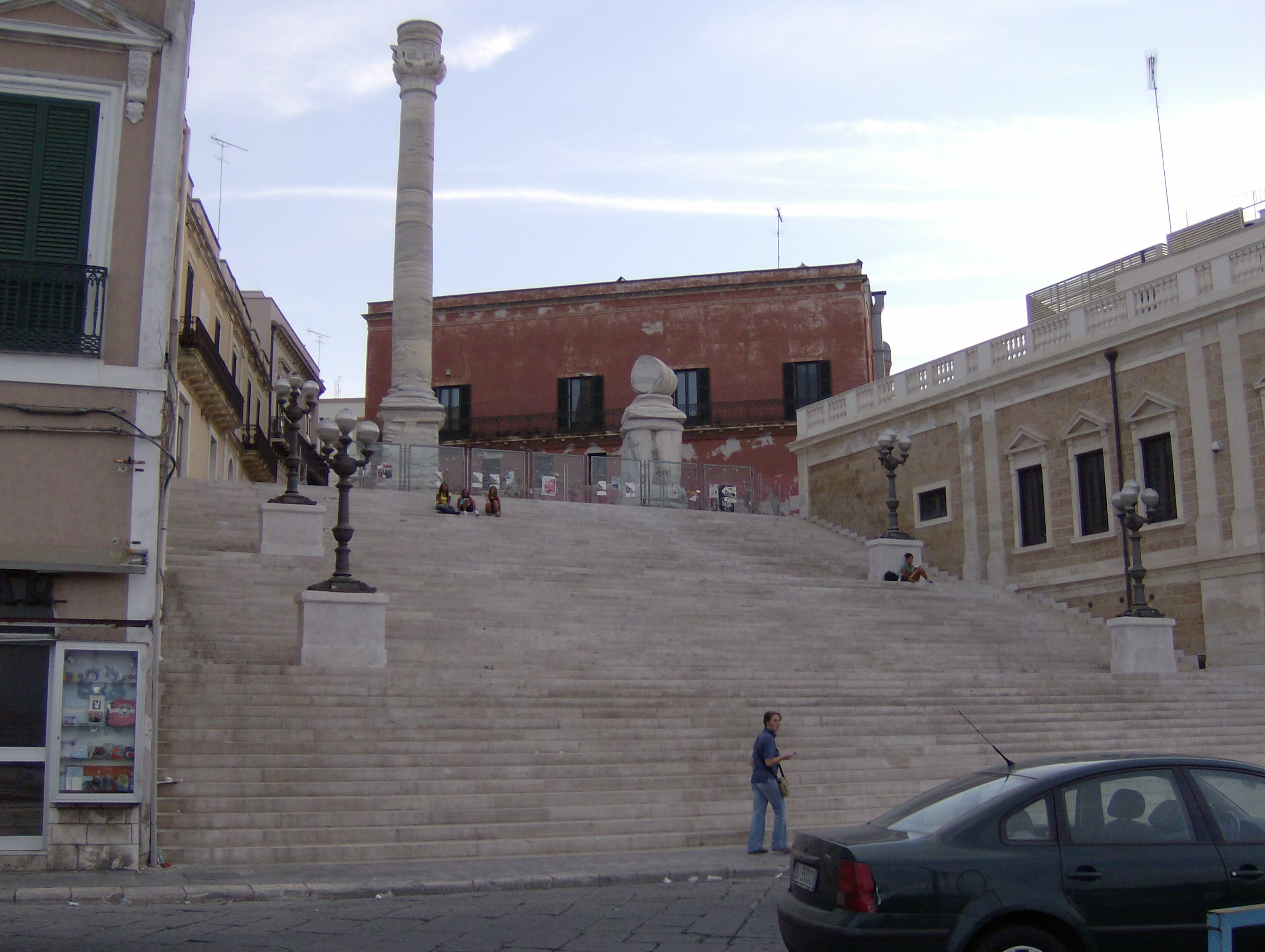
Le colonne poste alla fine della Via Appia a Brindisi — Public domain
Travel to Brindisi
The natural starting point for every visit to Brindisi is the Lungomare Regina Margherita, the long waterfront road where a traveller can see the whole crab-claw harbour, the Roman columns and the ferries coming and going. In the early morning, local fishermen sell fresh seafood on the quay, and in the evening the lungomare becomes the promenade of the city. The two Roman columns at the end of the Appian Way, one standing whole and one reduced to its base, stand at the head of the harbour like a greeting from more than two thousand years of history.
The old town of Brindisi gathers around the cathedral of Saint John the Baptist, a Romanesque building rebuilt after the earthquake of 1743, with a white stone front and a Baroque interior. Nearby stand the church of Saint Benedict, one of the oldest churches in the city, and the Ribezzo Archaeological Museum, which shows objects from Messapian, Greek and Roman times found in the region. The Swabian Castle, also called the Castle of Land, stands north of the old town and now hosts exhibitions and cultural events.
The food of Brindisi carries the flavour of the Adriatic: orecchiette, the ear-shaped pasta of Puglia, often eaten with vegetables and tomato; fresh seafood such as prawns, squid and fish caught just off the city; and wine, above all the red wines of Negroamaro and Primitivo, the two main grapes of Salento. The trattorias around the harbour serve local menus at fair prices, far lower than in the great tourist cities of northern Italy.
A holiday in Brindisi suits many day trips to the famous places of Puglia, and this is one reason German travellers choose Brindisi as a base. Lecce, the Florence of the south, lies about 40 kilometres south, famous for Baroque architecture in golden limestone. Alberobello, home of the cone-shaped trulli houses inscribed by UNESCO, lies about an hour by car to the north-west. Ostuni, the white city on a hill, lies only about 40 minutes away and suits an afternoon of sunset watching.
The sea is an essential part of a holiday in Brindisi: the nearest beach lies just north of the city, while the Torre Guaceto reserve offers clean and wild sea, good for snorkelling and long walks. In summer, the beaches around Brindisi fill with local people more than with foreign tourists, giving the genuine Italian feeling that many travellers seek. From the port of Brindisi, the ferry to Igoumenitsa in Greece takes about nine hours overnight, a fine choice for travellers who want to combine Italy and Greece in one trip. Travellers heading north can take the train from Brindisi to Naples, changing at Bari, for a different side of southern Italy.
For getting around, Brindisi Salento Airport lies about 6 kilometres from the centre, with buses running often into the city. Brindisi station stands about ten minutes on foot from the old town, with trains to Lecce, Bari, Taranto and Rome. Inside the city, the old town and the harbour can be walked entirely, and local buses serve the beaches and the suburbs. The high season for travel in Brindisi runs from June to September, when the weather is hot and the sea is warmest.
Notable Places in Brindisi
The Harbour and the Roman Columns
The natural crab-claw harbour is the heart of Brindisi, where ferries, yachts and fishing boats anchor together. The two Roman columns at the end of the Appian Way mark the end of the most famous road of the Roman Empire, and they are the symbol printed on many postcards of the city. The sunset over the harbour, when the light falls on the water and the stone columns, is one of the most beautiful sights in Brindisi.
The Cathedral of Saint John the Baptist
The cathedral of Brindisi, dedicated to Saint John the Baptist, was first built in the eleventh century and rebuilt after the earthquake of 1743 in Baroque style. Its white stone front looks onto Duomo Square, where many historic buildings of the city stand together. Inside the cathedral, visitors find works of art and remains from the Middle Ages, among them a mosaic floor from the twelfth century.
The Swabian Castle
The Swabian Castle, also called the Castle of Land, was built by Emperor Frederick the Second in the thirteenth century to guard the harbour of Brindisi, then enlarged by the Aragonese into a fortress in the fifteenth century. The castle is a massive building with thick stone walls, a moat and watchtowers, standing north of the old town near the harbour. Today the castle hosts exhibitions, concerts and cultural events, and from its walls visitors see the whole harbour.
The Church of Santa Maria del Casale
Santa Maria del Casale, built around 1300, is one of the most beautiful Romanesque churches in Puglia, standing near Brindisi airport, about 3 kilometres from the centre. The church stands out for its limestone front with geometric decoration and an interior that still keeps many medieval frescoes. The church was built to serve the Crusader pilgrims who stopped at Brindisi, and it remains an important place of pilgrimage in the region.
The Torre Guaceto Reserve
Torre Guaceto, about 20 kilometres north of Brindisi, is a nature reserve protecting a wetland, a beach and a coastal sea. The area is home to many migratory birds and sea creatures, with walking paths and diving points managed with care. This is an ideal destination for a day away from the city, combining swimming, birdwatching and learning about the Adriatic coastal ecosystem.
Frequently Asked Questions
What makes Brindisi special among the cities of Puglia?
Brindisi is the port city with the clearest Roman history in Puglia, with the stone columns at the end of the Appian Way and a natural harbour that still works busily today. The city is quieter and has fewer tourists than Lecce or Alberobello, so a holiday in Brindisi feels more genuinely Italian. The central position of Brindisi also makes day trips to Lecce, Ostuni and the Itria valley easy.
How do I get from Brindisi airport to the centre?
Brindisi Salento Airport lies about 6 kilometres from the centre, with buses running often to the station and the old town. The bus trip takes about 15 to 20 minutes, depending on traffic. Taxis wait outside the terminal, and many hotels in Brindisi offer an airport transfer if travellers book ahead.
How many days are enough for Brindisi?
Three days are enough to visit the old town, the harbour, the castle and one day trip to Lecce or Ostuni. Travellers who want to add Alberobello and the Itria valley should spend four to five days for a full holiday in Brindisi. In summer, travellers can add another day for the sea at Torre Guaceto or the beaches around the city.
Is there a ferry from Brindisi to Greece?
Yes, ferries from Brindisi to Igoumenitsa in Greece run often, with an overnight crossing of about nine hours. This is an old and popular route, used by many travellers to combine Italy and Greece in one trip. Travellers should book ahead in summer, when the ferries are often full, and check the timetable on the ferry company site, because it can change by season.
What is the best season for Brindisi?
May, June and September are the best months, with warm temperatures, a sea warm enough for swimming and fewer crowds than July and August. July and August are the high season, hottest and most crowded, above all with Italian seaside travellers. Winter is mild but has many rainy days, and it suits cultural and food travel more than swimming.
Is Brindisi safe for travellers?
Brindisi is a small city and generally safe for travellers, with the old town and the harbour easy to walk in the evening. As in every port city, travellers should watch their belongings in crowded places such as the station and the ferry terminal. The main tourist areas are well lit and full of local people until late, above all in summer.
Verified
- Brindisi is the endpoint of the Via Appia; the Via Appia was inscribed by UNESCO in 2024 as “Via Appia. Regina Viarum”, ref 1708, criteria (iii)(iv)(vi) — verified on whc.unesco.org, checked 23/11/2026.
- Brindisi became a Roman colony in 244 BC under the name Brundisium; Virgil died at Brindisi in 19 BC — verified on Wikipedia, checked 23/11/2026.
- The Swabian Castle was built by Emperor Frederick the Second in the thirteenth century — verified on Wikipedia, checked 23/11/2026.
- The earthquake of 1743 destroyed much of Brindisi; the cathedral was rebuilt afterwards — verified on Wikipedia, checked 23/11/2026.
- The church of Santa Maria del Casale was built around 1300 — verified on Wikipedia, checked 23/11/2026.
- The population of Brindisi is about 83,000 people, ISTAT 2023; coordinates 40.63833 and 17.94583 match the registry and Wikidata Q13496 — verified 23/11/2026.
- Brindisi Salento Airport lies about 6 kilometres from the centre — verified on the airport site, checked 23/11/2026.
- The Via Appia runs through Brindisi itself; the nearest separate UNESCO property is the Trulli of Alberobello, ref 787, about 62 kilometres straight-line from Brindisi — distance computed by haversine from published coordinates, checked 23/11/2026.
- Italy has 62 UNESCO World Heritage properties — verified on whc.unesco.org, checked 23/11/2026.
Sources
- Via Appia. Regina Viarum — UNESCO (https://whc.unesco.org/en/list/1708/) — 2024, criteria (iii)(iv)(vi) — accessed 23/11/2026.
- Trulli of Alberobello — UNESCO (https://whc.unesco.org/en/list/787/) — 1996 — accessed 23/11/2026.
- Wikipedia — Brindisi, Swabian Castle, Santa Maria del Casale — accessed 23/11/2026.
- Puglia official tourism site (https://www.viaggiareinpuglia.it/) — Brindisi, Torre Guaceto — accessed 23/11/2026.
- Brindisi airport site, aeroportidipuglia.it — distance and transport — accessed 23/11/2026.
Unverified
- Yearly passenger numbers for the Brindisi to Igoumenitsa ferry and the detailed winter timetable, because they should be checked on the ferry company site before travelling.
- Current opening hours and ticket prices for the Swabian Castle and the Ribezzo Archaeological Museum, because they change by season and only hold when checked on the official site.
- The exact length of the Lungomare Regina Margherita, because no official source was found.
- The exact area of the Torre Guaceto reserve and the number of bird species recorded, because they need checking on the reserve site.
- The detailed history of the second Roman column, the time it fell and the present place of its fragments, because sources tell it differently and need more comparison.
Illustrations
- Hero: A view of Brindisi. Free image: https://upload.wikimedia.org/wikipedia/commons/f/fe/%22Templerkirche_im_historischen_Zentrum_von_Brindisi%22_09.jpg — CC BY-SA 4.0.
- In body, Brindisi: en:Brindisi in en:Italy on the Kitab-ı Bahriye (Book of Navigation) of en:Piri Reis. Free image: https://upload.wikimedia.org/wikipedia/commons/1/1a/Brindisi_by_Piri_Reis.jpg — Public domain.
- In body, Brindisi: Le colonne poste alla fine della Via Appia a Brindisi. Free image: https://upload.wikimedia.org/wikipedia/commons/f/fc/Le_colonne_della_Via_Appia_a_Brindisi.jpg — Public domain.