
Calabria — The Toe of the Boot of Italy and the Land of Magna Graecia
Calabria is the toe of the boot of Italy, the southern tip of the peninsula. Greeks settled here in the 8th century BC, and the name Italia spread from this land.
Calabria is one of the least known regions of Italy among international visitors, and one of the richest in history. It was here that the ancient Greeks first set foot in Italy, and it was from this land that the name Italia spread to the whole peninsula. The region is a place of contrasts: white-sand beaches and clear water at Tropea and Capo Vaticano lie below mountains that hold snow in winter, hill towns like Gerace and Stilo still carry the marks of the Byzantine Empire, and ancient oak forests in the national parks form part of a transnational World Heritage property.
Quick Facts
| Item | Detail |
|---|---|
| Location | Southern tip of the Italian peninsula, southern Italy |
| Coordinates | 39.0° N, 16.5° E |
| Capital | Catanzaro |
| Largest city | Reggio Calabria |
| Population | 1,832,147 (2025, ISTAT) |
| Area | 15,221.90 km² |
| Provinces | Catanzaro, Cosenza, Crotone, Reggio Calabria, Vibo Valentia |
| Coastline | About 780 km (Ionian Sea in the east, Tyrrhenian Sea in the west) |
| Highest peak | Serra Dolcedorme, 2,267 m, Pollino National Park |
| UNESCO | Two ancient beech forests in the transnational property ref 1133; Sila is a UNESCO Biosphere Reserve |
| Languages | Italian; Greek (Griko) and Arbëresh (Albanian) in some communities |
| Time zone | CET (UTC+1), summer CEST (UTC+2) |
| Wikidata | Q1458 |
Geography of Calabria
Calabria is one of the 20 regions of Italy, lying at the southern tip of the peninsula. To the north it borders the region of Basilicata, to the east lies the Ionian Sea, to the west the Tyrrhenian Sea, and to the south-west the Strait of Messina, only about 3 km wide, separates Calabria from the island of Sicily. The capital of the region is Catanzaro, and the largest city is Reggio Calabria, standing on the Strait of Messina opposite Messina in Sicily. The region is divided into five provinces: Catanzaro, Cosenza, Crotone, Reggio Calabria and Vibo Valentia.
The land of Calabria is mostly hills and mountains: about 42 percent of the area is mountain, 49 percent is hill, and only 9 percent is plain. The Apennine range runs along the spine of the region in three main blocks: Pollino in the north, Sila in the centre and Aspromonte in the south. The highest peak is Serra Dolcedorme at 2,267 m in Pollino National Park, while Monte Montalto in the Aspromonte reaches 1,955 m and, on a clear day, both seas, the Ionian and the Tyrrhenian, can be seen from its summit.
The coastline of Calabria runs for about 780 km and is very varied. The Tyrrhenian coast in the west, called the Costa degli Dei, the Coast of the Gods, around Tropea and Capo Vaticano, has steep cliffs, white-sand beaches and clear water. The Ionian coast in the east is gentler, with long beaches and towns such as Soverato and Crotone. The Strait of Messina in the south-west is famous for its strong currents and for the Fata Morgana mirage, an optical illusion that the people of old believed was made by the fairy Morgana.
The climate of Calabria is typically Mediterranean: hot dry summers and mild winters on the coast, but cold winters with snow in the mountains. That contrast makes a region where a visitor can swim in the morning and ski in the afternoon in winter. The rivers of Calabria are all short and fast, running from the mountains to the sea through deep valleys, and those valleys have shaped the historic transport routes of the region.
Three national parks protect the most important natural areas of Calabria: Pollino National Park, the largest national park in Italy, on the border with Basilicata; Sila National Park, with pine forests and lakes on a high plateau; and Aspromonte National Park in the far south. In Pollino and Aspromonte there are ancient beech forests that form part of a transnational World Heritage property, and Sila was recognised as a UNESCO Biosphere Reserve in 2014.
Calabria is the toe of the boot of Italy, the southernmost part of the mainland, and its long narrow shape gives it two coasts and a mountain spine in between. No part of the region is far from the sea, yet the mountains dominate the interior, so the region feels both coastal and mountainous at once.
The region covers 15,221.90 square kilometres and has about 1,832,147 people (2025, ISTAT), so it is one of the emptier regions of Italy, with most people living on the coasts and in the few cities.
Away from the coasts, the interior of Calabria is a land of hill towns and mountain villages, many of them built on ridges for defence. The roads climb through pine forests, and in the far south the villages of Aspromonte still speak Griko, a language descended from ancient Greek.
Most people in Calabria speak Italian, but some communities keep older languages: Griko, descended from ancient Greek, survives in the far south around Bova, and Arbëresh, a form of Albanian, is spoken in villages settled by Albanians centuries ago.
History of Calabria
The history of Calabria begins in the 8th century BC, when Greeks from the Greek mainland crossed the Ionian Sea and settled on the southern coast of Italy. They called the land Magna Graecia, Greater Greece, and founded cities that grew rich and powerful: Sybaris, famous for its luxury; Croton, now Crotone, where the philosopher Pythagoras founded his school in about 530 BC; Locri; and Rhegium, now Reggio Calabria.
It was from this land that the name Italia was born. At first the Greeks used the word for the land around the Strait of Messina, and then it spread gradually to the whole peninsula. The Greek cities of Calabria traded across the Mediterranean, minted coins and built temples and theatres. Their remains can still be seen today at Capo Colonna, where a single column survives from the temple of the goddess Hera, and at Locri, among the ruins of the ancient city.
From the 3rd century BC, Rome conquered the Greek cities and the region became the Roman province of Bruttium. After the fall of the empire, Calabria passed to the Byzantines from Constantinople, and for centuries the region belonged to the Greek-Byzantine world, with monasteries, churches and the Greek language still surviving today in the Grecanica area around Bova.
In the 11th century the Normans came from northern France to conquer southern Italy, and the region became part of the Kingdom of Sicily, and later of the Kingdom of Naples. Under the Normans and the dynasties that followed, Anjou, Aragon and Bourbon, Calabria was a remote farming land, often attacked by pirates and struck by earthquakes. Among the worst were the earthquake of 1783, which destroyed many towns, and the Messina earthquake of 1908, which devastated Reggio Calabria.
In 1861 the region became part of the unified Kingdom of Italy. Over the century that followed, the region went through a great wave of emigration: hundreds of thousands of people from Calabria left home for the Americas, northern Europe and northern Italy in search of work. The population of the region reached a peak of about 2.07 million in 1991 and then fell steadily to about 1.83 million in 2025, one of the sharpest falls in Italy.
In the 20th century the region also faced the ‘ndrangheta, the organised crime group of the region, and slow economic development compared with northern Italy. In recent decades, however, Calabria has begun to be known as a new travel destination: Tropea has been voted one of the most beautiful villages in Italy, the national parks draw hikers, and the food of Calabria, above all ‘nduja and the red onion of Tropea, has become famous across Europe.
The Byzantine centuries left Calabria with some of the finest Byzantine churches in Italy, including the Cattolica di Stilo and the churches of Gerace and Rossano. The Normans who followed built castles and cathedrals on the same hill towns, so the towns of the interior carry both layers of history in their streets.
| Year | Event |
|---|---|
| 8th century BC | Greeks found cities in Magna Graecia |
| About 530 BC | Pythagoras founds his school at Croton |
| 3rd century BC | Rome conquers Calabria and names the province Bruttium |
| 6th–11th centuries | Calabria belongs to the Byzantine Empire |
| 11th century | Normans conquer southern Italy |
| 1783 | Great earthquake destroys many towns in Calabria |
| 1861 | Calabria becomes part of unified Italy |
| 1908 | Messina earthquake devastates Reggio Calabria |
| 1972 | Two Riace bronzes found under the sea near Riace |
| 1991 | Population of Calabria peaks at about 2.07 million |
| 2014 | Sila recognised as a UNESCO Biosphere Reserve |
| 2021 | Beech forests of Pollino and Aspromonte in the transnational World Heritage property |
Travel to Calabria
Summer, from June to September, is the high season in the region, with warm seas, plenty of sunshine and festivals in the coastal towns. The finest months to explore the region may be May and September, when the weather is still warm but the beaches are quieter and prices are lower. Spring is the best time for hiking in the national parks, when wild flowers cover the Sila plateau. Winter suits visitors who want to ski in Sila and Aspromonte, or to explore the old hill towns without crowds.
Visitors should allow at least four to five days for Calabria: one day for Tropea and the Costa degli Dei, one day for Reggio Calabria and the Strait of Messina, one day for the Byzantine towns such as Gerace and Stilo, and one or two days for the national parks or the Ionian coast. Travellers who want to explore in depth can spend a whole week, combining the sea, the mountains and the archaeological sites.
The main airport of Calabria is Lamezia Terme International Airport, in the centre of the region, with flights from many European cities. The A2 motorway runs the length of the region from north to south, linking Calabria with Naples and Rome. Trains run along both coasts, but the railway lines through the mountains are slow and infrequent, so hiring a car is the best way to explore Calabria, especially the hill towns and the national parks.
Food is one of the main reasons to come to Calabria. The most famous dish is ‘nduja, a soft spicy sausage made from pork and peperoncino chilli, which comes from the town of Spilinga. The red onion of Tropea, sweet and crisp, is protected by a geographical indication, and the bergamot oranges grown around Reggio Calabria supply most of the world’s bergamot, used to flavour Earl Grey tea. Cirò wine, made from Gaglioppo grapes, is one of the oldest wines in Italy.
For places to stay, Calabria offers everything from beach resorts at Tropea and Capo Vaticano to farm stays, known as agriturismo, in the mountains. Prices are generally much lower than in the famous tourist regions of Italy such as Tuscany and the art cities of Florence and Venice, which is one reason Calabria is seen as one of the best-value destinations in Italy.
A good base for a first visit is Tropea on the west coast, with its beaches and its old town, or Reggio Calabria in the south, with the museum and the seafront. From either base a car is the best way to move, since the mountain towns and the national parks are hard to reach by public transport. A week is enough to see the coast and one or two mountain areas, while a longer stay is needed for all three national parks.

Port of Tropea, Calabria, Italy — CC BY-SA 3
Notable Places in Calabria
Tropea and the Costa degli Dei — It is the most famous cliff town in Calabria, with the monastery of Santa Maria dell’Isola standing on a rock that juts into the sea, and white-sand beaches below. The town stands on the Costa degli Dei, the Coast of the Gods, and has been voted one of the most beautiful villages in Italy.
Reggio Calabria and the Riace bronzes — They are Greek bronze statues from the 5th century BC, found under the sea in 1972 and now shown at the National Archaeological Museum of Reggio Calabria. The seafront promenade of the city looks across the Strait of Messina towards Sicily.
Gerace — It is a medieval hill town with a Norman-Byzantine cathedral and views over the Ionian Sea. It is one of five places in the Italo-Greek heritage nomination that stands on the UNESCO Tentative List.
Cattolica di Stilo — It is a Byzantine church from the 9th to 10th century, one of the best-preserved Byzantine buildings in Italy, standing on a mountainside near the town of Stilo.
Capo Colonna — It is a headland near Crotone with a single column left standing from the temple of the goddess Hera Lacinia, the symbol of Magna Graecia.
Scilla and Chianalea — It is a fishing village at the foot of a cliff at the mouth of the Strait of Messina, tied to the legend of the monster Scylla in the Odyssey. The Chianalea quarter, with its houses close to the water, is called the little Venice of the south.
Pizzo — It is a coastal town famous for Tartufo ice cream and for Murat Castle, where King Joachim Murat was executed in 1815.
Pollino National Park — It is the largest national park in Italy, with the peak of Serra Dolcedorme at 2,267 m and ancient beech forests that form part of a UNESCO World Heritage property.
Sila National Park — It is a high plateau of pine forests, lakes and villages, recognised as a UNESCO Biosphere Reserve in 2014.
Aspromonte National Park — It covers the mountains of the far south, with the peak of Montalto at 1,955 m, the ancient beech forest of Valle Infernale in the World Heritage property, and the Greek-speaking Griko community.
Rossano and the Codex Purpureus Rossanensis — The town holds the Codex Purpureus Rossanensis, a Greek gospel manuscript from the 6th century written on purple-dyed parchment, recorded in the UNESCO Memory of the World programme.
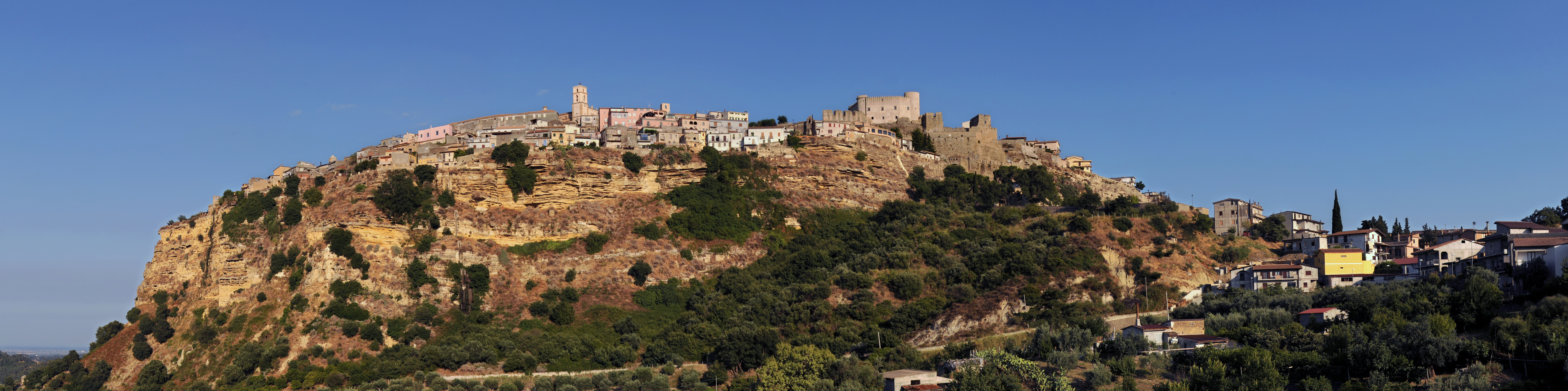
Panoramic image of Santa Severina village, Calabria, Italy — CC BY-SA 3
Frequently Asked Questions
Where is Calabria?
Calabria is the southernmost region of the Italian peninsula, the toe of the boot of Italy. It borders Basilicata in the north, the Ionian Sea in the east, the Tyrrhenian Sea in the west, and the Strait of Messina separates it from Sicily. The capital is Catanzaro, and the largest city is Reggio Calabria.
Does Calabria have a UNESCO World Heritage site?
Calabria has no World Heritage site of its own, but two ancient beech forests, in Pollino and Aspromonte national parks, form part of the transnational property Ancient and Primeval Beech Forests, reference 1133. Sila is also a UNESCO Biosphere Reserve, and the Italo-Greek heritage nomination stands on the UNESCO Tentative List.
What is the most famous food of Calabria?
The most famous food is ‘nduja, a soft spicy sausage made from pork and peperoncino chilli, which comes from Spilinga. Calabria is also known for the red onion of Tropea, bergamot oranges, Cirò wine and Tartufo ice cream from Pizzo. Calabria is a land of hot chilli: peperoncino appears in most dishes of the region.
When is the best time to visit Calabria?
May and September are the best months: the weather is warm, the sea is still good for swimming, and the crowds are smaller than in the summer high season. Summer, from June to August, is the beach season, spring suits hiking in the national parks, and winter brings skiing in Sila and Aspromonte.
What is special about Tropea?
Tropea is the most famous cliff town in Calabria, with the monastery of Santa Maria dell’Isola on a rock jutting into the sea and white-sand beaches below. The town stands on the Costa degli Dei and has been voted one of the most beautiful villages in Italy.
Is it hard to get around Calabria?
Calabria is a large region with mountainous terrain, so hiring a car is the best way to explore. The main airport is Lamezia Terme, the A2 motorway runs the length of the region, and trains serve the coastal towns. Buses to the hill towns and mountain areas are often infrequent, so plan ahead.
Verified
The region was checked figure by figure against the Italian statistics office ISTAT and the UNESCO lists, with the check completed on 23 November 2026. Wikidata holds Calabria as item Q1458, a region of Italy at 39.0 degrees north and 16.5 degrees east, which matches the registry entry. The population of 1,832,147 in 2025 and the area of 15,221.90 square kilometres come from ISTAT, and the five provinces are Catanzaro, Cosenza, Crotone, Reggio Calabria and Vibo Valentia.
Calabria holds no World Heritage site of its own. Two ancient beech forests, in Pollino and Aspromonte national parks, are components of the transnational property Ancient and Primeval Beech Forests of the Carpathians and Other Regions of Europe, reference 1133, and Sila was recognised as a UNESCO Biosphere Reserve in 2014. The nearest inscribed property outside the region is the Sassi and the Park of the Rupestrian Churches of Matera, in Basilicata to the north, inscribed in 1993 under reference 670 with criteria (iii), (iv) and (v) and covering 1,016 hectares, verified live on the UNESCO website on 23 November 2026. Italy holds 62 World Heritage sites, the most of any country, with 56 cultural and 6 natural properties.
Sources
- ISTAT via citypopulation.de — Calabria population and area, https://www.citypopulation.de/en/italy/cities/calabria/, checked 18/11/2026
- UNESCO — Ancient and Primeval Beech Forests of the Carpathians and Other Regions of Europe, https://whc.unesco.org/en/list/1133/, checked 23/11/2026
- UNESCO — The Sassi and the Park of the Rupestrian Churches of Matera, https://whc.unesco.org/en/list/670/, checked 23/11/2026
- UNESCO — Italo-Greek heritage, Tentative List, https://whc.unesco.org/en/tentativelists/6697/, checked 18/11/2026
- Road Calabria — UNESCO in Calabria, https://roadcalabria.it/en/unesco-calabria, checked 18/11/2026
- Wikidata — Q1458 Calabria, https://www.wikidata.org/wiki/Q1458, checked 23/11/2026
Unverified
- Exact length of the Calabria coastline — sources give about 780 km and some give about 800 km; this article uses about 780 km and notes the difference here.
- Populations of Reggio Calabria and Catanzaro by year — not checked against the latest ISTAT figures, so this article names Reggio Calabria as the largest city without giving a figure.
- Exact years when the beech forests of Pollino and Aspromonte were added to the transnational World Heritage property — the Italian components were added in the extensions of 2017 and 2021, but the year for each forest has not been checked against the World Heritage Committee decisions, so no year is given for either forest.
- Ticket prices and opening hours of the National Archaeological Museum of Reggio Calabria, the Cattolica di Stilo and the national parks — check the official website of each place before visiting; this article gives no prices or hours.
- Annual visitor numbers for Calabria and for Tropea — not checked against the official figures of the region, so this article gives no figure.
Illustrations
- Hero: View of Calabria. Free image: https://upload.wikimedia.org/wikipedia/commons/4/43/Reggio_Calabria_-Duomo-_08.jpg — CC BY-SA 4.0.
- In body, Calabria: Panoramic image of Santa Severina village, Calabria, Italy. Free image: https://upload.wikimedia.org/wikipedia/commons/4/46/20100803_Santa_Severina_Calabria_Italy_Panorama.jpg — CC BY-SA 3.
- In body, Calabria: Port of Tropea, Calabria, Italy. Free image: https://upload.wikimedia.org/wikipedia/commons/d/d0/Harbour_of_Tropea_-Calabria–Italy–July_17th_2013-_04.jpg — CC BY-SA 3.