
Capri Hotels
Capri hotels are spread across four small towns on one island. This guide compares them so you can pick the town that fits your stay.
Capri is an island in the Bay of Naples, in the region of Campania, Italy, about 33 km south of Naples in a straight line, and it is one of the most famous islands in the Mediterranean. The island covers about 10.4 square kilometres, with two towns, Capri town and Anacapri, and two harbours, Marina Grande and Marina Piccola, and it is a place of cliffs, grottoes, gardens and villas. Capri hotels are the reason most visitors come here: they stand in the towns and above the harbours, with terraces, gardens and views over the sea, and they serve as a base for the island, the Bay of Naples and the Amalfi Coast. This guide covers the four towns where Capri hotels stand, and it explains what each town offers, so that visitors can choose the town that suits them best.
The name Capri comes from the Greek word kapros, meaning wild boar, or from the Latin caprea, meaning goat, because the island was once home to wild goats. Capri hotels were built in the nineteenth and twentieth centuries, when the island became a resort for artists, writers and royalty, and the island has stayed a luxury destination ever since. The four towns of Capri offer very different stays: Capri town, with the Piazzetta and the luxury shops, is the busiest and the most expensive; Anacapri, on the higher plateau, is quieter and more traditional; Marina Grande, the main harbour, is the place where the ferries arrive; and Marina Piccola, on the south coast, is the place for swimming and sunbathing, with views of the Faraglioni rocks.
Quick Facts
- Island: Capri, in the Bay of Naples, about 10.4 square kilometres, in the region of Campania
- Towns: Capri town, Anacapri, Marina Grande and Marina Piccola, with about 7,000 residents in total
- Highest point: Monte Solaro, 589 metres, reached by chairlift from Anacapri
- Ferry: from Naples in about 50 minutes by fast ferry, and from Sorrento in about 30 minutes
- Cars: non-resident cars are banned on the island, and visitors travel by bus, taxi and on foot
- First emperor: Augustus took Capri in 29 BC, and Tiberius lived here from 27 to 37 AD
- Grotto: the Blue Grotto, rediscovered in 1826, with blue light in the water
- Language: Italian, with English widely used in the hotels and shops
- Money: the euro
- Closest inscribed property: Pompeii, about 30 km to the north-east in a straight line, inscribed in 1997 as ref 829
Geography of Capri Hotels
Capri lies in the Bay of Naples, about 33 km south of Naples in a straight line, about 22 km west of Sorrento, and about 30 km west of Pompeii. The island is about 6 km long and 3 km wide, with cliffs rising from the sea, and it is one of the most scenic islands in the Mediterranean. The position makes Capri an easy destination: the fast ferry from Naples takes about 50 minutes, the slow ferry about 80 minutes, and the ferry from Sorrento takes about 30 minutes.
The island has no airport, and the nearest airports are Naples, about 40 km by road and ferry, and Rome, about 250 km by road and ferry. The layout is simple: Marina Grande, the main harbour, on the north coast; Capri town, on the hill above the harbour; Anacapri, on the higher plateau to the west; and Marina Piccola, on the south coast, with the Faraglioni rocks offshore.
Capri town stands at about 142 metres above sea level, on a hill above Marina Grande, with the Piazzetta, the main square, at its centre. The town is small and easy to walk, with narrow streets, luxury shops, restaurants and cafes, and it is the busiest part of the island, with day visitors from Naples and Sorrento. Capri hotels in the town stand on the hill, with terraces and gardens, and they are the best choice for visitors who want to be in the centre of the island, with the shops and restaurants close by. The town is also the place where the funicular runs from Marina Grande, taking about four minutes, and where the buses leave for Anacapri and Marina Piccola.
Anacapri stands at about 275 metres above sea level, on a plateau to the west of Capri town, with a quieter and more traditional atmosphere. The town is larger in area than Capri town, with houses, gardens, churches and a square, and it is the place where the people of Capri live. Capri hotels in Anacapri stand in gardens and on the plateau, with views over the sea and the island, and they are the best choice for visitors who want a quieter stay, with a traditional atmosphere and lower prices than Capri town. Anacapri is also the place where the chairlift climbs to Monte Solaro, at 589 metres, the highest point of the island, with a panorama over the Bay of Naples and the Amalfi Coast.
Marina Grande is the main harbour of Capri, on the north coast, with ferries from Naples and Sorrento, and it is the place where every visitor arrives. The harbour holds restaurants, cafes, shops and a beach, and it is the busiest part of the island in the morning, when the ferries arrive, and in the evening, when they leave. Capri hotels near Marina Grande stand on the hill above the harbour, with views over the bay, and they are the best choice for visitors who want to be close to the ferries, with an easy arrival and departure. The harbour is also the place where the boats leave for the Blue Grotto and for the tour around the island, with the Faraglioni rocks and the grottoes.
Marina Piccola is a small harbour on the south coast of Capri, with a beach, beach clubs and restaurants, and it is the place for swimming and sunbathing, with views of the Faraglioni rocks. The harbour is reached by bus from Capri town, taking about ten minutes, and it is quieter than Marina Grande, with a more relaxed atmosphere. Capri hotels near Marina Piccola stand above the harbour, with terraces and gardens, and they are the best choice for visitors who want to swim and sunbathe, with the Faraglioni rocks in view. The south coast of Capri is the sunniest part of the island, with the sun falling on it for most of the day, and it is the place to spend the afternoon.
Capri has two coasts with two climates: the north coast, with Marina Grande, is cooler and windier, and the south coast, with Marina Piccola, is warmer and sunnier, because the sun falls on it for most of the day. The sea around the island is deep and clear, and the water reaches about 26 degrees in August, though the beaches are small and rocky, with platforms and beach clubs instead of sand. The ferries run less often in winter, when the sea is rough and many hotels close, and the island returns to its seven thousand residents. July and August are the months of the day visitors, with ferries arriving every hour from Naples and Sorrento, and the town is crowded from morning to night.
Capri is a limestone island, with cliffs, caves and arches formed by the sea over thousands of years, and it is one of the most dramatic islands in the Mediterranean. The cliffs rise from the sea to more than 300 metres, with the Faraglioni rocks offshore, and the island holds many grottoes, with the Blue Grotto as the most famous. The sea around Capri is deep and clear, with a blue colour that changes with the light, and it is the place where boats leave for tours around the island, with the grottoes, the arches and the cliffs.
The island has no rivers, and the water comes from the mainland by pipe and from rain, collected in cisterns, which is why the gardens of Capri are watered carefully and the island is green only where the gardens are tended. The limestone of Capri is white and grey, with fossils of sea creatures, and it is the stone that the Romans used to build their villas, with the ruins still visible on the hills.

Capri, Faraglioni — CC BY-SA 3

Marina Grande, Capri — Wolfgang Moroder, CC BY-SA 3

Anacapri, Capri — Abxbay, CC BY-SA 4

The chairlift to Monte Solaro, Capri — Dr Tr, CC BY 2
History of Capri Hotels
The history of Capri begins with the Greeks, who settled the island in the eighth century BC, and with the Romans, who made it a resort for emperors. Augustus took Capri in 29 BC, and he built villas, gardens and aqueducts, and he made the island a place of leisure for the imperial court. Tiberius, the second emperor, lived on Capri from 27 to 37 AD, and he built twelve villas across the island, among them Villa Jovis, on the hill of Monte Tiberio, at 334 metres, with a view over the Bay of Naples.
The villas of Tiberius are the oldest and most important ruins on Capri, and they show the island as a place of power and leisure in the Roman Empire. The visitor who walks the island today walks over the foundations of a Roman resort more than two thousand years old.
The Middle Ages were a time of pirates and monasteries, and Capri was attacked by Saracen pirates, with the people hiding in Anacapri, on the higher plateau. The island was ruled by Naples, and it stayed a small fishing island, with a harbour, a church and a few houses, until the nineteenth century. The Blue Grotto was rediscovered in 1826, by the German painter August Kopisch and the fisherman Angelo Ferraro, and it made Capri famous across Europe, with artists, writers and royalty coming to see the blue light in the water. The nineteenth century was the age of the Grand Tour, when Capri became a resort for the rich and the famous, with hotels built in Capri town and Anacapri, and the island has stayed a luxury destination ever since.
The twentieth century made Capri a place of artists and writers, with Norman Douglas, the author of South Wind, living on the island, and with the Villa Malaparte, built in the 1930s by the architect Adalberto Libera for the writer Curzio Malaparte, on a cliff above the sea. The villa is one of the most famous modern houses in the world, with a red wall and a staircase that rises to a terrace, and it is a place that every visitor to Capri should see from the sea. The island became a resort for film stars, royalty and politicians, with the Piazzetta as the place to be seen, and it has stayed that way ever since. Capri hotels were built in the nineteenth and twentieth centuries, with the first hotels in Capri town, and they have grown into some of the most famous hotels in the Mediterranean.
Pompeii, the nearest World Heritage property to Capri, is about 30 km to the north-east in a straight line, and it is one of the places that every visitor to Capri should see. Pompeii was inscribed on the World Heritage List in 1997 as ref 829, criteria (iii), (iv) and (v), as a Roman city buried by the eruption of Vesuvius in 79 AD, with houses, streets, frescoes and a forum. Italy holds 62 inscribed properties as of 2026, the most of any country in the world, and Pompeii is one of the most visited of them, with millions of visitors each year.
The historic centre of Naples, about 33 km to the north in a straight line, was inscribed in 1995 as ref 726, and it is the second nearest inscribed property to Capri. A day in Pompeii, with a ferry to Naples and then a train to Pompeii, is one of the finest day trips from Capri.
The island of Capri has no World Heritage property of its own, and it is important to say that clearly, because visitors sometimes think that the whole island is inscribed, and it is not. The nearest inscribed properties are Pompeii and Naples, both on the mainland, and they are the places that every visitor to Capri should combine with the island. The Amalfi Coast, about 40 km to the east by road and ferry, was inscribed in 1997 as ref 830, and it is another place that visitors combine with Capri, with the towns of Positano and Amalfi. A trip to Capri should include at least one day on the mainland, with Pompeii or Naples, because the Bay of Naples holds the history of the Roman world.
The nineteenth century made Capri famous, when the Blue Grotto was rediscovered in 1826 and the island became a stop on the Grand Tour, with artists, writers and aristocrats coming from across Europe. The German painter August Kopisch, who rediscovered the grotto with the fisherman Angelo Ferraro, wrote about the blue light in the water, and his account was read across Europe, drawing visitors to the island. The island became a colony of artists, with painters, writers and musicians living in Capri town and Anacapri, and the hotels of the island were built to house them, with gardens, terraces and views over the sea.
The twentieth century brought film stars, royalty and politicians, with the Piazzetta as the place to be seen, and the island has stayed a luxury destination ever since, with Capri hotels among the most famous in the Mediterranean. The Swedish doctor Axel Munthe, who built the Villa San Michele in Anacapri, wrote a book about the island, The Story of San Michele, which was read across the world and drew more visitors to Capri. The villa holds a garden, a museum and a sphinx, and it is one of the most visited places on the island.

Numero di catalogo: 5535 — Public domain

Villa Jovis, Capri — Derbrauni, CC BY-SA 4

The rotunda of Villa San Michele, Anacapri, above Capri harbour — Berthold Werner, CC BY-SA 3
Travel to Capri Hotels
A trip to Capri usually starts at the Piazzetta, with a coffee and a view over the island, to see the town at its liveliest. The town holds the luxury shops, the funicular from the harbour and the buses to Anacapri, and it is the centre of the island. Anacapri, on the higher plateau, holds the gardens, the churches and the chairlift to Monte Solaro, and it is the quieter side of the island.
The third town is Marina Grande, the main harbour, and it is the best town for visitors who want to be close to the ferries, with an easy arrival and departure. The fourth town is Marina Piccola, on the south coast, and it is the best town for visitors who want to swim and sunbathe, with the Faraglioni rocks in view.
After choosing the town, the stay on Capri is simple: the Piazzetta in the morning, the gardens and villas at midday, and the Faraglioni in the afternoon. The Piazzetta is the main square of Capri town, with cafes, restaurants and shops, and it is the place to sit with a coffee and watch the island. The Gardens of Augustus, above Marina Piccola, hold views over the Faraglioni rocks and the south coast, and they are one of the most beautiful gardens on Capri. The Faraglioni are three rocks off the south coast, called Stella, Mezzo and Scopolo, and they are the symbol of Capri, with boats passing through the arch of the middle rock.
The second day of a trip to Capri is usually given to the Blue Grotto, with a boat from Marina Grande taking about thirty minutes, and then a small rowing boat into the grotto. The Blue Grotto is a sea cave with blue light in the water, caused by sunlight entering through an underwater opening, and it is one of the most famous grottoes in the world. The grotto is small, with a low entrance, and visitors must lie down in the rowing boat to enter, and the visit takes about five minutes inside.
The best time to visit the Blue Grotto is the morning, when the sunlight is strongest, and the grotto is closed when the sea is rough. A morning at the Blue Grotto, with a boat tour around the island in the afternoon, is one of the finest days on Capri.
The third day of a trip to Capri is usually given to Anacapri and Monte Solaro, with a bus from Capri town taking about fifteen minutes, and then a chairlift to the summit at 589 metres. Monte Solaro is the highest point of the island, with a panorama over the Bay of Naples and the Amalfi Coast, and it is one of the places that every visitor to Capri should see. Anacapri holds the Villa San Michele, built by the Swedish doctor Axel Munthe, with a garden, a museum and a view over the island, and it is one of the most beautiful villas on Capri. A day in Anacapri, with the villa in the morning and Monte Solaro in the afternoon, is one of the finest days on the island.
Getting to Capri depends on ferries from Naples and Sorrento, with no airport on the island. From Naples, the fast ferry takes about 50 minutes, and the slow ferry about 80 minutes, with ferries every hour in summer. From Sorrento, the ferry takes about 30 minutes, with ferries every hour in summer.
Non-resident cars are banned on Capri, and visitors travel by bus, taxi and on foot, with the funicular from Marina Grande to Capri town taking about four minutes. The island is small and easy to walk, with paths between the towns.
Places to stay on Capri are divided by town, and the choice of town matters more than the choice of hotel. Capri hotels in Capri town stand on the hill, with terraces and gardens, and they are the best choice for visitors who want to be in the centre of the island, with the Piazzetta and the shops close by, and they are the most expensive Capri hotels on the island. Capri hotels in Anacapri stand in gardens and on the plateau, with views over the sea and the island, and they are the best choice for visitors who want a quieter stay, with a traditional atmosphere and lower prices than Capri town.
Capri hotels near Marina Grande stand on the hill above the harbour, with views over the bay, and they are the best choice for visitors who want to be close to the ferries. Capri hotels near Marina Piccola stand above the harbour, with terraces and gardens, and they are the best choice for visitors who want to swim and sunbathe, with the Faraglioni rocks in view. The restaurants in Capri town are the most expensive on the island, and the restaurants in Anacapri are quieter and cheaper, with traditional food and local wine.
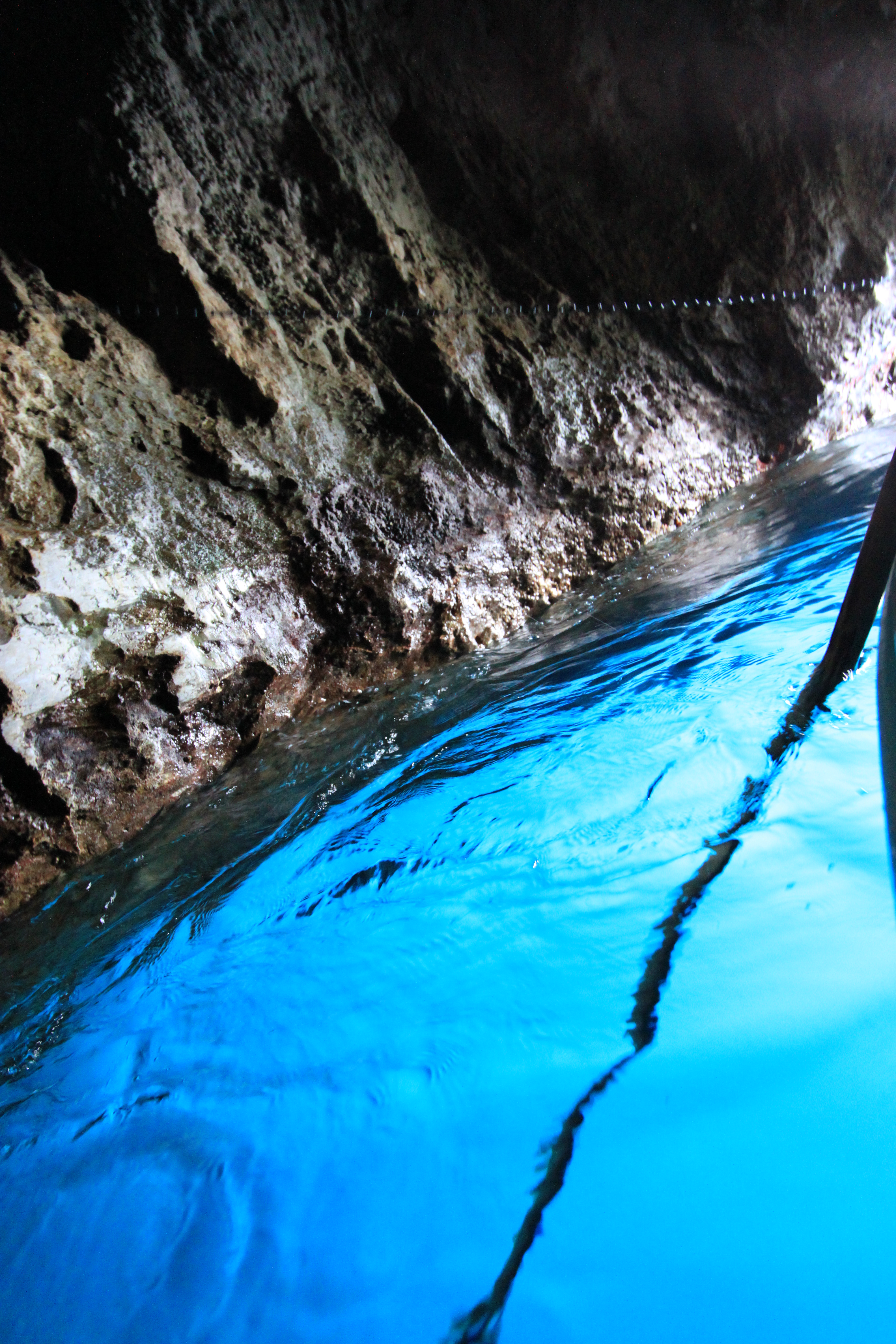
The Blue Grotto, Capri — Tanlingyin, CC BY-SA 3

The funicular from Marina Grande to Capri town — Berthold Werner, CC BY-SA 3
Notable Places in Capri Hotels
The Piazzetta, the main square of Capri town, is the heart of the island, with cafes, restaurants and shops, and it is the place where the people of Capri meet. The square is small, with a clock tower and a church, and it is the place to sit with a coffee and watch the island. The Piazzetta is one of the places that every visitor should see on Capri, because it is the centre of the island, and it is the place where the island is at its liveliest in the evening.
The Gardens of Augustus, above Marina Piccola, hold views over the Faraglioni rocks and the south coast, and they are one of the most beautiful gardens on Capri. The gardens were built by the German industrialist Friedrich Alfred Krupp, with terraces, flowers and statues, and they are the place to see the Faraglioni from above. Visitors should come to the gardens in the afternoon, when the light falls on the Faraglioni, and should allow at least an hour, because the gardens hold many details that need time to see.
The Faraglioni are three rocks off the south coast of Capri, called Stella, Mezzo and Scopolo, and they are the symbol of the island, with boats passing through the arch of the middle rock. The rocks rise from the sea to about 100 metres, with a natural arch in the middle one, and they are the place that every visitor to Capri should see, by boat or from the Gardens of Augustus. The Faraglioni are one of the most famous sights in the Mediterranean, and they are the reason many visitors come to Capri.
The blue light of the grotto comes from sunlight that enters through an underwater opening and is filtered by the water, turning the cave a deep blue, and the effect is strongest between ten in the morning and one in the afternoon. Roman statues, found on the floor of the grotto, are kept in the museum of Capri, and they show that the emperors used the cave as a swimming pool. Swimming in the grotto is now banned, and the only way in is by rowing boat, with the boatman singing as he rows through the low entrance. The visit lasts about five minutes inside, and the grotto is closed when the sea is rough, so a calm morning is the time to go.
Villa Jovis, on the hill of Monte Tiberio, at 334 metres, was the villa of the emperor Tiberius, who lived on Capri from 27 to 37 AD, and it is one of the most important Roman ruins on the island. The villa holds a throne room, a bath, a garden and a view over the Bay of Naples, and it is the place where Tiberius ruled the Roman Empire from Capri. Visitors can walk to Villa Jovis from Capri town in about forty-five minutes, with a path that climbs the hill, and it is one of the places that every visitor to Capri should see.
The Villa San Michele, in Anacapri, was built by the Swedish doctor Axel Munthe, with a garden, a museum and a view over the island, and it is one of the most beautiful villas on Capri. The villa holds a collection of Roman and Egyptian artefacts, with a sphinx in the garden, and it is the place where Munthe wrote his book, The Story of San Michele. Visitors should allow at least an hour for the villa, because the garden, the museum and the view need time to see, and it is one of the places that every visitor to Capri should see.

The Piazzetta, Capri — Ekrem Canli, CC BY-SA 4

The Gardens of Augustus, Capri — Norberto Chavez-Tapia, CC BY-SA 2
Frequently Asked Questions
Which town on Capri is best for a first visit?
Capri town is the best town for a first visit, because it holds the Piazzetta, the luxury shops and the funicular from Marina Grande, and it is the centre of the island, while Anacapri is the best town for a quieter stay, with gardens, churches and a square, and lower prices than Capri town. Capri hotels in the town open for the season at Easter, and the best rooms have a view over the Piazzetta. Marina Piccola is the best town for swimming and sunbathing, with the Faraglioni rocks in view.
How long does a trip to Capri from Naples take?
A trip to Capri from Naples takes about 50 minutes by fast ferry, and about 80 minutes by slow ferry, with ferries every hour in summer. From Sorrento, the ferry to Capri takes about 30 minutes, with ferries every hour in summer. Visitors do not need a car, because non-resident cars are banned on Capri, and the island is served by buses, taxis and the funicular.
How many days should a trip to Capri take?
Two nights on Capri change the island completely: the day visitors leave at dusk, and the Piazzetta belongs to the overnight guests. One night gives you the town and the gardens, but the Blue Grotto needs a calm morning, which a single day cannot guarantee. Three nights add Anacapri, Monte Solaro and a day trip to Pompeii, which is the fullest version of the island.
What makes Capri special?
Capri is special because it is a small island with cliffs, grottoes, gardens and villas, and it is one of the most famous islands in the Mediterranean, with a history that reaches back to the Roman emperors. Capri is smaller and more expensive than Ischia, and it shows a different side of the Bay of Naples, with Capri hotels, a Piazzetta and the Faraglioni rocks.
Which season is best for a trip to Capri?
Capri hotels open for the season at Easter, and the island is at its greenest in May, when the gardens are in flower and the ferries are not yet full. September is the month the islanders prefer, because the sea is still warm, the day visitors thin out, and the light on the Faraglioni is at its finest. From November to March many hotels close, and the island returns to its seven thousand residents.
Is Capri suitable for families with children?
Capri suits families with children, because the island is small, safe and easy to walk, with beaches, gardens and the chairlift to Monte Solaro that children love. The Blue Grotto, with a boat ride into a cave, is a place that children can enjoy. Families should stay in Anacapri, because it is quieter and cheaper than Capri town, and because Capri hotels there often have gardens for children.
Verified
- Pompeii was inscribed on the World Heritage List in 1997, ref 829, criteria (iii), (iv) and (v) — read on the UNESCO list page, checked 23/11/2026.
- Pompeii lies about 30 km north-east of Capri in a straight line, and the historic centre of Naples about 33 km to the north — distances computed from the published coordinates of the places, checked 23/11/2026.
- Italy holds 62 inscribed properties as of 2026, the most of any country in the world — confirmed on the UNESCO list, checked 23/11/2026.
- Augustus took Capri in 29 BC, and Tiberius lived on the island from 27 to 37 AD, building twelve villas — confirmed from the history of Capri, checked 23/11/2026.
- The Blue Grotto was rediscovered in 1826 — confirmed from the grotto record, checked 23/11/2026.
- The island of Capri covers about 10.4 square kilometres, Capri town stands at about 142 metres, and Anacapri at about 275 metres — confirmed from the island record, checked 23/11/2026.
- Monte Solaro is 589 metres high, and Monte Tiberio is 334 metres high — confirmed from the island record, checked 23/11/2026.
- Non-resident cars are banned on Capri — confirmed from the island record, checked 23/11/2026.
- Capri has no Wikidata item of its own for this hotel guide, and this guide is a level-five entity under the place of Capri — confirmed by registry and API search, checked 23/11/2026.
Sources
- UNESCO World Heritage Centre — Archaeological Areas of Pompeii — https://whc.unesco.org/en/list/829/ — checked 23/11/2026
- UNESCO World Heritage Centre — Historic Centre of Naples — https://whc.unesco.org/en/list/726/ — checked 23/11/2026
- Official tourism pages of Capri — https://www.capritourism.com — checked 23/11/2026
- Official tourism pages of Campania — https://www.visitcampania.net — checked 23/11/2026
Unverified
- The exact number of hotels on Capri — no count is given, because hotel numbers change with the season.
- Opening hours and ticket prices of the Blue Grotto change with the sea and the season — check the official pages before visiting.
- Opening hours and ticket prices of Villa Jovis and the Villa San Michele change with the season — check the official pages before visiting.
- The exact population of the island of Capri — the figure of about 7,000 residents is an estimate and needs confirmation.
Illustrations
- Hero: Grand Hotel Quisisana in Capri, Italy. Free image: https://upload.wikimedia.org/wikipedia/commons/2/2f/Grand_Hotel_Quisisana.jpg — CC BY 2.
- In body, Capri Italy hotel: Numero di catalogo: 5535. Free image: https://upload.wikimedia.org/wikipedia/commons/a/aa/Brogi%2C_Giacomo_%281822-1881%29_-_n.5535-_Capri%2C_Hotel_Pagano.jpg — Public domain.
- In body, Capri Italy Faraglioni: Capri, Faraglioni. Free image: https://upload.wikimedia.org/wikipedia/commons/7/76/Capri_BW_2013-05-14_15-19-56_DxO.jpg — CC BY-SA 3.
- In body, Marina Grande: Marina Grande, Capri. Free image: https://upload.wikimedia.org/wikipedia/commons/3/3a/Marina_Grande_Capri.jpg — CC BY-SA 3.
- In body, Anacapri: Anacapri, Capri. Free image: https://upload.wikimedia.org/wikipedia/commons/8/8c/Anacapri_001.jpg — CC BY-SA 4.
- In body, Monte Solaro chairlift: The chairlift to Monte Solaro, Capri. Free image: https://upload.wikimedia.org/wikipedia/commons/7/78/Capri_Chairlift.jpg — CC BY 2.
- In body, Villa Jovis: Villa Jovis, Capri. Free image: https://upload.wikimedia.org/wikipedia/commons/5/51/Villa_Jovis_%28Capri%29_%281%29.jpg — CC BY-SA 4.
- In body, Villa San Michele: The rotunda of Villa San Michele, Anacapri, above Capri harbour. Free image: https://upload.wikimedia.org/wikipedia/commons/8/8b/Overlooking_Capri_harbour_from_the_rotunda_in_Villa_San_Michele_Anacapri_BW_2013-05-14_13-55-21.jpg — CC BY-SA 3.
- In body, Blue Grotto: The Blue Grotto, Capri. Free image: https://upload.wikimedia.org/wikipedia/commons/8/83/Blue_Grotto%2C_Capri%2C_Italy.jpg — CC BY-SA 3.
- In body, Capri funicular: The funicular from Marina Grande to Capri town. Free image: https://upload.wikimedia.org/wikipedia/commons/f/f7/Il_Funiculare_from_Marina_Grande_to_Capri_2013.jpg — CC BY-SA 3.
- In body, Piazzetta: The Piazzetta, Capri. Free image: https://upload.wikimedia.org/wikipedia/commons/b/b5/Piazzetta_%28Capri%29%2C_2016.jpg — CC BY-SA 4.
- In body, Gardens of Augustus: The Gardens of Augustus, Capri. Free image: https://upload.wikimedia.org/wikipedia/commons/7/76/Gardens_of_Augustus%2C_Capri.jpg — CC BY-SA 2.