
Elba — Napoleon’s Island in the Tyrrhenian Sea
Elba is the largest island of the Tuscan Archipelago off Tuscany. Napoleon spent his first exile here, from May 1814 to February 1815.
Elba is the third largest island of Italy, after Sicily and Sardinia, and it is the largest island of the Tuscan Archipelago. The island lies in the Tyrrhenian Sea, about ten kilometres from the Tuscan coast, and it packs an unusual range of landscapes into a small space. In a single day a visitor can swim in a white-sand bay in the morning, climb the granite peak of Monte Capanne at midday, and visit Napoleon’s house in an old port town in the afternoon.
Elba is about 224 square kilometres, with about 147 kilometres of coastline and about 32,000 residents, and its capital is Portoferraio. Most of the island is protected inside the Tuscan Archipelago National Park, founded in 1996.
Quick Facts
| Item | Detail |
|---|---|
| Location | Tyrrhenian Sea, Tuscan Archipelago, Tuscany, Italy |
| Coordinates | 42.78° N, 10.275° E |
| Area | About 224 km² |
| Coastline | About 147 km |
| Population | About 32,000 |
| Capital | Portoferraio |
| Highest peak | Monte Capanne, 1,019 m |
| Famous for | Napoleon’s exile, 1814–1815 |
| National park | Tuscan Archipelago National Park, founded 1996 |
| Getting there | Ferry from Piombino, about 1 hour; Marina di Campo airport |
| Wikidata | Q45328 |
Geography of Elba
Elba lies in the Tyrrhenian Sea, about ten kilometres west of the Tuscan coast, and it belongs to the province of Livorno in the region of Tuscany. The island is the largest of the Tuscan Archipelago and the third largest island of Italy, after Sicily and Sardinia. Its name comes from the ancient Greek word Aithalia, meaning full of soot, a reminder of the iron-smelting furnaces that burned on Elba for thousands of years.
Elba is about 27 kilometres long from east to west and up to 18 kilometres wide. The coast is strikingly varied: the south has long sandy beaches and wide bays, the west has steep granite cliffs, and the east has quiet coves and old iron mines. The island is divided into eight municipalities, the largest being Portoferraio in the north, Capoliveri in the south-east, Marciana in the west and Campo nell’Elba in the south.
Portoferraio, the capital, is the ferry port and the historic heart of the island, ringed by sixteenth-century fortresses. Capoliveri stands on a hill above the south-eastern bays, Marciana guards the western slopes of Monte Capanne, and Campo nell’Elba faces the long beach of Marina di Campo in the south. Ferries from Piombino land at Portoferraio, Rio Marina and Cavo, so the eastern towns are the gateways to the island, and the airport at Marina di Campo serves seasonal flights from Italian, German and Swiss cities. Each town has its own character, and the drive from one end of the island to the other passes beaches, vineyards, chestnut woods and mining villages in less than an hour.
The land of Elba rises from the sea to the western mountain range, which climbs to Monte Capanne at 1,019 metres above sea level. From the summit on a clear day, visitors can see Corsica to the west, the Tuscan coast to the east, and the islands of Giglio, Montecristo and Pianosa scattered across the sea. The east of Elba is lower, with gentle hills covered in Mediterranean scrub, vineyards and olive groves.
The protected sea and the national park
The sea around Elba is one of the clearest in Italy, and the island is counted among the best diving places in the country. The protected waters hold rocky reefs where fish, octopus and starfish live, and the visibility is often high enough to see the sea floor from a boat. Dive centres in Portoferraio and Marina di Campo take visitors to wrecks and reefs, and snorkellers can find rich life in the shallow bays without going far from the beach.
On land, the national park guards the pine and oak woods, the maquis scrub and the granite ridges of the west. The park was founded in 1996 and covers most of the natural land of the island, from the chestnut woods below Monte Capanne to the cliffs of the western coast. Walking trails cross the park in every direction, and the spring flowers and the autumn colours are the best reward for walkers who leave the beaches behind.
Elba has a typical Mediterranean climate, with hot and dry summers when temperatures often sit around 27 to 30 degrees Celsius, and mild winters when temperatures rarely fall below 5 degrees. The sea breeze keeps the summer heat bearable, and the island rarely sees frost. The swimming season runs from May to October, while spring and autumn are the best seasons for hiking and cycling, when the air is cool and the wildflowers bloom.
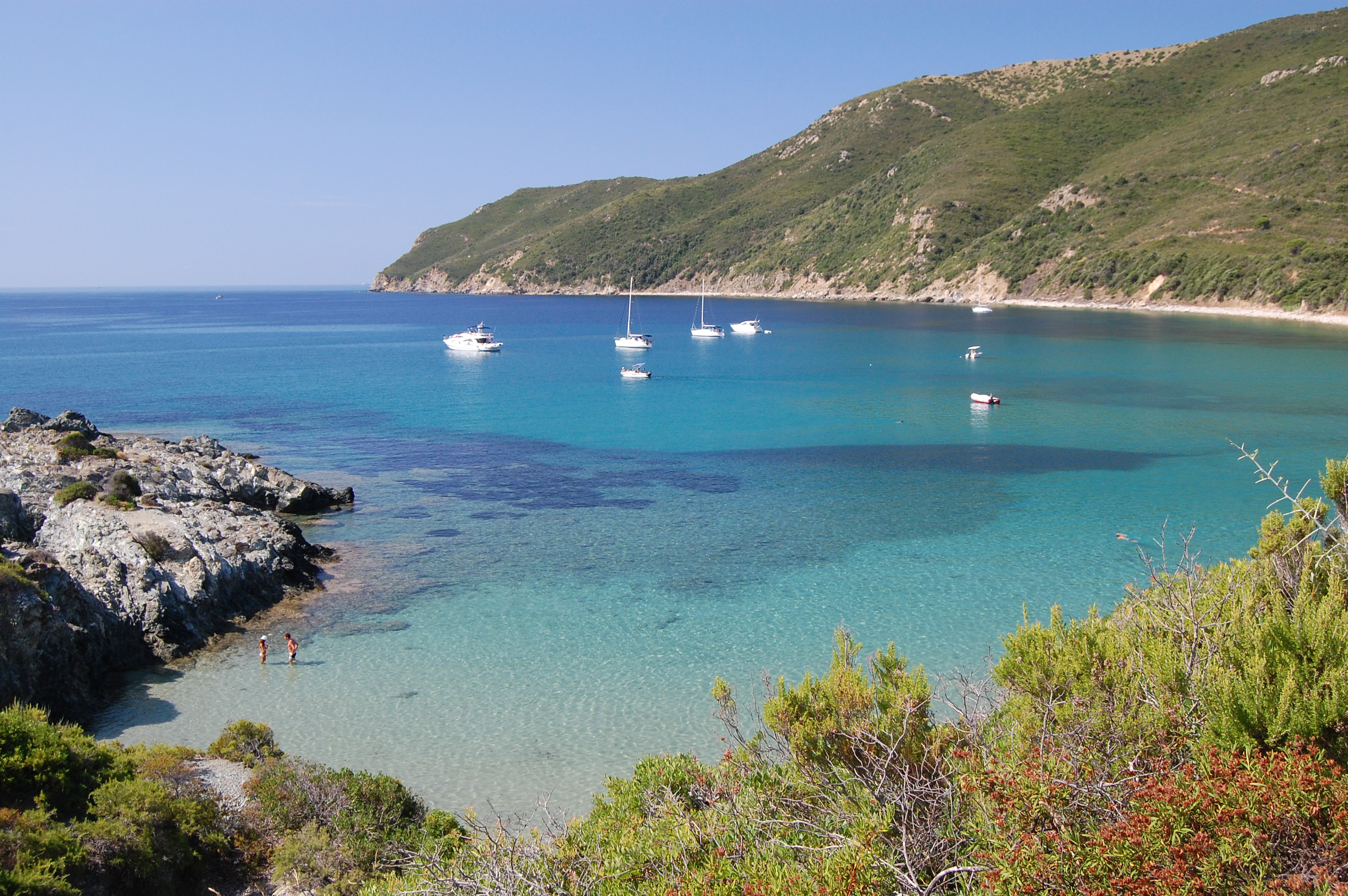
Elba island, Tuscan Archipelago, ITaly — CC BY 2
History of Elba
Iron, Etruscans and Romans
The history of Elba is the history of iron. The Etruscans began mining iron ore on Elba in the eighth century BC, and the Greeks called the island Aithalia because the smoke and soot from the smelting furnaces filled the sky. The Romans took over the mines and built seaside villas, the most famous being the Villa delle Grotte near Portoferraio. Iron from Elba supplied weapons and tools across the Roman Empire, and the mines made the island rich long before it became a place of holidays.
After the fall of the Roman Empire, Elba passed in turn to the Lombards, the Franks and the Republic of Pisa. In 1399 the island came under the Appiani family, the lords of Piombino, and later under the Medici of Florence. Fortresses were built along the coast to guard Elba against pirates from North Africa, the most famous being Forte Falcone and Forte Stella at Portoferraio, both raised in the sixteenth century.
Napoleon on Elba
The most famous chapter in the history of Elba began on 4 May 1814, when Napoleon Bonaparte landed on the island after being forced to abdicate and sign the Treaty of Fontainebleau. Under the treaty, Napoleon was made sovereign of Elba and given an annual allowance, while his wife Marie Louise and his son remained in Austria. Napoleon lived on Elba for almost ten months, until 26 February 1815, when he secretly left the island to return to France in the episode known as the Hundred Days.
In his short time on Elba, Napoleon worked with astonishing energy. He reformed the administration, built roads, improved the iron mines, founded schools and a hospital, and built two houses: the Villa dei Mulini at Portoferraio as his main residence and the Villa San Martino in the countryside as a summer retreat. He raised a small army and a small fleet, and he held a miniature court on the island. The two villas still stand, and both are open to visitors today.
From iron island to holiday island
After Napoleon left, Elba returned to the rule of the Grand Duchy of Tuscany, and in 1861 it became part of the unified Kingdom of Italy. Iron mining remained the main industry of Elba until the middle of the twentieth century, with large mines in the east around Rio Marina.
As the mines closed through the 1970s and 1980s, Elba turned to tourism, drawing on its beaches and its Napoleonic heritage. In 1996 the Tuscan Archipelago National Park was founded, protecting most of the natural land of the island. Today the island welcomes hundreds of thousands of visitors each year, mostly in summer, while winter returns Elba to the quiet rhythm of local life.
Timeline
| Year | Event |
|---|---|
| 8th century BC | Etruscans begin mining iron ore on Elba |
| Roman period | Romans take over the mines and build seaside villas |
| 1399 | Island passes to the Appiani family of Piombino |
| 16th century | Medici build Forte Falcone and Forte Stella at Portoferraio |
| 4 May 1814 | Napoleon arrives on Elba after the Treaty of Fontainebleau |
| 26 February 1815 | Napoleon secretly leaves Elba, opening the Hundred Days |
| 1861 | Elba becomes part of the unified Kingdom of Italy |
| 1996 | Tuscan Archipelago National Park founded |
Travel to Elba
When to go
Summer, from June to September, is the high season on Elba, when the sea is at its warmest and every service is open. The sea in August can reach 25 to 26 degrees Celsius, which is ideal for swimming and diving, but the island is also at its busiest then, with the highest room prices and crowded beaches, especially in August when Italians take their holidays. Spring, from April to May, and autumn, from September to October, are the best times for hiking, cycling and culture, with cool weather, spring flowers and far fewer visitors, while the sea stays warm enough for swimming until late October. Winter on Elba is very quiet, with many hotels and restaurants closed, but it is the best time to experience local life and the lowest room prices.
How long to stay
A full holiday on Elba usually lasts four to seven days. In that time visitors can swim in several different bays, climb Monte Capanne, visit Portoferraio and the other towns, and spend a day on a boat around the island. Elba is not a day-trip destination, because the ferry alone takes hours of the day.
Visitors with only two or three days should focus on the north and the south: Portoferraio and Napoleon’s villas on the first day, then the beaches of Marina di Campo and Fetovaia. A week allows the quieter corners too, such as the mountain villages of Marciana and Poggio, the old iron mines of Rio Marina, and the wild beaches of the east.
Getting there
The usual way to reach Elba is by ferry from Piombino, the port town on the Tuscan coast. The crossing to Portoferraio takes about one hour, while ferries to Rio Marina and Cavo take about 35 to 45 minutes. Ferries run all year, more often in summer, and most carry cars.
Bringing a car is the best way to explore Elba, because the beaches and mountain villages are spread out and the public buses do not reach everywhere. Elba also has a small airport at Marina di Campo, with seasonal flights from some Italian, German and Swiss cities. On the island, buses link Portoferraio with the main towns, but they run rarely, especially in winter. A day trip to Pisa on the mainland is possible from Piombino for travellers who want to add a Tuscan city to the journey.
Eating and staying
The food of Elba is the seafood cooking of Tuscany, with fresh fish and shellfish from the waters around the island, and local wine and olive oil. Dishes to try include cacciucco, the fish soup of the Livorno coast, pasta with seafood, grilled swordfish, and schiaccia briaca, a sweet cake made with Aleatico wine.
Aleatico wine from Elba has been made since Etruscan times and is one of the oldest sweet wines of Italy. The island offers every kind of stay, from seafront hotels at Marina di Campo and Portoferraio to rented flats, campsites and farm stays in the countryside. Room prices rise sharply in July and August, so summer visitors should book early.
Notable Places in Elba
Portoferraio and Napoleon’s villas. The capital of Elba is a handsome port town ringed by the sixteenth-century fortresses of Forte Falcone and Forte Stella. Napoleon’s main house, the Villa dei Mulini, stands on a hill above the harbour, with its library, study and garden that he once tended.
A few kilometres away, the Villa San Martino was his summer retreat, with rooms in Empire style and a gallery about his life. Both villas are open to visitors and give the clearest sense of how Napoleon lived during his exile.
Monte Capanne. The highest mountain of Elba, at 1,019 metres, can be climbed on foot from the village of Marciana or by a single-cabin cable car from the village of Poggio. From the summit, visitors can see the whole of Elba, Corsica to the west, the Tuscan coast to the east, and the islands of Giglio, Montecristo and Pianosa. The walking trail to the top takes about two to three hours and passes through chestnut woods and great granite boulders.
Fetovaia and Cavoli beaches. The two most famous beaches of Elba lie in the south-west of the island, near Marina di Campo. Fetovaia is a crescent of white sand framed by green cliffs, with water as clear as glass. Cavoli lies close by, known for fine sand and shallow water that suits families with small children.
Both beaches are at their best in the early morning, before the summer crowds arrive.
Marina di Campo. The largest seaside town in the south of Elba has the longest sandy beach on the island, about 1.4 kilometres, and a small harbour full of sailing boats. Marina di Campo is the liveliest holiday centre of Elba, with restaurants, cafes and shops, and the only airport on the island. In the evening, visitors stroll along the seafront, watch the sunset and eat at the restaurants by the water.
Rio Marina and the old iron mines. The town in the east of Elba was once the centre of iron mining on the island, and visitors can still tour the old mines and the mineral museum. The beaches around Rio Marina have dark red sand because of the iron ore in the ground, which makes a strange and striking contrast with the rest of Elba. The mining heritage of the town is the other half of the island’s story, the working side behind the holiday beaches.

View from the garden of the Palazzina dei Mulini in Portoferraio, looking east towards the lighthouse and the Forte Stella fortress on Elba — Public domain
Frequently Asked Questions
Where is Elba and how do I get there?
Elba is the largest island of the Tuscan Archipelago, in the Tyrrhenian Sea about ten kilometres from the Tuscan coast. The usual way to reach the island is by ferry from Piombino, about one hour to Portoferraio and about 35 to 45 minutes to Rio Marina or Cavo. The island also has a small airport at Marina di Campo with seasonal flights. Bringing a car is the best way to explore the island.
How long did Napoleon live on Elba and where did he stay?
Napoleon lived on Elba for almost ten months, from 4 May 1814, when he arrived after the Treaty of Fontainebleau, to 26 February 1815, when he secretly left to return to France. He lived at the Villa dei Mulini in Portoferraio as his main residence and at the Villa San Martino in the countryside as a summer retreat. Both houses are open to visitors today.
Which beaches are the most beautiful on Elba?
Fetovaia and Cavoli in the south-west are usually named the most beautiful, with white sand and water as clear as glass. Marina di Campo has the longest sandy beach on the island and suits families, while Sansone and La Biodola in the north are also much loved. Each beach has its own character, and visitors should try several, since Elba has about 147 kilometres of coastline with dozens of small bays.
How many days should I spend on Elba?
Four to seven days make a full holiday on Elba, long enough to swim, climb Monte Capanne, visit the towns and take a boat trip around the island. Two or three days are enough for Portoferraio, the Napoleonic villas and the southern beaches. Elba does not suit a day trip, because the ferry alone takes hours and the island has too much to see.
Is Elba a UNESCO World Heritage Site?
No. The island has no World Heritage listing of its own, and its protection comes instead from the Tuscan Archipelago National Park, founded in 1996, which guards most of its natural land. The nearest listed property is across the water in Pisa. Visitors who want a listed site can cross to the mainland, where Tuscany holds seven of them.
What is the best season to visit Elba?
Walkers and cyclists should come in spring or autumn, when the air is cool, the flowers are out, and the trails are quiet, while the sea stays warm enough for a swim until late October. Swimmers should come in summer, from June to September, when the water is at its warmest and every service is open. Winter is the quiet season, with many hotels and restaurants closed and the island back in the hands of its residents.
Verified
The facts below rest on the island’s own history, the UNESCO country page for Italy, and the Wikidata record checked on 23 November 2026. Napoleon arrived on Elba on 4 May 1814 and left on 26 February 1815, the Villa dei Mulini and the Villa San Martino were his two houses, Monte Capanne stands at 1,019 metres, and the island covers about 224 square kilometres. These points were checked against historical and travel sources current in 2026.
The Wikidata record Q45328 types Elba as an island in Italy at 42.78° N, 10.275° E, and that island reading is the one this article follows throughout. The French label Elbe and the Japanese label for the Elbe river in the registry belong to the Elbe river in Germany, not to this island, and this article does not use them.
Elba itself holds no UNESCO World Heritage listing. Across the water, the Piazza del Duomo in Pisa is the nearest inscribed property, reference 395, about 105 kilometres away in a straight line. Its four medieval masterpieces, the cathedral, the baptistery, the bell tower and the cemetery, were inscribed in 1987 under criteria (i), (ii), (iv) and (vi), and the property covers 8.87 hectares. The count for Italy as a whole stands at sixty-two properties, the highest national total in the world, and the most recent addition is Domus de Janas, from 2025.
Sources
- Wikidata, Q45328 — https://www.wikidata.org/wiki/Q45328 — checked 23 November 2026
- UNESCO, Piazza del Duomo, Pisa — https://whc.unesco.org/en/list/395/ — checked 23 November 2026
- UNESCO, Italy country page — https://whc.unesco.org/en/statesparties/it — checked 23 November 2026
- Historical and travel sources current in 2026 — Napoleon dates, villas, Monte Capanne, island area
Unverified
- Population figures for Elba differ between sources and between years, so this article states only the rounded figure of about 32,000 residents and gives no figure for a single year.
- Coastline length depends on how the bays and coves are measured, and the figure of about 147 kilometres comes from general sources rather than the latest survey of the national park.
- Ferry timetables and fares from Piombino, which change with the season and the operator, so this article gives only the estimated crossing times.
- Opening hours and ticket prices for the Villa dei Mulini and the Villa San Martino, which change with the season, so this article gives no specific prices.
- The exact annual number of visitors to the island, because sources differ, so this article gives only the general figure of hundreds of thousands of visits each year.
Illustrations
- Hero: Elba. Free image: https://upload.wikimedia.org/wikipedia/commons/f/f8/Elba_Oulu_20171015.jpg — CC0.
- In body, island: Elba island, Tuscan Archipelago, ITaly. Free image: https://upload.wikimedia.org/wikipedia/commons/f/fa/Elba_litorale.jpg — CC BY 2.
- In body, elba: View from the garden of the Palazzina dei Mulini in Portoferraio, looking east towards the lighthouse and the Forte Stella fortress on Elba. Free image: https://upload.wikimedia.org/wikipedia/commons/7/7d/Elba_Portoferraio_006.JPG — Public domain.