
Italy Tour Packages: Classic Routes Through Rome, Florence and Venice
Italy tour packages open Rome, Florence and Venice in one trip. Good routes balance famous cities with slow days in the regions.
Italy tour packages are the most popular way to see Italy for the first time, and they work because the country is too rich for a single journey. No traveller can cover the whole of Italy in one trip, whether seven days or two weeks, so the best Italy tour packages make hard choices and make them well. The classic route joins Rome, Florence and Venice in a single arc, while longer Italy tour packages add Naples and the Amalfi Coast, Tuscany and the Cinque Terre, or Sicily and the Dolomites.
There are three main kinds of Italy tour packages: fully guided tours with a tour leader through the whole journey, independent rail tours with hotels and tickets booked in advance, and themed tours built around food, art or the coast. This guide explains the geography that shapes every route, the history behind the cities on the classic circuit, the real itineraries that operators sell most, and the practical facts for choosing between the kinds of Italy tour packages on offer.
Quick Facts About Italy Tour Packages
| Fact | Detail |
|---|---|
| Country | Italy (Italia), Southern Europe |
| Capital | Rome |
| Language | Italian |
| Currency | Euro (EUR) |
| UNESCO | 62 World Heritage properties, 56 cultural and 6 natural, the most of any country |
| Main cities on tour | Rome, Florence, Venice, Milan, Naples, Bologna, Verona |
| Classic routes | Rome – Florence – Venice; Rome – Amalfi; Tuscany; Sicily; the Dolomites |
| Best months | April to June and September to October |
| Common lengths | 7 days, 10 days, 12 days, 14 days |
| Main transport | High-speed trains Frecciarossa and Italo, tour coaches, self-drive cars |
| Page type | Tour guide page (L5), no Wikidata identifier by design |
Italy has the shape of a boot stretching from the Alps in the north to the Mediterranean in the south, with the two large islands of Sicily and Sardinia. Most first-time Italy tour packages stay on the mainland of the north and centre: Rome in the middle, Florence and Tuscany north of Rome, Venice and Milan further north, and Naples with the Amalfi Coast south of Rome. The distances are short by the standards of a large country, yet the regions differ sharply in food, dialect, landscape and history.
Geography of Italy Tour Packages
The Shape of the Country
Italy tour packages follow the shape of a long peninsula, and the shape decides what any single tour can cover. The country runs about 1,200 kilometres from north to south, bordered by France, Switzerland, Austria and Slovenia in the north, and washed by the Mediterranean on its other three sides. The north holds the fertile Po plain, the centre holds the hills of Tuscany and Umbria with their medieval towns, and the south holds Naples, the Amalfi Coast and Puglia. Sicily lies off the southern tip and Sardinia off the western coast, and each island has its own culture and history, so Italy tour packages usually treat them as separate trips.
Rome, the capital of Italy, stands in the centre of the peninsula, and every classic route begins or ends there. Florence lies about 280 kilometres north of Rome, in the valley of the Arno river among the hills of Tuscany. Venice lies about 260 kilometres northeast of Florence, on a lagoon beside the Adriatic Sea.
Naples lies about 230 kilometres south of Rome, on the Bay of Naples beneath Mount Vesuvius. Those four distances are the skeleton of nearly all Italy tour packages, and the high-speed trains that link the four cities run the routes in about one to two and a half hours.
The Apennine mountains run down the spine of Italy, and they slow travel between the eastern and western coasts, so Italy tour packages usually move north to south rather than east to west. The Po plain in the north is flat and suits high-speed rail, while the Amalfi Coast is famous for its narrow cliff road that winds above the sea. The Dolomites in the northeast are a range of sharp limestone peaks, and the lakes of the north, Como, Garda and Maggiore, sit at the foot of the Alps. The geography of Italy tour packages is therefore a geography of contrasts: flat plains and steep coasts, volcanic bays and alpine lakes, all inside a single journey of two weeks.
The climate of Italy is Mediterranean, with hot dry summers, mild winters in the centre and south, and colder weather in the north and the mountains. Summer in Rome and Florence often passes 30 degrees Celsius in July and August, while Venice in summer is both hot and humid. The finest weather for Italy tour packages comes in spring and autumn, when the temperatures are gentle and the light is kind to photography. Winter brings rain to the centre and snow to the Dolomites, and the coastal towns of Amalfi and the Cinque Terre grow quiet, with some hotels and restaurants closed.
The Regions on the Classic Route
Tuscany is the region that most Italy tour packages spend the most time in after Rome, and its landscape of cypress trees, stone farmhouses and hill towns is the image of Italy that most travellers carry home. Siena, San Gimignano and Pisa stand within a short drive of Florence, and the Val d’Orcia valley south of Siena holds the rolling fields that appear on postcards of the region. The Chianti wine country lies between Florence and Siena, and the wine estates open their cellars for tastings. Tuscany suits slow travel, and Italy tour packages that rush through it in a single day miss the point of the region.
The Amalfi Coast, south of Naples, is the most dramatic coastline on the classic routes of Italy tour packages, with towns that cling to cliffs above the sea. Positano, Amalfi and Ravello each hold a different mood: Positano is steep and glamorous, Amalfi is the old maritime republic with its cathedral, and Ravello sits high above the water with gardens that look over the whole coast. The coastal road between them is narrow and winding, and coaches move slowly along it, so Italy tour packages usually base their travellers in Sorrento and visit the coast by boat or by small bus. The sea is the best way to see the coast, and the boat from Sorrento to Positano shows the cliffs as they were meant to be seen.
Venice stands apart from every other stop on Italy tour packages, because it is a city built on water, on 118 small islands in a lagoon, joined by more than 400 bridges. The Grand Canal winds through the city for about 3.8 kilometres, and the palaces along it show the wealth of a maritime republic that traded with the East for a thousand years. The lagoon covers 70,176.4 hectares, and the whole city with its lagoon has been a World Heritage Site since 1987. Venice faces the pressures of mass tourism and rising water, and Italy tour packages now visit with more care than they once did, spreading their groups across the day and the seasons.
The north of Italy holds the cities that longer Italy tour packages add after the classic triangle: Milan, with its cathedral and its fashion houses, and the lakes of Como and Garda, where the Alps meet the water. Verona, the city of the Roman arena and of the Romeo and Juliet story, lies between Milan and Venice and makes a natural stop on the rail line. Bologna, with its porticoes and its food markets, is the culinary heart of the country, and Italy tour packages that pass through it eat better than those that skip it. The north is richer and more industrial than the south, and the contrast between the two halves of Italy is part of what the longer tours teach.
Sicily, the largest island in the Mediterranean, needs three to four days of its own, and Italy tour packages rarely fit it into a first trip of seven or ten days. Palermo, the valley of the temples at Agrigento, Taormina and Mount Etna each deserve a day, and the island mixes Greek, Roman, Arab and Norman layers in a way no mainland region does. The Dolomites, in the far northeast, offer the opposite kind of tour: mountain walking, alpine villages and sharp limestone peaks, best in summer for hiking and in winter for skiing. Both Sicily and the Dolomites reward travellers who return to Italy a second time, and Italy tour packages built around them are usually slower, smaller and more expensive than the classic circuit.
Sardinia, the second large island of Italy, lies west of the mainland in the Mediterranean, and Italy tour packages rarely include it in a first trip. The island holds Nuragic stone towers, white sand beaches and a capital, Cagliari, with a history of its own. Its food, language and traditions differ from the mainland, and travellers who add Sardinia usually give it a week of its own.

The Basilica of Superga glows at sunset above Turin with the Monte Rosa massif behind — CC BY-SA 4
History of Italy Tour Packages
Rome, from Empire to Modern Capital
Every route of Italy tour packages starts or ends in Rome, and the reason is simple: the city was the centre of the Roman Empire, then of the Catholic Church, and it holds more monuments than any other city in Italy. According to legend, Rome was founded in 753 BC, and from a small town on the river Tiber it grew into the capital of an empire that stretched across Europe, North Africa and the Middle East. The Colosseum, built from 70 to 80 AD, still stands as the symbol of the city, with the Roman Forum, the Pantheon and Saint Peter’s Square in the Vatican beside it. A tour of Rome needs at least three days, and even that only touches the surface of the city.
After the fall of the empire, Rome became the centre of the Catholic Church, and the popes built the churches, palaces and squares that shape the city today. The Renaissance brought artists such as Michelangelo, who painted the ceiling of the Sistine Chapel in the Vatican between 1508 and 1512, and Raphael, who decorated the Vatican rooms. The Baroque age added fountains and churches by Bernini and Borromini, and the nineteenth century added the monuments of the unified kingdom. Rome is therefore not one city but many cities laid over each other, and Italy tour packages that stay three nights in Rome still leave their travellers wanting more.
Florence, Cradle of the Renaissance
Florence is the second stop on most Italy tour packages, and it is the city of the Renaissance. Under the patronage of the Medici family, Florence in the fifteenth century became the artistic and cultural centre of Europe, where Brunelleschi built the dome of the cathedral, Donatello and Michelangelo carved statues, and Leonardo da Vinci began his career. The Uffizi Gallery holds one of the most important collections of Renaissance art in the world, and the city is small enough that its old centre can be walked in a single day, with the cathedral, the Giotto bell tower, the Ponte Vecchio bridge and the Piazza della Signoria standing close together.
Florence is also the birthplace of modern Italian, since Dante wrote the Divine Comedy in the Florentine language rather than in Latin. The city gave the world the banking of the Medici, the art of the Renaissance and the language of the nation, and Italy tour packages that give Florence only a single afternoon sell the city short. Two days in Florence allow the Uffizi, the Accademia with the statue of David, and a walk across the Ponte Vecchio at sunset, with time left for the food markets and the view from the Piazzale Michelangelo above the river.
Venice, the City on the Water
Venice is the third point of the classic triangle of Italy tour packages, and it is the most unlike the other two. For more than a thousand years Venice was a powerful maritime republic, controlling the trade between Europe and the East, and its wealth shows in Saint Mark’s Square, in the golden domes of Saint Mark’s Basilica and in the Doge’s Palace. The city was built on 118 small islands in the lagoon, joined by more than 400 bridges, and its palaces rise straight from the water. Venice declined when the sea trade routes changed, yet the city kept its appearance almost intact, and UNESCO listed Venice and its lagoon as a World Heritage Site in 1987, reference 394.
The history of Venice matters to Italy tour packages because it explains why the city feels so different from Rome and Florence. Rome was built by emperors and popes, Florence by bankers and artists, and Venice by merchants and sailors. The three cities together tell the story of Italy: the empire, the Renaissance and the sea.
The Rialto Bridge, completed in 1591, is the emblem of that merchant city, and the market beside it still trades every morning. Venice today faces the challenge of too many visitors and rising seas, and the city has begun to limit day visitors on peak days, a change that Italy tour packages must plan around.
From Unification to Modern Tourism
Italy as a single country is young, and Italy tour packages cross regions that were separate states until the nineteenth century. The kingdoms and duchies of the peninsula were united into the Kingdom of Italy in 1861, and Rome became the capital in 1871. Before that, each region had its own history: Venice was a maritime republic, Florence a duchy of the Medici, Naples a kingdom, and Sicily an island of Greek, Roman, Arab and Norman layers. The unification explains why the food, the dialect and the architecture change so fast from one region to the next, and why a tour of Italy feels like a tour of several countries at once.
The modern tourism of Italy tour packages grew with the high-speed railways of the 1990s, which linked Rome, Florence, Milan and Naples in journeys of one to two and a half hours. The trains turned a country that once needed slow coach journeys into a place where three great cities could be visited in a single week. The growth of low-cost flights brought visitors from across Europe to the regional airports, and the rise of online booking let independent travellers build their own Italy tour packages from trains, hotels and tickets. The UNESCO list kept growing too, and the Via Appia, the Roman road, was listed in 2024 as reference 1708, bringing the total of Italian World Heritage properties to 62, the most of any country in the world.
Long before the modern Italy tour packages, the Grand Tour carried young aristocrats from Britain and northern Europe through Italy in the eighteenth and nineteenth centuries. The travellers spent months in Rome, Florence, Venice and Naples, studying the ruins, buying paintings and learning the manners of the continent. Their letters and diaries fixed the image of Italy as the land of art and antiquity, and the route they followed is the route that Italy tour packages still sell today.
Mass tourism reached Italy in the 1960s, when charter flights and package holidays brought northern Europeans to the beaches of the Adriatic and the Amalfi Coast. The coastal towns grew fast, and Rimini, the Amalfi Coast and the island of Capri became names that every European knew. The growth brought wealth to the south, yet it also crowded the historic centres, and the cities of the classic route began the long work of managing visitors that continues today.
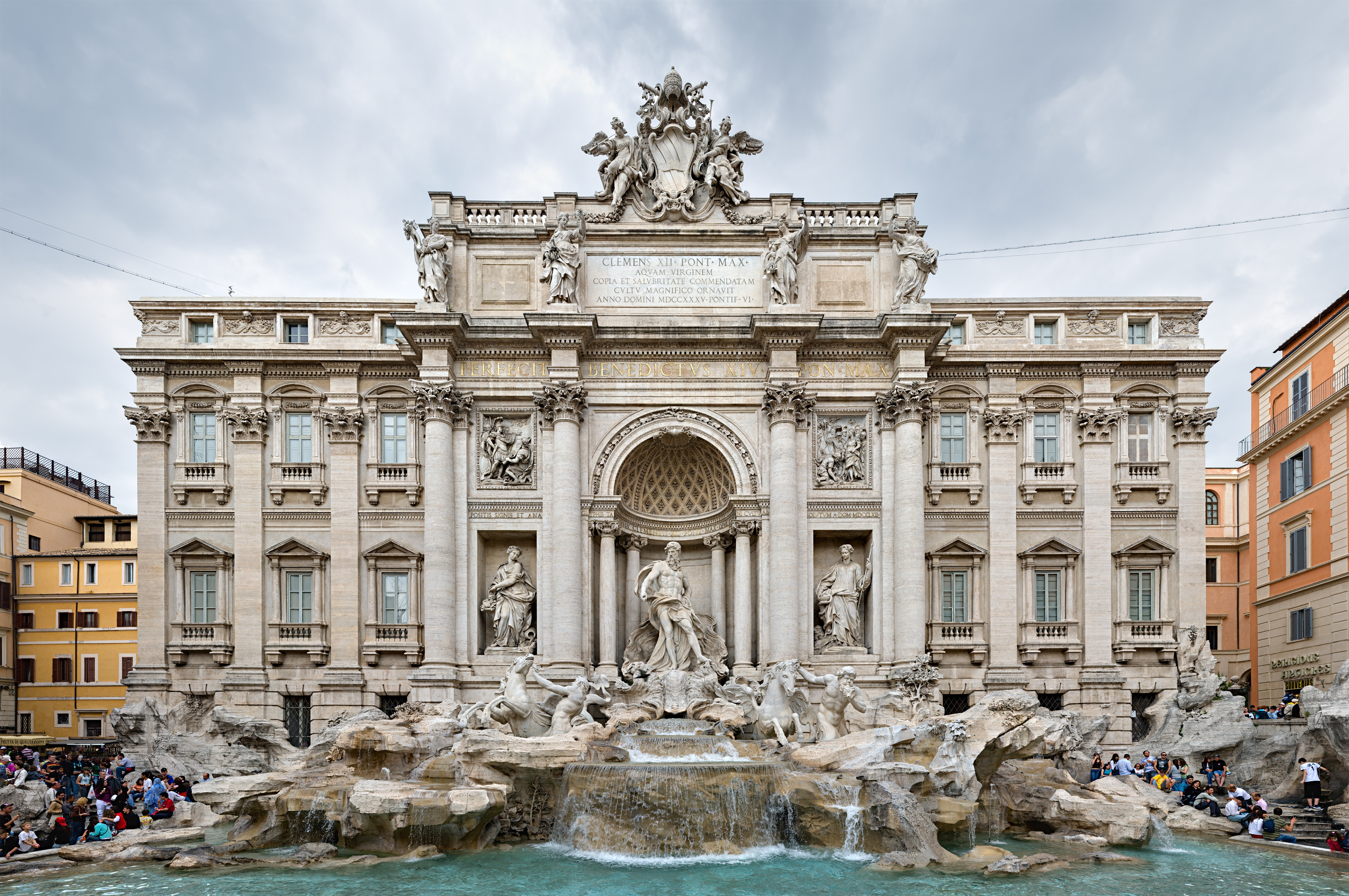
The Trevi Fountain fills its square in Rome with statues and water — CC BY 3
Italy Tour Packages by Route
The Classic Seven Days: Rome, Florence, Venice
The classic seven-day route of Italy tour packages covers the three great cities, with two nights in each and a day of travel between them. Days one and two belong to Rome, with the Colosseum, the Roman Forum, the Pantheon and the Vatican. Day three moves to Florence by high-speed train, with the afternoon at the cathedral and the Ponte Vecchio. Day four belongs to Florence, with the Uffizi Gallery and the Piazza della Signoria.
Day five moves to Venice, with the afternoon on the Grand Canal. Day six belongs to Venice, with Saint Mark’s Square, the Doge’s Palace and the islands of Murano and Burano. Day seven returns to Rome or flies home from Venice. The route is dense, and it suits first-time travellers who want the three names every Italy tour promises.
The seven-day route works best for travellers who accept early mornings and long days, since each city deserves more time than the route gives it. Guided Italy tour packages handle the logistics, the hotels, the coach and the tickets, and the traveller only follows the group. Independent travellers who build the same route by train should book the hotels and the main tickets weeks ahead, since the Colosseum, the Sistine Chapel and the Uffizi sell out in high season. The classic route is the most sold of all Italy tour packages, and it is the right choice for a first visit that must cover the greatest hits.
Ten Days: Adding Naples and the Amalfi Coast
Ten-day Italy tour packages usually add Naples and the Amalfi Coast to the classic triangle, with two nights in Naples or Sorrento to visit Pompeii, Mount Vesuvius and the towns of Positano and Amalfi. The tenth day runs along the Amalfi Coast, through Positano and Ravello, before the tour returns to Rome or flies home from Naples. The extra days change the character of the trip, because the south of Italy is slower, warmer and more informal than the north, and the food changes with it: Naples is the home of pizza, and a Margherita pizza in Naples remains the iconic meal of the country.
The ten-day route suits travellers who want the coast as well as the cities, and who can walk the steep lanes of Positano and climb the steps of Ravello. The Amalfi Coast road is narrow, and coaches move slowly, so the best ten-day Italy tour packages use boats for the coastal days and keep the coach for the longer moves. Pompeii needs a full morning, and Vesuvius needs a clear day, so the Naples base should allow a spare day for bad weather. Ten days is the length most travel writers recommend for a first trip to Italy, since it adds the south without rushing the north.
Twelve to Fourteen Days: The Grand Tour
Twelve to fourteen day Italy tour packages are the most complete journeys, combining the north, the centre and the south. Beyond the classic triangle and the Amalfi Coast, the grand tour adds Milan and Lake Como, or the Cinque Terre and Bologna, or Sicily with Palermo, the valley of the temples at Agrigento and Mount Etna. With this length, each city gets at least two nights, and there are days with no schedule, when travellers can rest, revisit a museum or simply sit in a square. The grand tour is the closest modern equivalent of the historical Grand Tour, when young Europeans spent months travelling through Italy.
The grand tour suits travellers who have already seen the three great cities, or who want one long trip instead of several short ones. The pace is slower, the groups are smaller, and the guides are more specialised, so the cost runs higher than the classic route. The grand tour also suits travellers who want the regions that the classic route skips: the wine country of Piedmont, the lakes of the north, the hill towns of Umbria, or the island of Sicily. Italy tour packages of this length should be chosen by the regions they add, since two grand tours can differ completely in their second week.
The North and the South by Themselves
Northern Italy tour packages stay above Florence and build a trip around Milan, the lakes, Verona and the Dolomites. The north is the richest part of the country, with fashion in Milan, the Roman arena in Verona, and the mountain walking of the Dolomites. A northern route of seven days can join Milan, Lake Como, Verona and Venice, with a day in the Dolomites for walkers. The food of the north is butter and rice rather than olive oil and pasta, and the wines are Barolo and Barbaresco from Piedmont, Prosecco from the Veneto and Amarone from the Valpolicella hills.
Southern Italy tour packages stay below Rome and build a trip around Naples, the Amalfi Coast, Puglia and Sicily. The south is the oldest part of the country, with Greek temples at Paestum and Agrigento, the trulli houses of Alberobello, and the cave dwellings of Matera. A southern route of ten days can join Naples, Pompeii, the Amalfi Coast, Matera and Puglia, with a flight to Sicily at the end. The south is hotter, cheaper and less crowded than the north, and its food is simpler: pizza in Naples, pasta in Puglia, and fish on every coast.
Themed Italy Tour Packages
Themed Italy tour packages suit travellers who have been to Italy once and want to return for depth rather than breadth. Food tours go to Bologna, Parma and Modena to taste Parmesan cheese, Parma ham and balsamic vinegar, or to Naples to learn pizza making and to Tuscany to taste Chianti wine. Art tours focus on the museums and churches, with specialist guides on the Renaissance, and they spend longer in Florence and Rome than the classic route allows. Coastal tours follow the Amalfi Coast, the Cinque Terre and Sardinia, and walking tours explore the Dolomites, the Cinque Terre and Umbria on foot.
Themed Italy tour packages are usually smaller, slower and more expensive than the classic circuit, yet they give a deeper experience. The groups are small, the guides are specialists, and the schedule leaves time for the subject itself, whether that is a wine cellar, a fresco cycle or a coastal path. Travellers who choose a themed tour should check the pace and the level of the activities, since a walking tour of the Dolomites and a food tour of Bologna ask for very different kinds of energy.
Travel to Italy Tour Packages
When to Go
The best time for Italy tour packages is April to June and September to October, when the temperatures are gentle, the sun is kind and the crowds are not at their peak. May and June bring flowers to Tuscany, when the sunflower and poppy fields colour the hillsides. July and August are the high summer: hot, crowded, and the only months for swimming on the Amalfi Coast or the Cinque Terre. Winter, from November to February, is the low season, with lower prices and fewer visitors, yet rain is common, and some hotels and restaurants in the coastal towns close.
Guided, Independent or Themed
Fully guided Italy tour packages suit first-time visitors, families with children and older travellers, since the guide handles the schedule, the transport, the hotels and the tickets. The drawback is a dense schedule, with early mornings and little free time, so travellers should choose tours with small groups, no more than about twenty people, and at least one free afternoon in each large city. Independent rail tours suit travellers who like freedom and who already know European travel, since the high-speed trains link the large cities in about one to two and a half hours, and the stations stand in the city centres. The independent traveller books the hotels, the train tickets and the entry tickets in advance, and gains a flexible schedule at a lower cost.
Themed Italy tour packages suit the second visit, when the traveller knows the classic cities and wants a single subject in depth. The choice between the three kinds depends less on money than on temperament: the guided tour suits the traveller who wants everything handled, the rail tour suits the traveller who wants to choose, and the themed tour suits the traveller who wants to learn. All three kinds appear in the catalogues under the same name, so the traveller should read the day-by-day schedule rather than the headline.
Getting Around and Eating
High-speed trains are the best way to move between the large cities of Italy, with Frecciarossa of the national railway and Italo of the private operator running between Rome, Florence, Bologna, Venice, Milan and Naples. The journey takes about one and a half hours between Rome and Florence, about two hours between Florence and Venice, and a little over an hour between Rome and Naples. Tour coaches are the main transport of guided Italy tour packages, and the only way to reach many small towns in Tuscany and Umbria that the trains do not serve.
Self-drive cars give the greatest freedom, above all in Tuscany and Sicily, yet drivers must respect the limited traffic zones in the historic centres, where cameras fine cars that enter without permission. In Venice there are no cars, and the main transport is the water bus on the canals and walking over the bridges.
Food is part of every route of Italy tour packages, and each region has its own dishes. Rome is known for pasta carbonara, cacio e pepe and amatriciana. Florence is known for the bistecca alla fiorentina steak and for Chianti wine.
Venice has its own seafood cooking, with black squid ink pasta and cicchetti, the small snacks of the wine bars. Naples is the home of pizza, and the wines of each region deserve their own time: Chianti and Brunello in Tuscany, Barolo and Barbaresco in Piedmont, Prosecco in the Veneto and Amarone in the Valpolicella hills. Long Italian meals are part of the culture, not only a matter of eating, and Italy tour packages that rush lunch miss one of the pleasures of the country.
Notable Places in Italy Tour Packages
- Rome — the capital of Italy, with the Colosseum, the Roman Forum, the Pantheon, Saint Peter’s Square and the Sistine Chapel in the Vatican.
- Florence — the cradle of the Renaissance, with the cathedral, the Uffizi Gallery, the Ponte Vecchio and the Piazza della Signoria.
- Venice — the city on the lagoon, with Saint Mark’s Square, the Doge’s Palace, the Grand Canal and the islands of Murano and Burano.
- Tuscany — the hill country with Siena, San Gimignano, Pisa and the Val d’Orcia valley, and the Chianti wine estates.
- Amalfi Coast — the cliff coast south of Naples, with Positano, Amalfi and Ravello above the sea.
- Milan — the northern capital of fashion and business, with the cathedral and the Last Supper of Leonardo da Vinci.
- Naples — the southern port city beneath Vesuvius, the home of pizza and the gateway to Pompeii.
- Pompeii — the Roman city buried by the eruption of Vesuvius, preserved as an archaeological park.
- Cinque Terre — the five cliff villages of the Ligurian coast, joined by walking paths above the sea.
- Sicily — the large island of the south, with Palermo, the valley of the temples at Agrigento, Taormina and Mount Etna.
- The Dolomites — the limestone mountain range of the northeast, with sharp peaks, alpine villages and walking trails.
Frequently Asked Questions About Italy Tour Packages
How many days should first-time Italy tour packages last?
Seven days is the minimum for a first trip to Italy, enough for the three great cities of Rome, Florence and Venice, with two nights in each. Ten days is the ideal length, since it adds Naples, Pompeii and the Amalfi Coast to the journey. Twelve to fourteen days allow a slower pace, with Tuscany, the Cinque Terre, Milan or Sicily added to the classic route.
Should I choose guided Italy tour packages or travel by train on my own?
Guided Italy tour packages suit a first visit to Italy, families with children and older travellers, since the schedule, the transport and the tickets are all handled in advance. Independent travel by high-speed train suits travellers who like freedom and who already know Europe, since the trains link the large cities in about one to two and a half hours, and the stations stand in the city centres.
What season suits Italy tour packages best?
April to June and September to October are the finest months, with gentle temperatures, kind sun and moderate crowds. July and August are the hottest and most crowded months, yet they are the only time for swimming on the Amalfi Coast or the Cinque Terre. Winter, from November to February, brings fewer visitors and lower prices, but rain is common and some coastal hotels close.
Can Italy tour packages include Sicily?
Sicily usually stays outside the classic seven or ten day Italy tour packages, since the island stands apart in the south and needs at least three to four days of its own. Tours of twelve to fourteen days can add Sicily, with Palermo, the valley of the temples at Agrigento, Taormina and Mount Etna, usually flying from Rome or Naples to Palermo or Catania. Many travellers make Sicily a separate trip instead of forcing the island into a mainland tour.
Do I need a visa for Italy tour packages?
Italy belongs to the Schengen Area, so the visa rules for Italy tour packages follow the Schengen rules for Italy. Citizens of the European Union and of visa-free countries enter with a passport or identity card, and other travellers should check the Schengen visa requirement for their nationality and apply at an Italian consulate before departure.
Should I book entry tickets in advance on Italy tour packages?
Guided Italy tour packages include the tickets in the price, so the traveller does not book them separately. Independent travellers should book ahead for the Colosseum, the Sistine Chapel in the Vatican, the Uffizi Gallery in Florence and the Doge’s Palace in Venice, since those are the busiest sights in Italy and tickets sell out early in high season.
Verified
The total of 62 World Heritage properties in Italy, 56 cultural and 6 natural, the most of any country, was verified on the UNESCO World Heritage List page on 22 November 2026. The listing of Venice and its lagoon in 1987 as reference 394 was verified directly on the UNESCO World Heritage Centre website on the same day.
The distances of about 280 kilometres from Rome to Florence, about 260 kilometres from Florence to Venice and about 230 kilometres from Rome to Naples, the length of Italy at about 1,200 kilometres from north to south, the founding of Rome in 753 BC by legend, the building of the Colosseum from 70 to 80 AD, the painting of the Sistine Chapel ceiling from 1508 to 1512, the unification of Italy in 1861, Rome becoming the capital in 1871, the listing of the Via Appia in 2024 as reference 1708, the completion of the Rialto Bridge in 1591, and the length of the Grand Canal at about 3.8 kilometres were checked against the sources below. This page is a tour guide page of level L5 and carries no Wikidata identifier by design. Verified 22 November 2026.
Sources
- UNESCO World Heritage Centre, World Heritage List, Italy — https://whc.unesco.org/en/list/?search=&search_by_country=italy&type=&media=®ion=&order=
- UNESCO World Heritage Centre, Venice and its Lagoon — https://whc.unesco.org/en/list/394/
- Wikipedia, “Italy” — https://en.wikipedia.org/wiki/Italy
- Wikipedia, “Rome” — https://en.wikipedia.org/wiki/Rome
- Trenitalia, official high-speed rail website — https://www.trenitalia.com/en.html
- TheTerraAtlas keyword file batch-eu6-en-keywords.json, entry TA-L5-italy-tours, focus keyword “italy tour packages”
Unverified
- Current prices of Italy tour packages by season and by operator — the article gives no prices, and travellers should check the official websites of the tour operators before booking.
- Current high-speed train times and fares by route and by day — check the Trenitalia or Italo official websites before travelling, since times and fares change.
- Current opening hours and ticket prices for the Colosseum, the Vatican, the Uffizi Gallery and the Doge’s Palace — check each official website before travelling.
- The latest rules on the day-visitor entry fee for Venice and the limits on visitors — check the official city website before travelling, since the rules change from year to year.
- Current boat timetables and fares on the Amalfi Coast and the Cinque Terre by season — check the boat operator websites before travelling.
Illustrations
- Hero: Italy Tour Packages. Free image: https://upload.wikimedia.org/wikipedia/commons/1/1a/Bergwandeltocht_van_Peio_Paese_naar_Lago_Covel_%281%2C839_m%29_in_het_Nationaal_park_Stelvio_%28Italy%29_23.jpg — CC BY-SA 4.0.
- In body, fountain: The Trevi Fountain fills its square in Rome with statues and water Free image: https://upload.wikimedia.org/wikipedia/commons/7/7e/Trevi_Fountain%2C_Rome%2C_Italy_2_-_May_2007.jpg — CC BY 3.
- In body, sunset: The Basilica of Superga glows at sunset above Turin with the Monte Rosa massif behind Free image: https://upload.wikimedia.org/wikipedia/commons/6/6e/La_basilica_al_tramonto.jpg — CC BY-SA 4.