
Spanish Steps Rome: The Staircase That Links the Square to the Pincio
Spanish Steps Rome is the great Baroque staircase between Piazza di Spagna and Trinità dei Monti. Its 135 travertine steps have drawn visitors since 1725.
Spanish Steps Rome is the most climbed staircase in the world, and its fame rests on a simple idea: a steep, muddy slope turned into a piece of theatre. The steps rise in a wide, butterfly-shaped sweep from the Piazza di Spagna to the church of Trinità dei Monti, and their travertine ramps divide, wind and rejoin in a way that makes the climb feel like a walk through a stage set. The staircase is free, open day and night, and it takes about five minutes to climb, yet its history spans three centuries of diplomacy, poetry and fashion. Spanish Steps Rome is not a monument to enter, because it is a monument to climb, and the view from the top is its reward.
The steps take their name from the square below, and the square takes its name from the Spanish Embassy to the Holy See, which has stood on the piazza for centuries. The staircase itself was built with French money, designed by an Italian architect and paid for by a French diplomat’s bequest, so its name is a reminder that Rome’s great works were often international. The church at the top is French, the square below is Spanish, and the steps between them are Roman, and that mixture is the story of Spanish Steps Rome in a single sentence.
Quick Facts
| Fact | Detail |
|---|---|
| Name | Spanish Steps (Scalinata di Trinità dei Monti) |
| Role | Monumental Baroque staircase linking Piazza di Spagna to Trinità dei Monti and the Pincio |
| Location | Piazza di Spagna, Rome |
| Steps | 135 travertine steps in 11 ramps |
| Built | 1723 to 1725, inaugurated for the Jubilee of 1725 |
| Architect | Francesco de Sanctis, with Alessandro Specchi |
| Funded by | The bequest of French diplomat Étienne Gueffier, 20,000 scudi |
| UNESCO | Spanish Steps Rome stands inside the property “Historic Centre of Rome, the Properties of the Holy See in that City Enjoying Extraterritorial Rights and San Paolo Fuori le Mura”, ref 91, inscribed 1980 and extended 1990, criteria (i)(ii)(iii)(iv)(vi); UNESCO’s criterion (i) text names the Trident, including Piazza di Spagna |
| Coordinates | 41.90611° N, 12.48278° E |
| Wikidata | Q848072, monumental staircase |
Geography of Spanish Steps Rome
A Slope Between Two Worlds
Spanish Steps Rome climbs the steep slope of the Pincian Hill, the rise that separates the Piazza di Spagna below from the Pincio gardens above. The hill is a spur of the Pincio, and its slope was once a bare, muddy bank that divided the Spanish quarter around the square from the French church on the hilltop. The staircase joins those two worlds, and its ramps follow the natural fall of the ground, because the architect worked with the slope rather than against it. The climb is about twenty metres from the square to the church, and the steps spread the height across 135 treads, so the ascent is gentle for a staircase of this fame.
The ground under Spanish Steps Rome is the soft tufa and alluvium of the Pincian Hill, and the staircase’s foundations rest on the slope’s natural terraces. The travertine stone of the steps comes from the quarries near Tivoli, east of Rome, and its pale colour catches the sun and makes the staircase glow in the afternoon. The stone is also the reason the steps are slippery when wet, because travertine polishes smooth under millions of feet, and rain turns the treads into a hazard. The staircase’s design answers the slope’s problems, because its wide landings give rest points and its balustrades give a handhold, and the climb is broken into short flights rather than one long run.
The square below, Piazza di Spagna, is the staircase’s counterpart, and the two form a single composition. The square is long and irregular, shaped like a butterfly, and the Barcaccia fountain sits at its centre, at the foot of the steps. The square’s shape and the staircase’s shape mirror each other, because both widen and narrow in the same rhythm, and the effect is deliberate, since the architect designed the steps to grow out of the square. A visitor who stands at the fountain sees the whole staircase rise in front of them, and the view is the most photographed in Rome after the Colosseum.
The Trident and the Streets Below
Spanish Steps Rome stands at the point of the Trident, the three streets that Sixtus V laid out in the sixteenth century and that UNESCO’s criterion text names as one of the historic centre’s great urban achievements. The Via del Babuino runs southeast from the square to the Piazza del Popolo, the Via del Corso runs south to the Piazza Venezia, and the Via di Ripetta runs southwest to the Tiber, and the three streets fan out from the square like the prongs of a trident. The staircase sits at the apex of that fan, and its position makes it the hinge of the whole district. The Trident’s streets are the most fashionable in Rome, and their shopfronts and cafes give the area its character as the city’s luxury quarter.
The streets around Spanish Steps Rome are among the most walked in the city, because the Via Condotti, the street of the great fashion houses, starts at the square and runs to the Via del Corso. The Via del Babuino holds antique shops and galleries, and the Via dei Due Macelli and the Via della Vite hold cafes and restaurants. The district’s streets are narrow and crowded, and the pavements are the city’s busiest, yet the area keeps a village feel, because the shops are small and the cafes are old. The staircase’s crowds spill into these streets, and the whole quarter lives off the steps’ fame.
The Pincio above Spanish Steps Rome is the staircase’s other half, because the gardens of the Pincio terrace stretch from the church to the Villa Borghese and offer the best view of Rome’s rooftops. The terrace, with its umbrella pines and its busts of famous Italians, is a public park, and its balustrade looks down over the Piazza del Popolo and the city’s domes. The climb from the square to the Pincio is the staircase’s purpose, because the steps were built to connect the square to the hill, and the view from the top is the reward for the climb. The Pincio’s gardens are cooler than the square, and their shade makes the terrace a refuge in summer.
Light, Stone and the Azaleas
The light on Spanish Steps Rome changes through the day, and the staircase’s travertine shows each change. Morning light strikes the church at the top and leaves the lower steps in shadow, while afternoon light fills the whole staircase and turns the stone gold. Evening light comes from the west, and the steps glow as the sun sets behind the Pincio, while the square below fills with the shadows of the buildings. Photographers favour the early morning, when the steps are quiet and the light is low, and the late afternoon, when the stone is warm and the crowds are thinning.
The azaleas are the staircase’s springtime glory, because about 450 potted azaleas are placed on the steps from mid-April to mid-May, a tradition that the Rome tourism board dates to the 1950s. The pink and white flowers cover the ramps in a cascade of colour, and the steps become a garden for a month, drawing crowds who come for the flowers as much as for the climb. The azaleas are removed after the season, and the steps return to bare stone, yet the month of flowers is the staircase’s most famous season. The tradition is maintained by the city, and the flowers are tended daily while they are in place.
The climate of Spanish Steps Rome is the climate of the city centre: hot summers, mild winters and sudden rain. The steps are exposed to the weather, and the stone is slippery when wet, so a rainy day calls for careful footing. Summer midday is the worst time to climb, because the stone holds the heat and there is no shade, while the early morning and the evening are the best. The staircase is open at all hours, and the night view, when the square’s lights come on and the church is lit, is quieter than the day.

The staircase of Spanish Steps Rome is the sight, and its 135 travertine steps in 11 ramps are the reason visitors come — CC BY 2

The Pincio terrace above the Spanish Steps, with its view over the rooftops of Rome — CC BY-SA 4

The Via Condotti, the street of the great fashion houses starting at the Piazza di Spagna — CC0
History of Spanish Steps Rome
A Slope That Needed a Staircase
Before Spanish Steps Rome was built, the slope between the Piazza di Spagna and the Trinità dei Monti church was a steep, muddy bank that separated the two quarters. The church, under French patronage, stood on the hilltop, and the Spanish Embassy stood on the square below, and the two communities had no easy way to reach each other. The French diplomat Étienne Gueffier left 20,000 scudi in his will for a staircase, and the bequest became the seed of the project, yet the design was disputed for decades, because the French and Spanish authorities argued over whose arms should appear on the work. The dispute delayed the staircase for a generation, and the slope stayed muddy while the diplomats argued.
The design was finally settled in 1723, when Francesco de Sanctis, with Alessandro Specchi, won the commission for a staircase that would join the square to the church. The design used the slope’s natural terraces, and its ramps divided and rejoined in a butterfly pattern that spread the climb across the whole width of the hill. The staircase was built from travertine, and its balustrades, landings and terraces were designed as a piece of urban theatre, because the steps were meant to be seen as well as climbed. The work took two years, and the staircase was inaugurated for the Jubilee of 1725, when pilgrims filled Rome and the new steps became the city’s newest wonder.
The staircase’s opening changed the district, because the square below became the city’s fashionable meeting place and the hill above became a destination. The steps joined the French church to the Spanish square, and the two quarters began to mix, while the streets around the square filled with hotels, cafes and shops for the Grand Tour travellers. The staircase’s success was immediate, and its design became a model for monumental staircases across Europe, yet none of them matched the original’s combination of scale and grace.
Poets, Painters and the English Ghetto
Spanish Steps Rome became the centre of the English Ghetto, the quarter where British travellers and artists settled in the eighteenth and nineteenth centuries. The poet John Keats lived at number 26 Piazza di Spagna, in the house that is now the Keats-Shelley House, and he died there in 1821, at the age of twenty-five, of tuberculosis. The house preserves his bedroom as a museum, and its rooms hold the manuscripts and relics of the Romantic poets who passed through Rome. The staircase’s literary fame rests on Keats, because his death made the square a place of pilgrimage for English readers, and the house is still the district’s most visited museum.
The painters came too, because the steps’ light and the square’s life drew artists from across Europe. Babington’s Tea Rooms, founded in 1893 at the foot of the steps, served the English community, and its rooms still hold the atmosphere of the Grand Tour. The church of Trinità dei Monti, at the top of the steps, holds frescoes by Daniele da Volterra and a famous anamorphic painting, and its French community still worships there. The steps’ history is therefore a history of foreigners in Rome, because the staircase was built by French money, designed by an Italian, named for a Spanish square, and made famous by English poets.
The fountain at the foot of Spanish Steps Rome is older than the staircase itself, because the Barcaccia, the half-sunk boat, was sculpted by Pietro Bernini, father of Gian Lorenzo, between 1626 and 1629. The fountain was commissioned by Pope Urban VIII Barberini, whose bees and sun appear on its sides, and it is fed by the Acqua Vergine, Rome’s only surviving ancient aqueduct. The fountain’s low, boat-shaped basin was designed to cope with the square’s low water pressure, and its leaking boat is one of Rome’s most loved sights. The fountain and the staircase together make the square, and neither is complete without the other.
Restoration and the Sitting Ban
Spanish Steps Rome was restored in 1995, and again in 2015 and 2016, when the luxury house Bulgari funded a full cleaning and repair of the travertine. The restoration reopened the staircase on 22 September 2016, and the clean stone showed the steps as they had looked when new, with the travertine’s pale colour restored. The work also repaired the damage of centuries of feet, weather and pollution, and it gave the staircase a new lease of life. The restoration’s cost was borne by a private sponsor, and its success set a pattern for the private funding of Rome’s monuments.
In 2019, the city banned sitting on the steps, under Rome’s urban police regulations, and the ban is enforced with fines that start at 250 euros. The ban followed years of damage, because the crowds who sat on the steps stained and chipped the travertine, and the city decided that the staircase’s preservation mattered more than its use as a seat. The ban is unpopular with visitors, who remember the steps as a place to sit and watch the square, yet the clean stone shows the ban’s effect. The steps are now a place to climb and to photograph, not a place to rest, and the city’s guards enforce the rule.
The staircase’s future is tied to its preservation, because the travertine will always wear under the feet of millions of visitors. The city has limited the damage by banning sitting and by cleaning the stone, yet the steps remain one of the most visited places in Rome, and the pressure will not ease. Spanish Steps Rome will survive because it is loved, and the love that brings the crowds is also the threat that wears the stone. The staircase’s story is therefore a story of a monument that must be protected from its own fame.

Babington’s Tea Rooms at the foot of the Spanish Steps, serving the English community since 1893 — CC BY 2

The palace of the Spanish Embassy on the Piazza di Spagna, which gave the square and the steps their name — CC BY-SA 4
Travel to Spanish Steps Rome
Getting There and When to Go
Spanish Steps Rome is easy to reach, because the Spagna metro station on line A stands at the foot of the steps, and the Via del Corso brings walkers from the Piazza del Popolo in about ten minutes. The square is also a short walk from the Trevi Fountain, the Pantheon and the Piazza Navona, and most visitors arrive on foot as part of a walk through the historic centre. The staircase is a public right of way, free and open at all hours, so there is no ticket, no queue and no opening time to plan around. The best approach is from the square below, because the view up the steps is the staircase’s great sight, and the climb is the experience.
The best time to visit Spanish Steps Rome is the early morning, when the steps are quiet and the light is low, or the evening, when the square’s lights come on and the crowds thin. Mid-April to mid-May is the azalea season, when about 450 potted azaleas cover the steps, and that month is the staircase’s most beautiful, yet also its most crowded. Summer midday should be avoided, because the stone holds the heat and there is no shade, while winter mornings are quiet and the steps are at their most peaceful. A visit of twenty to thirty minutes covers the climb, the church and the view, and the steps suit a short stop on a longer walk.
The staircase’s rules are simple, yet they matter, because sitting on the steps is banned and the ban is enforced with fines from 250 euros. Eating and drinking on the steps are also discouraged, and the city’s guards patrol the square, so visitors should climb, photograph and move on. The church of Trinità dei Monti at the top is free to enter, and its hours vary, so a check of the church’s site before a visit is wise. The steps’ lift, at Vicolo del Bottino, offers an alternative for visitors who cannot climb, though a small flight of stairs remains after it.
Walking, Eating and Practical Tips
Walking is the way to experience Spanish Steps Rome, because the staircase and its quarter reward a slow pace. A good route starts at the Barcaccia fountain, climbs the steps to the church, then follows the Pincio terrace to the viewpoint over the Piazza del Popolo, and returns by the Via del Babuino to the square. The walk takes about an hour, and it covers the staircase, the church, the terrace and the shopping streets in a single loop.
A longer day can continue across the river to Trastevere, the old quarter whose lanes and trattorias are the city’s most atmospheric. The route’s cobbles and the steps’ stone can be slippery when wet, so shoes with grip matter, and the climb is steep enough to need a pause on the landings.
Eating near Spanish Steps Rome means the streets around the square, because the square’s own cafes are priced for tourists and the food is undistinguished. The Via della Vite and the Via dei Due Macelli hold better cafes and trattorias, and Babington’s Tea Rooms, at the foot of the steps, is the district’s historic cafe. The best approach is to climb the steps, enjoy the view, then walk a few minutes from the square for a meal. The area’s shops are the city’s most fashionable, and the Via Condotti’s boutiques are worth a look even for visitors who do not buy.
A few practical points help a visit to Spanish Steps Rome. The steps are crowded from late morning to evening, and the early morning is the only quiet time, so an early start is worth the effort. The stone is slippery when wet, and the landings are the safest places to pause, while the ramps are the steepest part of the climb.
Photography is welcome, and the best photographs come from the square below, where the whole staircase fills the frame, and from the church terrace above, where the square spreads out below. The steps are a place of passage, not a place to linger, and the city’s guards will move visitors on.

Trinità dei Monti is the church at the top of Spanish Steps Rome, and its twin towers close the view from the square below — CC BY-SA 4

The Trevi Fountain, a short walk from the Spanish Steps through the historic centre — CC BY-SA 4

The Piazza Navona, the great Baroque square a short walk from the Spanish Steps — CC BY-SA 4
Notable Places in Spanish Steps Rome
The Staircase Itself
The staircase of Spanish Steps Rome is the sight, and its 135 travertine steps in 11 ramps are the reason visitors come. The ramps divide, wind and rejoin in a butterfly pattern, and the landings give rest points and views, while the balustrades frame the climb. The steps’ travertine, from the quarries near Tivoli, glows in the afternoon sun, and the staircase’s scale makes the square below feel like a stage. The climb takes about five minutes, and the view from the top, over the square and the city’s rooftops, is the reward.
The Barcaccia Fountain
The Barcaccia fountain stands at the foot of Spanish Steps Rome, in the centre of the Piazza di Spagna, and its half-sunk boat is one of Rome’s most loved sights. Pietro Bernini sculpted the fountain between 1626 and 1629, for Pope Urban VIII Barberini, whose bees and sun appear on its sides, and the fountain is fed by the Acqua Vergine, Rome’s only surviving ancient aqueduct. The boat’s low basin was designed for the square’s low water pressure, and its leaking hull is a joke in stone. The fountain is the square’s centrepiece, and the steps rise behind it in a single composition.
Trinità dei Monti
Trinità dei Monti is the church at the top of Spanish Steps Rome, and its twin towers close the view from the square below. The church is French, under the patronage of the Bourbon kings, and its interior holds frescoes by Daniele da Volterra and a famous anamorphic painting of St Francis of Paola. The church’s obelisk, the Sallustiano, stands in the piazza before it, and the terrace beside the church looks down over the square and the city. The church is free to enter, and its quiet interior is a contrast to the crowds on the steps.
The Keats-Shelley House
The Keats-Shelley House stands at number 26 Piazza di Spagna, at the foot of Spanish Steps Rome, and its rooms preserve the place where John Keats died in 1821, at the age of twenty-five. The house is a small museum of the British Romantics, and its bedroom, library and manuscripts draw visitors from across the English-speaking world. The house’s position, beside the steps, makes it the district’s literary heart, and its quiet rooms are a refuge from the square’s crowds. Entry is by ticket, and the house’s hours vary, so a check before a visit is wise.
The Pincio Terrace
The Pincio terrace lies beyond the church at the top of Spanish Steps Rome, and its balustrade offers the best view of Rome’s rooftops, domes and the Piazza del Popolo below. The terrace’s gardens, with their umbrella pines and their busts of famous Italians, are a public park, and their shade makes the terrace a refuge in summer. The walk from the steps to the terrace takes a few minutes, and the view is the staircase’s great reward. The terrace is free and open, and its sunsets are among the city’s finest.

The Barcaccia fountain stands at the foot of Spanish Steps Rome, in the centre of the Piazza di Spagna, and its half-sunk boat is one of Rome’s most loved sights — CC BY-SA 3
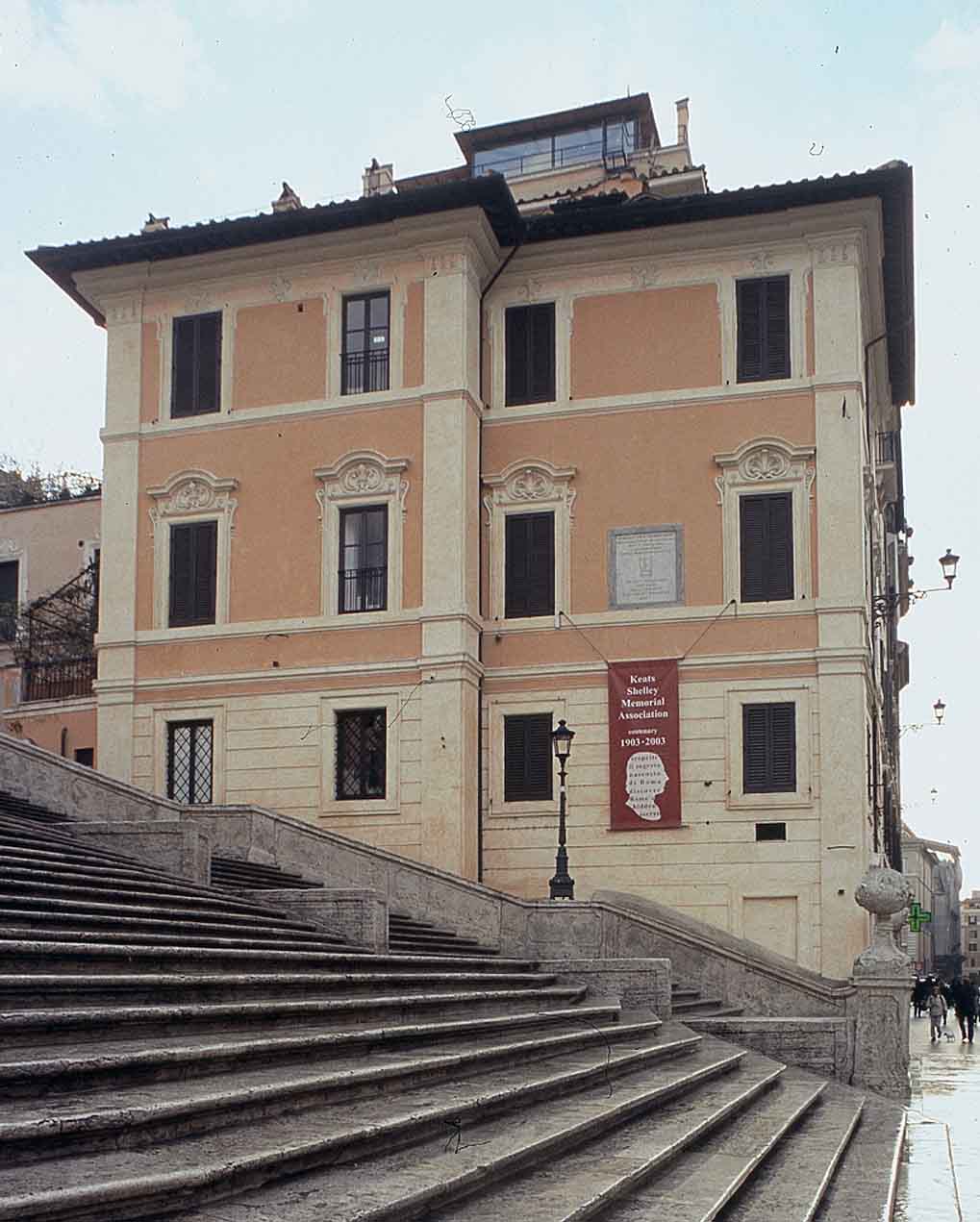
The Keats-Shelley House at number 26 Piazza di Spagna, where John Keats died in 1821 — Public domain

The Sallustiano obelisk before Trinità dei Monti, at the top of the Spanish Steps — CC BY-SA 4
Frequently Asked Questions About Spanish Steps Rome
How many steps are the Spanish Steps Rome?
Spanish Steps Rome has 135 travertine steps, arranged in 11 ramps that divide, wind and rejoin as they climb from Piazza di Spagna to Trinità dei Monti. The Rome tourism board describes 11 ramps of 12 steps each, and the commonly cited total is 135. The climb takes about five minutes, and the landings give rest points along the way.
Can you sit on the Spanish Steps Rome?
Sitting on the steps has been banned since 2019, under Rome’s urban police regulations, and the ban is enforced with fines starting at 250 euros. The ban followed years of damage to the travertine, because the crowds who sat on the steps stained and chipped the stone. Visitors should climb, photograph and move on, and use the cafes and the Pincio terrace for resting.
When is the best time to visit Spanish Steps Rome?
Mid-April to mid-May is the most beautiful time, because about 450 potted azaleas cover the steps in a tradition the Rome tourism board dates to the 1950s. The early morning and the evening are the quietest times, and the steps are free and open at all hours. Summer midday should be avoided, because the stone holds the heat and there is no shade.
Is Spanish Steps Rome free to visit?
Spanish Steps Rome is a public staircase, free to climb at any hour, with no ticket, no queue and no opening time. The church of Trinità dei Monti at the top is also free to enter, and the Pincio terrace beyond it is a free public park. The Keats-Shelley House at the foot of the steps charges admission, and its hours vary.
Why are they called the Spanish Steps Rome?
The steps take their name from the Piazza di Spagna below, and the square takes its name from the Spanish Embassy to the Holy See, which has stood on the piazza for centuries. The staircase itself was built with French money, from the bequest of the French diplomat Étienne Gueffier, and the church at the top is French. The official name, Scalinata di Trinità dei Monti, recalls the church, while the everyday name recalls the square.
Is Spanish Steps Rome a UNESCO World Heritage site?
The steps carry no inscription of their own, yet they stand inside the inscribed property “Historic Centre of Rome, the Properties of the Holy See in that City Enjoying Extraterritorial Rights and San Paolo Fuori le Mura” (ref 91, 1980, extended 1990). UNESCO’s criterion (i) text singles out the Trident laid out by Sixtus V, including Piazza di Spagna, among the property’s outstanding features, so the steps are one of the few individual places the inscription names. The registry flag for this entity reads false, and that understates the steps’ position, which is recorded in the fix queue.
Verified
Every figure below was checked against a named source on 22 November 2026, and the checks are listed here so a reader can repeat them. The staircase’s 135 steps, its construction from 1723 to 1725, its architect Francesco de Sanctis and its inauguration for the Jubilee of 1725 were confirmed from the Rome tourism board’s listing on 22 November 2026. The bequest of Étienne Gueffier, 20,000 scudi, was confirmed from the same listing and from the published history of the steps on the same day. The Barcaccia fountain’s dates, 1626 to 1629, and its sculptor Pietro Bernini were confirmed from the tourism board’s listing on 22 November 2026, as were the azaleas, about 450 potted plants from mid-April to mid-May, a tradition dated to the 1950s.
The Wikidata record for the steps was read directly from the Wikidata API on 22 November 2026: Q848072, labelled Spanish Steps, instance of monumental staircase, at 41.90611° N, 12.48278° E, matching the registry exactly. The UNESCO position was read directly on whc.unesco.org on 22 November 2026: the property “Historic Centre of Rome, the Properties of the Holy See in that City Enjoying Extraterritorial Rights and San Paolo Fuori le Mura” is ref 91, first inscribed in 1980 and extended in 1990, criteria (i)(ii)(iii)(iv)(vi), and its criterion (i) text names the Trident marked out by Sixtus V, including Piazza di Spagna, among the property’s testimonies of incomparable artistic value. Spanish Steps Rome stands at the apex of that Trident, inside the inscribed property.
The registry flag for this entity reads unesco:false, and that flag understates the steps’ position; the discrepancy is recorded in the fix queue as item #208, and this article follows the UNESCO record rather than the flag. The restoration of 2015 to 2016, funded by Bulgari, and the reopening on 22 September 2016 were confirmed from the published accounts on 22 November 2026.
Sources
- UNESCO World Heritage Centre, “Historic Centre of Rome, the Properties of the Holy See in that City Enjoying Extraterritorial Rights and San Paolo Fuori le Mura”, ref 91 (https://whc.unesco.org/en/list/91/)
- Wikidata, Q848072, Spanish Steps (https://www.wikidata.org/wiki/Q848072)
- Turismo Roma, Piazza di Spagna and Piazza San Pietro (https://www.turismoroma.it/en/node/31552)
Unverified
- The exact number of steps is commonly cited as 135, yet some sources count 138, because the landings and the lowest treads are counted differently, and no official count was confirmed on 22 November 2026.
- The current hours of the church of Trinità dei Monti are not stated, because they vary by day and the church’s own site is the authority.
- The fine for sitting on the steps is stated as starting at 250 euros, because that figure appears in the city’s published regulations, yet the amount enforced on the day may differ.
Illustrations
- Hero: The Staircase That Links the Square to the Pincio. Free image: https://upload.wikimedia.org/wikipedia/commons/a/ae/Gustave_de_Beaucorps%2C_Spanish_Steps%2C_Rome%2C_c._1858%2C_NGA_131946.jpg — CC0.
- In body, The Staircase Itself: The staircase of Spanish Steps Rome is the sight, and its 135 travertine steps in 11 ramps are the reason visitors come. Free image: https://upload.wikimedia.org/wikipedia/commons/2/22/Spanish_Steps%2C_Rome%2C_September_1965.jpg — CC BY 2.
- In body, The Barcaccia Fountain: The Barcaccia fountain stands at the foot of Spanish Steps Rome, in the centre of the Piazza di Spagna, and its half-sunk boat is one of Rome’s most loved sights. Free image: https://upload.wikimedia.org/wikipedia/commons/b/b4/Rome%2C_the_fountain_Fontana_della_Barcaccia.JPG — CC BY-SA 3.
- In body, Trinità dei Monti: Trinità dei Monti is the church at the top of Spanish Steps Rome, and its twin towers close the view from the square below. Free image: https://upload.wikimedia.org/wikipedia/commons/d/da/Trinita_dei_Monti_in_Rome_%281%29.jpg — CC BY-SA 4.
- In body, The Pincio terrace: The Pincio terrace above the Spanish Steps, with its view over the rooftops of Rome. Free image: https://upload.wikimedia.org/wikipedia/commons/9/9d/Pincio_terrace_in_Rome.jpg — CC BY-SA 4, by Krzysztof Golik.
- In body, The Via Condotti: The Via Condotti, the street of the great fashion houses starting at the Piazza di Spagna. Free image: https://upload.wikimedia.org/wikipedia/commons/e/ee/Via_dei_Condotti.jpg — CC0, by Perituss.
- In body, Babington’s Tea Rooms: Babington’s Tea Rooms at the foot of the Spanish Steps, serving the English community since 1893. Free image: https://upload.wikimedia.org/wikipedia/commons/0/0b/Babington%27s_Tea_Rooms%2C_Rome_%289931235416%29.jpg — CC BY 2, by Andy Hay from UK.
- In body, The Spanish Embassy palace: The palace of the Spanish Embassy on the Piazza di Spagna, which gave the square and the steps their name. Free image: https://upload.wikimedia.org/wikipedia/commons/4/43/Palacio_de_Espa%C3%B1a%2C_plaza_de_Espa%C3%B1a%2C_Roma%2C_Italia%2C_2022-09-14%2C_DD_22.jpg — CC BY-SA 4, by Diego Delso.
- In body, The Trevi Fountain: The Trevi Fountain, a short walk from the Spanish Steps through the historic centre. Free image: https://upload.wikimedia.org/wikipedia/commons/a/ad/Fuente_de_Trevi%2C_Roma%2C_Italia%2C_2022-09-15%2C_DD_02.jpg — CC BY-SA 4, by Diego Delso.
- In body, The Piazza Navona: The Piazza Navona, the great Baroque square a short walk from the Spanish Steps. Free image: https://upload.wikimedia.org/wikipedia/commons/1/19/Piazza_Navona_in_Rome_07.jpg — CC BY-SA 4, by Krzysztof Golik.
- In body, The Keats-Shelley House: The Keats-Shelley House at number 26 Piazza di Spagna, where John Keats died in 1821. Free image: https://upload.wikimedia.org/wikipedia/commons/a/a3/Keats-Shelley_House.jpg — Public domain, by Keats1795.
- In body, The Sallustiano obelisk: The Sallustiano obelisk before Trinità dei Monti, at the top of the Spanish Steps. Free image: https://upload.wikimedia.org/wikipedia/commons/0/0b/Obelisco_Sallustiano_a_Trinit%C3%A0_dei_Monti%2C_Roma.jpg — CC BY-SA 4, by Albarubescens.