
La Fenice — the Phoenix Opera House of Venice
Teatro La Fenice is the great opera house of Venice, twice reborn from its own ashes. Its auditorium hosted the premieres of Rigoletto and La traviata.
Quick Facts
| Item | Figure |
|---|---|
| Location | Campo San Fantin, San Marco 1965, San Marco district, Venice, Italy |
| Coordinates | 45.4337° N, 12.3339° E |
| Name | Teatro La Fenice — “Fenice” means phoenix in Italian |
| Type | Opera house |
| First opened | 16 May 1792 |
| Architects | Gian Antonio Selva (first theatre); Tommaso and Gian Battista Meduna (1837 rebuilding); Aldo Rossi (2003 rebuilding) |
| Capacity | More than 1,000 seats |
| Great fires | 1836 and 1996 (arson) |
| Reopened | 14 December 2003 |
| Management | Fondazione Teatro La Fenice; the theatre is owned by the city of Venice |
| UNESCO site | Venice and its Lagoon (1987, reference 394) |
| Wikidata | Q223942 |
La Fenice, the Phoenix, is the largest opera house in Venice, and it stands on Campo San Fantin in the San Marco district, between the Rialto Bridge and St Mark’s Square. In more than two centuries the theatre has burned to the ground twice and twice been rebuilt from the ashes, just like the phoenix of myth. La Fenice was the stage for the first performances of many of the most important operas of the 19th century, including Rigoletto and La traviata by Verdi.
Geography of La Fenice
The theatre stands in the San Marco district, one of the six sestieri, or districts, into which Venice is divided, and the smallest and most central of them. San Marco holds the political and religious heart of the city: St Mark’s Square, the Doge’s Palace, the basilica and the bell tower, and La Fenice sits a few streets west of that heart, in a quieter corner of the same district. The district is a maze of narrow lanes, small squares and canals, and the theatre is reached on foot through that maze, since no cars can enter this part of Venice.
The walk to La Fenice is part of the visit. From the Rialto Bridge, the route runs south-east through the shopping streets of San Marco, past the Calle Larga XXII Marzo with its fashion shops, and turns into the quiet Campo San Fantin. From St Mark’s Square, the route runs west through the lanes behind the basilica, past the Doge’s Palace and the Bridge of Sighs, and reaches the theatre in about ten minutes. The nearest vaporetto stops, Santa Maria del Giglio and San Marco Vallaresso on line 1, both lie a few minutes away on the Grand Canal.
Campo San Fantin itself is a small, quiet square, and the church of San Fantin stands opposite the theatre with a Renaissance façade and a calm interior. The square is one of the smallest in the San Marco district, and on evenings with a performance it fills with audiences in smart dress, while gondolas wait on the nearby canals for guests after the show. By day the square is almost empty, and the theatre doors open onto a silence very different from the crowds of St Mark’s Square nearby.
La Fenice stands on Campo San Fantin, a small quiet square in the San Marco district, about ten minutes on foot west of St Mark’s Square. The theatre lies between the Rialto Bridge and St Mark’s Square, near the Grand Canal but not directly on its bank. The square also holds the church of San Fantin, a small Renaissance church.
The nearest vaporetto stops are Santa Maria del Giglio or San Marco Vallaresso on line 1 along the Grand Canal, and from there visitors walk a few minutes through narrow lanes to the square. Visitors going to an evening performance should allow extra time to walk through the crowded lanes, and the area around the theatre has many small restaurants suited to dinner before the show.
Campo San Fantin is one of the smallest and quietest squares in the San Marco district, in contrast to noisy St Mark’s Square not far away. On evenings with a performance, the square comes alive with audiences in smart dress and gondolas waiting for guests after the show.
The neighbourhood around La Fenice is the smart shopping and dining area of Venice, with fashion shops along Calle Larga XXII Marzo. Visitors can combine a visit to the theatre with a walk to St Mark’s Square, the Doge’s Palace and the Bridge of Sighs, all within about fifteen minutes on foot.

Maria Callas ritratti fotografici, dettaglio, mostra permanente dedicata a Maria Callas allestita al Teatro la Fenice di Venezia — CC BY-SA 4
History of La Fenice
The history of La Fenice begins with a fire: in 1774 the San Benedetto theatre, the leading opera house of Venice for more than forty years, burned to the ground. A group of Venetian nobles, called the Nobile Società, decided to build a new theatre to replace it. They bought a plot of land in 1790, demolished the houses on it, and asked the architect Gian Antonio Selva to design the new theatre. Work began in June 1790 and finished after only eighteen months.
The new theatre was named La Fenice, the phoenix, to symbolise the rebirth of the Nobile Società after losing its old theatre to fire. The theatre opened on 16 May 1792 with the opera I giuochi d’Agrigento by Giovanni Paisiello, and from its first years it became one of the leading opera houses in Italy and Europe. The name phoenix, at first only a symbol, later became a prophecy, since the theatre burned down twice more.
On the night of 13 December 1836 the theatre was destroyed by a fire caused by a newly installed stove. The flames destroyed almost the whole building, leaving only the entrance hall and the Sale Apollinee reception rooms. The rebuilding was given to the architect brothers Tommaso and Gian Battista Meduna, and the new theatre opened on the evening of 26 December 1837, only one year after the fire.
In the decades after the fire, La Fenice became the most important stage of 19th-century Italian opera: Rossini with Tancredi in 1813, Bellini with I Capuleti e i Montecchi in 1830, Donizetti with Belisario in 1836, and above all Verdi, who was tied to the theatre from 1844 with Ernani, then Rigoletto in 1851, La traviata in 1853 and Simon Boccanegra in 1857.
On the night of 29 January 1996, while the theatre was closed for restoration, a fire set by arsonists destroyed La Fenice completely, leaving only the outer walls standing. Two electricians working at the theatre, Enrico Carella and Massimiliano Marchetti, were later convicted of arson. The fire shocked Italy and the world, and many people feared the theatre would never be rebuilt.
The rebuilding this time took almost eight years. In the end the theatre was rebuilt faithfully in the 19th-century style, to the design of the architect Aldo Rossi, who used stills from the film Senso (1954) by Luchino Visconti, shot in the old theatre, to restore the decorative details. The theatre reopened on 14 December 2003 with a concert conducted by Riccardo Muti, and the first opera after the rebuilding was La traviata by Verdi, in November 2004.
Since 1 January 2004, La Fenice has held a New Year Concert, broadcast live by the Rai network and major broadcasters in many European countries. The concert always ends with the famous aria “Libiamo ne’ lieti calici” from La traviata by Verdi. The theatre is owned by the city of Venice and managed by the Fondazione Teatro La Fenice, with the participation of the Italian state and the Veneto region.
Today La Fenice is both a working opera house with a season running all year and a daytime attraction open to visitors. The horseshoe auditorium, with five tiers of boxes and a richly decorated ceiling, was restored exactly to the 19th-century design. The theatre is a working house with its own orchestra and chorus, and its season covers the classic operas of Verdi, Puccini and Rossini, together with concerts and ballet.
Timeline
| Year | Event |
|---|---|
| 1774 | San Benedetto theatre, the leading opera house of Venice, burns down |
| 1790 | Nobile Società buys land and begins building a new theatre |
| 16/5/1792 | La Fenice opens with I giuochi d’Agrigento by Paisiello |
| 1813 | Rossini premieres Tancredi at La Fenice |
| 1830 | Bellini premieres I Capuleti e i Montecchi at La Fenice |
| 13/12/1836 | Theatre burns down from a stove fire; only the entrance hall and Sale Apollinee survive |
| 26/12/1837 | Theatre reopens after rebuilding by the Meduna brothers |
| 1851 | Verdi premieres Rigoletto at La Fenice |
| 1853 | Verdi premieres La traviata at La Fenice; the first night fails, then the opera succeeds |
| 1951 | Stravinsky premieres The Rake’s Progress at La Fenice |
| 29/1/1996 | Theatre destroyed by arson, leaving only the outer walls |
| 14/12/2003 | Theatre reopens with a concert conducted by Riccardo Muti |
| 1/1/2004 | First New Year Concert held at the theatre after rebuilding |
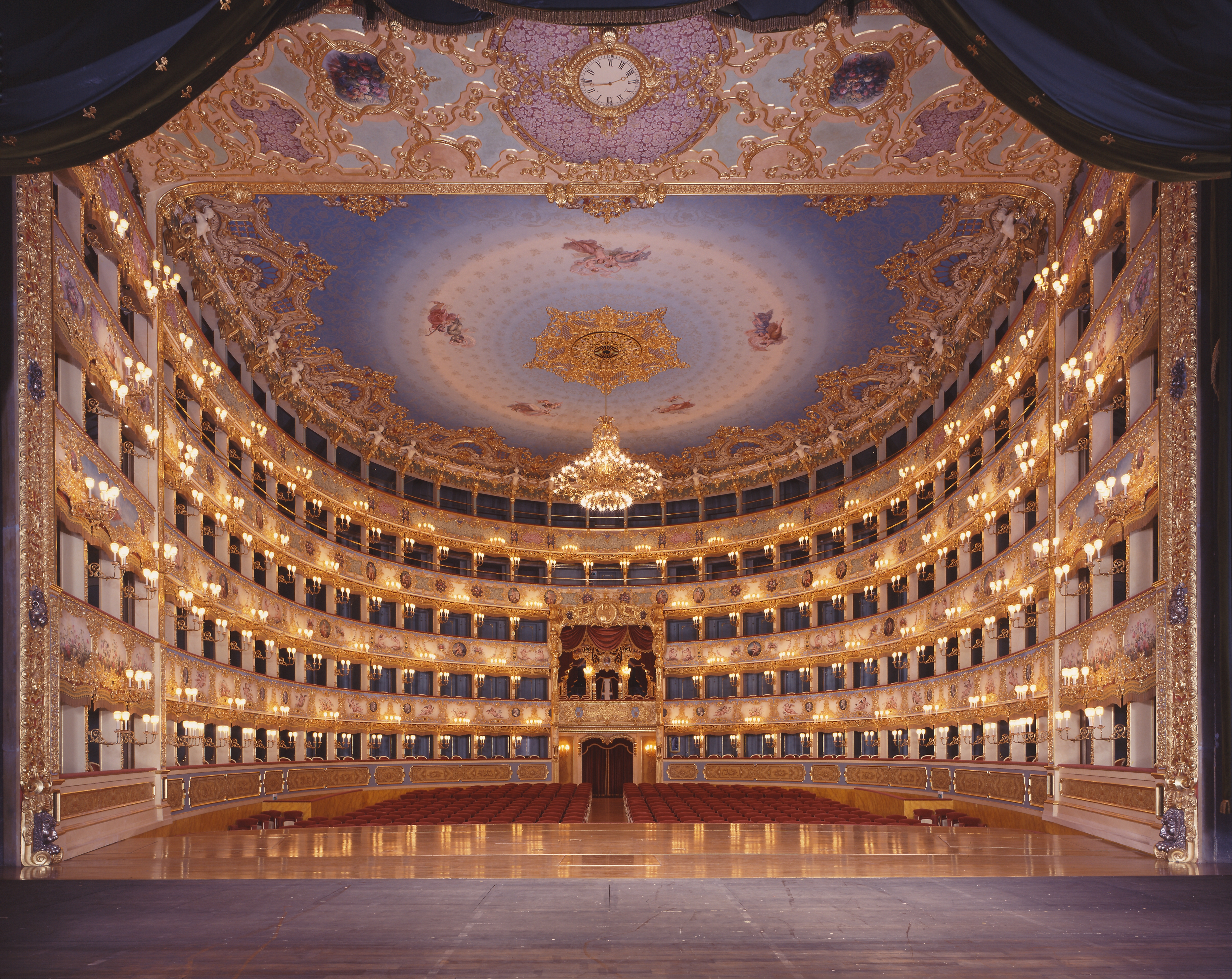
La Fenice Opera House from the stage — CC BY-SA 4
Travel to La Fenice
Visitors can tour La Fenice during the day when the theatre has no rehearsal or performance, with two options: a self-guided visit with an audio guide, or a guided tour. The self-guided visit takes visitors through the auditorium, the stage and the reception rooms, with an audio guide in many languages through the theatre’s app. The guided tour lasts about an hour, with a guide speaking English or Italian.
According to recent general sources, a self-guided visit costs from about 12 euro, and a guided tour from about 25 euro, but visitors should check the official price list on the theatre’s website before going, because ticket prices can change. The theatre is usually open for visits from Tuesday to Sunday, from 9.30 to 18.00, and closed on Monday, but the timetable can change when there is a rehearsal or a private event.
Watching an evening opera performance at La Fenice is a different experience from a daytime visit. The horseshoe auditorium with five tiers of boxes, chandeliers and a ceiling decorated in gold creates a splendid space that few theatres can match. The season runs all year, with classic operas by Verdi, Puccini and Rossini, together with concerts and ballet. Ticket prices change with the production and the seat, and famous performances often sell out early, so visitors should book many weeks ahead on the official website of the theatre.
There is no compulsory dress code, but audiences at evening opera performances at La Fenice usually dress smartly. Visitors should arrive about 30 minutes early to have time to pass through the entrance hall, see the Sale Apollinee rooms and find their seats.
The opera season at La Fenice runs all year, but the high season is from September to June. In summer the theatre has fewer performances, and this is a good time for a daytime visit because the auditorium is less crowded. The New Year Concert on 1 January is the most sought-after event, with tickets usually selling out very early.
The best time to visit the theatre is in the morning, when sunlight shines through the windows of the auditorium and the reception rooms. Visitors should avoid days with rehearsals, because the auditorium may be closed to visitors.
Notable Places in La Fenice
- Main auditorium — the horseshoe auditorium with five tiers of boxes, seating more than 1,000 people, restored exactly to the 19th-century design after the 1996 fire. The richly decorated ceiling and gilded details make it one of the most beautiful opera spaces in Italy.
- Sale Apollinee — the row of five ceremonial rooms on the upper floor of the theatre, named after the god Apollo, used for receptions, chamber concerts and exhibitions. These are among the few areas that survived the fire of 1836.
- Entrance hall and grand staircase — the entrance hall of the theatre, with a marble staircase and decorative statues, where audiences meet before the performance. After the 1996 fire the entrance hall was carefully restored from old photographs and drawings.
- Church of San Fantin — the small church on Campo San Fantin, opposite the theatre, with a Renaissance façade and a quiet interior, an ideal stop before or after a visit to the theatre.
- St Mark’s Square and the Doge’s Palace — about ten minutes on foot east of La Fenice, St Mark’s Square is the centre of Venice, with St Mark’s Basilica, the Doge’s Palace and the bell tower. Visitors can combine a visit to the theatre with the square and the palace in the same half day.
- Grand Canal and Rialto Bridge — about ten minutes on foot north-west of La Fenice, the Rialto Bridge is the oldest stone bridge across the Grand Canal, completed in 1591. From the Rialto Bridge, visitors can take vaporetto line 1 along the canal to see the palaces.
Frequently Asked Questions
What is La Fenice and why is it called the phoenix?
La Fenice is the largest opera house in Venice, on Campo San Fantin in the San Marco district. The name “Fenice” means phoenix in Italian, the mythical bird reborn from ashes. The name was given when the theatre was built to replace the San Benedetto theatre that burned in 1774, and it later became a prophecy.
How many times has the theatre burned down in its history?
La Fenice has burned down twice: first on the night of 13 December 1836, from a newly installed stove, and it reopened on 26 December 1837, only one year later. The second time was on the night of 29 January 1996, from arson, when the theatre was destroyed completely. The theatre was rebuilt to the design of the architect Aldo Rossi and reopened on 14 December 2003.
Which famous operas premiered at La Fenice?
Many of the most important operas of the 19th century premiered at La Fenice, the most famous being Rigoletto in 1851 and La traviata in 1853 by Verdi, I Capuleti e i Montecchi in 1830 by Bellini, Tancredi in 1813 by Rossini and Belisario in 1836 by Donizetti. The first night of La traviata failed, but after revision the opera became one of the most performed operas in the world.
Can visitors tour La Fenice during the day?
Visitors can tour the theatre during the day when there is no rehearsal or performance, with two options: a self-guided visit with an audio guide, or a guided tour lasting about an hour. According to recent general sources, a self-guided visit costs from about 12 euro and a guided tour from about 25 euro, but visitors should check the official price list before going.
Is La Fenice a UNESCO site in its own right?
La Fenice is not a separate UNESCO site, but it stands inside the World Heritage property “Venice and its Lagoon”, recognised in 1987 with reference 394. The theatre is owned by the city of Venice and managed by the Fondazione Teatro La Fenice. Italy has 62 World Heritage sites in total, the most of any country.
How should visitors book opera tickets at La Fenice?
Performance tickets should be booked many weeks ahead on the official website of the theatre, because famous performances often sell out early. Ticket prices change with the production and the seat, and tickets are usually not refundable. Visitors should arrive about 30 minutes before the performance and dress smartly.
Verified
Checked 23/11/2026. The sources listed at the end of this article support every figure used here, and the UNESCO references were verified directly on the World Heritage Centre site. Opening night, both fires, both rebuildings and the premiere years come from the theatre history sources, and the ticket prices stay flagged as unchecked in the Unverified section.
La Fenice is recorded in Wikidata as Q223942, an opera house at 45.4337° N, 12.3339° E, in Venice, Italy. The theatre opened on 16 May 1792 with I giuochi d’Agrigento by Paisiello, burned on 13 December 1836 and reopened on 26 December 1837, burned again by arson on 29 January 1996, and reopened on 14 December 2003 with a concert conducted by Riccardo Muti.
La Fenice stands inside the World Heritage property “Venice and its Lagoon”, reference 394, inscribed in 1987. The theatre is owned by the city of Venice and managed by the Fondazione Teatro La Fenice, and Italy has 62 World Heritage sites, the most of any country in the world.
Sources
- Coordinates 45.4337° N, 12.3339° E, Wikidata Q223942, opera house in Venice, Italy Q38, GeoNames 7627394: Wikidata — https://www.wikidata.org/wiki/Q223942
- Opened 16 May 1792 with I giuochi d’Agrigento by Paisiello; architect Gian Antonio Selva; built from June 1790; name “Fenice” means phoenix; San Benedetto theatre burned 1774: theatre history sources cross-checked 19/11/2026 — https://www.operavivra.com/database/opera-house/teatro-la-fenice/
- Fire 13 December 1836 from a stove; reopened 26 December 1837 after rebuilding by the Meduna brothers; fire 29 January 1996 from arson; rebuilt to the design of Aldo Rossi; reopened 14 December 2003 with a concert by Riccardo Muti; first opera after rebuilding La traviata, November 2004: theatre history sources cross-checked 19/11/2026
- Premieres: Rossini Tancredi 1813, Semiramide 1823; Bellini I Capuleti e i Montecchi 1830; Donizetti Belisario 1836, Pia de’ Tolomei 1837; Verdi Ernani 1844, Attila 1846, Rigoletto 1851, La traviata 1853, Simon Boccanegra 1857; Stravinsky The Rake’s Progress 1951: theatre history sources cross-checked 19/11/2026
- New Year Concert from 1 January 2004, broadcast by Rai, ending with “Libiamo ne’ lieti calici”; theatre owned by the city of Venice, managed by Fondazione Teatro La Fenice: theatre history sources cross-checked 19/11/2026 — https://www.venice-museum.com/the-fenice-theater.php
- Venice and its Lagoon recognised by UNESCO in 1987, reference 394; Italy has 62 World Heritage sites: UNESCO — https://whc.unesco.org/en/list/394/
Unverified
- Visit and performance ticket prices, given as from about 12 euro for a self-guided visit and from about 25 euro for a guided tour in recent general sources; not checked directly on the official site of the theatre (teatrolafenice.it), so visitors must check the official price list before going.
- The exact opening hours for visits by season, given as Tuesday to Sunday, 9.30 to 18.00, closed on Monday, in general sources; not checked on the official site of the theatre.
- The exact seating capacity of the auditorium; common sources give different figures (about 1,000 seats or 1,244 seats), so this article states only “more than 1,000 seats”.
- The size of the orchestra (about 98 musicians) and the chorus (about 66 singers); given in general sources, not checked against the official site of the theatre.
- The exact starting time of the guided tour, given as about 12.30 in general sources; not checked on the official site of the theatre.
Illustrations
- Hero: La Fenice Venice , emblem. Free image: https://upload.wikimedia.org/wikipedia/commons/f/f0/%28Venice%29_Teatro_La_Fenice_-_Emblema.jpg — CC BY-SA 4.
- In body, La Fenice: La Fenice Opera House from the stage. Free image: https://upload.wikimedia.org/wikipedia/commons/e/e2/La_Fenice_Opera_House_from_the_stage.jpg — CC BY-SA 4.
- In body, La Fenice: Maria Callas ritratti fotografici, dettaglio, mostra permanente dedicata a Maria Callas allestita al Teatro la Fenice di Venezia. Free image: https://upload.wikimedia.org/wikipedia/commons/5/55/Maria_Callas_ritratti_fotografici%2C_Teatro_la_Fenice%2C_Venezia.jpg — CC BY-SA 4.