
Murano Venice: The Glass Island of the Venetian Lagoon
Murano Venice is seven small islands in the Venetian Lagoon. Glass has been blown on these islands since 1291, when Venice moved its furnaces here.
Murano Venice is a place where the craft is still alive in the furnaces, not only in the museum cases. The glassblowers work every day along the canals, the furnaces glow behind open doors, and the sound of the blowpipe carries across the water. Visitors come to Murano Venice for that living craft, and they stay for the quiet that follows it: the pastel houses along the canals, the old church with its mosaic floor, and the slow pace of an island that has no cars at all. Venice is crowded and theatrical, while Murano Venice is a working village that happens to make the most famous glass in the world.
The island lies close to Venice, about one and a half kilometres north of the historic centre, yet the mood changes completely on the short boat ride across the lagoon. Murano Venice feels like a smaller and calmer Venice, with the same canals and bridges but far fewer people, and with workshops instead of palaces along the water. A morning is enough to see the glassblowing, the museum and the old church, and many travellers combine Murano Venice with Burano and Torcello in a single day on the lagoon.
This guide gives no prices, because workshop visits, museum entry and boat fares change with the season, and it names no single workshop as the best. Murano Venice is described here by its geography, its history and its craft, so that a traveller can recognise real glass, choose a good workshop and enjoy the island on its own terms.
Quick Facts About Murano Venice
| Fact | Detail |
|---|---|
| Name | Murano, island group in the Venetian Lagoon |
| Location | Venetian Lagoon, Veneto, north-east Italy, about one and a half kilometres north of Venice |
| Coordinates | 45.4575° N, 12.3536° E |
| Islands | Seven small islands joined by bridges |
| Population | About 4,500 people |
| Area | A little over one square kilometre |
| Best known for | Glassblowing, moved here from Venice in 1291 |
| Main church | Santa Maria e San Donato, from the seventh century, rebuilt in the twelfth century |
| Museum | Museo del Vetro, the Glass Museum, founded in 1861 |
| Transport | Vaporetto lines 4.1, 4.2, 12 and 13; no cars on the island |
| UNESCO | Part of Venice and its Lagoon, inscribed in 1987 as reference 394, under criteria (i), (ii), (iii), (iv), (v) and (vi) |
| Wikidata | Q52437 |
| Language | Italian; English is widely used in the workshops and shops |
| Currency | Euro |
| Time zone | CET (UTC+1), CEST (UTC+2) in summer |
Geography of Murano Venice
Seven islands joined by bridges
Murano Venice is not a single island but a group of seven small islands joined by footbridges, like a miniature Venice. The islands are named San Donato, San Pietro, Santo Stefano, San Giuseppe, San Martino, San Michele and the small Sacca Serenella, and they are divided by narrow canals with the main canal, the Canale degli Angeli, running through the middle. The pastel houses and the glass workshops line the canals, and the bridges between the islands are low and short, so the whole group can be crossed on foot in well under an hour. Murano Venice covers a little over one square kilometre, which makes it small enough to explore slowly and large enough to hold a real town.
The ground of Murano Venice is entirely flat, like the whole lagoon, and the islands sit barely above the average sea level, only about one metre higher. The low ground means that Murano Venice shares the high water of Venice, known as acqua alta, when autumn and winter tides flood the lowest quays. The mobile MOSE barriers at the lagoon inlets protect the whole lagoon, including Murano Venice, from the worst tides, and the island drains quickly once the tide turns. The flat land also means that the horizon is wide, with the lagoon stretching in every direction and the bell towers of Venice visible across the water on a clear day.
The canals of Murano Venice are narrower than the Grand Canal of Venice, and they give the island its rhythm. The main canal carries the water buses and the delivery boats, while the smaller canals carry only local traffic, and the workshops open their doors onto the water so that raw glass and finished pieces can be moved by boat. Murano Venice is a town built for the water, with steps down to the canals at every corner and no road wide enough for a car. Walking is the only way to move inside the island, and the bridges force a slow pace that suits the place.
The lagoon around the island
Murano Venice stands in the northern part of the Venetian Lagoon, a shallow saltwater basin on the Adriatic coast that covers about 70,000 hectares. The lagoon is joined to the sea by three inlets, and its tides, winds and seasons shape the islands constantly. The water around Murano Venice is shallow, with mud banks that appear at low tide and fishing grounds that have fed the island for centuries. The lagoon also holds the islands of Burano and Torcello to the north-east, and the water bus routes link all three in a single chain, so that Murano Venice is the first stop on the classic island day from Venice.
The lagoon is a protected landscape, and its fragility is part of the story of Murano Venice. The high water that floods Venice also floods the quays of Murano, and the erosion of the salt marshes threatens the edges of the islands. UNESCO inscribed the whole lagoon with Venice in 1987, and the management plan for the property covers the islands as well as the city. Murano Venice benefits from that protection, because the furnaces, the churches and the canals are treated as parts of a single cultural landscape rather than as separate sights.
The climate of Murano Venice is the mild coastal climate of the northern Adriatic, with hot humid summers and mild wet winters. Summer temperatures often sit between 27 and 30 degrees, while winter temperatures rarely fall below freezing, because the sea softens the cold. The best months to visit Murano Venice are spring and autumn, when the air is mild, the light is soft and the crowds are thinner than in summer. Winter is quiet and atmospheric, yet some small workshops close for the Christmas and New Year holidays, so a winter visit needs a check of opening days.
The lighthouse and the eastern shore
The eastern shore of Murano Venice holds the Faro, the white lighthouse that stands about 30 metres high on the edge of the lagoon. The lighthouse was built in the twentieth century on the site of an older watchtower, and it has become the familiar landmark of the island, visible from the boats long before the houses come into view. The area around the Faro gives a wide view across the lagoon to the Adriatic and to the island of Sant’Erasmo, and it is one of the best places on Murano Venice to watch the sunset. The lighthouse itself is a working aid to navigation, and its light guides the boats that cross the lagoon at night.
The eastern shore is also the quietest part of Murano Venice, with fewer workshops and more open water, and it shows the island as a place of fishermen as well as glassblowers. The houses here are lower and plainer than those along the main canal, and the gardens behind them hold vegetables and vines. A walk to the Faro takes a traveller away from the shops and into the daily life of the island, where the boats are moored for fishing rather than for tours. Murano Venice keeps that double character in every quarter: the craft that made it famous and the lagoon life that made it home.

Canale San Giovanni (Murano) — CC BY-SA 4

The main canal runs through Murano, joining its seven islands by bridge — CC BY-SA 3
History of Murano Venice
From a fishing village to a glass town
Murano Venice began as a fishing village and a refuge for people fleeing the mainland during the invasions of the fifth and sixth centuries. The first churches on the island appeared in the seventh century, and the church of Santa Maria e San Donato, the oldest church still standing on the island, was built in that century. For many centuries Murano Venice lived by fishing, salt making and small trade inside the lagoon, and its people were lagoon people first, with boats, nets and salt pans rather than furnaces. The island was part of the lagoon world that gave birth to Venice itself, and its early history is the history of refugees who learned to live on the water.
The turning point came in 1291, when the government of the Republic of Venice ordered all the glass furnaces to move from the centre of Venice to Murano Venice. The stated reason was to reduce the risk of fire in a city built of wood, and the hidden reason was to keep the secrets of Venetian glassmaking under control. From that year, glass became the soul of the island, and the glassmaking families were given special privileges, while leaving the island or revealing a secret was punished severely. Murano Venice became a town of furnaces, and its workshops lined the canals with chimneys that burned day and night.
The glassmakers of Murano Venice were given rights that no other craftsmen held. They were allowed to carry swords, their daughters were allowed to marry into the nobility, and the island council of Murano Venice governed itself with a measure of independence inside the Republic. The island was called a small republic within the Republic, and its masters guarded their recipes as state secrets. Murano Venice grew rich on that monopoly, and its glass travelled to the courts of Europe as a luxury that no other city could match.
The golden age of Murano glass
In the fifteenth and sixteenth centuries, the glass of Murano Venice reached the height of its fame. The craftsmen of the island created cristallo, a clear glass that imitated rock crystal, along with enamelled glass, milk glass and elaborate chandeliers. Murano glass was exported across Europe and became a luxury in royal palaces, and the great families of glassmakers, such as the Barovier, the Seguso and the Salviati, wrote their names into the history of the craft. Murano Venice was not only a workshop but a school, and its techniques spread wherever a master travelled, although the Republic tried to keep them secret.
The golden age also gave Murano Venice its palaces and its churches. Wealthy glass families built houses along the main canal, and the island gained the Palazzo da Mula, a Gothic palace that still stands on the water, along with other noble houses that now serve as hotels, restaurants and galleries. The church of Santa Maria e San Donato was rebuilt in the twelfth century in the Romanesque and Byzantine style, with a geometric marble mosaic floor and a mosaic of the Madonna in the apse from the twelfth century. Murano Venice in those centuries was a small city of craft and wealth, with its own council, its own churches and its own pride.
The craft itself changed with the centuries. The masters of Murano Venice learned to make mirrors, beads, chandeliers and vessels of every shape, and the island supplied the glass for palaces, churches and theatres across Europe. The beads of Murano travelled even further, traded across Africa and Asia, and the island became a name known far beyond the lagoon. Murano Venice in its golden age was a place where a single family could hold a secret for generations, and where a new technique could make a fortune overnight.
Decline and revival
From the seventeenth century onward, other countries in Europe learned the secrets of glassmaking, and the monopoly of Murano Venice faded slowly. The fall of the Republic of Venice in 1797 struck the island hard, and many furnaces closed while many craftsmen left. The nineteenth century was the hardest time, when Murano Venice became a poor island living mainly by fishing and farming, and the great workshops stood empty. The craft that had made the island famous seemed ready to vanish, and the population shrank as young people left for the mainland.
The revival began in the late nineteenth century, when artistic glass workshops reopened and Murano glass was shown at international exhibitions. The Glass Museum, the Museo del Vetro, was founded in 1861 in the Palazzo Giustinian, and its opening marked the recognition of glassmaking as a cultural heritage rather than only a trade. In the twentieth century, modern designers such as Carlo Scarpa and Paolo Venini brought Murano glass into contemporary design, and the island found a new voice that joined tradition with modern art. Murano Venice today still holds that balance, with old workshops beside new studios.
In 1987, together with Venice and the whole lagoon, Murano Venice was inscribed by UNESCO as a World Heritage property, recognising the value of the entire cultural landscape. Murano Venice today keeps its place as the artistic glass centre of the world, although cheap glass and counterfeit pieces are a serious challenge. The old workshops still work by traditional methods, and the island still teaches its craft to new generations. Murano Venice is a place where the fire has never gone out, even when the market turned against it.
Timeline
| Year | Event |
|---|---|
| 5th–6th centuries | Refugees from the mainland settle the lagoon islands, including Murano |
| 7th century | Church of Santa Maria e San Donato built, the oldest church on the island |
| 1291 | Republic of Venice orders all glass furnaces moved to Murano |
| 15th–16th centuries | Golden age of Murano glass, cristallo created |
| 1797 | Republic of Venice falls, Murano glass declines |
| 1861 | Museo del Vetro founded in the Palazzo Giustinian |
| 1987 | UNESCO inscribes Venice and its Lagoon, including Murano |

Paolo veronese, le sette divinità planetarie, da palazzo trevisan a murano, 1557 ca. 01 — CC BY 3
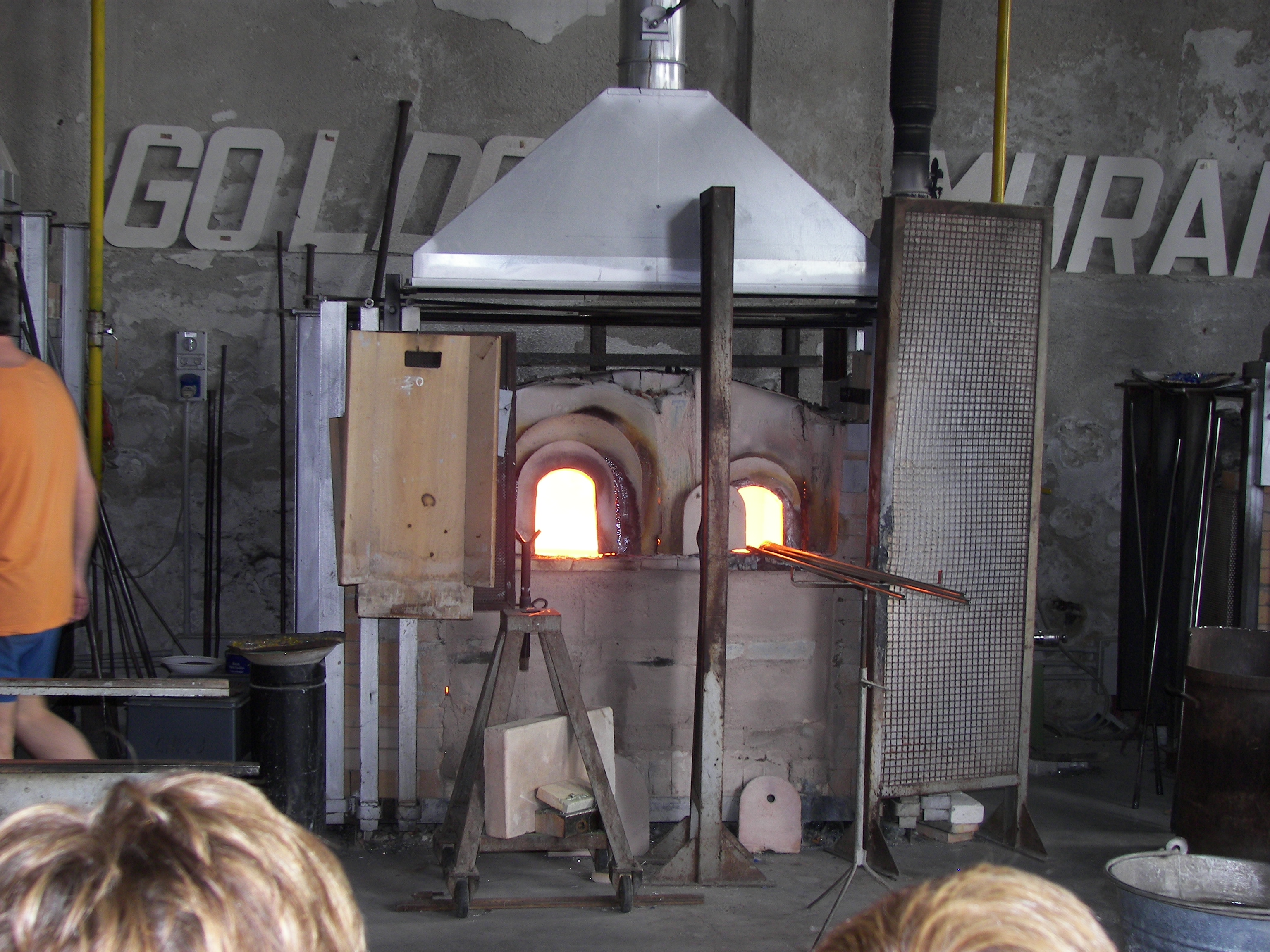
A glass furnace at work on Murano, where the furnaces still burn every day — CC BY-SA 3

A Murano glass chandelier shows the craft at its most splendid — CC BY-SA 4
Travel to Murano Venice
When to go and how long to stay
Spring, from April to June, and autumn, from September to October, are the finest times to visit Murano Venice. The air is mild, the light is good for photographs, and the workshops run normally with moderate crowds. Summer, from July to August, brings far more visitors from Venice, and the humid heat of the lagoon makes walking outdoors tiring.
Winter is quiet and has its own still beauty, yet some small workshops close for the Christmas and New Year holidays, and the high water of autumn and winter can flood the lowest quays. Travellers should check the tide forecast before visiting in those months.
Half a day is enough for most visitors to see Murano Venice. A morning boat from Venice, a glassblowing demonstration, the museum and the church of Santa Maria e San Donato, then a walk along the canal before returning in the early afternoon, makes a full visit. Many travellers combine Murano Venice with Burano and Torcello in the same day, because the three islands lie close together and the water bus links them directly. A traveller who wants a deeper visit can spend a whole day on Murano Venice, with several workshops, lunch at a canal-side restaurant and sunset on the lagoon.
Getting there and getting around
The usual way to reach Murano Venice is the vaporetto, the public water bus of Venice. The circular lines run from Fondamente Nove in the north of Venice to Murano in about fifteen to twenty minutes, while line 12 passes through Murano on its way to Burano and Torcello. Travellers can also travel from Santa Lucia station or Piazzale Roma on the circular lines, and many glass tour companies run private boats from Venice with a demonstration at a workshop.
A private boat is convenient, yet travellers should know that some tours visit only one workshop and can feel like a sales visit.
Movement inside Murano Venice is entirely on foot, because the island has no cars, and the small islands are joined by bridges. The walk from the main landing stage to the museum takes only a few minutes, and the far end of the island near the Faro is about twenty minutes away. Comfortable shoes matter, because the stone quays can be slippery after rain, and the bridges have steps. Murano Venice rewards a slow walk, because the workshops, the churches and the canals are all within a small area, and the best discoveries come from turning down a side canal.
Eating and sleeping
Murano Venice holds many canal-side restaurants and cafes serving the cooking of Venice, above all fresh seafood from the lagoon and the Adriatic. The dishes to try include fried squid, fried fish, pasta with seafood and cuttlefish risotto, and the eating in Murano Venice is usually calmer and less costly than around Saint Mark Square in Venice. The island also holds small cafes and bakeries around Campo San Donato and along the main canal, good places to rest after visiting the workshops. Travellers who stay for lunch should choose a restaurant away from the main landing stage, where the cooking is more local and the tables are quieter.
Murano Venice has only a few small hotels and guesthouses, so travellers who want to sleep on the island should book early, above all in the high season. Most visitors sleep in Venice and visit Murano Venice as a day trip, which is simpler, because the boats run late and the island is close. A night on Murano Venice suits travellers who want the quiet of the lagoon after the crowds leave, with the canals empty and the furnaces cooling for the night.

The vaporetto stop at Colonna serves Murano from Venice across the lagoon — CC BY-SA 4

A canal on Murano, lined with houses where the glass workshops meet the water — CC BY 2
Notable Places in Murano Venice
- Museo del Vetro, the Glass Museum — The museum stands in the Palazzo Giustinian, a Gothic palace on the main canal, and it shows the history of Murano glass from Roman times to the present. Visitors can see fine cristallo cups from the sixteenth century, bright chandeliers and works by contemporary designers. The museum was founded in 1861, and it is the essential stop for understanding why Murano Venice is famous around the world.
- Santa Maria e San Donato — The oldest church of Murano Venice, built in the seventh century and rebuilt in the twelfth century in the Romanesque and Byzantine style. Inside, the church holds a beautiful geometric marble mosaic floor and a twelfth-century mosaic of the Madonna in the apse. The church also keeps the relics of Saint Donatus, and the dragon bones hung behind the altar are said, by legend, to be the bones of the dragon the saint defeated.
- The glass furnaces and workshops — Along the main canal and the smaller canals, dozens of glass furnaces still work every day, and many workshops open their doors for visitors to watch a glassblowing demonstration. In about twenty minutes, a master turns a lump of molten glass into a vase, a horse or a small chandelier, a show that is both art and technique. Travellers should favour workshops with a long history and a real furnace, and avoid places that only sell souvenirs without a furnace of their own.
- The Faro, the lighthouse of Murano — The white lighthouse stands about 30 metres high on the eastern side of the island, and it is the familiar mark of Murano Venice on the lagoon horizon. The lighthouse was built in the twentieth century on the site of an older watchtower, and the area around it is the best place to watch the sunset, with a wide view across the Adriatic and the island of Sant’Erasmo.
- Palazzo da Mula and the canal palaces — Along the main canal, visitors can see the old palaces of the noble and glassmaking families, above all the Palazzo da Mula with its Gothic facade. Many of these palaces are now hotels, restaurants or glass galleries, and a walk along the canal in the afternoon, when the sun reflects on the water and the glass shops light up, is one of the finest sights of Murano Venice.

Murano Lighthouse (4042800999) — CC BY 2

The Glass Museum stands in the Palazzo Giustinian, a Gothic palace on the main canal — Public domain

Santa Maria e San Donato is the oldest church of Murano, rebuilt in the twelfth century — CC BY-SA 4

Palazzo da Mula stands among the canal palaces of the old glassmaking families — CC BY 4
Frequently Asked Questions About Murano Venice
How far is Murano Venice from Venice and how do I get there?
Murano Venice lies about one and a half kilometres north of the historic centre, and the water bus takes about fifteen to twenty minutes from Fondamente Nove on the circular lines. Line 12 also passes through Murano on its way to Burano and Torcello, so travellers can visit all three islands in one day. Movement on the island is entirely on foot, because Murano Venice has no cars.
How long should I spend on Murano Venice?
Half a day is enough for most visitors, with a morning glassblowing demonstration, the museum and the church of Santa Maria e San Donato, then a walk along the canal. Many travellers combine Murano Venice with Burano and Torcello in the same day, because the water bus links the three islands directly. A whole day suits travellers who want to visit several workshops and eat lunch at a canal-side restaurant.
Is the glass on Murano Venice real?
Real Murano glass is made on the island by hand in a furnace, and the best way to recognise it is to watch it being made. Workshops with a real furnace and a master at work are the surest sign, while shops that only sell souvenirs without a furnace deserve caution. The Glass Museum shows the history and the marks of the craft, and it helps a traveller tell genuine work from cheap copies.
What is the best time to visit Murano Venice?
Spring, from April to June, and autumn, from September to October, are the best months, with mild air, soft light and moderate crowds. Summer is the busiest season, and the humid heat of the lagoon makes walking tiring by midday. Winter is quiet and atmospheric, yet some small workshops close for the holidays, so check opening days before a winter visit.
Can I combine Murano Venice with Burano and Torcello?
From Murano the water bus runs on to Burano and then Torcello, so the three islands fit into one morning without rushing. Lunch in Burano breaks the loop in the middle, and Torcello’s quiet lanes make a calm finish. Buy a day pass and the boats run all day, with no advance booking needed.
Is Murano Venice part of the UNESCO site?
Yes, Murano Venice lies inside the property of Venice and its Lagoon, inscribed by UNESCO in 1987 as reference 394. The inscription covers the city, the lagoon and the islands together, under criteria (i), (ii), (iii), (iv), (v) and (vi). Murano Venice is therefore protected as part of a single cultural landscape, not as a separate site.
Verified
Wikidata records Murano under Q52437, with instance-of values for island and archipelago, and coordinates that match the registry entry exactly. The island group counts seven small islands, and its population is about 4,500 people on a little over one square kilometre of land.
The church of Santa Maria e San Donato was built in the seventh century and rebuilt in the twelfth century, and the Glass Museum was founded in 1861 in the Palazzo Giustinian.
The furnaces moved from Venice to Murano in 1291, and the golden age of Murano glass fell in the fifteenth and sixteenth centuries, when cristallo was created. The Republic of Venice fell in 1797, and the craft revived in the late nineteenth century with new artistic workshops. UNESCO inscribed Venice and its Lagoon in 1987 as reference 394, under criteria (i), (ii), (iii), (iv), (v) and (vi), and the property covers the city, the lagoon and the islands together, including Murano. Verified 22 November 2026.
Sources
- Wikidata, Murano, Q52437, instance of island and archipelago, coordinates 45.4575° N, 12.3536° E: https://www.wikidata.org/wiki/Q52437
- UNESCO, Venice and its Lagoon, reference 394, criteria (i) to (vi), inscribed 1987: https://whc.unesco.org/en/list/394/
- Museo del Vetro, Glass Museum of Murano, official site: https://museovetro.visitmuve.it/en/home/
- TheTerraAtlas registry, entity TA-L4-murano, Wikidata Q52437
- TheTerraAtlas Vietnamese article murano.vi.md, facts and sources checked 18 November 2026
- Comune di Venezia, official city site: https://www.comune.venezia.it/
Unverified
- The exact population of Murano, given as about 4,500 people, which changes with the census and needs a current municipal record.
- The exact area of the island group, given as a little over one square kilometre, which should be confirmed against the municipal record before publication.
- The height of the Faro lighthouse, given as about 30 metres, which needs confirmation from the port authority.
- The vaporetto journey times from Venice to Murano, which change with the season and the timetable and must be checked on the ACTV site.
- The opening days of small workshops in winter, which vary from year to year and must be checked before a winter visit.
Illustrations
- Hero: Faro (Murano). Free image: https://upload.wikimedia.org/wikipedia/commons/c/c2/Faro_%28Murano%29.jpg — CC BY-SA 4.
- In body, Seven islands joined by bridges: Paolo veronese, le sette divinità planetarie, da palazzo trevisan a murano, 1557 ca. 01. Free image: https://upload.wikimedia.org/wikipedia/commons/8/8f/Paolo_veronese%2C_le_sette_divinit%C3%A0_planetarie%2C_da_palazzo_trevisan_a_murano%2C_1557_ca._01.JPG — CC BY 3.
- In body, The lagoon around the island: Canale San Giovanni (Murano). Free image: https://upload.wikimedia.org/wikipedia/commons/6/68/Canale_San_Giovanni_%28Murano%29.jpg — CC BY-SA 4.
- In body, The lighthouse and the eastern shore: *Murano Lighthouse (4042800999). Free image: https://upload.wikimedia.org/wikipedia/commons/a/aa/%2AMurano_Lighthouse_%284042800999%29.jpg — CC BY 2.
- In body, Seven islands joined by bridges: The main canal runs through Murano, joining its seven islands by bridge. Free image: https://upload.wikimedia.org/wikipedia/commons/b/b9/Grand_Canal_of_Murano_-Venice%2C_Italy-_panoramio.jpg — CC BY-SA 3.
- In body, From a fishing village to a glass town: A glass furnace at work on Murano, where the furnaces still burn every day. Free image: https://upload.wikimedia.org/wikipedia/commons/4/41/Murano_furnace.jpg — CC BY-SA 3.
- In body, The golden age of Murano glass: A Murano glass chandelier shows the craft at its most splendid. Free image: https://upload.wikimedia.org/wikipedia/commons/0/0f/Murano_Glass_Chandelier.jpg — CC BY-SA 4.
- In body, Getting there and getting around: The vaporetto stop at Colonna serves Murano from Venice across the lagoon. Free image: https://upload.wikimedia.org/wikipedia/commons/e/e8/Venezia_-Murano-_Vaporetto_stop_Colonna.jpg — CC BY-SA 4.
- In body, Museo del Vetro, the Glass Museum: The Glass Museum stands in the Palazzo Giustinian, a Gothic palace on the main canal. Free image: https://upload.wikimedia.org/wikipedia/commons/4/4b/Murano_-_Museo_del_vetro.JPG — Public domain.
- In body, Santa Maria e San Donato: Santa Maria e San Donato is the oldest church of Murano, rebuilt in the twelfth century. Free image: https://upload.wikimedia.org/wikipedia/commons/4/41/Venice_-Church_of_Santa_Maria_e_San_Donato-_20170918130238.jpg — CC BY-SA 4.
- In body, Palazzo da Mula and the canal palaces: Palazzo da Mula stands among the canal palaces of the old glassmaking families. Free image: https://upload.wikimedia.org/wikipedia/commons/4/49/0_Murano%2C_Palazzo_da_Mula.jpg — CC BY 4.
- In body, Eating and sleeping: A canal on Murano, lined with houses where the glass workshops meet the water. Free image: https://upload.wikimedia.org/wikipedia/commons/5/52/Canal_on_the_island_of_Murano%2C_Venice%2C_Italy_%2849872815333%29.jpg — CC BY 2.