
Doge’s Palace — the Gothic Heart of the Venetian Republic
The Doge’s Palace fills the eastern side of St Mark’s Square in Venice. It was home, court, prison and government seat of the Venetian Republic.
Quick Facts
| Item | Detail |
|---|---|
| Italian name | Palazzo Ducale |
| French name | Palais des Doges |
| German name | Dogenpalast |
| Spanish name | Palacio Ducal |
| Location | St Mark’s Square, Venice, Italy |
| Coordinates | 45.4337° N, 12.3404° E |
| Style | Venetian Gothic, with Renaissance parts |
| Present building begun | Around 1340, under Doge Bartolomeo Gradenigo |
| Piazzetta wing | Built from 1424, under Doge Francesco Foscari |
| Former functions | Residence of the doge, seat of government, law courts, prison |
| Current function | Museum, part of the Civic Museums of Venice |
| UNESCO | Venice and its Lagoon, inscribed 1987, reference 394 |
| Wikidata | Q189883 |
Geography of the Doge’s Palace
The Doge’s Palace occupies the whole eastern side of St Mark’s Square, with its long southern facade facing the lagoon and its western facade looking onto the Piazzetta, the small courtyard that joins the square to the Molo landing stage. From the southern facade, visitors look straight across St Mark’s Basin to the island of San Giorgio Maggiore on the far side, one of the most famous views in Venice. The Rio di Palazzo canal runs along the eastern side of the Doge’s Palace and separates it from the New Prisons, and the Bridge of Sighs crosses this canal at a high level to join the interrogation rooms with the prison cells.
The site of the Doge’s Palace was not chosen by chance, since it stands exactly where the political centre, the religious centre and the sea gateway of the city meet. St Mark’s Basilica stands immediately to the west, the Campanile rises at the corner of the square, and the Molo in front of the Doge’s Palace was once the landing place for ambassadors and merchants arriving from across the Mediterranean. Venice stands on a shallow lagoon in the northern Adriatic, and the Doge’s Palace rests on foundations of wooden piles driven deep into the mud, like every other large building in the city. Visitors reach the Doge’s Palace by vaporetto to the San Marco stop, or on foot through narrow lanes from the railway station and Piazzale Roma, because the centre of Venice has no cars.
The Doge’s Palace sits at the edge of the water in a way that few government buildings in Europe can match. Its ground floor is a double row of pointed arches, open to the square and to the lagoon, so that the heavy upper storeys seem to float above slender stone columns. This effect was deliberate, and it announced the wealth and confidence of the Republic to every ship that entered the basin. The pink and white marble of the upper walls catches the light of the lagoon at different hours of the day, and the pattern of diamond-shaped stonework gives the facade a woven appearance that has become the visual signature of Venice.
Around the Doge’s Palace, the square and the waterfront form a single ceremonial space. The Piazzetta opens between the Doge’s Palace and the Marciana Library towards the water, framed by the two granite columns of St Theodore and St Mark. The Molo stretches along the basin in front of the palace, and from here the ferry routes fan out to the Lido, Murano, Burano and the other lagoon islands. The whole district can be walked in minutes, yet it contains the densest concentration of historic buildings in the city.
The approach to the Doge’s Palace by water is part of the experience. Vaporetto lines run along the Grand Canal to the San Marco stop, and the palace rises directly from the Molo, so that visitors step from the boat onto the waterfront in front of the facade. From the water, the two storeys of arches read as a loggia open to the lagoon, and the pink marble of the upper walls glows in the late afternoon sun. The lagoon around Venice covers more than 700 square kilometres, and the city itself stands on 118 small islands, so the palace has always been a building of the water as much as of the land.

the Doge’s Palace seen from the Molo — CC BY-SA 4

the Basilica di San Giorgio Maggiore in Venice — CC BY-SA 4

the clock tower in St Mark’s Square, Venice — CC BY-SA 4

Saint Mark’s Campanile and the Doge’s Palace, Venice — CC BY-SA 4

History of the Doge’s Palace
From a Ninth-Century Fortress to a Gothic Palace
The first palace on this site was built around 810, when Doge Agnello Partecipazio moved the seat of government from the island of Malamocco to the Rialto area. That early building was a fortress and residence in the Byzantine manner, and it was destroyed by fire, most famously in the great fire of 976. Under Doge Sebastiano Ziani, around 1172 to 1178, a new palace was built, but by the end of the thirteenth century the political changes of the Republic had made that building cramped and out of date.
Construction of the palace that visitors see today began around 1340, under Doge Bartolomeo Gradenigo, and started with the wing facing the lagoon. The western wing facing the Piazzetta was built from 1424, under Doge Francesco Foscari, and the Great Council first met in its new hall in 1419.
The Serrata of 1297, the law that closed the Great Council to a fixed circle of noble families, shaped the building as much as any architect did. The Republic needed a hall large enough for more than a thousand councillors, and the new palace was designed around that assembly. The doge lived in the palace, but Venetian law kept his personal power tightly limited, and his apartments occupied a modest part of the second floor compared with the vast council chambers above. The building therefore expressed a political idea in stone, with the rooms of the state far larger than the rooms of the head of state.
Fire, Art and Power
The Doge’s Palace suffered several serious fires, including one in 1483 that burned the canal wing where the doge’s apartments stood, and two great fires in 1574 and 1577 that destroyed much of the upper interior. The fire of 1577 was especially destructive, because it consumed the Great Council hall and the Sala dello Scrutinio together with many works by Bellini, Titian and Carpaccio.
After the fire of 1577, the greatest painters of Venice were invited to redecorate the council rooms, among them Tintoretto and Veronese. Tintoretto painted Paradise, one of the largest oil paintings in the world, covering the wall behind the doge’s throne in the Great Council hall. Veronese painted ceilings and canvases that celebrated Venice, turning the council rooms into a visual statement of the greatness and the justice of the Republic.
The rebuilding after 1577 also fixed the character of the palace that survives today. The plain brick walls of the upper storeys were hidden behind marble and painting, and every ceiling became a programme of allegory. The Sala del Senato, the Sala del Consiglio dei Dieci and the Sala della Bussola each received a distinct decorative scheme, so that a visitor moving through the palace passed from one idea of the state to another.
The art was not decoration for its own sake, and it was meant to remind every councillor and ambassador of the history and the laws of Venice. The same ambition drove the great building programmes of Rome and Florence in the same century, and the three cities competed openly in painting, sculpture and architecture.
Prisons, the Bridge of Sighs and the Fall of the Republic
From the sixteenth century, the Doge’s Palace was tied to the prison system of Venice, with cells in the basement and in the attic storey inside the building itself. In the middle of the sixteenth century, the New Prisons were built on the far side of the Rio di Palazzo, and the Bridge of Sighs was built around 1600, to a design by Antonio Contino, to join the interrogation rooms with the new prison. The most famous prisoner of the Doge’s Palace was Giacomo Casanova, who escaped from the attic cell known as the Piombi in 1756, a story he told in his memoirs that became part of the legend of Venice.
In 1797, the army of Napoleon ended the Republic of Venice, the last doge, Ludovico Manin, abdicated, and the Doge’s Palace lost its political role after more than a thousand years. The building was then used for various administrative purposes before it became a museum in 1923, and today it is one of the most visited museums in Italy. In 1987, Venice and its Lagoon were inscribed on the World Heritage List under reference 394, and the Doge’s Palace stands inside that property as one of its defining monuments. The palace is not a separate listing, and the inscription covers the whole historic city and the lagoon around it.
Timeline
| Year | Event |
|---|---|
| Around 810 | First palace built when the seat of government moved to the Rialto |
| 976 | Early palace destroyed in a great fire |
| 1172–1178 | Doge Sebastiano Ziani builds a new palace |
| 1297 | The Serrata closes the Great Council of the Republic |
| Around 1340 | Construction of the present Gothic palace begins, under Gradenigo |
| 1419 | Great Council first meets in the new hall |
| 1424 | Construction of the Piazzetta wing begins, under Francesco Foscari |
| 1483 | Fire burns the canal wing, where the doge’s apartments stood |
| 1574 and 1577 | Two great fires destroy the upper interior |
| Around 1600 | Bridge of Sighs built, joining the palace to the New Prisons |
| 1756 | Casanova escapes from the Piombi attic cell |
| 1797 | Republic of Venice falls, last doge Ludovico Manin abdicates |
| 1923 | The Doge’s Palace becomes a museum |
| 1987 | Venice and its Lagoon inscribed on the World Heritage List, reference 394 |

Tintoretto, Paradise, in the Great Council Hall of the Doge’s Palace, Venice, 1588-92 (2) (48802525996) — CC BY 2
Travel to the Doge’s Palace
A visit to the Doge’s Palace usually begins in the courtyard, where visitors pass the Giants’ Staircase, flanked by statues of Mars and Neptune, and climb the Golden Staircase to the council rooms on the upper floors. The Golden Staircase is richly decorated with gilded stucco, as its name suggests, and it was once the route for ambassadors and important guests of the Republic. From here, the route passes through the Great Council hall, the Senate hall, the rooms of the Council of Ten and the doge’s apartments, each with painted ceilings and walls covered in works of art.
After the council rooms, the route leads down to the interrogation rooms and across the Bridge of Sighs to the New Prisons, where visitors can see the cramped stone cells and feel the cold contrast with the splendour of the council rooms only a few dozen metres away. The route ends at the armoury and the Opera Museum, which displays original sculptural fragments from the facade and objects replaced during restoration. Besides the main route, the Doge’s Palace offers the Secret Itineraries tour, which takes visitors into hidden rooms behind the council chambers, such as the secretaries’ offices, the torture chamber, the archives and the attic cell where Casanova was held. Travellers interested in the judicial history and the secret life of the Republic of Venice should allow time for this tour, because it shows the darker side of a state famous for its beauty and wealth.
Ticket prices and the combined ticket options change with the season and the exhibition programme, so visitors should check the official website of the Civic Museums of Venice before going. This article gives no ticket prices, because prices can change faster than an article can be updated, and travellers should compare the official price list before they travel. The Doge’s Palace is busiest in the late morning and early afternoon, especially in the high season from April to October, when cruise groups pour into the square.
Visitors should arrive early when the doors open, or come in the late afternoon, for quieter rooms in the great halls. The Doge’s Palace stands right beside St Mark’s Basilica, so travellers often combine the two in a single morning, then continue to the Campanile for a view over the lagoon from above. The square itself, St Mark’s Square, rewards a slow walk after the palace visit, when the crowds thin and the light changes over the water. Travellers staying in Venice for two days should give the palace a full morning, because a hurried visit misses many details, from the ceiling paintings to the inscriptions on the walls of the council rooms.

Bridge of Sighs, Venice (30127461850) — Public domain
Notable Places in the Doge’s Palace
The Great Council Hall and Tintoretto’s Paradise
The Great Council hall is the largest room in the Doge’s Palace, where more than a thousand members of the Venetian nobility once met to elect the doge and decide the great questions of the state. The room is long and wide, with a gilded ceiling decorated by Veronese and other painters, and the wall behind the doge’s throne is covered by Tintoretto’s Paradise, painted in the years 1588 to 1592. The painting shows heaven with hundreds of figures, from Christ and the Virgin to the saints and the dead doges of Venice, and it is regarded as one of the largest oil paintings in the world.
Standing in this hall, visitors can sense the scale of the machinery of the Venetian state, one of the longest-lived republics in Europe, with a complex electoral system designed to stop any single person or family from gathering too much power. The portraits of the doges run in a frieze around the upper walls, and the space left black for Doge Marino Faliero, executed for treason in 1355, is a silent reminder of the price of overreaching in Venice.
The Bridge of Sighs and the New Prisons
The Bridge of Sighs is the most famous enclosed stone bridge in Venice, crossing the Rio di Palazzo at a high level to join the interrogation rooms in the Doge’s Palace with the New Prisons on the far side. The bridge was built around 1600 to a design by Antonio Contino, with two separate corridors inside, so that prisoners from the courtroom and prisoners from the interrogation rooms would never meet. The outside of the bridge is decorated with carved stone faces and ornament, an elegant appearance that hides the harsh function within.
The New Prisons have damp, dark stone cells, very different from the splendour of the council rooms only a few dozen metres away. The name of the bridge, according to legend, comes from the sighs of prisoners glimpsing the lagoon for the last time through the stone grilles, although historians note that the story was much embroidered in the Romantic period. The bridge remains the symbol of the judicial system of Venice, and visitors can walk through it on the main visiting route.
The Golden Staircase and the Doge’s Apartments
The Golden Staircase, the Scala d’Oro, is one of the most striking spaces in the Doge’s Palace, with its ceiling and walls decorated in gilded stucco and painting, leading from the courtyard up to the council rooms and the doge’s apartments. The staircase was built in the sixteenth century and shows clearly the ambition of Venice, a city that wanted every public space, even a passage, to display wealth and power. Visitors climbing this staircase follow the exact route that foreign ambassadors once took to their audience with the doge.
The doge’s apartments form a suite of rooms on the second floor, with a bedroom, reception rooms and a study, decorated with paintings by Titian, Tintoretto and Veronese. What is striking is that the doge, although head of state, lived in apartments of modest scale compared with the palaces of the kings of Europe in the same period, because the laws of Venice limited the power and the personal wealth of the head of state.

the Scala d’Oro, the Golden Staircase in the Doge’s Palace — CC BY-SA 4
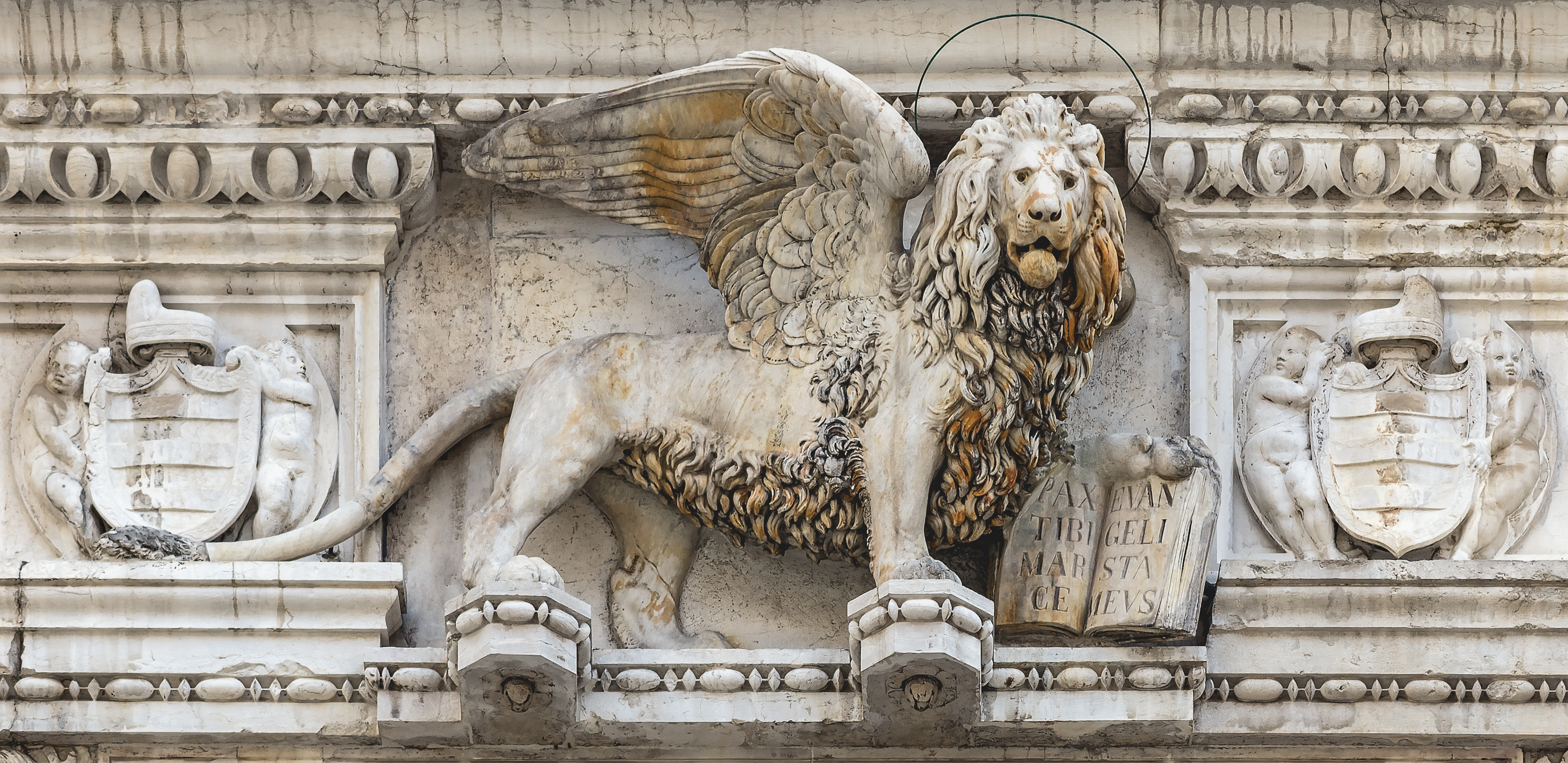
the Scala dei Giganti, the Giants’ Staircase in the courtyard of the Doge’s Palace — CC BY-SA 4
Frequently Asked Questions
Where is the Doge’s Palace and what makes it special?
The Doge’s Palace stands on the eastern side of St Mark’s Square in Venice, beside St Mark’s Basilica and facing the lagoon. It was the home of the doge, the seat of government, the law courts and the prison of the Republic of Venice for many centuries, and today it is a museum.
How much time should I allow for the Doge’s Palace?
Allow at least two to three hours for the main route, including the council rooms, the doge’s apartments, the Bridge of Sighs and the prisons. Travellers who also want to visit St Mark’s Basilica and the Campanile should give the whole square a full day.
Did prisoners really sigh for the last time on the Bridge of Sighs?
The name of the Bridge of Sighs is tied to the legend that prisoners sighed as they saw the lagoon for the last time through the stone grille on their way to prison. The story was embroidered in the Romantic period, but the bridge remains the emblem of the judicial system of Venice.
How much is a ticket to the Doge’s Palace and where can I buy one?
This article gives no ticket prices, because prices change with the season and with the combined ticket options. Check the official price list on the website of the Civic Museums of Venice before going, and consider buying online to avoid queuing.
What is the connection between the Doge’s Palace and UNESCO?
The Doge’s Palace stands inside the property of Venice and its Lagoon, inscribed on the World Heritage List in 1987 under reference 394. The palace is one of the defining monuments of that property, and Italy holds 62 World Heritage properties, the most of any country.
When is the best time of year to visit the Doge’s Palace?
Spring and autumn are the most comfortable seasons, with mild weather and moderate crowds, while summer from June to August is crowded and hot. Winter in Venice is much quieter, but travellers should note that high water can flood the square temporarily.
Verified
This article was verified on 23/11/2026. The main historical dates of the Doge’s Palace, from the start of construction around 1340 to the fire of 1577 and the fall of the Republic in 1797, come from the sources listed below. The Wikidata record for the Doge’s Palace is Q189883, a palace in Venice, Italy, at coordinates 45.4337° N, 12.3404° E. The UNESCO property of Venice and its Lagoon was inscribed in 1987 under reference 394, and the synthesis of that property names Palazzo Ducale among its great monuments. The figure of 62 World Heritage properties in Italy comes from the UNESCO list of States Parties.
Sources
- First palace around 810, fire of 976, Ziani palace 1172–1178, Gothic construction from around 1340 under Bartolomeo Gradenigo, Piazzetta wing from 1424 under Francesco Foscari, Great Council first meeting 1419: Wikipedia and the official material of the Civic Museums of Venice, 18/11/2026
- Fires of 1483, 1574 and 1577, paintings by Tintoretto and Veronese after the fire of 1577, Paradise painted 1588–1592: historical sources on the Doge’s Palace, 18/11/2026
- Bridge of Sighs built around 1600, design by Antonio Contino, joining the interrogation rooms with the New Prisons: historical sources on the Doge’s Palace, 18/11/2026
- Casanova escape from the Piombi in 1756, fall of the Republic in 1797, last doge Ludovico Manin abdicating, palace becoming a museum in 1923: historical sources on Venice, 18/11/2026
- Venice and its Lagoon inscribed 1987, reference 394; Italy with 62 World Heritage properties, the most of any country: UNESCO, https://whc.unesco.org/en/list/394/, checked 23/11/2026
- Wikidata Q189883, coordinates 45.4337° N, 12.3404° E, palace in Venice, Italy: Wikidata API, 23/11/2026
- Official visitor information: Civic Museums of Venice, https://palazzoducale.visitmuve.it/en/home/
Unverified
- Current ticket prices and combined ticket options by season — this article gives no prices; check the official website of the Civic Museums of Venice before going.
- Exact opening hours by season and the schedule of the Secret Itineraries tour — check the official website before going.
- Lift access and step-free routes in each part of the palace for visitors with limited mobility — check before going.
- Temporary exhibitions currently running in the palace — check the official website before going.
- The level of high water flooding at St Mark’s Square on any given day — check local forecasts before going.
- Maximum group size for the Secret Itineraries tour under current rules — check when booking.
Illustrations
- Hero: (Venice) Courtyard of the Doge’s Palace – Scala dei giganti – Neptune. Free image: https://upload.wikimedia.org/wikipedia/commons/6/61/%28Venice%29_Courtyard_of_the_Doge%27s_Palace_-Scala_dei_giganti-_Neptune.jpg — CC BY-SA 4.
- In body, Great Council Hall and Tintoretto’s Paradise: Tintoretto, Paradise, in the Great Council Hall of the Doge’s Palace, Venice, 1588-92 (2) (48802525996). Free image: https://upload.wikimedia.org/wikipedia/commons/4/47/Tintoretto%2C_Paradise%2C_in_the_Great_Council_Hall_of_the_Doge%27s_Palace%2C_Venice%2C_1588-92_%282%29_%2848802525996%29.jpg — CC BY 2.
- In body, Bridge of Sighs and the New Prisons: Bridge of Sighs, Venice (30127461850). Free image: https://upload.wikimedia.org/wikipedia/commons/3/3c/Bridge_of_Sighs%2C_Venice_%2830127461850%29.jpg — Public domain.
- In body, the Doge’s Palace: the Doge’s Palace seen from the Molo. Free image: https://upload.wikimedia.org/wikipedia/commons/7/7a/Doge%27s_Palace_from_Molo%2C_Venice_-_Venezia_300_77.jpg — CC BY-SA 4.
- In body, San Giorgio Maggiore: the Basilica di San Giorgio Maggiore in Venice. Free image: https://upload.wikimedia.org/wikipedia/commons/0/07/Basilica_di_San_Giorgio_Maggiore_%28Venice%29.jpg — CC BY-SA 4.
- In body, St Mark’s Square: the clock tower in St Mark’s Square, Venice. Free image: https://upload.wikimedia.org/wikipedia/commons/1/15/Piazza_San_Marco_%28Venice%29_-Clock_tower-_Lion_of_San_Marco.jpg — CC BY-SA 4.
- In body, the Campanile: Saint Mark’s Campanile and the Doge’s Palace, Venice. Free image: https://upload.wikimedia.org/wikipedia/commons/d/d1/Saint_Mark%27s_Campanile_and_Palazzo_Ducale%2C_Venice%2C_September_2017_-2.jpg — CC BY-SA 4.
- In body, the Golden Staircase: the Scala d’Oro, the Golden Staircase in the Doge’s Palace. Free image: https://upload.wikimedia.org/wikipedia/commons/3/36/La_Scala_d%27Oro_in_the_Doge%27s_Palace.JPG — CC BY-SA 4.
- In body, the Giants’ Staircase: the Scala dei Giganti, the Giants’ Staircase in the courtyard of the Doge’s Palace. Free image: https://upload.wikimedia.org/wikipedia/commons/3/3c/Courtyard_of_the_Doge%27s_Palace_%28Venice%29_-Scala_dei_giganti-_Lion_of_Saint_Mark.jpg — CC BY-SA 4.
- In body, St Mark’s Basilica: The south facade of St Mark’s Basilica in Venice. Free image: https://upload.wikimedia.org/wikipedia/commons/3/3b/Basilica_San_Marco_facciata_sud_Venezia.jpg — CC BY-SA 3, by Wolfgang Moroder.