
Riga, Latvia: The Baltic Capital of Art Nouveau on the Daugava
Riga Latvia is the capital of Latvia, where the Daugava meets the Gulf of Riga. Its old town joins medieval spires with Art Nouveau streets.
Riga Latvia is a city of two faces that fit together, because the medieval lanes of Vecriga end at a boulevard ring of graceful Art Nouveau facades. The spires of Saint Peter’s Church and Riga Cathedral rise over the red roofs of the old town, and a ten-minute walk brings the visitor to Albert Street, where the stone faces of the early twentieth century stare down from every doorway. The city is the largest in the three Baltic states, yet it feels like a small capital, because the old town can be walked end to end in an afternoon.
The Daugava river runs through the life of Riga Latvia, and the city grew where the river meets the sea as a trading port. The merchants of the Hanseatic League made it rich, the Swedes and the Russians ruled it in turn, and the Latvians who built it kept their language and their songs through every occupation. Today Riga Latvia is the political, cultural and economic centre of Latvia, and it is also one of the most rewarding city breaks in northern Europe.
Quick Facts About Riga Latvia
| Fact | Detail |
|---|---|
| Name | Riga Latvia, capital of Latvia |
| Role | Capital and largest city of Latvia; largest city of the Baltic states |
| Location | Western Latvia, on the Daugava river near the Gulf of Riga |
| Founded | 1201, by Bishop Albert of Buxhoeveden |
| Area | About 304 square kilometres |
| Population | About 592,000 (early 2025); about one third of the population of Latvia |
| Language | Latvian |
| Currency | Euro, since 1 January 2014 |
| Time zone | EET, UTC plus two hours, with summer time EEST |
| UNESCO | Historic Centre of Riga, ref 852, inscribed 1997, criteria i, ii |
| Art Nouveau | About 800 Art Nouveau buildings, the finest concentration in the world |
| Coordinates | 56.95° N, 24.11° E |
| Wikidata | Q1773, capital of Latvia |
Geography of Riga Latvia
The Daugava River and the Gulf of Riga
Riga Latvia stands on the Daugava river, about 15 km inland from the Gulf of Riga, where the river widens toward the Baltic Sea. The city lies on a flat coastal plain, and its ground rises only a few metres above sea level, so the river and the sea set the whole character of the place. The Daugava divides Riga Latvia into two halves, and the old town and the centre stand on the right bank, while the left bank holds the residential districts and the parks.
The river has always been the reason for Riga Latvia, because it carried timber, grain and flax from the forests of the east down to the sea. The port grew at the mouth of the river, and the ships of the Hanseatic League loaded their cargoes beside the quays where the old town now stands. The river still works today, and the port handles cargo and cruise ships, while the bridges that cross the Daugava are the main routes between the two halves of the city.
The Gulf of Riga softens the climate of Riga Latvia, because the sea keeps the winters milder than the inland cold and the summers cooler than the heat of the interior. The coast near the city holds long sandy beaches, and the resort town of Jurmala lies a short train ride to the west, where the Latvians have taken their summer holidays for generations. The river freezes in the coldest winters, and the ice on the Daugava is a familiar sight in January and February.
The land around Riga Latvia is flat and sandy, and the pine forests begin at the edge of the city, so the landscape is one of water, sand and trees. The city covers about 304 square kilometres, and much of that area is taken up by the river, the parks and the forests that ring the centre. The flat ground makes Riga Latvia an easy city to walk and to cycle, because there are almost no hills to climb.
The Old Town, the Boulevards and the Districts
The geography of Riga Latvia is really three cities in one, and the UNESCO property covers all three of them. The medieval core of Vecriga is the oldest part, and it holds the churches, the guild houses and the narrow lanes inside the line of the old walls. The boulevard ring of the nineteenth century wraps around the old town in a semicircle, with a green belt of parks along the city canal, and the former suburbs beyond the ring hold the wooden houses of the eighteenth and nineteenth centuries.
Vecriga is small enough to walk across in twenty minutes, and its streets still follow the medieval plan, with the Town Hall Square at its heart and the Dome Square beside the cathedral. The spires of Saint Peter’s Church, Riga Cathedral and Saint James’s Cathedral rise over the roofs, and they are the landmarks that guide a walker through the lanes. The old town is closed to most traffic, and its cobbled streets belong to walkers, cafes and markets.
The boulevard ring is the second city, and it is where the Art Nouveau of Riga Latvia reaches its height. The ring was built after the old ramparts came down in the nineteenth century, and its wide streets and parks were lined with apartment houses of stone and stucco. Albert Street is the most famous of them, and its facades by the architect Mikhail Eisenstein are the finest Art Nouveau in the world, with stone faces, peacocks and swirling plants carved over every doorway.
Beyond the ring, the districts of Riga Latvia spread out along the river and the railway, and they show the later history of the city. The wooden houses of the suburbs are painted in soft colours, and they are one of the reasons UNESCO inscribed the city, because the nineteenth-century wooden architecture is rare in Europe. The districts of Agenskalns and Maskavas Forstate hold the best of the wooden houses, and the Central Market stands beside the river in the great halls that once housed airships.
Climate and the Baltic Year
Riga Latvia has a humid continental climate, with cold winters and mild summers, and the sea softens the extremes in both seasons. Winter days are short and cold, and the snow lies on the roofs of the old town from December to March, while the river freezes and the markets sell hot drinks and warm bread. The cold is dry and clear, and the low sun turns the snow to gold in the afternoon, so winter in Riga Latvia is beautiful for those who dress for it.
Summer in Riga Latvia is mild and bright, with long days that stretch past ten in the evening in June. The temperature rarely reaches the heat of southern Europe, and the sea breeze keeps the city comfortable, while the beaches of Jurmala fill with swimmers and the parks fill with concerts. The white nights of June are the best season in the city, because the light never fully leaves the sky and the squares stay busy late into the night.
Spring and autumn are the quiet seasons in Riga Latvia, and they show the city at its most local, because the tourists have gone and the markets belong to the residents. The spring brings the first green to the parks and the first boats to the river, and the autumn brings the mushrooms and the berries to the markets. The Christmas season is the most festive time in the city, because the markets fill the Town Hall Square and the old town glows with lights, and legend says that one of the first decorated Christmas trees stood in Riga Latvia in 1510.
The best time to visit Riga Latvia depends on what the visitor wants, because the city changes with the season. Summer suits the beaches and the long evenings, winter suits the Christmas markets and the snow on the spires, and spring and autumn suit the walker who wants the city to themselves. The city is open in every season, and the old town is beautiful in the snow as well as in the summer sun.

the view over Riga from the Church of St Peter — CC BY-SA 3

the railway bridge over the Daugava River in Riga — CC BY-SA 3

the interior of the Cathedral of Saint James, Riga — CC BY-SA 3
History of Riga Latvia
Founding in 1201 and the Hanseatic Port
Riga Latvia was founded in 1201 by Bishop Albert of Buxhoeveden, who built a town at the mouth of the Daugava as a base for the Christianisation of the Baltic lands. The bishop chose a site that was already a trading place, because the Livonian tribes had traded on the river for centuries, and he gave the new town a charter that drew German merchants to its quays. The town grew fast, and its walls, its churches and its guild houses rose within a generation of its founding.
The merchants of Riga Latvia joined the Hanseatic League, the great trading alliance of the northern seas, and the city became one of the richest ports of the Baltic. The League carried timber, wax, flax and furs from the east to the west, and it carried salt, cloth and wine back up the river, and Riga Latvia grew rich on the trade. The House of the Blackheads, the guild house of the unmarried merchants, became the symbol of that wealth, and its decorated facade still stands on the Town Hall Square.
The city was ruled by its German merchants and by the archbishop, and the Latvians who lived in the countryside came to the city as workers and servants. The cathedral of Riga, founded in 1211, became the largest church in the Baltic lands, and the churches of Saint Peter and Saint James rose beside it as the town grew. The old town that visitors walk today was largely built in these centuries, and its street plan still follows the medieval layout.
Riga Latvia kept its Hanseatic character for centuries, and the city was a free port where merchants from many lands met. The town hall, the guild houses and the warehouses of the old town all belong to this age, and they show a city that lived by trade. The river was the highway of the city, and the ships that tied up at its quays joined Riga Latvia to the whole of northern Europe.
Swedish Rule, Russian Rule and the National Awakening
The fortunes of Riga Latvia changed in the seventeenth century, when Sweden took the city in 1621 and made it the largest city of the Swedish empire. The Swedes built new fortifications and new suburbs, and the city grew beyond its medieval walls for the first time. The Swedish age left the city with a reputation for order and good government, and it also left the wooden suburbs that still stand today.
Russia took Riga Latvia in 1710, and the city became the capital of the Russian province of Livonia for the next two centuries. The Russians opened the port to the trade of the whole empire, and Riga Latvia became one of the largest ports of Russia, with shipyards, factories and a railway that joined the city to Moscow and Saint Petersburg. The population grew fast, and Latvians, Russians, Germans and Jews all lived in the city together.
The nineteenth century brought the national awakening of the Latvians, and Riga Latvia became the centre of Latvian language, literature and song. The first Latvian Song Festival was held in Riga Latvia in 1873, and the choirs that sang there became a symbol of the nation, while the newspapers and the schools of the city carried the Latvian language into public life. The boulevard ring and the Art Nouveau houses were built in these decades, and the city took on the shape that visitors see today.
The Art Nouveau of Riga Latvia belongs to the years around 1900, when the city was growing fast and its architects built in the new style. Mikhail Eisenstein and his colleagues covered the new streets with facades of stone faces, flowers and swirling lines, and the city gained about 800 Art Nouveau buildings in a single generation. The style was an expression of a city that was modern and confident, and it is still the reason that many visitors come to Riga Latvia today.
Independence, Occupation and the Return of Freedom
Latvia declared its independence in 1918, and Riga Latvia became the capital of a free republic for the first time. The interwar years were a time of building and confidence, and the Freedom Monument was raised in 1935 as a symbol of the new nation, while the Central Market was built in 1930 in the great halls that had once housed airships. The city was the home of a young democracy, and its cafes, its theatres and its newspapers made it one of the liveliest capitals in northern Europe.
The Second World War brought occupation and destruction to Riga Latvia, because the Soviet Union took the city in 1940, the Germans took it in 1941, and the Soviets took it again in 1944. The old town was damaged by bombing, and the House of the Blackheads was destroyed in 1941, while thousands of Latvians were deported or fled into exile. The city lived under Soviet rule for the next forty-five years, and its historic centre was neglected while new housing blocks rose on the outskirts.
The Singing Revolution of the late 1980s brought the Latvians back to the streets of Riga Latvia, and the choirs that had sung in 1873 sang again for freedom. Latvia restored its independence in 1991, and Riga Latvia became the capital of a free country once more, while the old town was rebuilt and the House of the Blackheads rose again on the Town Hall Square. The city joined the European Union and NATO in 2004, and it adopted the euro on 1 January 2014, which tied it firmly to the west.
The UNESCO inscription of the Historic Centre of Riga in 1997 came in the middle of this rebirth, and it recognised the city as a place of outstanding universal value. The inscription covers the medieval core, the boulevard ring and the wooden suburbs, and it honours the Art Nouveau architecture that UNESCO called unparalleled anywhere in the world. The city has restored its facades, its churches and its markets since independence, and Riga Latvia today is a capital that has recovered its history.
Timeline
- 1201 — Bishop Albert of Buxhoeveden founds Riga Latvia on the Daugava
- 1211 — Riga Cathedral is founded as the largest church in the Baltic lands
- 1282 — Riga Latvia joins the Hanseatic League
- 1510 — According to legend, one of the first decorated Christmas trees stands in Riga Latvia
- 1621 — Sweden takes Riga Latvia and makes it the largest city of the Swedish empire
- 1710 — Russia takes Riga Latvia and makes it the capital of Livonia
- 1873 — The first Latvian Song Festival is held in Riga Latvia
- 1900s — The Art Nouveau streets of the boulevard ring are built
- 1918 — Latvia declares independence and Riga Latvia becomes its capital
- 1930 — The Central Market opens in the former airship hangars
- 1935 — The Freedom Monument is raised in the centre of Riga Latvia
- 1940-1944 — Riga Latvia is occupied by the Soviet Union and then by Germany
- 1941 — The House of the Blackheads is destroyed by bombing
- 1991 — Latvia restores its independence and Riga Latvia becomes a free capital again
- 1997 — The Historic Centre of Riga is inscribed on the UNESCO World Heritage List
- 1999 — The House of the Blackheads is rebuilt on the Town Hall Square
- 2004 — Latvia joins the European Union and NATO
- 2014 — Latvia adopts the euro on 1 January

the nave of Riga Cathedral — CC BY-SA 3
Travel to Riga Latvia
Getting There and Getting Around
Riga Latvia is served by Riga International Airport, which stands about 10 km west of the city centre, and by buses that run from the airport to the old town. The airport is the largest in the Baltic states, and it joins Riga Latvia with the cities of Europe by direct flights, while the bus and the taxi cover the short journey into the centre. The railway station stands at the edge of the old town, and it handles the trains to Jurmala, to the Latvian countryside and to the neighbouring capitals.
The old town of Riga Latvia is best explored on foot, because its streets are narrow and its sights are close together. The city centre is compact, and the walk from the Town Hall Square to Albert Street takes about twenty minutes, while the boulevard ring and the parks can be walked in an afternoon. Trams and buses serve the wider city, and they are the best way to reach the wooden districts and the suburbs beyond the ring.
Cycling has grown in Riga Latvia, and the flat ground makes the city easy to ride, with cycle lanes along the river and the parks. The city is also good for walking along the Daugava, because the embankment offers a long promenade with views across the river to the left bank. Taxis are plentiful, and ride-hailing cars work across the city, but the feet and the tram are usually enough in the centre of Riga Latvia.
A One-Day Itinerary
A day in Riga Latvia should begin in the old town, before the crowds arrive, because Vecriga is at its best in the quiet morning. The Town Hall Square, the House of the Blackheads and the church of Saint Peter are the first sights, and the tower of Saint Peter can be climbed for a view over the red roofs of the old town. The Dome Square and Riga Cathedral lie a short walk away, and the lanes between them hold the guild houses and the smallest streets of the city.
The middle of the day belongs to the Art Nouveau streets, and the walk from the old town through the boulevard ring takes the visitor to Albert Street in about twenty minutes. The facades of Albert Street deserve a slow look, because every doorway carries a different stone face or flower, and the Art Nouveau Museum stands on the same street. The Central Market is the next stop, because its great halls hold the food of Latvia, from smoked fish and black bread to berries and mushrooms, and lunch in the market is the best meal in Riga Latvia.
The evening belongs to the river, and the walk along the Daugava embankment at sunset shows the old town spires against the sky. The Freedom Monument stands at the edge of the old town, and it is the meeting place of the city, while the parks of the boulevard ring fill with walkers in the evening. Dinner in the old town or in the wooden district of Agenskalns brings the day to a close, and the cafes of Riga Latvia stay busy late into the night.
Art Nouveau, Markets and the River
The Art Nouveau of Riga Latvia is the reason many visitors come, and the best way to see it is to walk the boulevard ring slowly. Albert Street is the centre of it, and its buildings by Mikhail Eisenstein are the finest in the world, but the streets around it hold hundreds more facades in the same style. The Art Nouveau Museum on Albert Street shows the interior of a period apartment, and it explains how the Latvians lived in the age when the style was new.
The Central Market is the second great sight of Riga Latvia, because it is one of the largest markets in Europe and it fills five great halls beside the river. The halls were built from the frames of airship hangars, and they now hold the meat, the fish, the vegetables and the dairy of the Latvian countryside. The market is a working market rather than a tourist show, and the stalls, the smells and the voices are the daily life of the city.
The river is the third sight, and the Daugava embankment offers the best views of Riga Latvia, with the spires of the old town on one side and the new National Library on the other. The library stands on the left bank as a glass castle, and it is the most important new building in the city, while the old town across the water shows the history that the library guards. A boat trip on the river is the best way to see the city from the water, and the canal boats of the old town offer a shorter trip through the parks.

the Riga Central Market — CC BY-SA 4
Notable Places in Riga Latvia
The Old Town of Riga is the first place in Riga Latvia, and it is the medieval heart of the city, with the Town Hall Square, the House of the Blackheads and the three great churches. The House of the Blackheads was destroyed in 1941 and rebuilt in 1999, and its decorated facade is the symbol of the city. The old town is the core of the UNESCO property, and its lanes are the oldest streets in Riga Latvia.
Saint Peter’s Church is the second place, and its tall spire has guided sailors up the Daugava for centuries. The tower rises about 123 metres over the old town, and its viewing platform looks out over the roofs, the river and the sea. Riga Cathedral is the third place, and it was founded in 1211 as the largest church in the Baltic lands, with a great organ and a cloister that holds the history of the city.
Albert Street is the fourth place in Riga Latvia, and it is the finest Art Nouveau street in the world, with facades by Mikhail Eisenstein and his contemporaries. The street holds the Art Nouveau Museum, and its stone faces, peacocks and flowers are the most photographed sights in the city. The Freedom Monument stands at the edge of the old town, and it was raised in 1935 as a symbol of Latvian independence, while the Central Market fills the great halls beside the river with the food of the country.

the old Town Hall Square in Riga — CC BY-SA 4

an Art Nouveau building on Albert Street, Riga — CC BY 4

the Freedom Monument in Riga — CC BY-SA 4
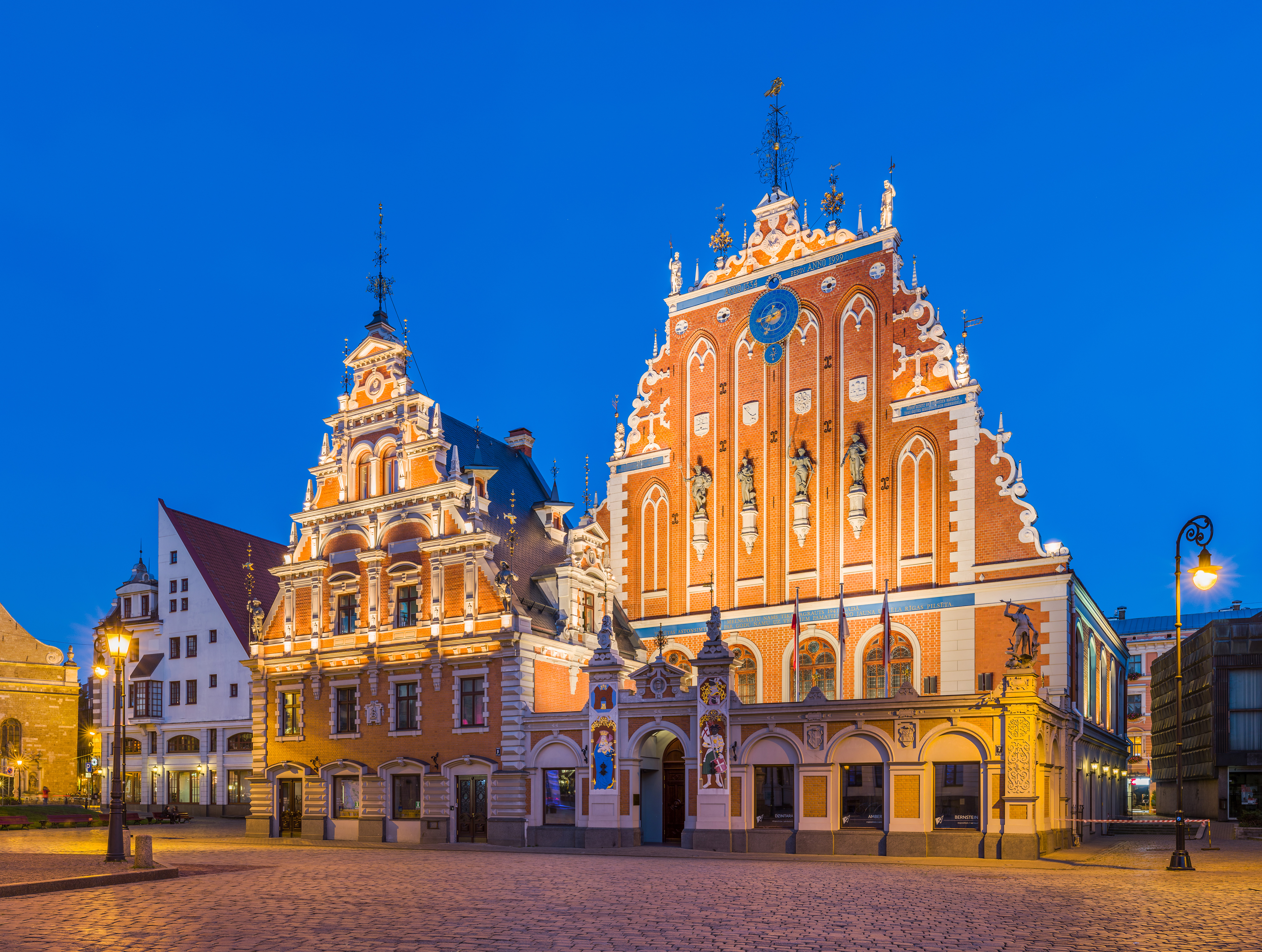
the House of the Blackheads at dusk, Riga — CC BY-SA 3

the spire of St Peter’s Church, Riga — CC BY 3

the Art Nouveau staircase in the Art Nouveau Museum, Riga — CC BY-SA 4
Frequently Asked Questions
Where is Riga Latvia?
Riga Latvia stands in western Latvia, on the Daugava river near the Gulf of Riga, about 15 km inland from the Baltic Sea. It is the capital of Latvia and the largest city of the Baltic states, and it is the political, cultural and economic centre of the country.
What is Riga Latvia famous for?
Riga Latvia is famous for its Art Nouveau architecture, with about 800 Art Nouveau buildings and the finest concentration in the world. It is also famous for its medieval old town, its Hanseatic history, its Central Market and its Freedom Monument.
When is the best time to visit Riga Latvia?
Summer is the best time for the long days, the beaches of Jurmala and the festivals of Riga Latvia, while winter is the best time for the Christmas markets and the snow on the old town. Spring and autumn are the quietest seasons, and they suit the visitor who wants the city to themselves.
How many days do you need in Riga Latvia?
Two days are enough to see the old town, the Art Nouveau streets and the Central Market of Riga Latvia at a comfortable pace. A third day allows a trip to Jurmala beach or to the countryside, and the city rewards a slow visit.
Is Riga Latvia a UNESCO World Heritage site?
Yes, the Historic Centre of Riga was inscribed on the UNESCO World Heritage List in 1997, under criteria i and ii, with ref 852. The property covers the medieval core, the boulevard ring and the wooden suburbs of Riga Latvia.
What language is spoken in Riga Latvia?
Latvian is the official language of Riga Latvia, and it is spoken everywhere in the city, while Russian is also widely spoken. English is widely understood in hotels, restaurants and the main attractions, and visitors can travel easily with English alone.
Verified
The founding of Riga Latvia in 1201 by Bishop Albert, the founding of Riga Cathedral in 1211, the Hanseatic membership, the Swedish capture in 1621, the Russian capture in 1710, the first Song Festival in 1873, independence in 1918, the Central Market in 1930, the Freedom Monument in 1935, the restoration of independence in 1991, the UNESCO inscription of the Historic Centre of Riga in 1997 under criteria i and ii with ref 852, the rebuilding of the House of the Blackheads in 1999, the adoption of the euro on 1 January 2014, and the population of about 592,000 in early 2025 were checked against the sources below. The Wikidata entry Q1773 for Riga, at 56.95° N, 24.11° E, was verified through the Wikidata API on 22 November 2026.
Sources
- UNESCO World Heritage Centre, Decision 21 COM VIII.C, inscription of the Historic Centre of Riga, ref 852, 1997, criteria i and ii — https://whc.unesco.org/en/decisions/2891/
- LiveRiga, official tourism portal of Riga, the capital of Latvia — https://www.liveriga.com/en/
- Riga, capital of Latvia, Q1773 — https://en.wikipedia.org/wiki/Riga
- Historic Centre of Riga, UNESCO World Heritage Site, ref 852, criteria i and ii — https://en.wikipedia.org/wiki/Vecr%C4%ABga
- Wikidata Q1773 (Riga, coordinates 56.9475/24.1069) — verified through the Wikidata API, 22 November 2026
Unverified
- The population of about 592,000 in early 2025 is an estimate that varies by source — this article uses an approximate figure and records the variation here.
- The figure of about 800 Art Nouveau buildings is widely repeated, and different counts give different totals — this article uses the approximate figure and records the variation here.
- The story of the first decorated Christmas tree standing in Riga in 1510 is a legend rather than a documented fact — this article presents it as legend.
- The height of Saint Peter’s tower at about 123 metres is an approximate figure, and different sources give slightly different heights — this article uses the approximate figure.
Illustrations
- Hero: the Riga skyline on the Daugava. Free image: https://upload.wikimedia.org/wikipedia/commons/7/71/Riga_Skyline_Panorama%2C_Latvia_-_Diliff.jpg — CC BY-SA 3.
- In body, Riga Cathedral: the nave of Riga Cathedral. Free image: https://upload.wikimedia.org/wikipedia/commons/a/a2/Riga_Cathedral_Nave%2C_Riga%2C_Latvia_-_Diliff.jpg — CC BY-SA 3.
- In body, the Old Town: the view over Riga from the Church of St Peter. Free image: https://upload.wikimedia.org/wikipedia/commons/1/1f/Vistas_desde_la_iglesia_de_San_Pedro%2C_Riga%2C_Letonia%2C_2012-08-07%2C_DD_01.JPG — CC BY-SA 3.
- In body, Town Hall Square, Riga: the old Town Hall Square in Riga. Free image: https://upload.wikimedia.org/wikipedia/commons/6/67/Riga_old_town_hall_square.JPG — CC BY-SA 4.
- In body, Albert Street, Riga: an Art Nouveau building on Albert Street, Riga. Free image: https://upload.wikimedia.org/wikipedia/commons/8/8f/Latvia%2C_Riga%2C_Central_Riga%2C_Art_Nouveau_Building_150502-64.jpg — CC BY 4.
- In body, Freedom Monument, Riga: the Freedom Monument in Riga. Free image: https://upload.wikimedia.org/wikipedia/commons/d/df/Freedom_Monument_Latvia_01.jpg — CC BY-SA 4.
- In body, Riga Central Market: the Riga Central Market. Free image: https://upload.wikimedia.org/wikipedia/commons/9/95/Riga_Central_Market%2C_2006_%2801%29.jpg — CC BY-SA 4.
- In body, House of the Blackheads, Riga: the House of the Blackheads at dusk, Riga. Free image: https://upload.wikimedia.org/wikipedia/commons/0/03/House_of_Blackheads_at_Dusk_3%2C_Riga%2C_Latvia_-_Diliff.jpg — CC BY-SA 3.
- In body, Saint Peter’s Church, Riga: the spire of St Peter’s Church, Riga. Free image: https://upload.wikimedia.org/wikipedia/commons/2/23/Spire_of_St_Peter%27s_Church_-_panoramio.jpg — CC BY 3.
- In body, Daugava River, Riga: the railway bridge over the Daugava River in Riga. Free image: https://upload.wikimedia.org/wikipedia/commons/9/9e/Puente_del_Ferrocarril%2C_Riga%2C_Letonia%2C_2012-08-07%2C_DD_11.JPG — CC BY-SA 3.
- In body, Art Nouveau Museum, Riga: the Art Nouveau staircase in the Art Nouveau Museum, Riga. Free image: https://upload.wikimedia.org/wikipedia/commons/c/ca/6799_LVA_Riga_art_nouveau_staircase.jpg — CC BY-SA 4.
- In body, Saint James’s Cathedral, Riga: the interior of the Cathedral of Saint James, Riga. Free image: https://upload.wikimedia.org/wikipedia/commons/4/4a/Cathedral_of_Saint_James_Interior_1%2C_Riga%2C_Latvia_-_Diliff.jpg — CC BY-SA 3.