
Day Trips from Amsterdam: Windmills, Tulips and Harbour Towns
Within an hour, day trips from amsterdam reach windmills, tulip fields and old harbour towns. The city is the perfect base for them.
Amsterdam sits at the centre of a small and densely settled country, and its railway station sends trains in every direction from early morning until late at night. A traveller can stand beside a working windmill before lunch, walk through a tulip field in the afternoon and be back in the city for dinner, all without a car. The best day trips from amsterdam start early, because the light is soft, the villages are quiet and the return trains run often enough that nobody needs to rush. This guide covers the classic routes in every direction, the seasons that shape them and the practical choices that make a day out of the city work.
Quick Facts About Amsterdam Day Trips
| Fact | Detail |
|---|---|
| Base city | Amsterdam, capital of the Netherlands |
| Country | The Netherlands, in northwestern Europe |
| Main station | Amsterdam Centraal, with trains in every direction |
| Classic destinations | Zaanse Schans, Keukenhof, Giethoorn, Volendam, Utrecht and Haarlem |
| Typical travel time | About 20 to 60 minutes each way by train |
| Best season | Mid March to mid May for tulips, May to September for villages and coast |
| UNESCO sites in the country | 13 inscribed properties, 12 cultural and 1 natural |
| Language | Dutch, with English widely spoken |
Geography of Amsterdam Day Trips
North and West: Windmills, Coast and Old Cities
North of Amsterdam the land is flat, low and cut by water, and the day trips from amsterdam in this direction follow the old polder landscape. The Zaan River runs through a strip of green villages where windmills once sawed timber for the shipyards, and the Zaanse Schans keeps several of those mills working beside wooden houses painted green. The train reaches the village in under half an hour, and the walk from the station crosses a small bridge into a scene that looks much as it did two centuries ago. Cheese makers, wooden shoe workshops and a bakery sit along the same path, so a morning there feels like a visit to a working village rather than a museum.
West of the city the dunes and the sea begin, and Haarlem lies about 20 kilometres away on the edge of that dune country. The town grew rich on beer and tulips, and its market square still holds a great church, a town hall and rows of gabled houses that reward a slow walk. Beyond Haarlem the dunes run to the beach towns of Zandvoort and Bloemendaal, where wide sand meets the North Sea and the wind never quite stops. The day trips from amsterdam that head west suit travellers who want a town and a beach in one day, because the train to Haarlem takes about 15 minutes and the bus to the coast takes only a little longer.
The whole northern plain sits at or below sea level, and dikes, canals and pumping stations hold the water back. This is why the landscape looks so open, with long straight horizons, black and white cows in green fields and church towers marking villages miles away. Travellers who cycle out of the city see this flat country at its best, because the cycle paths run beside canals and through meadows that trains and buses pass too quickly. The flat land also explains why the windmills mattered so much, since they drained the polders and sawed the wood that built the ships of the Dutch trading empire.
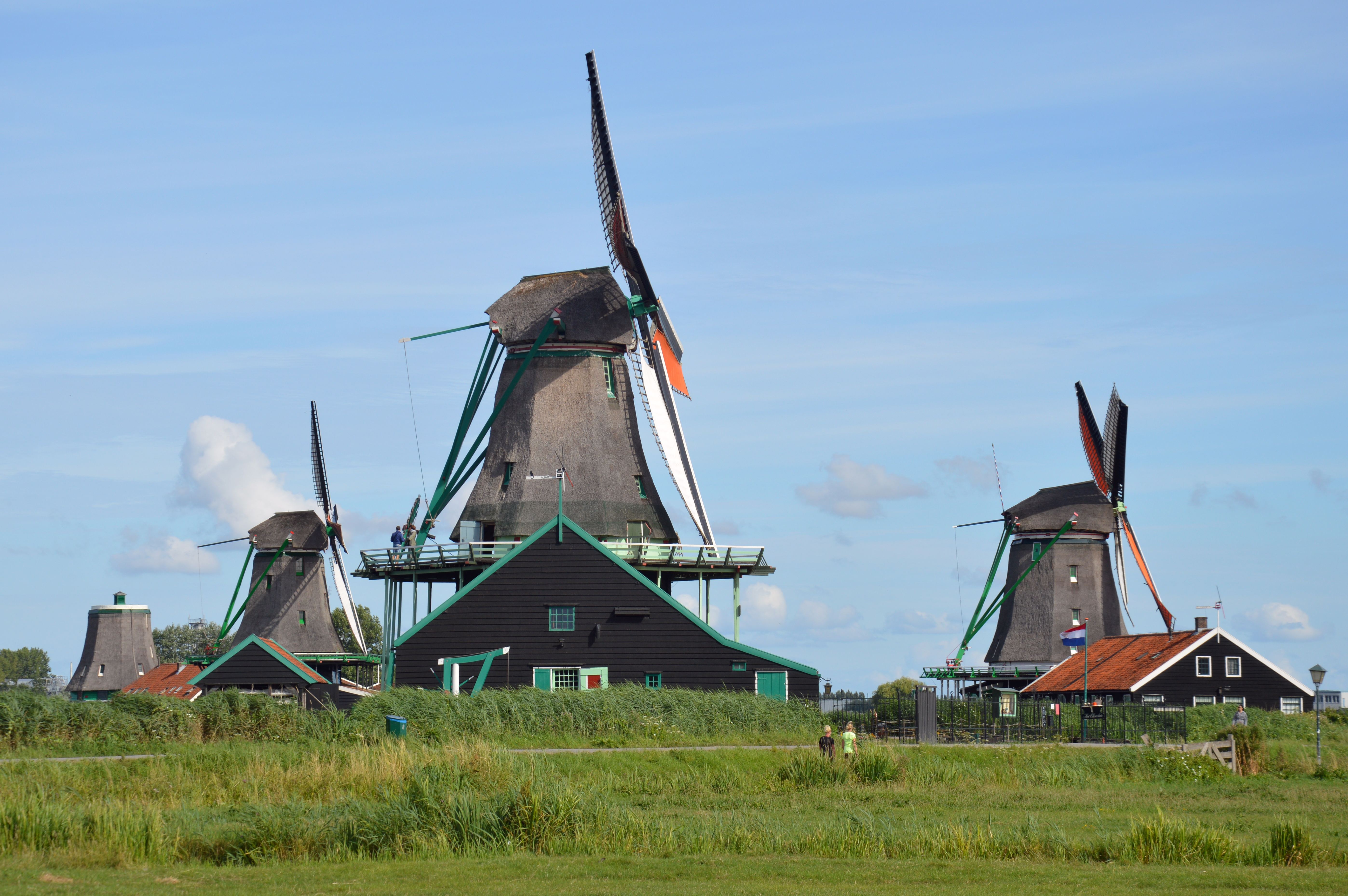
Windmills at the Zaanse Schans, Netherlands — CC0
South: Tulips, Lakes and Green Heart
South of Amsterdam the bulb fields begin, and the day trips from amsterdam in spring turn toward Lisse and the Keukenhof gardens. The fields run in strips of red, yellow, pink and white, and the colours change from week to week as different varieties open. Keukenhof itself is a park of about 32 hectares where millions of bulbs bloom among lakes, pavilions and old trees, and it opens only in the spring season from mid March to mid May. Buses run from the airport and from Leiden during the season, and the ride takes about half an hour through fields that are worth the journey on their own.
Beyond the bulb country lies the Green Heart, a wide area of meadows, lakes and peat villages between Amsterdam, Rotterdam, Utrecht and Leiden. The rivers here are slow and the villages are small, with thatched farms, drawbridges and church towers rising from flat fields. Gouda stands on the edge of this region, famous for its cheese market and its old town hall, and the lakes near the town suit a quiet boat ride on a warm day. The day trips from amsterdam that head south reward travellers who like open space and small towns, because the Green Heart feels far from the city even though it lies less than an hour away.
The southern routes also pass the great rivers, and the Rhine, the Maas and the Lek shape the towns along their banks. Utrecht stands where the Rhine once split, and its canals run below street level with wharves and cellars that now hold cafes and restaurants. The Dom Tower rises 112 metres above the old town, and its bells mark the hours over a city that is older than Amsterdam itself. Further south, Rotterdam shows a different Netherlands altogether, with a vast harbour, modern towers and the tilted Cube Houses, and the contrast between the two cities makes a fine pair of days out.

Tulips at Keukenhof, Lisse, Netherlands — CC BY 2
East: Water Villages and the Old Zuiderzee Shore
East of Amsterdam the old Zuiderzee shore begins, and the day trips from amsterdam in this direction visit fishing villages that once faced an inland sea. Volendam keeps its harbour, its fish stalls and its traditional costume, and the boats still go out onto the Markermeer, which is what remains of the old sea after the great dike closed it off. Marken lies nearby on a small peninsula, joined to the mainland by a dike built in 1957, and its wooden houses stand on raised mounds that once kept them above the floods. The two villages sit about 20 kilometres from the city, and a bus ride of under an hour reaches them both.
Further east the water village of Giethoorn lies in the province of Overijssel, about 120 kilometres from Amsterdam and best reached by train and bus in about two hours. The old village has almost no roads in its centre, and thatched farmhouses line canals crossed by more than 170 small wooden bridges. Visitors move by whisper boat or by canoe, and the silence on the water is the point of the place, since no cars pass and the loudest sound is often a duck. The day trips from amsterdam that reach Giethoorn need a full day, but the village rewards the effort with a landscape that exists nowhere else in the country.
The eastern shore also holds the old trading towns of the Zuiderzee, and places such as Hoorn, Enkhuizen and Kampen grew rich on the Baltic trade and the fishing fleets. Their harbours still hold old sailing ships, and their town halls and warehouses tell the story of a sea that fed the country for centuries. The Zuiderzee Museum at Enkhuizen keeps that history alive in an open air museum beside the water, with houses, workshops and boats brought from villages around the old sea. These towns suit travellers who want history without crowds, because they sit a little further from the city and keep a quieter pace than the famous villages.

Canal houses and the Oude Kerk at blue hour in Amsterdam — CC BY-SA 4

Canals and houses at Giethoorn, Netherlands — CC BY-SA 3
History of Amsterdam Day Trips
From Trading City to Touring Base
Amsterdam began as a small fishing settlement beside a dam across the Amstel River in the 13th century, and the dam gave the city its name. Trade made it rich in the 17th century, when ships of the Dutch East India Company carried spices, silk and porcelain into the harbour and merchants built tall houses along the canals. The villages around the city fed that trade, with windmills sawing timber for ships, dairy farms sending cheese to market and fishing fleets working the Zuiderzee. The day trips from amsterdam that visitors take today follow the same web of waterways and roads that once carried goods into the city, so the routes are old even when the trains are new.
The Golden Age left its mark on every town within reach of the capital, and Haarlem, Delft, Leiden and Utrecht all hold churches, town halls and almshouses from that rich century. Painters such as Rembrandt and Vermeer worked in these towns, and their pictures still hang in the museums that travellers visit on a day out. The tulip trade also belongs to this period, and the flower that came from the Ottoman Empire became a luxury good, a subject of speculation and finally a symbol of the country. A visitor who walks through Haarlem or Delft today is walking through the same streets that merchants and painters knew four centuries ago.
The city itself changed slowly after the Golden Age, and the 18th and 19th centuries brought a quieter period before industry and trade revived the port. The canals stayed, the gabled houses stayed, and the villages around the city kept their old shape because the land was flat and the waterways set the pattern of settlement. This slow change is a gift to the modern traveller, because the places on a day out of Amsterdam still look much as they did when the trading ships came home. The history of the region is therefore visible in a single day, from a windmill to a cheese market to a church tower.

The Grote Kerk in Haarlem, Netherlands — CC BY-SA 3
Railways, Dikes and the Tulip Trade
The first railway in the Netherlands opened between Amsterdam and Haarlem in 1839, and it changed the day trip from a cart ride into a short journey. More lines followed, reaching Utrecht, Rotterdam, The Hague and the towns of the old Zuiderzee shore, and the railway map of today still follows the lines laid down in that century. The trains made the villages into suburbs of a sort, yet the villages kept their own character, because the Dutch protected their old centres while the cities grew. The day trips from amsterdam now run on those same lines, and the 15 minute ride to Haarlem is the oldest railway journey in the country.
The great engineering works of the 20th century reshaped the water around Amsterdam, and the Afsluitdijk of 1932 closed off the Zuiderzee and turned it into the freshwater IJsselmeer. Fishing villages such as Volendam and Marken lost their sea, and Marken became a peninsula joined to the mainland by a dike in 1957. The villages adapted by keeping their harbours, their boats and their old houses, and the change from sea to lake is part of what visitors come to see. The polders also grew in this period, with new land drained from the sea and new towns built on it, so the map east of Amsterdam is younger than the city itself.
The tulip industry grew alongside the railways, and the bulb fields south of the city became a spring spectacle that draws visitors from around the world. Keukenhof opened in 1949 as a showcase for bulb growers, and it grew into a garden visited by more than a million people each spring. The Zaanse Schans took shape in the 1960s, when old windmills and wooden houses were moved to one site beside the Zaan River to save them from demolition. Both places show how the Dutch turned working landscapes into places to visit, and the day trips from amsterdam that lead to them are the direct result of that decision.

The harbour of Volendam, Netherlands — CC BY 3
The Modern Day Trip
Tourism grew fast after the Second World War, and Amsterdam became one of the most visited cities in Europe as cheap flights and guidebooks spread its name. The city centre filled with visitors, and the day trip became the natural answer, spreading travellers across the country and easing the pressure on the canals. Regional tourism boards began to promote the villages, the bulb fields and the old towns as part of a single Dutch experience, and the routes became easier with better trains, buses and cycle paths. The day trips from amsterdam of today are therefore a modern habit built on old roads, and they work because the country is small and the transport is good.
The city has also learned to manage its visitors, and the day trip is now part of that policy, with museums, gardens and villages timed to spread arrivals through the day. Keukenhof sells timed entry in the spring, the Zaanse Schans spreads its mills and workshops along a single path, and the villages ask visitors to respect the people who still live there. Travellers who plan ahead and travel early get the best of these places, while those who arrive late meet the crowds. The habit of the day trip will keep growing, because Amsterdam itself can only hold so many people, and the country around it holds so much more.
The future of the day trip is likely to be slower and greener, with more cycling, more electric boats and more small villages on the map. The Dutch already cycle more than almost anyone, and the cycle network out of Amsterdam reaches villages that buses never serve. Electric boats now glide through Giethoorn without noise, and the bulb fields are farmed with more care for the soil and the water. A day out of Amsterdam in the coming years will feel much like today, only quieter, and the windmills, the tulips and the harbour towns will still be waiting at the end of the train line.
Travel to Amsterdam Day Trips
Trains, Buses and Boats
Trains are the backbone of the day trips from amsterdam, and Amsterdam Centraal sends intercity and local trains to every destination in this guide. Haarlem takes about 15 minutes, Utrecht about 25 minutes, Rotterdam about 40 minutes and The Hague about 30 minutes, so the cities need no planning beyond checking the platform. Buses fill the gaps that trains miss, with direct services to Volendam and Marken, to the Keukenhof in spring and to the Zaanse Schans from the city centre. The Dutch railway site and the station boards give live times, and the trains run often enough that a missed connection costs minutes rather than hours.
Boats add a slower pleasure to the day, and the canals and lakes around Amsterdam carry ferries, tour boats and rental craft through the warmer months. A boat from Volendam crosses to Marken in about half an hour, and the ride shows the old Zuiderzee shore from the water as the fishermen once saw it. In Giethoorn the boat is the only way to see the old village properly, and the whisper boats glide silently past thatched houses and under wooden bridges. Travellers who want the water should allow extra time, because boats run to a timetable of their own and the lake wind can slow them down.
Cycling suits the flat country better than any other transport, and the day trips from amsterdam by bike reach villages that trains pass by. Rental bikes are easy to find near the station, and the cycle paths are separate from the roads, marked with numbered junctions and lined with signposts. A ride to the Zaanse Schans or to the Waterland villages north of the city takes about an hour each way, and the path runs beside canals and through meadows. Cyclists should carry water and a light rain jacket, because the Dutch weather changes quickly and the wind across the polders is stronger than it looks.
Guided Tours or Going Alone
Guided tours suit travellers who want a full day without planning, and the day trips from amsterdam sold as guided tours usually combine two or three places in one coach. A common combination pairs the Zaanse Schans with Volendam and Marken, while another pairs Keukenhof with a tulip farm in spring, and both include a guide who explains the windmills, the cheese and the fishing history. The advantage is simplicity, since the coach waits while visitors walk and the guide handles the tickets, while the disadvantage is pace, since the group moves together and the stops are short. Travellers who like a slow morning should go alone, and those who like a full day without decisions should take the tour.
Going alone is easy in the Netherlands, because the trains are frequent, the signs are clear and English is spoken almost everywhere. A traveller can buy a train ticket at the station or with a card, follow the signs to the platform and walk from the station to the village in minutes. The freedom matters most at places such as Giethoorn and the bulb fields, where the best moments come from wandering rather than following a flag. Independent travellers should still check the last train home, because the villages go quiet in the evening and the buses stop earlier than the trains.
Small group tours offer a middle way, and they suit travellers who want a guide without a coach full of strangers. These tours often use a minibus or a boat, visit one place properly rather than three in a hurry, and leave time for a cafe or a walk. Food tours, photography walks and tulip tours in spring all run in small groups, and they are worth the extra cost when the subject needs a local eye. Whatever the choice, the day should be planned around one main place and one extra stop, because three places in one day leaves no time to enjoy any of them.
When to Go and What to Pack
Spring is the great season for the day trips from amsterdam, because the tulips bloom from mid March to mid May and the whole bulb country turns to colour. The Keukenhof gardens are open only in those weeks, and the fields around Lisse are at their best in April, so a spring visit should be booked ahead. Summer brings long days and warm weather to the villages and the coast, and the lakes and beaches fill with swimmers and sailors, while autumn brings quiet streets, golden trees and the cheese markets of Gouda. Winter is the quietest season, and the villages are at their most peaceful, though the days are short and the boats run less often.
The weather in the Netherlands changes fast, and a day out needs layers, a waterproof jacket and comfortable shoes for cobbled streets and sandy paths. Sun protection matters on the water and in the open fields, because the flat land offers little shade and the wind hides the strength of the sun. A small bag with water and snacks helps in the villages, where shops close early and cafes fill quickly at lunch. The day trips from amsterdam reward travellers who pack light and dress for wind, because the same day can bring sun, rain and a cold breeze off the sea.
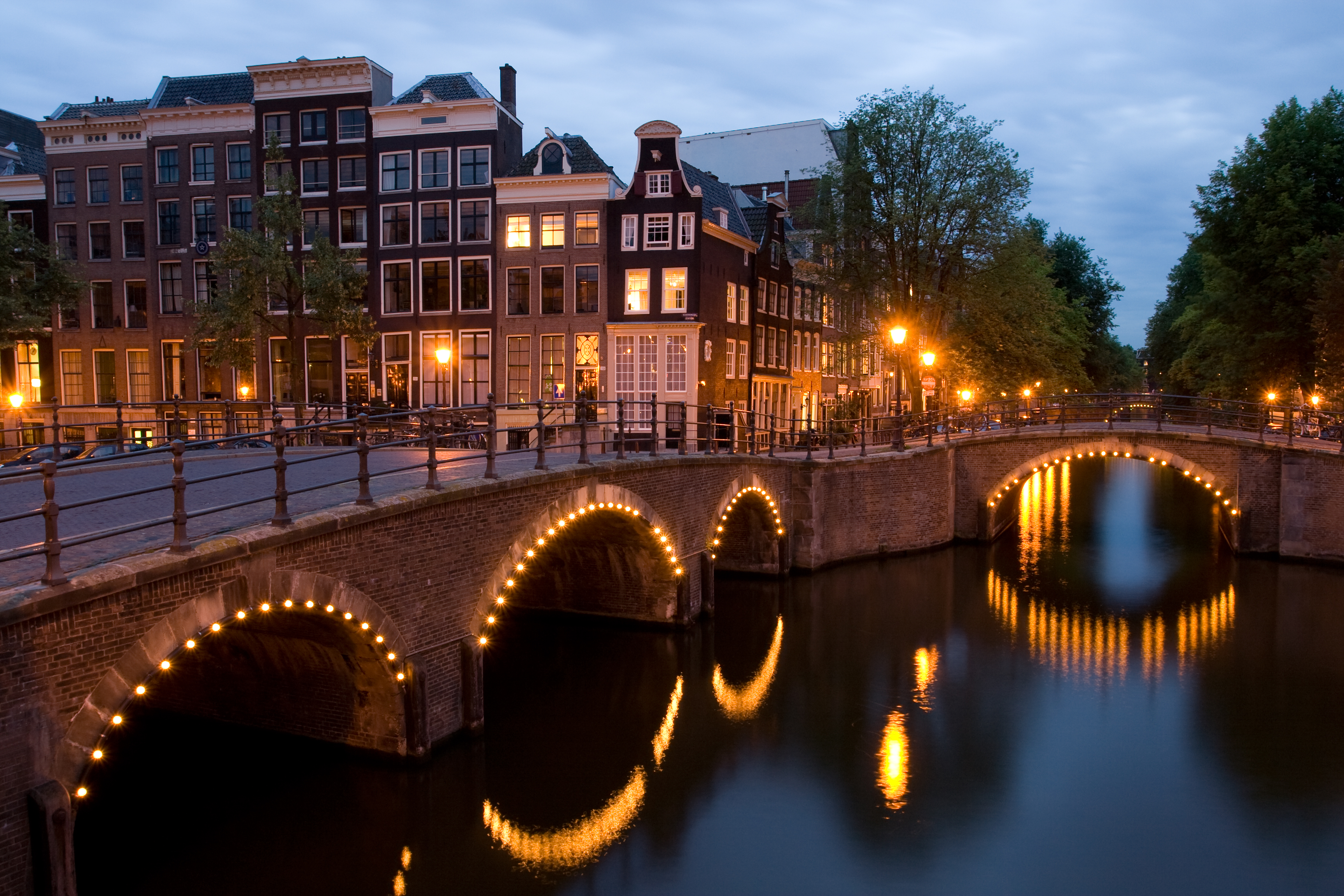
A view of the Reguliersgracht on the corner with the Keizersgracht, in Amsterdam, the Netherlands at dusk. — CC BY-SA 3

The Erasmus Bridge in Rotterdam, Netherlands — CC BY 3

The Dom Tower in Utrecht, Netherlands — CC BY-SA 4
Planning Your Amsterdam Day Trips
A good plan starts with one main destination and builds the day around it, because the country is small and the temptation is to add too much. A windmill morning at the Zaanse Schans pairs well with an afternoon in Haarlem, since the two lie in the same direction and the train links them in minutes. A tulip day in spring pairs Keukenhof with the fields around Lisse and a stop in Leiden, where the canals and the old university town make a gentle end to the day. The day trips from amsterdam work best when the plan leaves an hour unplanned, because the best moments are often a cafe, a market stall or a view that was not on the list.
Families should pick the places with space to run and things to touch, and the Zaanse Schans, the beach at Zandvoort and the boats of Giethoorn all suit children. Couples often prefer the quiet villages and the tulip fields, where the pace is slow and the cafes are small, while walkers and cyclists should head for the Waterland villages and the dune paths behind Haarlem. A rainy day suits Utrecht or Delft, where the museums and the covered arcades keep the day dry, and a sunny day suits the coast or the lakes. The plan should match the people, not the guidebook, and the country offers a good day for every kind of traveller.
A two day plan shows the country properly, with the north and west on the first day and the south and east on the second. The first day can hold the Zaanse Schans in the morning and Haarlem and the beach in the afternoon, while the second day can hold Keukenhof in spring or Utrecht and Gouda in other seasons. Travellers with a third day can add Giethoorn or the old Zuiderzee towns, which need a full day each and reward the effort. The day trips from amsterdam are short enough that nobody needs to change hotels, and the city is a comfortable base for the whole week.
Notable Places in Amsterdam Day Trips
Zaanse Schans, the Working Windmills
The Zaanse Schans is the most visited of all the day trips from amsterdam, and it keeps the working windmills of the Zaan River alive beside green wooden houses. Eight windmills still turn there, grinding spices, sawing timber, pressing oil and making paint, and visitors can climb inside to see the great wooden gears at work. Cheese makers, a wooden shoe workshop, a bakery and a small museum line the same path, so a morning there shows a whole working village in one walk. The site is free to enter, and the mills themselves charge a small fee to climb, which keeps the place feeling like a village rather than a theme park.
Keukenhof Gardens, the Spring Tulip Park
Keukenhof is the flower garden that defines spring in the Netherlands, and the day trips from amsterdam in April and May lead there above all other places. About seven million bulbs bloom across the park each spring, planted in beds, borders and drifts among lakes, pavilions and old beech trees. The gardens open only from mid March to mid May, and the peak bloom shifts with the weather, so the gardeners plant early, mid and late varieties to stretch the colour across the season. Buses run from the airport and from Leiden during the season, and the tulip fields around Lisse are worth a slow drive or cycle ride on the way back.
Giethoorn, the Village Without Roads
Giethoorn is the quietest of the great day trips from amsterdam, and its old centre has almost no roads, only canals crossed by more than 170 wooden bridges. Thatched farmhouses line the water, and visitors move by whisper boat, by canoe or on foot along the narrow paths beside the canals. The village lies about 120 kilometres from the city, and the journey by train and bus takes about two hours each way, so it needs a full day. The silence is the reward, because no cars pass and the water carries only the sound of the boats and the birds.
Volendam and Marken, the Old Fishing Villages
Volendam and Marken keep the harbour life of the old Zuiderzee, and the day trips from amsterdam to the two villages show a Netherlands that fishing built. Volendam has a busy harbour with fish stalls, cafes and boats, and many visitors try the traditional costume in the photo studios along the dike. Marken is quieter, with wooden houses on raised mounds, a small harbour and a lighthouse at the end of the peninsula, and the boat between the two villages takes about half an hour. The pair makes an easy half day from the city, and the bus from Amsterdam reaches Volendam in under an hour.
Utrecht, the City Below the Canals
Utrecht is the oldest of the city day trips, and its canals run below street level with wharves and cellars that now hold cafes, restaurants and small shops. The Dom Tower rises 112 metres above the old town, and the climb to the top gives a view across the whole province on a clear day. The old town holds the university, the museums and the churches of a city that was once the religious centre of the country, and the streets are lively with students and markets. The train from Amsterdam takes about 25 minutes, so Utrecht works as a morning, an afternoon or a full day.
Haarlem, the Market Town by the Dunes
Haarlem is the nearest of the old cities, and the day trips from amsterdam often start there because the train takes only about 15 minutes. The market square holds the great church of Saint Bavo, the town hall and the Frans Hals Museum, which keeps the lively portraits of the painter who lived and worked in the town. The streets around the square are full of small shops, cafes and courtyards, and the town feels lived in rather than preserved. Beyond the town the dunes run to the beach at Zandvoort, so a day in Haarlem can end with sand and sea.
Delft, The Hague, Rotterdam and Kinderdijk
The southern cities make a second set of day trips, and each one shows a different face of the country. Delft is the town of Vermeer and blue pottery, with quiet canals, a tall leaning church tower and workshops where painters still decorate tiles by hand. The Hague is the seat of government, with the Binnenhof beside its pond, the Mauritshuis holding the Girl with a Pearl Earring, and the seaside quarter of Scheveningen nearby. Rotterdam is the modern city, rebuilt after the war around Europe’s largest port, with the Erasmus Bridge, the Cube Houses and the market hall, while Kinderdijk keeps 19 windmills in a row beside the river, a sight inscribed by UNESCO in 1997.

Wooden houses at Marken, Netherlands — CC BY-SA 4

The Oude Delft canal in Delft, Netherlands — CC BY-SA 4
Frequently Asked Questions About Amsterdam Day Trips
What is the best first choice among the day trips from amsterdam?
The Zaanse Schans is the best first choice, because it is close, it shows windmills, cheese and wooden shoes in one morning, and the train ride takes under half an hour. Haarlem pairs well with it in the afternoon, since the two lie in the same direction.
How long should I allow for the day trips from amsterdam?
Allow a full day for Giethoorn and for Keukenhof in spring, and a half day for the Zaanse Schans, Volendam and Marken. The cities of Utrecht and Haarlem each deserve at least half a day, and a full day if the museums matter.
Do I need a car for the day trips from amsterdam?
No car is needed, because the trains reach every city and the buses reach the villages, while the cycle paths cover the rest. A car helps only for the bulb fields and the small villages of the Green Heart, where buses run less often.
When is the best time for the tulip day trips from amsterdam?
Mid April is the best time, because the Keukenhof gardens are open, the fields around Lisse are in colour and the weather is mild. Early April suits the early varieties and late April suits the late ones, so the season rewards more than one visit.
Are the day trips from amsterdam good for families with children?
Yes, and the Zaanse Schans, the beach at Zandvoort and the boats of Giethoorn suit children best. The windmills can be climbed, the boats are quiet and safe, and the villages have space to run.
Can I visit more than one place in a single day?
Yes, and the best pairs are the Zaanse Schans with Haarlem, Keukenhof with Leiden, and Volendam with Marken. Pick one main place and one extra stop, because three places in one day leaves no time to enjoy any of them.
Verified
The Netherlands holds 13 inscribed properties on the UNESCO World Heritage List, 12 cultural and 1 natural, and the list was read directly on whc.unesco.org on 22 November 2026. The Amsterdam canal ring was inscribed in 2010, the mill network at Kinderdijk in 1997, the Beemster polder in 1999 and the Dutch water defence lines in 1996 with an extension in 2021, so the day trips from amsterdam pass through several inscribed properties without any single inscription covering the tour routes themselves. The registry flag for this tour entity reads false, and that is correct at entity level, because a tour holds no inscription of its own even when its destinations stand inside inscribed properties.
The first railway between Amsterdam and Haarlem opened in 1839, the Afsluitdijk closed the Zuiderzee in 1932, the dike joining Marken to the mainland was completed in 1957, and Keukenhof opened in 1949. The Dom Tower of Utrecht rises 112 metres, the Keukenhof season runs from mid March to mid May, and the travel times in this guide are approximate, since timetables and seasons change. Distances are given as rounded figures for planning, and the details were checked against the Dutch railway site and the official garden and tourism pages on 22 November 2026.
Sources
- UNESCO World Heritage Centre, World Heritage List for the Netherlands, 13 properties, checked on whc.unesco.org on 22 November 2026: https://whc.unesco.org/en/statesparties/nl
- I amsterdam, official city guide, day trips and transport: https://www.iamsterdam.com/en
- NS Dutch Railways, train times and tickets: https://www.ns.nl/en
- Keukenhof, official garden site, season and tickets: https://keukenhof.nl/en
- Holland.com, official Netherlands tourism site, regions and villages: https://www.holland.com/global/tourism
Unverified
- The exact opening and closing dates of Keukenhof shift slightly from year to year, so the mid March to mid May window in this guide should be checked on the garden site before travel.
- Travel times by train and bus are approximate, and they change with the timetable, the season and road works, so the times given here are planning figures only.
- The number of bulbs planted at Keukenhof each spring is given as about seven million, and the figure is the garden’s own published estimate rather than a counted total.
- Visitor numbers and opening hours for the windmills, museums and boat services change with the season, and they are not stated in this guide because they should be checked on the day of travel.
Illustrations
- Hero: An aerial view of the Amsterdam city centre and Canal Ring. Free image: https://upload.wikimedia.org/wikipedia/commons/1/10/Amsterdam_Aerial.jpg — CC BY-SA 3.
- In body, panorama: A view of the Reguliersgracht on the corner with the Keizersgracht, in Amsterdam, the Netherlands at dusk. Free image: https://upload.wikimedia.org/wikipedia/commons/b/be/KeizersgrachtReguliersgrachtAmsterdam.jpg — CC BY-SA 3.
- In body, canal houses and the: Canal houses and the Oude Kerk at blue hour in Amsterdam. Free image: https://upload.wikimedia.org/wikipedia/commons/4/44/Canal_houses_and_Oude_Kerk_at_blue_hour_with_water_reflection_in_Damrak_Amsterdam_Netherlands.jpg — CC BY-SA 4.
- In body, Zaanse Schans: Windmills at the Zaanse Schans, Netherlands. Free image: https://upload.wikimedia.org/wikipedia/commons/3/30/Windmills_at_Zaanse_Schans%2C_Zaanstad%2C_2022.jpg — CC0.
- In body, Keukenhof: Tulips at Keukenhof, Lisse, Netherlands. Free image: https://upload.wikimedia.org/wikipedia/commons/8/86/Keukenhof_tulips4.jpg — CC BY 2.
- In body, Giethoorn: Canals and houses at Giethoorn, Netherlands. Free image: https://upload.wikimedia.org/wikipedia/commons/1/19/Giethoorn_Netherlands_Channels-and-houses-of-Giethoorn-01.jpg — CC BY-SA 3.
- In body, Haarlem Grote Kerk: The Grote Kerk in Haarlem, Netherlands. Free image: https://upload.wikimedia.org/wikipedia/commons/d/d1/Grote-Kerk-Haarlem.jpg — CC BY-SA 3.
- In body, Volendam: The harbour of Volendam, Netherlands. Free image: https://upload.wikimedia.org/wikipedia/commons/f/f8/Touristic_harbour_of_Volendam_with_churchtower_-_panoramio.jpg — CC BY 3.
- In body, Erasmus Bridge: The Erasmus Bridge in Rotterdam, Netherlands. Free image: https://upload.wikimedia.org/wikipedia/commons/5/53/Erasmus_Bridge%2C_Pylon%2C_from_East.jpg — CC BY 3.
- In body, Utrecht Dom Tower: The Dom Tower in Utrecht, Netherlands. Free image: https://upload.wikimedia.org/wikipedia/commons/e/e4/Dom_Tower%2C_Domplein%2C_seen_from_Stadhuisbrug%2C_Utrecht_01.jpg — CC BY-SA 4.
- In body, Marken: Wooden houses at Marken, Netherlands. Free image: https://upload.wikimedia.org/wikipedia/commons/b/be/Marken%2C_The_Netherlands_01.jpg — CC BY-SA 4.
- In body, Delft: The Oude Delft canal in Delft, Netherlands. Free image: https://upload.wikimedia.org/wikipedia/commons/0/06/Delft_Oude_Delft_016_6224.jpg — CC BY-SA 4.