
Day Trips from Netherlands: Windmills, Tulips and Old Trading Towns from Amsterdam
Day trips from Netherlands start in Amsterdam, where trains reach most towns fast. Windmills, tulip fields and old trading towns all lie within a single day. Day trips from Netherlands suit travellers who stay in Amsterdam for a few days and want to see more than the capital, because the windmills, the tulip fields, the old trading towns and the beaches of the country all lie within easy reach, and each place has a character of its own. This guide follows the flat land and the railways that make such trips easy, traces the history from the Golden Age to the present day, and ends with practical one-day routes for first-time visitors.
Quick Facts
| Item | Detail |
|---|---|
| Base | Amsterdam, capital of the Netherlands |
| Focus | Day trips from Netherlands |
| Area of the Netherlands | About 41,500 square kilometres |
| Amsterdam to Utrecht | About 35 kilometres, about 25 minutes by train |
| Amsterdam to Rotterdam | About 60 kilometres, about 40 minutes by train |
| Amsterdam to The Hague | About 55 kilometres, about 30 minutes by train |
| Amsterdam to Delft | About 60 kilometres, about 1 hour by train |
| Amsterdam to Kinderdijk | About 80 kilometres, about 1.5 hours |
| Amsterdam to Giethoorn | About 120 kilometres, about 2 hours |
| Amsterdam to Keukenhof | About 35 kilometres, about 1 hour by bus |
| UNESCO in the Netherlands | 13 World Heritage properties |
| Kinderdijk | 19 windmills, UNESCO 1997, reference 818 |
| Tulip season | Mid-March to mid-May |
| Language | Dutch; English widely used |
| Currency | Euro |
Geography of Netherlands Day Trips
A flat and small country
The Netherlands is one of the flattest countries in the world, with much of its land at or below sea level, and it is a country where travellers can cycle through fields, canals and villages without meeting a single hill. The flat land is the result of centuries of work, as the Dutch reclaimed land from the sea and built dikes around it, creating new land called polder by pumping water out and walling it in, a process that continues today. Canals, windmills and tulip fields are the symbols of the country, and travellers on day trips from Netherlands will see them everywhere, from the farmland near Amsterdam to the distant provinces. The small size of the country is what makes day trips from Netherlands work, because the distances between the great cities are only a few dozen kilometres.
The area of the Netherlands, about 41,500 square kilometres, is the reason why day trips here are easier than in most other countries, because a traveller can reach any great city from Amsterdam in about two hours and most small villages in about three. A single day from Amsterdam can therefore hold two or three destinations, a thing that few other European countries allow, and the flat land also makes cycling a practical way to explore the countryside that the trains do not reach. The traveller who takes day trips from Netherlands should think of the country as a single compact region, where the train timetable matters more than the map. The horizon is wide, the sky is large, and the next town is never far away.
The densest railway network in Europe
The Netherlands holds one of the densest railway networks in Europe, with frequent trains between the great cities and the small towns, and travellers can buy tickets through an app or use a contactless bank card to travel without a paper ticket. Intercity trains run between Amsterdam, Utrecht, Rotterdam, The Hague and the other great cities, about every 15 to 30 minutes, and Sprinter trains serve the smaller towns with similar frequency. From Amsterdam Centraal, travellers reach Utrecht in about 25 minutes, Rotterdam in about 40 minutes and The Hague in about 30 minutes, short journeys that make day trips from Netherlands easy and flexible. The train is the backbone of every day trip from Netherlands, and it runs on time often enough to plan around.
Travellers on day trips from Netherlands should buy train tickets in advance through the NS app, the national railway company, because advance tickets are often cheaper and the app shows live times and delays. Buses serve the places that trains do not reach, such as Keukenhof and Giethoorn, but buses run less often than trains and travellers should check the timetable first, especially at weekends and in the low season. Hiring a car suits those who want to reach the far countryside, such as Giethoorn and the Hoge Veluwe, but drivers should note that the roads hold many cyclists and that care is needed in the great cities. For most day trips from Netherlands, the train and the bus are enough.
The Wadden Sea and the northern islands
North of the country lies the Wadden Sea, a shallow sea of mudflats that UNESCO inscribed as a World Heritage property in 2009 as reference 1314, shared with Germany and Denmark, and it is a place where travellers can walk on the mudflats at low tide, an activity the Dutch call wadlopen and one of the most unusual nature experiences in the country. The Wadden islands, such as Texel, Terschelling and Ameland, are reached by ferry from the mainland, with beaches, dunes and small villages, and they make a fine day of walking, cycling and birdwatching, an experience very different from the cities that travellers usually visit in the Netherlands. The Wadden Sea shows the other face of the country, wild and tidal, and it belongs on any longer list of day trips from Netherlands.
The islands are quieter than the mainland towns, with small harbours, bike paths and nature reserves, and they reward travellers who like open space and sea air. Ferries run often in summer and less often in winter, so travellers should check the times before setting out, and they should bring warm clothes because the wind off the North Sea is strong even on sunny days. A day on Texel, the largest island, can combine a beach, a village and a nature reserve, and it shows why the Dutch protect the Wadden Sea so carefully. The sea is a reminder that the country was made from water, and that water still sets its limits.
The sea climate and the tulip season
Travel in the Netherlands is travel in the wind, because the country is flat and near the North Sea, so the wind blows strongly all year and it is the thing that travellers feel most when they cycle, with a headwind able to turn a short ride into a hard one. The Dutch check the rain radar on their phones before leaving home, because a shower can arrive and pass within 20 minutes, and a sunny morning can turn into a rainy afternoon without warning. Travellers should carry a rain jacket and a windproof layer, whether they travel by train or by bicycle, because wind and rain are the two things they will meet in the Netherlands in every season. The canal-side cafés fill whenever the rain comes, and they are the best shelter in the country.
The tulip season, from mid-March to mid-May, is the finest time for day trips from Netherlands, because the tulip fields at Keukenhof and in the surrounding region burst into colour, forming bands of red, yellow and pink that travellers see from the train and from the road. Keukenhof, a flower park in Lisse about 35 kilometres from Amsterdam, opens only in the tulip season, and it holds millions of tulip bulbs planted each year, forming one of the largest flower shows in the world. Travellers should come to Keukenhof in mid-April, when the flowers are at their best, and they should book tickets in advance, because the park grows crowded at weekends and on public holidays. The tulip season is short, and it sets the calendar for spring day trips from Netherlands.
Canals, windmills and polder
The canals form an important part of the geography of the Netherlands, with great canals joining the cities and small canals running through villages and fields, forming a network of water that travellers can sail. The windmills, for which the country is famous, were built to pump water from the low land and to grind grain, and about 1,000 windmills still stand in the Netherlands, with the best-known at Kinderdijk and Zaanse Schans. Kinderdijk, with 19 windmills inscribed by UNESCO in 1997 as reference 818, is where travellers see the Dutch water system most clearly, with the mills standing in rows along the canals and the polder fields around them. The windmills are working monuments, and some of them still turn.
The polder lands, reclaimed from the sea, are flat fields with straight canals and farmhouses, and they are where travellers see most clearly how the Dutch made land from the sea. Cyclists riding through the polder pass tulip fields, cattle and windmills, a scene that many travellers take as the emblem of the Netherlands. These lands also shelter many water birds, and nature lovers can see species that other parts of Europe do not hold.
The polder is the Dutch landscape at its purest, a human-made plain that feels entirely natural. Day trips from Netherlands that include a polder ride show the country as its people made it.

The windmills of Kinderdijk are one of the best known Dutch tourist sites — CC BY-SA 3 nl
History of Netherlands Day Trips
The Golden Age and the trading cities
The 17th century was the Golden Age of the Netherlands, when the country became one of the greatest trading and seafaring powers in the world, with the Dutch East India Company and the Dutch West India Company controlling trade to Asia, Africa and the Americas. Cities such as Amsterdam, Rotterdam, Delft and Leiden grew rich on that trade, and the canals, merchants’ houses and museums that travellers see today were all built in that period. Amsterdam became one of the richest cities in the world, with its semicircular canals and narrow houses, and it was where artists such as Rembrandt and Vermeer worked. The wealth of the Golden Age still pays for the beauty of the Dutch towns.
Delft, a small city to the south, became famous for Delft Blue pottery, a ware that Dutch potters learned from Chinese potters and turned into an industry of their own, and it was where the painter Vermeer lived and worked. Leiden, a university city, holds the oldest university in the Netherlands, founded in 1575, and it was where famous scientists and philosophers worked. These cities, though small, all hold a rich history and well-kept old centres, and they are the places that travellers on day trips from Netherlands visit most. The Golden Age left the Netherlands with more beauty per square kilometre than almost any country in Europe, and day trips from Netherlands show it at its best.
Windmills, dikes and the war with water
The history of the Netherlands is the history of the war with water, because much of the country lies below sea level and survives only through the dikes, windmills and pumping systems that the Dutch built over many centuries. The windmills of Kinderdijk, built in the 18th century, form part of the water system that UNESCO inscribed in 1997, with 19 windmills working together to pump water from the low land into the river, a system that still works today even though modern pumping stations now exist. The dikes, such as the Afsluitdijk, 32 kilometres long, were built to hold back the North Sea and to create the IJsselmeer lake, one of the great engineering works of the 20th century, and travellers can drive across it and see the sea on one side and the lake on the other.
The flood of 1953, when a storm from the North Sea broke the dikes and killed more than 1,800 people, was a turning point in the history of Dutch water management, and after the flood the government built the Delta Plan, a system of dikes, dams and storm barriers that today ranks among the finest flood defences in the world. Travellers interested in engineering can visit the Delta works in the province of Zeeland, where huge storm barriers can be seen on guided tours. This history is why the Dutch treat water as both enemy and friend, and why the windmills and the dikes have become the symbols of the country. Every one of the day trips from Netherlands crosses land that water once owned.
The Second World War and rebuilding
The Second World War left a deep mark on the Netherlands, because the country was occupied by Germany from 1940 to 1945, and Rotterdam was bombed heavily in May 1940, with the city centre destroyed almost completely. After the war, Rotterdam was rebuilt with modern architecture, with tall buildings, bridges and works that travellers see today, forming a city entirely different from the old towns such as Amsterdam and Delft. Other cities, such as Amsterdam and Utrecht, suffered less damage and kept their old centres, so travellers on day trips from Netherlands will see a sharp contrast between modern Rotterdam and the old trading towns. The war is still present in the memorials and the war museums across the country.
The Anne Frank House in Amsterdam ranks among the most visited places in the Netherlands, and it is where Anne Frank and her family hid during the war, a story that travellers across the world know. The memorials and the war museums of the country remind visitors of the occupation, and they form an important part of historical travel here. After the war, the Netherlands became one of the founding members of the European Union and one of the richest and most open countries in Europe, with a multicultural society and an economy built on trade, farming and technology. The rebuilt country kept its old towns and added a modern port city, and both are worth a day.
The Netherlands today: bicycles, tulips and travel
Today the Netherlands ranks among the most visited countries in Europe, with Amsterdam as the main destination and day trips from Netherlands to the towns and the countryside forming an important part of Dutch travel. The bicycle is the main transport of the Dutch, with tens of thousands of kilometres of cycle paths and more bicycles than people, and travellers can hire a bicycle at most destinations to explore the countryside that trains do not reach. The tulip, though it came from Turkey, has become the symbol of the Netherlands, with the tulip fields of Keukenhof and the surrounding region drawing millions of visitors each spring. The bicycle and the tulip together define the modern image of the country for travellers on day trips from Netherlands.
The Netherlands holds 13 World Heritage properties, including the Amsterdam canal ring inscribed in 2010 as reference 1349, Kinderdijk in 1997 as reference 818, and the Wadden Sea in 2009 as reference 1314, a property shared with Germany and Denmark. These properties reflect the history of water management, trade and culture in the Netherlands, and they are why travellers come here for more than Amsterdam alone. Day trips from Netherlands are therefore a journey through a small country with much to see, where every town and every village holds its own story and its own character. The country rewards those who leave the capital, even for a single day.
The Delta Plan and the war with water
In the province of Zeeland, travellers can visit on guided tours the huge storm barriers of the Delta Plan, an experience that few other places in Europe offer. These works show how the Dutch learned from the disaster of 1953 and built a system that protects millions of people living below sea level, and they are why the Netherlands ranks among the world leaders in water engineering. The barriers are vast concrete and steel structures that close against the sea when a storm comes, and they stand as monuments to a country that refuses to surrender land to water.
A visit to the Delta works is a visit to the engineering soul of the Netherlands, and it belongs on any list of day trips from Netherlands. The war with water never ends, and the Dutch never stop fighting it.
Travel to Netherlands Day Trips
Zaanse Schans and the windmills near Amsterdam
Zaanse Schans is the easiest day trip from Amsterdam, with windmills, wooden houses and craft workshops about 15 kilometres north of the city, and travellers reach it by train to Zaandijk Zaanse Schans station in about 20 minutes, then walk about 15 minutes to the windmills. Zaanse Schans is an open-air museum, with windmills that visitors can enter, cheese workshops and shops that sell wooden clogs, one of the symbols of the Netherlands. Travellers should come in the morning to avoid the crowds, because Zaanse Schans is busiest in the afternoon, when tour groups arrive from Amsterdam. The morning light on the river and the mills is the finest time of the day here.
A day at Zaanse Schans should begin with the windmills, including an oil mill, a flour mill and a paint mill, each offering a short tour that visitors can join. After that, travellers can visit the craft workshops, eat lunch in a local restaurant and walk along the River Zaan, where wooden houses and boats line the banks. Those who want to go further can hire a bicycle and ride to the nearby villages, a route that shows fields and canals without the need for a car. The whole visit takes half a day, and it pairs well with an afternoon in Amsterdam itself.
Keukenhof and the tulip fields
Keukenhof is a flower park in Lisse, about 35 kilometres south-west of Amsterdam, and it opens only from mid-March to mid-May, when the tulips bloom, and it ranks among the most visited places in the Netherlands in spring. Travellers reach Keukenhof by bus from Schiphol Airport or from Amsterdam, and they should book tickets in advance, because the park grows crowded at weekends and on public holidays, especially in mid-April, when the flowers are at their best. Inside the park, visitors see millions of tulip bulbs in beds of every colour, with walking paths and lakes, a scene that many travellers call the finest in the Netherlands. The park is a place to walk slowly, not to rush.
Travellers should allow at least half a day for Keukenhof, with the morning in the park and the afternoon cycling through the tulip fields around it, where bands of tulips in every colour stretch to the horizon. These fields belong to growers who plant tulips to sell the bulbs, and visitors should not walk into them without permission, because they can damage the flowers and face a fine. Travellers on day trips from Netherlands to Keukenhof should bring a camera, because the park holds many fine angles and visitors often take more photographs than they expect. The tulip season is short, and the park rewards those who plan ahead.
Kinderdijk, Delft and Rotterdam in one day
Kinderdijk, Delft and Rotterdam are three places that travellers can combine in a single day, because they lie near each other in the south of the Netherlands and are joined by train and bus. Travellers begin in Rotterdam in the morning, visiting the modern buildings and the port, then go to Kinderdijk at midday, where 19 windmills inscribed by UNESCO stand and where visitors can walk along the canals and enter a windmill. The afternoon belongs to Delft, an old city of canals, merchants’ houses and Delft Blue pottery workshops, where travellers can visit a pottery and buy ceramics as a gift. The three places together show three faces of the Netherlands in a single day, and few day trips from Netherlands match that range.
This route gives travellers modern Rotterdam, old Kinderdijk with its windmills and Delft with its canals and pottery, a combination that few other day trips from Netherlands can match. Travellers should take the train from Amsterdam to Rotterdam, then the bus or train to Kinderdijk and Delft, and they should check the timetable first, because buses to Kinderdijk run less often than trains and careful planning of time matters. Those who want a slower day can spend the whole day on Kinderdijk and Delft alone, or on Rotterdam alone, according to their taste. The south of the country rewards a full day, and it punishes haste.
Giethoorn, the village without car roads
Giethoorn is a village in the north-east of the Netherlands, about 120 kilometres from Amsterdam, and it is where travellers go to see a village without car roads, with canals instead of streets and boats instead of cars. Travellers reach Giethoorn by bus or by hire car, because no train serves the village, and they should allow a whole day for the trip, because the journey takes longer than other trips from Amsterdam. In the village, travellers can hire a boat and sail through the canals, walk across the wooden bridges and eat lunch in a canalside restaurant, an experience that many travellers remember longest from a trip to the Netherlands. The village is small, quiet and unlike anywhere else in the country.
Giethoorn is often called the Venice of the North, a name that many canal villages in Europe share, but Giethoorn earns the name more than most, because its canals are the main transport and its thatched farmhouses stand along them, forming a scene that travellers cannot see in Amsterdam. Travellers should come to Giethoorn in spring or summer, when the weather is warm and the canals are full of boats, while winter is quieter but many restaurants close and the canals can freeze. The village rewards a slow day on any list of day trips from Netherlands, with a boat, a walk and a long lunch by the water. Day trips from Netherlands rarely feel as peaceful as this one does.
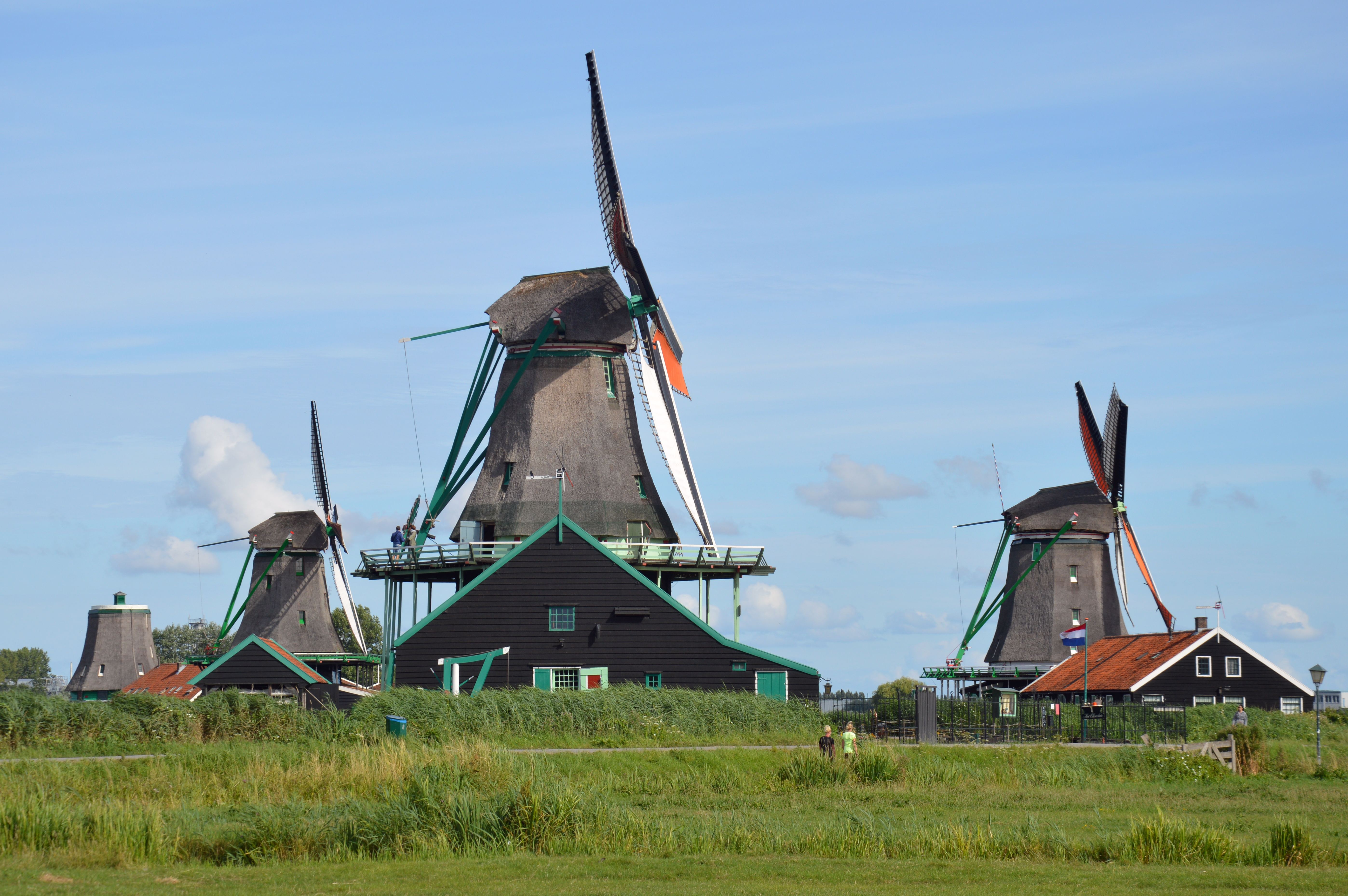
Windmills at Zaanse Schans, Zaanstad — CC0
Notable Places in Netherlands Day Trips
The 19 windmills of Kinderdijk
Kinderdijk is a water system with 19 windmills built in the 18th century, and it ranks among the most famous UNESCO properties in the Netherlands, inscribed in 1997 as reference 818. The windmills stand in rows along the canals, and they are where travellers see most clearly how the Dutch used windmills to pump water from the low land, a system that still works today even though modern pumping stations now exist. Visitors can walk along the canals, enter a windmill and see how the mill keepers lived and worked inside these tall buildings. Kinderdijk is the single most important stop on any list of day trips from Netherlands.
Zaanse Schans, the open-air museum of windmills
Zaanse Schans is an open-air museum of windmills, wooden houses and craft workshops, about 15 kilometres from Amsterdam and one of the most visited places in the Netherlands. The windmills here still work, with an oil mill, a flour mill and a paint mill, and visitors can enter them and see how the mills work, an experience that many travellers call the most interesting of their trip to the Netherlands. Zaanse Schans also holds cheese workshops and shops that sell wooden clogs, other symbols of the Netherlands that visitors can buy as gifts. The museum shows the working Netherlands, not the Netherlands of postcards, and it rewards a morning of slow looking.
Delft, the city of Vermeer and blue pottery
Delft is an old city of canals, merchants’ houses and Delft Blue pottery workshops, and it is where the painter Vermeer lived and worked in the 17th century. Visitors to Delft can tour a pottery workshop, see how the potters make blue and white ceramics, and buy pottery as a gift, an experience that many travellers call the most interesting of their trip to the Netherlands. Delft also holds a great church, the Nieuwe Kerk, where members of the Dutch royal family are buried, and a central square where travellers can sit with coffee and look at the old houses. Delft is small enough to walk in a morning and rich enough to fill a day.
Giethoorn, the village on the canals
Giethoorn is remembered by many travellers for its thatched farmhouses along the canals, with small gardens and wooden bridges that the owners built to reach their boats. The boats here, called punters, are flat-bottomed craft that the people use for daily travel, and visitors can hire one to sail slowly through the canals, a way of moving that no other place in the Netherlands offers. The village carries the nickname Venice of the North, but its mood differs from Venice, because Giethoorn is quiet and small, with narrow canals and houses where visitors can see the daily life of the people, from the gardens to the fishing boats. The scene ranks among the finest in the Netherlands, and it rewards travellers who come without hurry.
Frequently Asked Questions
Which day trips from Netherlands are best from Amsterdam?
Zaanse Schans is the easiest and nearest trip, only about 15 kilometres from Amsterdam, while Keukenhof is the finest trip in spring, when the tulips bloom, and Kinderdijk is the best trip for those who want to see windmills inscribed by UNESCO. Travellers should choose one destination for each day, because every place holds much to see and moving between them takes time.
Do day trips from Netherlands need a hire car?
No hire car is needed for most day trips from Amsterdam, because trains run often to Utrecht, Rotterdam, The Hague and Delft, and buses run to Keukenhof and Zaanse Schans, but a hire car will help travellers reach Giethoorn and the Hoge Veluwe more easily, because no train serves those places. Drivers who hire a car should note that the roads hold many cyclists and that care is needed.
How do travellers use the train for day trips from Netherlands?
Travellers can buy train tickets through the NS app or use a contactless bank card to travel, and Intercity trains run between Amsterdam, Utrecht, Rotterdam and The Hague about every 15 to 30 minutes. Travellers should check the timetable first through the NS app, because the times can change at weekends and on public holidays.
What is the best time for day trips from Netherlands?
Spring, from mid-March to mid-May, is the best time, because the tulips bloom and the weather is cool, while summer is also good because the weather is warm and the days are long, though it is more crowded. Autumn is quieter with coloured leaves, while winter is cold and wet, though the old towns stay fine and hold fewer visitors.
Can day trips from Netherlands cover several places in one day?
Yes, travellers can combine two or three places that lie near each other in one day, such as Rotterdam, Kinderdijk and Delft, because they lie near each other in the south of the Netherlands, but they should choose places that lie near each other and plan the time carefully, because moving between them takes time. Those who want a slower day should give the whole day to one place.
When does Keukenhof open?
Keukenhof opens only from mid-March to mid-May each year, when the tulips bloom, and travellers should come in mid-April, when the flowers are at their best, and they should book tickets in advance, because the park grows crowded at weekends. Outside the tulip season, Keukenhof closes and travellers cannot enter, so they should plan a spring trip to the Netherlands if they want to see it.
Verified
The Netherlands covers about 41,500 square kilometres, and its rail network reaches Utrecht from Amsterdam in about 25 minutes, Rotterdam in about 40 minutes and The Hague in about 30 minutes, with the distances of about 35, 60 and 55 kilometres recorded in local travel guides. Keukenhof opens only from mid-March to mid-May, a season confirmed on the official Keukenhof site, and the park lies about 35 kilometres from Amsterdam. The country holds 13 World Heritage properties, and the three that matter most to these trips are Kinderdijk, inscribed in 1997 as reference 818 under criteria (i), (ii) and (iv), the Amsterdam canal ring, inscribed in 2010 as reference 1349 under criteria (i), (ii) and (iv), and the Wadden Sea, inscribed in 2009 as reference 1314 and shared with Germany and Denmark. The 19 windmills of Kinderdijk were built in the 18th century, with the mills of De Nederwaard raised in 1738 and those of De Overwaard in 1740, as the UNESCO record states.
This tour product is not itself a World Heritage property, so the registry flag of false is correct at the level of the tour, even though its routes visit inscribed sites. The distances from Amsterdam to the day-trip destinations follow the verified figures in the Vietnamese guide, checked on 19 November 2026, and the tulip season follows the official Keukenhof site. The Afsluitdijk measures 32 kilometres, the flood of 1953 killed more than 1,800 people, and the Delta Plan that followed it remains one of the finest flood defences in the world. The University of Leiden, founded in 1575, is the oldest university in the Netherlands, and the Golden Age of the 17th century built the canals and merchants’ houses that travellers see today.
Sources
- https://whc.unesco.org/en/list/818/
- https://whc.unesco.org/en/list/1349/
- https://en.wikipedia.org/wiki/Netherlands
- https://www.holland.com/
- https://keukenhof.nl/en/
Every source above was checked on 22 November 2026.
Unverified
- The number of windmills left in the Netherlands is given differently by different sources, about 1,000, and this guide gives about 1,000 and notes the difference here.
- The number of tulip bulbs planted at Keukenhof each year is given as about 7 million bulbs by some sources but is not confirmed on the official site, and this guide gives millions of bulbs and notes the difference here.
- The length of the cycle paths of the Netherlands is given as more than 35,000 kilometres by some sources without a recent official figure, and this guide gives no exact length and notes the difference here.
- Train and bus ticket prices change with the season and the ticket type, and this guide gives no exact prices and advises travellers to check the official price list.
Illustrations
- Hero: Night view of the windmills at Kinderdijk. Free image: https://upload.wikimedia.org/wikipedia/commons/4/41/Nightview_of_the_Dutch_windmills_at_Kinderdijk_%28Netherlands%29..JPG — CC BY-SA 3.
- In body, Kinderdijk windmills: The windmills of Kinderdijk are one of the best known Dutch tourist sites. Free image: https://upload.wikimedia.org/wikipedia/commons/3/3e/The_windmills_of_Kinderdijk.JPG — CC BY-SA 3 nl.
- In body, Zaanse Schans: Windmills at Zaanse Schans, Zaanstad. Free image: https://upload.wikimedia.org/wikipedia/commons/3/30/Windmills_at_Zaanse_Schans%2C_Zaanstad%2C_2022.jpg — CC0.