
Norway Hotels — A Guide to Staying by Region in Norway
Norway hotels range from city hotels in Oslo to fishermen’s cabins in Lofoten. The right choice depends on the region, not the star rating.
Quick Facts
- Place: Norway, a country in northern Europe, on the western side of the Scandinavian Peninsula.
- Stays by region: Norway hotels by region: Oslo in the south-east, Bergen in the west, the western fjords, Lofoten in the north, and Tromso and the far north.
- Gateway: Oslo airport, with flights from cities across Europe, and Bergen airport for the west.
- Best season: June to August for the midnight sun and the fjords, and September to March for the northern lights.
- Language: Norwegian, with English widely spoken in hotels and tourist towns.
- Currency: The Norwegian krone, as in the whole of Norway.
- Nearest World Heritage: Bryggen in Bergen, ref 59, stands in the city itself, and Urnes stave church, ref 58, is about 242 km straight-line from Oslo.
Geography of Norway Hotels
Norway hotels stand in a country that stretches from the south of Scandinavia to the far north of Europe, with a coastline of fjords, islands and mountains that runs for thousands of kilometres. The country lies on the western side of the Scandinavian Peninsula, with the North Sea to the south, the Norwegian Sea to the west and the Barents Sea to the north, and the land is a narrow strip of mountains and valleys between the sea and the border with Sweden. From the hotels of Norway, a visitor can look out over fjords, glaciers and the northern lights, a landscape that no other place in Europe can match.
The south-east of Norway is the region of Oslo, the capital, with a city that stands at the head of the Oslo fjord, surrounded by hills and forests. Oslo is a city of about 700,000 people, with a harbour, a castle and a royal palace, and it is a place where a visitor can find city hotels near the station and the centre. The hotels of Oslo are the most urban in Norway, with modern rooms and a view over the fjord, and they are a good base for a first visit to the country.
The west of Norway is the region of Bergen and the fjords, with a coastline of deep water and steep mountains, and it is the place where a visitor can find fjord hotels and wooden cabins by the water. Bergen is a city founded in 1070, with a harbour and a historic wharf called Bryggen, and it is a place where a visitor can find harbour hotels with a view over the water. Norway hotels in Bergen stand near Bryggen, and they are a good base for a fjord cruise, with the harbour a few minutes on foot from the hotel door. The fjords of the west, such as the Sognefjord and the Hardangerfjord, are long arms of the sea that cut into the mountains, with hotels that stand on the shore of the fjord.
The hotels of Norway differ by region, and a visitor who understands the difference will choose well. Norway hotels in Oslo are city hotels, with modern rooms near the station and the harbour, and they suit a first visit to the country. Norway hotels in Bergen are harbour hotels, with rooms that look over the water and the wooden houses of Bryggen, and they suit a fjord cruise. Norway hotels in the fjords are wooden lodges on the shore of the water, and Norway hotels in Lofoten are fishermen’s cabins on stilts, and each type of stay gives a different view of the country.
The north of Norway is the region of Lofoten and Tromso, with islands and mountains that rise from the sea, and it is the place where a visitor can find fishermen’s cabins and northern lights hotels. Lofoten is a group of islands in the north, with fishing villages and white beaches, and it is a place where a visitor can stay in a rorbu, a traditional fishermen’s cabin on stilts over the water. Tromso is a city in the far north, with a cathedral and a university, and it is a place where a visitor can see the northern lights in winter and the midnight sun in summer.
The climate of Norway depends on latitude, with mild summers and cold winters in the south, and long winters and short summers in the north, and the country is at its best from June to August, when the sun never sets in the north. In winter, the northern lights appear in the sky from September to March, and the hotels of the north are built for the cold, with warm rooms and a view of the sky. A visitor who comes to Norway should carry warm clothes in any season, because the weather can change quickly in the mountains and by the sea.
Travel to Norway depends on the airport of Oslo, with flights from cities across Europe, and a visitor who searches for a flight to Norway should fly to Oslo airport, then take a train or a flight to Bergen or Tromso. The train from Bergen to Oslo takes about seven hours, and it is one of the most beautiful train journeys in Europe, with a view over the mountains and the fjords. A visitor who searches for a train to Lofoten should take a train to Bodo, then a ferry to the islands, because Lofoten has no railway.
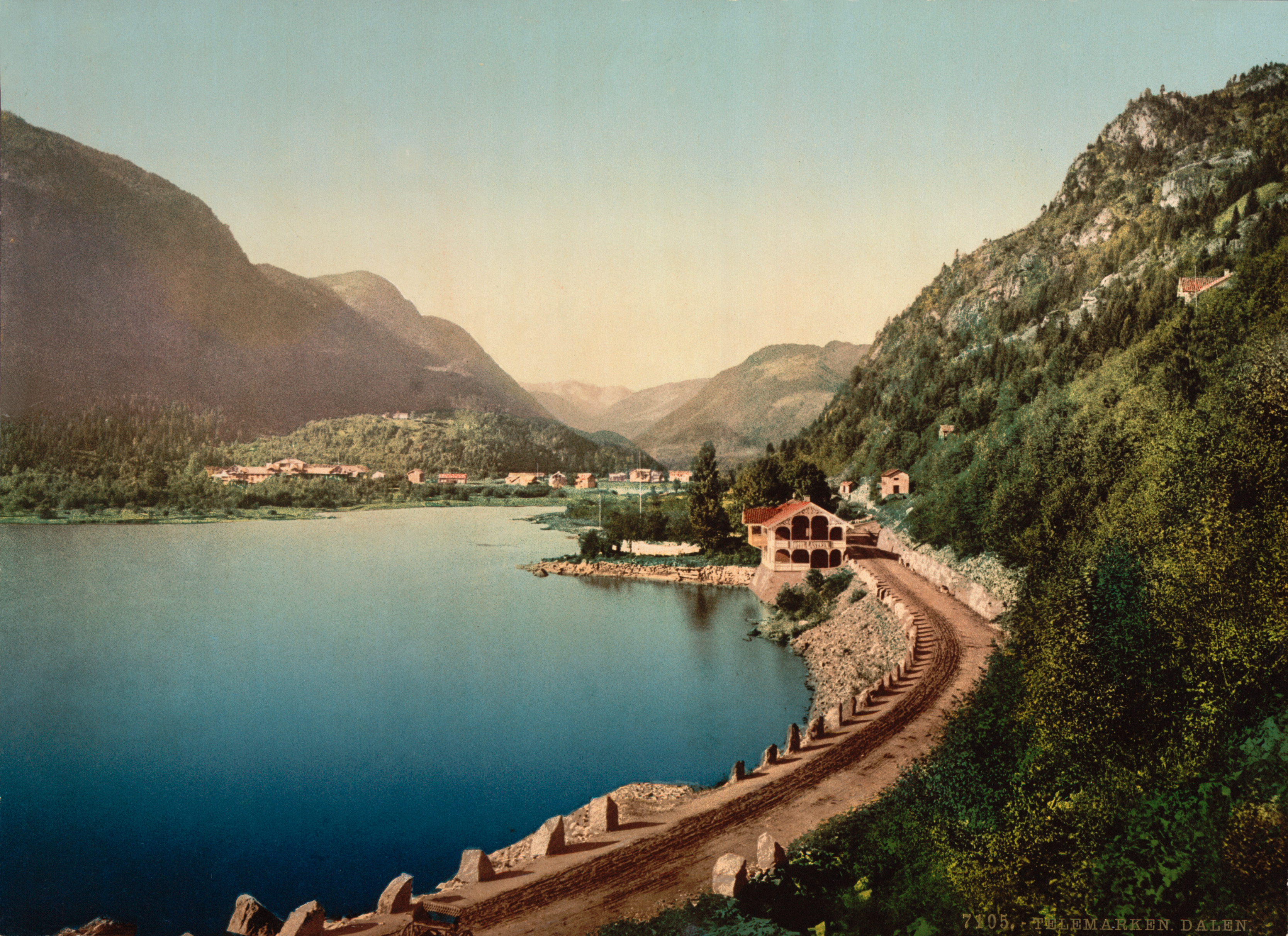
Dalen, Telemark, Norway — Public domain
History of Norway Hotels
The history of Norway hotels begins in the nineteenth century, when the first hotels were built for travellers who came to see the fjords, with wooden buildings that stood on the shore of the water. The fjord hotels of Norway were built in the 1880s and 1890s, when British and German tourists came to the country by steamer, and they were places where a visitor could stay in a wooden hotel with a view over the fjord. The hotels of the fjords were built in the Swiss chalet style, with white wood and a steep roof, and they are a place where a visitor can see the history of tourism in Norway.
Bergen was founded in 1070, and it became a trading city of the Hanseatic League, with a wharf called Bryggen that was inscribed by UNESCO in 1979 as ref 59, with criterion (iii). Bryggen is a row of wooden houses that stand on the harbour, and it is a place where a visitor can see how merchants lived and worked in the Middle Ages. The hotels of Bergen stand near Bryggen, and they are a place where a visitor can stay in the old town, with a view over the harbour and the wooden houses.
Urnes stave church, inscribed by UNESCO in 1979 as ref 58, with criteria (i)(ii)(iii), is one of the oldest stave churches in Norway, and it stands on the shore of the Lustrafjord, a branch of the Sognefjord. The church was built around 1130, and it is a place where a visitor can see the wooden architecture of medieval Norway, with carved animals and a steep roof. The Borgund stave church, built around 1180, is one of 28 stave churches that survive in Norway, and it is a place where a visitor can see the same wooden tradition in the mountains.
Roros, a mining town in the east of Norway, was inscribed by UNESCO in 1980 as ref 55, with criteria (iii)(iv)(v), and it is a place where a visitor can see a town that was built for copper mining in the seventeenth century. The town has wooden houses and a church, and it is a place where a visitor can stay in a hotel in the old town, with a view over the wooden streets. The hotels of Roros are small and historic, with rooms in old wooden buildings, and they are a place where a visitor can understand the history of mining in Norway.
In the twentieth century Norway became independent in 1905, and the country grew into a modern state, with oil wealth that changed the cities and the hotels. Roald Amundsen, a Norwegian explorer, was the first person to reach the South Pole, on 14 December 1911, and his ship, the Fram, is preserved in a museum in Oslo. The hotels of Norway grew with the country, with modern city hotels in Oslo and Bergen, and small hotels in the fjords and the north, and today Norway is one of the most popular destinations in northern Europe.
The fjord hotels of Norway are still the heart of the country’s hotel tradition, and Norway hotels on the Sognefjord and the Hardangerfjord keep the wooden style of the nineteenth century, with white walls, steep roofs and dining rooms that look over the water. Many of them were built by the same families who ran them a hundred years ago, and they serve local food, with fish from the fjord and lamb from the mountains. A visitor who stays in a fjord hotel will eat breakfast with a view of the water, and the hotel will arrange boat trips and walks in the hills, a tradition that has not changed since the first tourists came by steamer.
The northern lights hotels of the north were built in the twenty-first century, when tourists came to see the aurora in winter, and they are places where a visitor can stay in a glass cabin or an ice hotel, with a view of the sky. The ice hotels of the north are rebuilt every winter, with rooms made of ice and snow, and they are a place where a visitor can sleep in a room of ice, with a warm sleeping bag and a view of the northern lights. The history of Norway hotels is the history of a country that opened to tourists, and it is a story that the hotels of Norway tell in every region.

classicnorway.no — CC BY-SA 4
Travel to Norway Hotels
Visiting Norway hotels means choosing a stay by region, and the best choice depends on what a visitor wants to see. Oslo is the best region for a first visit, with city hotels near the station and the centre, and it is a place where a visitor can see the royal palace, the castle and the museums of the capital. A visitor to Oslo should allow at least two days, one day for the city centre and one day for the museums and the fjord, because the city is at its best when walked slowly along the harbour.
Bergen is the best region for the fjords, with harbour hotels near Bryggen, and it is a place where a visitor can take a fjord cruise and see the wooden houses of the old town. A visitor to Bergen should allow at least two days, one day for the city and one day for a fjord cruise, because the fjords are at their best from the water. The train from Bergen to Oslo takes about seven hours, and it is one of the most beautiful train journeys in Europe, with a view over the mountains and the fjords.
The western fjords are the best region for a quiet stay, with fjord hotels that stand on the shore of the water, and it is a place where a visitor can stay in a wooden hotel with a view over the fjord. A visitor to the fjords should allow at least three days, one day for the Sognefjord, one day for the Hardangerfjord and one day for the Flam railway, because the fjords are at their best when explored slowly by boat and train. Before a visit, a traveller should check the latest ticket prices and opening hours on the official website of each attraction in Norway.
Lofoten is the best region for fishing villages, and Norway hotels in Lofoten are rorbu cabins on stilts over the water, with a view over the sea and the mountains. A visitor to Lofoten should allow at least three days, one day for the fishing villages, one day for the beaches and one day for a boat trip, because the islands are at their best when explored slowly by car and boat. The flight from Oslo to Bodo takes about one hour and 25 minutes, and the ferry from Bodo to Lofoten takes about four hours.
Tromso is the best region for the northern lights, and Norway hotels in Tromso range from city hotels in the centre to glass cabins in the countryside, with a view of the sky. A visitor to Tromso should allow at least three days, one day for the city, one day for a northern lights tour and one day for a fjord cruise, because the north is at its best when explored slowly in the dark of winter. The flight from Oslo to Tromso takes about two hours, and it is the fastest way to reach the far north.
From Norway, a visitor can also take a day trip to Sweden, with a train from Oslo to Stockholm, and to Denmark, with a ferry from Oslo to Copenhagen. The town of Trondheim, with a cathedral and a university, is about seven hours by train from Oslo, and it is a place where a visitor can see the old capital of Norway. The countryside of Norway around the hotels is a place where a visitor can walk through mountains and valleys, with a view of the fjords and the glaciers.
Notable Places in Norway Hotels
Bryggen is the most important place in Bergen, and Norway hotels in Bergen stand a few minutes on foot from its wooden houses, so a visitor can walk from the hotel to the wharf in the morning. The narrow alleys between the houses hold small shops and a Hanseatic museum, and the wooden facades lean at odd angles, a sign of the fires and floods that shaped the wharf over six centuries. A visitor who walks the alleys in the early morning, before the shops open, will see the old Bergen that the merchants knew.
Urnes stave church is one of the oldest stave churches in Norway, built around 1130, inscribed by UNESCO in 1979 as ref 58, with criteria (i)(ii)(iii), and it stands on the shore of the Lustrafjord. A ferry crosses the fjord from Solvorn to the church, and the walk from the landing takes about half an hour up a steep path through the woods. The carvings on the church door show animals that twist and fight, and they are the oldest wood carvings in Norway, made by craftsmen who worked in a style that mixed Christian and Viking art.
The Sognefjord is the longest fjord in Europe, 204 kilometres long and 1,308 metres deep, and it is a place where a visitor can take a boat trip and see the steep mountains and the waterfalls. The fjord is one of the most beautiful places in Norway, and it is a place where a visitor can stay in a fjord hotel with a view over the water.
The Hardangerfjord is a fjord in the west of Norway, 179 kilometres long, and it is famous for its orchards, with apple and cherry trees that bloom white in May and fruit in late summer. Waterfalls fall from the cliffs into the fjord, and the villages along the shore sell cider and jam made from the fruit. A boat trip on the fjord in May, when the blossom is out and the snow is still on the mountains, is one of the prettiest journeys in Norway.
Lofoten is a group of islands in the north of Norway, and Norway hotels in Lofoten are rorbu cabins, traditional fishermen’s cabins on stilts over the water, with a kitchen and a view of the sea. The villages of Reine and Henningsvaer are the prettiest in the islands, with red cabins, drying racks for stockfish and mountains that rise straight from the water. A visitor who stays in a rorbu will hear the boats in the morning and see the northern lights from the cabin door in winter, and the midnight sun from the same door in summer.
Tromso is a city in the far north of Norway, with a cathedral and a university, and it is a place where a visitor can see the northern lights in winter and the midnight sun in summer. The city is one of the most important places in the north, and it is a place where a visitor can take a northern lights tour and a fjord cruise.
Frequently Asked Questions
Where should a visitor stay in Norway?
A visitor should stay in Oslo for a first visit, in Bergen for the fjords, in a fjord hotel for a quiet stay, in a rorbu cabin in Lofoten for fishing villages, and in Tromso for the northern lights. The right choice depends on the region, not the star rating, and Norway hotels should be chosen by region first and by hotel second.
How do visitors reach Norway?
Visitors usually fly to Oslo airport, because Norway has no direct flights to every region, and from Oslo, a train or a flight reaches Bergen in about seven hours by train or one hour by air. From Oslo, a flight to Tromso takes about two hours, and a flight to Bodo takes about one hour and 25 minutes, with a ferry to Lofoten. Norway hotels in Oslo, Bergen and Tromso all stand within a short transfer of their airports, so a visitor can reach the hotel on the day of arrival.
What is the best time to visit Norway?
June to August is the best time for the midnight sun and the fjords, when the sun never sets in the north and the weather is warm. September to March is the best time for the northern lights, when the sky is dark and the aurora appears, and a visitor should carry warm clothes in any season.
How long is the Sognefjord?
The Sognefjord runs 204 kilometres from the coast to the mountains, and it is 1,308 metres deep at its deepest point, which makes it the longest and deepest fjord in Europe. A boat from Flam or Gudvangen takes visitors along the narrow arms of the fjord, and the Flam railway climbs from the shore to the mountain station at Myrdal, with a view over the water and the waterfalls.
Is Norway suitable for families?
Families travel well in Norway, because the fjord cruises, the Flam railway and the fishing villages of Lofoten keep children busy, and Norway hotels in the fjords have family rooms with space for everyone. The trains and boats are comfortable for children, and a visitor should check the current prices of hotels and attractions on the official websites before travelling, because prices change by season.
What are the northern lights?
The northern lights are a natural light display in the sky, caused by charged particles from the sun, and they appear in the north of Norway from September to March. A visitor can see the aurora from Tromso and the far north, and a northern lights tour is the best way to see the display, with a guide who knows the best places to watch.
Verified
- Norway has 8 UNESCO World Heritage properties, including Bryggen ref 59, Urnes stave church ref 58, Roros ref 55, the West Norwegian Fjords ref 1195, Vegaoyan ref 1143, the Struve Geodetic Arc ref 1187, the Rock Art of Alta ref 352 and Rjukan-Notodden ref 1486. Source: whc.unesco.org, checked 23/11/2026.
- Bryggen was inscribed in 1979 with criterion (iii), and Urnes stave church was inscribed in 1979 with criteria (i)(ii)(iii). Source: whc.unesco.org/en/list/59/ and whc.unesco.org/en/list/58/, checked 23/11/2026.
- The West Norwegian Fjords were inscribed in 2005 with criteria (vii)(viii), and they cover the Geirangerfjord and the Naeroyfjord. Source: whc.unesco.org/en/list/1195/, checked 23/11/2026.
- The Sognefjord is 204 kilometres long and 1,308 metres deep, and it is the longest fjord in Europe. Source: Wikipedia, “Sognefjord”, checked 23/11/2026.
- The Hardangerfjord is 179 kilometres long. Source: Wikipedia, “Hardangerfjord”, checked 23/11/2026.
- Bergen was founded in 1070, and Norway became independent in 1905. Source: Wikipedia, “Bergen” and “Norway”, checked 23/11/2026.
- Roald Amundsen was the first person to reach the South Pole, on 14 December 1911. Source: Wikipedia, “Roald Amundsen”, checked 23/11/2026.
- The Borgund stave church was built around 1180, and it is one of 28 stave churches that survive in Norway. Source: Wikipedia, “Borgund stave church”, checked 23/11/2026.
- The train from Bergen to Oslo takes about seven hours. Source: Wikipedia, “Bergen Line”, checked 23/11/2026.
- The nearest UNESCO property to Oslo is Urnes stave church, ref 58, about 242 km straight-line to the north-west, and Bryggen, ref 59, stands in Bergen itself. Source: haversine calculation from Oslo’s coordinates to the property’s listed coordinates, checked 23/11/2026.
Sources
- Wikipedia, “Norway” (https://en.wikipedia.org/wiki/Norway) — checked 23/11/2026.
- Wikipedia, “Sognefjord” (https://en.wikipedia.org/wiki/Sognefjord) — checked 23/11/2026.
- Wikipedia, “Bergen” (https://en.wikipedia.org/wiki/Bergen) — checked 23/11/2026.
- Wikipedia, “Borgund stave church” (https://en.wikipedia.org/wiki/Borgund_stave_church) — checked 23/11/2026.
- UNESCO, Bryggen (https://whc.unesco.org/en/list/59/) — checked 23/11/2026.
- UNESCO, Urnes Stave Church (https://whc.unesco.org/en/list/58/) — checked 23/11/2026.
- UNESCO, West Norwegian Fjords – Geirangerfjord and Nærøyfjord (https://whc.unesco.org/en/list/1195/) — checked 23/11/2026.
- Wikidata, Q26824 (https://www.wikidata.org/wiki/Q26824) — checked 23/11/2026.
Unverified
- The exact current population of Oslo, because the figure changes every year and the estimate of 700,000 is the latest published.
- The exact flight times from Oslo to Tromso and Bodo, because timetables change by season and are only current on the official websites of the airlines.
- The current ticket prices for the Flam railway and the fjord cruises, because prices change by season and are only current on the official websites of the operators.
- The number of visitors to Norway each year, because the figure changes every year and is only current on the official website of the country’s tourism board.
Illustrations
- Hero: Norway Hotels. Free image: https://upload.wikimedia.org/wikipedia/commons/4/45/Nyv%C3%A5gar_Rorbuhotell_by_Classic_Norway_Hotels.jpg — CC BY-SA 4.
- In body, Norway Hotels: Dalen, Telemark, Norway. Free image: https://upload.wikimedia.org/wikipedia/commons/f/f2/Dalen%2C_Telemark%2C_Norway%2C_1890s.jpg — Public domain.
- In body, Norway Hotels: classicnorway.no. Free image: https://upload.wikimedia.org/wikipedia/commons/0/07/Flatflesa_Fyr_by_Classic_Norway_Hotels_%28cropped%29.jpg — CC BY-SA 4.