
Things to Visit in Poland: Old Towns, Forests and Baltic Coast
Things to visit in Poland range from medieval old towns to primeval forests. The country rewards travellers who look beyond Warsaw and Kraków.
Poland is a large country in Central Europe, between the Baltic Sea in the north and the Carpathian Mountains in the south. Its capital is Warsaw, its old capital is Kraków, and its history runs from the first Piast kings through partitions, wars and the Solidarity movement to the European Union. Things to visit in Poland include 18 UNESCO World Heritage sites, the primeval Białowieża Forest, the salt mines of Wieliczka, the beaches of the Baltic coast and the mountain town of Zakopane. The country is big enough that a first trip needs at least a week, and it is varied enough that no two regions feel the same.
Poland covers 312,696 square kilometres and has about 37.3 million people, according to the January 2026 estimate. It is divided into 16 voivodeships, and its cities range from the rebuilt old town of Warsaw to the Gothic streets of Toruń and the port of Gdańsk. The official language is Polish, the currency is the złoty, and the country has been a member of the European Union since 2004. Things to visit in Poland are spread across the whole map, from the Baltic dunes in the north to the Tatra peaks in the south.
Quick Facts About Things to Visit in Poland
| Fact | Detail |
|---|---|
| Official name | Republic of Poland (Rzeczpospolita Polska) |
| Capital and largest city | Warsaw |
| Coordinates (centre) | 52° N, 19° E |
| Area | 312,696 square kilometres |
| Population | About 37.3 million people (January 2026 estimate); 38,036,118 (2022 census) |
| UNESCO sites | 18 sites (16 cultural, 2 natural) |
| Official language | Polish |
| Government | Parliamentary republic, 16 voivodeships |
| Currency | Złoty (PLN); EU member since 2004 |
| Highest peak | Rysy, 2,499 metres (Tatra Mountains) |
| Longest river | Vistula, 1,047 kilometres |
| Borders | Germany, Czechia, Slovakia, Ukraine, Belarus, Lithuania, Russia (Kaliningrad) |
| Wikidata | Q36 |
Geography of Things to Visit in Poland
Poland is a country of plains, and the plain is its defining feature. The land rises gently from the Baltic coast in the north to the mountains in the south, and most of the country is lowland, farmland and forest.
The Vistula, the longest river in Poland at 1,047 kilometres, flows from the Carpathians in the south through Kraków and Warsaw to the Baltic at Gdańsk. The Oder forms much of the western border with Germany. Between them lie lakes, marshes and the forests that cover about a third of the country.
The Baltic coast is the first landscape of things to visit in Poland. The coast runs for more than 500 kilometres, from the German border to the Russian exclave of Kaliningrad, and it holds the port cities of Gdańsk, Gdynia and Sopot, the moving dunes of Słowiński National Park, and the long sandy beaches of the Hel Peninsula. The Tri-City of Gdańsk, Gdynia and Sopot is the urban heart of the coast, and the dunes of Łeba are the strangest landscape in Poland, with sand hills that shift with the wind.
The Lakes, Forests and Mountains of Things to Visit in Poland
The Masurian Lake District in the north-east holds more than 2,000 lakes, and it is the sailing and kayaking centre of Poland. The lakes are linked by canals and rivers, and the towns of Giżycko and Mikołajki serve the boats. The Białowieża Forest, on the border with Belarus, is the last primeval forest of the European lowland, and it shelters the European bison, the continent’s largest land animal. The forest is a UNESCO site, and its strict reserve can only be entered with a guide.
The south of Poland is mountain country. The Tatra Mountains, on the border with Slovakia, hold the highest peak in the country, Rysy, at 2,499 metres, and the resort town of Zakopane at their foot. The Tatras are the only Alpine-type mountains in Poland, with granite peaks, glacial lakes and valleys that draw hikers in summer and skiers in winter. West of the Tatras lie the Beskids and the Sudetes, lower and greener, with the spa towns and the hiking trails of the Karkonosze range.
Things to visit in Poland in the mountains include the wooden churches of the south, the salt mines of Wieliczka near Kraków, and the castles of the Kraków-Częstochowa Upland, where limestone cliffs hold the ruins of medieval strongholds on the Trail of the Eagles’ Nests. The south is also the most densely settled part of the country, with the industrial cities of Silesia around Katowice and the old towns of Kraków, Wrocław and Poznań within a few hours of each other.
The climate of Poland is temperate, with cold winters and warm summers. The Baltic coast is cooler and windier than the interior, the mountains are colder and snowier, and the east has the most continental climate, with hot summers and freezing winters. The best months to visit Poland are May to September, when the days are long and the rain is least, and December brings the Christmas markets of Kraków, Wrocław and Gdańsk. Things to visit in Poland change with the season more than in most European countries, and the country rewards visitors who match their route to the weather.
The cities of Poland each hold a different piece of the country. Warsaw, the capital, is a rebuilt city: its Old Town was destroyed in the Second World War and rebuilt from paintings and photographs, and it is now a UNESCO site. Kraków, the old capital, kept its medieval centre intact, with the largest market square in Europe and the Wawel Castle above the Vistula.
Gdańsk, on the Baltic, is a Hanseatic port where the Second World War began and the Solidarity movement was born. Wrocław, on the Oder, is a city of bridges and islands, and Poznań, in the west, is a trading city with a Renaissance market square.

Angling at Masurian Lake District, Poland, June 2021 — CC BY-SA 4

Gdansk Old Town and City Tower — CC BY 4

European bison (Bison bonasus) female Białowieza — CC BY-SA 4
History of Things to Visit in Poland
The history of Poland begins with the Piast dynasty. Mieszko I, the first ruler of Poland, was baptised in 966, and his son Bolesław I was crowned the first king of Poland in 1025. The early kingdom grew around Gniezno and Poznań, and Kraków became the capital in the eleventh century. The Mongol invasions of the thirteenth century devastated the country, and the kingdom fragmented into duchies before Casimir III the Great reunited much of it in the fourteenth century.
In 1385, the Union of Krewo joined Poland with the Grand Duchy of Lithuania through the marriage of Queen Jadwiga and Grand Duke Jogaila. The union created one of the largest states in Europe, and in 1410 the Polish-Lithuanian army defeated the Teutonic Order at the Battle of Grunwald, one of the greatest battles of medieval Europe. In 1569, the Union of Lublin turned the personal union into the Polish-Lithuanian Commonwealth, a republic of nobles with an elected king. The Commonwealth was one of the largest and most tolerant states in Europe, and its capital moved from Kraków to Warsaw in 1596.
Partitions, Uprisings and Independence
The eighteenth century broke the Commonwealth. In 1791, Poland adopted the Constitution of 3 May, the first written constitution in Europe and the second in the world after the United States. The neighbours answered with the partitions: Russia, Prussia and Austria divided Poland between them in 1772, 1793 and 1795, and the country disappeared from the map for 123 years. The Poles rose in uprisings in 1794, 1830 and 1863, and each time the revolt was crushed, but the language, the faith and the memory of the state survived.
Poland regained independence in 1918, at the end of the First World War, and Józef Piłsudski became the head of the new state. The Second Polish Republic lasted only two decades: in 1939, Germany invaded from the west and the Soviet Union from the east, and the Second World War began in Gdańsk. Poland suffered more than any other country in proportion to its population: six million people died, including three million Polish Jews, and the German camp at Auschwitz-Birkenau became the symbol of the Holocaust. Warsaw rose against the occupiers in 1944, and the city was destroyed in revenge.
After the war, Poland’s borders moved west to the Oder and Neisse rivers, and the country fell under Communist rule. The shipyard workers of Gdańsk founded the Solidarity movement in 1980, led by Lech Wałęsa, and the Round Table talks of 1989 brought free elections and the end of Communism in Poland. Things to visit in Poland from this period include the Gdańsk Shipyard, the European Solidarity Centre, and the streets of Warsaw where the uprising was fought.
From 1989 to the European Union
The transition after 1989 was swift. Poland rebuilt its economy, joined NATO in 1999 and the European Union in 2004, and became one of the fastest-growing economies in Europe. The country kept its own currency, the złoty, and its cities rebuilt their old towns, their museums and their cultural life. Kraków, Gdańsk and Wrocław became major destinations, and the countryside kept its villages, its forests and its lakes.
Polish culture runs through the whole story. Nicolaus Copernicus, born in Toruń in 1473, moved the Earth from the centre of the universe. Frédéric Chopin, born near Warsaw in 1810, wrote the music that still defines the country, and the International Chopin Piano Competition in Warsaw is one of the great events of classical music.
Marie Curie, born in Warsaw in 1867, won two Nobel Prizes, and Pope John Paul II, born in Wadowice in 1920, shaped the century from Rome. Things to visit in Poland include the birthplaces and the museums of all of them, and a visitor who follows their trail sees the country through its greatest minds.

Wawel Castle from the Vistula, Krakow — CC BY-SA 4
UNESCO World Heritage Sites in Poland
Poland has 18 UNESCO World Heritage sites, 16 cultural and 2 natural, and it ratified the World Heritage Convention in 1976. The first two sites were inscribed in 1978: the Historic Centre of Kraków and the Wieliczka and Bochnia Royal Salt Mines. Kraków’s old town holds the largest market square in Europe, the Wawel Castle and the Cloth Hall, and the salt mine at Wieliczka has been worked since the thirteenth century, with chapels and sculptures carved from salt hundreds of metres underground.
The list grew through the following decades. Auschwitz-Birkenau was inscribed in 1979, and the Białowieża Forest, shared with Belarus, was inscribed in the same year. The Historic Centre of Warsaw followed in 1980, a tribute to the rebuilding of a destroyed city.
Zamość, the Renaissance ideal town, was inscribed in 1992, and the medieval towns of Toruń and the Castle of the Teutonic Order in Malbork were inscribed in 1997. The Churches of Peace in Jawor and Świdnica came in 2001, the Wooden Churches of Southern Małopolska in 2003, and the Centennial Hall in Wrocław in 2006.
The most recent sites are the Tarnowskie Góry lead-silver-zinc mine, inscribed in 2017, the Krzemionki prehistoric striped flint mining region, inscribed in 2019, and the Gdynia Modernist City Centre, inscribed on 27 July 2026 as Poland’s 18th site. The two natural sites are the Białowieża Forest and the Ancient and Primeval Beech Forests of the Carpathians, which include the beech forests of the Bieszczady Mountains. Together the 18 sites cover the whole country, from the Baltic coast to the Carpathians.

Wieliczka Salt Mine — CC BY-SA 4
Travel to Things to Visit in Poland
A first trip to Poland needs at least seven to ten days: three days for Warsaw and Kraków, two days for Gdańsk and the Baltic coast, and one or two days for Wrocław, Poznań or the mountains. The trains of PKP Intercity link the main cities, and the high-speed routes connect Warsaw with Kraków, Gdańsk and Poznań. Warsaw Chopin Airport is the main international gateway, with Kraków and Gdańsk airports serving the south and the coast. Drivers use the motorways, which are modern and well signposted.
The best months to visit Poland are May to September, when the days are long and the weather is warmest. June to August is the high season for the Baltic coast and the mountains, while May and September are quieter and suit the cities. Winter, from December to February, brings snow to the Tatras and the Christmas markets to Kraków, Wrocław and Gdańsk. Things to visit in Poland are open year round, yet the mountains and the lakes change so much with the season that the choice of month shapes the trip.
Food is part of the journey. Pierogi, dumplings filled with potato, cheese, meat or fruit, are the best-known dish in Poland. Bigos, a stew of cabbage and meat, and żurek, a sour rye soup, fill the menus of the traditional inns, and the barszcz, a beetroot soup, is served at Christmas.
Kielbasa, the Polish sausage, and vodka, which Poland claims as its own invention, are the country’s table staples. The milk bars, the cheap canteens of the Communist period, still serve simple Polish food in the cities.
Notable Places on Things to Visit in Poland
Warsaw is the capital of Poland, with the rebuilt Old Town, the Royal Castle, the Łazienki Park and the Warsaw Uprising Museum. Kraków is the old capital, with the largest market square in Europe, Wawel Castle, the Cloth Hall and the Kazimierz Jewish quarter. Gdańsk is the Hanseatic port on the Baltic, where the Second World War began and the Solidarity movement was born, with the European Solidarity Centre and the crane on the Motława river.
Wrocław is the city of bridges on the Oder, with the Centennial Hall, the market square and the small bronze dwarfs hidden on its streets. Poznań is the trading city of the west, with a Renaissance market square and the mechanical goats that butt heads at noon. Zakopane is the mountain resort at the foot of the Tatras, with wooden architecture, the cable car to Kasprowy Wierch and the trails of Tatra National Park. Germany and Czechia are the western and southern neighbours most often combined with a Polish trip.
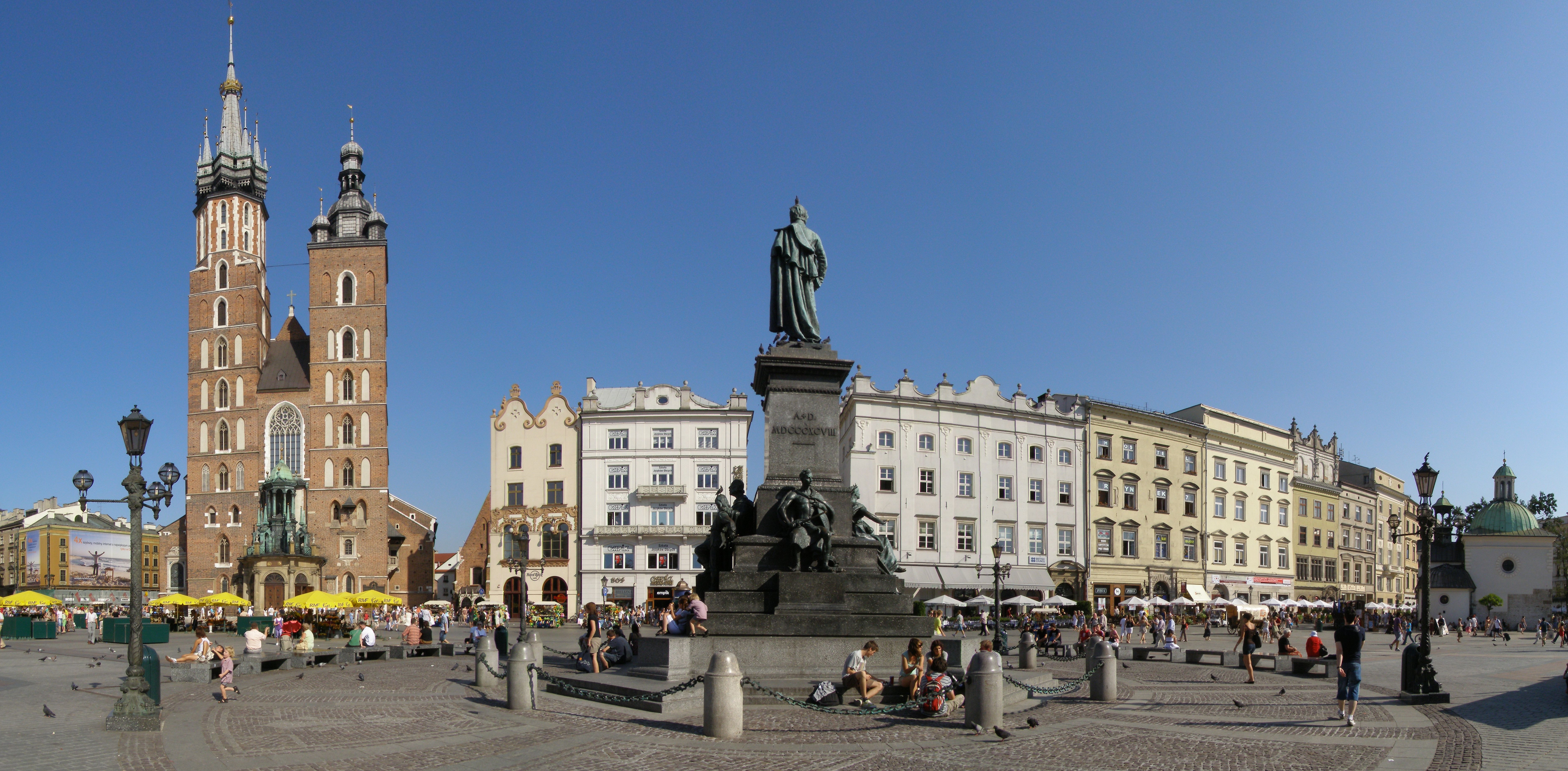
Krakow Rynek Glowny panorama 2 — CC BY-SA 4

Castle Square, Warsaw Old Town — CC BY-SA 4
Frequently Asked Questions About Things to Visit in Poland
What are the best things to visit in Poland on a first trip?
Kraków, Warsaw and Gdańsk form the classic first route, with Wrocław or the Tatra Mountains as the fourth stop. Kraków gives the medieval old town, Warsaw gives the rebuilt capital and the museums, and Gdańsk gives the Baltic port and the Solidarity story.
How many UNESCO World Heritage sites does Poland have?
Poland has 18 UNESCO sites, 16 cultural and 2 natural. The first two were inscribed in 1978, Kraków and the Wieliczka Salt Mine, and the most recent is the Gdynia Modernist City Centre, inscribed in July 2026.
What is the best month to visit Poland?
May to September suits most of the country, with long days and warm weather. December to February is the ski season in the Tatras and the season of the Christmas markets in Kraków, Wrocław and Gdańsk.
Do I need a visa to visit Poland?
Poland has applied the Schengen rules since 2007, three years after it joined the European Union, so its land borders with Germany, Czechia, Slovakia and Lithuania have no routine checks. Most travellers enter visa-free for up to 90 days in any 180 days; those who need a visa apply at a Polish embassy or consulate before departure.
What currency does Poland use?
Poland uses the złoty (PLN), not the euro, although it is a member of the European Union. Cards are accepted almost everywhere in the cities, and cash machines are easy to find.
How long should I spend in Poland?
A first visit deserves a full week: three days in Warsaw and Kraków, two on the Baltic coast around Gdańsk, and the rest in Wrocław, Poznań or the Tatras. A shorter stay still works when it concentrates on Kraków and Warsaw.
Verified
Poland is a country in Central Europe with its capital in Warsaw and its centre at 52° N, 19° E, confirmed through Wikidata Q36, which lists the country as a sovereign state. Its area is 312,696 square kilometres, and its population is about 37.3 million people according to the January 2026 estimate, with 38,036,118 people counted in the 2022 census. The country is divided into 16 voivodeships, and its highest peak, Rysy, reaches 2,499 metres in the Tatra Mountains.
Mieszko I was baptised in 966, Bolesław I was crowned the first king in 1025, the Union of Lublin created the Commonwealth in 1569, and the Constitution of 3 May was adopted in 1791. Poland regained independence in 1918, Germany invaded in 1939, the Solidarity movement was founded in Gdańsk in 1980, and Poland joined NATO in 1999 and the European Union in 2004. Copernicus was born in Toruń in 1473, Chopin near Warsaw in 1810, and Marie Curie in Warsaw in 1867.
Poland has 18 UNESCO World Heritage sites, 16 cultural and 2 natural, confirmed on the UNESCO list for Poland. The first two were inscribed in 1978, Kraków and Wieliczka, and the most recent, the Gdynia Modernist City Centre, was inscribed on 27 July 2026. Every statement above is drawn from the sources listed below. Verified 22 November 2026.
Sources
- Wikidata, Poland (Q36) — type sovereign state, coordinates 52° N, 19° E
- UNESCO World Heritage Centre, Poland — https://whc.unesco.org/en/statesparties/pl/
- UNESCO World Heritage Centre, World Heritage List — https://whc.unesco.org/en/list/
- Wikipedia, Poland — area 312,696 square kilometres, population 37,314,000 (January 2026 estimate), 2022 census 38,036,118
- Government of Poland, Gdynia Modernist City Centre on UNESCO list — https://www.gov.pl/web/oecd-en/gdynia-modernist-city-centre-on-unesco-world-heritage-list
Unverified
- The exact number of visitors to Poland in a given year, which varies by source and by counting method.
- Current train timetables and ticket prices between Polish cities, which change by season and were not checked on an official site.
- The exact share of the population living in Warsaw, given here only in general terms, which varies slightly between census years.
Illustrations
- Hero: All Saints Orthodox church in Suwałki, Poland 01. Free image: https://upload.wikimedia.org/wikipedia/commons/4/4a/All_Saints_Orthodox_church_in_Suwa%C5%82ki%2C_Poland_01.jpg — CC BY-SA 3.
- In body, The Lakes, Forests and Mountains of Things to Visit in: Angling at Masurian Lake District, Poland, June 2021. Free image: https://upload.wikimedia.org/wikipedia/commons/5/57/Angling_at_Masurian_Lake_District%2C_Poland%2C_June_2021.jpg — CC BY-SA 4.
- In body, panorama: Krakow Rynek Glowny panorama 2. Free image: https://upload.wikimedia.org/wikipedia/commons/a/a3/Krakow_Rynek_Glowny_panorama_2.jpg — CC BY-SA 4.
- In body, Gdansk: Gdansk Old Town and City Tower. Free image: https://upload.wikimedia.org/wikipedia/commons/5/52/Poland%2C_Gdansk%2C_Old_Town%2C_City_Tower_150501-48.jpg — CC BY 4.
- In body, Bialowieza Forest: European bison (Bison bonasus) female Białowieza. Free image: https://upload.wikimedia.org/wikipedia/commons/c/cb/European_bison_%28Bison_bonasus%29_female_Bia%C5%82owieza.jpg — CC BY-SA 4.
- In body, Wawel Castle: Wawel Castle from the Vistula, Krakow. Free image: https://upload.wikimedia.org/wikipedia/commons/6/6f/Krakow_-Wawel_from_Vistula-_4.jpg — CC BY-SA 4.
- In body, Wieliczka Salt Mine: Wieliczka Salt Mine. Free image: https://upload.wikimedia.org/wikipedia/commons/f/f8/Wieliczka_salt_mine_Poland_03.JPG — CC BY-SA 4.
- In body, Warsaw: Castle Square, Warsaw Old Town. Free image: https://upload.wikimedia.org/wikipedia/commons/7/7a/Castle_Square_%2822346p%29.jpg — CC BY-SA 4.