
Barcelona: Gaudi’s Mediterranean City and the Capital of Catalonia
Barcelona is the capital of Catalonia, on the Mediterranean coast of Spain. Gaudi’s curves, Gothic lanes and Roman walls fill its streets.
Barcelona rewards the visitor who slows down and looks up, because the city hides its best details above the shopfronts and behind the courtyards. The mosaic lizards of Park Guell, the stone waves of Casa Mila and the spires of the Sagrada Familia all belong to the same restless imagination, and they sit beside Roman stones that are two thousand years old. A morning in Barcelona can begin with coffee in a medieval square and end with a swim at Barceloneta beach, and that easy swing between old and new is the heart of the city.
The city is also a working Mediterranean port and the home of a language and a culture that Catalans guard with pride. Street signs speak Catalan first, festivals fill the squares with human towers, and the food moves from market stalls to white tablecloths without losing its Catalan roots. Barcelona is famous around the world, yet it still feels like a neighbourhood city, because each district keeps its own market, its own square and its own rhythm.
Quick Facts About Barcelona
| Fact | Detail |
|---|---|
| Name | Barcelona, capital of Catalonia, Spain |
| Role | Second largest city in Spain; capital and largest city of Catalonia |
| Location | North-east Spain, on the Mediterranean coast, about 150 km south of the French border |
| Founded | Roman colony of Barcino, late first century BC |
| Area | About 101 square kilometres |
| Population | About 1.7 million (2025); metropolitan area about 4.8 million |
| Languages | Catalan and Spanish |
| Rivers | Llobregat to the south-west, Besos to the north-east |
| Hills | Montjuic by the port, Tibidabo in the Collserola range |
| UNESCO | Works of Antoni Gaudi, ref 320, inscribed 1984 and extended 2005, criteria i, ii, iv; Palau de la Musica Catalana and Hospital de Sant Pau, ref 804, inscribed 1997, criteria i, ii, iv |
| Honours | RIBA Royal Gold Medal 1999, awarded to the city itself; UNESCO-UIA World Capital of Architecture 2024-2026 |
| Coordinates | 41.38° N, 2.18° E |
| Wikidata | Q1492, city in Catalonia, Spain |
Geography of Barcelona
Between the Sea and the Collserola Hills
Barcelona stands on a narrow coastal plain between the Mediterranean Sea and the Collserola hills, in the north-east of the Iberian Peninsula. The city faces south-east toward the sea, and the hills rise behind it to the north-west, so the whole urban area tilts gently from the mountains down to the beaches. That slope shapes everything about Barcelona, from the way the light falls in the evening to the way the streets run in straight lines toward the water.
The plain is hemmed in by two rivers, the Llobregat to the south-west and the Besos to the north-east, and by the hills of Montjuic and Tibidabo at either end of the waterfront. Montjuic rises above the old port as a broad rocky hill crowned by a castle, and it carries parks, museums and the Olympic stadium on its slopes. Tibidabo is the highest point of the city, and its church and amusement park look down over the whole plain, while the Collserola range behind it forms a green wall that stops the city from spreading inland.
The sea has always been the front door of Barcelona, and the port still works beside the beaches where visitors swim. The old harbour, the Port Vell, sits at the foot of La Rambla, and the modern marina and the cruise terminals stretch along the coast to the south-west. Barceloneta beach was once a fishermen’s quarter, and it is now a long sandy strip where the city meets the Mediterranean, while the newer beaches run north-east toward the Besos river.
Barcelona covers only about 101 square kilometres inside its municipal boundary, which makes it a compact city for its population of about 1.7 million people. The density is high, and the streets are busy, yet the city feels open because the sea and the hills frame every view. The metropolitan area spreads far beyond the boundary, into the towns of the Llobregat and Besos valleys, and about 4.8 million people live in that wider area.
The Eixample Grid and the Old City
The geography of Barcelona is really two cities laid side by side, and the contrast between them tells the story of the place. The old city, the Ciutat Vella, is a tangle of narrow medieval lanes around the Roman walls and the Gothic cathedral, and it holds the Barri Gotic, the Raval and the Born districts. The streets there twist and turn, the squares are small and shaded, and a walker can pass from a Roman temple to a medieval palace in a few minutes.
Beside the old city stands the Eixample, the great nineteenth-century extension that gave Barcelona its famous grid of wide avenues and chamfered corners. The planner Ildefons Cerda drew the Eixample in 1859 as a city of light and air, with blocks cut at forty-five degrees so that every junction opens into a small square. The long avenues of the Eixample run from the old city toward the hills and the sea, and they carry the modernist houses of Gaudi and his contemporaries along Passeig de Gracia.
The grid is not perfectly regular, because the old city and the hills push against it, and the Diagonal avenue cuts across the whole pattern from corner to corner. That diagonal gives Barcelona its most recognisable map shape, and it joins the districts of Gracia, Sants and Sant Marti into one urban fabric. Gracia was once a separate village, and it still feels like one, with low houses and small squares, while Sants grew around the railway and the factories of the industrial age.
Beyond the Eixample, the city climbs into the hills, where the districts of Horta, Sarria and Vallcarca keep a village character among the pine trees. The Collserola park covers much of the hillside, and it is one of the largest metropolitan parks in the world, with walking paths that lead from the city streets into the forest in less than an hour. The hills also carry the water towers and the viewpoints that explain the city at a glance, because from Tibidabo the whole plain, the port and the sea lie open below.
Climate, Beaches and the Mediterranean Year
Barcelona enjoys a Mediterranean climate, with hot dry summers and mild winters, and the sea softens the extremes in both seasons. Summer days are warm and humid, and the beaches fill from June to September, while winter days are often sunny and cool enough for a jacket rather than a heavy coat. Rain falls mostly in autumn and spring, and it usually arrives in short sharp showers rather than long grey weeks.
The city has more than four kilometres of beaches, and they are part of daily life rather than a holiday extra. Barceloneta is the closest beach to the old city, and it draws swimmers, volleyball players and evening walkers in every season. The beaches of Bogatell, Mar Bella and Nova Icaria run north-east from the Olympic port, and they are quieter and wider, with promenades, showers and beach bars that stay open through the summer.
The mild climate shapes the calendar of Barcelona, because life happens outdoors for most of the year. Markets spill into the streets, cafes put their tables on the pavements, and festivals fill the squares from spring to autumn. The great festival of La Merce in late September closes the summer, and the festival of Sant Jordi in April fills the streets with books and roses, while the human towers of the castellers rise in the squares on feast days through the year.
The sea also brings a wind that locals know well, and the afternoon breeze off the Mediterranean cools the Eixample in summer. In winter the Tramuntana wind can blow cold from the north, but the Collserola hills shelter the city from the worst of it. The result is a city that can be visited in any month, because Barcelona never truly closes for winter, and the light on the stone of the old city is beautiful in every season.
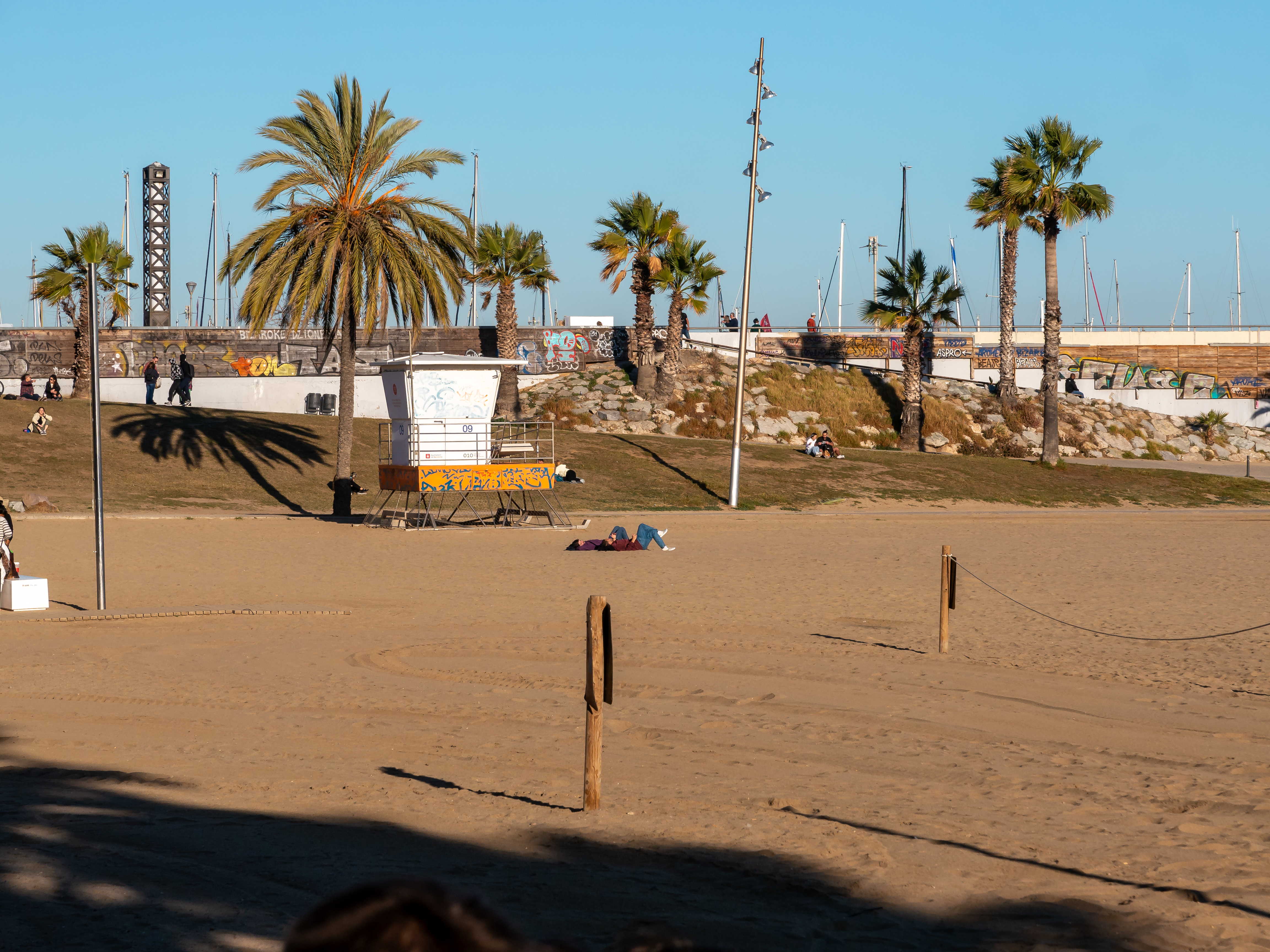
Barceloneta beach in Barcelona — CC BY-SA 4

The Torre de Collserola seen from Tibidabo, Barcelona — CC BY-SA 4

Montjuïc Castle in Barcelona — CC BY-SA 4
History of Barcelona
Roman Barcino and the Medieval Counts
Barcelona began as the Roman colony of Barcino, founded in the late first century BC on a low hill between the sea and the hills. The Romans laid out a walled town with the forum at its centre, and they built walls, temples and an aqueduct that carried water from the Collserola hills. Traces of that Roman town still stand in the Barri Gotic, where the old walls, the columns of the Temple of Augustus and the Roman necropolis can be seen among the medieval streets.
After Rome fell, the town passed through Visigothic and Frankish hands, and it became the seat of the Counts of Barcelona in the ninth century. The counts built a palace on the Roman forum, and the city grew around it as a trading port and a centre of Catalan power. In 1137 the County of Barcelona joined with the Kingdom of Aragon, and the city became the capital of a Mediterranean empire that stretched from Catalonia to Sicily and Naples.
Medieval Barcelona was a city of merchants, shipbuilders and bankers, and its wealth built the great Gothic buildings that still define the old city. The cathedral of Santa Eulalia rose over the Roman town, the church of Santa Maria del Mar rose over the Ribera quarter, and the royal shipyards built the galleys that carried Catalan trade across the sea. The city council, the Consell de Cent, governed with a confidence that matched the wealth of the port, and the Catalan language and laws took shape in these centuries.
The city kept its medieval walls and its narrow streets for centuries, and the Barri Gotic still shows that history in its stones. The Plaça del Rei holds the palace of the counts, the Plaça de Sant Jaume holds the city hall and the palace of the Catalan government, and the lanes between them are the oldest streets in Barcelona. A walker in the old city is walking through a thousand years of Catalan history, and the Roman stones underfoot are the foundation of it all.
War, Industry and the Cerda Plan
The fortunes of Barcelona changed in 1714, when the city fell after a long siege in the War of the Spanish Succession. The victorious Bourbon king stripped Catalonia of its laws and institutions, and he built the great fortress of the Ciutadella to watch over the city. The fortress stood for more than a century as a symbol of defeat, and its grounds later became the park that now holds the zoo and the Catalan parliament.
The nineteenth century brought industry, and Barcelona became the workshop of Spain, with textile mills, steam engines and a growing working class. The city outgrew its walls, and the factories and the workers spilled into the villages around it, while the port handled the cotton and the coal that fed the mills. The old walls came down in 1854, and the city finally had room to breathe, but it needed a plan for the empty land beyond the ramparts.
That plan came from Ildefons Cerda, whose Eixample of 1859 gave Barcelona its grid of wide streets and open blocks. The new district was built for light, air and movement, and it filled quickly with the houses of the industrial bourgeoisie. The same decades brought two world exhibitions, in 1888 and 1929, which left the city with the Arc de Triomf, the Ciutadella park and the exhibition palaces of Montjuic, and each exhibition announced Barcelona to the world.
The city also grew outward in these years, absorbing the villages of Gracia, Sants, Sant Marti and Sarria into the municipal boundary. Each village kept its own character, and that is why Barcelona still feels like a collection of neighbourhoods rather than a single centre. The trams and the trains joined the districts together, and the population rose fast, because the factories drew workers from all over Catalonia and Spain.
Gaudi and the Modernista City
The most famous chapter in the history of Barcelona belongs to Antoni Gaudi and the Modernista movement, which turned the Eixample into an open-air museum. Gaudi was born in 1852, and he took over the Sagrada Familia in 1883, a year after the first stone had been laid, and he worked on the great church until his death in 1926. The church was his life’s work, and it remains unfinished, with construction continuing toward completion and the central tower finished in 2026.
Gaudi built for the industrial families of the city, and each commission became a work of art shaped by nature and faith. Casa Vicens of 1883 to 1885 was his first great house, and Palau Guell of 1886 to 1890 was a palace of stone and iron in the old city. Park Guell rose on a hill above Gracia between 1900 and 1914, and Casa Batllo of 1904 to 1906 and Casa Mila of 1906 to 1912 turned Passeig de Gracia into the most famous street in Spain.
The Modernista movement was larger than Gaudi alone, and the city holds the work of his rivals and friends beside his own. Lluis Domenech i Montaner built the Palau de la Musica Catalana and the Hospital de Sant Pau, two buildings of colour and light that UNESCO inscribed as World Heritage in 1997. The whole movement was an expression of Catalan identity, because the architects used Catalan craft, Catalan materials and Catalan symbols to build a city that looked like no other in Europe.
Gaudi died in 1926 after being struck by a tram, and he was buried in the crypt of the Sagrada Familia, the church he had given his life to. His work was recognised slowly, and it took decades before the world understood what he had built, but today the seven buildings of the Works of Antoni Gaudi stand on the UNESCO World Heritage List. The inscription came in 1984 for the first three buildings and was extended in 2005 to cover the full series, and it honours a creative contribution that changed the course of modern architecture.
Civil War, the Olympics and the City Today
The Spanish Civil War reached Barcelona in 1936, and the city endured three years of war, bombing and hunger before falling to Franco’s forces in 1939. The dictatorship that followed suppressed the Catalan language and institutions, and the city lived under a long silence that lasted until the death of Franco in 1975. The return of democracy brought back the Catalan government and the Catalan language, and Barcelona began to rebuild its confidence and its public life.
The turning point came in 1992, when Barcelona hosted the Summer Olympic Games and rebuilt its waterfront for the world. The old industrial beaches were cleaned and opened to the public, the Olympic port was built, and the ring roads and the new hotels gave the city a modern face. The Games changed the image of Barcelona from an industrial port into a Mediterranean city of design and leisure, and the visitors who came for the Olympics kept coming afterwards.
The city continued to grow as a centre of design, tourism and technology, and in 1999 it became the only city ever to receive the RIBA Royal Gold Medal, an honour normally given to architects. The medal recognised the way Barcelona had rebuilt itself through architecture and public space, from the Olympic waterfront to the new squares of the old city. The city also served as the UNESCO-UIA World Capital of Architecture for 2024 to 2026, a title that confirmed its standing in world architecture.
Today Barcelona is a city that lives with the tension between its fame and its daily life, because millions of visitors arrive each year to see the works of Gaudi and the old city. The city has answered with new rules for tourism and new investment in its neighbourhoods, and it keeps building on the same strengths that made it famous. The sea, the hills, the grid and the old city are still there, and Barcelona still rewards the visitor who walks slowly and looks up.
Timeline
- Late first century BC — The Roman colony of Barcino is founded on the coastal plain
- Ninth century — Barcelona becomes the seat of the Counts of Barcelona
- 1137 — The County of Barcelona joins with the Kingdom of Aragon
- 1714 — Barcelona falls after a siege in the War of the Spanish Succession
- 1854 — The medieval walls come down and the city begins to expand
- 1859 — Ildefons Cerda draws the Eixample plan
- 1882 — The first stone of the Sagrada Familia is laid
- 1883 — Antoni Gaudi takes over the Sagrada Familia
- 1888 — Barcelona hosts its first world exhibition
- 1900-1914 — Park Guell is built above Gracia
- 1926 — Gaudi dies and is buried in the crypt of the Sagrada Familia
- 1929 — Barcelona hosts its second world exhibition
- 1936-1939 — The Spanish Civil War reaches Barcelona
- 1975 — The death of Franco opens the way back to democracy
- 1984 — Three works of Gaudi are inscribed on the UNESCO World Heritage List
- 1992 — Barcelona hosts the Summer Olympic Games and rebuilds its waterfront
- 1997 — The Palau de la Musica Catalana and the Hospital de Sant Pau are inscribed by UNESCO
- 1999 — Barcelona receives the RIBA Royal Gold Medal
- 2005 — The Gaudi World Heritage inscription is extended to seven buildings
- 2024-2026 — Barcelona serves as UNESCO-UIA World Capital of Architecture

The Sagrada Familia in Barcelona — CC BY-SA 4

The dragon staircase in Park Güell, Barcelona — CC BY-SA 3

Casa Batlló in Barcelona — CC BY-SA 3
Travel to Barcelona
Getting There and Getting Around
Barcelona is served by El Prat airport, which stands south-west of the city on the coast, and by fast trains that join the city with Madrid and with France. The airport train and the airport bus both reach the city centre, and the metro now runs to the airport as well, so the journey into Barcelona is straightforward. The Sants station is the main railway station, and it handles the high-speed trains, the regional trains and the local commuter lines in one place.
The metro, the buses and the trams cover the whole city, and the Eixample grid makes the network easy to understand. The metro has eight lines, and the stations are close together in the centre, so most journeys in Barcelona take only a few stops. A travel card covers the metro, the bus and the tram, and the city is also one of the best in Europe for walking, because the centre is compact and the streets are flat.
Cycling has grown fast in Barcelona, and the city has built cycle lanes along the main avenues and the waterfront. The public bike scheme serves residents and long-stay visitors, and rental bikes are easy to find near the beaches and the old city. Taxis are plentiful, and ride-hailing cars work across the city, but the metro and the feet are usually faster in the centre.
A One-Day Itinerary
A day in Barcelona should begin early in the Barri Gotic, before the crowds arrive, because the old city is at its best in the quiet morning. The cathedral square, the Roman walls and the Plaça del Rei can be walked in an hour, and the lanes of the Born lead on to Santa Maria del Mar and the market streets beyond. Coffee in a square in the old city is the right start, and the morning light on the stone is worth the early rise.
The middle of the day belongs to Gaudi, and the walk up Passeig de Gracia takes the visitor past Casa Batllo and Casa Mila in a single stroll. The Sagrada Familia stands at the end of the avenue, and it deserves a long unhurried visit, because the interior light changes through the day and the towers reward a slow look. Park Guell lies on the hill above Gracia, and the afternoon is the best time for the mosaics and the view over the city.
The evening belongs to the sea, and the walk down La Rambla to the old port ends at the waterfront where Barcelona meets the Mediterranean. Barceloneta beach is a short walk from the port, and the promenade is full of walkers, cyclists and swimmers as the sun goes down. Dinner in Barceloneta or in the Born brings the day to a close, and the tapas bars of the old city stay busy late into the night.
Gaudi, the Old Town and the Hills
The best way to see the works of Gaudi is to take them slowly, because each building rewards a close look at the details. The Sagrada Familia is the centre of any visit, and its towers, its facades and its forest of columns tell the story of Gaudi’s faith and his love of nature. Casa Batllo and Casa Mila stand close together on Passeig de Gracia, and both can be visited in a single morning, while Park Guell needs a separate trip up the hill.
The old town rewards the same slow approach, because the Barri Gotic hides its best corners in the side lanes. The Roman temple, the Jewish quarter and the medieval palaces are all within a short walk of the cathedral, and the Born district holds the church of Santa Maria del Mar and the Picasso museum. The Raval, across La Rambla, is livelier and rougher, with markets, galleries and the old Hospital de la Santa Creu.
The hills give the best views of Barcelona, and Montjuic is the easiest of them to reach, by cable car or by a walk through the gardens. The castle, the Olympic stadium and the museums of Montjuic fill a full afternoon, and the view from the castle covers the port, the city and the sea. Tibidabo is further out, and it needs a tram and a funicular, but the view from the church terrace is the finest in Barcelona, and it shows the whole city laid out between the hills and the sea.

The Glòries Tower (Torre Glòries) at night, in Barcelona, Spain — CC BY-SA 4

Casa Milà (La Pedrera) in Barcelona — CC BY-SA 4
Notable Places in Barcelona
The Sagrada Familia is the first place in Barcelona, and it is the unfinished church that has become the symbol of the city. Gaudi worked on it from 1883 until his death in 1926, and construction continues today, with the central tower finished in 2026. The towers rise over the Eixample, and the interior is a forest of stone columns lit by coloured glass, and no visit to Barcelona is complete without it.
Park Guell is the second place, and it is the garden city that Gaudi built on the hill above Gracia. The mosaic lizard at the entrance, the serpentine bench of the terrace and the gingerbread gatehouses are the most photographed sights in Barcelona. The park was inscribed by UNESCO in 1984 as part of the Works of Antoni Gaudi, and its terrace looks out over the city to the sea.
Casa Batllo and Casa Mila stand together on Passeig de Gracia, and they are the two great houses of the Eixample. Casa Batllo of 1904 to 1906 is a house of bone and scale, with a roof like a dragon’s back, while Casa Mila of 1906 to 1912 is a house of stone waves with a roof of chimneys like warriors. Both were inscribed by UNESCO in 1984 and 2005, and both can be visited from the inside.
The Barri Gotic is the fourth place, and it is the old city of Barcelona, with the cathedral, the Roman walls and the Plaça del Rei. The Gothic quarter holds the palace of the counts and the city hall, and its lanes are the oldest streets in the city. Camp Nou is the home of FC Barcelona, founded in 1899, and the stadium opened in 1957 as one of the largest in the world. The beaches of Barceloneta and Bogatell complete the visit, because they are where the city meets the sea, and the promenade is the evening walk of Barcelona.

The Glòries Tower (Torre Glòries) at night, in Barcelona, Spain — CC0

A street in the Gothic Quarter, Barcelona — CC BY 2

The Temple of the Sacred Heart on Tibidabo, Barcelona — CC BY-SA 4
Frequently Asked Questions
What is Barcelona famous for?
Barcelona is famous for the architecture of Antoni Gaudi, above all the Sagrada Familia, Park Guell, Casa Batllo and Casa Mila. It is also famous for its Gothic old city, its Mediterranean beaches, its food and its football club, FC Barcelona.
Where is Barcelona?
Barcelona stands on the Mediterranean coast of north-east Spain, about 150 km south of the French border. It is the capital of Catalonia and the second largest city in Spain, between the Collserola hills and the sea.
When is the best time to visit Barcelona?
Late spring and early autumn are the best times, because the weather is warm and the crowds are smaller than in high summer. Barcelona can be visited in any month, because the winters are mild and the city never closes for winter.
How many days do you need in Barcelona?
Three days are enough to see the Sagrada Familia, Park Guell, the Gothic quarter and the beaches at a comfortable pace. A longer stay allows day trips to Montserrat and the Costa Brava, a short flight to Mallorca, and time to explore the neighbourhoods of Gracia and Sants.
Is the Sagrada Familia finished?
No, construction continues, although the central tower was finished in 2026. Gaudi took over the church in 1883 and worked on it until his death in 1926, and the building is expected to be completed in the coming years.
What language is spoken in Barcelona?
Catalan and Spanish are both official languages in Barcelona, and Catalan comes first on street signs and in public life. Visitors can use Spanish everywhere, and English is widely spoken in hotels, restaurants and the main attractions.
Verified
The Roman foundation of Barcino, the 1137 union with Aragon, the 1714 siege, the 1854 demolition of the walls, the 1859 Cerda plan, the 1888 and 1929 exhibitions, the Sagrada Familia first stone in 1882 and Gaudi taking over in 1883, the dates of Casa Vicens, Palau Guell, Park Guell, Casa Batllo and Casa Mila, the death of Gaudi in 1926, the 1992 Olympic Games, the 1999 RIBA Royal Gold Medal, the UNESCO inscriptions of the Works of Antoni Gaudi in 1984 and 2005 and of the Palau de la Musica Catalana and the Hospital de Sant Pau in 1997, and the population of about 1.7 million in 2025 were checked against the sources below. The Wikidata entry Q1492 for Barcelona, at 41.38° N, 2.18° E, was verified through the Wikidata API on 22 November 2026.
Sources
- UNESCO World Heritage Centre, Works of Antoni Gaudi, ref 320, inscribed 1984 and extended 2005, criteria i, ii, iv — https://whc.unesco.org/en/list/320/
- UNESCO World Heritage Centre, Palau de la Musica Catalana and Hospital de Sant Pau, Barcelona, ref 804, inscribed 1997, criteria i, ii, iv — https://whc.unesco.org/en/list/804/
- Barcelona Tourism, official tourism portal of the city — https://www.barcelonaturisme.com/wv3/en/
- Barcelona, city in Catalonia, Spain, Q1492 — https://en.wikipedia.org/wiki/Barcelona
- Sagrada Familia, first stone 1882, Gaudi from 1883, central tower — https://sagradafamilia.org/en/history
- Wikidata Q1492 (Barcelona, coordinates 41.3825/2.1769) — verified through the Wikidata API, 22 November 2026
Unverified
- The population of about 1.7 million in 2025 and the metropolitan figure of about 4.8 million are estimates that vary by source — this article uses approximate figures and records the variation here.
- The exact completion date of the Sagrada Familia is not fixed, and published dates have shifted over the years — this article records the central tower finished in 2026 and does not give a final completion date.
- The claim that Barcelona is the only city to receive the RIBA Royal Gold Medal is widely repeated but the medal is normally awarded to architects — this article reports the honour as given to the city in 1999.
- The founding date of Barcino is given as the late first century BC by most sources, and the exact year is debated — this article uses the century rather than a single year.
Illustrations
- Hero: Barcelona is the capital of Catalonia, on the Mediterranean coast of Spain. Free image: https://upload.wikimedia.org/wikipedia/commons/8/87/Barcelona_Cathedral_Interior_-Royal_tombs_in_the_Cathedral_of_Barcelona-_The_Kings.jpg — CC BY-SA 4.0.
- In body, Barcelona: The Glòries Tower (Torre Glòries) at night, in Barcelona, Spain. Free image: https://upload.wikimedia.org/wikipedia/commons/3/3f/Barcelona_March_2015-2a.jpg — CC BY-SA 4.
- In body, Barcelona: The Glòries Tower (Torre Glòries) at night, in Barcelona, Spain. Free image: https://upload.wikimedia.org/wikipedia/commons/0/02/Barcelona_March_2015-2b.jpg — CC0.
- In body, Barcelona: Barceloneta beach in Barcelona. Free image: https://upload.wikimedia.org/wikipedia/commons/a/a6/Beach%2C_Barcelona_%28P1170712%29.jpg — CC BY-SA 4.
- In body, Barcelona: The Torre de Collserola seen from Tibidabo, Barcelona. Free image: https://upload.wikimedia.org/wikipedia/commons/f/f2/Barcelona_-_Torre_de_Collserola_from_Tibidabo.jpg — CC BY-SA 4.
- In body, Barcelona: Montjuïc Castle in Barcelona. Free image: https://upload.wikimedia.org/wikipedia/commons/a/ae/Castell_Montjuic%2C_Barcelona_%28P1170651%29.jpg — CC BY-SA 4.
- In body, Barcelona: The Sagrada Familia in Barcelona. Free image: https://upload.wikimedia.org/wikipedia/commons/f/f0/Barcelona_Sagrada_Familia_2019_11.jpg — CC BY-SA 4.
- In body, Barcelona: The dragon staircase in Park Güell, Barcelona. Free image: https://upload.wikimedia.org/wikipedia/commons/b/b7/Barcelona_Parc_G%C3%BCell_el_drac.jpg — CC BY-SA 3.
- In body, Barcelona: Casa Batlló in Barcelona. Free image: https://upload.wikimedia.org/wikipedia/commons/9/96/Casa_Batll%C3%B3_01.jpg — CC BY-SA 3.
- In body, Barcelona: Casa Milà (La Pedrera) in Barcelona. Free image: https://upload.wikimedia.org/wikipedia/commons/d/de/Casa_Mil%C3%A0%2C_general_view.jpg — CC BY-SA 4.
- In body, Barcelona: A street in the Gothic Quarter, Barcelona. Free image: https://upload.wikimedia.org/wikipedia/commons/e/ed/Gothic_Quarter%2C_Barcelona_%2815%29_%2830442722553%29.jpg — CC BY 2.
- In body, Barcelona: The Temple of the Sacred Heart on Tibidabo, Barcelona. Free image: https://upload.wikimedia.org/wikipedia/commons/8/8e/%28Barcelona%29_Torres_venecianes_-El_Tibidabo-_Temple_Expiatori_del_Sagrat_Cor.jpg — CC BY-SA 4.