
Costa del Sol — The Best Beaches on the Andalusian Coast
The best beaches Costa del Sol offers run along 150 kilometres of shore. Golden sand, calm water and white villages meet beneath the mountains.
This is the Mediterranean coast of the province of Málaga in Andalusia, in the far south of Spain. The name means Coast of the Sun, and the coast earns it with mild winters, long summers and a light that painters and photographers have praised for generations. The best beaches Costa del Sol offers are only the start, because behind every beach stands a white village, a fishing harbour or a mountain road worth the climb.
The coast runs from Nerja in the east to Manilva in the west, passing through Málaga city, Torremolinos, Benalmádena, Fuengirola, Mijas, Marbella and Estepona. Each town keeps its own character, from the busy city beach of La Malagueta to the quiet coves beneath the cliffs of Maro. Visitors who choose the best beaches Costa del Sol offers can move from a family beach with sunbeds and beach restaurants to a wild cove in a natural park within a single afternoon.
Quick Facts About Costa del Sol
| Fact | Detail |
|---|---|
| Name | Costa del Sol, Spanish for Coast of the Sun |
| Location | Mediterranean coast of the province of Málaga, Andalusia, southern Spain |
| Coordinates | 36.5160° N, 4.8825° W |
| Country | Spain |
| Coastline | About 150 kilometres, from Nerja in the east to Manilva in the west |
| Main city | Málaga, about 590,000 people |
| Airport | Málaga-Costa del Sol Airport, west of Málaga city |
| Language | Spanish, with English widely spoken in resort towns |
| Currency | Euro |
| Best-known beaches | La Malagueta, La Carihuela, Burriana, La Rada, Puerto Banús, Cabopino |
| UNESCO connection | No World Heritage property on the coast itself, nearest is the Antequera Dolmens Site, inscribed in 2016 under reference 1501 |
| Wikidata | Q215254 |
The Costa del Sol is a region rather than a single town, and that shape defines how to travel here. The coast road runs along the shore for its whole length, so a traveller can base in one town and reach several beaches by bus or car in a day. The best beaches Costa del Sol offers reward that kind of slow movement, because the sand changes from town to town and the mountains behind the shore change the light hour by hour.
Geography of Costa del Sol
The Coastline
The Costa del Sol faces the Mediterranean Sea along the southern edge of Andalusia, looking south towards North Africa on clear days. The shore runs roughly east to west for about 150 kilometres, from the cliffs near Nerja to the gentler beaches of Manilva close to the border with the province of Cádiz. Most of the coast is sandy, with wide beaches in the resort towns and smaller coves where the cliffs meet the sea. The best beaches Costa del Sol offers sit along this line, and each one takes its character from the town behind it and the shape of the shore beneath it.
The beaches of the east, around Nerja and Torre del Mar, sit beneath steep cliffs and small headlands that break the sand into coves. The beaches of the centre, around Málaga, Torremolinos and Fuengirola, are long, flat and urban, with promenades, palm trees and beach restaurants running their whole length. The beaches of the west, around Marbella and Estepona, mix long golden stretches with dune systems and quieter corners. The best beaches Costa del Sol offers therefore suit different travellers, from families who want shallow water and shade to walkers who want a long empty shore at dawn.
The sea here is the western Mediterranean, and the water stays calm for much of the year because the coast shelters behind the Strait of Gibraltar and the mountains inland. Waves are usually small, the water warms through the summer, and the sand shelves gently in most resort beaches, which makes swimming easy for children and for weaker swimmers. The best beaches Costa del Sol offers share this calm water, and that calm is one reason the coast became a family destination long before it became a resort for golfers and yacht owners.
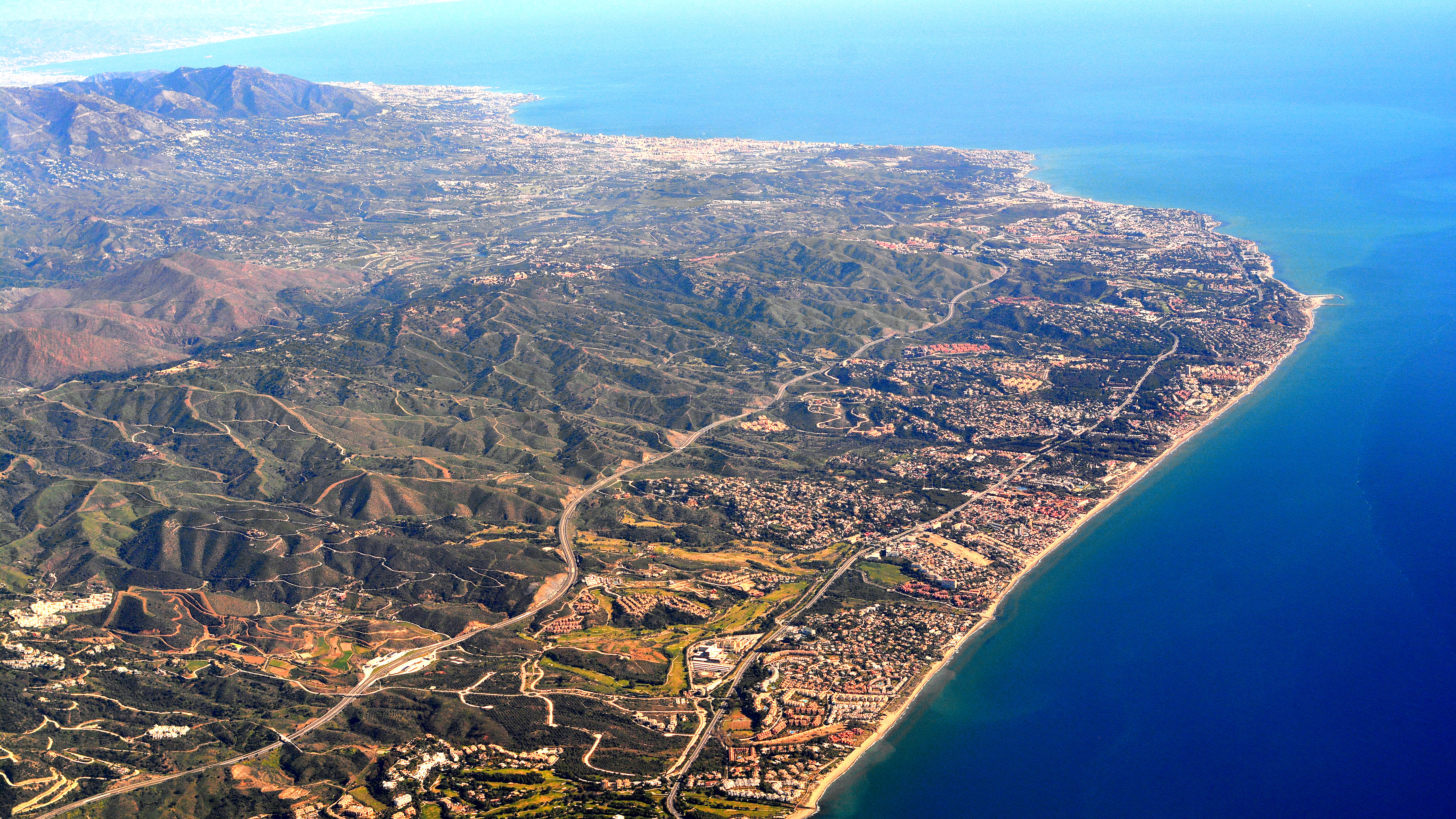
The coast between Marbella and Fuengirola, by Mike McBey — CC BY 2
Mountains Behind the Shore
Mountains rise close behind the coast along almost its whole length, and they shape the weather, the views and the villages of the Costa del Sol. The Sierra de Mijas stands behind Fuengirola and Mijas, the Sierra Bermeja rises behind Estepona with its rare red rock, and the limestone peaks of the Sierra de Tejeda stand behind Nerja and the eastern coast. These ranges trap warm air over the shore and block much of the cold wind from the north, which is why the coast stays mild while the inland plateaus of Andalusia turn cold in winter.
The mountains also explain the white villages that hang above the resorts, because for centuries people lived uphill for safety and water while fishing and farming happened below. Mijas Pueblo, Benalmádena Pueblo and Casares keep that pattern today, with whitewashed houses, narrow lanes and views down to the sea. A traveller who climbs from the beach to one of these villages in an afternoon sees the whole coast laid out below, and understands why the best beaches Costa del Sol offers are never far from a mountain walk.
On the clearest days the snow-capped peaks of the Sierra Nevada appear to the east beyond Granada, a reminder that Andalusia holds both beach and high mountain within a short drive. The contrast is one of the great pleasures of the coast, because a morning swim and an afternoon in cool mountain air are both possible on the same day. The mountains also feed short rivers that cut through the coastal plain, and their valleys hold the orange groves, avocado farms and subtropical gardens that give the coast its green edge.

The Sierra de las Nieves, Málaga, by JABerrocal — CC BY-SA 4
Rivers and Natural Parks
Short rivers cross the coastal plain from the mountains to the sea, and the largest of them is the Guadalhorce, which reaches the Mediterranean just west of Málaga city. Its mouth forms a wetland where flamingos and herons gather, and the river valley behind the coast holds farmland, orange groves and the white town of Álora. Smaller rivers such as the Fuengirola and the Guadiaro cut narrower valleys, and their mouths often mark the boundary between one resort town and the next. The best beaches Costa del Sol offers near these river mouths sometimes have darker sand, because the rivers carry mountain sediment down to the shore.
Two protected landscapes stand out along the coast and give its wildest beaches their setting. The cliffs of Maro and Cerro Gordo form a natural park between Nerja and La Herradura, where steep limestone cliffs drop into clear water and small coves hide beneath the rock. The dunes of Artola, known as the Cabopino dunes, form a natural monument east of Marbella, where a long beach runs beside pine trees and shifting sand. These protected places show the coast before the resorts, and they hold some of the best beaches Costa del Sol offers for swimmers who prefer clear water and quiet sand to sunbeds and music.
The sea floor matters as much as the sand, because the clear water around the cliffs of Maro and the rocky points near Nerja supports fish, octopus and seagrass meadows. Snorkellers find more life around rocks than on the open sandy beaches, and divers use the coves of the eastern coast as their base. The calm water and the rocky headlands together make the coast a gentle place to learn to swim, to paddle or to take a first boat trip, and the harbours of the resort towns rent boats for short trips along the shore.

The Tornillo rock at El Torcal, Antequera, by Ingo Mehling — CC BY-SA 4
Climate and the Seasons
The Costa del Sol has a Mediterranean climate with hot dry summers and mild winters, and the mountains behind the shore keep the worst weather away for much of the year. Summer brings long days, strong sun and warm evenings, with the sea at its warmest in late summer and the beaches at their busiest in July and August. Winter brings cooler air and shorter days, yet the sun still shines on most days and the temperature rarely falls far, which is why northern Europeans have spent winters here for generations.
Spring and autumn are the kindest seasons for travellers who want the best beaches Costa del Sol offers without the summer crowds. In May and June the water warms, the wildflowers cover the hills, and the beach restaurants open their terraces for the season. In September and October the sea keeps its summer warmth, the crowds thin, and the light turns golden in the late afternoon. These shoulder months suit walkers, cyclists and swimmers who prefer space on the sand to the high season buzz.
Rain falls mainly in autumn and winter, often in short heavy showers rather than long grey spells, and the coast dries quickly afterwards. The wind that matters most is the easterly Levante, which can bring choppy water and cooler air, and the westerly Poniente, which usually brings clear skies. A traveller who checks the wind before choosing a beach will find a calm cove on most days, because the headlands shelter one side of the coast while the other side catches the breeze.
Towns Along the Coast
The towns of the Costa del Sol fall into three kinds, and each kind shapes its beaches. Málaga is a real city with a port, a historic centre, museums and a working population, and its beaches sit beside the life of the city rather than apart from it. Torremolinos, Benalmádena and Fuengirola are resort towns built for visitors, with long promenades, hotels and beach restaurants in a continuous line. Marbella and Estepona mix resort life with old towns, fishing harbours and quieter residential quarters, and their beaches range from glamorous marinas to family shores.
Inland towns add a second layer to the coast, because Ronda, Antequera, Álora and the white villages of the mountains lie within an hour of the sea. Ronda stands above a deep gorge in the mountains north-west of Marbella, Antequera holds dolmens and limestone towers north of Málaga, and the villages of the Sierra de las Nieves keep a slower rural life. The best beaches Costa del Sol offers are therefore part of a wider region, and a traveller who never leaves the sand misses the mountains, the history and the food that make the coast more than a beach strip.
The coast road, the promenades and the local buses tie the towns together, and the train line from Málaga runs west through Torremolinos, Benalmádena and Fuengirola. Marbella and Estepona lie beyond the end of that train line, so buses and cars serve them instead. This transport pattern shapes a beach holiday here, because the eastern and central towns are easy without a car while the western towns reward a driver who can stop at coves and viewpoints along the way.

Spanish handball players of Costa del Sol Málaga 2022-2023 — CC BY-SA 3
History of Costa del Sol
Phoenicians and Romans
People have lived on this coast for more than three thousand years, and the sea brought the first settlers. Phoenician traders founded Malaca, the ancestor of Málaga, around the eighth century before the common era, and they used the harbour to trade metals, salt fish and purple dye across the Mediterranean. The best beaches Costa del Sol offers today lie beside harbours that began as Phoenician anchorages, and the fish salting that fed the ancient trade still survives in the grilled sardines of the beach restaurants.
The Romans took the coast in the third and second centuries before the common era and built towns, roads, baths and fish-salting factories along the shore. Málaga became a Roman municipality, and Roman remains still surface in the city centre, where a theatre stands at the foot of the Alcazaba fortress. The Romans also built the coastal road that later travellers followed, and they planted the vines and olives that still cover the hills behind the resorts. Their legacy is easy to miss on a beach holiday, yet it underlies the towns, the roads and the food of the whole coast.

The Roman Theatre of Málaga, by Ingo Mehling — CC BY-SA 4
Muslim Andalusia
Muslim armies crossed from North Africa in 711 and ruled this coast for nearly eight centuries, and their mark on the Costa del Sol is deeper than any other. Málaga became an important port of the Caliphate of Córdoba and later of the Nasrid Kingdom of Granada, and its Alcazaba fortress and Gibralfaro castle still watch over the harbour from their hill. The white villages of the mountains keep the street patterns, the courtyard houses and the water channels of that period, and the names of towns and rivers still carry their Arabic roots.
The coast lived by trade, fishing and farming under Muslim rule, and its harbours sent silk, fruit, pottery and dried fish across the Mediterranean. The Nasrid period, from the thirteenth century onwards, gave Málaga its great fortress and its role as the port of Granada, the last Muslim kingdom in Iberia. The best beaches Costa del Sol offers were working shores in those centuries, with fishermen, boat builders and merchants rather than sunbathers, and the chiringuitos of today stand where fish were once salted and dried.

The Alcazaba of Málaga, by Diego Delso — CC BY-SA 4
The Catholic Monarchs and After
Ferdinand and Isabella took Málaga in 1487 after a long siege, and the coast passed into Christian Spain. Churches rose beside mosques, the Alcazaba became a fortress of the new kingdom, and the port kept its trade with the Mediterranean and the Americas. The centuries that followed were hard for the coast, because Barbary pirates raided the shore, earthquakes shook the towns, and the population stayed small and poor. Watchtowers still stand along the beaches as a memory of those raids, and many of them now serve as landmarks for walkers on the coastal path.
The eighteenth and nineteenth centuries brought slow change, with new roads, a growing port in Málaga and the first industries around the city. Málaga exported wine, raisins and olive oil, and its merchants built the fine houses that still line the old town. The best beaches Costa del Sol offers remained fishing shores through these centuries, and the fishing quarters of El Palo in Málaga and La Carihuela in Torremolinos still keep the low houses and the boat sheds of that life.
Fishing Villages to Resorts
The modern Costa del Sol began in the 1950s, when a few writers, artists and travellers discovered the fishing villages west of Málaga. Torremolinos grew first, because its beach, its climate and its closeness to the airport made it an easy first stop for northern Europeans. Marbella followed when Prince Alfonso von Hohenlohe opened the Marbella Club in 1954, and the town became a meeting place for aristocrats, film stars and wealthy travellers. The airport at Málaga grew with the trade, and package holidays carried millions of visitors to the coast from the 1960s onwards.
The boom changed the coast fast, and hotels, apartments and marinas rose along the shore in a few decades. Fuengirola, Benalmádena and Estepona grew from villages into resort towns, and the fishing boats gave way to pleasure craft in harbours such as Puerto Banús, which opened in 1970. The change brought wealth and work, yet it also buried much of the old coast under concrete, and the towns that kept their old quarters, such as Estepona and Marbella, are now prized for exactly that survival.
The Modern Coast
Today the Costa del Sol is one of the most visited coasts in Europe, and it lives by tourism, golf, sailing and the long stays of northern Europeans who winter here. Málaga city has remade itself as a cultural centre, with the Picasso Museum in the house where the painter was born in 1881, the Carmen Thyssen Museum and a revived historic centre. The best beaches Costa del Sol offers now sit beside that cultural life, so a traveller can spend a morning in a museum and an afternoon on the sand without leaving the city.
The coast has also begun to protect what the boom nearly lost, with natural parks at Maro and Cabopino, restored old towns and a coastal path that links the towns on foot. The fishing quarters survive in El Palo and La Carihuela, the white villages keep their festivals, and the mountain towns of Ronda and Antequera draw visitors inland. The history of the coast is therefore still visible from the beach, in the watchtowers, the fortresses, the fishing boats and the white houses above the shore.

Plantilla completa del Club Balonmano Femenino Málaga Costa del Sol 2024/25 — CC BY 4
Travel to Costa del Sol
When to Go and How to Get There
May to October suits a beach holiday best, with warm seas and long days, while November to April suits walkers, golfers and travellers who prefer mild weather and quiet towns. July and August bring the highest temperatures and the fullest beaches, and families with children fill the resorts during the school holidays. The best beaches Costa del Sol offers in the shoulder months of May, June, September and October give the same sun with more space, and the sea stays warm well into autumn.
Málaga-Costa del Sol Airport sits about eight kilometres west of Málaga city and serves flights from across Europe all year. Trains run from the airport to Málaga city and west to Torremolinos, Benalmádena and Fuengirola, and buses serve Marbella, Estepona and Nerja. Many visitors hire a car at the airport, because a car opens the coves, the white villages and the mountain towns that buses reach slowly. The coast road runs the whole length of the shore, and the toll motorway inland offers a faster route between Málaga and Marbella.
Beach Days and Water
A beach day on the Costa del Sol follows a simple rhythm, with a morning swim, a long lunch at a beach restaurant and a slow afternoon in the shade. The resort beaches rent sunbeds and umbrellas, and the beach restaurants, called chiringuitos, grill sardines on skewers over wood fires and serve fried fish, salads and cold drinks. The best beaches Costa del Sol offers for families have shallow water, lifeguards in summer and playgrounds nearby, while the coves of the east suit swimmers who want clear water and quiet.
Swimming is safe on most beaches, yet travellers should watch the flags, because the Levante wind can raise waves and pull currents along the shore. The water is calmest in the morning before the afternoon breeze, and the coves beneath cliffs stay sheltered when the open beaches turn choppy. Snorkelling is best around the rocks at Nerja, Maro and Cabopino, and paddleboards and kayaks rent by the hour in the resort harbours. The best beaches Costa del Sol offers reward an early start, because the sand is empty at dawn and the light on the mountains is at its finest.

Cabopino beach on the Costa del Sol, by Konstantin — CC BY-SA 3
Food, Markets and Evenings
Andalusian food on the coast begins with the sea, and the espeto of grilled sardines is the dish that defines the Costa del Sol. Beach restaurants grill the sardines on skewers over olive wood, and they serve them with bread, salad and cold beer as the sun sets. Fried fish, known as pescaíto frito, follows the same tradition, with small fish, squid and anchovies fried crisp and eaten with lemon. The best beaches Costa del Sol offers are never far from a chiringuito, and lunch on the sand is part of the holiday rather than an interruption to it.
Inland food adds a second table to the coast, with gazpacho in summer, oxtail stew in Ronda, goat cheese from the mountains and sweet wine from Málaga. The markets of Málaga and Marbella sell the produce of the valleys, from mangoes and avocados to almonds and olives, and the market halls are worth a morning even for travellers who never cook. Evenings on the coast run late, with the promenades filling after sunset, the old towns opening their bars, and the harbour restaurants serving dinner until midnight in summer.

The Atarazanas Market in Málaga, by Luis García — CC BY-SA 4
Getting Around and Day Trips
The train from Málaga serves the airport, Torremolinos, Benalmádena and Fuengirola, and it runs often enough that a car is unnecessary in the central coast. Buses run along the whole coast and link the resort towns with each other and with Málaga, and they also climb to Mijas Pueblo, Ronda and Antequera. The best beaches Costa del Sol offers are easy to reach by bus from a central base, and the coastal path lets walkers move between neighbouring towns on foot along the shore.
Day trips give the coast its depth, and three stand out above the rest. Ronda, about an hour inland from Marbella, stands above a deep gorge with an eighteenth-century bridge and one of the oldest bullrings in Spain. Antequera, north of Málaga, holds the prehistoric dolmens of the UNESCO-listed Antequera Dolmens Site, inscribed in 2016 under reference 1501, and the strange limestone towers of El Torcal.
Granada, about ninety minutes from Málaga, holds the Alhambra, Generalife and Albayzín, a World Heritage property under reference 314, and Córdoba holds its historic centre under reference 313. These trips turn a beach holiday into a journey through Andalusian history, and Seville, the capital of Andalusia, lies a little further west for travellers with a second day to spare.
Notable Places in Costa del Sol
La Malagueta, Málaga
La Malagueta is the city beach of Málaga, a wide stretch of dark sand beside the port and the historic centre. The promenade runs its whole length, the beach restaurants grill sardines a few steps from the water, and the skyline mixes the Alcazaba fortress with modern towers. The best beaches Costa del Sol offers include La Malagueta because it shows the coast as a city beach, where a swim, a museum and a market lunch fit into one morning. The sand is dark and coarse, the water shelves gently, and the beach is busiest at weekends when the whole city comes down to the sea.
Burriana, Nerja
Burriana is the main beach of Nerja, a wide golden bay beneath the cliffs of the eastern coast. The water is clear and deep enough for swimming and diving, the beach rents kayaks and paddleboards, and the restaurants along the sand serve fish caught that morning. The best beaches Costa del Sol offers in the east begin here, because Burriana mixes a resort beach with a real town behind it, and the old town of Nerja, with its Balcón de Europa viewpoint, lies a short walk away. The Nerja Caves, discovered in 1959, lie a few kilometres inland and hold vast chambers with prehistoric paintings.

Burriana Beach, Nerja, by michael clarke stuff — CC BY-SA 2
La Carihuela, Torremolinos
La Carihuela is the old fishing quarter of Torremolinos, and its beach keeps the character that made the town famous. Low white houses line the sand, the beach restaurants are among the oldest on the coast, and the fishing boats still work from the shore at dawn. The best beaches Costa del Sol offers for food lovers include La Carihuela, because the sardines grilled here are the standard by which the rest of the coast is judged. The promenade runs east to the centre of Torremolinos and west towards Benalmádena, so walkers can follow the sand for kilometres.
Puerto Banús, Marbella
Puerto Banús is the marina of Marbella, a harbour of yachts, designer shops and restaurants that opened in 1970 and became the glamorous face of the coast. The beach beside the marina is wide and golden, with sunbeds, beach clubs and a view back to the old town and the Sierra Blanca mountains. The best beaches Costa del Sol offers for a stylish afternoon include this one, because the scene is part of the pleasure, with yachts in the harbour and the mountains rising behind the town. A short walk east leads to quieter sand, and the old town of Marbella, with its orange square and narrow lanes, lies a few minutes inland.

Puerto Banús, Marbella, by kallerna — CC BY-SA 4
La Rada, Estepona
La Rada is the main beach of Estepona, a long golden beach that runs along the whole seafront of the old town. The promenade is lined with flowers and sculptures, the old town behind it keeps whitewashed lanes and flower-filled squares, and the beach is wide enough for families even in high summer. The best beaches Costa del Sol offers for a slow family holiday include La Rada, because the town is calmer than Marbella and the beach is never far from a café or a playground. The Sierra Bermeja rises behind the town, and its red rock glows at sunset.
Cabopino Dunes, Marbella
The dunes of Artola, known as Cabopino, form a natural monument east of Marbella, where a long beach runs beside pine trees and shifting sand. A wooden walkway crosses the dunes to the shore, the beach is quieter than the resort beaches, and the sand is pale and fine. The best beaches Costa del Sol offers for nature lovers include Cabopino, because the dunes, the pines and the open sea give a sense of the coast before the resorts. The old watchtower of Torre Ladrones stands at the eastern end of the beach, a reminder of the pirate raids of earlier centuries.
Maro Beach, Nerja
Maro Beach lies beneath the cliffs of the Maro and Cerro Gordo natural park, east of Nerja, and it is one of the wildest beaches on the coast. The cove is small, the water is clear and deep, and the cliffs shelter it from the wind, so snorkellers and kayakers use it as their base. The best beaches Costa del Sol offers for clear water include Maro, because the rocky shore supports fish and seagrass that the sandy beaches cannot. The beach is reached by a steep path from the village of Maro, and the effort keeps it quiet even in summer.
La Cala de Mijas
La Cala de Mijas is a small beach town between Fuengirola and Marbella, with a golden beach, a fishing harbour and a relaxed village atmosphere. The beach is wide and sandy, the restaurants serve fish and rice dishes, and the coastal path runs east and west along the shore. The best beaches Costa del Sol offers for a quiet base include La Cala, because the town is small enough to walk across yet close enough to the larger resorts for a day trip. The white village of Mijas Pueblo sits in the hills above, a short bus ride from the sand.
El Bajondillo and Los Álamos, Torremolinos
El Bajondillo and Los Álamos are the long beaches of Torremolinos and the eastern edge of Benalmádena, a continuous stretch of sand with promenades, beach bars and family facilities. The sand is fine and golden, the water is shallow, and the beaches suit children, swimmers and evening walkers. The best beaches Costa del Sol offers for a classic resort holiday include these two, because they hold the full package of sunbeds, restaurants and easy access from the train. The beach at Los Álamos turns lively at weekends, with music and crowds, while El Bajondillo stays calmer near the old fishing quarter.
Torre del Mar and Benajarafe
Torre del Mar and Benajarafe lie east of Málaga, where the coast turns quieter and the beaches grow longer and emptier. Torre del Mar has a wide promenade, a long sandy beach and a fishing harbour, while Benajarafe keeps a village feel with beach restaurants and low houses. The best beaches Costa del Sol offers for space and calm include these eastern shores, because the crowds of the central resorts thin out here and the mountains of the Sierra de Tejeda stand close behind the sand. The area suits travellers who want a beach holiday with a slower pace and a lower price.
Frequently Asked Questions About Costa del Sol
What are the best beaches Costa del Sol has for families with children?
La Carihuela, La Rada and the beaches of Torremolinos suit families best, because the water is shallow, lifeguards work in summer and restaurants and shade sit close to the sand. Maro and the cliff coves of the east suit older children who can swim well, because the water is deeper and the paths are steep.
When is the best time to enjoy the best beaches Costa del Sol offers?
May, June, September and October give warm seas, sunny days and fewer crowds than July and August. The sea is warmest in late summer, while spring brings wildflowers to the hills and autumn brings golden light to the sand.
Does the Costa del Sol hold a UNESCO World Heritage property?
No World Heritage property stands on the Costa del Sol itself. The nearest is the Antequera Dolmens Site, inscribed in 2016 under reference 1501, about an hour north of Málaga, while the Alhambra in Granada holds reference 314 and the historic centre of Córdoba holds reference 313.
How do I get around the best beaches Costa del Sol offers without a car?
Trains run from Málaga airport and city to Torremolinos, Benalmádena and Fuengirola, and buses serve Marbella, Estepona and Nerja along the coast. The coastal path also links neighbouring towns on foot, and a car is most useful for the coves, the white villages and the mountain towns.
Which beach is best for clear water and snorkelling on the Costa del Sol?
Maro Beach and the coves beneath the cliffs of Nerja have the clearest water, because the rocky shore supports fish and seagrass. Burriana also suits snorkellers and divers, while the sandy resort beaches are better for swimming and sunbathing than for underwater life.
Is the Costa del Sol a good winter destination?
Yes, the coast stays mild in winter, with sunny days and temperatures that suit walking, golf and outdoor meals. The beaches are quiet, many restaurants stay open, and the white villages and mountain towns are at their most peaceful.
Verified
The coastline of about 150 kilometres from Nerja to Manilva, the identity of the Costa del Sol as the Mediterranean coast of the province of Málaga, and the role of Málaga as its main city are drawn from the Andalusian tourist board and the Costa del Sol tourist board, checked on 22 November 2026. The history dates in this article were read against the same sources and general reference works: Phoenician Malaca in the eighth century before the common era, Muslim rule from 711, Málaga taken by the Catholic Monarchs in 1487, the Marbella Club in 1954, the Nerja Caves discovered in 1959, Puerto Banús opened in 1970, and Picasso born in Málaga in 1881.
UNESCO’s own listing shows the Antequera Dolmens Site under reference 1501, inscribed in 2016 with criteria (i), (iii) and (iv), and it confirms that no World Heritage property stands on the Costa del Sol itself. The same UNESCO listings confirm the Alhambra, Generalife and Albayzín in Granada under reference 314 and the Historic Centre of Córdoba under reference 313, with the Great Mosque inscribed in 1984 and the property extended in 1994. Spain holds 50 World Heritage properties, made up of 44 cultural, 4 natural and 2 mixed properties.
The coast’s registry position comes from Wikidata item Q215254, read through the API on 22 November 2026. Its coordinates, 36.515956° N, 4.882473° W, agree with the registry, and its types — coast, tourism region, tourist destination — do the same. Every point tested matched.
Sources and Verification Date
- Andalusia Tourist Board, Costa del Sol: coastline, towns, climate and beaches — https://www.andalucia.org/en/costa-del-sol
- Costa del Sol Tourist Board, beaches and towns — https://www.visitcostadelsol.com/
- UNESCO World Heritage Centre, Antequera Dolmens Site, reference 1501, inscribed 2016 — https://whc.unesco.org/en/list/1501/
- UNESCO World Heritage Centre, Alhambra, Generalife and Albayzín, Granada, reference 314 — https://whc.unesco.org/en/list/314/
- UNESCO World Heritage Centre, Historic Centre of Córdoba, reference 313 — https://whc.unesco.org/en/list/313/
- Wikipedia, Costa del Sol: Phoenician Malaca, Muslim rule, 1487, Marbella Club 1954, Nerja Caves 1959, Puerto Banús 1970, Picasso 1881 — https://en.wikipedia.org/wiki/Costa_del_Sol
- Wikidata API, Q215254: instance of coast, tourism region, tourist destination; coordinates 36.515956° N, 4.882473° W — checked 22 November 2026
- TheTerraAtlas registry: Costa del Sol, parent Spain, canonical URL /en/europe/spain/costa-del-sol/
- All facts in this article were checked on 22 November 2026.
Unverified
- The current list of Blue Flag beaches on the Costa del Sol — the list changes every year, so check the official Blue Flag list before travelling.
- The claim of more than 300 days of sunshine a year — widely quoted by tourist boards, but this article does not state it as a measured figure.
- Current opening hours and ticket prices for the Nerja Caves and the Picasso Museum in Málaga — check the official price list before going.
- Current bus and train timetables along the coast — check the official operator sites before travelling.
- Sea temperatures by month — this article gives only the general pattern of warmest water in late summer.
- The exact population of Málaga city in the current year — this article gives about 590,000 as a rounded figure.
Illustrations
- Hero: View of Costa del Sol. Free image: https://upload.wikimedia.org/wikipedia/commons/b/bd/Hotel_Ramada_Costa_del_Sol%2C_Tumbes.jpg — CC BY-SA 3.0.
- In body, Costa del Sol: Spanish handball players of Costa del Sol Málaga 2022-2023. Free image: https://upload.wikimedia.org/wikipedia/commons/0/08/CBF_M%C3%A1laga_Costa_del_Sol_2023.jpg — CC BY-SA 3.
- In body, Costa del Sol: Plantilla completa del Club Balonmano Femenino Málaga Costa del Sol 2024/25. Free image: https://upload.wikimedia.org/wikipedia/commons/a/ab/Club_Balonmano_Femenino_M%C3%A1laga_Costa_del_Sol_2024_2025.jpg — CC BY 4.
- In body, Costa del Sol coastline: The coast between Marbella and Fuengirola, by Mike McBey. Free image: https://upload.wikimedia.org/wikipedia/commons/c/c7/Litoral_entre_Marbella_y_Fuengirola_-_50003391192.jpg — CC BY 2.
- In body, Sierra de las Nieves: The Sierra de las Nieves, Málaga, by JABerrocal. Free image: https://upload.wikimedia.org/wikipedia/commons/1/14/Panor%C3%A1mica_%C3%A1rea_de_Turquillas_en_Sierra_de_las_Nieves_%28M%C3%A1laga%29.jpg — CC BY-SA 4.
- In body, El Torcal: The Tornillo rock at El Torcal, Antequera, by Ingo Mehling. Free image: https://upload.wikimedia.org/wikipedia/commons/f/f3/El_Torcal_-_Tornillo.jpg — CC BY-SA 4.
- In body, Roman Theatre of Málaga: The Roman Theatre of Málaga, by Ingo Mehling. Free image: https://upload.wikimedia.org/wikipedia/commons/8/87/Malaga_-_Roman_Theatre.jpg — CC BY-SA 4.
- In body, Alcazaba of Málaga: The Alcazaba of Málaga, by Diego Delso. Free image: https://upload.wikimedia.org/wikipedia/commons/2/25/Alcazaba%2C_M%C3%A1laga%2C_Espa%C3%B1a%2C_2023-05-20%2C_DD_09.jpg — CC BY-SA 4.
- In body, Costa del Sol beach: Cabopino beach on the Costa del Sol, by Konstantin. Free image: https://upload.wikimedia.org/wikipedia/commons/9/95/Cabopino_beach%2C_Costa_del_Sol%2C_Spain_2005_10.jpg — CC BY-SA 3.
- In body, Atarazanas Market: The Atarazanas Market in Málaga, by Luis García. Free image: https://upload.wikimedia.org/wikipedia/commons/9/90/Mercado_de_Atarazanas_%28M%C3%A1laga%29_01.jpg — CC BY-SA 4.
- In body, Puerto Banús: Puerto Banús, Marbella, by kallerna. Free image: https://upload.wikimedia.org/wikipedia/commons/0/00/Puerto_Ban%C3%BAs_1.jpg — CC BY-SA 4.
- In body, Burriana Beach: Burriana Beach, Nerja, by michael clarke stuff. Free image: https://upload.wikimedia.org/wikipedia/commons/5/5e/BurrianaD02_%286846988376%29.jpg — CC BY-SA 2.