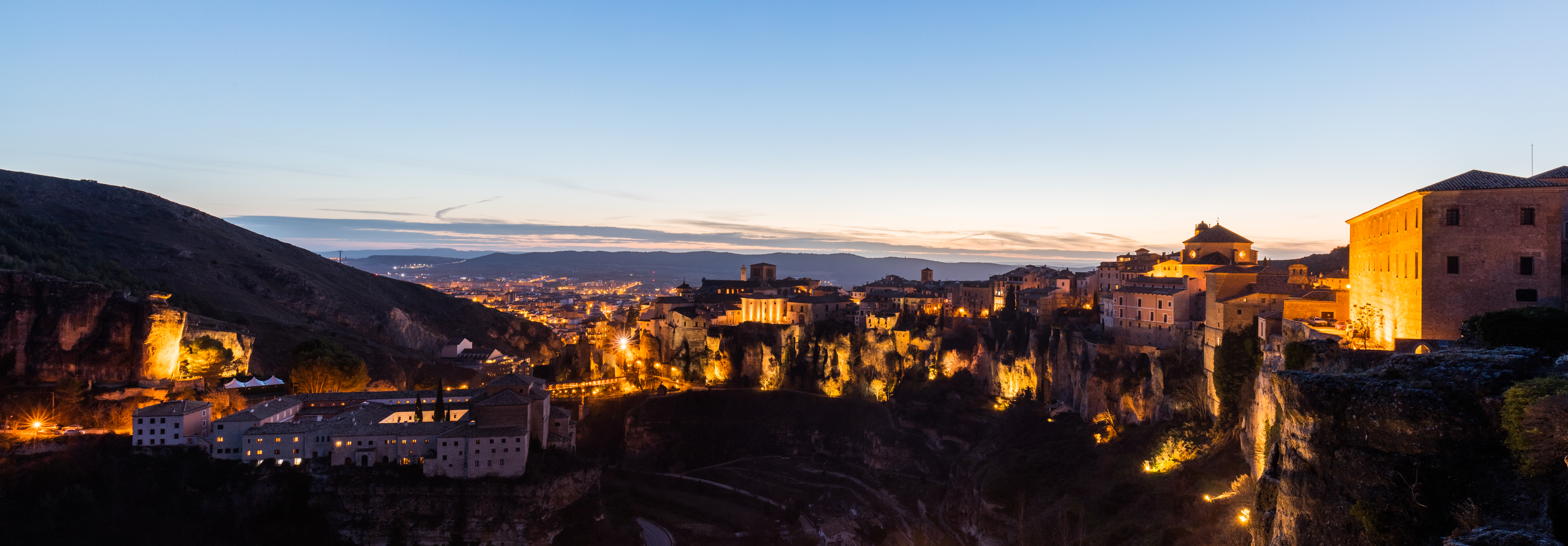
Cuenca
Cuenca stands on a narrow rock spur between two gorges in central Spain. Its walled old town, a UNESCO site since 1996, is a fine medieval fortress town. The city is famous for the Casas Colgadas, houses that hang from a cliff above the Huécar gorge, and for a cathedral that was the first Gothic cathedral built in Spain. Visitors come for the old town, the gorges, and the modern art museum housed inside one of the hanging houses, and most find a single day is enough to walk the whole upper town.
Quick Facts
| Item | Detail |
|---|---|
| Name | Cuenca |
| Type | Historic city, capital of Cuenca province |
| Location | Central Spain, Castilla-La Mancha, about 170 km south-east of Madrid |
| Coordinates | 40.0717° N, 2.1344° W |
| Country | Spain |
| Population | About 53,000 |
| Language | Spanish |
| Currency | Euro (EUR) |
| Highlights | Casas Colgadas, Cuenca Cathedral, San Pablo Bridge, Museum of Spanish Abstract Art |
| UNESCO | Historic Walled Town of Cuenca, inscribed 1996, reference 781 |
| Wikidata code | Q15098 |
Cuenca lies in the autonomous community of Castilla-La Mancha, about 170 km south-east of Madrid by road. The upper town sits on a rocky spur between the gorges of the Júcar and the Huécar, while the newer town spreads across the plain below. High-speed trains from Madrid reach the Cuenca-Fernando Zóbel station in about an hour, and the old town is a short bus or taxi ride from the station.
Geography of Cuenca
Cuenca stands at 40.0717° N, 2.1344° W, in the province of the same name in central Spain. The city occupies a narrow ridge of rock between two deep river gorges, the Júcar to the west and the Huécar to the east, and the old town crowns the top of that ridge. From the upper town, the ground falls away sharply on both sides, so the streets, churches, and houses of the old town look out over wooded ravines and the open countryside of La Mancha beyond. The setting is the reason the city was built here, and it is also the reason the old town has survived so intact.
The Huécar gorge, on the eastern side of the city, is the more dramatic of the two. Its cliffs rise almost vertically beneath the old town, and the Casas Colgadas were built on the very edge of those cliffs, with their wooden balconies projecting out over the drop. A path follows the river below, and walkers can look up at the hanging houses from the gorge floor, which is one of the best views in the city. The gorge is wooded, with pines and poplars along the river, and the air down by the water is cooler than on the exposed ridge above.
The Júcar gorge, on the western side, is broader and more open, with rocky slopes and pine woods that climb away from the river. Footpaths run along both gorges, and the city has marked viewpoints where visitors can look across the ravines toward the old town. The two rivers meet south of the city, and the land beyond them is the dry rolling plateau of La Mancha, broken by low hills and farmland.
The old town itself covers about 23 hectares inside its historic walls, and its streets follow the shape of the ridge, narrow and winding, with small squares opening suddenly between tall stone houses. The cathedral stands near the highest point of the spur, beside the Plaza Mayor, and the streets fall away from it toward the castle quarter at the far end of the ridge. Below the old town, the modern city spreads across flatter ground, with the railway station, shops, and most of the hotels.
Cuenca stands at an altitude of about 1,000 metres above sea level, and its climate is a continental Mediterranean one, with hot summers and cold winters. Summer temperatures often reach 25 to 32 degrees Celsius, while winter days can fall to between 0 and 8 degrees. Spring and autumn are the most comfortable seasons for walking the old town and the gorges, with mild weather and fewer visitors, and May, June, September, and October are usually the best months to visit.
The city is easy to reach from Madrid by high-speed train, which takes about an hour to the Cuenca-Fernando Zóbel station, about 5 km from the old town. Buses and taxis connect the station with the upper town in about 10 minutes, and the walk takes about an hour. By road, the drive from Madrid takes about two hours on the motorway, and buses run the same route. Travellers often combine Cuenca with Toledo or Madrid in a single trip through Castilla-La Mancha.

Vindel, Cuenca, Spain — CC BY-SA 4
History of Cuenca
Cuenca began as a Muslim fortress town on the outer edge of the Caliphate of Córdoba, built on the narrow ridge between the two gorges because the position was almost impossible to attack. The Islamic rulers raised walls, towers, and a fortress on the spur, and the town grew inside those defences, with a mosque, a market, and houses packed along the ridge. The setting that made Cuenca a fortress also made it a prize, and the Christian kings of Castile wanted it for the same reason the Muslims had chosen it.
The Castilians conquered Cuenca in 1177, after a long siege, and the town became a royal town and a bishopric. The conquerors built a cathedral on the site of the former Great Mosque, beginning in the late 12th century, and that cathedral became the first Gothic cathedral in Spain. The upper town filled with churches, convents, and noble houses from the 12th to the 18th centuries, and the walls, gates, and towers of the fortress town were kept and extended. Cuenca grew rich on wool, cloth, and trade, and its merchants built tall houses on the ridge, some of them projecting out over the cliffs.
The Casas Colgadas, the hanging houses, are the most famous product of that building. They were private houses near the Episcopal Palace, built in the later medieval period on the steep bluffs above the Huécar, and most of them were rebuilt in the 16th century in their present narrow, high form, with two or three rooms on each of three or more floors. Their wooden balconies hang over the gorge, and the houses became the symbol of Cuenca, painted and photographed more than any other building in the city. One of the surviving hanging houses now holds the Museum of Spanish Abstract Art, founded in 1966, which brought modern art into the heart of the medieval town.
Cuenca declined after the 17th century, as trade routes shifted and the wool industry faded, and the long period of economic stagnation is one reason the old town survived so completely. Houses were not pulled down and rebuilt, streets were not widened, and the medieval townscape stayed almost as it was. The city was declared a Picturesque Site in 1963, and its historic zone was protected under Spanish heritage law, but the decisive moment came in 1996, when UNESCO inscribed the Historic Walled Town of Cuenca as a World Heritage property, reference 781, under criteria (ii)(v).
The inscription recognised Cuenca as an outstanding example of a medieval fortress town, preserved remarkably intact, and as a townscape that blends into and enhances the natural landscape around it. The property covers 23 hectares, including the walled town and its suburbs, and the inscription brought new attention, new visitors, and new investment in restoration. The old town is now one of the most visited historic towns in Castilla-La Mancha, and its museums, festivals, and Holy Week processions draw visitors from across Spain and beyond.
Timeline
| Year | Event |
|---|---|
| Islamic period | Cuenca founded as a fortress town on the edge of the Caliphate of Córdoba |
| 1177 | The Castilians conquer Cuenca after a long siege |
| Late 12th century | Work begins on Cuenca Cathedral, the first Gothic cathedral in Spain |
| 16th century | The Casas Colgadas rebuilt in their present narrow, high form |
| 1963 | The historic zone declared a Picturesque Site |
| 1966 | Museum of Spanish Abstract Art founded in a hanging house |
| 1996 | Historic Walled Town of Cuenca inscribed by UNESCO, reference 781 |
Travel to Cuenca
Most visitors reach Cuenca by high-speed train from Madrid, which takes about an hour to the Cuenca-Fernando Zóbel station, and then a bus or taxi up to the old town. The old town is best explored on foot, because its streets are narrow, steep, and mostly pedestrian, and the whole upper town can be walked in a few hours. Comfortable shoes matter more than anything else in Cuenca, because the climb from the lower town to the Plaza Mayor is steep, and the gorge paths are uneven.
A single day is enough for the main sights: the cathedral, the Plaza Mayor, the Casas Colgadas, the San Pablo Bridge, and a walk along the Huécar gorge. Visitors who stay overnight can walk the Júcar gorge as well, visit the Museum of Spanish Abstract Art at leisure, and eat in the old town after the day visitors have left. The best light for photographs of the hanging houses comes in the late afternoon, when the sun falls on the eastern cliff.
The city has hotels in the lower town and a small number of places to stay in the old town itself, and most visitors sleep below and walk up to the upper town in the morning. Restaurants in the old town serve the food of Castilla-La Mancha, with lamb, game, cheese, and wines from the region, and the Plaza Mayor has cafes where visitors can sit and look at the cathedral. Spring and autumn are the best seasons, and visitors should book ahead for Holy Week, when the city fills with processions and crowds.
Cuenca works well as a day trip from Madrid, but it also works as a stop on a longer route through Castilla-La Mancha, with Toledo to the west and the wine country of La Mancha to the south. Drivers can continue from Cuenca to the south, toward the plains and the windmills of La Mancha, or east toward Valencia and the Mediterranean coast. The high-speed train makes the return to Madrid simple, and the evening trains leave time for a full day in the old town.

Hanging houses of Cuenca lighted up at night — CC BY-SA 4
Notable Places in Cuenca
The Casas Colgadas
The Casas Colgadas are the symbol of Cuenca, three houses built on the edge of the Huécar gorge with wooden balconies that project out over the drop. They were private houses near the Episcopal Palace, rebuilt in the 16th century in their present narrow, high form, and they look as if they are about to fall into the gorge. One of them holds the Museum of Spanish Abstract Art, and the best view of the houses comes from the San Pablo Bridge, across the gorge, especially in the late afternoon.
Cuenca Cathedral
Cuenca Cathedral stands on the Plaza Mayor, at the highest point of the old town, and it was built from the late 12th century on the site of the former Great Mosque. It was the first Gothic cathedral in Spain, and its interior mixes Gothic structure with later Renaissance and Baroque additions, with stained glass, paintings, and a cloister to visit. The cathedral is the anchor of the old town, and its tower can be seen from the gorges below and from the roads that approach the city.
The San Pablo Bridge
The San Pablo Bridge is an iron footbridge built in 1902, crossing the Huécar gorge from the old town to the former monastery of San Pablo on the far side. It is the best viewpoint in Cuenca, with the hanging houses on one side and the gorge falling away below, and it is the place where most visitors take their photographs. The bridge is narrow and high, and walkers who dislike heights should cross it slowly and keep to the middle.
The Museum of Spanish Abstract Art
The Museum of Spanish Abstract Art was founded in 1966 inside one of the Casas Colgadas, and it holds one of the most important collections of Spanish abstract art in the country. The museum shows paintings and sculptures by the Spanish artists of the 1950s and 1960s, and the contrast between the medieval house and the modern art inside it is part of the visit. The museum is small, and an hour is enough to see it properly.
The Huécar and Júcar gorges
The two gorges that frame Cuenca are worth walking in their own right, with footpaths along the rivers, viewpoints over the cliffs, and pine woods that smell of resin in summer. The Huécar path runs below the hanging houses, and the Júcar path is quieter, with fewer visitors and longer views across the plateau. Both paths are easy to reach from the old town, and both show why the city was built on this ridge in the first place.
Frequently Asked Questions
Where is Cuenca?
Cuenca is in central Spain, in the autonomous community of Castilla-La Mancha, about 170 km south-east of Madrid, on a narrow rock spur between the gorges of the Júcar and the Huécar. The old town sits on top of the spur, at about 1,000 metres above sea level, and the new town spreads across the plain below.
What is Cuenca famous for?
Cuenca is famous for its walled old town, inscribed by UNESCO in 1996 as reference 781, and for the Casas Colgadas, houses built on the edge of a cliff above the Huécar gorge. The city is also known for its cathedral, the first Gothic cathedral in Spain, and for the Museum of Spanish Abstract Art in one of the hanging houses.
What are the Casas Colgadas?
The Casas Colgadas are houses built in the later medieval period on the steep bluffs above the Huécar gorge, near the Episcopal Palace, and rebuilt in the 16th century in their present narrow, high form. Their wooden balconies project out over the drop, and one of them now holds the Museum of Spanish Abstract Art, founded in 1966.
What is special about Cuenca Cathedral?
Cuenca Cathedral was built from the late 12th century on the site of the former Great Mosque, and it was the first Gothic cathedral in Spain. The interior mixes Gothic structure with later Renaissance and Baroque work, with stained glass, paintings, and a cloister, and the cathedral stands on the Plaza Mayor at the highest point of the old town.
Is Cuenca a World Heritage site?
The Historic Walled Town of Cuenca was inscribed by UNESCO in 1996 as reference 781, under criteria (ii)(v), and the property covers about 23 hectares. Spain holds 50 World Heritage properties, and Cuenca is one of the best preserved medieval fortress towns among them.
How long should I spend in Cuenca?
One day is enough for the cathedral, the Plaza Mayor, the Casas Colgadas, the San Pablo Bridge, and a walk along the Huécar gorge. Visitors who stay overnight can also walk the Júcar gorge and visit the Museum of Spanish Abstract Art at leisure, and many combine Cuenca with Toledo and Madrid in a single trip.
Verified
- Cuenca is a city in central Spain, in Castilla-La Mancha, about 170 km south-east of Madrid, at 40.0717° N, 2.1344° W, and its old town stands on a narrow rock spur between the gorges of the Júcar and the Huécar. The coordinates match the registry and were checked against the Wikidata record for Q15098 on 23/11/2026, which gives the municipality of Cuenca in Spain, in Cuenca province.
- The Historic Walled Town of Cuenca was inscribed by UNESCO in 1996 as reference 781, under criteria (ii)(v), and the property covers 23 hectares. The UNESCO page states that the cathedral is the first Gothic cathedral in Spain, that the Casas Colgadas were rebuilt in the 16th century in their present narrow, high form, and that the old town is an outstanding example of a medieval fortress town.
- The nearest World Heritage property to Cuenca is the University and Historic Precinct of Alcalá de Henares, reference 876, about 114 km away in a straight line. Aranjuez, reference 1044, is about 125 km away, and Toledo, reference 379, is about 163 km away, so Alcalá de Henares is the nearest.
- Spain holds 50 World Heritage properties, confirmed on the UNESCO list for Spain and in the matching Vietnamese article, checked 19/11/2026.
- The registry entry for Cuenca records unesco as false, which is wrong, because the city is itself reference 781. This is recorded in fix-queue entry #410.
- All figures above were checked on 23/11/2026 against the UNESCO World Heritage Centre pages for references 781 and 876 and the matching Vietnamese article, checked 19/11/2026.
Sources
- UNESCO World Heritage Centre, https://whc.unesco.org/en/list/781/ — Historic Walled Town of Cuenca.
- UNESCO World Heritage Centre, https://whc.unesco.org/en/list/876/ — University and Historic Precinct of Alcalá de Henares.
- The matching Vietnamese article cuenca.vi.md — facts and sources, checked 19/11/2026.
- Wikidata, Q15098 Cuenca — municipality in Spain, coordinates 40.0717° N, 2.1344° W, checked 23/11/2026.
Unverified
- The population of Cuenca, about 53,000, comes from encyclopaedic sources and has not been checked against the latest Spanish statistics.
- The San Pablo Bridge was built in 1902 according to encyclopaedic sources, and this has not been checked against the city archives.
- The Museum of Spanish Abstract Art was founded in 1966 according to encyclopaedic sources, and this has not been checked against the museum records.
- Opening hours of the cathedral and the museum change by day and season and need checking on the official sites before a visit.
- The altitude of Cuenca, about 1,000 metres above sea level, comes from travel sources and has not been checked against the latest geographical data.
Illustrations
- Hero: Cuenca. Free image: https://upload.wikimedia.org/wikipedia/commons/b/bb/Casas_colgadas%2C_Cuenca%2C_Espa%C3%B1a%2C_2017-01-03%2C_DD_115-117_HDR.jpg — CC BY-SA 4.0.
- In body, Cuenca: Vindel, Cuenca, Spain. Free image: https://upload.wikimedia.org/wikipedia/commons/3/3f/Ayuntamiento%2C_Vindel%2C_Cuenca%2C_Espa%C3%B1a%2C_2017-05-22%2C_DD_21.jpg — CC BY-SA 4.
- In body, Cuenca: Hanging houses of Cuenca lighted up at night. Free image: https://upload.wikimedia.org/wikipedia/commons/c/c0/Casas_colgantes_de_Cuenca_iluminadas_02.jpg — CC BY-SA 4.