
La Palma Hotels: Where to Stay on La Isla Bonita
La Palma hotels cluster in Santa Cruz, Los Cancajos and Puerto Naos. The right base depends on hiking, beaches or stargazing.
La Palma is a volcanic island in the Canary Islands, the greenest island in the archipelago, with the Caldera de Taburiente crater and the summit of Roque de los Muchachos at 2,426 metres. The island is called La Isla Bonita, the beautiful island, with laurel forests, black sand beaches and the clearest night sky in Europe. Most visitors fly into La Palma Airport near Santa Cruz de La Palma, and then travel by car or bus to their base. This guide covers the three main areas for a stay: Santa Cruz de La Palma on the east coast, Los Cancajos near the airport, and Puerto Naos on the sunny west coast, with advice on who each area suits best.
Quick Facts
- Guide type: Hotel and stay guide for La Palma, Canary Islands, Spain
- Island area: About 708 square kilometres, the greenest Canary island
- Capital town: Santa Cruz de La Palma, on the east coast of the island
- Highest point: Roque de los Muchachos, 2,426 metres
- Airport: La Palma Airport, near Santa Cruz de La Palma
- Main stay areas: Santa Cruz, Los Cancajos, Puerto Naos
- Key sights: Caldera de Taburiente, Roque de los Muchachos, Los Tilos, Tazacorte
- Best season: Spring and autumn for hiking, summer for the sea
- Getting around: A hire car is the best way to reach the finest walks and beaches
- UNESCO status: La Palma is a UNESCO Biosphere Reserve since 2002, not a World Heritage property
- Nearest World Heritage property: Garajonay National Park ref 380, about 80 kilometres away
Geography of La Palma Hotels
La Palma is a volcanic island in the Canary Islands, in the west of the archipelago, with an area of about 708 square kilometres, and its capital Santa Cruz de La Palma lies on the east coast of the island. The island is almost round in shape, with the Caldera de Taburiente crater in the north and the Cumbre Vieja volcanic ridge running down the south, and this shape gives La Palma both green forests and black lava fields. A package of La Palma hotels and flights usually lands at La Palma Airport near Santa Cruz, and from there visitors travel by car or bus to their base around the island.
The shape of La Palma comes from the Caldera de Taburiente, a huge volcanic crater about 10 kilometres across with cliffs up to 2,000 metres high, at the centre of the Caldera de Taburiente National Park. The summit of Roque de los Muchachos at 2,426 metres is the highest point on the island, with the largest telescopes in the world, and from the top visitors can see a sea of clouds below. The Cumbre Vieja ridge in the south is where the eruption of 2021 took place, with lava flows running to the sea and forming new black lava fields. The national park protects the crater and its forests, and its marked trails lead down to the streams on the crater floor and along the rim, where walkers look across the whole island.
The climate of La Palma is mild and subtropical, with warm winters and summers cooler than on the other Canary Islands, thanks to the altitude and the forests. Temperatures on the coast usually range from 20 to 28 degrees Celsius all year, while on the high mountains temperatures can fall below 10 degrees Celsius in winter, and clouds often cover the east of the island while the west is sunny. Visitors who book La Palma hotels in spring or autumn find the best weather for hiking, while summer is the time for the sea and evenings outdoors.
The coast of La Palma is mostly black volcanic sand beaches, with the main bathing beaches at Puerto Naos, Tazacorte and Los Cancajos near the airport, and steep cliffs along the north coast. The sea at La Palma is clear and warm all year, with bathing areas sheltered from large waves, and natural pools such as Charco Azul are safe places for families to swim. A full stay on La Palma should combine the sea with the mountains, because the island is most famous for its long-distance walking trails, not only for its beaches.
The Los Tilos forest in the north-east of La Palma is one of the largest remaining laurel forests in the Canary Islands, with walking paths past waterfalls and ancient laurel trees. The summit of Roque de los Muchachos is not only the highest point on the island but also the site of the largest telescopes in the world, thanks to a night sky that is clear and free of light pollution. The black sand beaches of La Palma formed from volcanic lava, with beaches such as Puerto Naos and Tazacorte offering warm water all year and cliffs that shelter them from waves.
The trade winds shape the weather of La Palma, bringing moist air from the north-east that piles clouds against the eastern slopes and leaves the west sunny and dry. The eastern side holds the laurel forests, fed by the mist, while the western side holds the driest land and the sunniest beaches. This split means a visitor can leave cloud in Santa Cruz and find blue sky in Puerto Naos within half an hour by car. The same winds carry Saharan dust in summer, which can haze the sky for a few days, and they keep the island cooler than the eastern Canary Islands.
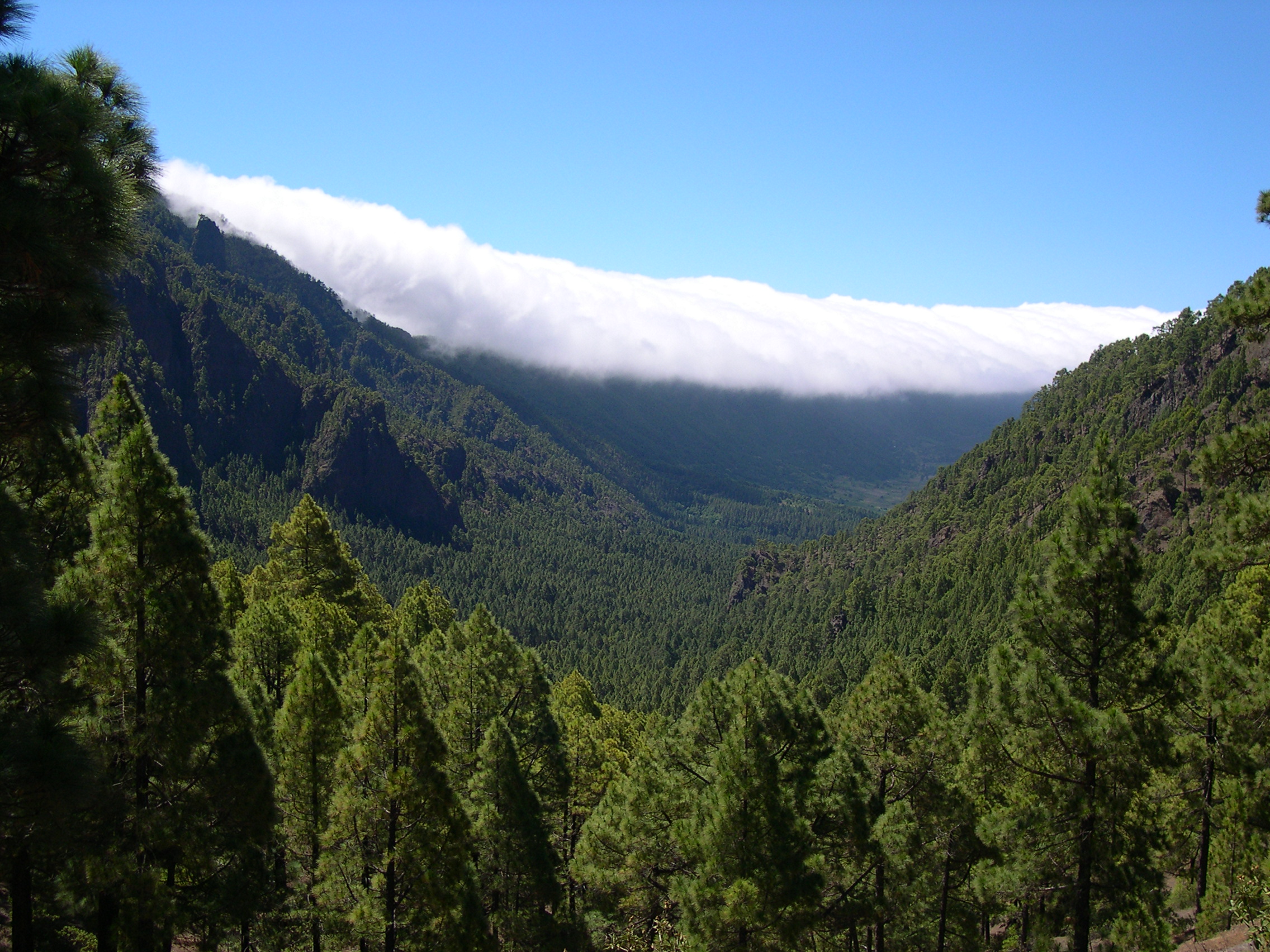
Caldera de Taruriente National Park , La Palma , Canary Islands ( Spain ) — CC BY-SA 3
History of La Palma Hotels
The history of La Palma begins with the Guanches, the native people of the Canary Islands, who lived on the island in caves and settlements with religious rites linked to the volcanoes. The Guanches called the island Benahoare, and their rock carvings and remains are still found in the Caldera de Taburiente and other areas of the island. In 1493, Alonso Fernandez de Lugo conquered La Palma for the Kingdom of Castile, and the island became part of Spain, with the capital Santa Cruz de La Palma founded on the east coast.
The 16th and 17th centuries saw La Palma become an important port on the route to the Americas, with ships stopping to take on water and food before crossing the Atlantic. Santa Cruz de La Palma grew into a rich port city, with houses with wooden balconies, churches and trading palaces, and the old streets of the city still show traces of this period. Pirate attacks, including the attack by Francois Le Clerc in 1553, forced the city to build forts and watchtowers along the coast.
The 19th and 20th centuries saw La Palma live by farming, with banana, sugar cane and tobacco plantations, and the laurel forests of the island were protected in the Los Tilos forest. In 2002, UNESCO named the whole island of La Palma a Biosphere Reserve, recognising its biodiversity and its conservation efforts, and in 2012 the night sky of La Palma was named the first Starlight Reserve in the world. The astronomical observatories on the summit of Roque de los Muchachos, with the largest telescopes in the world, put La Palma on the international astronomy map.
The greatest turn for La Palma in the 21st century was the eruption of the Cumbre Vieja volcano in 2021, which lasted 85 days from September to December and destroyed many houses and banana plantations in the west of the island. The eruption formed a new lava peninsula on the coast and changed the landscape of the island, but the main tourist areas such as Santa Cruz, Caldera de Taburiente and Roque de los Muchachos were not affected. Today, La Palma is recovering with sustainable tourism, and a modern package of La Palma hotels and flights usually combines a flight to La Palma Airport with days in a quiet area of the island.
The port of Santa Cruz de La Palma was once one of the most important ports in Spain on the route to the Americas, with ships stopping to take on water and food before crossing the Atlantic. In 1553, the French pirate Francois Le Clerc attacked and burned Santa Cruz, which forced the city to build forts and watchtowers along the coast to protect the port. The Bajada de la Virgen de las Nieves festival, held once every five years, is one of the largest religious festivals in the Canary Islands, with processions, concerts and events lasting many weeks.
The 20th century brought two eruptions before the great one of 2021, and each reshaped the south of the island. The San Juan eruption of 1949 lasted 47 days and opened new vents on the Cumbre Vieja ridge, while the Teneguia eruption of 1971 lasted 24 days and built a new cone near Fuencaliente. Both eruptions were smaller than the one in 2021, yet they reminded the islanders that La Palma is a living volcano, and the lava fields they left are now walking routes.
The banana trade grew in the same century, and the port of Santa Cruz sent fruit to Europe, until tourism overtook farming as the main income of the island. The lava of 1971 reached the sea near Fuencaliente and formed a new point of land, and the vineyards of the south still grow on the black soil left by that eruption.

Salinas de Fuencaliente salt extraction pans with the old and new Fuencaliente lighthouses in background, La Palma, Canary Islands — CC BY-SA 4
Travel to La Palma Hotels
Travel on La Palma centres on long-distance walking, astronomy and the sea, with experiences that suit families and active visitors alike. The Caldera de Taburiente National Park is the most famous destination on the island, with walking routes down to the floor of the crater and along streams, and visitors should allow a full day for the national park. The summit of Roque de los Muchachos is the best place in Europe for stargazing, with astronomical observatories and the clearest night sky, and visitors can join stargazing tours in the evening.
The area of Santa Cruz de La Palma is the most convenient base for visitors who want to combine the sea with food and shopping, with an old town, a harbour and restaurants along the coast. Los Llanos de Aridane, the largest town on the island in the west, lies near the beaches of Puerto Naos and Tazacorte, while El Paso in the centre of the island is the gateway to the Caldera de Taburiente. Families who book La Palma hotels often choose Los Cancajos near the airport or Puerto Naos for safe beaches and many facilities, while walkers often choose Santa Cruz or El Paso.
The beaches of La Palma are mostly black volcanic sand, with Puerto Naos the largest beach on the island, Tazacorte a quiet harbour and Los Cancajos near the airport the most convenient beach. From these beaches, visitors can take boat trips to see whales and dolphins, and the waters around La Palma are among the best in Europe for whale watching. A week of La Palma hotels can combine three days of walking, two days at the sea and one day of stargazing on the summit of Roque de los Muchachos.
Puerto Naos deserves a note of its own, because it was evacuated after the eruption of 2021 and stayed closed for years while volcanic gases were monitored. The resort has largely reopened since 2025, with a carbon dioxide traffic-light system that watches air quality and shows which areas are safe to enter, and the main beach is open again. Visitors should check the signs on site and the latest local advice before visiting, and they should not enter areas where the light is red. The large seafront hotel reopened in July 2024, and bars, restaurants and apartments have followed in stages through 2025 and 2026.
Eating on La Palma means fish from the morning market in Santa Cruz, goat cheese from the farms of the north and Malvasia wine from the vineyards of Fuencaliente in the south. The island dish of wrinkled potatoes with spicy mojo sauce appears on most menus, and the small restaurants of Los Llanos serve it with fresh catch from Tazacorte. Market mornings in Santa Cruz are the best time to taste the island, with stalls of cheese, honey and wine.
Air travel to La Palma runs through the airport just south of Santa Cruz, with direct flights from Germany in the season and connections through Madrid and Tenerife all year. The flight from Madrid takes about two and a half hours, and the approach comes in low over the sea before landing beside the coast. Buses link the terminal with Santa Cruz in about ten minutes, and hire cars can be collected on arrival for the drive to the west or the north.
Notable Places in La Palma Hotels
Santa Cruz de La Palma — La Palma
Santa Cruz de La Palma is the capital of the island, with an old town of houses with wooden balconies, churches and trading palaces from the days when the port was rich. The city has a harbour, a market and restaurants along the coast, and it is a good place to spend an afternoon after a long walk. Staying in Santa Cruz suits visitors who want a town to walk in, with shops and tavernas close by, and who plan walks in the Caldera de Taburiente and the Los Tilos forest. The festivals of Santa Cruz, including the Bajada de la Virgen de las Nieves held once every five years, are among the most famous in the Canary Islands.
Los Cancajos — La Palma
Los Cancajos is the beach resort near La Palma Airport, and it suits families and visitors who want the most convenient base on the island. The area has black sand beaches, apartments and hotels within a short walk of the sea, and the airport is only a few minutes away by taxi or bus. Staying in Los Cancajos means easy days at the beach, with restaurants and shops close by, and day trips by car to Santa Cruz, the Caldera de Taburiente and the north of the island. The beach at Los Cancajos is sheltered and safe for children, and the promenade is good for evening walks.
Puerto Naos — La Palma
Puerto Naos is the main beach resort on the west coast of La Palma, with a wide black sand beach, west-coast sunshine and a relaxed holiday atmosphere. The resort was evacuated after the eruption of 2021 and stayed closed for years because of volcanic gases, and it has largely reopened since 2025, with a carbon dioxide traffic-light system that monitors air quality. Staying in Puerto Naos suits visitors who want sunshine and a beach holiday, with bars and restaurants reopening in stages, and who will check the signs on site before visiting. The new lava field north of the village is now an excursion destination, reached on guided walks with a licensed local operator.
Frequently Asked Questions
Which airport should I fly to for La Palma hotels?
Book early for the summer season, since direct flights from Germany sell out and the remaining seats route through Madrid. The island airport is small, so arrival is quick, and the baggage hall clears fast. A hire car booked ahead is the best move, because the counters at the terminal can run out in the high season.
Which area of La Palma should I stay in?
The choice comes down to what the days will hold. Santa Cruz suits walkers and town lovers, with the old streets and the trailheads close by, while Los Cancajos suits families who want the beach and the airport within minutes. Puerto Naos suits sun seekers who want the warmest coast and the longest evenings, with the gas monitoring signs worth a glance before swimming.
Did the volcanic eruption of 2021 affect tourism on La Palma?
The eruption of Cumbre Vieja in 2021 lasted 85 days and destroyed many houses and banana plantations in the west of the island, but the main tourist areas such as Santa Cruz, Caldera de Taburiente and Roque de los Muchachos were not affected. Today the island has recovered, and visitors can see the new lava fields and the affected areas, with tours of the eruption zone a unique experience on La Palma. Puerto Naos, the main beach resort in the west, has largely reopened since 2025, with gas monitoring in place.
How hard is the walking on La Palma?
La Palma has walking routes for every level, from short routes around Los Tilos to long routes down to the floor of the Caldera de Taburiente. The most famous route runs from Los Brecitos down to Barranco de las Angustias, taking about five to six hours, and it needs strong walking shoes and enough water. Visitors should check the weather before walking, because mountain paths can be slippery after rain and temperatures change fast with altitude.
Is La Palma suitable for families?
La Palma works well for families who like the outdoors, with the natural pools of Charco Azul, the short forest walks of Los Tilos and the black sand beaches of Los Cancajos. Children enjoy the boat trips to see whales and the stargazing evenings on the summit, while the beaches have lifeguards in the season. The island has no big amusement parks, so families who want rides should look elsewhere.
What is special about stargazing on La Palma?
La Palma has the clearest night sky in Europe, with little light pollution and the largest telescopes in the world on the summit of Roque de los Muchachos. In 2012, the night sky of La Palma was named the first Starlight Reserve in the world, and evening stargazing tours are an experience not to miss. Visitors should book stargazing tours ahead, because they often sell out in the high season and the weather on the summit changes fast.
Verified
- La Palma has an area of about 708 square kilometres, its capital is Santa Cruz de La Palma, and its highest point is Roque de los Muchachos at 2,426 metres. The Caldera de Taburiente is about 10 kilometres across. These figures were checked against the island records.
- La Palma was named a UNESCO Biosphere Reserve in 2002, covering the whole island, and its night sky was named the first Starlight Reserve in the world in 2012. A Biosphere Reserve is not a World Heritage property, so La Palma holds no World Heritage property.
- The eruption of Cumbre Vieja in 2021 lasted 85 days, from September to December, and the Caldera de Taburiente National Park was founded in 1954. Puerto Naos was evacuated after the eruption and stayed closed for years because of volcanic gases, and it has largely reopened since 2025, with a carbon dioxide traffic-light system monitoring air quality. The main beach reopened, the small cove of Playa Chica reopened on 28 July 2026, and the large seafront hotel reopened on 15 July 2024.
- Spain has 50 properties on the World Heritage List. The nearest to La Palma is Garajonay National Park on La Gomera ref 380, inscribed in 1986 under criteria (vii)(ix), about 80 kilometres away in straight-line distance from Santa Cruz de La Palma. The second nearest is Teide National Park on Tenerife ref 1258, inscribed in 2007 under criteria (vii)(viii), about 119 kilometres away.
- La Palma was conquered in 1493 by Alonso Fernandez de Lugo for the Kingdom of Castile, and the French pirate Francois Le Clerc attacked and burned Santa Cruz in 1553. The Bajada de la Virgen de las Nieves festival is held once every five years.
Sources
- Wikipedia — La Palma (https://en.wikipedia.org/wiki/La_Palma)
- Wikipedia — 2021 Cumbre Vieja volcanic eruption (https://en.wikipedia.org/wiki/2021_Cumbre_Vieja_volcanic_eruption)
- UNESCO — Garajonay National Park (https://whc.unesco.org/en/list/380/)
- UNESCO — Spain, properties inscribed on the World Heritage List (https://whc.unesco.org/en/statesparties/es)
- UNESCO — La Palma Biosphere Reserve (https://en.unesco.org/biosphere/eu-na/la-palma)
- Wikidata Q11955 — La Palma (https://www.wikidata.org/wiki/Q11955)
Unverified
- Prices for flight and hotel packages to La Palma change with the season and the airline, and they should be checked on the official websites of the airline and the stay before booking.
- Ferry timetables from Santa Cruz de La Palma to Tenerife and other Canary Islands change with the season, and they should be checked on the official ferry websites before travelling.
- The annual number of visitors to La Palma after the eruption of 2021 and the prices of stargazing tours should be confirmed from official sources.
- The reopening status of individual premises in Puerto Naos changes as gas checks are passed, so visitors should check the latest local advice before visiting.
Illustrations
- Hero: La Palma Hotels. Free image: https://upload.wikimedia.org/wikipedia/commons/2/27/La_Palma_Los_Cancajos_R07.jpg — CC BY 3.0.
- In body, la palma: Salinas de Fuencaliente salt extraction pans with the old and new Fuencaliente lighthouses in background, La Palma, Canary Islands. Free image: https://upload.wikimedia.org/wikipedia/commons/0/09/At_La_Palma_2023_097_-_Salinas_de_Fuencaliente.jpg — CC BY-SA 4.
- In body, la palma: Caldera de Taruriente National Park , La Palma , Canary Islands ( Spain ). Free image: https://upload.wikimedia.org/wikipedia/commons/4/43/Caldera_de_Taburiente_La_Palma.jpg — CC BY-SA 3.