
Best Places to Go in the Cotswolds: Honey-Coloured Villages and Limestone Hills
The best places to go in the Cotswolds are honey-coloured villages set among limestone hills. This guide tours them village by village.
The Cotswolds is a range of limestone hills in south-central England, famous for villages built of honey-coloured stone, green pastures and medieval wool churches. The area has been an Area of Outstanding Natural Beauty since 1966, covering 2,038 square kilometres, and it is one of the largest protected landscapes in England. The region stretches across six counties, Gloucestershire, Oxfordshire, Wiltshire, Somerset, Worcestershire and Warwickshire, and no large city stands entirely inside its boundary.
The name is thought to come from the Old English words for a sheep enclosure and for gently rolling hills, and the name records the sheep farming that made the region rich for centuries. The best places to go in the Cotswolds are the villages themselves, and the villages of Bibury, Bourton-on-the-Water, Stow-on-the-Wold and Chipping Campden are counted among the most beautiful in England. The best places to go in the Cotswolds are spread across six counties, so this guide groups them by village and by valley.
Today the Cotswolds is one of the most loved rural destinations in England, drawing visitors from London, Oxford and Bath for a day or for several nights. The region holds no World Heritage property inside its own boundary, yet the city of Bath, a World Heritage property, stands at its southern edge and is often visited on the same journey. Travellers come to walk the long trails, drive between small villages, visit gardens and eat in pubs that have served travellers for hundreds of years. The best places to go in the Cotswolds repay a slow pace, because the beauty of the region is in the detail of a stone wall, a low bridge over a stream and a church tower rising above a village green.
Quick Facts
| Item | Detail |
|---|---|
| Name | Cotswolds, a limestone hill region in south-central England |
| Location | South-central England, across six counties |
| Coordinates | 51.8° N, 2.0333° W |
| Area | 2,038 square kilometres (Area of Outstanding Natural Beauty) |
| Highest point | Cleeve Hill, 330 metres, near Cheltenham |
| Counties | Gloucestershire, Oxfordshire, Wiltshire, Somerset, Worcestershire, Warwickshire |
| Standing | Area of Outstanding Natural Beauty since 1966 |
| Main towns | Cirencester, Cheltenham, Stroud, Tetbury, Stow-on-the-Wold |
| Long trail | Cotswold Way, 164 kilometres, Chipping Campden to Bath, a National Trail since 2007 |
| UNESCO | No property inside the Cotswolds; nearest are Blenheim Palace, reference 425, and Bath, reference 428 |
| Wikidata | Q301833 |
Geography of the Cotswolds
The Cotswolds is a band of Jurassic limestone hills running about 100 kilometres from near Bath in the south to near Stratford-upon-Avon in the north, and about 40 kilometres from east to west. The western side is a steep scarp called the Cotswold Edge, looking down over the valley of the River Severn and the Gloucestershire plain, while the eastern side falls gently toward the valley of the Thames. The golden limestone of the region, known as Cotswold stone, was quarried locally and used to build houses, walls and churches for centuries, and the colour of the stone is what gives the villages their shared look. The best places to go in the Cotswolds show that stone at its finest, in the long rows of cottages, the market halls and the tall towers of the wool churches.
The River Thames, the longest river in England, rises in this region, with its official source at Seven Springs near Cirencester, where seven small streams join to form the river. Other small rivers, the Windrush, the Coln, the Leach and the Evenlode, run through the valleys and create the riverside meadows and old stone bridges that shape the look of villages such as Bourton-on-the-Water. These rivers once powered flour mills and wool mills, and today they give the villages their gentle setting.
The rivers give the best places to go in the Cotswolds their setting, and the villages that grew beside them kept their mills, their bridges and their water meadows. The Windrush at Bourton-on-the-Water and the Coln at Bibury are the two most photographed rivers in the region, and both are crossed by low stone bridges that are older than the houses beside them. The best places to go in the Cotswolds for a riverside walk are the paths that follow the Coln from Bibury to Coln Saint Aldwyns and the Windrush from Bourton to Lower Slaughter.
The highest ground is Cleeve Hill, at 330 metres near Cheltenham, and the town of Stow-on-the-Wold, at 244 metres, is the highest town in the region.
The climate is mild and damp, with cool summers when daytime temperatures usually sit near 20 to 23 degrees, and winters that are cold without long periods below freezing. Rain falls fairly evenly through the year, and morning mist is a familiar sight in autumn and winter. Spring brings fields of yellow oilseed rape and cherry blossom in the gardens, while autumn turns the oaks and chestnuts along the village roads to gold.
The best places to go in the Cotswolds in spring are the gardens, when the cherry blossom and the oilseed rape are out together. The best places to go in the Cotswolds change with the seasons, and a village that is crowded on a summer Saturday can feel almost empty on a misty winter morning.
The landscape is a working one, with sheep pastures, dry stone walls, beech woods and arable fields between the villages, and the protection given by the Area of Outstanding Natural Beauty has kept the development of the region in check. The Cotswold Way, the long-distance trail that runs 164 kilometres from Chipping Campden to Bath, follows the western scarp for much of its length, and the views from the edge across the Severn valley are the widest in the region. The trail became a National Trail in 2007 and now draws thousands of walkers each year. The best places to go in the Cotswolds are often found by leaving the main roads, because the small lanes and the footpaths cross the prettiest valleys, and the villages that sit off the main routes keep the quiet that the famous ones have lost.
The region has no single centre, and that is part of its character. Cirencester is the largest town, Cheltenham is the spa town on the western edge, Stroud sits in the steep valleys of the south-west, and Tetbury, Stow-on-the-Wold and Moreton-in-Marsh serve as market towns for the surrounding villages. London lies about two hours to the east by road, Oxford sits on the eastern edge of the region, and Bath stands at the southern end of the Cotswold Way.
The best places to go in the Cotswolds are scattered across all six counties, so a visitor needs a plan, a car or a walking route, and enough time to move slowly between them. The best places to go in the Cotswolds are reached by lanes that climb gently from the valleys, and the stone walls beside them are older than the villages they enclose.
The western scarp gives the best places to go in the Cotswolds their widest views, and the villages below the edge, such as Winchcombe, Broadway and Snowshill, sit where the hills meet the plain. The stone of the scarp villages is the same golden limestone, but the gardens and the views change with the height. The best places to go in the Cotswolds for walkers are the stretches of the Cotswold Way above the scarp, where the path runs along the edge and the Severn valley opens below. A walker who follows the trail from Broadway to Winchcombe crosses the prettiest ground in the region in a single morning.

A view of cotswolds — CC BY-SA 4
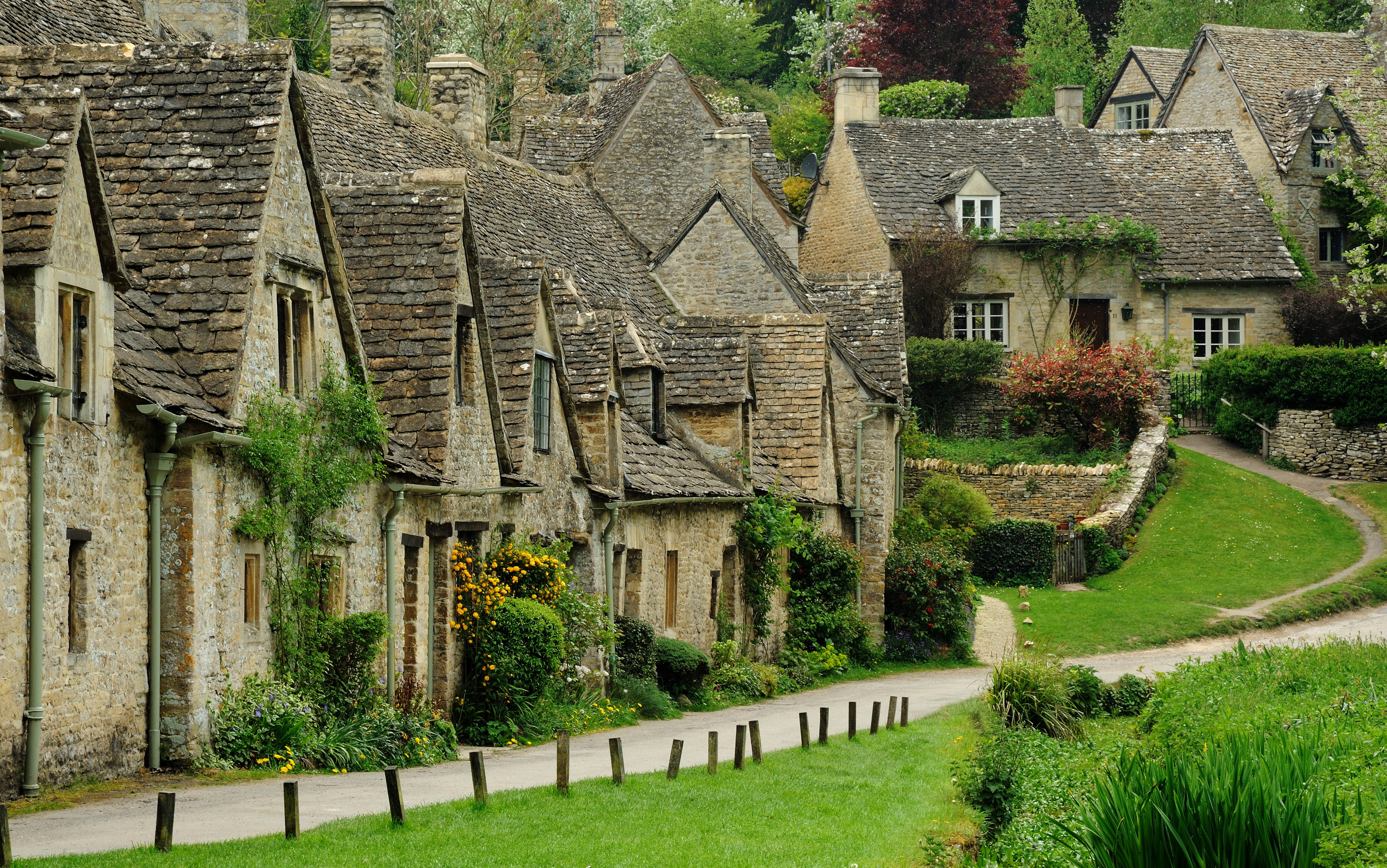
Arlington Row, Bibury, by Saffron Blaze — CC BY-SA 3

The River Windrush at Bourton-on-the-Water, by Kmtextor — CC BY-SA 4

The view from Cleeve Hill, by Stephen Richards — CC BY-SA 2
History of the Cotswolds
From Roman Corinium to the wool age
People have lived in the Cotswolds since the Neolithic period, but the first great centre was Corinium Dobunnorum, the Roman city built on the site of modern Cirencester. In the second century AD Corinium was the second largest Roman city in Britain, after London, with mosaic-floored villas, a market and an amphitheatre. After the Romans left Britain in the early fifth century, the region fell into disorder and was gradually settled by the Saxons, and many village names ending in ton, ham and bury date from that period.
By the Middle Ages sheep farming had become the foundation of the economy of the region, thanks to the Cotswold Lion breed, whose long fine wool was prized across Europe. The wool of the Cotswolds was exported to Flanders and Italy, and the trade brought great wealth to the wool merchants and paid for the large churches that still dominate the villages.
The wealth of the wool trade is clearest in the great churches built in small towns such as Northleach, Fairford, Chipping Campden and Cirencester in the fifteenth century. The church of Saint Peter at Northleach and the church of Saint James at Chipping Campden are fine examples, with tall towers, stained glass and carved stone paid for by rich wool merchants. The church of Saint Mary at Fairford is famous for its complete set of medieval stained glass, one of the finest collections of its kind in England.
These churches are called wool churches because the money that built them came from sheep, and they remain the grandest buildings in villages that never grew into towns. The best places to go in the Cotswolds for church lovers are Northleach, Fairford and Chipping Campden, where the wool money built the tallest towers. The best places to go in the Cotswolds include these churches, because they hold the history of the region in stone and glass more plainly than any museum.

The Roman amphitheatre at Cirencester, by Chris McKenna — CC BY-SA 4
Decline, the Arts and Crafts movement, and protection
From the eighteenth century the wool trade of the Cotswolds declined, as new textile centres grew in the north of England, where water power was plentiful and labour was cheaper, and many wool towns fell into poverty. That decline preserved the old buildings by accident, because the people of the region had no money to pull down old houses and build new ones in the fashionable style. By the end of the nineteenth century the Arts and Crafts movement led by William Morris had come to the Cotswolds as a symbol of traditional craftsmanship, and Morris lived at Kelmscott Manor near Lechlade until the end of his life. The movement valued hand work, local materials and honest building, and the stone cottages of the Cotswolds became its ideal.
In 1966 the Cotswolds was designated an Area of Outstanding Natural Beauty, giving legal protection to the landscape and the buildings of the region against the pressure of development. The designation covers the whole of the limestone hills and the villages within them, and it is the reason the region still looks as it does. In 2007 the Cotswold Way became a National Trail, drawing walkers from across the country and supporting a growing trade in walking holidays.
The best places to go in the Cotswolds are protected by those two decisions, and the region has kept its character while becoming one of the most visited rural areas in England. The villages still farm sheep, the dry stone walls are still repaired by hand, and the pubs still serve the walkers who cross the hills.

Kelmscott Manor, home of William Morris, by Stefan Czapski — CC BY-SA 2
The villages and their stories
Each village of the Cotswolds carries its own story, and the stories explain why the region feels like a collection of separate places rather than a single destination. Bibury, with its seventeenth-century Arlington Row, was called the most beautiful village in England by William Morris, and the cottages that once housed weavers now stand beside the River Coln. Bourton-on-the-Water grew around the low stone bridges that cross the River Windrush, and its nickname of the Venice of the Cotswolds comes from the water that runs through the middle of the village.
Stow-on-the-Wold, the highest town in the region, held the great wool fairs of the Middle Ages, and its market square still keeps the stocks where traders were punished. Chipping Campden was a wool town whose market hall of 1627 and church of Saint James record the wealth of its merchants. The best places to go in the Cotswolds are these villages, and each one repays a visit on its own terms, with a church to enter, a stream to follow and a pub to sit in at the end of the day.
The towns of the region have their own histories as well. Cirencester, the old Corinium, is the largest town and keeps a church, a park and a museum of Roman finds. Moreton-in-Marsh grew along the Fosse Way, the old Roman road, and its wide high street is lined with golden stone houses.
Tetbury is an old wool town with steep streets and a market, close to the Highgrove estate. Castle Combe, a small village often called one of the prettiest in England, appears in films because its streets have changed so little. Winchcombe stands near Sudeley Castle, where Catherine Parr, the last wife of Henry VIII, once lived.
Broadway has a wide main street and a tower on the hill above it that looks out over the whole region. Burford, the gateway town of the east, has a steep high street running down to the River Windrush and a large church. The history of the Cotswolds is written in these places, and a visitor who moves from village to village reads it in order.
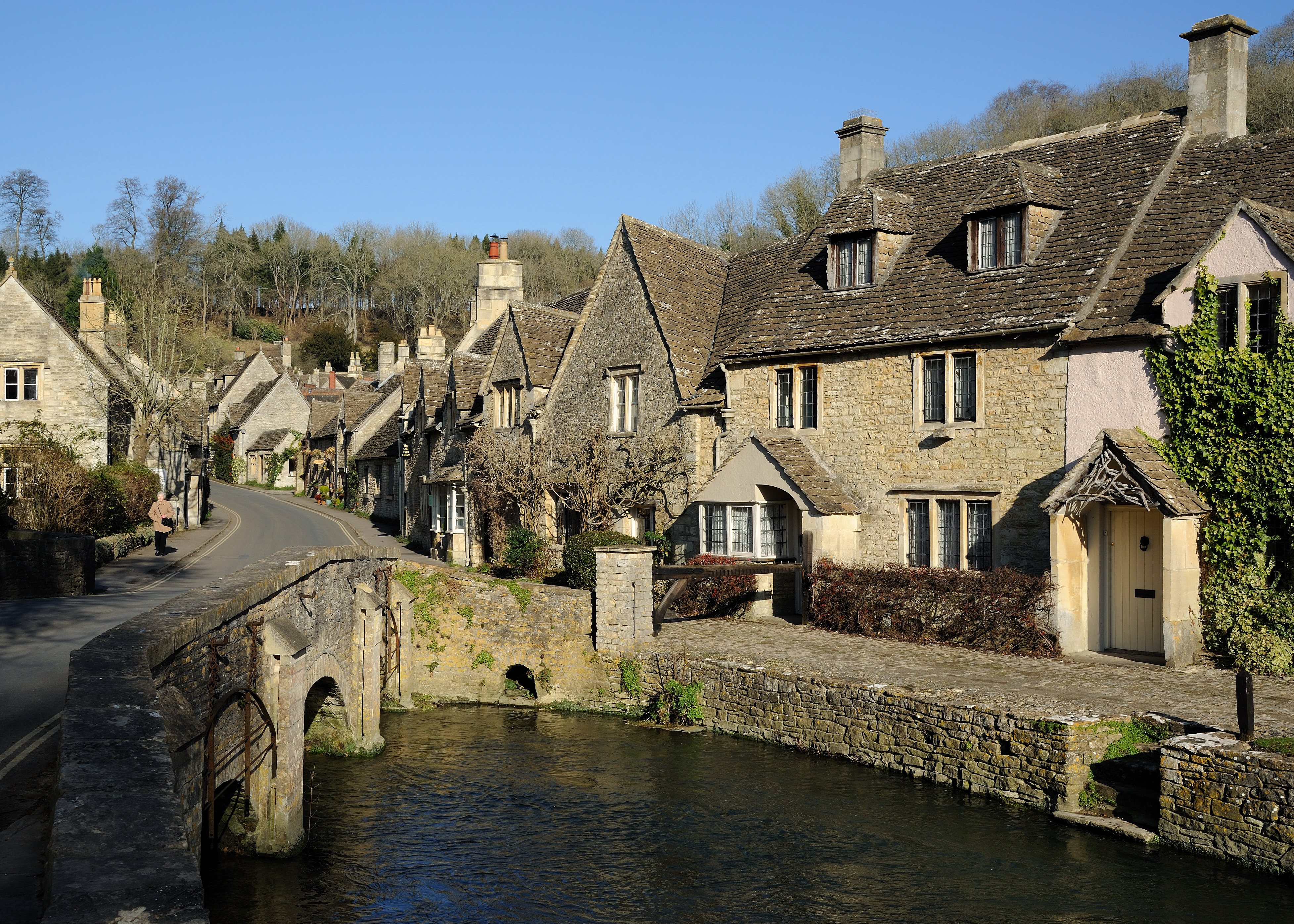
Castle Combe is a small Cotswold village in Wiltshire, England — CC BY-SA 3

Broadway Tower, Cotswolds, by Craig Archer — CC BY-SA 4
Travel to the Cotswolds
The Cotswolds is one of the most searched rural destinations in England, and visitors look for it with phrases such as Cotswolds tour from London, Cotswold tours, Cotswolds trip, tour of the Cotswolds and Cotswolds travel guide. Many plan a day trip from London or Oxford, searching for Cotswolds tour from Oxford and Cotswold itinerary, while those who want to combine the region with Bath search for Bath to Cotswolds tour and Bath and Cotswolds tour from London. Visitors also search for the best places to go in the Cotswolds to choose the prettiest villages, and for Cotswolds to London train to plan the journey by rail. The best way to see the region is by car, because the small villages are scattered and the public buses do not reach them all, but travellers without a car can take a train to Moreton-in-Marsh, Kingham or Kemble and join an organised tour from there.
Many tours leave London in the morning, take visitors through three or four villages in a day and return to London in the evening. Travellers with more time should stay two or three nights in a central town such as Stow-on-the-Wold or Cirencester, then drive out to the villages in turn. Walkers can spend a week on the Cotswold Way, covering about 15 to 20 kilometres a day between Chipping Campden and Bath. The best places to go in the Cotswolds are best reached early in the day, because the famous villages are crowded by midday in summer, and an early start gives a visitor the streets almost to themselves.
When to go and how long to stay
Spring, from April to June, and autumn, from September to October, are the finest seasons, with mild weather, bright landscapes and moderate numbers of visitors. Spring brings yellow fields of oilseed rape, cherry blossom in the gardens and lambs on the pastures, while autumn colours the trees and brings a cool air that suits walking. Summer, from July to August, is the high season, with warm weather and village festivals, but the famous villages such as Bibury and Bourton-on-the-Water can be very crowded.
The best places to go in the Cotswolds in autumn are the woods above the villages, when the oaks and chestnuts turn gold. Winter is quiet, with morning mist and Christmas markets, and the pubs are at their best with fires lit. One day is enough for three or four famous villages on a tour from London, but the visit is hurried, while two or three days allow a stay in a small town, a stretch of the Cotswold Way and time in the gardens and the pubs.
A full week covers the whole of the Cotswold Way on foot.

A field of oilseed rape, by Jonathan Thacker — CC BY-SA 2
Getting there and getting around
Most international visitors reach the Cotswolds through London, about two hours to the west by the M40 or M4 motorways. Trains from London Paddington reach Moreton-in-Marsh in about one hour and a half, Kingham in about one hour and twenty minutes, and Kemble, near Cirencester, in about one hour and twenty minutes, and from those stations visitors can hire a car or join a local tour. The Cotswold Airport at Kemble is a small airfield for private aircraft and aircraft storage, with no scheduled passenger flights, so visitors should fly to London or Bristol.
Inside the region, driving is the most convenient way to travel, along narrow and winding village roads that demand care but give the finest views. Public buses link the larger towns such as Cheltenham, Cirencester and Stroud, but they do not reach many small villages, so travellers without a car should join an organised tour. Walking is also a fine way to explore, with the Cotswold Way and many shorter local paths crossing the villages and valleys.
Food in the Cotswolds is the food of the English countryside, with old pubs serving beef and ale pie, fish and chips, roast lamb and Yorkshire pudding. Many pubs in the region are hundreds of years old, with stone fireplaces, oak beams and beer gardens, and they are the natural resting place after a day of walking. Village tea rooms serve afternoon tea with scones, jam and clotted cream, an experience that belongs to any visit to the English countryside. The best places to go in the Cotswolds include those pubs and tea rooms, because the region is tasted as much as it is seen.

The Cotswold Way above Wotton-under-Edge, by Derek Harper — CC BY-SA 2
Notable Places in the Cotswolds
The places below are the best places to go in the Cotswolds on a first visit, and each one can be reached by car or by footpath from a market town. The list runs from the famous villages to the long trail itself, and it mixes stone cottages, wool churches and viewpoints. The best places to go in the Cotswolds are best taken slowly, one village at a time, with a pub at the end of the day.
- Bibury — the village with the seventeenth-century Arlington Row, called the most beautiful village in England by William Morris, beside the River Coln.
- Bourton-on-the-Water — the village on the River Windrush with low stone bridges, known as the Venice of the Cotswolds.
- Stow-on-the-Wold — the highest town in the region at 244 metres, famous for its wool fairs and its old market square.
- Chipping Campden — a wool town with the market hall of 1627 and the church of Saint James.
- Moreton-in-Marsh — a market town with rows of golden stone houses along the old Fosse Way.
- Cirencester — the largest town in the region, once the Roman city of Corinium Dobunnorum, with the church of Saint John Baptist and the Abbey park.
- Tetbury — an old wool town with steep streets and a market, near the Highgrove estate.
- Castle Combe — a small village often called one of the prettiest in England, much used as a film setting.
- Winchcombe — a town near Sudeley Castle, where Catherine Parr, the last wife of Henry VIII, once lived.
- Broadway — a village with a wide main street and Broadway Tower on the hill, a famous viewpoint of the region.
- Burford — the gateway town of the east, with a steep high street running down to the River Windrush and a large church.
- Cotswold Way — the National Trail of 164 kilometres from Chipping Campden to Bath, crossing the finest scenery of the region.

Market Square, Stow-on-the-Wold, by Bill Boaden — CC BY-SA 2
Frequently Asked Questions about the Cotswolds
Does the Cotswolds hold a UNESCO World Heritage property?
No World Heritage property lies inside the boundary of the Cotswolds, and this article states that plainly to avoid confusion. The nearest property by straight-line distance is Blenheim Palace, reference 425, inscribed in 1987 under criteria (ii) and (iv), and the city of Bath, reference 428, inscribed in 1987 under criteria (i), (ii) and (iv), stands at the southern edge of the region.
Which village is the prettiest in the Cotswolds?
Bibury is usually named the prettiest village, thanks to the seventeenth-century Arlington Row and the River Coln running through the village, and William Morris once called it the most beautiful village in England. Bourton-on-the-Water is also much loved for its stone bridges over the River Windrush, while Castle Combe and Chipping Campden feel quieter because fewer visitors reach them.
Can the Cotswolds be visited in a day from London?
A day trip from London is possible and is the most common way to see the region, with many tours leaving in the morning and returning in the evening. Tours usually cover three or four villages such as Bibury, Bourton-on-the-Water and Stow-on-the-Wold in about ten hours, and independent travellers can take a train from London Paddington to Moreton-in-Marsh in about one hour and a half.
How long should a stay in the Cotswolds last?
One day is enough for the most famous villages, but two or three days give a far better visit, with a stay in a small town and time to explore the region in turn. Walkers can spend a week on the Cotswold Way, covering 164 kilometres from Chipping Campden to Bath, and any stay should leave at least one afternoon for a village tea room. The best places to go in the Cotswolds fill two or three days without repeating a village.
How do travellers get around the Cotswolds without a car?
Travellers without a car should take a train from London to Moreton-in-Marsh, Kingham or Kemble, then join an organised tour or hire a car with a local driver. Public buses link the larger towns such as Cheltenham, Cirencester and Stroud, but they do not reach many small villages, and many companies run day tours from London, Oxford and Bath.
When is the best time to visit the Cotswolds?
Spring, from April to June, and autumn, from September to October, are the finest seasons, with mild weather, bright scenery and moderate numbers of visitors. Summer is warm but crowded, above all at Bibury and Bourton-on-the-Water at weekends, while winter is quiet, with morning mist and Christmas markets, and the famous villages are best visited early in the morning or late in the afternoon.
Verified
The figures in this article were checked one by one against the Cotswolds National Landscape site, the National Trails site and the UNESCO list entries on 22 November 2026, and only the numbers those sources give are used. The Cotswolds has been an Area of Outstanding Natural Beauty since 1966, covers 2,038 square kilometres and stretches across six counties, and the Cotswold Way runs 164 kilometres from Chipping Campden to Bath and became a National Trail in 2007. The distances to the nearest World Heritage properties were measured from the registry coordinates of 51.8 degrees north and 2.0333 degrees west: Blenheim Palace, reference 425, inscribed in 1987 under criteria (ii) and (iv), lies about 46 kilometres to the east, and the City of Bath, reference 428, inscribed in 1987 under criteria (i), (ii) and (iv), lies about 52 kilometres to the south, so Blenheim is the nearer of the two by straight line.
The city of Bath was also inscribed a second time in 2021 within the Great Spa Towns of Europe, reference 1613. Across the whole of the United Kingdom, the UNESCO list counts 35 inscribed properties. Wikidata item Q301833 records the Cotswolds as a protected area, a hill and a National Landscape in the United Kingdom, at 51.8 degrees north and 2.0333 degrees west, which matches the registry coordinates exactly.
The registry primary for this entity reads cotswold tours, while the article uses the search phrase best places to go in the Cotswolds as its focus, because the registry form names a tour product and the article covers the region itself. Ticket prices, tour departure times and hotel rates do not appear in this article, because none of them was confirmed on an official site at the time of writing and all of them change by season, so travellers should confirm them directly before booking.
Sources
- Cotswolds designated an Area of Outstanding Natural Beauty in 1966, area 2,038 square kilometres, six counties: Cotswolds National Landscape — https://www.cotswolds-nl.org.uk/
- Cotswold Way 164 kilometres from Chipping Campden to Bath, a National Trail since 2007: National Trails — https://www.nationaltrail.co.uk/en_GB/trails/cotswold-way/
- Blenheim Palace, reference 425, inscribed 1987, criteria (ii) and (iv): UNESCO — https://whc.unesco.org/en/list/425/
- City of Bath, reference 428, inscribed 1987, criteria (i), (ii) and (iv): UNESCO — https://whc.unesco.org/en/list/428/
- Bibury and Arlington Row, seventeenth century, called the most beautiful village in England by William Morris: Wikipedia — https://en.wikipedia.org/wiki/Bibury
- Wikidata Q301833, protected area and National Landscape, coordinates 51.8° N, 2.0333° W, verified through the Wikidata API on 22 November 2026 — https://www.wikidata.org/wiki/Q301833
Unverified
- Prices and departure times for day tours of the Cotswolds from London, which change by season and should be confirmed on the site of the tour operator before booking.
- Hotel and country inn prices at Stow-on-the-Wold, Cirencester and other towns by season, which should be confirmed on a booking site before travelling.
- Admission prices and seasonal opening hours for the gardens of Hidcote Manor and Kiftsgate Court, which should be confirmed on the National Trust site before visiting.
- Train times and fares from London Paddington to Moreton-in-Marsh, Kingham and Kemble by departure, which should be confirmed on the Great Western Railway site before travelling.
- The exact population of the whole Cotswolds Area of Outstanding Natural Beauty, a figure that is quoted only in general terms and should be confirmed on the Cotswolds National Landscape site.
- Public bus timetables linking the towns of the region, which should be confirmed on the site of the local transport authority before travelling.
Illustrations
- Hero: View of Go in the Cotswolds. Free image: https://upload.wikimedia.org/wikipedia/commons/8/80/Highways_and_byways_in_Oxford_and_the_Cotswolds.%24With_illus.by_Frederick_L.Griggs%281916%29%2814764133625%29.jpg — No restrictions.
- In body, cotswolds: Castle Combe is a small Cotswold village in Wiltshire, England. Free image: https://upload.wikimedia.org/wikipedia/commons/e/e7/Castle_combe_cotswolds.jpg — CC BY-SA 3.
- In body, cotswolds: A view of cotswolds. Free image: https://upload.wikimedia.org/wikipedia/commons/4/44/Cotswolds_02.jpg — CC BY-SA 4.
- In body, Bibury: Arlington Row, Bibury, by Saffron Blaze. Free image: https://upload.wikimedia.org/wikipedia/commons/6/6f/Arlington_Row_Bibury.jpg — CC BY-SA 3.
- In body, River Windrush: The River Windrush at Bourton-on-the-Water, by Kmtextor. Free image: https://upload.wikimedia.org/wikipedia/commons/8/89/Bourton-in-the-Water_River_Windrush.jpg — CC BY-SA 4.
- In body, Cleeve Hill: The view from Cleeve Hill, by Stephen Richards. Free image: https://upload.wikimedia.org/wikipedia/commons/5/50/View_from_Cleeve_Hill_%281%29_-geograph.org.uk-_7510712.jpg — CC BY-SA 2.
- In body, Cirencester amphitheatre: The Roman amphitheatre at Cirencester, by Chris McKenna. Free image: https://upload.wikimedia.org/wikipedia/commons/b/be/Cirencester_Amphitheatre.jpg — CC BY-SA 4.
- In body, Kelmscott Manor: Kelmscott Manor, home of William Morris, by Stefan Czapski. Free image: https://upload.wikimedia.org/wikipedia/commons/b/b4/Kelmscott_Manor%2C_once_the_home_of_William_Morris-geograph-2140313-by-Stefan-Czapski.jpg — CC BY-SA 2.
- In body, Broadway Tower: Broadway Tower, Cotswolds, by Craig Archer. Free image: https://upload.wikimedia.org/wikipedia/commons/6/64/Broadway_Tower%2C_Cotswolds.jpg — CC BY-SA 4.
- In body, Oilseed rape: A field of oilseed rape, by Jonathan Thacker. Free image: https://upload.wikimedia.org/wikipedia/commons/a/aa/Field_of_oilseed_rape_%28geograph_5635584%29.jpg — CC BY-SA 2.
- In body, Cotswold Way: The Cotswold Way above Wotton-under-Edge, by Derek Harper. Free image: https://upload.wikimedia.org/wikipedia/commons/6/6d/Cotswold_Way_above_Wotton-Under-Edge_-geograph.org.uk-_4231450.jpg — CC BY-SA 2.
- In body, Stow-on-the-Wold: Market Square, Stow-on-the-Wold, by Bill Boaden. Free image: https://upload.wikimedia.org/wikipedia/commons/7/75/Market_Square%2C_Stow-on-the-Wold_-geograph.org.uk-_5601438.jpg — CC BY-SA 2.