
Durham: The Cathedral on the Wear
Durham is a small city in the north of England. Its cathedral and castle stand together on a peninsula of the River Wear.
The community of Saint Cuthbert arrived in Durham in 995, carrying the body of the saint, and the Normans built a cathedral and a castle on the peninsula to hold the north for the king. The cathedral was begun in 1093 and consecrated in 1133, and its great tower and its rib-vaulted nave were a revolution in architecture, the first building in the world to use the stone vault that made Gothic possible. The castle became the home of the Prince Bishops, the bishops who ruled the county as princes, and the university that was founded in 1832 took the castle as its first college. Durham was inscribed on the UNESCO World Heritage List in 1986, and the cathedral, the castle and the old town remain one of the most complete Norman landscapes in England.
Quick Facts
| Item | Detail |
|---|---|
| County and region | Durham, in the north east of England, United Kingdom |
| Population | About 50,000 people in the city, about 54,000 in the built-up area |
| River | The River Wear, which bends around the peninsula in a deep loop |
| University founded | 1832, the third oldest university in England |
| Inscribed | Durham Cathedral and Castle, ref 370, inscribed 1986 |
| Cathedral tower | The central tower rises 66 metres above the peninsula |
| Nearest separate World Heritage property | Frontiers of the Roman Empire, ref 430, Chesters fort about 45 km straight-line to the northwest |
Geography of Durham
Durham stands on a peninsula formed by a sharp bend in the River Wear, and the river loops around the old town on three sides, leaving only a narrow neck of land to the north. The cathedral and the castle stand on the highest ground of the peninsula, on Palace Green, and the river falls steeply below them, with wooded banks that hide the city from the valley. The old town climbs from the river bridges to the cathedral in steep lanes, and the market place sits on the neck of the peninsula, where the roads from the north meet the roads from the south. The peninsula is the reason Durham exists, because it could be defended from three sides by the river, and the Normans saw its value at once.
The River Wear runs through Durham from the Pennines to the North Sea, and it is a fast river that floods in winter and runs low in summer. The river is crossed by three old bridges in the city: Elvet Bridge, built in the twelfth century and rebuilt in the thirteenth, Framwellgate Bridge, built in the fifteenth century, and Prebends Bridge, built between 1772 and 1778 by the architect George Nicholson, which gives the classic view of the cathedral from the riverside walk. The banks of the Wear are wooded and steep, and the riverside walks run beneath the cathedral and the castle, with views up to the tower through the trees. The river is the centre of the rowing life of the university, and the college boathouses line the banks below the city.
The land around Durham is the coalfield of the county, a landscape of pit villages, farmland and the Pennine foothills to the west. The city stands at the edge of the coalfield, and the villages around it were built for the miners who worked the pits until the last collieries closed in the 1990s. The countryside east of the city runs to the North Sea at Seaham and Hartlepool, and the coast is a line of cliffs and beaches that has been restored since the mines closed. The Pennines rise to the west, with the moors of Weardale and Teesdale, and the city is a gateway to the dales as well as to the coast.
The suburbs of Durham grew around the peninsula, and each one has its own character. Old Elvet, across Elvet Bridge, holds the Georgian houses of the university and the old grammar school, and its quiet streets are the most elegant in the city. Gilesgate, to the east, was the road to the coast, and its medieval church of Saint Giles stands on the hill above the suburb.
Claypath, to the north, was the road to Newcastle, and its steep lane climbs from the market place to the station. The three suburbs were once separate villages, and they were absorbed into the city as it grew, but they keep their own churches, pubs and street patterns, and they give Durham a sense of a city made of villages. The university colleges that now stand on the hill south of the city were built in the twentieth century, and they give Durham a second centre away from the peninsula.
The climate of Durham is cool and damp, with mild winters and cool summers, and the city sits far enough north that the winter days are short. Summer temperatures reach the high teens, and the sun rarely stays out for long, with cloud and rain common through the year. Winter brings frost and occasional snow, and the river mists rise from the Wear on cold mornings, wrapping the cathedral in fog. May to September is the best season for walking the riverside and the old town, when the trees are in leaf and the light falls on the cathedral stone, and the university terms bring the city to life in autumn and spring.
History of Durham
Durham began in 995, when the community of Saint Cuthbert arrived on the peninsula carrying the body of the saint, who had died in 687 on the island of Lindisfarne. The community had wandered for more than a century, fleeing the Viking raids, and it settled on the peninsula because the river protected it on three sides. The monks built a church of wood and stone, and the town that grew around it became the centre of the cult of Saint Cuthbert, the most popular saint in the north of England. The relics of Saint Cuthbert and of the Venerable Bede, brought to Durham in the eleventh century, made the city a place of pilgrimage, and the shrine drew visitors from across the north.
The Normans transformed Durham after the Conquest. William the Conqueror ordered the building of the castle in 1072, to hold the north against the Scots, and the cathedral was begun in 1093 by Bishop William of Saint Calais. The cathedral was consecrated in 1133, and its nave, with its great columns and its stone rib vault, was the first building in the world to use the rib vault that made Gothic architecture possible.
The Galilee Chapel was added in the 1170s, and the central tower, which rises 66 metres above the peninsula, was rebuilt in the fifteenth century after the original tower fell. The castle became the home of the Prince Bishops, the bishops of Durham who ruled the county as princes, with their own army, their own courts and their own mint, and the bishops held the north for the king for six centuries.
The university was founded in 1832, the third oldest university in England after Oxford and Cambridge, and the castle became University College, the first college of the new university. The railway reached Durham in 1844, when the first station opened at Gilesgate on 15 April of that year, and the current station, opened on 1 April 1857, brought the city onto the main line between London and Edinburgh. The coal industry grew around the city, and the Durham Miners’ Gala, first held in 1871, became the great festival of the coalfield, with brass bands and banners marching through the city each July. The cathedral and the castle were inscribed on the UNESCO World Heritage List in 1986, in the first group of British sites to be listed.
The twentieth century brought the decline of coal and the growth of the university. The last collieries of the county closed in the 1990s, and the pit villages around Durham lost their industry, but the university grew into one of the leading universities in England, with colleges spread across the city and the hill to the south. The cathedral remains a working church, with daily services and a choir that sings in the nave, and the castle remains a college, with students living in the rooms of the Prince Bishops. The Miners’ Gala still marches through the city each July, and the banners of the old lodges are carried through the streets to the cathedral, in a festival that honours the mining past of the county.

Gravestones in Saint Oswald’s Churchyard Wildlife Meadow, Durham — CC BY-SA 4
Travel to Durham
Durham is on the East Coast Main Line, and trains from London take about three hours, with services every half hour at peak times, and trains from Edinburgh take about an hour and a half. The railway station sits on a hill above the city, a ten-minute walk down to the market place, and the view from the station approach looks across the valley to the cathedral tower. Newcastle Airport lies about forty kilometres north of Durham, and the Metro and bus links connect the airport to the city in about an hour. The A1 motorway runs east of the city, and drivers reach Durham in about four hours from London.
The city is small and walkable, and the whole old town fits on the peninsula, so a visitor can walk from the station to the market place, to the cathedral and to the riverside in half an hour. The climb to Palace Green is steep, and the lanes of the old town are narrow and cobbled, so comfortable shoes matter. Buses run from the station to the university, to the Botanic Garden and to the villages of the county, and the park and ride sites on the edge of the city keep cars out of the centre. The best time to visit Durham is May to September, when the riverside walks are green and the cathedral is open late, and the Miners’ Gala in July is the biggest day of the year in the city.
A single day covers the cathedral, the castle, the market place and the riverside walks, and the cathedral tower, climbed by 325 steps, gives the best view in the city, across the peninsula to the Pennines. A second day allows a trip to the coast at Seaham, to the open-air museum at Beamish, or to the cathedral city of York, an hour south by train. The city is quiet in the university holidays, and the cathedral is at its most peaceful in the early morning, before the visitors arrive, when the choir sings and the light falls through the great windows of the nave.
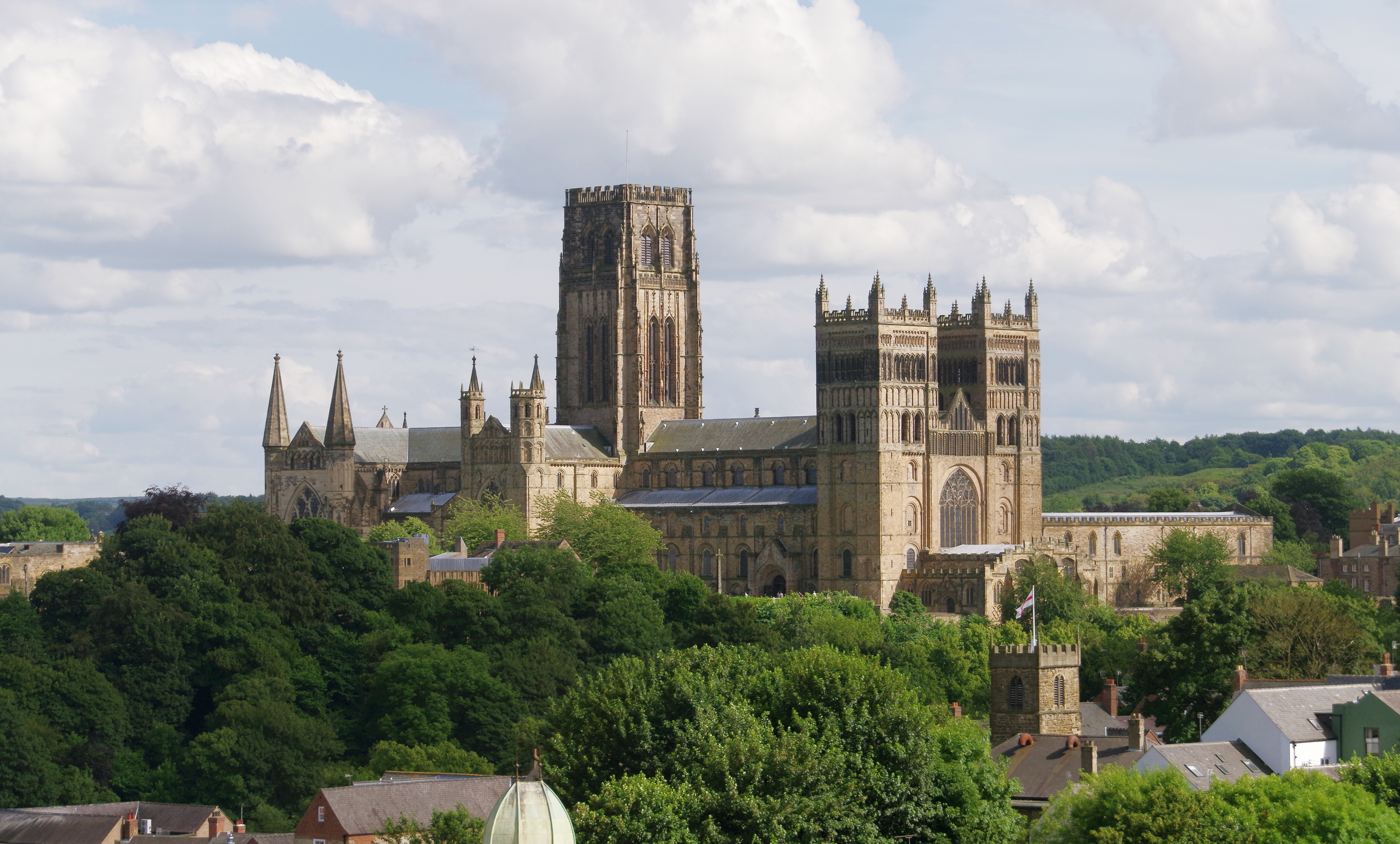
Durham Cathedral, seen from a train on the East Coast Main Line — CC BY-SA 4
Notable Places in Durham
Durham Cathedral. The cathedral was begun in 1093 and consecrated in 1133, and it is one of the greatest Romanesque buildings in Europe. The nave holds the first stone rib vault in the world, and the great columns, carved with chevron and diamond patterns, carry the weight of the roof. The shrine of Saint Cuthbert stands behind the high altar, and the tomb of the Venerable Bede stands in the Galilee Chapel. The central tower, 66 metres high, is climbed by 325 steps, and the view from the top looks across the city to the Pennines and the sea.
Durham Castle. The castle was ordered by William the Conqueror in 1072, and it stands on Palace Green beside the cathedral, on the highest ground of the peninsula. The castle became the home of the Prince Bishops, and its great hall, built in the fifteenth century, is one of the largest medieval halls in England. The castle has been University College since 1837, and students live in the rooms of the bishops, and the guided tours take visitors through the hall, the chapel and the keep.
Palace Green. Palace Green is the open space between the cathedral and the castle, a lawn that has been the heart of the city for nine hundred years. The green holds the cathedral, the castle, the university library and the museum of archaeology, and it is the place where the university holds its graduations and where the Miners’ Gala banners are blessed. The green is the finest open space in the city, and the view from it across the river to the old town is the classic image of Durham.
Elvet Bridge. Elvet Bridge was first built in the twelfth century and rebuilt in the thirteenth, and it crosses the Wear from the peninsula to the suburb of Elvet. The bridge is lined with houses, and the view from it back to the cathedral is one of the best in the city. The foundations of the bridge date from the 1160s, and the bridge has carried traffic across the river for more than eight centuries.
Prebends Bridge. Prebends Bridge was built between 1772 and 1778 by the architect George Nicholson, and it crosses the Wear below the cathedral, on the riverside walk. The bridge gives the classic view of Durham, with the cathedral and the castle reflected in the river, and it is the most photographed place in the city. The walk from the bridge along the river to the city is one of the finest riverside walks in England.
The Oriental Museum. The Oriental Museum stands on the hill south of the city, on Elvet Hill Road, and it holds the university collection of art and archaeology from Asia, Egypt and the Near East. The museum is the only museum in the north of England devoted to the art of the East, and its galleries hold Chinese ceramics, Japanese prints, Egyptian mummies and Indian sculpture. The museum is free, and its garden gives a view back to the cathedral.
The Botanic Garden. The Botanic Garden lies south of the city, on the hill above the Wear, and it holds ten hectares of gardens, woodland and glasshouses. The garden has a tropical rainforest house, a desert house and a collection of alpine plants, and its paths run through woodland that looks down to the river. The garden is a quiet place, and it is the best place in the city for a walk away from the crowds.
The Durham Miners’ Gala. The Gala is held each July, on the second Saturday of the month, and it is the great festival of the coalfield, first held in 1871. The brass bands and the banners of the old lodges march through the city to the racecourse, and the cathedral service blesses the banners in the morning. The Gala draws tens of thousands of people to the city, and it is the living memory of the mining past of the county.
Frequently Asked Questions
How long do I need in Durham?
One full day covers the cathedral, the castle, the market place and the riverside walks. Add a second day for Beamish, the coast at Seaham or a trip to York.
Can I climb the cathedral tower?
Yes, the central tower is climbed by 325 steps, and the view from the top looks across the city to the Pennines and the sea. The tower is open in the warmer months, and tickets are bought in the cathedral.
How do I get to Durham from London?
The East Coast Main Line serves Durham, about three hours from London Kings Cross.
What is the Durham Miners’ Gala?
The Gala is the festival of the coalfield, first held in 1871, with brass bands and banners marching through the city each July. The banners are blessed in the cathedral in the morning, and the march ends at the racecourse.
Is Durham a good base for the north east?
Yes, Durham is an hour and a half from Edinburgh by train and twenty minutes from Newcastle. Beamish, the coast and the Pennine dales are all within an hour by bus or car.
What is the nearest UNESCO World Heritage property to Durham, apart from the cathedral itself?
Durham Cathedral and Castle, ref 370, was inscribed in 1986, and the nearest separate property is the Frontiers of the Roman Empire, ref 430, with Chesters fort about 45 km straight-line to the northwest.
Verified
- The nave of the cathedral holds great columns carved with chevron and diamond patterns, and the shrine of Saint Cuthbert stands behind the high altar, with the tomb of the Venerable Bede in the Galilee Chapel.
- The castle became the home of the Prince Bishops, who ruled the county with their own army, their own courts and their own mint, and the great hall of the fifteenth century is one of the largest medieval halls in England.
- The central tower of the cathedral, 66 metres high, is climbed by 325 steps, and the view from the top looks across the city to the Pennines and the sea.
- Elvet Bridge was first built in the twelfth century and rebuilt in the thirteenth, and its foundations date from the 1160s, and the bridge has carried traffic across the Wear for more than eight centuries.
- Prebends Bridge was built between 1772 and 1778 by the architect George Nicholson, and it gives the classic view of the cathedral reflected in the river.
- Durham Cathedral and Castle, ref 370, was inscribed in 1986 under criteria (ii), (iv) and (vi), and the two buildings were among the first British sites on the list.
Sources
- UNESCO World Heritage Centre, Durham Castle and Cathedral, whc.unesco.org/en/list/370/
- Durham Cathedral, history of the cathedral and the shrine of Saint Cuthbert
- Durham University, history of the university and University College
- National Railway Museum, the railway history of Durham
- Durham Miners’ Association, history of the Durham Miners’ Gala
Unverified
- The claim that the cathedral nave holds the first stone rib vault in the world is the standard scholarly view, but the exact priority is debated among architectural historians.
- The population of Durham is given as about 50,000 in the city, but the figure depends on where the boundary of the built-up area is drawn.
Illustrations
- Hero: Durham. Free image: https://upload.wikimedia.org/wikipedia/commons/0/06/Buildings_in_Durham%2C_North_Carolina_2.jpg — CC BY-SA 4.0.
- In body, durham: Durham Cathedral, seen from a train on the East Coast Main Line. Free image: https://upload.wikimedia.org/wikipedia/commons/d/d6/Durham_MMB_02_Cathedral.jpg — CC BY-SA 4.
- In body, durham: Gravestones in Saint Oswald’s Churchyard Wildlife Meadow, Durham. Free image: https://upload.wikimedia.org/wikipedia/commons/7/7b/At_Durham_2025_093_-_Gravestones_at_St_Oswald%27s_Churchyard.jpg — CC BY-SA 4.