
Bermondsey: From an Old Abbey and Leather Yards to a Beer Mile and an Antiques Market
Bermondsey is a district of south-east London with more than a thousand years of history. Its abbey and leather yards have given way to markets and breweries.
The district stands on the south bank of the River Thames, in the London Borough of Southwark, about two and a half miles south-east of Charing Cross. Its story runs from a small Anglo-Saxon monastery and the great medieval abbey of Bermondsey, through its years as the largest leather-making centre in London, to its present life as one of the liveliest quarters of the capital. This guide follows that story, from the Domesday Book to the Friday antiques market, and shows how to spend a day walking its streets.
The name can be read as the island of Beornmund, where Beornmund is a personal name in Old English and the ending ey means an island or a patch of dry land in a marsh. The name fits the old geography of the place, because Bermondsey was once a high and dry island in the marshes beside the Thames, and the abbey was built on that dry ground.
Quick Facts About Bermondsey
| Item | Detail |
|---|---|
| Character | Residential and commercial district in south-east London |
| Location | South bank of the River Thames, between London Bridge and Rotherhithe, London, England |
| Coordinates | 51.4986° N, 0.0757° W |
| Administration | London Borough of Southwark, historic county of Surrey |
| Distance | About 2.5 miles, or 4 kilometres, south-east of Charing Cross |
| Name | The island of Beornmund, from Old English |
| Oldest monument | Bermondsey Abbey, a Cluniac priory founded in 1082 |
| Industry | Leather making and the leather trade, Leather Market 1833, Leather Exchange 1878 |
| Tube station | Bermondsey station, Jubilee line, Zone 2, opened 17 September 1999 |
| UNESCO | Not a World Heritage property; the United Kingdom holds 35 properties |
| Wikidata | Q822040 |
| GeoNames | 2655853 |
Bermondsey lies on the south bank of the Thames, between the London Bridge area in the west and Rotherhithe in the east, with Tower Bridge crossing the river at the eastern edge of the district. The main axis of Bermondsey is Bermondsey Street, a long street running from Tooley Street beside the river to the south, through Bermondsey Square to the area around Bermondsey station. From the district, visitors can walk across Tower Bridge to the Tower of London, or walk along the Thames to the west to London Bridge and the Shard.
Geography of Bermondsey
The district stands on the south bank of the Thames, on land that was once a marsh cut by tidal creeks, including the River Neckinger, a small stream that once flowed through the area and now runs underground as a culvert. The abbey rose on the highest, driest ground in the district — the old ey, or island, that gave the place its name. Today the ground of the district is mostly flat, with long and straight streets running parallel to the Thames and red-brick warehouse buildings from the industrial age.
The boundary of the district has no clear official line on a modern map, because it is a historic district rather than a modern administrative unit. The area belongs to the London Borough of Southwark, formed in 1965 from the merger of the old boroughs of Bermondsey, Southwark and Camberwell. The Thames borders Bermondsey to the north, the London Bridge area lies to the west, Rotherhithe and Canada Water lie to the east, and Walworth and the Old Kent Road lie to the south.
Bermondsey Street runs as the district’s spine, lined with nineteenth-century red-brick warehouses now converted into homes, offices, cafes and restaurants. The square stands in the middle of Bermondsey Street, on the site of the abbey, and it is the home of the antiques market on Friday mornings. Around the square are small streets whose names recall the industrial past, such as Leathermarket Street, Tanner Street and Morocco Street.
The transport of the district is convenient, with Bermondsey station on the Jubilee line, London Bridge station nearby serving the Jubilee and Northern lines and the national railways, and South Bermondsey station on the suburban railway. The area lies in Zone 2 of the London fare system, while London Bridge and Borough stations nearby lie in Zone 1. The Thames is never far away, and the riverside walk to the west leads to London Bridge, while the walk to the east leads to Tower Bridge.
The riverside is the northern edge of the district, and the walk along the Thames links the old warehouses with the modern towers at London Bridge. The railway arches that carry the lines into London Bridge station run through the southern part of the district, and the arches now hold the food market and the breweries that draw visitors at the weekend. The red-brick warehouses along the main street are the most visible survival of the industrial age, and their conversion into homes and restaurants is the clearest sign of how the district has changed.
The flat ground makes the district easy to walk, and the district is best seen on foot. The streets run in a simple pattern, with Bermondsey Street as the spine and the smaller streets branching off it towards the river and towards the railway arches. The warehouses, the market square and the church all stand within a short walk of each other, and a visitor can cover the historic core of the district in a single morning.
History of Bermondsey
The Anglo-Saxon monastery and Bermondsey Abbey
The history of the district begins more than a thousand years ago, when a small monastery of monks from Saint Peter’s Abbey at Peterborough was founded here in about the year 700. The monastery was one of the earliest religious houses on the south bank of the Thames, and it laid the foundation for the growth of the district over the centuries that followed. The name appears for the first time in the Domesday Book, the great survey ordered by King William the Conqueror and compiled in 1086, with the spellings Bermundesy and Bermundesye.
In the Domesday Book, the district is recorded as a royal manor belonging to King William, with 13 hides of land, a new and beautiful church, 5 ploughs, 20 acres of meadow and woodland enough for 5 pigs. The church named in the Domesday Book was probably the young church of Bermondsey Abbey, founded as a Cluniac priory in 1082 and dedicated to Saint Saviour. The priory was founded by Aylwin Child, and monks from La Charité-sur-Loire arrived in 1089.
The abbey quickly became one of the most important monasteries in England, and in 1399 it formally became a great abbey under Abbot John Attleburgh. The monks of the abbey reclaimed land, built dykes along the river and turned a tidal creek at the mouth of the Neckinger into a dock, named Saint Saviour after the abbey. The abbey owned land and villages across the region, and its wealth made the district a place of consequence long before the leather trade arrived.
The industrial age and the leather trade
In the nineteenth century, the district became one of the largest industrial centres in London, and above all the centre of the leather trade. Like Spitalfields and the East End across the river, the district gathered the trades that were thought too foul-smelling for the crowded City, and leather making became the leading trade of the district. The tanners, the curriers and the leather merchants filled the streets around Bermondsey Street, and the smell of the yards was the smell of the district.
In 1703, the tanners of the district received a royal charter from Queen Anne, allowing them to hold a monopoly on the leather trade and the training of apprentices within 30 miles of the ancient parish, in the manner of a livery company of the City. The charter fixed the position of the district as the leather centre of England, and the trade fed thousands of families in the district for centuries. The Leather Market was built in 1833, and the Leather, Hide and Wool Exchange followed in 1878, and both buildings stood at the heart of the trade.
Beside the leather trade, the district was also famous for food processing and biscuit making. The firm of Peek, Frean and Company was founded in 1857 at Dockhead by James Peek and George Hender Frean, and it quickly became one of the largest biscuit factories in England. The district earned the name of Biscuit Town, and it kept that name until the brand was discontinued in 1989. The biscuit factory and the leather yards together made Bermondsey one of the hardest-working districts in London.
The first railway in London and the twentieth century
The district holds a special place in the railway history of London, because the first passenger railway in the capital, the London and Greenwich Railway, was built in 1836 with its terminus at London Bridge. The first section to open ran between Spa Road station and Deptford High Street, and Spa Road station in the district worked until it closed in 1915. The railway made the district an important transport junction, with lines from Croydon and Kent meeting at South Bermondsey.
In the twentieth century, the district went through great changes, from a busy industrial district to a working-class residential area with many difficulties. The area was heavily damaged by bombing in the Second World War, and many factories and warehouses were destroyed. After the war, the leather industry declined, the factories closed and moved away, and many empty buildings and run-down areas were left behind.
From the 1990s onwards, the district began to be redeveloped, as the old warehouses were converted into high-quality homes, cafes and restaurants, and Bermondsey Street became one of the most famous food streets in London. The tube station opened on 17 September 1999, as part of the Jubilee line extension, and it greatly improved access to the area. The regeneration turned the leather yards into a place where people come to eat, drink and shop, and the red-brick warehouses are now the most sought-after addresses in the district.
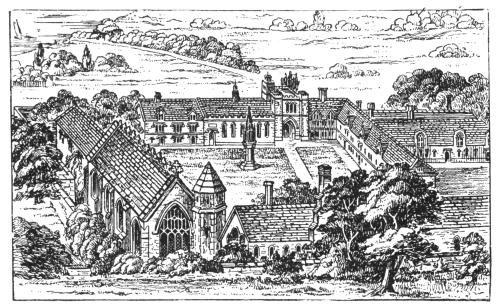
Line drawing of Bermondsey Abbey, England — Public domain
Travel to Bermondsey
The best way to explore the district is to start from Bermondsey Street in the morning, walking down this red-brick street from Tooley Street to the south, through Bermondsey Square and past the church of Saint Mary Magdalen. Along the way, visitors can look at the old leather warehouses, now converted, with street names that recall the industrial past, such as Leathermarket Street and Tanner Street. Bermondsey Street holds many cafes, restaurants and independent shops, and it is one of the most interesting streets to walk in London.
On Friday mornings, the square comes alive with the antiques market, one of the oldest antiques markets in London. The market has its roots in the Caledonian Market, moved from Islington to Bermondsey Square in 1950, and today it draws hunters of antiques, jewellery and old household goods. Visitors should arrive early in the morning, when the stalls have just opened and the best pieces are still there.
At the weekend, visitors should go to Maltby Street Market, a small food market under the railway arches near London Bridge station. The market is famous for street food, cakes, coffee and local produce, and it is a good place for lunch in a lively atmosphere. Next to Maltby Street Market is the Bermondsey Beer Mile, a long route with many craft breweries under the railway arches, where visitors can taste fresh beer at the place where it is made.
The afternoon is the best time to walk from the district across Tower Bridge to the north bank of the Thames, where the Tower of London stands, a UNESCO World Heritage property inscribed in 1988 as ref 488. From Tower Bridge, visitors can see the whole sweep of the Thames, the Shard rising at London Bridge and the City in the distance. The walk across the bridge takes about fifteen minutes, and it is the natural end to a day in Bermondsey.
The food market at Borough Market near London Bridge is a short walk west from Bermondsey Street, and it pairs well with a morning in the district. A visitor can spend the morning in Bermondsey, lunch at Borough Market, and walk back along the river in the afternoon.
Notable Places in Bermondsey
Bermondsey Square and the antiques market is the historic heart of Bermondsey, standing on the site of the old abbey and hosting the antiques market on Friday mornings. What began as the Caledonian Market in Islington reached this square in 1950, and antique hunters now count it among their favourite London haunts. The square is ringed by cafes and by the converted warehouses that once served the leather trade.
The church of Saint Mary Magdalen and the abbey remains stand on Bermondsey Street, where the parish church of the district has stood for centuries, and the present building was rebuilt in 1680. Nearby, on Grange Walk, visitors can see the remains of the south gate of Bermondsey Abbey, the only surviving remnant of the medieval abbey, thought to have been demolished in about 1541. The gate is a small fragment, but it is the one place where the abbey can still be touched.
Maltby Street Market and the Bermondsey Beer Mile fill the railway arches near London Bridge station with food and beer. Maltby Street Market is a small food market under the arches, famous for street food, cakes and coffee, and it opens at the weekend. The Beer Mile is a route of craft breweries under the same arches, where visitors can taste beer brewed on the spot, and it has become one of the favourite destinations for lovers of craft beer in London, especially at the weekend.
Bermondsey Street and the leather warehouses form the main axis of the district, with nineteenth-century red-brick buildings converted into homes, offices, cafes and restaurants. Along the street are small lanes whose names recall the industrial past, such as Leathermarket Street, where the great Leather Market was built in 1833, and Tanner Street, where many tanneries once stood. The street is the best place to see how the industrial district became a residential and food quarter.
Tower Bridge and the Tower of London across the river stand just east of the district, and the bridge is one of the most famous symbols of London. From the district, visitors can walk across the bridge in about fifteen minutes to reach the Tower of London, a UNESCO World Heritage property inscribed in 1988 as ref 488. The Tower was built by William the Conqueror, and its White Tower is the most complete survival of an eleventh-century fortress palace in Europe.

Abbey Street, Bermondsey — CC BY-SA 2
Frequently Asked Questions about Bermondsey
Where is Bermondsey in London?
The district lies in south-east London, in the London Borough of Southwark, on the south bank of the Thames and about two and a half miles south-east of Charing Cross. The coordinates of the district are 51.4986° N, 0.0757° W, and the nearest tube station is Bermondsey station on the Jubilee line, opened on 17 September 1999. From the district, visitors can walk across Tower Bridge to the Tower of London, or walk along the Thames to the west to London Bridge.
What does the name Bermondsey mean?
Old English breaks the name into a personal name, Beornmund, and ey, a word for an island or a patch of dry ground in marshland. That reading matches the old landscape, when a high, dry ey stood among Thames marshes. Domesday Book spellings of 1086 — Bermundesy and Bermundesye — mark its first written appearance, and the name has run without a break for more than nine centuries.
Why is Bermondsey famous for leather and biscuits?
In the nineteenth century, the district was the largest leather centre in London, with the Leather Market built in 1833 and the Leather, Hide and Wool Exchange built in 1878, and a royal charter of 1703 that gave the tanners a monopoly on the trade within 30 miles. Beside the leather trade, the firm of Peek, Frean and Company was founded in 1857 at Dockhead, and it turned the district into Biscuit Town, a name it kept until the brand was discontinued in 1989.
When is the Bermondsey antiques market?
Bermondsey Square hosts the antiques market on Friday mornings, among the oldest such markets in London. Friday’s stalls descend from the Caledonian Market, which left Islington for Bermondsey Square in 1950, and they still draw collectors after antiques, jewellery and old household goods. An early start pays, while the stalls are freshly opened and the interesting pieces are still out.
What is the Bermondsey Beer Mile?
The Beer Mile is a long route of craft breweries under the railway arches near London Bridge station, where visitors can taste fresh beer at the place where it is made. The breweries use the old Victorian railway arches, making a distinctive space of red brick and warm light. The Beer Mile has become one of the favourite destinations for lovers of craft beer in London, especially at the weekend.
Is Bermondsey a UNESCO World Heritage site?
No, the district is not a UNESCO World Heritage site, although the district has more than a thousand years of history and many important monuments. The United Kingdom holds 35 World Heritage properties in total, and in London the Tower of London was inscribed in 1988 as ref 488, standing just across the Thames and reached on foot over Tower Bridge from the district. Maritime Greenwich, inscribed in 1997 as ref 795, lies a short journey east along the river.
Verified
- Wikidata Q822040 is the item for Bermondsey, with the instance-of value for an area of London, and coordinates 51.4986° N, 0.0757° W that match the registry exactly. A Wikidata API lookup dated 22 November 2026 confirmed the entry.
- The name Bermondsey appears in the Domesday Book of 1086 as Bermundesy and Bermundesye, and the abbey was founded as a Cluniac priory in 1082 and became a great abbey in 1399. Every date in this bullet was matched to the sources below on 22 November 2026.
- The tanners received their royal charter in 1703, the Leather Market was built in 1833, the Leather, Hide and Wool Exchange was built in 1878, and Peek, Frean and Company was founded in 1857. The sources below were used to verify each of these dates on 22 November 2026.
- The London and Greenwich Railway was built in 1836, Spa Road station closed in 1915, and The tube station opened on 17 September 1999. All three dates above were checked on 22 November 2026 against the sources listed below.
- The Tower of London is ref 488, inscribed by UNESCO in 1988 with criteria (ii) and (iv), and the United Kingdom holds 35 World Heritage properties, and this was confirmed directly on whc.unesco.org on 22 November 2026. Bermondsey itself holds no UNESCO inscription.
- The antiques market moved from Islington to Bermondsey Square in 1950, and the church of Saint Mary Magdalen was rebuilt in 1680, and both dates were checked against the sources below on 22 November 2026.
- The district is protected at the national and local level through listed buildings and conservation areas, not through the UNESCO list.
The details in this article were confirmed on 22 November 2026, with the Wikidata record for Bermondsey checked through the Wikidata API that day.
Sources
- Wikidata, Bermondsey Q822040 — https://www.wikidata.org/wiki/Q822040 — checked through the Wikidata API on 22 November 2026, with coordinates matching the registry.
- UNESCO, Tower of London — https://whc.unesco.org/en/list/488/ — for the inscription of 1988, ref 488 and criteria (ii) and (iv), checked on 22 November 2026.
- Wikipedia, “Bermondsey” — https://en.wikipedia.org/wiki/Bermondsey — for the geography, the history, the name, the leather trade, Peek Frean and the railway, checked on 22 November 2026.
- Wikipedia, “Bermondsey tube station” — https://en.wikipedia.org/wiki/Bermondsey_tube_station — for the opening date of 17 September 1999, checked on 22 November 2026.
- Visit London, official visitor guide — https://www.visitlondon.com/ — for the markets, the Beer Mile and the streets of Bermondsey, checked on 22 November 2026.
- Transport for London, official site — https://tfl.gov.uk/ — for Bermondsey station on the Jubilee line and the fare zones, checked on 22 November 2026.
- TheTerraAtlas registry, entities-p2.json — for the entity TA-L4-bermondsey, its parent London and the keyword set, checked on 22 November 2026.
Unverified
- The current opening hours of Maltby Street Market were not confirmed here, because the hours change with the season and with each stall.
- The current prices at the breweries on the Bermondsey Beer Mile were not listed, because prices and opening hours change from one brewery to another.
- The exact population of the Bermondsey district was not given, because Bermondsey is a historic district with no clear official boundary.
- The current opening hours of the church of Saint Mary Magdalen were not confirmed, because the hours change with the services and the events of the parish.
- The exact date of the antiques market this week was not confirmed, because the market meets on Friday mornings but may change on public holidays.
Illustrations
- Hero: Bermondsey. Free image: https://upload.wikimedia.org/wikipedia/commons/d/da/Facade_of_St_Mary_Magdalen%27s_church%2C_Bermondsey_-London-_England_2024.jpg — CC BY-SA 4.0.
- In body, Bermondsey: Abbey Street, Bermondsey. Free image: https://upload.wikimedia.org/wikipedia/commons/c/cc/Abbey_Street%2C_Bermondsey_-geograph.org.uk-_4385676.jpg — CC BY-SA 2.
- In body, Bermondsey: Line drawing of Bermondsey Abbey, England. Free image: https://upload.wikimedia.org/wikipedia/commons/a/a9/Bermondsey_Abbey.jpg — Public domain.