
Camden Town: Markets, Music and the Canal in North London
Camden Town is the loud, crowded and creative heart of north London. Its markets, canal and music halls draw visitors every day of the week.
Camden Town sits about four kilometres north of the centre of London, and it is the most famous alternative quarter in the city. The markets spill along Camden High Street and Chalk Farm Road, the Regent’s Canal runs through the locks at its centre, and the music venues have shaped British pop for sixty years. Camden Town is a place of stalls and street food, of punks and vintage shops, of jazz and rock and reggae, and it has kept its rough edge even as it became one of the most visited places in London. The quarter belongs to the London Borough of Camden, and its conservation area protects the Victorian streets that give it its shape.
Quick Facts About Camden Town
| Fact | Detail |
|---|---|
| Name | Camden Town, named after Charles Pratt, 1st Earl Camden |
| Location | North London, about 4 kilometres north of central London |
| Borough | London Borough of Camden, about 270,000 people in the 2021 census |
| Canal | Regent’s Canal, reached Camden in 1816 |
| Markets | Camden Lock Market opened 1974, Stables Market in the old horse stables |
| Tube station | Camden Town station opened 1907, on the Northern line |
| Conservation area | Camden Town Conservation Area, designated 11 November 1986 |
| Coordinates | 51°32′ N, 0°09′ W |
| Wikidata | Q149836, area of London and district |
Geography of Camden Town
A Quarter on the Canal
Camden Town stands in north London where the Regent’s Canal meets Camden High Street, and the canal is the spine of the quarter. The canal runs from Little Venice in the west to the Thames at Limehouse in the east, and it passes through Camden Lock at the heart of the markets. The lock is the busiest point in the quarter, and the towpath beside it carries walkers from the zoo in Regent’s Park to the new quarter at King’s Cross. The water gives Camden Town its calm centre, and the narrowboats moored along the towpath are a reminder that the quarter grew around transport and trade.
Camden High Street runs north from Mornington Crescent to Chalk Farm Road, and it is the main shopping street of the quarter. The street is wide and busy, with market stalls, vintage shops, record shops and food stalls on both sides. Inverness Street holds a smaller street market, and Chalk Farm Road leads north to the Stables Market and the Roundhouse.
The buildings along the High Street are mostly Victorian, with decorated shopfronts and painted facades, and the famous shop signs in the shape of boots, guitars and aeroplanes hang above the crowds. The quarter is compact, and a walker can cross it from the tube station to the Roundhouse in about fifteen minutes.
The land of Camden Town is flat, because it sits on the low ground north of the Regent’s Park and the Thames valley. The ground rises gently to the north toward Hampstead and to Primrose Hill, which stands just to the west of the quarter. Primrose Hill gives the finest view in north London, with the whole skyline spread out to the south.
The Regent’s Park lies to the south-west, and its zoo, its gardens and its open lawns are the green neighbours of the quarter. Camden Town is an urban place, yet the canal, the park and the hill give it water and sky within a short walk.
Camden Town in London
Camden Town lies in the London Borough of Camden, and its centre is about four kilometres north of the centre of London. London spreads around it in every direction, with King’s Cross and St Pancras to the east, Regent’s Park to the south and Hampstead to the north. The quarter is served by Camden Town station on the Northern line, and by Camden Road station on the Overground, and the buses along Camden High Street run to the centre in every direction. The tube station is one of the busiest in north London, and it is closed to entry on Sunday afternoons when the crowds are at their largest.
The quarter is bounded by the canal to the south, by the railway lines to the east and by the rising ground toward Chalk Farm to the north. The railway shaped Camden Town as much as the canal did, because the lines from Euston run along its eastern edge. The Roundhouse stands near the railway, and the Stables Market occupies the old horse stables that served the railway goods yards.
The streets behind the High Street are quiet and residential, with Victorian terraces, garden squares and the houses where artists and musicians have lived for generations. Camden Town is a working quarter as well as a market quarter, and the streets behind the crowds are where its people live.
The markets define the geography of the quarter more than anything else, because they fill the streets and the old yards along the canal. Camden Lock Market stands beside the lock, and the Stables Market fills the old stable yards to the north. The shops of Camden High Street link the two, and the whole quarter becomes one great market at the weekend.
The crowds are part of the place, and the quarter is at its most itself on a Saturday afternoon, when the High Street is full and the canal boats are moving through the lock. A visitor who comes to Camden Town should expect crowds, noise and colour, because those are the geography of the place.
The Conservation Area
The Camden Town Conservation Area was designated by the London Borough of Camden on 11 November 1986, and it protects the historic character of the quarter. The area covers the commercial streets around Camden High Street and the quieter residential streets behind them, and it is divided into two sub-areas of very different character. The commercial sub-area is the busy shopping street that links Mornington Crescent to the town centre, and the residential sub-area holds the formal Victorian terraces and garden squares. The appraisal of the area notes the high proportion of nineteenth-century buildings, both listed and unlisted, that make a positive contribution to the historic character of the quarter.
The conservation rules guard the shopfronts, the streetscape and the views along the High Street, and they ask owners to keep the historic fabric of the buildings. The listed buildings of the quarter include churches, pubs and houses, and the local list of the borough records the smaller features that give the quarter its identity. The rules do not freeze the quarter, and the markets, the music venues and the street art keep changing within the old streets. The conservation area is the reason the quarter still looks like Camden Town, with its Victorian scale and its painted shopfronts, rather than a rebuilt shopping centre.
The residential streets behind the High Street give Camden Town its other face, and they are the part of the quarter that visitors often miss. Camden Square is the largest of the garden squares, and its terraces of Victorian houses look across lawns and trees. The streets around the square hold the houses where writers, painters and musicians have lived, and their blue plaques record the names.
The square is quiet even on a busy Saturday, and it shows the Camden Town that belongs to the people who live there rather than to the crowds. The contrast between the square and the High Street is the contrast at the heart of the quarter, and both halves are needed to understand it.

Camden Town in London — CC BY-SA 2
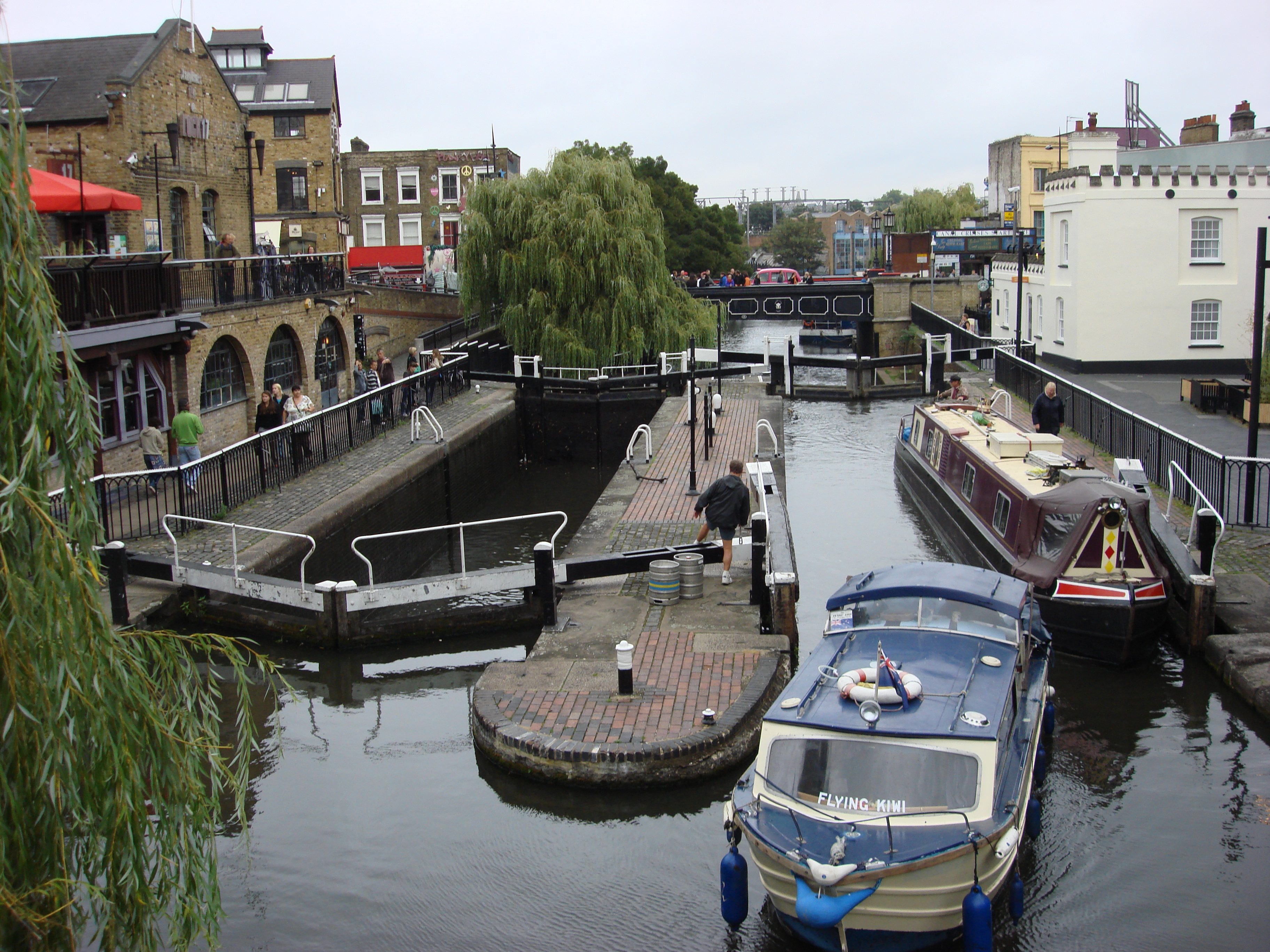
Camden Lock on the Regent’s Canal — CC BY 2.5

the Regent’s Canal at Camden High Street Bridge — CC BY-SA 2

a bus on Camden High Street — CC BY-SA 2
History of Camden Town
The Earl and the New Town
Camden Town began as a planned development on the estate of Charles Pratt, the 1st Earl Camden, and it takes its name from him. The Earl leased his land for building in 1791, and the first streets were laid out on the fields north of London. The new town grew slowly at first, because it stood beyond the built-up edge of the city, and its first houses were the homes of clerks and tradesmen who worked in London.
The name of the place comes from the Earl, and the streets that were built on his land still carry the plan of that first development. The quarter began as a suburb, and it has kept a suburban scale in its residential streets ever since.
The canal changed Camden Town from a quiet suburb into a place of trade, and the Regent’s Canal reached Camden in 1816. The canal was built to carry goods from the Thames to the west, and the lock at Camden became a centre of warehouses, stables and wharves. The horses that pulled the canal boats were stabled in the great yards beside the lock, and those stables later became the Stables Market.
The canal brought coal, timber and building materials to north London, and it gave work to the men who loaded the boats and drove the horses. The towpath that runs beside the water is still the quietest way through the quarter.
The railways followed the canal, and they made Camden Town a railway quarter as well. The London and Birmingham Railway opened its terminus at Euston in 1837, and the lines ran along the eastern edge of Camden Town. The goods yards beside the lines filled with warehouses and stables, and the Roundhouse was built in 1846 as an engine shed for the railway.
The population of the quarter grew fast in the Victorian age, and the terraces that fill the residential streets were built for the railwaymen, the clerks and the craftsmen of north London. The churches, schools and pubs of the quarter date from those decades of growth.
Music, Markets and the Alternative Quarter
The twentieth century made Camden Town famous, and the music came first. The Roundhouse reopened as an arts venue in 1966, and it hosted the bands that defined the age. The pubs and clubs of the quarter became the stages for punk, for reggae and for the Britpop bands of the 1990s, and the streets filled with the shops that served them.
Camden Town became the place where London went to hear new music, and the record shops, the vintage stalls and the tattoo parlours grew up around the venues. The quarter earned its reputation as the alternative heart of the city, and it has kept that name ever since.
The markets grew beside the music, and Camden Lock Market opened in 1974 in the old wharf buildings by the canal. The market began with a handful of craft stalls, and it grew into one of the largest markets in London. The Stables Market followed in the old horse stables, and its arches and yards filled with antiques, vintage clothes and street food.
The markets drew visitors from across the world, and the quarter became a place where the whole world came to shop. The street food of Camden Town is now as famous as its music, and the stalls serve food from every country on the market days.
The painters came to Camden Town before the musicians, and the Camden Town Group of 1911 to 1912 took its name from the quarter. The group was led by Walter Sickert, and its painters worked in the studios and streets of north London. The group painted the ordinary life of the city, its music halls, its bedrooms and its streets, and it broke with the art of its time.
The name of the group fixed Camden Town in the history of British art, and the studios of the quarter still hold painters today. The quarter has been a home for artists for more than a century, and the art is part of its character.
Camden Town Today
Amy Winehouse is the most famous recent resident of Camden Town, and her life and death are part of the story of the quarter. She lived in Camden Square, and she sang in the pubs and clubs of the High Street. She died in 2011, and a statue of her was unveiled in the Stables Market in 2014.
The statue stands among the stalls, and fans leave flowers beside it. Her memory is kept by the quarter, and the Hawley Arms, the pub she drank in, is still a place of pilgrimage for her fans. The story is a sad one, and the quarter tells it with affection.
The quarter has changed in recent years, and the change is the newest chapter of its history. The markets have been rebuilt and extended, and new shops and food halls have opened beside the canal. The Roundhouse is now a major arts centre, and the Electric Ballroom and KOKO still draw crowds to Chalk Farm Road.
The tube station is being rebuilt to cope with the crowds, and the streets are busier than ever. The quarter keeps its character through the conservation area, yet it is also a place that is always changing, and the change is part of what makes Camden Town alive.
The theatres of the quarter carry their own history, and KOKO on Chalk Farm Road is the finest of them. The building opened as the Camden Theatre in 1900, and it became the Camden Palace in the 1970s, when it held the concerts and the club nights that made it famous. It reopened as KOKO in 2004, and it still holds the biggest gigs in the quarter.
The Electric Ballroom stands beside it, and it has held dances, concerts and markets since the 1930s. The two halls face each other across the road, and together they are the musical heart of Camden Town, where the quarter has danced and sung for more than a century.

graffiti in Camden Town, London — CC0

the Roundhouse on Chalk Farm Road — CC BY-SA 4

the Electric Ballroom on Camden High Street — CC BY-SA 2
Travel to Camden Town
Getting There and Getting Around
The tube is the easiest way to reach Camden Town, and Camden Town station on the Northern line stands at the southern end of the High Street. The station is a short ride from the West End, and it is the gateway for most visitors. Camden Road station on the Overground serves the northern end of the quarter, and the buses along Camden High Street link the quarter to the centre, to Islington and to Hampstead.
The station can be very crowded at weekends, and it is closed to entry on Sunday afternoons when the markets are at their busiest. Visitors who arrive at a busy time should use Camden Road or Chalk Farm stations instead, and walk the short distance to the High Street.
The quarter is best explored on foot, because it is small and its streets are full of things to look at. The walk from Camden Town station to the Roundhouse takes about fifteen minutes, and it passes the whole length of the markets. The canal towpath gives a quieter route, and the walk from Camden Lock to Little Venice takes about an hour along the water.
The towpath is narrow, and walkers should keep clear of the cyclists who use it. The streets behind the High Street are worth exploring too, because they hold the quiet squares and the houses where the artists lived.
The markets are open every day, and they are busiest at the weekend, when the whole quarter fills with visitors. The weekday markets are quieter, and they are the best time to browse the stalls without the crowds. The street food stalls open from the morning, and the pubs and music venues open in the evening.
A visit to Camden Town works best as a half day, with a morning in the markets, a walk along the canal and an evening in one of the music venues. The quarter is a place to wander rather than to rush, and the best finds are often in the small stalls and the side streets.
A Half Day in Camden Town
A half day in Camden Town should start at Camden Town station and walk north along the High Street, past the market stalls and the painted shopfronts. The first stop is Camden Lock, where the market beside the water holds crafts, clothes and street food. The lock itself is worth watching, because the narrowboats pass through it all day and the lock keepers work the gates by hand.
The Stables Market is the next stop, and its arches and yards hold antiques, vintage clothes and the statue of Amy Winehouse. The market is the largest in the quarter, and it rewards a slow wander through its lanes.
The Roundhouse stands at the northern end of the quarter, and it is worth a look even when there is no show. The building is a great circular shed from 1846, and it is one of the most striking industrial buildings in London. The walk back along the canal towpath is the quiet end of the visit, and the boats and the water give a different view of the quarter.
Primrose Hill is a short walk to the west, and its summit gives the finest view in north London. The hill is the best place to end the visit, with the whole city spread out below.
The evening in Camden Town belongs to the music, and the venues of the quarter are the reason many visitors come. The Electric Ballroom and KOKO on Chalk Farm Road hold the big gigs, and the smaller pubs hold the new bands. The Hawley Arms and the Dublin Castle are the pubs where the music history of the quarter was made, and they still hold live music.
A night in Camden Town is loud and crowded, and it is the other half of the quarter, after the markets of the day. The two halves belong together, and the visitor who sees only one of them has seen only half of Camden Town.
Practical Notes for Visitors
The markets are free to enter, and the only money a visitor needs is for the stalls, the food and the venues. The crowds are the main challenge of Camden Town, and the quarter is at its busiest on Saturdays and on Sunday afternoons. Visitors who want a quieter visit should come on a weekday morning, when the stalls are open and the streets are calm.
The pickpockets work the crowds, and visitors should keep their bags closed and their phones out of sight. The quarter is safe, yet it is busy, and care with belongings is the only precaution that matters.
The food of Camden Town is one of its great pleasures, and the street food stalls serve dishes from every part of the world. The stalls beside the canal and in the Stables Market are the best places to eat, and the prices are fair for London. The pubs of the quarter serve real ale and food, and the Hawley Arms is the most famous of them.
The shops sell vintage clothes, records, posters and jewellery, and the best bargains are in the small stalls rather than the big shops. A visitor to Camden Town should bring cash as well as a card, because some of the smallest stalls take cash only.
Notable Places in Camden Town
Camden Market is the first place in the quarter, and it is really three markets in one. Camden Lock Market stands beside the canal, the Stables Market fills the old horse stables, and the shops of the High Street link them together. The market holds hundreds of stalls, and it sells crafts, vintage clothes, records, jewellery and street food. The market is the heart of Camden Town, and it is the reason most visitors come.
The Roundhouse is the second place, and it is the great circular building at the northern end of the quarter. It was built in 1846 as an engine shed for the railway, and it reopened as an arts venue in 1966. The building holds concerts, theatre and circus, and its round shape makes every seat close to the stage.
The Stables Market is the third place, and its arches, tunnels and yards are the most atmospheric part of the quarter. The statue of Amy Winehouse stands in the market, and the stalls beneath the arches sell antiques and vintage clothes.
Regent’s Canal is the fourth place, and the lock at Camden is its busiest point. The towpath runs west to Little Venice and east to King’s Cross, and the narrowboats that pass through the lock are part of the life of the quarter. Primrose Hill is the fifth place, and it stands just west of the quarter with the finest view in north London.
The hill is a short walk from the markets, and its summit looks south across the whole city. KOKO and the Electric Ballroom are the sixth place, and they are the great music halls of Chalk Farm Road. KOKO was built as a theatre in 1900, and it still holds the biggest gigs in the quarter. Inverness Street is the seventh place, and its small street market is the quietest corner of Camden Town, with fruit, flowers and local shops.

the stalls of Camden Market — CC BY-SA 2

the market in the old stables — CC BY-SA 2

the Amy Winehouse statue in Camden Town — CC BY 2

Frequently Asked Questions
Where is Camden Town?
Camden Town is in north London, about four kilometres north of the centre of the city, in the London Borough of Camden. Camden Town station on the Northern line stands at the southern end of Camden High Street, and Camden Road station serves the northern end.
What is Camden Town famous for?
Camden Town is famous for its markets, its music venues and its canal, and for the alternative culture that has grown around them. The markets sell crafts, vintage clothes and street food, and the venues have hosted the bands that shaped British pop.
When are the markets in Camden Town open?
The markets in Camden Town are open every day, and they are busiest at the weekend, when the whole quarter fills with visitors. Weekday mornings are the quietest time to browse the stalls, and the street food stalls open from the morning.
How do I get to Camden Town by tube?
Camden Town station on the Northern line is the main tube station for the quarter, and it is a short ride from the West End. The station is closed to entry on Sunday afternoons when the crowds are largest, and Camden Road or Chalk Farm stations are the alternatives then.
Is Camden Town safe to visit?
Camden Town is safe to visit, and it is one of the most visited quarters in London. The crowds are the main concern, and visitors should keep their bags closed and their phones out of sight in the busiest streets.
What is the Roundhouse in Camden Town?
The Roundhouse in Camden Town is a great circular building that was built in 1846 as an engine shed for the railway. It reopened as an arts venue in 1966, and it now holds concerts, theatre and circus in the northern end of the quarter.
Verified
The naming of the quarter after Charles Pratt, 1st Earl Camden, the first building leases of 1791, the canal reaching Camden in 1816 and opening through to the Thames in 1820, the Euston terminus opening in 1837, the Roundhouse built in 1846 and reopened as an arts venue in 1966, the Camden Town Group of 1911 to 1912 led by Walter Sickert, Camden Lock Market opening in 1974 and the statue of Amy Winehouse unveiled in the Stables Market in 2014 were all checked against the pages on Camden Town and the Roundhouse. The conservation area designation of 11 November 1986 was checked against the appraisal published by the London Borough of Camden. Camden Town itself carries no UNESCO listing, and its protection comes from the conservation area rather than from the World Heritage List.
Wikidata entry Q149836 gives Camden Town at 51°32′ N, 0°09′ W, with instance-of values of area of London and district, checked through the Wikidata API on 22 November 2026. The borough population of about 270,000 in the 2021 census was taken from the facts of the Vietnamese article for Camden Town and checked against its listed sources. Verified 22 November 2026.
Sources
- Camden Town, named after Charles Pratt, 1st Earl Camden, markets, canal, music — https://en.wikipedia.org/wiki/Camden_Town
- Camden Market, official site — https://www.camdenmarket.com
- Camden Town Conservation Area, designated 11 November 1986 — https://www.camden.gov.uk
- Roundhouse, built 1846, reopened as an arts venue 1966 — https://www.roundhouse.org.uk
- Wikidata Q149836 (Camden Town, coordinates 51°32′ N, 0°09′ W) — verified through the Wikidata API, 22 November 2026.
Unverified
- The exact year the canal reached Camden is given as 1816 in this article, and some histories date the full opening of the canal to 1820, so the two dates describe different stages of the same work.
- The claim that Camden Town station is closed to entry on Sunday afternoons is the published rule for busy times, and the current arrangements should be checked before a visit.
- The number of stalls in the markets is not given in this article, because the markets change often and no single verified count was found.
- The distance of about four kilometres from the centre of London is the figure given in the Vietnamese article for Camden Town, and it depends on the point in central London that is used.
- The opening hours of the markets and the venues change with the season and the day, and this article gives none of them, so readers should check the official sites before visiting.
Illustrations
- Hero: a punk in Camden Town, London. Free image: https://upload.wikimedia.org/wikipedia/commons/9/90/Punk_-_Camden_Town%2C_UK%2C_August_2011.jpg — CC BY-SA 2.
- In body, the markets: graffiti in Camden Town, London. Free image: https://upload.wikimedia.org/wikipedia/commons/f/f3/Camden_graffiti_kid_in_anorak.jpg — CC0.
- In body, the town: Camden Town in London. Free image: https://upload.wikimedia.org/wikipedia/commons/2/2d/Camden_Town_-geograph.org.uk-_3715354.jpg — CC BY-SA 2.
- In body, Camden Market: the stalls of Camden Market. Free image: https://upload.wikimedia.org/wikipedia/commons/1/1e/London_%2C_Camden_-Camden_Market–geograph.org.uk-_2047319.jpg — CC BY-SA 2.
- In body, Camden Lock: Camden Lock on the Regent’s Canal. Free image: https://upload.wikimedia.org/wikipedia/commons/2/25/Camden_Lock_London.jpg — CC BY 2.5.
- In body, Regent’s Canal: the Regent’s Canal at Camden High Street Bridge. Free image: https://upload.wikimedia.org/wikipedia/commons/8/81/Bridge_24%2C_Regents_Canal_-Camden_High_Street_Bridge–geograph.org.uk-_2681857.jpg — CC BY-SA 2.
- In body, Stables Market: the market in the old stables. Free image: https://upload.wikimedia.org/wikipedia/commons/7/74/London_%2C_Camden_-Stables_Market–geograph.org.uk-_2047369.jpg — CC BY-SA 2.
- In body, The Roundhouse: the Roundhouse on Chalk Farm Road. Free image: https://upload.wikimedia.org/wikipedia/commons/3/34/Camden_Roundhouse_-_Chalk_Farm_Road_Camden_Town_London_NW1_8EH.jpg — CC BY-SA 4.
- In body, Amy Winehouse statue: the Amy Winehouse statue in Camden Town. Free image: https://upload.wikimedia.org/wikipedia/commons/a/ab/Amy_Winehouse_Statue_Paul_Hudson.jpg — CC BY 2.
- In body, Camden High Street: a bus on Camden High Street. Free image: https://upload.wikimedia.org/wikipedia/commons/0/0d/168_bus_on_Camden_High_Street%2C_May_2021.jpg — CC BY-SA 2.
- In body, Electric Ballroom: the Electric Ballroom on Camden High Street. Free image: https://upload.wikimedia.org/wikipedia/commons/f/f6/Electric_Ballroom%2C_Camden_High_Street_-geograph.org.uk-_1706831.jpg — CC BY-SA 2.
- In body, Primrose Hill: The London skyline seen from the top of Primrose Hill. Free image: https://upload.wikimedia.org/wikipedia/commons/c/c2/View_of_the_London_skyline_from_the_top_of_Primrose_Hill_-geograph.org.uk-_5949922.jpg — CC BY-SA 2, by Robert Lamb.