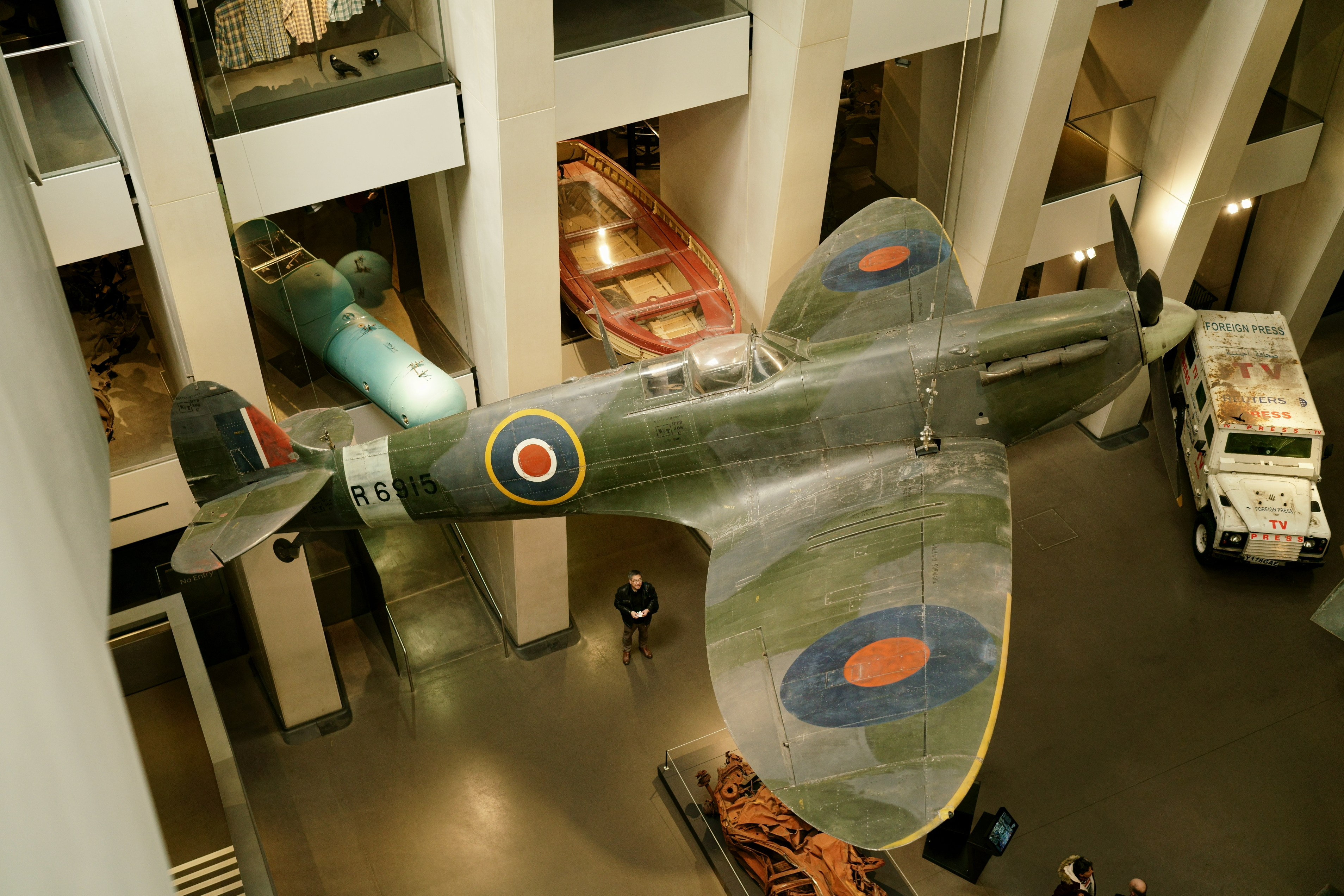
Imperial War Museum London — The National Museum of Modern War on Lambeth Road
Imperial War Museum London stands on Lambeth Road, south of the Thames, in a former hospital built for Bedlam. Six floors hold the human cost of modern war.
Imperial War Museum London is the national museum of Britain on modern war, and its London branch on Lambeth Road is the headquarters and the most important branch of the organisation. The museum is not a single building but a national institution with five branches, namely Imperial War Museum London, IWM North, IWM Duxford, HMS Belfast and the Churchill War Rooms. The London branch was founded in 1917, while the First World War was still raging, and it has told the story of war from the viewpoint of ordinary people ever since.
Visitors come to Imperial War Museum London for the First World War Galleries, the Holocaust Galleries and the great atrium with its aircraft and tanks, but the building itself is part of the story. It is the surviving central block of the old Bethlem Royal Hospital, built in 1812 to 1814, and its dome looks out over Geraldine Mary Harmsworth Park. This guide explains the geography and history of the museum, and it shows how to plan a visit to its galleries.
Quick Facts
| Item | Detail |
|---|---|
| Name | Imperial War Museum London (IWM London) |
| Type | National museum of modern war, headquarters of Imperial War Museums |
| Location | Lambeth Road, Lambeth, Southwark, south of the Thames, London, United Kingdom |
| Address | Lambeth Road, London SE1 6HZ |
| Coordinates | 51.4958° N, 0.1086° W |
| Founded | 1917, while the First World War was still raging |
| First opened | 9 June 1920 at Crystal Palace, opened by King George V |
| Moved to Lambeth Road | 7 July 1936, reopened by the Duke of York, later King George VI |
| Building | Central block of the former Bethlem Royal Hospital, built 1812 to 1814, designed by James Lewis |
| Opening hours | Daily 10:00 to 18:00, last entry 17:30, closed 24 to 26 December |
| Admission | Free entry to the permanent galleries, with charges for some special exhibitions |
| Galleries | Six floors, with more than 1,300 objects in the First World War Galleries |
| Branches | Five branches: IWM London, IWM North, IWM Duxford, HMS Belfast and Churchill War Rooms |
| UNESCO property nearby | None at the museum, and the nearest inscribed property is Westminster, reference 426, inscribed 1987 |
| Wikidata | Q749808 |
| GeoNames | 12382199 |
| Official website | iwm.org.uk/visits/iwm-london |
| Language | English |
| Time zone | Greenwich Mean Time (UTC+0), British Summer Time (UTC+1) in summer |
Geography of Imperial War Museum London
Lambeth, south of the Thames
Imperial War Museum London stands on Lambeth Road in the Lambeth area of the borough of Southwark, south of the River Thames. Lambeth is one of the oldest districts of London, with a history reaching back to Roman times, and today it is a mixed area of housing, offices, hospitals and cultural institutions. The museum stands near Lambeth Palace, the home of the Archbishop of Canterbury, and the Garden Museum in the old church of Saint Mary stands beside it.
The building of Imperial War Museum London is the surviving central block of the Bethlem Royal Hospital, the famous mental hospital known as Bedlam. The hospital was built in 1812 to 1814 to the design of James Lewis, and it moved to Beckenham in Kent in the 1930s, leaving the central block to the museum. The dome of the building is its most recognisable feature, and it looks out over the park in front of the museum.
The museum stands about 2 kilometres south-east of Westminster, across the Thames from the political heart of London. The distance is short, but the character of the two places is very different, because Westminster holds the parliament and the abbey, while Lambeth holds hospitals, housing and the museum. The walk between them crosses Westminster Bridge and passes Big Ben and the London Eye, and it shows how the river divides the ceremonial city from the working city.
Geraldine Mary Harmsworth Park and the surroundings
Imperial War Museum London stands in Geraldine Mary Harmsworth Park, a small park with lawns, trees and footpaths that gives visitors a quiet space before they enter the museum. The park is named after the mother of the newspaper owner Lord Rothermere, who gave the land, and it is used by local residents as well as by museum visitors. The green in front of the dome is one of the calmest open spaces in central London.
The area around Imperial War Museum London holds several sights within walking distance, including Lambeth Palace, the Garden Museum and the Thames embankment with its view across to Westminster. The Imperial War Museum London is also close to the Elephant and Castle, a busy road junction to the south-east, and to Waterloo station to the north-west. The museum is therefore easy to combine with a walk along the South Bank, which runs from Westminster Bridge to Tower Bridge.
The South Bank walk from Westminster
The walk from Westminster to Imperial War Museum London is one of the pleasant approaches to the museum, and it takes about twenty minutes on foot. The route crosses Westminster Bridge, with the river below and the dome of the museum visible ahead across the rooftops of Lambeth. The South Bank on the far side holds the London Eye, the riverside gardens and the old County Hall, and the walk shows how the museum sits between the ceremonial city and the residential districts south of the river.
The walk also passes Jubilee Gardens and the embankment, where the view across the Thames takes in the parliament buildings and the abbey. Visitors who arrive this way see the museum as part of a longer riverside journey, rather than as a single stop, and they can continue from the museum to Waterloo station or to the Elephant and Castle. The route is flat and well signed, and it suits visitors who want to combine the museum with the river, the gardens and the bridges.
Climate and the best time to visit
London has a mild climate, with cool summers and cold damp winters, and Imperial War Museum London opens all year round, except for 24 to 26 December. The museum is indoors, so the weather matters little to the visit, and it is a good destination on a rainy day in London. Summer is the busiest season, especially at weekends and during school holidays, when families bring children to the galleries.
Visitors should come to Imperial War Museum London on a weekday morning to avoid the crowds, because the First World War Galleries and the Holocaust Galleries attract the most visitors. Weekend afternoons are usually busier, and some special exhibitions may need advance booking. Visitors should allow at least half a day for the museum, because the six floors hold many objects, films and personal stories to explore.

Naval guns stand in front of the Imperial War Museum in London — CC BY-SA 2
History of Imperial War Museum London
Founded in 1917, while the war was still raging
Imperial War Museum London was founded in 1917, while the First World War was still raging, with an unusual idea, to record the war while it was happening rather than waiting until it was over. On 5 March 1917 the War Cabinet approved the proposal to establish a National War Museum, to record the events then unfolding in the First World War. The museum was soon renamed the Imperial War Museum, and its purpose was to record the civil and military war effort and the sacrifice of Britain and the British Empire.
The museum collected weapons, uniforms, diaries, letters, keepsakes, film and works of art from the battlefields and the home front, with the view that the story of ordinary people mattered as much as the story of generals. That founding idea still shapes Imperial War Museum London today, because its galleries tell the war through personal testimony, letters home and everyday objects as much as through weapons and strategy. The museum was founded in war, and it has kept the voices of those who lived through war at its centre.
Three moves: Crystal Palace, South Kensington and Lambeth Road
Imperial War Museum London opened for the first time on 9 June 1920 at Crystal Palace, opened by King George V, and it quickly became a popular destination for Londoners. In 1924 the museum moved to two galleries beside the former Imperial Institute in South Kensington, where it stayed for more than a decade. In 1936 the museum found its lasting home south of the Thames, in the surviving central block of the Bethlem Royal Hospital on Lambeth Road.
On 7 July 1936 the Duke of York, later King George VI, reopened Imperial War Museum London in its new home on Lambeth Road. The move gave the museum room to grow, with large galleries for aircraft, tanks and artillery, and a central atrium that still impresses visitors today. The Bethlem building, with its dome and its long wings, became the visual identity of the museum, and the park in front of it became its forecourt.
The Second World War and the growth after the war
In 1939, when the Second World War began, Imperial War Museum London began moving its collections out of London to escape bombing, and the museum closed from 1940 to 1946. After the war the museum reopened and widened its scope, from the First World War to the Second World War and later conflicts. The collections grew to cover every aspect of modern war, from the home front to the battlefield, and from propaganda to art.
From the 1970s Imperial War Museum London grew into an organisation with five branches, including IWM Duxford opened in 1976, HMS Belfast in 1978, the Churchill War Rooms in 1984 and IWM North in 2002. Imperial War Museum London remained the most important branch and the headquarters, with its galleries renewed for the centenary of the First World War. The new Holocaust Galleries opened in 2021, and the Blavatnik Art, Film and Photography Galleries followed, bringing the museum into the twenty-first century.
| Year | Event |
|---|---|
| 1812 to 1814 | The central block of the Bethlem Royal Hospital is built on Lambeth Road |
| 1917 | The War Cabinet approves the National War Museum on 5 March, and it becomes the Imperial War Museum |
| 1920 | The museum opens at Crystal Palace on 9 June, opened by King George V |
| 1924 | The museum moves to the Imperial Institute in South Kensington |
| 1936 | The museum moves to Lambeth Road on 7 July, reopened by the Duke of York |
| 1940 to 1946 | The museum closes during the Second World War, and the collections are evacuated |
| 1976 to 2002 | The museum grows to five branches: Duxford, HMS Belfast, Churchill War Rooms and IWM North |
| 2021 | The new Holocaust Galleries open at Imperial War Museum London |

The Imperial War Museum in London shows its domed building from the north — CC BY-SA 4
Travel to Imperial War Museum London
Reaching the museum by tube, bus and on foot
The nearest tube station to Imperial War Museum London is Lambeth North on the Bakerloo line, a few minutes on foot to the east of the museum. Elephant and Castle station, with the Bakerloo and Northern lines, lies about 10 minutes on foot to the south-east, and the larger Waterloo station lies about 10 minutes on foot to the north-west. The walk from any of these stations passes through residential streets and the park, and it gives a sense of the Lambeth neighbourhood.
Buses are another convenient option, with many routes running along Lambeth Road and Westminster Bridge Road, stopping near the museum. Visitors travelling by bus from Covent Garden or elsewhere in central London can get off at the stop near the museum on Lambeth Road, then walk for a few minutes through Geraldine Mary Harmsworth Park. The museum is also easy to reach on foot from Westminster, across the bridge and along the South Bank.
The main galleries
The First World War Galleries are the most important galleries of Imperial War Museum London, with more than 1,300 objects, including weapons, uniforms, diaries, keepsakes, film and works of art. The galleries tell the story of the war from 1914 to 1918, with the emphasis on the experience of ordinary people, and visitors should give them the most time. The galleries were renewed for the centenary of the First World War, and they remain the reason the museum was founded.
The Holocaust Galleries, opened in 2021, tell the story of the Holocaust and the murder of the Jews of Europe in the Second World War, with objects, film and the testimony of survivors. The Blavatnik Art, Film and Photography Galleries show the work of artists, filmmakers and photographers on war, exploring the relationship between creation and destruction. The main atrium of Imperial War Museum London, with its high ceiling and wide space, displays large objects such as aircraft, tanks and missiles, and it makes a strong impression as soon as visitors step inside.
The family exhibition Childhood in War, running from 31 July 2026 to 28 February 2027, is a free exhibition for families, telling the story of children in conflict from 1914 to the present day. It is designed for families with children aged 8 and over, with younger visitors welcome too, and it combines hands-on activities with real stories. The exhibition shows how Imperial War Museum London speaks to new generations, and it gives families a way into difficult subjects.
Practical notes: free entry, time and sensitive content
Entry to the permanent galleries of Imperial War Museum London is free and no ticket is needed, according to the official website of the museum. Some special exhibitions may charge and need advance booking, and visitors should check the official website before travelling. The museum opens daily from 10:00 to 18:00, with last entry at 17:30, and it closes on 24 to 26 December.
Visitors should allow at least half a day, about 3 to 4 hours, to see Imperial War Museum London, because the six floors hold a great deal of content. The content of the museum, especially the Holocaust Galleries and the First World War Galleries, can be deeply moving, and parents should think carefully before bringing young children, although the museum has a family exhibition for children aged 8 and over. Resting between galleries helps, because the material is intense and the building is large.
Notable Places in Imperial War Museum London
The places below cover the galleries and the spaces that define Imperial War Museum London. The First World War Galleries and the Holocaust Galleries hold the core of the museum, while the atrium and the park frame the visit.
| Place | What it is |
|---|---|
| First World War Galleries | The core galleries of the museum, with more than 1,300 objects telling the war of 1914 to 1918 |
| Holocaust Galleries | The galleries opened in 2021, telling the story of the Holocaust with objects, film and testimony |
| Blavatnik Art, Film and Photography Galleries | Galleries showing how artists, filmmakers and photographers have responded to war |
| Main atrium | The high hall at the entrance, displaying large objects such as aircraft, tanks and missiles |
| Childhood in War | The free family exhibition running from 31 July 2026 to 28 February 2027, on children in conflict |
| The dome | The dome of the former Bethlem Royal Hospital, built 1812 to 1814, the visual mark of the museum |
| Geraldine Mary Harmsworth Park | The small park in front of the museum, with lawns, trees and footpaths |
| Lambeth Palace | The home of the Archbishop of Canterbury, a short walk from the museum |
| Garden Museum | The museum in the old church of Saint Mary, beside Lambeth Palace |
| The Thames embankment | The river walk near the museum, with views across to Westminster |
Frequently Asked Questions about Imperial War Museum London
Where is Imperial War Museum London in London?
Imperial War Museum London stands on Lambeth Road in Southwark, south of the Thames, at Lambeth Road, London SE1 6HZ. The coordinates are 51.4958° N and 0.1086° W, about 2 kilometres south-east of Westminster.
Is entry to Imperial War Museum London free?
Yes, entry to the permanent galleries of Imperial War Museum London is free and no ticket is needed, according to the official website. Some special exhibitions may charge and need advance booking, so visitors should check the official website before travelling.
When was Imperial War Museum London founded and why?
Imperial War Museum London was founded in 1917, while the First World War was still raging, to record the war effort and the sacrifice of the people of Britain and the British Empire. On 5 March 1917 the War Cabinet approved the proposal for a National War Museum, later renamed the Imperial War Museum.
What was the building of the museum before it was a museum?
Before the museum moved in, the building served as the central block of Bethlem Royal Hospital — Bedlam, the famous mental hospital. James Lewis designed it, construction ran from 1812 to 1814, and in the 1930s the hospital left for Beckenham in Kent, handing the central block to the museum.
How much time should I allow for Imperial War Museum London?
Allow at least half a day, about 3 to 4 hours, for Imperial War Museum London, because the six floors hold many objects, films and personal stories. The First World War Galleries and the Holocaust Galleries need the most time, and visitors should rest between galleries.
Is Imperial War Museum London a UNESCO World Heritage Site?
No, Imperial War Museum London is not a World Heritage Site. The nearest inscribed property is Westminster, inscribed by UNESCO in 1987 as reference 426, and the Tower of London was inscribed in 1988 as reference 488.
Verified
The Wikidata record for the museum was consulted through the public API on 22 November 2026, and it gives the entry as Q749808, labelled Imperial War Museum London, with the instance types of military museum and national museum. The record places the museum in London in the United Kingdom at 51.49583333333333° N and 0.10861111111111112° W, and those figures agree exactly with the registry. The GeoNames identifier 12382199 also agrees, so the identifier, the type and the coordinates needed no correction.
On UNESCO, the position was checked on the World Heritage Centre pages for the two nearest inscribed properties in London. Westminster, reference 426, was inscribed in 1987, and the Tower of London, reference 488, was inscribed in 1988, and the United Kingdom holds 35 World Heritage properties in total. Imperial War Museum London holds no inscription of its own, so the registry flag of unesco:false is correct for the museum, and the article states the nearest properties rather than claiming any inscription.
The museum facts and the UNESCO references in this guide were confirmed from their official pages on 22 November 2026. The founding in 1917, the opening at Crystal Palace on 9 June 1920, the move to South Kensington in 1924 and the move to Lambeth Road on 7 July 1936 come from the official history of the museum. The hours of 10:00 to 18:00, the last entry at 17:30, the closure on 24 to 26 December and the free entry to the permanent galleries were confirmed on the official website, and the figure of more than 1,300 objects in the First World War Galleries was confirmed there as well.
Sources
- Imperial War Museums, IWM London: https://www.iwm.org.uk/visits/iwm-london (checked 22 November 2026)
- Wikidata, Imperial War Museum London (Q749808): https://www.wikidata.org/wiki/Q749808 (checked 22 November 2026)
- UNESCO World Heritage Centre, Westminster: https://whc.unesco.org/en/list/426/ (checked 22 November 2026)
- UNESCO World Heritage Centre, Tower of London: https://whc.unesco.org/en/list/488/ (checked 22 November 2026)
- Wikipedia, Imperial War Museum: https://en.wikipedia.org/wiki/Imperial_War_Museum (checked 22 November 2026)
Unverified
- Ticket prices and advance booking requirements for the current special exhibitions were not confirmed, so the article states only that the permanent galleries are free and that some special exhibitions may charge.
- The current bus timetables to the museum and the opening hours of the café and shop inside the museum were not confirmed, so no times are stated for them.
- The opening hours of Lambeth Palace and the Garden Museum beside the museum were not confirmed, so the article does not state their hours.
- The annual visitor number for IWM London alone could not be confirmed, because the published figure covers all five branches together, so no visitor total is given here.
- The detailed history of the Bethlem hospital building and the move of the hospital to Beckenham could not be confirmed in full, so the article gives only the building dates and the architect.
Illustrations
- Hero: Imperial War Museum London. Free image: https://upload.wikimedia.org/wikipedia/commons/d/da/Supermarine_Spitfire_at_Imperial_War_Museum_London.jpg — CC BY-SA 2.0.
- In body, museum: The Imperial War Museum in London shows its domed building from the north Free image: https://upload.wikimedia.org/wikipedia/commons/3/39/Imperial_War_Museum%2C_London_-_north_view.jpg — CC BY-SA 4.
- In body, museum: Naval guns stand in front of the Imperial War Museum in London Free image: https://upload.wikimedia.org/wikipedia/commons/c/c5/Guns_in_front_of_the_Imperial_War_Museum_%28geograph_2788057%29.jpg — CC BY-SA 2.