
Sky Garden in London
The sky garden london crowns the Walkie-Talkie tower in the City. Its free public garden sits 155 metres above the streets below.
The sky garden london fills the top three floors of 20 Fenchurch Street, a tower that swells outward as it rises and that Londoners nicknamed the Walkie-Talkie, in London. Inside a glass dome, tropical planting climbs across terraced floors, and the viewing decks look out over the Thames in every direction. It is the highest public garden in London, and it is one of the few viewpoints in the city that costs nothing to enter.
Quick Facts About Sky Garden
Location: Floors 35 to 37 of 20 Fenchurch Street, City of London.
Address: 1 Sky Garden Walk, London EC3M 8AF.
Height: 155 metres above street level.
Building: 20 Fenchurch Street, nicknamed the Walkie-Talkie, 160 metres tall, completed 2014.
Architect of the tower: Rafael Viñoly.
Landscape design: Gillespies.
Opened: January 2015.
Admission: Free, with a timed ticket booked in advance on the official site.
Restaurants: Darwin Brasserie on floor 36, Fenchurch Restaurant on floor 37, Sky Pod Bar at the top.
Outdoor terrace: Francis Golding Terrace.
Nearest stations: Monument, Bank, Fenchurch Street and Tower Hill.
Coordinates: 51.5113 degrees north, 0.0835 degrees west.
Wikidata: Q61740755.
Geography of Sky Garden
The sky garden london stands on Fenchurch Street in the City of London, the historic financial quarter and the home of the tallest modern towers in the capital. The tower rises between Fenchurch Street, Philpot Lane and Lime Street, in streets that still follow the narrow medieval pattern of lanes and alleys. The entrance to the garden lies on Philpot Lane, and visitors pass through airport-style security before a high-speed lift carries them to floor 35. The quarter around the tower is quiet at weekends, when the offices close, and the garden therefore feels like a green refuge in a district built for work rather than for leisure.
From 155 metres up, the sky garden london looks out over a wide sweep of London and the valley of the River Thames. The river bends past the City and flows east toward Greenwich and the sea, and the garden windows frame that curve from three floors of planting and decking. To the south the view crosses the Thames to The Shard on the south bank and the South Bank walkway along the river. To the east stand Tower Bridge and the Tower of London, with Canary Wharf rising further away, and to the west the dome of Saint Paul’s Cathedral leads the eye toward Westminster and the Elizabeth Tower.
The height of the sky garden london shapes the whole experience, because the glass dome turns the garden into a greenhouse that stays warm enough for tropical plants through the year. The planting climbs in terraces between the decks, and winding paths lead visitors through the greenery from one viewpoint to another. The outdoor terrace, the Francis Golding Terrace, gives the only open-air view in the garden, and it closes when the weather turns bad, while the indoor garden stays open. The contrast between the sheltered planting inside and the wind on the terrace makes the height of the place felt in the body as well as in the view.
London weather decides how far the eye can travel from the sky garden london, since low cloud and winter fog can hide the horizon altogether. A clear day after rain gives the sharpest views, when the air is washed clean and the light falls hard on the river and the towers. Late afternoon gives the finest light for photography, as the low sun colours the Thames and the city lights begin to appear. Morning visits in the week feel calmer than weekend afternoons, and the garden rewards visitors who check the forecast before booking, since a foggy day takes away the main attraction of the place.
The garden sits a short walk from several of the most visited places in London, and that position shapes how visitors combine it with the rest of the City. The Tower of London stands about ten minutes away on foot to the east, and the walk there passes the old streets around the tower and the river steps at Tower Pier. Monument station and Bank station lie a few minutes away, and the walk west from the garden leads to Saint Paul’s Cathedral and the Millennium Bridge across the Thames. The garden therefore works as the high point of a walking day in the City, between the historic streets below and the skyline above.
The walk from the garden down to the river takes only a few minutes, and the Thames path below gives a ground-level view of the tower, with the garden glass glinting above the offices of the City.

HMS Belfast (C35) and north bank of the Thames River seen from the Queen’s Walk, London, UK julesvernex2 — CC BY-SA 4

The Shard at sunset — CC BY-SA 4

Aerial Tower of London — CC BY-SA 3

Canary Wharf skyline — CC BY-SA 3
History of Sky Garden
The tower that holds the sky garden london was designed by the Uruguayan architect Rafael Viñoly, and its shape caused argument from the first drawings. The building swells outward as it rises, growing wider at the top than at the base, and Londoners soon nicknamed it the Walkie-Talkie after the shape of a two-way radio. The tower stands 160 metres tall with 36 floors of offices, and it was completed in 2014 on the site of a lower office block from the 1960s.
The outward lean of the glass created an unexpected problem while the tower was still rising, because the curved facade focused sunlight onto the street below and damaged parked cars in the summer of 2013. The builders fitted shading fins to break up the reflection, and the episode became one of the most talked-about stories in the history of the building.
The garden was never an afterthought added to the tower, because it formed part of the planning permission granted by the City of London. The developer had to set aside the top three floors as a public space, open free of charge to everyone, instead of turning the whole tower into rented offices. That condition created the highest public garden in London, a green space in a financial district that holds very few parks or trees.
The landscape firm Gillespies designed the planting for life inside a glasshouse at height, choosing species that could stand the warm air, the strong light and the wind that reaches the upper floors. The result is a garden that feels like a conservatory, with dense tropical planting under a curved glass roof.
The sky garden london opened to the public in January 2015, a few months after the tower was completed, and it quickly became one of the most sought-after free attractions in the city. The garden spreads across three floors, with terraced planting, winding paths between the trees and open decks that look out through the glass walls. The glass dome keeps the air warm enough for the plants to grow through the year, while the outdoor terrace lets visitors feel the height and the wind of the city. Restaurants and a bar opened with the garden, and the Darwin Brasserie on floor 36 and the Fenchurch Restaurant on floor 37 soon became known as dining rooms with a view.
In the first years the free tickets for the sky garden london ran out quickly, above all at weekends and in summer, and the booking system changed several times to stop tickets being resold. The garden set a rule that each ticket carries the name of the visitor and stays valid for one hour from entry, and it added early morning and evening slots linked to the restaurants and the bar. Tickets now go on sale in batches on Monday mornings, for dates across the following three weeks, and weekend slots still disappear fast. The garden has kept its founding rule through all those changes, and entry to the public garden remains free.
The building and the garden together show how planning rules can shape a private tower into a public place. The City of London required the garden as the price of permission for a tall building on a crowded site, and the developer accepted a loss of office floors in return for the right to build. The garden has since become a landmark in its own right, better known to most Londoners than the offices below it. The tower remains a working office building, and the garden sits above it as a separate world, open to anyone who books a free ticket.

20 Fenchurch St (Walkie-Talkie building) from Rood Ln, London, UK – Diliff — CC BY-SA 3
Travel to Sky Garden
The sky garden london can be visited in any season, since the indoor garden sits inside a glasshouse, but the finest days are clear ones, when the view opens across the whole of London. Spring and summer, from April to September, give the longest days and the best light, while autumn and winter bring early sunsets with the city lights coming on from late afternoon. Weekday mornings feel quieter than weekend afternoons, and the late afternoon is the busiest time, when many visitors combine the view with dinner in the restaurants of the garden. Foggy winter days should be avoided when the view matters, since low cloud can hide the skyline altogether and take away the main reason for the visit.
A visit to the sky garden london needs a timed ticket booked in advance on the official site, since entry is free but numbers in each slot are limited. Tickets are released in batches on Monday mornings for the following three weeks, and each ticket carries the name of the visitor, so identification that matches the name should be brought along. The ticket stays valid for one hour from entry, and visitors should arrive on time, since late arrival can mean losing the slot. Booking a table at a restaurant or a bar inside the garden also gives entry, and that route works even when the free tickets have run out.
One hour covers a walk through all three floors of the sky garden london, the viewing decks and the outdoor terrace when the weather allows. The view rewards a slow circuit, because each direction holds a different landmark, and each floor gives a different angle on the city. Photographs taken through the indoor glass suffer from reflections, above all in the evening, when the lights inside shine brighter than the city outside, so pressing the lens close to the glass and avoiding flash gives the clearest results. The outdoor terrace gives the best photographs without glass in the way, yet it closes earlier than the indoor garden and can shut without warning when the weather turns.
The restaurants of the sky garden london suit a longer stay, and a meal adds one or two hours to the visit. The Darwin Brasserie on floor 36 serves British and European dishes in a room that looks out over the Thames, and it works well for lunch or dinner with a view.
The Fenchurch Restaurant on floor 37 is the more formal dining room, with a seasonal menu and the widest view in the garden, and tables there should be booked days ahead. The Sky Pod Bar at the top serves cocktails with live music on weekend evenings, and it draws a crowd after dark. Prices in the restaurants sit at the higher end for London, and menus should be checked on the official site before booking.
Notable Places in Sky Garden
-
Landscaped garden — The tropical planting across floors 35 to 37 of the sky garden london, designed by Gillespies for life inside a glasshouse.
-
Viewing decks — The 360-degree decks that look out over the Thames, The Shard, Tower Bridge and Saint Paul’s Cathedral.
-
Francis Golding Terrace — The outdoor terrace, the best place for photographs without glass, which can close in bad weather.
-
Darwin Brasserie — The restaurant on floor 36, serving British and European dishes with a view over the Thames.
-
Fenchurch Restaurant — The formal restaurant on floor 37, with a seasonal menu and the widest view in the garden.
-
Sky Pod Bar — The bar at the top of the garden, known for cocktails and live music on weekend evenings.
-
20 Fenchurch Street — The Walkie-Talkie tower itself, 160 metres tall, designed by Rafael Viñoly and completed in 2014.
-
Tower of London — The World Heritage fortress about ten minutes away on foot to the east, inscribed by UNESCO in 1988 as reference 488.
-
Tower Bridge — The landmark bridge seen clearly from the eastern decks of the garden.
-
Saint Paul’s Cathedral — The dome that stands out in the western view from the garden.

Tower Bridge aerial view from Sky Garden at night Christmas 2025 — CC BY-SA 4

Millennium Bridge and Saint Paul’s Cathedral — CC BY-SA 3
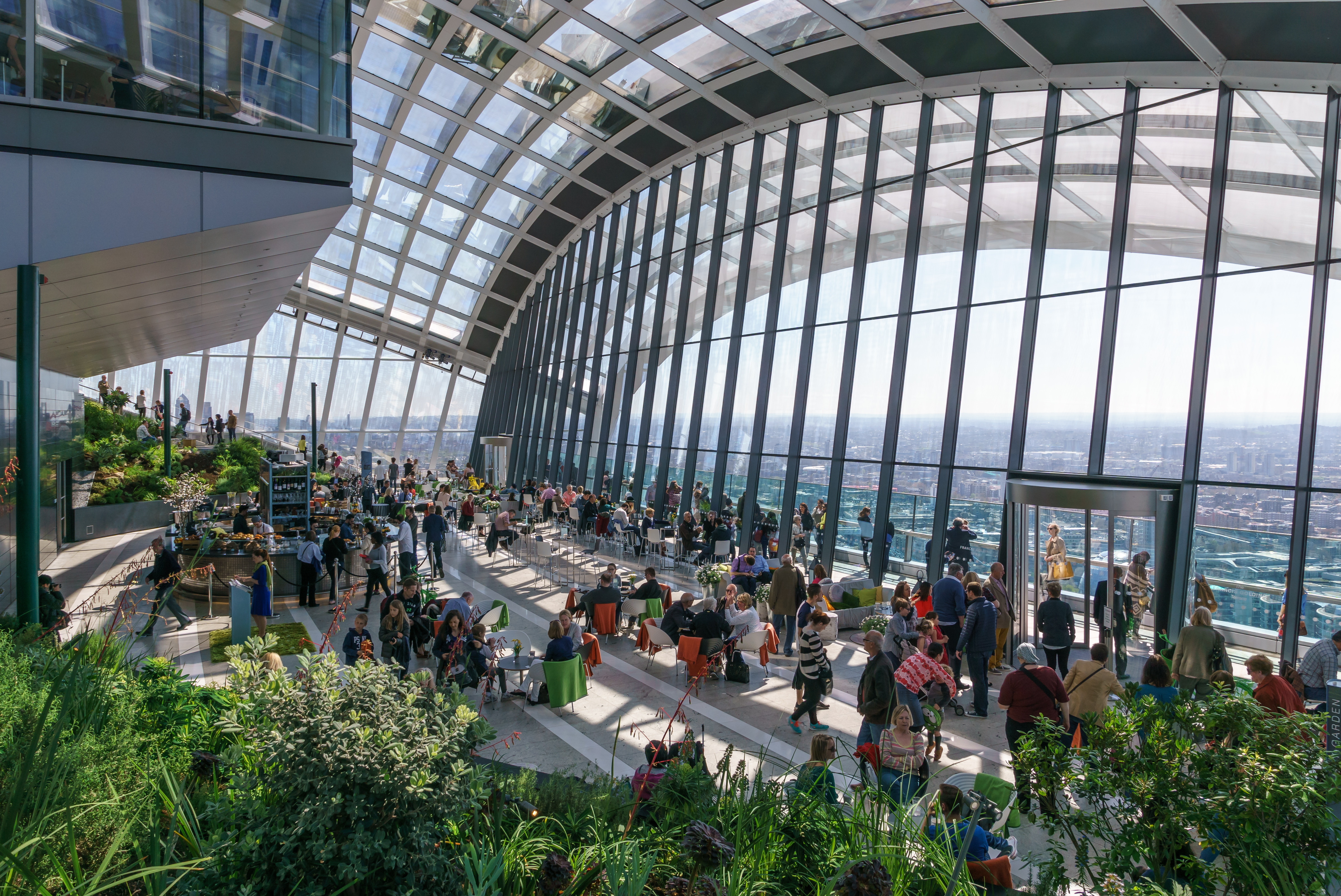
The Sky Garden interior, London — Colin, CC BY-SA 4
Frequently Asked Questions About Sky Garden
Is the sky garden london free to enter?
Entry to the public garden is free, and visitors book a timed ticket in advance on the official site. Tickets are released in batches on Monday mornings for the following three weeks, and each ticket carries the name of the visitor and stays valid for one hour from entry. Booking a table at a restaurant or a bar inside the garden also gives entry, even when the free tickets have run out.
Where is the sky garden london and how do visitors reach it?
The garden fills floors 35 to 37 of 20 Fenchurch Street, at 1 Sky Garden Walk, London EC3M 8AF, in the City of London. Monument and Bank stations stand a few minutes away on foot, and Fenchurch Street and Tower Hill stations are also close. The entrance lies on Philpot Lane, and visitors pass through security checks before taking the lift to floor 35.
How high is the sky garden london and what can visitors see from it?
The garden sits 155 metres above street level, on the top three floors of a tower that stands 160 metres tall. The decks look south to the Thames and The Shard, east to Tower Bridge and the Tower of London, west to Saint Paul’s Cathedral and north to the modern towers of the City. On a clear day the view stretches for many kilometres, while fog can cut the view sharply.
How long should a visit to the sky garden london last?
One hour covers the three floors of the garden, the viewing decks and the outdoor terrace when the weather allows. A meal at the Darwin Brasserie or the Fenchurch Restaurant adds one or two hours, and tables should be booked well ahead, above all at weekends. Time for security checks and the lift should be added on top, above all in the busy hours of weekend afternoons.
Is the sky garden london a UNESCO World Heritage property?
The garden itself holds no UNESCO listing, since it is a modern building that opened in 2015. The nearest listed property is the Tower of London, inscribed in 1988 as reference 488, about ten minutes away on foot to the east. The United Kingdom holds 35 World Heritage properties in total, and London also holds the Palace of Westminster and Westminster Abbey, inscribed in 1987 as reference 426.
How does the sky garden london differ from The Shard?
The garden gives free entry with a booked ticket and a one-hour stay, while the viewing deck of The Shard charges admission and stands far higher, at nearly 310 metres. The garden holds the advantage of green planting inside a glasshouse, with restaurants and a bar that make the visit feel relaxed. The Shard gives a higher and wider view, and many visitors choose the garden for a free panorama and The Shard for the tallest viewpoint in London.
Verified
The Wikidata item Q61740755 covers Sky Garden and classes it simply as a garden. Its stated position, 51.5113 north and 0.0835 west, agrees exactly with the registry coordinates.
The record therefore describes the same place in the registry and in Wikidata, with no mismatch of kind or of location.
The height of 155 metres, the floors from 35 to 37, the tower of 20 Fenchurch Street, the nickname Walkie-Talkie and the opening in January 2015 were checked against the Wikipedia articles on Sky Garden and 20 Fenchurch Street. The free timed tickets, the Monday morning release for the following three weeks, the one-hour limit and the restaurants on floors 36 and 37 were checked on the official site of the garden. The tower architect Rafael Viñoly, the completion year of 2014 and the landscape design by Gillespies come from the same published histories of the building.
The garden holds no inscription of its own, which is what the registry flag records. The Tower of London, reference 488, inscribed in 1988 under criteria two and four, is the closest listed property. The Palace of Westminster and Westminster Abbey, reference 426, inscribed in 1987, lie further west.
Sources
-
Wikipedia, Sky Garden, for the height of 155 metres, the floors from 35 to 37, the opening in January 2015 and the landscape design by Gillespies: https://en.wikipedia.org/wiki/Sky_Garden
-
Wikipedia, 20 Fenchurch Street, for the tower height of 160 metres, the architect Rafael Viñoly, the completion in 2014 and the sunlight reflection in 2013: https://en.wikipedia.org/wiki/20_Fenchurch_Street
-
Sky Garden, official site, for free timed tickets, the Monday morning release, the one-hour limit and the restaurants: https://skygarden.london/
-
UNESCO World Heritage Centre, Tower of London, reference 488, inscribed 1988, criteria two and four, checked 22 November 2026: https://whc.unesco.org/en/list/488/
-
UNESCO World Heritage Centre, Palace of Westminster and Westminster Abbey, reference 426, inscribed 1987, checked 22 November 2026: https://whc.unesco.org/en/list/426/
-
Wikidata, Q61740755 Sky Garden, instance-of and coordinate claims checked through the Wikidata API on 22 November 2026: https://www.wikidata.org/wiki/Q61740755
Unverified
-
Opening hours of the garden by day of the week, which change with the season and with events and must be checked on the official site.
-
Current food and drink prices at the Darwin Brasserie, the Fenchurch Restaurant and the Sky Pod Bar, which change with the menu and must be checked on the official site.
-
The ticket release calendar across holiday weeks, which may differ from the usual Monday morning pattern.
-
Temporary limits on lift capacity and on visitor numbers, which change from time to time and must be checked in the latest notices.
-
Seasonal closing hours of the outdoor Francis Golding Terrace, which can close earlier than the indoor garden and without warning in bad weather.
Illustrations
- Hero: Osaka Japan from Kuchu Teien (Floating Garden) atop Umeda Sky building by Don Ramey Logan. Free image: https://upload.wikimedia.org/wikipedia/commons/9/98/Osaka_Japan_from_Kuchu_Teien_%28Floating_Garden%29_atop_Umeda_Sky_building_by_Don_Ramey_Logan.jpg — CC BY 4.
- In body, aerial view: Tower Bridge aerial view from Sky Garden at night Christmas 2025. Free image: https://upload.wikimedia.org/wikipedia/commons/f/fd/Tower_Bridge_aerial_view_from_Sky_Garden_at_night_Christmas_2025.jpg — CC BY-SA 4.
- In body, Sky Garden in London panorama: HMS Belfast (C35) and north bank of the Thames River seen from the Queen’s Walk, London, UK julesvernex2. Free image: https://upload.wikimedia.org/wikipedia/commons/c/ca/HMS_Belfast_%28C35%29_and_north_bank_of_the_Thames_River_seen_from_the_Queen%27s_Walk%2C_London%2C_UK_julesvernex2.jpg — CC BY-SA 4.
- In body, The Shard: The Shard at sunset. Free image: https://upload.wikimedia.org/wikipedia/commons/f/f2/The_Shard_at_sunset_2017-10-27.jpg — CC BY-SA 4.
- In body, Tower of London: Aerial Tower of London. Free image: https://upload.wikimedia.org/wikipedia/commons/d/df/Aerial_Tower_of_London.jpg — CC BY-SA 3.
- In body, Canary Wharf: Canary Wharf skyline. Free image: https://upload.wikimedia.org/wikipedia/commons/d/df/Canary_Wharf_Skyline_2%2C_London_UK_-_Oct_2012.jpg — CC BY-SA 3.
- In body, 20 Fenchurch Street: 20 Fenchurch St (Walkie-Talkie building) from Rood Ln, London, UK – Diliff. Free image: https://upload.wikimedia.org/wikipedia/commons/c/c9/20_Fenchurch_St_%28Walkie-Talkie_building%29_from_Rood_Ln%2C_London%2C_UK_-_Diliff.jpg — CC BY-SA 3.
- In body, Saint Paul’s Cathedral: Millennium Bridge and Saint Paul’s Cathedral. Free image: https://upload.wikimedia.org/wikipedia/commons/9/93/London_-Millennium_Bridge%26_Saint_Paul_Cathedral.jpg — CC BY-SA 3.
- In body, landscaped garden: The Sky Garden interior, London. Free image: https://upload.wikimedia.org/wikipedia/commons/c/ca/The_Sky_Garden.jpg — CC BY-SA 4.