
Costa Rica — All-Inclusive Eco-Vacations in the Land of Pura Vida
Costa Rica is a small country between Nicaragua and Panama. Its volcanoes, beaches and eco-lodges draw travellers from every part of the world.
Costa Rica is a country in Central America, between Nicaragua to the north and Panama to the south-east, with the Caribbean Sea to the north-east and the Pacific Ocean to the south-west, and it is a country that chose the forest over the army. A Costa Rica vacation all inclusive is the way many travellers meet it, staying in an eco-lodge where the room, the meals, the guides and the trails are arranged as one package, yet the country behind the lodge is a democracy without soldiers, a land of volcanoes, cloud forests and two coasts. This guide explains where Costa Rica stands, how it grew from a poor Spanish colony into a green republic, and how a traveller plans a Costa Rica vacation all inclusive, with the lodges, the parks and the wildlife beyond them.
Quick Facts
- Name: Costa Rica, officially the Republic of Costa Rica, a presidential republic in Central America.
- Position: Between Nicaragua to the north and Panama to the south-east, with the Caribbean Sea to the north-east and the Pacific Ocean to the south-west.
- Coordinates: Ten degrees north and eighty-four degrees west, by the country Wikidata item Q800.
- Capital: San José, the capital and the largest city, with about three hundred and fifty thousand residents and about two million people in its metropolitan area.
- Area: Fifty-one thousand one hundred and eighty square kilometres, a small country with two coasts.
- Population: Around five million people.
- Army: Costa Rica has no standing army, abolished by the constitution of nineteen forty-nine.
- Heritage: Four World Heritage sites, three natural and one cultural, with the first inscribed in nineteen eighty-three.
- Nearest World Heritage: The Precolumbian Chiefdom Settlements with Stone Spheres of the Diquís, ref 1453, about one hundred and thirty kilometres south-east of the geographic centre of the country in a straight line.
- Highest peak: Cerro Chirripó, the highest elevation in Costa Rica and in all of southern Central America, at three thousand eight hundred and nineteen metres.
- Climate: Tropical, with a dry season from December to April and a wet season from May to November, and cooler air in the highlands.
- Economy: Once dependent on coffee and bananas, now diversified into finance, corporate services, pharmaceuticals and ecotourism.
Geography of Costa Rica
Costa Rica is a small country with a large nature, and its geography is a narrow bridge between two continents and two oceans. The country borders Nicaragua to the north, the Caribbean Sea to the north-east, Panama to the south-east and the Pacific Ocean to the south-west, and it shares a maritime border with Ecuador to the south of Cocos Island. The land is a chain of volcanic mountains running north-west to south-east, with the Central Valley in the middle, where most of the people live, and the coasts on either side. The mountains divide the country into the Caribbean slope, wet and green all year, and the Pacific slope, drier and sunnier, and the traveller who crosses the country passes through both in a single day.
The volcanoes are the great fact of Costa Rican geography, and they rise in a chain across the centre of the country. Arenal is the most famous, a near-perfect cone that rises above the lake of the same name, and Poás and Irazú stand near the capital, with their craters and their lakes. The Talamanca Range in the south-east holds Cerro Chirripó, the highest elevation in Costa Rica and in all of southern Central America, at three thousand eight hundred and nineteen metres, and the range holds the cloud forests, the oak forests and the high páramo of the World Heritage reserves. The volcanoes are the reason for the rich soil, the hot springs and the lakes, and the traveller who visits them sees the living geology of the isthmus.
The coasts of Costa Rica are two different worlds, and the holiday changes with the ocean. The Caribbean coast is wet and green, with the canals and the rainforest of Tortuguero, where the sea turtles come to nest, and the beaches of the south Caribbean, with their Afro-Caribbean culture and their reggae. The Pacific coast is drier and sunnier, with the beaches of the Nicoya Peninsula, the surf of Santa Teresa and the national park of Manuel Antonio, where the forest meets the sand.
The Osa Peninsula in the far south holds the Corcovado National Park, a rainforest of extraordinary wildlife, and the Gulf of Dulce is the quiet water behind it. A Costa Rica vacation all inclusive can be built on either coast, and the choice between the Caribbean rain and the Pacific sun is the first choice of the holiday.
The forests of Costa Rica are the reason the country is famous, and they cover the mountains, the coasts and the valleys. The cloud forests of Monteverde and the Talamanca Range hold the mosses, the orchids and the resplendent quetzal, and the lowland rainforests of the Osa and the Caribbean hold the monkeys, the toucans and the scarlet macaws. About a quarter of the country is protected in national parks and reserves, and the protected areas are the backbone of the ecotourism that brings the travellers. The country is small, yet it holds a remarkable share of the species of the planet, and its forests are the reason travellers come from every part of the world to see them.
The climate of Costa Rica is tropical, with the dry season from December to April and the wet season from May to November, which the locals call the green season. The Caribbean coast has no true dry season, and the rain falls there in every month, while the Pacific coast and the Central Valley are drier from December to April. The highlands are cooler than the coasts, and the nights in the mountains need a jacket, while the beaches are hot all year. The best season for a Costa Rica vacation all inclusive is December to April, when the Pacific is dry and the roads are good, though the green season brings lower prices, fewer visitors and a greener forest.
The nearest World Heritage site to the geographic centre of Costa Rica is the Precolumbian Chiefdom Settlements with Stone Spheres of the Diquís, ref 1453, inscribed in two thousand and fourteen with criterion three, about one hundred and thirty kilometres south-east of the centre in a straight line. The property is a serial site of four archaeological settlements in the Diquís Delta, with the stone spheres, the mounds and the paved areas of the chiefdom societies that lived there from the sixth to the sixteenth century. The Talamanca Range-La Amistad Reserves, ref 205, inscribed in nineteen eighty-three with criteria seven, eight, nine and ten, are the second nearest, about one hundred and thirty-four kilometres south-east of the centre, along the border with Panama. The reserve covers large tracts of the highest and wildest non-volcanic mountain range in Central America, with peaks above three thousand metres, a surface of five hundred and seventy thousand and forty-five hectares, some ten thousand flowering plants, about six hundred species of birds and two hundred and fifteen species of mammals.
The land around the lodges is the countryside of Costa Rica, with the coffee farms of the Central Valley, the banana plantations of the Caribbean lowlands and the cattle ranches of Guanacaste. The coffee was first planted in eighteen hundred and eight, and by the eighteen twenties it had become the main export, and the wealth of the coffee growers modernised the country. The railroad from San José to the Caribbean port of Limón was completed in eighteen ninety, and the bananas that followed it came to rival coffee as the main export. The country that was once the poorest Spanish colony in the Americas is now a high-income economy, and the only country in Central America and the Caribbean in the Organisation for Economic Co-operation and Development.
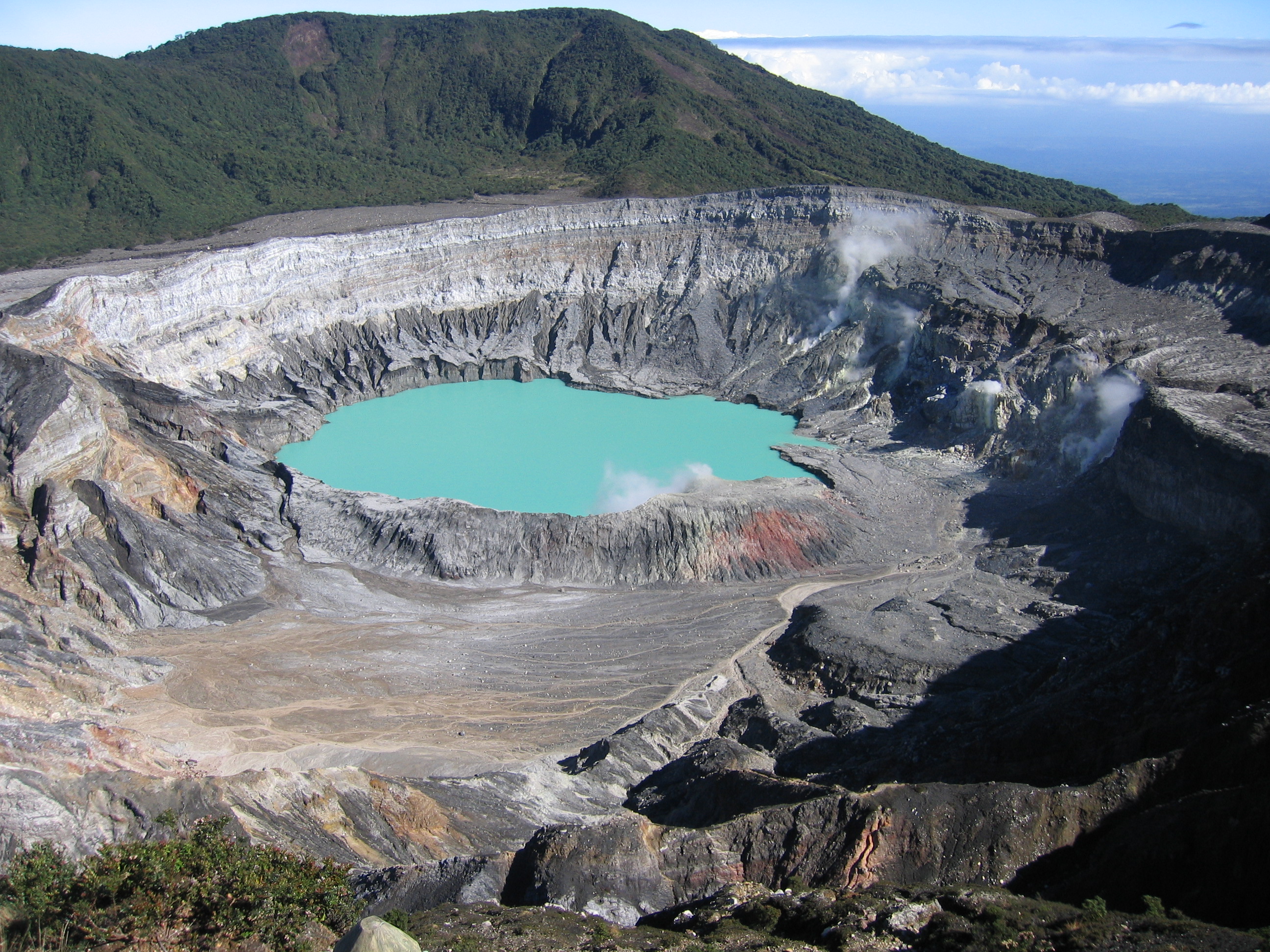
The crater lake of Poás Volcano — CC BY 2.5

The crater of Irazú Volcano — CC0
History of Costa Rica
People have lived in Costa Rica since between seven thousand and ten thousand years before Christ, and the stone tools of the Turrialba Valley are the oldest evidence of their presence. The indigenous peoples of the country belonged to the Intermediate Area, where the Mesoamerican and Andean cultures met, and the Bribri and the Boruca peoples still live in the mountains of the Talamanca Range. Agriculture appeared about five thousand years ago, with tubers and roots as the first crops, and the settled farming communities of the first and second millennia before Christ built the villages and the pottery of the early country. The name of the country, meaning rich coast, was first applied by Christopher Columbus, who sailed to the eastern shores on his final voyage in fifteen hundred and two, and reported the gold jewellery of the natives, though the gold was never as rich as the name promised.
The Spanish colonised Costa Rica in the sixteenth century, and the country was the southernmost province of the Captaincy General of Guatemala, nominally part of the Viceroyalty of New Spain, under the rule of Spain. The distance from the capital in Guatemala, the legal ban on trade with Panama, and the lack of gold and silver made Costa Rica a poor, isolated and sparsely inhabited region of the Spanish Empire, and a Spanish governor in seventeen nineteen called it the poorest and most miserable Spanish colony in all America. The country had no great native civilisation to absorb, and most of the native population was absorbed into the Spanish-speaking colonial society through marriage, except for the small remnants in the mountains. The poverty of the colony is the root of the equality of the republic, because there were no great estates and no great fortunes to divide the people.
Costa Rica declared independence with the rest of Central America on the fifteenth of September eighteen twenty-one, after the Spanish defeat in the Mexican War of Independence, and it joined the First Mexican Empire of Mexico and then the Federal Republic of Central America. The country withdrew from the federation and stood alone as a sovereign republic, and the capital moved from Cartago to San José after the Battle of Ochomogo in eighteen twenty-three. Coffee was first planted in eighteen hundred and eight, and by the eighteen twenties it had surpassed tobacco, sugar and cacao as the main export, and the revenue of the coffee growers, the so-called Coffee Barons, modernised the country. The coffee was grown around the Central Valley and carried by oxcart to the Pacific port of Puntarenas, and the main market was Britain, in the United Kingdom, so the country looked to the sea and to the world.
The railroad changed the country, and the government contracted with the businessman Minor Keith in the eighteen seventies to build a railroad from San José to the Caribbean port of Limón. The railroad was completed in eighteen ninety, after enormous difficulties with construction, disease and financing, and the Afro-Costa Ricans who built it, descended from Jamaican immigrants, now make up about three per cent of the population. In exchange for the railroad, the government granted Keith large tracts of land and a lease on the train route, which he used to grow bananas and export them to the United States, and the bananas came to rival coffee as the main export. The foreign companies that followed became a symbol of the exploitative export economy, and the great banana strike was a step towards the trade unions of the country.
The twentieth century brought the two great turning points of Costa Rican history, and both made the country what it is today. The first was the brief civil war of nineteen forty-eight, after which the country adopted its current constitution in nineteen forty-nine, granting universal suffrage and permanently abolishing the army, becoming one of the few sovereign nations without a standing military. The second was the decision to protect the forest, and the country built the system of national parks and reserves that now covers about a quarter of its land. Costa Rica has enjoyed greater peace and more consistent political stability than many of its fellow Latin American nations, and it has performed favourably in the Human Development Index, placing sixty-second globally and fifth in Latin America in two thousand and twenty-three.
Today Costa Rica is a presidential republic with a robust and stable democracy, a high-income economy and a leader in human rights and environmentalism. The country spends about a quarter of its national budget on education, which has been free and compulsory since eighteen eighty-six, and it has one of the highest literacy rates in the Americas. A Costa Rica vacation all inclusive is a holiday in a country that chose schools and forests over soldiers, and the traveller who goes finds a place where the lodge, the park and the wildlife are the whole of the holiday, and where the greeting of pura vida, the pure life, is the philosophy of the country.

The National Theatre in San José — CC BY-SA 3
Travel to Costa Rica
Most travellers reach Costa Rica by air, landing at the international airport of San José in the Central Valley, or at the airport of Liberia in Guanacaste, near the Pacific beaches. A Costa Rica vacation all inclusive usually begins with the flight and the lodge booked as one package, and the package covers the room, the meals, the guides and the excursions, with the transport between the lodges as an extra. The traveller should check what is included before booking, and should compare the lodge, the park and the distance from the airport, because a lodge near Arenal is a different holiday from a lodge in the Osa Peninsula. The eco-lodges are the heart of the holiday, and the best of them are small, with a handful of rooms, a restaurant of local food and a guide who knows the forest.
The lodges divide by region, and the choice of region is the choice of holiday. Arenal holds the volcano lodges, with the hot springs, the lake and the hanging bridges, and Monteverde holds the cloud forest lodges, with the mist, the quetzal and the canopy walks. Manuel Antonio holds the beach lodges, with the forest meeting the sand, and Tortuguero holds the canal lodges, reached only by boat or by small plane, with the turtles and the canals.
The Osa Peninsula holds the wildest lodges, with the rainforest of Corcovado and the dolphins of the gulf, and the traveller who wants the deepest nature should go there. A Costa Rica vacation all inclusive works best when the traveller stays in two or three lodges, moving from the volcano to the cloud forest to the beach, rather than staying in one place.
The wildlife is the reason most travellers come, and the guides are the key to seeing it. The sloths hang in the trees, the toucans call from the canopy, the scarlet macaws fly over the Osa, and the monkeys move through the forest in troops, and the guide finds them by ear and by eye. The sea turtles nest on the beaches of Tortuguero from July to October, and the humpback whales visit the Pacific coast in the winter months, and the resplendent quetzal lives in the cloud forest of Monteverde and the Talamanca Range. The traveller should take the guided walk at dawn, when the forest is loudest, and should bring binoculars, because the wildlife is often high in the trees.
The best season for a Costa Rica vacation all inclusive is December to April, when the Pacific coast is dry and the roads are good, and the lodges are busiest at Christmas and Easter. The green season from May to November brings the rain in the afternoons, the lower prices and the fewer visitors, and the forest is at its greenest then, with the rivers full and the waterfalls strong. November is the shoulder month, with the rain easing and the prices still low, and it is a good month for the traveller who wants the green without the crowds. The traveller should pack light clothes, rain gear, sturdy shoes and binoculars, and should carry cash in small notes for tips and for the markets, because the cards work in the lodges but the small stalls prefer cash.
Costa Rica is one of the safer countries in the region, and the lodges have their own guides and transport, yet the traveller should still take the usual care. The roads are narrow and winding, and the traveller should use the shared shuttles and the domestic flights between the regions, and hire a car only for the main paved roads. The sun is strong and the rain is sudden, so sun protection and rain gear matter, and the traveller should drink bottled water outside the lodges. A Costa Rica vacation all inclusive works best when the traveller slows down, because the forest rewards the patient, and the holiday is measured in animals seen and trails walked, not in miles covered.

Shows a Montezuma oropendola, a bird of the Costa Rican forest, in the trees — CC0
Notable Places in Costa Rica
Arenal Volcano — The Cone Above the Lake
Arenal is the most famous volcano in Costa Rica, a near-perfect cone that rises above the lake of the same name in the north of the country. The volcano stands in a national park of forest, lava fields and hot springs, and the lodges around it give the traveller the view of the cone from the pool. The lake is the largest in the country, and the hanging bridges of the forest give a walk through the canopy. Come in the dry season, when the cone is clear, and take the hot springs in the evening, when the air cools and the steam rises.
Monteverde Cloud Forest — The Mist and the Quetzal
Monteverde is a cloud forest reserve in the mountains of the north-west, and it is the place to see the resplendent quetzal, the bird of the cloud forest. The forest is wet and green, with the mosses, the orchids and the epiphytes covering the trees, and the canopy walks and the hanging bridges give a view from above. The reserve is cooler than the lowlands, and the mist comes and goes through the day, so the traveller should bring a jacket and patience. Come at dawn, when the birds are loudest, and take the guided walk, because the guide finds the quetzal by ear.
Manuel Antonio — The Forest on the Beach
Manuel Antonio is a small national park on the Pacific coast, where the rainforest meets the white sand beaches, and it is the most visited park in the country. The trails run through the forest to the beaches, with the monkeys, the sloths and the iguanas along the way, and the sea is warm and calm. The park is small, so the traveller should arrive early, because the entry is limited and the beaches fill by midday. Come in the morning, when the animals are active, and swim in the afternoon, when the sun is high and the water is warm.
Tortuguero — The Canals and the Turtles
Tortuguero is a national park on the Caribbean coast, a network of canals, lagoons and rainforest, reached only by boat or by small plane. The park is the nesting ground of the sea turtles, which come ashore from July to October, and the canals hold the caimans, the monkeys and the birds of the rainforest. The lodges of Tortuguero are the base for the boat trips, and the village is small and quiet. Come in the turtle season, with a guide and a red light, and take the boat in the morning, when the canals are calm and the wildlife is feeding.
The Osa Peninsula and Corcovado — The Wild South
The Osa Peninsula is the wild south of Costa Rica, with the Corcovado National Park as its heart, a rainforest of extraordinary wildlife on the Pacific coast. The park holds the tapirs, the scarlet macaws, the monkeys and the wild cats of the forest, and the beaches of the peninsula are the nesting grounds of the turtles. The lodges of the Osa are the most remote in the country, reached by boat or by small plane, and the traveller should allow several days for the visit. Come in the dry season, with a guide and sturdy shoes, and take the trail at dawn, when the forest wakes.

Shows the volcano cone above the green forest — CC BY-SA 4
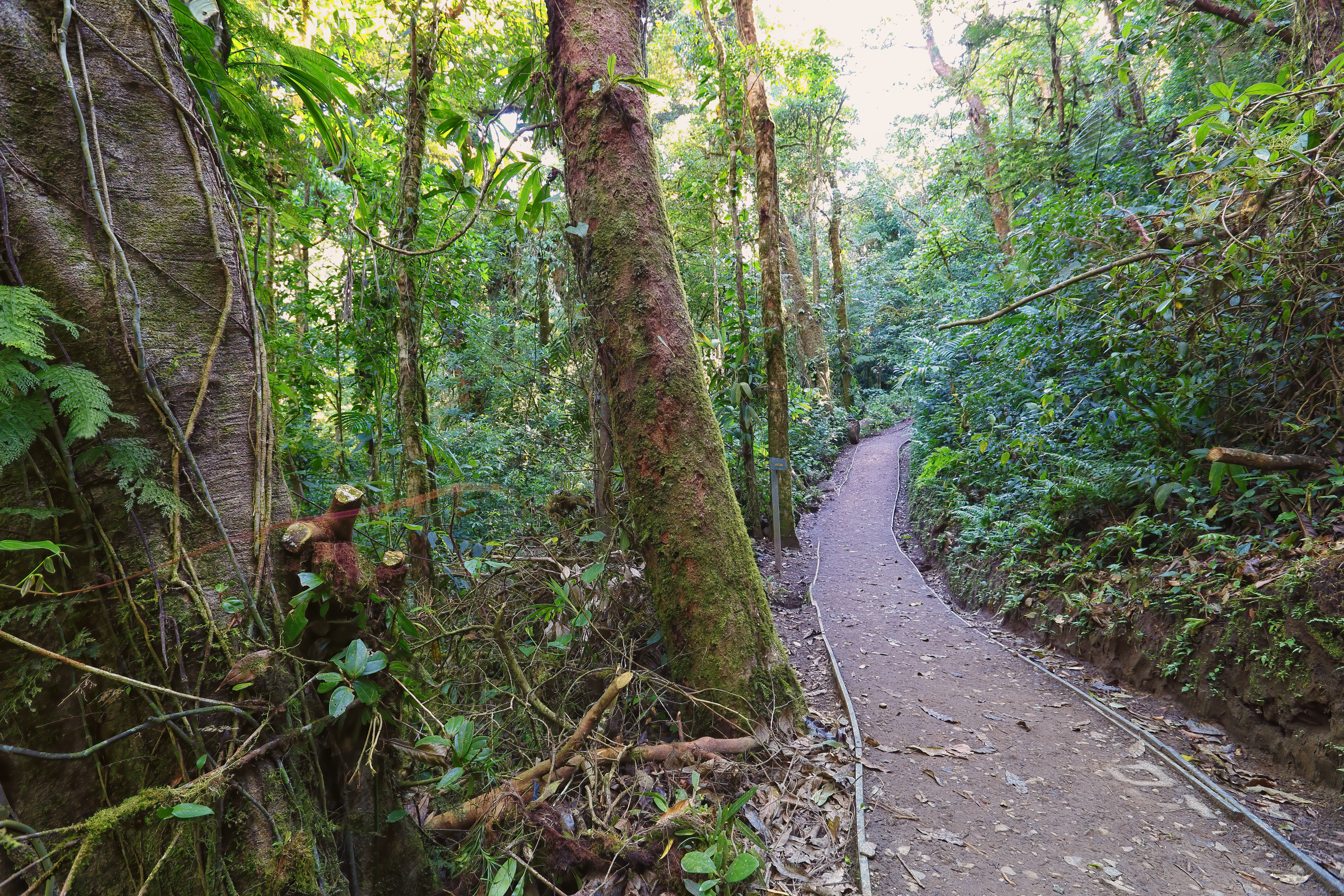
Shows the misty green forest of the reserve, with the trees and the undergrowth — CC BY-SA 4

The beach and forest of Manuel Antonio National Park — CC BY 4

A canal through the rainforest of Tortuguero — CC BY 2

The rainforest of Corcovado National Park on the Osa Peninsula — CC0

A resplendent quetzal in the cloud forest of Costa Rica — CC0
Frequently Asked Questions
What should I visit in Costa Rica?
Visit Arenal, Monteverde, Manuel Antonio, Tortuguero and the Osa Peninsula for volcanoes, cloud forest, beaches and wildlife.
When is the best time to visit Costa Rica?
Visit from December to April for dry weather, or May to November for green landscapes and lower prices.
Do I need a visa to visit Costa Rica?
Most visitors from North America and Europe enter without a visa, but check the current rules before travel.
Is Costa Rica safe for travellers?
Costa Rica is one of the safer countries in the region, but guard valuables and avoid lonely beaches at night.
What animals can I see in Costa Rica?
Look for sloths, toucans, scarlet macaws, monkeys, sea turtles and the resplendent quetzal in the cloud forest.
How do I get around Costa Rica?
Use shared shuttles and domestic flights between regions, and hire a car only for the main paved roads.
Verified
- Costa Rica is Wikidata item Q800, a country in Central America, at ten degrees north and eighty-four degrees west, checked 26/11/2026.
- Costa Rica has a population of around five million people in a land area of fifty-one thousand one hundred and eighty square kilometres, with San José as its capital and largest city, checked 26/11/2026.
- Costa Rica declared independence with the rest of Central America on the fifteenth of September 1821, and it joined the First Mexican Empire and then the Federal Republic of Central America, checked 26/11/2026.
- Following a brief civil war in 1948, Costa Rica adopted its current constitution in 1949, which permanently abolished the army and granted universal suffrage, checked 26/11/2026.
- Coffee was first planted in Costa Rica in 1808, and by the 1820s it had become the main export, checked 26/11/2026.
- The railroad from San José to the Caribbean port of Limón was completed in 1890, and bananas came to rival coffee as the main export, checked 26/11/2026.
- Education has been free and compulsory in Costa Rica since 1886, and the country placed sixty-second globally in the Human Development Index in 2023, checked 26/11/2026.
- The Talamanca Range-La Amistad Reserves, ref 205, was inscribed in 1983 with criteria (vii), (viii), (ix) and (x), and lies about one hundred and thirty-four kilometres south-east of the geographic centre of Costa Rica in a straight line, the second nearest World Heritage site after the Diquís, checked 26/11/2026.
- Cerro Chirripó is the highest elevation in Costa Rica and in all of southern Central America, at three thousand eight hundred and nineteen metres, checked 26/11/2026.
- The Precolumbian Chiefdom Settlements with Stone Spheres of the Diquís, ref 1453, was inscribed in 2014 with criterion (iii), is the only cultural World Heritage site in Costa Rica, and lies about one hundred and thirty kilometres south-east of the geographic centre of the country in a straight line, the nearest World Heritage site, checked 26/11/2026.
Sources
- Costa Rica — Wikipedia (https://en.wikipedia.org/wiki/Costa_Rica) — population, area, history, coffee, railroad, army abolition, education; checked 26/11/2026.
- Talamanca Range-La Amistad Reserves / La Amistad National Park — UNESCO (https://whc.unesco.org/en/list/205/) — ref 205, criteria (vii), (viii), (ix) and (x), Cerro Chirripó; checked 26/11/2026.
- List of World Heritage Sites in Costa Rica — Wikipedia (https://en.wikipedia.org/wiki/List_of_World_Heritage_Sites_in_Costa_Rica) — four sites, Diquís 2014, La Amistad 1983; checked 26/11/2026.
- Wikidata API — Q800 (https://www.wikidata.org/wiki/Q800) — country, coordinates; checked 26/11/2026.
Unverified
- The room rates and the package prices of the eco-lodges in Arenal, Monteverde and the Osa Peninsula change with the season, and the article gives no fixed price, so the traveller should check the lodge directly before booking.
- The entry and visa rules for Costa Rica change, and the article gives no fixed rule for any nationality, so the traveller should check the official government site before going.
- The exact share of the country under protection has not been checked against a source from two thousand and twenty-six, so the article gives no figure for it beyond the protected areas named.
- The nesting dates of the sea turtles at Tortuguero change each year, and the article gives no fixed dates, so the traveller should check the park operators before going.
Illustrations
- Hero — Arenal Volcano above the lake. Placement: opening of the article. Shows the cone of the volcano rising above the forest and the lake, with the clouds around its peak. Free image: Arenal Volcano 01.jpg (https://upload.wikimedia.org/wikipedia/commons/a/af/Arenal_Volcano_01.jpg) — Wikimedia Commons, CC0.
- In-body — Arenal Volcano from the forest. Placement: Notable Places section, Arenal entry. Shows the volcano cone above the green forest. Free image: Arenal Volcano (70602).jpg (https://upload.wikimedia.org/wikipedia/commons/7/7a/Arenal_Volcano_%2870602%29.jpg) — Wikimedia Commons, CC BY-SA 4.
- In-body — Monteverde cloud forest. Placement: Notable Places section, Monteverde entry. Shows the misty green forest of the reserve, with the trees and the undergrowth. Free image: Monteverde Reserve Costa Rica 02.jpg (https://upload.wikimedia.org/wikipedia/commons/2/20/Monteverde_Reserve_Costa_Rica_02.jpg) — Wikimedia Commons, CC BY-SA 4.
- In-body — The forest wildlife of Costa Rica. Placement: Travel section. Shows a Montezuma oropendola, a bird of the Costa Rican forest, in the trees. Free image: Montezuma oropendola (Psarocolius montezuma), Costa Rica.jpg (https://upload.wikimedia.org/wikipedia/commons/8/83/Montezuma_oropendola_%28Psarocolius_montezuma%29%2C_Costa_Rica.jpg) — Wikimedia Commons, CC0.
– In body, Manuel Antonio: The beach and forest of Manuel Antonio National Park. Free image: https://upload.wikimedia.org/wikipedia/commons/5/58/Manuel_Antonio_beach%2C_Costa_Rica.jpg — CC BY 4.
– In body, Tortuguero: A canal through the rainforest of Tortuguero. Free image: https://upload.wikimedia.org/wikipedia/commons/9/91/A_Tortuguero_canal_-Flickr-_S._Rae.jpg — CC BY 2.
– In body, the Osa Peninsula and Corcovado: The rainforest of Corcovado National Park on the Osa Peninsula. Free image: https://upload.wikimedia.org/wikipedia/commons/c/c0/Corcovado_National_Park%2C_Costa_RIca_01.jpg — CC0.
– In body, Poás Volcano: The crater lake of Poás Volcano. Free image: https://upload.wikimedia.org/wikipedia/commons/3/3f/Poas_crater.jpg — CC BY 2.5.
– In body, Irazú Volcano: The crater of Irazú Volcano. Free image: https://upload.wikimedia.org/wikipedia/commons/f/f5/Iraz%C3%BA_Volcano_01.jpg — CC0.
– In body, San José: The National Theatre in San José. Free image: https://upload.wikimedia.org/wikipedia/commons/6/69/Costa_Rica-Teatro_Nacional.JPG — CC BY-SA 3.
– In body, the resplendent quetzal: A resplendent quetzal in the cloud forest of Costa Rica. Free image: https://upload.wikimedia.org/wikipedia/commons/f/fe/Resplendent_quetzal_in_Costa_Rica_01.jpg — CC0.