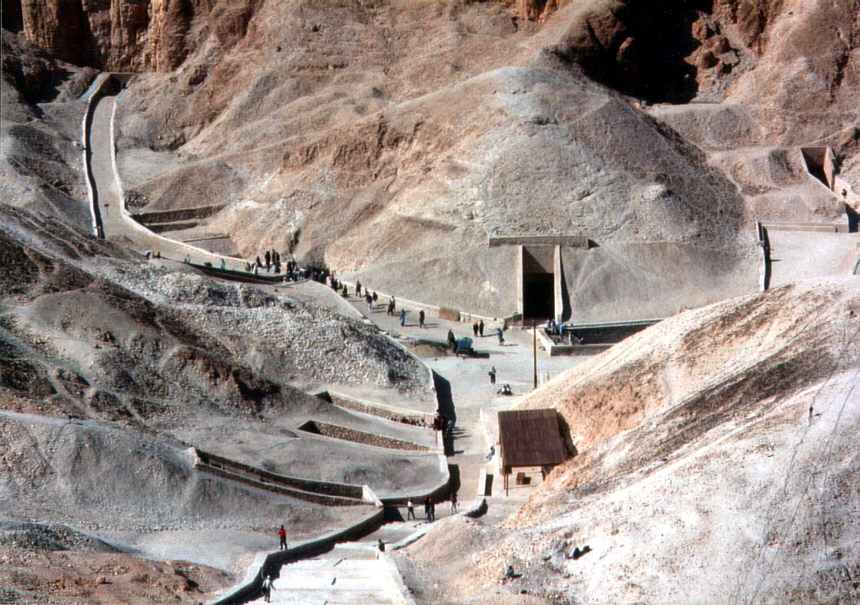
Valley of the Kings — Tombs of the New Kingdom Pharaohs at Luxor
The Valley of the Kings holds the tombs of New Kingdom pharaohs. Painted corridors run deep into the limestone hills west of Luxor.
Travellers search for the Valley of the Kings with the French phrase “voyage egypte vallée des rois”, and this guide follows that intent: the place of the valley inside ancient Thebes, nearly five centuries of royal burial, the famous tombs from KV62 of Tutankhamun to KV17 of Seti I, and how to visit the valley in a morning from Luxor. The valley is part of Ancient Thebes with its Necropolis, listed by UNESCO in 1979.
Quick Facts
- Place: A dry valley on the west bank of the Nile, opposite Luxor, about seven hundred kilometres south of Cairo.
- Arabic name: Wadi al-Muluk, the Valley of the Kings.
- In use: About 1539 to 1075 before the common era, through Dynasties 18, 19 and 20 of the New Kingdom.
- Tombs: More than sixty known tombs and chambers, numbered KV1 to KV65, of which about twenty belonged to kings.
- Famous tomb: KV62 of Tutankhamun, found in 1922, the only royal tomb found nearly intact.
- UNESCO: Part of Ancient Thebes with its Necropolis, listed in 1979, ref 87, criteria (i), (iii) and (vi).
Geography of the Valley of the Kings
The Valley of the Kings lies in a dry mountain valley on the west bank of the Nile, behind the limestone hills of Thebes, opposite the city of Luxor today. From the river bank, visitors cross the green fields of the village of Qurna, then turn onto a narrow mountain road leading to the gate of the valley, where steep rock walls close around a dry river bed. The shape of the place was chosen with care: the ancient Egyptians picked a hidden valley, hard to reach, to hide the royal tombs from robbers, unlike the open pyramids of the Old Kingdom.
The valley has two branches. The East Valley holds most of the famous royal tombs, from KV62 of Tutankhamun to KV17 of Seti I and KV9 of Ramesses V and Ramesses VI. The West Valley, also called the Valley of the Monkeys, holds only a few tombs, among them WV22 of Amenhotep III and WV23 of Ay, and fewer visitors walk there. Between the two branches stands a limestone peak shaped like a natural pyramid, called el-Qurn, which the ancient Egyptians saw as a pyramid of nature guarding the valley.
The ancient craftsmen reached the valley on foot, over the mountain from their village, and the same path can still be walked today. The trail climbs from Deir el-Medina over the Theban hills, past the peak of el-Qurn, and drops into the valley from above, giving a view over the whole wadi that the road from the river never shows. Walking the path takes about an hour and a half, and it suits the cooler months, when the climb is pleasant and the light on the limestone is at its best. The path also explains why the valley stayed hidden for so long: from the river the hills look like a solid wall, and only the narrow gap at the valley mouth gives the secret away.
The Valley of the Kings is part of the great Theban Necropolis, stretching over about ten square kilometres on the west bank, where archaeologists have found thousands of tombs, scores of temples, and many villages, monasteries and ancient workshops. East of the valley lies the village of Deir el-Medina, home of the craftsmen who dug and painted the tombs for many generations. To the south stands the funerary temple of Hatshepsut at Deir el-Bahari and the temple of Medinet Habu of Ramesses III, and to the north lies the Valley of the Queens, where queens and princes of the New Kingdom were buried.
The climate of the Valley of the Kings is hot and dry desert, with summer temperatures often above forty degrees and a much cooler winter. The valley has almost no natural shade, so visitors should come in the early morning, with a hat, water and sunscreen. Rain rarely falls here, but sudden heavy rains in history have flooded and damaged some tombs, so a modern drainage system has been built to protect the monuments. The best light for photographs comes in the morning, when the sun is low and the rock walls glow, and the heat of midday makes the valley hard to walk in summer.
From the centre of Luxor, visitors cross the bridge to the west bank and drive about thirty minutes to the gate of the Valley of the Kings. The west bank of Luxor is also called the City of the Dead, set against the east bank as the City of the Living, with the temples of Karnak and Luxor. The division reflects ancient Egyptian belief: the sun rises in the east, tied to life, and sets in the west, tied to the world of the dead, so the pharaohs chose the west bank for their eternal rest.
The valley is part of Ancient Thebes with its Necropolis, listed by UNESCO in 1979, ref 87, under criteria (i), (iii) and (vi). The property covers seven thousand three hundred and ninety hectares, with a buffer zone of four hundred and forty-four hectares, and it holds the temples of Karnak and Luxor on the east bank and a large archaeological area on the west bank. The nearest separate inscribed property is Saint Catherine Area, ref 954, about three hundred and forty-one kilometres to the north-north-east in a straight line, on the Sinai Peninsula. Abu Simbel, ref 88, lies about three hundred and ninety-one kilometres to the south-south-west.
History of the Valley of the Kings
Before the New Kingdom, the pharaohs of Egypt were buried in pyramids, but these open monuments had been robbed clean very early. At the start of Dynasty 18, about 1539 before the common era, the kings of Thebes decided to hide their tombs inside the limestone hills of the Valley of the Kings, hoping to keep the places secret and protect the treasure. The first tomb in the valley is usually said to be that of Thutmose I, though some evidence suggests that burial here may have begun under Amenhotep I, his predecessor.
For nearly five hundred years after that, the Valley of the Kings was the main royal cemetery of Egypt, with pharaohs of Dynasties 18, 19 and 20 brought here in turn. Each tomb is a sloping corridor cut deep into the rock, leading to pillared halls and a burial chamber, with walls covered in paintings and hieroglyphs from books about the world beyond, such as the Amduat, the Book of Gates and the Litany of Ra. Building each tomb took many years, sometimes the whole reign of the king, and the work was done by the craftsmen of Deir el-Medina.
The golden age of the Valley of the Kings belongs to the most famous kings of the New Kingdom. Thutmose III, the great conqueror, rests in KV34, deep in a narrow cleft. Amenhotep III, the king of an age of plenty, has his tomb WV22 in the West Valley.
Seti I, who opened Dynasty 19, owns KV17, the longest and most beautiful tomb in the valley. Ramesses II, who reigned for sixty-six years, was buried in KV7, and his son Ramesses III in KV11. Tutankhamun, the young king who died at nineteen, was buried in haste in KV62, a small tomb that was probably not made for a king.
Late in the New Kingdom, Egypt grew weak and the Valley of the Kings was no longer guarded as before. Most tombs had been robbed in ancient times, and the priests of Dynasty 21 had to move the mummies of many pharaohs to hidden places to protect them. Two famous royal mummy caches were found in modern times: the cache at Deir el-Bahari in 1881 and the cache inside KV35 in 1898, where the mummies of many great kings were found. After Ramesses X or Ramesses XI, about 1075 before the common era, royal burial in the Valley of the Kings came to an end.
The valley lay forgotten for many centuries, though local people still knew the entrances. In modern times the first tomb to be recorded was KV17 of Seti I, found by the explorer Giovanni Battista Belzoni in 1817. In 1827 John Gardner Wilkinson devised the KV numbering system still used today, with the tombs numbered in the order of discovery. Systematic searching ran through the nineteenth century and the early twentieth century, with many archaeologists holding the concession to dig in the valley in turn.
The peak of the modern story came on 4 November 1922, when Howard Carter, working for Lord Carnarvon, found the first step leading down to KV62, the tomb of Tutankhamun. This is the only royal tomb ever found nearly intact, though ancient robbers had once broken in and sealed it again. Clearing and conserving the treasure lasted until 1932, and the discovery made the Valley of the Kings the most famous archaeological place in the world.
After KV62 the valley kept giving up secrets: KV63 was found in 2005, two further tomb entrances were found in 2008, and the entrance now called KV65 was found in 2018. In February 2025 Egypt announced the identification of the tomb of Thutmose II west of the valley, the first royal tomb found since Tutankhamun.
In 1979 UNESCO listed Ancient Thebes with its Necropolis, including the Valley of the Kings, on the World Heritage List, under criteria (i), (iii) and (vi). The property holds the temples of Karnak and Luxor on the east bank and the great archaeological area on the west bank, as an outstanding witness to Egyptian civilisation at its height. Today the Valley of the Kings is the most visited archaeological site of Egypt, and conservation work goes on to fight damp, mould and the wear of millions of visitors each year.
Travel to the Valley of the Kings
The general ticket for the Valley of the Kings covers three tombs among those open, and visitors choose three tombs when they enter. Some of the most famous tombs need a separate ticket, among them KV62 of Tutankhamun, KV9 of Ramesses V and Ramesses VI, and KV17 of Seti I. Visitors should arrive early, because the tombs open in the morning and the midday sun in the valley is fierce. From the gate a small train runs to the area of the tombs, saving a walk under the sun.
A sound plan for a morning in the Valley of the Kings begins with KV17 of Seti I, if a separate ticket has been bought, because it is the longest and most beautifully painted tomb, with a starry vaulted ceiling and reliefs that keep their colour. Next comes KV9, the shared tomb of Ramesses V and Ramesses VI, known for a ceiling painted with the goddess Nut and scenes from the Book of Day and Night. KV62 of Tutankhamun is much smaller than the other tombs, but its modesty tells the story of the sudden death of the young king, and his mummy still lies in the burial chamber. KV34 of Thutmose III lies deep in a narrow cleft, reached by many steps, but it repays the climb with a rare style of painting, with stick figures on a gold ground.
Beyond the three tombs of the general ticket, visitors can choose KV11 of Ramesses III, with scenes of craftsmen and musicians, KV35 of Amenhotep II, where many royal mummies were once hidden, or KV5, the huge tomb with more than one hundred and twenty rooms for the sons of Ramesses II, lost and then found again. Each tomb has its own rules on photography, and visitors should follow the signs at the door, because flash light damages colours that have lasted more than three thousand years. A local guide helps visitors read the wall paintings and understand each scene in the journey of the king through the world beyond.
A visit to the Valley of the Kings usually combines with other sights on the west bank of Luxor in the same day. The funerary temple of Hatshepsut at Deir el-Bahari stands not far from the valley, with striking terraced architecture set into the rock. The pair of Colossi of Memnon, eighteen metres high, stand in the fields, the remains of the funerary temple of Amenhotep III.
The temple of Medinet Habu of Ramesses III and the craftsmen’s village of Deir el-Medina complete the picture of the life and belief of the people who built the Valley of the Kings. In the afternoon visitors return to the east bank to see Karnak Temple and Luxor Temple as the evening sun turns the stone gold.
The best time to visit the Valley of the Kings is from October to April, when daytime temperatures are mild and the morning light is fine for photographs. Summer from May to September is very hot, with temperatures often above forty degrees, and visitors should begin as soon as the valley opens in the early morning. Winter is the high season for tourism in Luxor, so the valley is busier, but the weather makes up for it. Visitors should avoid midday in summer, when the sun in the limestone valley is fierce and there is no shade.
A trip from Cairo to Luxor usually lasts two or three days, combining the Valley of the Kings with the east bank and a short Nile cruise. From Cairo visitors can fly to Luxor in about an hour, or take a night train and a coach. Many visitors combine the Valley of the Kings with Giza in the same trip to Egypt, then continue to Aswan by Nile cruise. The valley rewards visitors who give it a full morning, because three or four tombs in the heat is enough, and the west bank as a whole deserves a whole day.
Notable Places in the Valley of the Kings
KV62 — The Tomb of Tutankhamun in the Valley of the Kings
KV62 is the most famous tomb of the Valley of the Kings, though it is small and modest beside the other royal tombs. Tutankhamun came to the throne at nine and died at nineteen, so his tomb was probably prepared for an official, then enlarged in haste when the young king died suddenly. Howard Carter found the entrance on 4 November 1922, after many seasons of systematic digging on the valley floor.
Inside he found more than five thousand objects, among them the famous gold mask, the throne, the chariots and many things of daily life. The mummy of Tutankhamun still lies in the stone coffin in the burial chamber, and visitors today can see the mummy through a glass cover. KV62 needs a separate ticket beyond the general ticket of the Valley of the Kings.
KV17 — The Tomb of Seti I in the Valley of the Kings
KV17 is the longest and most beautifully painted tomb of the Valley of the Kings, about one hundred and thirty-seven metres deep into the rock. Seti I, father of Ramesses II, had this tomb built with vaulted star ceilings, fine carved reliefs and colours still fresh after more than three thousand years. Belzoni found KV17 in 1817 and called it the Belzoni Tomb, and plaster copies of the reliefs were shown in Europe soon after.
The ceiling of the main corridor is painted with star charts and an astronomical calendar, while the burial chamber has a vaulted ceiling like the night sky. KV17 opens only at times and needs a separate ticket, so visitors should check the opening state before coming to the Valley of the Kings.
KV9 — The Tomb of Ramesses V and Ramesses VI in the Valley of the Kings
KV9 is one of the most visited tombs of the Valley of the Kings, because it lies near the entrance and has a ceiling painted with the goddess Nut arched across the sky. The tomb was first built for Ramesses V, then Ramesses VI took it over and enlarged it, so the wall paintings carry the marks of both kings.
The main corridor leads down to the burial chamber with scenes from the Book of Day and Night, showing the journey of the god Ra through twelve hours of day and twelve hours of night. KV9 needs a separate ticket beyond the general ticket, and the light inside the tomb is set so visitors can admire the ceiling without flash. The tomb is a good choice for visitors who want the finest painted art of the New Kingdom in a short time.
KV34 — The Tomb of Thutmose III in the Valley of the Kings
KV34 lies deep in a narrow cleft at the far side of the Valley of the Kings, and visitors must climb many metal steps to reach the entrance. Thutmose III, the greatest conquering king of Egypt, was buried in an oval chamber shaped like a primeval cave, with walls painted with stick figures on a gold ground showing the journey of the king through the world beyond. This plain but powerful style of painting differs sharply from the rich tombs of Dynasty 19, and it shows how funerary art changed across the generations.
KV34 is usually among the three tombs of the general ticket, so visitors can see it without buying a further ticket. From KV34 visitors see the whole valley and the peak of el-Qurn in the distance.
KV5 — The Tomb of the Sons of Ramesses II in the Valley of the Kings
KV5 is the largest tomb of the Valley of the Kings, with more than one hundred and twenty rooms and corridors, built for the sons of Ramesses II. The tomb was known from the early nineteenth century, then lost, until the archaeologist Kent Weeks found it again and dug it from 1987. The size of KV5 shows that Ramesses II, a king with more than one hundred children, prepared a family cemetery inside the royal valley.
Many rooms in KV5 are still being dug and studied, and the tomb does not open often to visitors. Even so, the story of KV5 is an important part of the Valley of the Kings, because it proves that the valley still holds secrets after more than two hundred years of archaeology.
Temple of Hatshepsut at Deir el-Bahari — A Stop After the Valley of the Kings
The funerary temple of the female pharaoh Hatshepsut at Deir el-Bahari lies not far from the Valley of the Kings, and most visitors stop there after leaving the valley. The temple was built in three terraces set into the limestone cliff, with stone columns and reliefs telling of the expedition to the land of Punt and the coronation of Hatshepsut. The architecture of the temple differs wholly from the hidden tombs of the Valley of the Kings, because this is a place of open worship, where the living came to offer to the dead queen.
From the temple court, visitors see the whole west bank of Luxor and the Nile in the distance. The temple of Hatshepsut helps visitors understand that the Valley of the Kings is only one part of the great funerary system of ancient Thebes.
Frequently Asked Questions
How many tombs are in the Valley of the Kings?
More than sixty tombs and chambers are known, numbered KV1 to KV65, with about twenty for kings.
What does the general ticket include?
The general ticket covers three open tombs, while KV62, KV9 and KV17 need separate tickets.
Which tomb should I see first?
Start with KV17 of Seti I for its painted halls, then KV9 and KV62.
How long should I allow for the valley?
Allow at least half a day, about three hours inside the valley for three or four tombs.
When is the best time to visit?
October to April brings mild days and soft morning light for photographs.
Where is the Valley of the Kings?
The valley lies on the west bank of the Nile opposite Luxor, about seven hundred kilometres south of Cairo.
Verified
- The Valley of the Kings lies on the west bank of the Nile opposite Luxor, about 700 kilometres south of Cairo, per UNESCO.
- The valley served as the royal necropolis from about 1539 to 1075 before the common era, through Dynasties 18, 19 and 20 of the New Kingdom.
- The valley holds 63 numbered tombs by the traditional count, or 65 counting chambers and entrances found after 2005; about twenty belonged to kings.
- KV62, the tomb of Tutankhamun, was found by Howard Carter on 4 November 1922 and held more than 5,000 objects.
- KV17 of Seti I was found by Giovanni Battista Belzoni in 1817, and John Gardner Wilkinson devised the KV numbering system in 1827.
- KV5, the tomb of the sons of Ramesses II, holds more than 120 rooms and was rediscovered by Kent Weeks from 1987.
- The royal mummy caches were found at Deir el-Bahari in 1881 and in KV35 in 1898.
- KV63 was found in 2005, two further tomb entrances were found in 2008, and the entrance now called KV65 was found in 2018.
- In February 2025 Egypt announced the identification of the tomb of Thutmose II west of the valley, the first royal tomb found since Tutankhamun.
- Ancient Thebes with its Necropolis was inscribed in 1979, ref 87, under criteria (i), (iii) and (vi), covering 7,390 hectares with a buffer zone of 444 hectares.
- The nearest separate inscribed property is Saint Catherine Area, ref 954, inscribed in 2002 under criteria (i), (iii), (iv) and (vi), about 341 kilometres north-north-east of the valley in a straight line.
- Coordinates are 25 degrees 44 minutes north, 32 degrees 36 minutes east, per Wikidata Q133423.
Sources
- Ancient Thebes with its Necropolis — UNESCO (https://whc.unesco.org/en/list/87/) — ref 87, criteria (i)(iii)(vi), checked 20/11/2026, re-checked 24/11/2026.
- Valley of the Kings — Wikipedia (https://en.wikipedia.org/wiki/Valley_of_the_Kings) — tomb counts, KV62, KV17, KV5, recent finds, checked 20/11/2026, re-checked 24/11/2026.
- Saint Catherine Area — UNESCO (https://whc.unesco.org/en/list/954/) — ref 954, criteria (i)(iii)(iv)(vi), checked 24/11/2026.
- Wikidata — Q133423 (https://www.wikidata.org/wiki/Q133423) — Valley of the Kings, coordinates, checked 24/11/2026.
Unverified
- Ticket prices and separate-ticket prices change, so this article states no prices.
- Opening hours change by season, so check the current hours before visiting.
- The list of open tombs changes with maintenance, so check at the gate before choosing three tombs.
- The display place of individual Tutankhamun treasures changes as objects move to the Grand Egyptian Museum in Giza, so check before visiting.
Illustrations
- Hero: View of Valley of the Kings. Free image: https://upload.wikimedia.org/wikipedia/commons/0/0c/Luxor%2C_Tal_der_K%C3%B6nige_%281995%2C_860x605%29.jpg — CC BY-SA 2.