
Red Pyramid — Egypt’s First True Smooth-Sided Pyramid
The Red Pyramid at Dahshur was Egypt’s first successful smooth-sided pyramid. King Sneferu built it around 2600 BC, and it still stands today.
The pyramid rises from a limestone plateau in the desert south of Cairo, its core of reddish stone exposed where the white outer casing was stripped away centuries ago. It is the third largest pyramid in Egypt, after the Great Pyramid of Khufu and the Pyramid of Khafre at Giza, and it is the one that proved a true pyramid could be built at all. Sneferu, the first king of the Fourth Dynasty, learned from two earlier failures and gave the Red Pyramid a single gentle slope from base to summit. Visitors who make the trip to Dahshur find a quiet site, an interior they can enter, and a building that changed architecture for a thousand years.
Quick Facts
- Name: Red Pyramid, also called the North Pyramid of Dahshur
- Type: Smooth-sided pyramid, the first true pyramid completed in Egypt
- Place: Dahshur, about 40 kilometres south of Cairo, on the west bank of the Nile
- Builder: King Sneferu, first king of the Fourth Dynasty, reigned about 2613 to 2589 BC
- Date: Built around 2600 BC, the third and last pyramid of Sneferu
- Size: About 104 metres high, with a base about 220 metres on each side
- Slope: 43 degrees 22 minutes from base to summit
- Ancient name: The Egyptian name means the Shining One
- UNESCO: Part of Memphis and its Necropolis, ref 86, inscribed in 1979
- Neighbour: The Bent Pyramid stands about 1 to 2 kilometres to the south
Geography of the Red Pyramid
The Red Pyramid stands at Dahshur, a royal cemetery on the west bank of the Nile, about forty kilometres south of Cairo and about thirty kilometres south of Giza. Dahshur is one of the most important archaeological areas in Egypt, with pyramids and tombs from the Fourth and Twelfth Dynasties, and it is where Sneferu built all three of his pyramids. The Red Pyramid stands at the northern end of the Dahshur field, with the Bent Pyramid about one to two kilometres to the south, and the two together dominate a plateau of sand and broken stone. From the Red Pyramid, the desert runs to the horizon in every direction, and the silence of the place is part of its pull.
The pyramid was built on a limestone plateau from blocks of reddish local stone, and it is one of the largest structures in Egypt. Its base measures about two hundred and twenty metres on each side, its height is about one hundred and four metres, and its slope of forty-three degrees twenty-two minutes is far gentler than the slopes of most other pyramids. The gentle angle was the lesson of the Bent Pyramid, where the slope had to change halfway up because the structure was failing, and the Red Pyramid applied that lesson from the first course of stone. The pyramid has about one hundred and sixty courses of masonry, laid with great precision, and its smooth faces still show how close the builders came to a perfect pyramid.
The name Red Pyramid comes from the colour of its core stone, a pale red limestone that shows in the sunlight now that the white outer casing is gone. When the casing was still in place, the pyramid shone white, and its ancient Egyptian name meant the Shining One, a name that described the building as it looked when new. Visitors today see a pyramid of red-brown stone, with smooth faces and a single entrance high on the north side, and the colour is the first thing that sets it apart from the grey stone of Giza.
Dahshur belongs to the World Heritage property of Memphis and its Necropolis, ref 86, inscribed by UNESCO in 1979. The property runs along the west bank of the Nile from Giza to Dahshur, and it holds more than thirty-eight pyramids, the temples of Memphis, and thousands of rock-cut tombs. The Red Pyramid is one of the most important buildings in the property, because it marks the moment when builders moved from the step pyramid to the true pyramid. The property has no buffer zone, and the Egyptian authorities are still working to draw one.
The climate of Dahshur is desert, with very hot summers, mild winters and strong sunshine all year. Daytime temperatures often reach thirty to forty degrees in summer and twenty to twenty-five degrees in winter, and rain is rare. Visitors should come in the early morning or late afternoon, when the sun is lower and the light is best for photographs, and they should bring a hat, sunscreen and drinking water, because there is no shade on the plateau. Closed shoes are wise, because the stone and sand underfoot can be hot and sharp.
The Bent Pyramid stands about two kilometres south of the Red Pyramid, and the Black Pyramid of Amenemhat the Third lies to the east, so a visit to Dahshur can cover three pyramids in one trip. The Bent Pyramid is the most striking of the three, with its two slopes and its unusual shape, and it was Sneferu’s second attempt at a true pyramid, built before the Red Pyramid. The Black Pyramid belongs to the Middle Kingdom, much later than Sneferu, and it shows how the pyramid form changed over the centuries. A visitor who walks between the three can see the whole history of the pyramid in one place, from experiment to perfection to decline.
The Red Pyramid stands on a limestone plateau in the desert, with the Nile valley and its palm groves far below to the east. The site is quiet, with few visitors and no crowds, and the desert around it is open and empty, so the pyramid seems larger than it is. In the morning the light is soft and the stone looks pale, while in the late afternoon the sun turns the pyramid a deep red, which is how it got its name. There is almost no shade at Dahshur, so visitors should bring water, a hat and sunscreen, and they should plan to spend the hottest hours inside the pyramid or in the car.

the Bent Pyramid at Dahshur — CC BY-SA 4

the Black Pyramid of Amenemhat III at Dahshur — CC BY-SA 4
History of the Red Pyramid
The history of the Red Pyramid begins with Sneferu, the first king of the Fourth Dynasty, who reigned from about 2613 to 2589 BC. Sneferu was one of the most prolific builders in Egyptian history, and he was the father of Khufu, who built the Great Pyramid at Giza. He began with the pyramid at Meidum, a step pyramid that was being converted into a true pyramid when it ran into structural trouble and was abandoned. He continued with the Bent Pyramid at Dahshur, whose slope changes from fifty-four degrees at the bottom to forty-three degrees at the top, because the builders feared the structure would collapse.
The Red Pyramid was Sneferu’s third and last pyramid, built around 2600 BC after the lessons of the two earlier attempts. Sneferu and his architects chose a gentle slope of forty-three degrees twenty-two minutes, the same angle as the upper part of the Bent Pyramid, and they kept it constant from base to summit. The result was the first pyramid with a true smooth-sided form, and it became the model for every pyramid that followed, including the Great Pyramid of Khufu and the Pyramid of Khafre at Giza. The Red Pyramid is therefore a turning point in the history of Egyptian architecture, and the building that proved the form worked.
The pyramid was built of limestone, with large blocks quarried nearby and hauled to Dahshur, and it rose course by course to about one hundred and four metres. Inside it has three chambers with corbelled ceilings, built from overlapping blocks of stone, reached by a long passage from the entrance on the north face. The chambers are among the finest pyramid interiors in Egypt, with high ceilings and quiet stone rooms that have survived for more than four thousand six hundred years. The pyramidion, the capstone of the Red Pyramid, was found in fragments and has been reconstructed at the site.
After Sneferu died, the Red Pyramid served as his tomb, although his body has never been found inside it, and scholars still debate where he was actually buried. Some argue that the Red Pyramid was almost certainly his burial place, while others point to the Bent Pyramid or to a tomb that has not been found. The pyramid was left alone for centuries, and its white casing was stripped away to build other structures, leaving the red core exposed. In the nineteenth century, European archaeologists began to study Dahshur, and they recognised the Red Pyramid as the first successful true pyramid in Egypt.
The Bent Pyramid was closed to visitors from about 1965 because of a nearby army camp, and it reopened in July 2019 after a long restoration, together with a small satellite pyramid on its south side. The Red Pyramid itself has long been open to visitors, and it is now one of the least crowded pyramids in Egypt, where visitors can enter the chambers without long queues. The pyramid stands as the first true pyramid ever completed, and as the building that taught Egyptian architects how to build the pyramids of Giza.
Sneferu ordered three large pyramids, at Meidum and twice at Dahshur, and the stone in them together is more than in the Great Pyramid of Khufu. The pyramid at Meidum, begun by his predecessor Huni and finished by Sneferu, was the first attempt at a true pyramid, and its outer casing collapsed, leaving a tower that still stands today. The Bent Pyramid at Dahshur was the second attempt, and its builders changed the angle halfway up, which gave it its bent shape. The Red Pyramid was the third attempt, and it was the first to succeed, with a single gentle slope from base to summit, so it is the building that proved a true pyramid could be built at all.

the long passage inside the Red Pyramid — CC BY 2

the Pyramid of Meidum, the first pyramid of Sneferu — CC BY 2
Travel to the Red Pyramid
The best way to visit the Red Pyramid is by private car or tour from Cairo, because Dahshur lies about forty kilometres south of the city and has no direct public transport. Visitors should hire a car with a driver or book a tour, with about one hour of driving each way, and they should start early in the morning to avoid the heat and the crowds. Tours to the Red Pyramid usually combine it with the Bent Pyramid and the other pyramids of Dahshur, and they can also combine it with Saqqara and the Step Pyramid of Djoser in the same day. Visitors should book ahead, because tours to Dahshur are less common than tours to Giza, and a guide who knows the area makes the visit far richer.
Going inside the Red Pyramid is the main experience, and visitors descend a long steep passage from the entrance on the north face into three chambers with corbelled ceilings. The passage is narrow and low, with steep steps, and visitors should take care on the way down, because the space is tight and the air can feel hot and close. The chambers themselves are high and quiet, with stone walls and overlapping blocks, and they are among the most beautiful pyramid interiors in Egypt. Visitors should bring a torch, because the interior is dark and has little light, and they should bring drinking water.
Photographing the Red Pyramid works best in the early morning or late afternoon, when the light is soft and the shadow of the pyramid stretches across the sand. The red-brown stone stands out against the desert and the blue sky, and visitors should also photograph the Red Pyramid together with the Bent Pyramid, because the two stand close enough to frame in one view. A wide-angle lens helps, because the pyramid is very large, and a camera with a good zoom is useful for the details of the stonework.
Combining the Red Pyramid with other Egyptian sights makes good use of a trip. Visitors can pair Dahshur with the pyramid fields of Giza, with the Pyramid of Khafre and the Great Pyramid of Khufu, in a two-day tour, or with Saqqara and the Step Pyramid of Djoser in a single day. Many visitors also combine the Red Pyramid with the Grand Egyptian Museum in Cairo, which holds many objects from the time of Sneferu and the Fourth Dynasty. Visitors should allow at least one full day for Dahshur and Saqqara, because the two areas hold many pyramids and tombs, and they are the best place to understand how pyramid building developed.
Many visitors combine the Red Pyramid with Saqqara, because the two sites lie close together on the west bank of the Nile, and a single day can cover both. Saqqara holds the Step Pyramid of Djoser, the oldest stone building in the world, and the contrast between the two sites shows how the pyramid form grew from a stepped design into a smooth one. A driver can cover Dahshur and Saqqara in one morning, with time for lunch in between, and the combination suits travellers who want the full story of the pyramid. Visitors who make this trip should start early, because the desert heat builds quickly, and they should carry water for the walk between the monuments.

the Step Pyramid of Djoser at Saqqara — CC BY 4
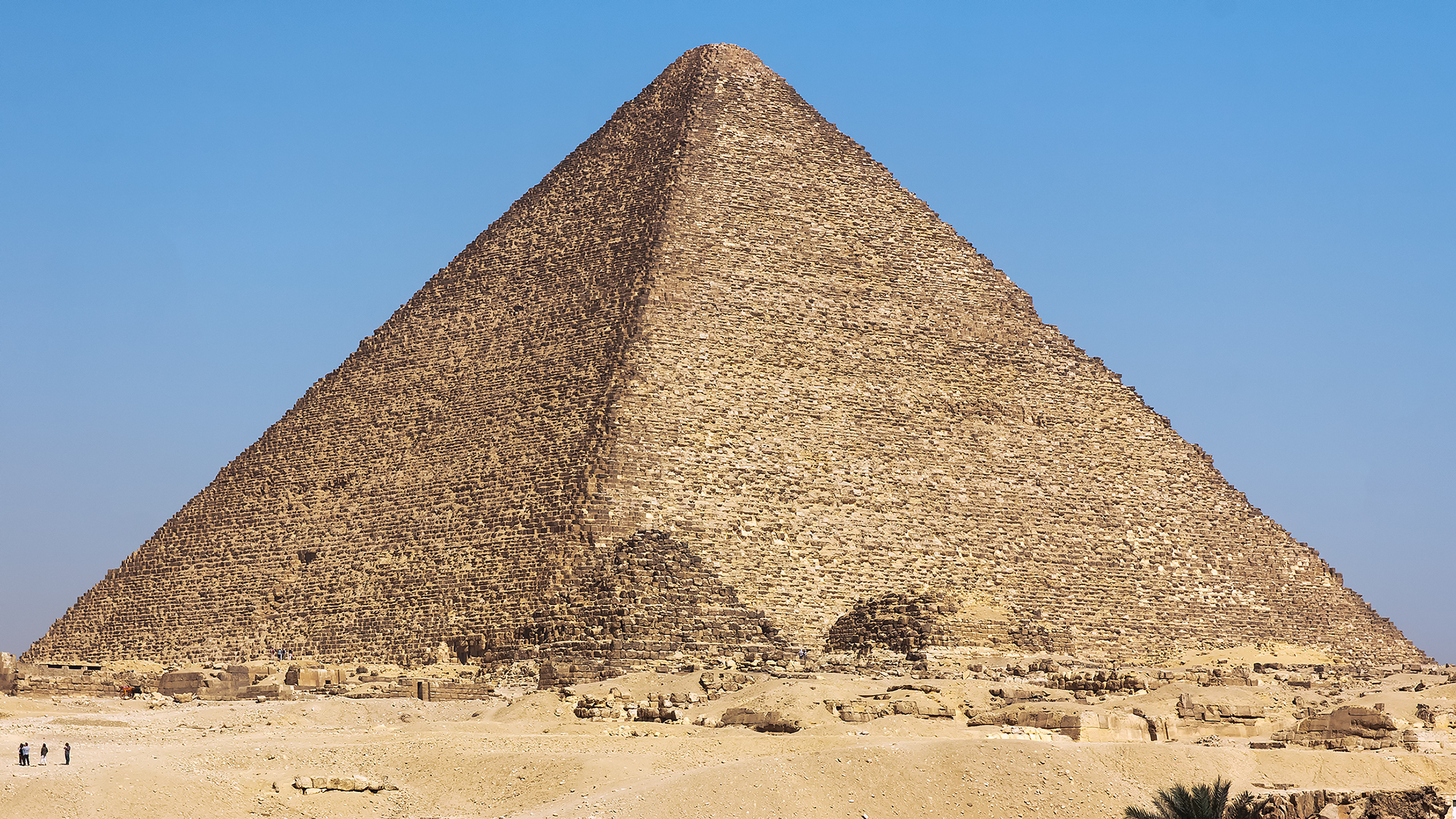
the Great Pyramid of Khufu at Giza — CC BY-SA 4
Notable Places in the Red Pyramid
The Red Pyramid Interior. The descent from the north entrance leads down a steep passage into three corbelled chambers, and the climb back up is the part most visitors remember. The chambers are quiet and cool after the desert heat, and the height of their ceilings makes the space feel far larger than the narrow passage suggests.
The Bent Pyramid. The second pyramid of Sneferu stands about one to two kilometres south, and its kinked profile shows the mistake the Red Pyramid corrected. It keeps more of its original limestone casing than any other pyramid in Egypt, and its two entrances are unique among pyramids.
The Pyramid of Meidum. The first pyramid of Sneferu stands south of Dahshur, a step pyramid that was being turned into a true pyramid when it failed. Today only a tall tower remains above the rubble, and it is the least visited of the three, which makes it a good stop for visitors who want the full story.
The Dahshur Necropolis. The field around the two great pyramids holds smaller pyramids, the tombs of queens and officials, and the ruined Black Pyramid of Amenemhat the Third from the Twelfth Dynasty. A walk across the plateau shows how a royal cemetery grew over centuries, and the desert views are among the best in Egypt.
Memphis and Saqqara. The ancient capital of Memphis lies north of Dahshur, with an open-air museum and the great statue of Rameses the Second, and Saqqara holds the Step Pyramid of Djoser, the first pyramid ever built. The three sites together tell the story of pyramid building from the step pyramid to the true pyramid, and they fit easily into one day.

the Grand Egyptian Museum in Cairo — Public domain
Frequently Asked Questions
Where is the Red Pyramid?
At Dahshur, about 40 kilometres south of Cairo, on the west bank of the Nile.
When was the Red Pyramid built?
Around 2600 BC, by King Sneferu, the first king of the Fourth Dynasty.
How tall is the Red Pyramid?
About 104 metres high, with a base about 220 metres on each side.
Can I go inside the Red Pyramid?
Yes, through the north entrance, down a steep passage to three corbelled chambers.
Is it the first true pyramid?
Yes, the first smooth-sided pyramid completed in Egypt, after two earlier attempts failed.
How long should I allow?
Half a day for Dahshur, or a full day with Saqqara and the Step Pyramid.
Verified
- The Red Pyramid was built by King Sneferu, first king of the Fourth Dynasty, who reigned about 2613 to 2589 BC, around 2600 BC — Wikipedia, checked 23 November 2026.
- The Red Pyramid is about 104 metres high, with a base about 220 metres on each side and a slope of 43 degrees 22 minutes — Wikipedia, checked 23 November 2026.
- The Red Pyramid is the third largest pyramid in Egypt, after the pyramids of Khufu and Khafre at Giza — multiple travel guides, checked 23 November 2026.
- Dahshur belongs to the World Heritage property Memphis and its Necropolis, ref 86, inscribed in 1979 under criteria (i)(iii)(vi), and the property has no buffer zone — whc.unesco.org/en/list/86/, checked 23 November 2026.
- The Bent Pyramid reopened to visitors in July 2019 after closure since about 1965, while the Red Pyramid was open before that — travel guides, checked 23 November 2026.
- The Red Pyramid is verified on Wikidata as Q135332, instance of smooth-sided pyramid, archaeological site and Egyptian pyramids, with coordinates matching the registry — Wikidata API, checked 23 November 2026.
- Historic Cairo, ref 89, is the nearest separate World Heritage property, 27 kilometres away in a straight line — haversine from Wikidata coordinates, checked 23 November 2026.
Sources
- UNESCO — Memphis and its Necropolis (https://whc.unesco.org/en/list/86/) — inscription 1979, ref 86, Dahshur named; checked 23 November 2026.
- Wikipedia — Red Pyramid (https://en.wikipedia.org/wiki/Red_Pyramid) — Sneferu, 104 metres, 220 metres, 43 degrees 22 minutes; checked 23 November 2026.
- Wikidata — Red Pyramid Q135332 (https://www.wikidata.org/wiki/Q135332) — type and coordinates; checked via API 23 November 2026.
Unverified
- The true burial place of King Sneferu, because his body was never found in the Red Pyramid and scholars still debate whether he was buried there, in the Bent Pyramid or elsewhere.
- The exact number of stone courses in the Red Pyramid, because sources give different figures around 160 courses.
- The exact distance from the Red Pyramid to the Bent Pyramid, because sources give a range of 1 to 2 kilometres.
- Ticket prices and opening hours, because they change with the season and were not verified directly on the official site.
Illustrations
- Hero: the Red Pyramid at Dahshur, Egypt. Free image: https://upload.wikimedia.org/wikipedia/commons/8/8c/The_Red_Pyramid.jpg — CC BY-SA 4.
- In body, the Red Pyramid interior: the long passage inside the Red Pyramid. Free image: https://upload.wikimedia.org/wikipedia/commons/2/27/Inside_the_Red_Pyramid_-_The_61m.long_passage_leading_to_the_master_chamber%2814795442922%29.jpg — CC BY 2.
- In body, the Bent Pyramid: the Bent Pyramid at Dahshur. Free image: https://upload.wikimedia.org/wikipedia/commons/a/af/Bent_Pyramid_of_Snofru.jpg — CC BY-SA 4.
- In body, the Black Pyramid: the Black Pyramid of Amenemhat III at Dahshur. Free image: https://upload.wikimedia.org/wikipedia/commons/8/8e/Dahshur_-_Pyramid_of_Amenemhet_III.JPG — CC BY-SA 4, by Daniel Mayer.
- In body, the Pyramid of Meidum: the Pyramid of Meidum, the first pyramid of Sneferu. Free image: https://upload.wikimedia.org/wikipedia/commons/f/fd/Meidum_Pyramid.jpg — CC BY 2, by Charlie Phillips.
- In body, the Step Pyramid of Djoser: the Step Pyramid of Djoser at Saqqara. Free image: https://upload.wikimedia.org/wikipedia/commons/4/4f/Saqqara%2C_Pyramid_of_Djoser%2C_Ancient_Egypt.jpg — CC BY 4, by Vyacheslav Argenberg.
- In body, the Great Pyramid of Khufu: the Great Pyramid of Khufu at Giza. Free image: https://upload.wikimedia.org/wikipedia/commons/e/e7/Great_Pyramid_of_Giza_-_Pyramid_of_Khufu.jpg — CC BY-SA 4, by Douwe C. van der Zee.
- In body, the Grand Egyptian Museum: the Grand Egyptian Museum in Cairo. Free image: https://upload.wikimedia.org/wikipedia/commons/0/04/Grand_Egyptian_Museum_2025.jpg — Public domain, by Amr F.Nagy.