
Japan Tours: The Golden Route From Tokyo to Osaka by Way of Mount Fuji and Kyoto
Japan Tours follow the golden route from Tokyo to Osaka, by way of Mount Fuji and Kyoto. For the first trip, most visitors book a guided package.
For a Vietnamese traveller, Japan Tours are the usual first meeting with Japan, and the reason is plain: the sights stretch from Tokyo to Osaka, the hops between them call for the high-speed Shinkansen, and the speech, the railways and the prices are all strange to a newcomer. A guided package lifts that burden, with a guide, a coach, rooms and food settled beforehand, so the traveller can gaze at the cherry blossom, the mountain and the temples rather than puzzle over the timetable.
What follows is a guide to the tours, not to a single sight: the routes, the kinds of tour, the seasons, the preparation and the stops that make each route worth its days. No operator and no hotel appears by name, and no price is quoted, since prices shift with the season and the operator, and the best choice turns on the traveller, the days to spare and the time of year.
Quick Facts About Japan Tours
| Item | Detail |
|---|---|
| Name | Japan Tours, guided package tours of Japan |
| Common route | The golden route: Tokyo to Mount Fuji to Kyoto to Osaka |
| Common length | 5 days 4 nights, or 6 days 5 nights, from Vietnam by direct flight |
| Best seasons | Late March to early April for the cherry blossom, and November for the autumn leaves |
| Seasons to avoid | June to July for the rainy season, August for heat, humidity and crowds, and December to February for cold, except for Hokkaido |
| Highlights | Mount Fuji, Kiyomizu-dera Temple, Fushimi Inari Shrine, Osaka Castle, Dotonbori, Tokyo Skytree, Nara |
| Arrival airports | Narita International Airport or Haneda Airport in Tokyo, and Kansai International Airport in Osaka |
| Visa | Vietnamese citizens need a tourist visa for Japan before the trip, and the latest rules should be checked at the visa application centre or the Japanese embassy |
| Wikidata | None, since this is a page about a journey, not a single place |
Geography of Japan Tours
Japan Tours cross an archipelago that is long and narrow, and the first thing to grasp is the spine of the golden route. Tokyo stands in the east, on the Kanto Plain, the largest plain of Japan, while Osaka stands in the west, on the plain of the Kansai region, and between them lie the mountain of Fuji, the lakes at its foot and the old capital of Kyoto. The route runs from east to west along the southern coast of the island of Honshu, and it is the classic route of Japan, the route that the travellers of the old Tokaido road walked, and that the Shinkansen follows today.
The land of the route is a land of mountains and plains, with the mountains of the Japanese Alps to the north and the sea of the Pacific to the south. The Kanto Plain around Tokyo is the largest flat land of Japan, with the capital, the suburbs and the farms, while the plain of Kansai around Osaka and Kyoto is the old heart of the country, with the temples, the shrines and the castles. The mountain of Mount Fuji stands between the two plains, a cone of 3,776 metres, and the route passes it on the way from Tokyo to Kyoto, so the mountain is the landmark of the journey, seen from the train, from the lakes and from the road.
The tours of Japan follow the seasons, and the geography of each season is different. In spring the cherry blossom moves north through the archipelago, from the south to the north, over several weeks, and the tours follow the blossom, starting in Tokyo and ending in Kyoto, or starting in the south and ending in the north. In autumn the red and gold leaves move from the mountains of the north to the south, and the tours follow the colour, with the temples of Kyoto as the high point. In summer the mountains are green and the coasts are warm, while in winter the north is white with snow, and the island of Hokkaido is the place for skiing.
The Tokyo part of Japan Tours is a city geography, with the Skytree, the old temple of Asakusa, the crossing of Shibuya and the gardens of the imperial palace. Tokyo is the largest city of Japan, and it is a city of neighbourhoods, each with its own character, from the electronics of Akihabara to the fashion of Harajuku and the old streets of Asakusa. The city is a city of the present, and the tours of Tokyo are tours of the modern Japan, with the towers, the trains and the crowds.
The Kyoto part of Japan Tours is a geography of temples and shrines, with the temple of Kiyomizu-dera on the hill, the shrine of Fushimi Inari with its thousand gates, and the bamboo grove of Arashiyama. Kyoto was the capital of Japan for more than a thousand years, and it is the city of the traditional Japan, with the temples, the gardens and the old streets. The tours of Kyoto are tours of the old Japan, and they are the contrast to the tours of Tokyo, with the quiet of the temples against the noise of the capital.
The Osaka part of Japan Tours is a geography of food and commerce, with the castle, the street of Dotonbori and the markets. Osaka is the kitchen of Japan, and the tours of Osaka are tours of eating, with the takoyaki, the okonomiyaki and the street food of the Dotonbori. The city is a city of the merchants, and it is a different Japan from Tokyo and Kyoto, a city where the food is the culture and the streets are the theatre.
The day trip to Nara is the western extension of the route, and it is the geography of the first capital, with the great Buddha, the deer park and the temples in the forest. Nara was the capital before Kyoto, and it is a city of the eighth century, with the Todai-ji temple, the deer that roam the park and the old streets. The tours that add Nara add the oldest Japan to the route, and the day in Nara is the day of the temples that came before Kyoto.
The geography of Japan Tours is the geography of a route from east to west, with a capital in the east, a mountain in the middle, an old capital in the west and a merchant city at the end. The traveller who takes a tour of Japan sees the route from the inside, moving from the towers of Tokyo to the cone of Fuji, to the temples of Kyoto and to the streets of Osaka, and the journey between the points is as much a part of the tour as the stops themselves.
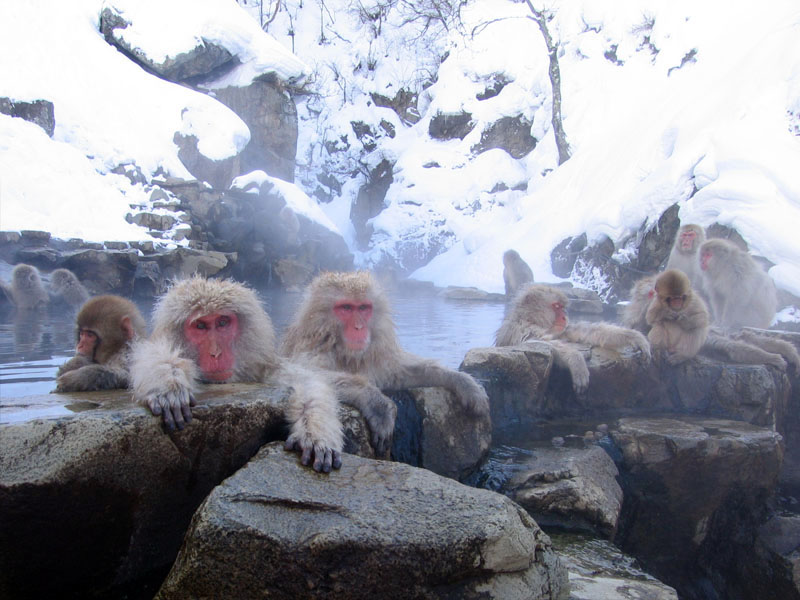
Snow monkeys bathe in the hot spring of Jigokudani Park in Nagano — CC BY-SA 3
History of Japan Tours
The history of Japan Tours begins with the opening of the country, and the first great opening was the Meiji era, when Japan opened itself to the world after more than two centuries of seclusion. The port of Yokohama opened in 1859, and the first foreign travellers came to see the temples, the mountains and the art of Japan, with the Tokaido road as their route from Tokyo to Kyoto. The tours of that age were tours of the old road, with the fifty-three stations of the Tokaido, the inns, the mountains and the sea, and the prints of Hiroshige showed the route to the world.
The Tokaido road itself is the ancestor of the golden route, and its fifty-three stations are the stations that the tours of today still pass. The road ran from Edo, the Tokyo of today, to Kyoto, along the southern coast, with the inns, the checkpoints and the views of Mount Fuji, and the travellers of the Edo period walked it in about two weeks. Hiroshige painted the fifty-three stations in his great series of prints, and the prints showed the road to the world, with the rain, the snow, the bridges and the mountain. The golden route of today is the Tokaido road by train, with the same stations, the same mountain and the same sea, crossed in hours instead of weeks.
The second great opening was the Olympic Games of Tokyo in 1964, and the Tokaido Shinkansen, the first high-speed railway in the world, opened in the same year, joining Tokyo to Osaka in about four hours. The Games and the railway changed the tours of Japan, since the country could now be crossed in a day, and the golden route of Tokyo to Fuji to Kyoto to Osaka became the classic route of the first visit. The Shinkansen is still the spine of the tours today, and the journey from Tokyo to Kyoto by bullet train is the journey that every tour takes.
The third great opening was the Osaka Expo of 1970, which brought the world to the Kansai region, and which made Osaka a city of the future, with its towers, its pavilions and its crowds. The Expo showed the Japan of technology, and the tours that followed were tours of a country that was at once old and new, with the temples of Kyoto and the towers of Tokyo in a single journey. The country that had once been a stop for the temples and the mountains became a destination for the whole of its culture, from the old to the new.
Vietnamese visitors are the newest travellers on the routes of Japan, and the trips they take have widened with them. The earliest Vietnamese journeys stayed in Tokyo, with the Skytree, the Asakusa temple and the Shibuya crossing, and the journeys widened into the routes of today, with Fuji, Kyoto and Osaka added as the flights multiplied and the visas eased. The tours are now how most Vietnamese visitors meet Japan at first, with a guide who speaks their tongue, with rooms and food settled in advance, and with a plan that fits five or six days.
The mountain of Fuji has its own history as a destination, and it was listed by UNESCO in 2013, as Fujisan, Sacred Place and Source of Artistic Inspiration, with 25 components and an area of 20,702.1 hectares. The listing made the mountain known to the world as a place of faith and of art, and the tours of Fuji grew from a climb into a visit, with the lakes, the shrines and the views as the stops. The mountain is now the centre of the golden route, and it is the landmark that every tour passes.
The history of Japan Tours is the history of a country that opened itself to the world in stages, with the Meiji opening, the Olympic Games, the Shinkansen and the Expo, each of them bringing a new kind of traveller and a new kind of tour. The tours of today are the product of those openings, with the towers of Tokyo, the mountain of Fuji, the temples of Kyoto and the streets of Osaka in a single journey, and the Shinkansen joining them all. The route is the Tokaido road by train, and the journey from Tokyo to Osaka is the journey that the tours of Japan have taken since 1964.
Travel on Japan Tours
The first choice on Japan Tours is the length, and the two lengths that dominate the market are five days and four nights, and six days and five nights. The five-day tour is the shorter choice, with Tokyo and Mount Fuji as its centre, while the six-day tour is the classic golden route, with Tokyo, Mount Fuji, Kyoto and Osaka in a single journey. The five-day tour is the easier choice for a first visit, since it stays in the east, while the six-day tour is the fuller choice, since it shows the whole route from east to west.
The route comes next, and the market offers three kinds of route. The golden route is the most booked, with Tokyo for one to two days, Mount Fuji and Lake Kawaguchi, then the Shinkansen to Kyoto for the temple of Kiyomizu-dera, the shrine of Fushimi Inari and the bamboo grove of Arashiyama, and finally Osaka for the castle and the street of Dotonbori, with the flight home from Kansai Airport. The Tokyo to Fuji tour is shorter and more focused, with Tokyo and the mountain as its centre, while the Kyoto to Osaka tour is the tour of the old Japan, with the temples, the shrines and the food.
The month sets the mood of the journey, and the finest months are late March to early April, for the cherry blossom, and November, for the autumn leaves. The blossom drifts north across the islands, and the spring journeys chase it, while the leaves drift from the northern peaks to the south, and the autumn journeys chase the colour, with the temples of Kyoto at their best. June to July brings the rains, August brings heat, damp and crowds, and December to February brings cold, except in Hokkaido, where the snow is the draw.
Getting ready for Japan Tours begins with the visa, and a Vietnamese citizen must hold a tourist visa for Japan before the trip, with the papers filed at the visa application centre or the Japanese embassy, and the newest rules looked up before booking. The passport must stay good for at least six months past the return date, and the operator usually wants the passport, the photographs and the proof of work and income the embassy asks for. The money is the yen, and notes and coins still change hands in the markets and the temples, while the speech is Japanese, and the guide is the link between the traveller and the country.
What goes in the suitcase turns on the month, and the spring and autumn journeys call for layers, a warm jacket after dark and a light coat by day, while the summer journeys call for thin clothes and rain cover, and the winter journeys call for a heavy coat, gloves and a hat. The feet do the work on these tours, with the temples, the shrines and the lanes all covered on foot, so soft shoes matter more than anything else in the luggage. The coach leaves early each morning and the days run long, so the traveller should be set for early rises and full days, and for the trains, which keep their time.
Read the timetable before the brochure when you choose a tour, and ask how many hours go to each city, how much free time there is, and what the price includes. A tour that spends two days in Tokyo, one day at Mount Fuji and two days in Kyoto and Osaka is a tour that shows Japan, while a tour that spends a day in each of four cities is a tour that shows the stations. The best tours are the ones that leave a free afternoon in Kyoto, so the traveller can walk the old streets and the temples at their own pace.

Tokyo Tower rises above the city in Japan — CC BY-SA 4
Notable Places on Japan Tours
Mount Fuji
Mount Fuji is the highest mountain in Japan, at 3,776 metres, and it is the centre of the golden route, seen from the train, from the lakes and from the road. The mountain is a World Heritage site, listed by UNESCO in 2013, and it is the landmark that every tour passes, with Lake Kawaguchi as the best place to see it.
Kiyomizu-dera Temple
Kiyomizu-dera Temple stands on the hill of eastern Kyoto, with its wooden stage, its pagoda and its spring, and it is the most famous temple of the city. The temple is the first stop of the Kyoto part of the tours, and it is the place where the old Japan is seen at its finest.
Fushimi Inari Shrine
Fushimi Inari Shrine is the shrine of a thousand vermilion gates, climbing the mountain of Inari to the south of Kyoto, and it is the most photographed place in Japan. The shrine is the second stop of the Kyoto part of the tours, and the walk through the gates is the walk that every visitor remembers.
Osaka Castle
Osaka Castle stands in the centre of Osaka, with its keep, its moats and its park, and it is the great sight of the city. The castle is the first stop of the Osaka part of the tours, and it is the place where the history of the merchant city is told.
Dotonbori
Dotonbori is the street of food and neon in Osaka, with its takoyaki, its okonomiyaki and its street food, and it is the evening stop of the tours, after the castle and the markets. The street is the theatre of Osaka, and it is the place where the food is the culture.
Tokyo Skytree and Nara
Tokyo Skytree is the tallest tower in Japan, and it is the landmark of the Tokyo part of the tours, with its observation decks and its view over the whole capital. Nara, the old capital before Kyoto, is the day trip from Kyoto and Osaka, with its great Buddha, its deer park and its temples, and it is the place where the history of Japan begins.
Frequently Asked Questions About Japan Tours
How many days do I need for a Japan tour?
Five days and four nights is the classic length for a first trip, with Tokyo and Mount Fuji as its centre, while six days and five nights is the golden route, with Tokyo, Mount Fuji, Kyoto and Osaka in a single journey, by Shinkansen between the cities.
What is the golden route in Japan?
The golden route is the classic route of Tokyo to Mount Fuji to Kyoto to Osaka, with the Shinkansen joining the cities, and it is the route that most first-time visitors take, since it shows the modern Japan, the mountain and the old Japan in a single trip.
When is the best time for a Japan tour?
Late March to early April is the best time for the cherry blossom, which moves north through the archipelago, and November is the best time for the autumn leaves, with the temples of Kyoto as the high point, while June to July is the rainy season.
Do Vietnamese citizens need a visa for a Japan tour?
Yes, a Vietnamese passport holder must hold a tourist visa for Japan before departure, and the papers go to the visa application centre or the Japanese embassy, with the newest rules looked up before booking, and the operator usually lends a hand with the paperwork.
What is included in a Japan package tour?
The fare normally buys the air tickets, the rooms, the coach, the guide, the bullet-train seats, the entries and most of the food, while the visa charge, the gratuities and the shopping stay outside the fare, so study the day-by-day plan and the list of what the fare covers before you book.
How do I travel between Tokyo and Kyoto on a Japan tour?
Take the Tokaido Shinkansen, the first high-speed railway in the world, opened in 1964, which joins Tokyo to Kyoto in about two and a half hours, while the tour coach and the guide take care of the rest of the journey, from the station to the temples.
Verified
- The common lengths for Japan Tours from Vietnam are 5 days 4 nights and 6 days 5 nights, by direct flight. Checked 21 November 2026.
- The common route is the golden route: Tokyo to Mount Fuji to Kyoto to Osaka. Checked 21 November 2026.
- The best seasons are late March to early April for the cherry blossom, and November for the autumn leaves. Checked 21 November 2026.
- The Tokaido Shinkansen opened in 1964, in the year of the Olympic Games of Tokyo, and it joins Tokyo to Kyoto in about two and a half hours. Checked 21 November 2026.
- Mount Fuji is 3,776 metres high, and it was listed by UNESCO in 2013, reference 1458, with 25 components and an area of 20,702.1 hectares. Checked 21 November 2026.
- The Osaka Expo was held in 1970, and it brought the world to the Kansai region. Checked 21 November 2026.
- The port of Yokohama was opened in 1859, after more than two centuries of seclusion. Checked 21 November 2026.
- The arrival airports are Narita and Haneda in Tokyo, and Kansai in Osaka. Checked 21 November 2026.
- Japan Tours is a page about a journey, with no single place, no coordinates and no Wikidata entry. Checked 21 November 2026.
Sources
- Japan National Tourism Organization — https://www.japan.travel/en/ — for the routes, the seasons and the practical information for visitors.
- UNESCO, Fujisan, Sacred Place and Source of Artistic Inspiration — https://whc.unesco.org/en/list/1458/ — for the listing of 2013, checked on the UNESCO site.
- Wikipedia, Tokaido Shinkansen — https://en.wikipedia.org/wiki/Tokaido_Shinkansen — for the opening of 1964 and the first high-speed railway in the world.
- Wikidata, Japan Q17 — https://www.wikidata.org/wiki/Q17 — for the identity of the country that the tours cross, verified through the Wikidata API on 21 November 2026.
Unverified
- No price is given in this article for Japan Tours, since prices change with the season and with the operator, and the price should be checked with the operator on the day of booking.
- This article names no hotel, since the hotels on a tour change with the operator and with the season.
- The blossom and the leaves come on different dates every year, with the weather, so the months in this article are the usual months, and the forecast should be checked before the trip.
Illustrations
- Hero: Japan Tours. Free image: https://upload.wikimedia.org/wikipedia/commons/e/e5/Exterior_view_of_the_illuminated_facade_of_Maison_Herm%C3%A8s%2C_Ginza%2C_Tokyo%2C_Japan.jpg — CC BY-SA 4.0.
- In body, tower: Tokyo Tower rises above the city in Japan Free image: https://upload.wikimedia.org/wikipedia/commons/3/3b/Japan-Tokyo-tower-1024.jpg — CC BY-SA 4.
- In body, park: Snow monkeys bathe in the hot spring of Jigokudani Park in Nagano Free image: https://upload.wikimedia.org/wikipedia/commons/8/8c/Jigokudani_hotspring_in_Nagano_Japan_001.jpg — CC BY-SA 3.