
History Museum Osaka: Fourteen Centuries of the City, Told from the Tenth Floor
History Museum Osaka tells fourteen centuries of the city. Its Naniwa Palace hall and Edo street models start at the tenth floor.
The history museum of Osaka stands beside Osaka Castle Park, in Chuo Ward, and it tells nearly 1,400 years of the history of the city, from the Naniwa Palace of the seventh century, through the age when Osaka was the kitchen of the whole country, to the industrial city of the early twentieth century. The museum opened on 3 November 2001, in a modern building shared with the NHK Osaka Broadcasting Center, and the way to visit it is unusual: a visitor takes the lift straight to the tenth floor and then walks down, floor by floor, going backwards in time from ancient Osaka to modern Osaka. The tenth floor rebuilds part of the great hall of the Naniwa Palace, with vermilion pillars rising to the ceiling; the ninth floor holds street models of the Edo period at a scale of one to twenty, detailed down to every roof; the eighth floor is an archaeology area where a visitor can touch the finds with their own hands; and the seventh floor is Osaka of the Taisho period and the early Showa period, when the city rose to become one of the great industrial centres of Japan.
From the windows of the tenth floor, a visitor looks straight across to Osaka Castle and its moat, one of the finest and quietest views of the castle in the city. This guide covers the four floors, the palace beneath the building, and the practical notes for a visit.
Quick Facts About History Museum Osaka
| Item | Detail |
|---|---|
| Name | History Museum Osaka, in Japanese 大阪歴史博物館, Osaka Museum of History |
| Location | 4-1-32 Otemae, Chuo Ward, Osaka, Japan, southwest of Osaka Castle Park |
| Coordinates | 34.682722° N, 135.520806° E |
| Building | A 13-storey building shared with the NHK Osaka Broadcasting Center |
| Floors | Permanent exhibitions on floors 7 to 10, special exhibitions on floor 6 |
| Opened | 3 November 2001, successor to the old Osaka City Museum |
| Hours | 9:30 to 17:00, last entry 16:30; closed on Tuesdays and from 28 December to 4 January |
| Nearest station | Tanimachi 4-chome Station, Tanimachi and Chuo lines, about five minutes on foot |
| Wikidata | Q11261312, coordinates 34.682722/135.520806 |
Geography of History Museum Osaka
History Museum Osaka stands in the Otemae area of Chuo Ward, just southwest of Osaka Castle Park and facing the Naniwa Palace Site Park. The position is not by chance: directly under the museum building lie the remains of the Naniwa Palace, the first capital of Japan in ancient times, and the basement of the museum still keeps parts of those remains, including the storehouse foundations, the walls and the water system. Standing at the museum, a visitor stands on the very place where the history of Osaka began.
From the museum, Osaka Castle is only a few minutes on foot through the park, and the area around it is one of the densest clusters of monuments in the city: Osaka Castle, the Naniwa Palace Site Park, and the NHK Osaka building standing right beside the museum, in the same architectural complex. The nearest subway station is Tanimachi 4-chome, on the Tanimachi and Chuo lines, about five minutes on foot from the museum. The climate of Osaka is mild, with hot humid summers and lightly cold winters, and because the whole visit takes place indoors, the museum is an ideal destination for rainy days, for the harsh sun of summer, and for the cold days of winter.
The building itself is a landmark of the area. It is a thirteen-storey building shared with the NHK Osaka Broadcasting Center, designed by the firm Cesar Pelli and Associates together with Nihon Sekkei, and the two buildings were built at the same time as a single complex, joined by an atrium. The museum occupies the upper floors, and the broadcasting centre occupies the lower ones, so the building is at once a museum, a studio and a tower in the skyline of Otemae.
The Otemae area is the administrative heart of Osaka, with the prefectural and city offices nearby, and the castle park beside it, so the museum stands between government and history. The streets around it are wide and modern, very different from the narrow streets of Namba or Shinsaibashi, and the change of scale is part of the visit: from the shopping city of the south to the official city of the east, where the castle, the palace and the museum stand together. The wide pavements and the open squares of Otemae make the walk to the museum easy, even in the rain, and the park beside it gives the area its green edge.
From the windows of the tenth floor, the geography of Osaka opens up. The castle and its moat lie to the northeast, the park spreads below, and the towers of the modern city rise beyond. The view is one of the quietest in the city, because few visitors think to look out of a museum window, yet it is one of the best, and it joins the story inside the museum to the city outside it in a single look.
The cluster around History Museum Osaka is the densest group of historic places in the city, and it rewards a slow walk. The castle park holds the keep, the walls and the moats of the castle of Toyotomi Hideyoshi, the Naniwa Palace Site Park holds the foundations of the palace of the seventh century, and the museum holds the story that joins the two. A visitor who walks from the palace site to the castle, and then to the museum, walks the whole history of Osaka in a single morning, from the first capital to the castle town, and the museum is the place where the walk is explained.
The building of History Museum Osaka is itself a part of the geography of Otemae. The thirteen-storey tower stands beside the NHK broadcasting centre, and the atrium that joins them is open to the sky, so the museum and the studio share a single entrance and a single view of the park. The tower is visible from the castle park, and it serves as a landmark for anyone walking from the station to the museum, rising above the low roofs of the administrative quarter. History Museum Osaka is easy to find from the park, and the walk from the castle keep to the museum door takes only a few minutes through the trees.

International Institute for Childrens Literature Osaka — Public domain

Osaka Castle, a few minutes on foot from the museum through the park — CC BY-SA 4, by DXR

The Naniwa Palace Site Park, holding the foundations of the palace of the seventh century — CC0, by Sakai Yayoi
History of History Museum Osaka
The history of Osaka begins in the seventh century, when Emperor Kotoku moved the capital to Naniwa and built the Naniwa Nagara-Toyosaki Palace in 645. This was one of the first capitals of Japan, standing on the very ground where the museum stands today. The Naniwa Palace was later rebuilt and used through many reigns, becoming the political and diplomatic centre of the country in the Nara period. When the capital moved elsewhere, the palace was gradually forgotten, but its foundations stayed under the ground of Osaka for more than 1,300 years, until modern archaeological digs found them again.
That is why the story of the museum begins on the tenth floor with the Naniwa Palace: part of the Daigokuden great hall of the Nara-period palace is rebuilt at full size, with vermilion pillars 70 centimetres in diameter, figures in court dress, and a video rebuilding the life of the court. It is the most striking sight in the museum, and the reason many visitors call it one of the best city history museums in Japan.
After the age of Naniwa, Osaka grew into a centre of trade and religion. In the sixteenth century, the Hongan-ji temple in Osaka became a great centre of power, and after Toyotomi Hideyoshi built Osaka Castle at the end of the sixteenth century, the city around the castle became one of the busiest cities in Japan. In the Edo period, from 1603 to 1868, Osaka was called tenka no daidokoro, the kitchen of the whole country, because it was the place where food, above all rice, was gathered and distributed to the whole nation. The rich merchants of Osaka made a brilliant townsman culture, with bunraku puppet theatre, rakugo comic storytelling and street food, and those marks are still strong in the Osaka of today.
In the Meiji period, and above all in the Taisho period and the early Showa period, Osaka rose to become Great Osaka, one of the largest industrial cities in Japan, with textile factories, shipbuilding and trade growing strongly. The seventh floor of the museum tells that age through photographs, documentary films and street models of the time, showing a modern, noisy and energetic Osaka, very different from the quiet old capital of Kyoto nearby.
The museum of today had a predecessor. The old Osaka City Museum stood in a building of 1931 inside Osaka Castle Park, just before the keep of the castle, and it closed at the start of 2001. On 3 November 2001, the new History Museum Osaka opened at its present place, in a building designed by Cesar Pelli and Associates and Nihon Sekkei, shared with the new NHK Osaka Broadcasting Center. The two buildings were built together as a single complex, joined by an atrium.
The new museum was designed with a clear philosophy of display: to tell the history of Osaka through images, models and full-size rebuilds, rather than only showing objects in glass cases. The collection of the museum passed 100,000 objects in 2005, and it kept growing in the years after, while the permanent exhibition floors tell the story of the city through four floors, from the tenth down to the seventh, with two visiting routes: the Highlight Course of about one hour, and the Complete Course for anyone who wants to see every object in detail.
The choice to build the museum beside the palace remains is the heart of that philosophy. A museum of the history of Osaka could have been built anywhere in the city, but it was built on the ground where the history began, above the foundations of the first capital, and the basement tour of the remains is the proof of the choice. The visitor descends from the tenth floor to the basement, from the rebuilt hall to the real foundations, and the story ends where it began, under the ground of the city.
Timeline of History Museum Osaka
- 645: Emperor Kotoku moves the capital to Naniwa and builds the Naniwa Nagara-Toyosaki Palace.
- Eighth century: The Naniwa Palace of the Nara period works as the political centre of Japan.
- End of the sixteenth century: Toyotomi Hideyoshi builds Osaka Castle, and the city around the castle grows strongly.
- 1603 to 1868: In the Edo period, Osaka becomes the kitchen of the whole country, tenka no daidokoro.
- 1931: The old Osaka City Museum opens in Osaka Castle Park.
- Early twentieth century: In the Taisho and early Showa periods, Osaka becomes Great Osaka, a great industrial centre.
- 2001: The old Osaka City Museum closes, and the new History Museum Osaka opens on 3 November 2001.
- 2005: The collection of the museum passes 100,000 objects.

Osaka Museum of History and NHK Osaka Broadcasting Center Building — CC BY-SA 4

Osaka Castle, built by Toyotomi Hideyoshi at the end of the sixteenth century — CC BY-SA 3

A display in the museum showing the 1970 to 1971 excavation of the great hall of the Naniwa Palace — CC BY 2, by shankar s. from Poona (pune), India, India
Travel to History Museum Osaka
The museum is open all year, except on Tuesdays each week, and if Tuesday is a holiday, it closes on the Wednesday after, and at the turn of the year, from 28 December to 4 January. The opening hours are 9:30 to 17:00, with last entry at 16:30, and on Friday evenings with a special exhibition, the museum opens until 20:00. Because the whole visit takes place indoors, the museum is an ideal choice for rainy days, for the harsh sun of summer, and for the cold days of winter, and it is also a sensible stop after a walk around Osaka Castle Park in the open air.
Most visitors spend about one to one and a half hours on the four floors of the permanent exhibition. The Highlight Course suggested by the museum itself takes about one hour, and it concentrates on the full-size rebuilds, the street models and the important photographs and films. Anyone who loves history and archaeology can spend two to three hours, above all on the eighth floor, the interactive archaeology area, and in the basement, where a guided tour visits the remains of the Naniwa Palace. A good plan is a morning at Osaka Castle and the park, and an afternoon at the museum, to understand the history behind what was just seen.
The nearest subway station is Tanimachi 4-chome, served by the Tanimachi and Chuo lines, about five minutes on foot from the museum. From the station, walk east to the museum building, which stands beside the NHK Osaka Broadcasting Center. City buses also stop near the Otemae area.
The museum has lifts serving all floors, and it suits wheelchairs and pushchairs. Note that this museum is a completely separate place from the museum inside the keep of Osaka Castle: the two places tell two different stories, and the ticket of one cannot be used for the other.
The ticket for the permanent exhibition, according to the official Osaka tourism site, is 600 yen for an adult, 400 yen for a high school or university student, free for a junior high school pupil and below, and free for a person from 65 years old who is a resident of Osaka. A group ticket for 20 people or more is reduced to 540 yen for an adult and 360 yen for a high school or university student. The special exhibition on the sixth floor charges separately.
This ticket price has not been checked directly on the official site of the museum, so check it again before going. Inside the museum there is a souvenir shop and a cafe, and the area around Otemae and Osaka Castle Park holds many restaurants serving the specialities of Osaka, such as takoyaki, okonomiyaki and kushikatsu.
Inside the museum there is a cafe serving drinks and light food, enough for a rest in the middle of a visit. But the real food experience lies outside: the area around Osaka Castle and Tanimachi 4-chome Station holds many cheap restaurants serving takoyaki, okonomiyaki and kushikatsu, the three street foods that made the name of the food of Osaka, true to the tradition of the kitchen of the whole country that the museum has just told. In the evening, the Dotonbori area, a few subway stops away, is the liveliest food destination in the city, and the walk from the quiet museum to the bright canal is the best way to end a day of history.
Many passports from Europe, North America and Asia allow a short stay in Japan without a visa, while others need one, so check the current rule for your own nationality before the trip. Inside the museum, photography rules differ by floor and by exhibition, so check the signs at each floor, and remember that the visit is designed from the top down: start at the tenth floor, or the story will lose its order.
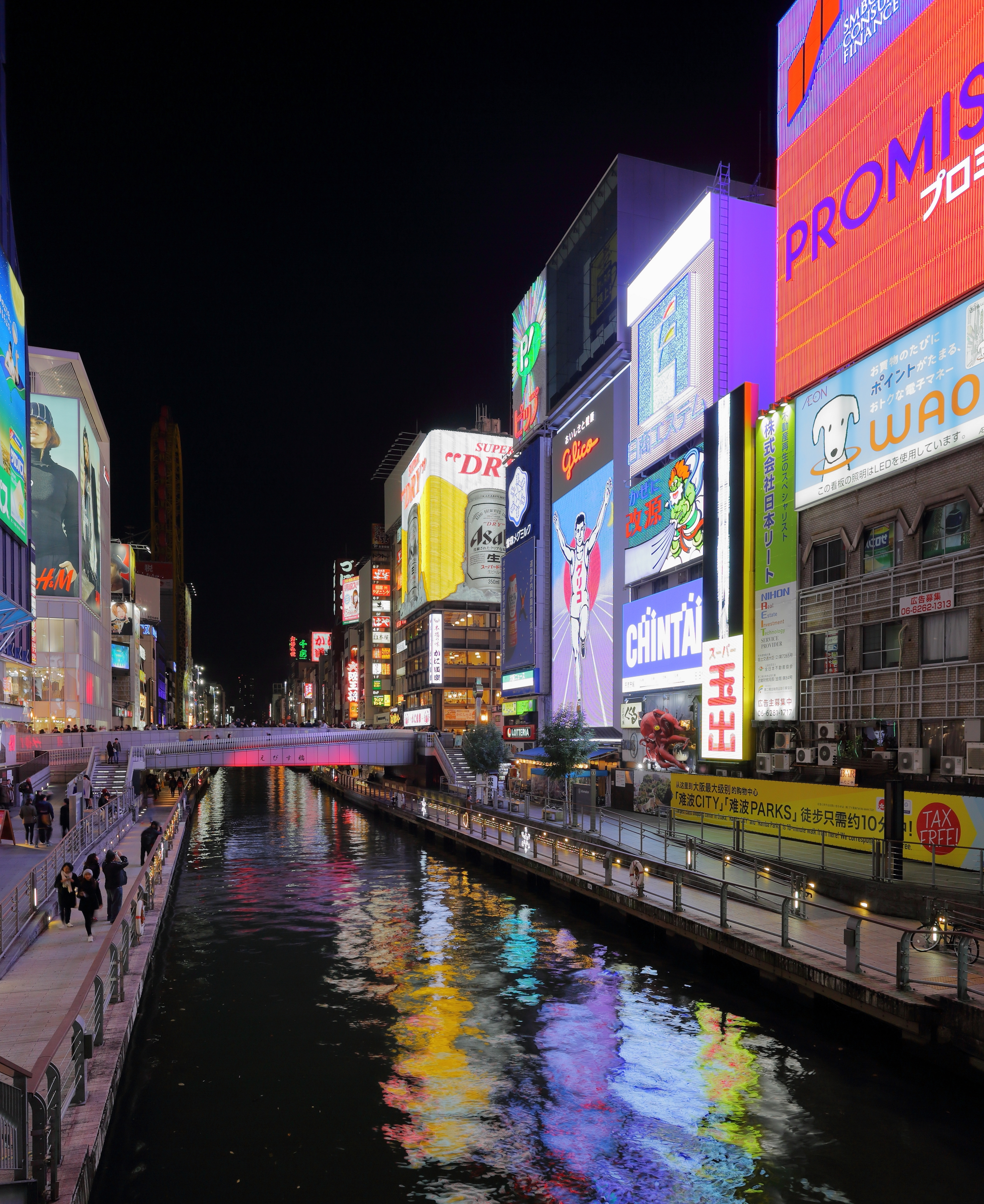
Dotonbori at night, the liveliest food destination in the city — CC BY-SA 4, by Martin Falbisoner

A food street in Dotonbori, where takoyaki, okonomiyaki and kushikatsu are sold — CC BY 2, by chopstuey
Notable Places in History Museum Osaka
The Tenth Floor, Ancient Osaka and the Naniwa Palace
The tenth floor rebuilds part of the Daigokuden great hall of the Naniwa Palace of the Nara period at full size, with vermilion pillars 70 centimetres in diameter. From the windows of this floor, the view looks straight across to Osaka Castle and its moat, one of the finest and quietest views of the castle in the city.
The Ninth Floor, Medieval and Early Modern Osaka
The ninth floor tells the story of the city from the Muromachi period through the Edo period, when Osaka became the kitchen of the whole country, through street models at a scale of one to twenty, detailed down to every roof and every stall.
The Eighth Floor, the Naniwa Archaeology Centre
The eighth floor is an interactive area, where a visitor can touch real archaeological tools with their own hands and see a full-size model of a dig, learning how archaeologists found the Naniwa Palace under the ground of Osaka.
The Seventh Floor, Modern Osaka
The seventh floor shows the Taisho period and the early Showa period, when Osaka became Great Osaka, a great industrial centre with textile factories, shipbuilding and trade, through photographs, documentary films and street models of the time.
The Sixth Floor, the Special Exhibition Room
The sixth floor holds the special exhibitions, which change through the year and cover the history and culture of Osaka in depth, and which charge a separate fee beyond the ticket for the permanent exhibition.
The Basement, the Naniwa Palace Remains
The basement keeps the storehouse foundations, the walls and the water system of the Naniwa Palace, preserved directly under the building, and a guided tour visits the remains. It is the oldest part of the story, lying under the newest building.
The Building Shared with NHK Osaka
The building shared with the NHK Osaka Broadcasting Center was designed by Cesar Pelli and Associates and Nihon Sekkei, and it is joined to the broadcasting centre by an atrium. The building itself is an example of the modern architecture of Osaka at the start of the twenty-first century.

Osaka Castle and its moat, which the tenth-floor windows look across to — Public domain
Frequently Asked Questions About History Museum Osaka
Is History Museum Osaka the museum inside Osaka Castle?
No, they are two completely separate places, with different stories and different tickets.
Which period of history does the museum cover?
Nearly 1,400 years of Osaka, from the Naniwa Palace of the seventh century to the industrial city of the early twentieth.
Which floor should I start the visit from?
From the tenth floor, by lift, and then walk down floor by floor, following time backwards.
How much is a ticket for History Museum Osaka?
Adults pay 600 yen, students pay 400 yen, and junior high pupils and below enter free.
Which days is the museum closed?
Tuesdays each week, and from 28 December to 4 January at the turn of the year.
How much time should I spend at the museum?
About one to one and a half hours for the four floors, and two to three hours for a full visit.
Verified
- History Museum Osaka stands at 4-1-32 Otemae, Chuo Ward, Osaka, southwest of Osaka Castle Park and facing the Naniwa Palace Site Park. Checked 21 November 2026.
- The museum opened on 3 November 2001, as the successor to the old Osaka City Museum, which closed at the start of 2001. Checked 21 November 2026.
- The building is a 13-storey building shared with the NHK Osaka Broadcasting Center, designed by Cesar Pelli and Associates and Nihon Sekkei. Checked 21 November 2026.
- The permanent exhibition stands on floors 7 to 10, the special exhibition on floor 6, and the Naniwa Palace remains lie in the basement. Checked 21 November 2026.
- The tenth floor rebuilds part of the Daigokuden great hall of the Naniwa Palace at full size, with vermilion pillars 70 centimetres in diameter. Checked 21 November 2026.
- The ninth floor holds street models of the Edo period at a scale of one to twenty, and the eighth floor is an interactive archaeology area. Checked 21 November 2026.
- The collection of the museum passed 100,000 objects in 2005, and the Highlight Course takes about one hour. Checked 21 November 2026.
- Coordinates 34.682722/135.520806 and Wikidata Q11261312 for the Osaka Museum of History were verified through the Wikidata API on 21 November 2026. Checked 21 November 2026.
Sources
- Trip To Japan, Osaka Museum of History — https://www.triptojapan.com/places/osaka-museum-of-history/EHP_I7yGRvaN8aWCi5pO8w — for the opening in 2001, the building and the collection.
- Osaka Museum of History, official site — https://www.osakamushis.jp/ — for the museum, its floors and its history.
- OSAKA-INFO, Osaka Museum of History — https://osaka-info.jp/experience/en/osaka/spot/258 — for the tenth floor, the ninth floor, the eighth floor and the seventh floor.
- OSAKA-INFO, Osaka Museum of History — https://osaka-info.jp/special/coolosaka/en/cool-spot/1759/ — for the ticket prices, the hours and the closing days.
- Roavina, Osaka Museum of History — https://roavina.com/en/japan/osaka/osaka-museum-of-history — for the Highlight Course and the visit route.
Unverified
- The ticket prices and the opening hours were checked on the official Osaka tourism site, but they were not checked directly on the official site of the museum.
- The present number of objects in the collection is not given here, since the figure of more than 100,000 objects is from 2005.
- The layout of the second floor and the other floors outside the exhibition area is described differently by different sources.
- The exact month in which the old Osaka City Museum closed, at the start of 2001, is not given by the sources.
Illustrations
- Hero: NHK Osaka Hall and Osaka Museum of History from Osaka Castle Park. Free image: https://upload.wikimedia.org/wikipedia/commons/7/79/NHK_Osaka_Hall_and_Osaka_Museum_of_History_from_Osaka_Castle_Park.JPG — CC BY-SA 3.
- In body, The Building Shared with NHK Osaka: Osaka Museum of History and NHK Osaka Broadcasting Center Building. Free image: https://upload.wikimedia.org/wikipedia/commons/d/d1/Osaka_Museum_of_History_and_NHK_Osaka_Broadcasting_Center_Building.jpg — CC BY-SA 4.
- In body, panorama: International Institute for Childrens Literature Osaka. Free image: https://upload.wikimedia.org/wikipedia/commons/8/8e/International_Institute_for_Childrens_Literature_Osaka.jpg — Public domain.
- In body, Osaka Castle: Osaka Castle, a few minutes on foot from the museum through the park. Free image: https://upload.wikimedia.org/wikipedia/commons/a/ab/Osaka_Castle%2C_Keep_tower%2C_South_view_20190415_1.jpg — CC BY-SA 4, by DXR.
- In body, Naniwa Palace Site Park: The Naniwa Palace Site Park, holding the foundations of the palace of the seventh century. Free image: https://upload.wikimedia.org/wikipedia/commons/6/66/Naniwa_Palace_Site.jpg — CC0, by Sakai Yayoi.
- In body, Osaka Castle under Hideyoshi: Osaka Castle, built by Toyotomi Hideyoshi at the end of the sixteenth century. Free image: https://upload.wikimedia.org/wikipedia/commons/a/af/At_Osaka_Castle.JPG — CC BY-SA 3.
- In body, The Naniwa Palace excavation: A display in the museum showing the 1970 to 1971 excavation of the great hall of the Naniwa Palace. Free image: https://upload.wikimedia.org/wikipedia/commons/a/a5/Another_picture_of_the_ancient_excavation_opposite_the_Osaka_museum_%2849399455511%29.jpg — CC BY 2, by shankar s. from Poona (pune), India, India.
- In body, Dotonbori at night: Dotonbori at night, the liveliest food destination in the city. Free image: https://upload.wikimedia.org/wikipedia/commons/4/47/Dotonbori%2C_Osaka%2C_at_night%2C_November_2016.jpg — CC BY-SA 4, by Martin Falbisoner.
- In body, Dotonbori food street: A food street in Dotonbori, where takoyaki, okonomiyaki and kushikatsu are sold. Free image: https://upload.wikimedia.org/wikipedia/commons/d/d2/Food_street_in_Dotonbori%2C_Osaka%3B_January_2016.jpg — CC BY 2, by chopstuey.
- In body, The Tenth Floor view: Osaka Castle and its moat, which the tenth-floor windows look across to. Free image: https://upload.wikimedia.org/wikipedia/commons/a/ac/Osaka_Castle_Nishinomaru_Garden_April_2005.JPG — Public domain.