
Dome of the Rock: The Golden Dome on the Temple Mount in Jerusalem
The Dome of the Rock is the golden dome on the Temple Mount in Jerusalem. Its golden octagon has stood for thirteen centuries.
The Dome of the Rock stands on the Temple Mount, the Haram al-Sharif, in the Old City of Jerusalem, and it is the oldest Islamic monument in the world. The shrine was completed in 691–692, under the Umayyad Caliph Abd al-Malik, and its golden dome, its octagonal plan and its mosaics have stood for thirteen centuries. The shrine holds the Foundation Stone at its centre, and its walls carry a band of Kufic calligraphy about 240 metres long, and its dome, re-gilded in 1993 with 80 kilograms of gold, is the landmark of Jerusalem.
This article keeps a neutral position on questions of political status, as the Jerusalem article does. It describes the geography, the history and the places a visitor can see, and it records the facts that UNESCO and other sources have verified. When UNESCO inscribed the Old City in 1981, the listing named no state as the site’s owner, and this article follows that neutrality: it assigns the Dome of the Rock to no country, and it speaks only of the shrine, its stone and its dome.
Quick Facts About the Dome of the Rock
| Fact | Detail |
|---|---|
| Name | Dome of the Rock (Qubbat al-Sakhra; Cúpula de la Roca) |
| Place | Old City of Jerusalem, on the Temple Mount (Haram al-Sharif) |
| Administration | Neutral — assigned to no country in this article |
| Completed | 691–692, under the Umayyad Caliph Abd al-Malik |
| Architects | Raja ibn Haywah and Yazid ibn Salam |
| Plan | Octagonal, with a dome of about 20 m in diameter; the Foundation Stone at the centre |
| Highlights | Golden dome; mosaics; Kufic calligraphy band about 240 m long; Foundation Stone |
| UNESCO | Part of the Old City of Jerusalem and its Walls, inscribed 1981, ref 148, criteria (ii), (iii) and (vi); on the List of World Heritage in Danger since 1982 |
| Wikidata | Q172077 |
| Coordinates | 31.778° N, 35.2353° E |
Geography of the Dome of the Rock
The Temple Mount and the Old City
The Dome of the Rock stands on the Temple Mount, the Haram al-Sharif, in the centre of the Old City of Jerusalem. The Old City covers about one square kilometre, and it holds about 220 historic monuments, according to the description of UNESCO, and its walls, rebuilt under the Ottomans in the sixteenth century, enclose the quarters of the city. The Temple Mount is the raised platform at the south-eastern corner of the Old City, and the Dome of the Rock stands at its centre, on the highest ground of the platform, so that its dome is seen from every part of the city.
The platform of the Temple Mount is a rectangle of stone, and its western wall is the Western Wall, and its southern wall holds the Al-Aqsa Mosque, and its northern and eastern sides hold the gates, the schools and the fountains. The Dome of the Rock stands in the middle of the platform, on a smaller raised terrace, and its octagon is the centre of the whole, and its dome is the crown of the city. The visitor who stands on the Mount of Olives, to the east, sees the dome first, golden against the stone, and the city spreads below it.
The Old City around the platform is divided by tradition into four quarters, and its lanes, its markets and its churches, mosques and synagogues are the city of the three faiths. The Muslim Quarter lies to the north-east, the Christian Quarter to the north-west, the Armenian Quarter to the south-west and the Jewish Quarter to the south-east, and the Temple Mount stands beyond them, a sacred space of its own. The Dome of the Rock is the shrine of the platform, and the platform is the heart of the Old City, and the Old City is the heart of Jerusalem.

The Old City walls of Jerusalem — Suicasmo, CC BY-SA 4

The Western Wall, Jerusalem — Godot13, CC BY-SA 4
The View from the Mount of Olives
The Mount of Olives stands east of the Old City, across the Kidron Valley, and its slope is the viewpoint of the Dome of the Rock. From the mount, the whole of Jerusalem spreads below, and the golden dome is the centre of the view, with the walls, the quarters and the city around it. The viewpoint is the photograph of Jerusalem, and the visitor who stands there in the morning sees the dome lit by the rising sun, and the city golden in the light.
The valley between the mount and the city is the Kidron Valley, and its tombs, its gardens and its olive trees are the valley of the city. The Garden of Gethsemane lies at the foot of the mount, and its olive trees are among the oldest of Jerusalem, and the garden is the place of the prayer of Jesus, on the night before the crucifixion. The mount, the valley and the garden together are the eastern side of Jerusalem, and the Dome of the Rock is the dome that crowns them.

The Dome of the Rock and the Temple Mount seen from the Mount of Olives — Godot13, CC BY-SA 4
The Octagon and the Dome
The Dome of the Rock is built on an octagonal plan, and its eight sides are the shape of the shrine. The walls of the octagon are covered in tiles, in blue, green and white, and their patterns are the patterns of the Ottoman tiles, laid in the sixteenth century and restored since. The doors of the octagon open on four sides, and the interior is a circle within the octagon, with its columns, its arches and its mosaics, and the Foundation Stone lies at its centre, under the dome. The plan is the plan of a shrine, not of a mosque, and the building was built as a monument, to mark the stone and to honour the place.
The dome of the Dome of the Rock is about 20 metres in diameter, and its height is given as about 20.48 metres by the guides, although the figure has not been checked against the official survey of the shrine. The dome is covered in gold, and it was re-gilded in 1993, with 80 kilograms of gold, and its gold is the gold of the city, shining in the sun and glowing in the rain. The dome is the landmark of Jerusalem, and its gold is seen from the hills around the city, and the visitor who sees it sees the Dome of the Rock, because no other dome of the city is gold.
The mosaics of the Dome of the Rock cover the interior, and their gold, their green and their blue are the mosaics of the Umayyad age. The mosaics show no figures, and their patterns are the plants, the jewels and the crowns of the early Islamic art, and their gold is the gold of the mosaics of the empire. The calligraphy of the shrine is a band of Kufic script, about 240 metres long, running around the interior, and its verses are the earliest dated calligraphy of Islam, and their letters are the letters of the seventh century.

Tile detail on the Dome of the Rock — Godot13, CC BY-SA 4
The Foundation Stone
The Foundation Stone lies at the centre of the Dome of the Rock, under the dome, and it is the stone that the shrine was built to honour. The stone is a rock, irregular and bare, and it rises from the floor, and its surface is the rock of the Temple Mount, the rock on which the shrine stands. The stone is sacred to the three faiths, and its meanings differ, and the shrine honours it in its own way, by covering it with a dome, and by surrounding it with mosaics, and by keeping it at the centre.
In the Jewish tradition, the Foundation Stone is the stone of the creation, and the place of the Temple, and the Holy of Holies stood upon it. In the Christian tradition, the stone is the place of the Temple, and of the history of Jerusalem. In the Muslim tradition, the stone is the place from which the Prophet Muhammad ascended to heaven on the Night Journey, and the shrine was built to mark it. The three traditions meet at the stone, and the Dome of the Rock is the monument of that meeting, and its dome covers the stone that all three honour.
The climate of Jerusalem governs the visit to the Dome of the Rock, because the platform and the viewpoints are outdoor places. The summers are hot and dry, and the winters are cool and rainy, and the light snow sometimes falls in the cold years. The spring and the autumn are the best seasons, with their cool air and their clear light, and the dome is at its brightest in the morning, when the sun rises over the Mount of Olives, and at its most golden in the evening, when the sun sets over the city.
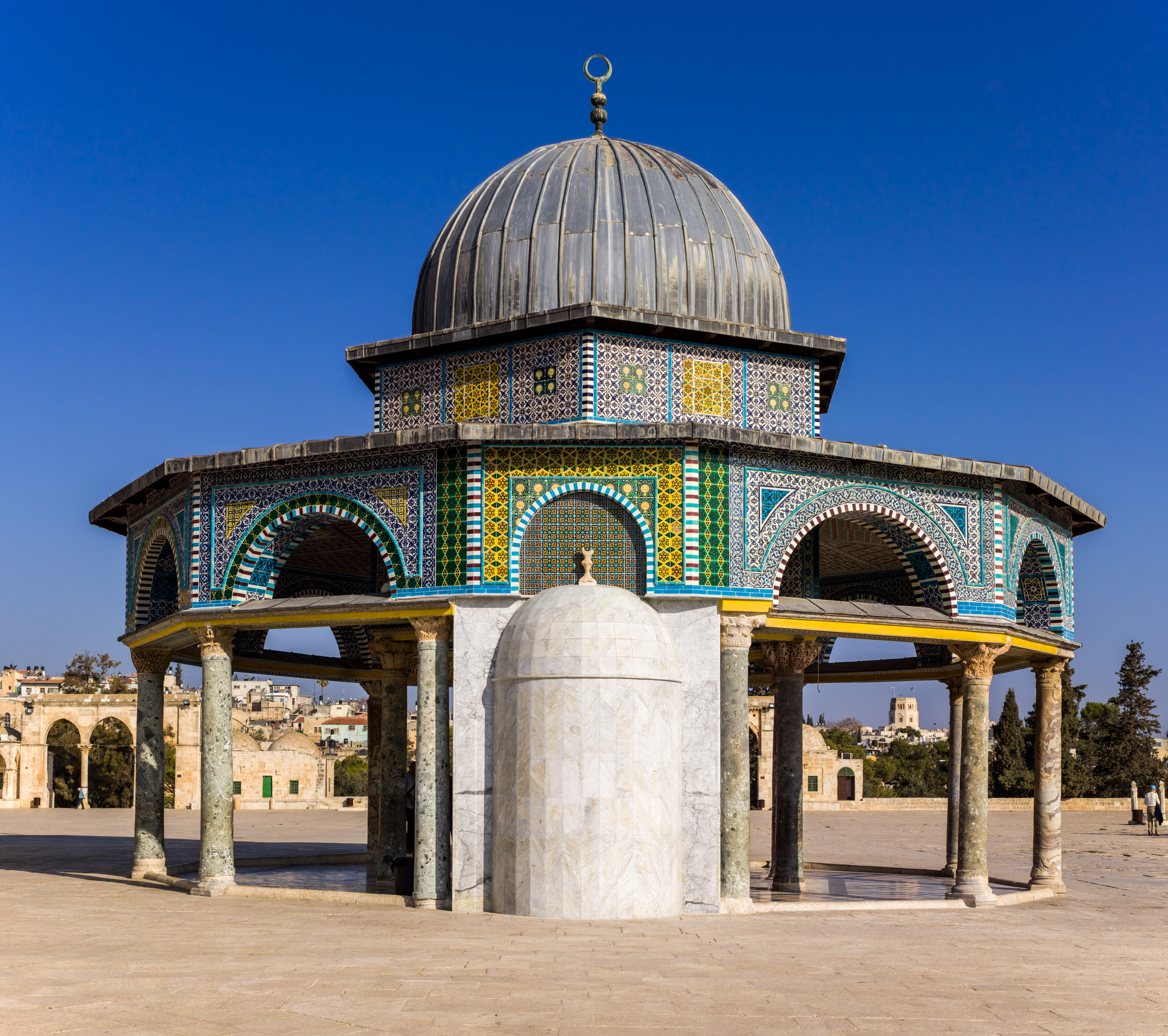
The Dome of the Chain (Arabic: قبة السلسلة, Qubbat al-Silsila), on the Temple Mount in the Old City of Jerusalem — CC BY-SA 4
History of the Dome of the Rock
Built Under the Caliph Abd al-Malik
The history of the Dome of the Rock begins in 691–692, when the shrine was completed, under the Umayyad Caliph Abd al-Malik. The caliph ruled the Islamic world from Damascus, and he built the shrine on the Temple Mount, on the site of the Jewish Temple, as a monument of Islam, and as a rival to the churches of Jerusalem. The architects were Raja ibn Haywah and Yazid ibn Salam, and their design was new: an octagon, with a dome, with mosaics and with calligraphy, and the shrine was the first great monument of Islamic architecture, and its plan became the model of the mosques that followed.
The shrine was built in a time of war, when the caliph fought for the throne, and the Dome of the Rock was his statement, in stone and in gold, that his rule was the rule of Islam. The mosaics of the shrine show the crowns, the jewels and the plants of the empires that Islam had conquered, and their message is the message of the victory, and the calligraphy, about 240 metres long, is the earliest dated calligraphy of Islam, and its verses are the verses of the Quran. The shrine is the monument of the seventh century, and its dome is the dome of the Umayyad age.
The Dome of the Rock is not a mosque, and it was not built as a place of prayer, but as a shrine, a monument to mark the Foundation Stone. The Al-Aqsa Mosque, which stands at the southern end of the platform, is the mosque of the Temple Mount, and the Dome of the Rock is its shrine, and the two together are the Haram al-Sharif, the Noble Sanctuary. The distinction matters, because the visitor who comes to the Dome of the Rock comes to a shrine, and the shrine is seen from the outside, and its interior is the place of the stone.

The Al-Aqsa Mosque on the Temple Mount — Godot13, CC BY-SA 4
The Foundation Stone and Its Meaning in Three Faiths
The Foundation Stone is the reason the Dome of the Rock was built, and its meaning is the meaning of Jerusalem. In the Jewish tradition, the stone is the foundation of the world, and the place where Abraham was to sacrifice Isaac, and the place where the Temple stood, and the Holy of Holies was built upon it. The Temple was destroyed by the Romans in AD 70, and its stones were scattered, but the rock remained, and the memory of the Temple remained with it, and the stone is the holiest place of Judaism.
In the Christian tradition, the stone is the stone of the Temple, and the Temple is the place of the history of Jerusalem, of the kings, the prophets and Jesus, who taught in its courts. The Church of the Holy Sepulchre, which stands in the Christian Quarter, is the church of the crucifixion and the resurrection, and the Dome of the Rock is the shrine of the Temple, and the two are the two poles of the Christian Jerusalem, the Temple and the Tomb.
In the Muslim tradition, the stone is the place of the Night Journey, when the Prophet Muhammad was taken from Mecca to Jerusalem, and from the stone he ascended to heaven. The Dome of the Rock was built to mark that journey, and its dome covers the stone, and its mosaics and its calligraphy tell the story of the faith. The three traditions honour the same stone, and their stories differ, and the shrine honours the stone, and the stone honours the three.
Through the Centuries: Restoration and Change
The Dome of the Rock has stood for thirteen centuries, and it has been restored, repaired and changed, but its plan has not changed, and its dome has stood through every century. The Crusaders, who held Jerusalem from 1099 to 1187, made the shrine a church, and they placed a cross on its dome, and they called it the Temple of the Lord. The Muslims retook the city in 1187, and the shrine became a shrine again, and the cross was taken down, and the dome was restored, and the mosaics were repaired.
The Ottomans, who ruled Jerusalem from the sixteenth century, covered the exterior of the Dome of the Rock in tiles, in the sixteenth century, and the tiles are the tiles that the visitor sees today, blue, green and white, with their patterns of flowers and of geometry. The tiles were restored in the twentieth century, and the dome was re-gilded in 1993, with 80 kilograms of gold, and the gold is the gold that the visitor sees, shining over the city. The shrine has been restored by every age, and each age has left its mark, and the dome is the dome of thirteen centuries.
The earthquakes of Jerusalem have shaken the Dome of the Rock, and its dome has been repaired, and its mosaics have been restored, and its tiles have been replaced, but the octagon has stood, and the stone has stood, and the shrine has stood. The Dome of the Rock is the oldest Islamic monument in the world, and its age is the measure of its endurance, and its dome is the dome that has seen every century of Jerusalem.
UNESCO and World Heritage
The Dome of the Rock is part of the Old City of Jerusalem and its Walls, inscribed on the UNESCO World Heritage List in 1981, as ref 148, under criteria (ii), (iii) and (vi). The listing names the Dome of the Rock among the about 220 historic monuments of the Old City, and it describes the shrine as one of the finest monuments of the city. The Old City was placed on the List of World Heritage in Danger in 1982, and it has remained on the list ever since, a measure of the risks that the city faces. The listing named no state as the site’s owner, and this article follows that neutrality.
The Old City covers about one square kilometre, and its walls, rebuilt under the Ottomans in the sixteenth century, enclose the quarters, the markets and the shrines. The Dome of the Rock is the landmark of the Old City, and its golden dome is the image of Jerusalem, and the visitor who sees it sees the city. The shrine is the monument of the Temple Mount, and the Temple Mount is the heart of the Old City, and the Old City is the heart of Jerusalem, and the Dome of the Rock is its crown.
Timeline of the Dome of the Rock
The Dome of the Rock was completed in 691–692, under the Umayyad Caliph Abd al-Malik, designed by Raja ibn Haywah and Yazid ibn Salam. The shrine was the first great monument of Islamic architecture, and its octagon, its dome, its mosaics and its calligraphy became the model of the mosques that followed. The Crusaders held Jerusalem from 1099 to 1187, and they made the shrine a church, and the Muslims retook the city in 1187, and the shrine became a shrine again.
The Ottomans covered the exterior in tiles in the sixteenth century, and they rebuilt the walls of the Old City in the same century. The dome was re-gilded in 1993, with 80 kilograms of gold. The Old City of Jerusalem and its Walls was inscribed on the UNESCO World Heritage List in 1981, as ref 148, under criteria (ii), (iii) and (vi), and it was placed on the List of World Heritage in Danger in 1982, where it has remained.
The Dome of the Rock (Arabic: مسجد قبة الصخرة, Hebrew: כיפת הסלע), on the Temple Mount in the Old City of Jerusalem — CC BY-SA 4
Travel to the Dome of the Rock
How to Enter the Temple Mount Area
The Dome of the Rock stands on the Temple Mount, the Haram al-Sharif, and the visitor who is not Muslim enters the platform through the Mughrabi Gate, on the western side, near the Western Wall. The gate is the only gate for visitors who are not Muslim, and the visitor should arrive early, because the queue is long, and the platform is open to visitors only in the mornings, from Sunday to Thursday, according to the guides. The platform is closed on Friday and Saturday, and on Muslim holidays, and it can be closed without notice, when the security situation changes, and the visitor should check on the day.
The visitor who is not Muslim does not enter the Dome of the Rock itself, and does not enter the Al-Aqsa Mosque, and the shrine is seen from the outside only. The interior of the shrine is the place of Muslim prayer, and its doors are closed to the visitor, and the Foundation Stone is seen only by those who pray there. The visitor should respect the rule, and should not attempt to enter, and should see the shrine from the platform, where its octagon, its tiles and its dome can be seen in full. The platform is the place of the visit, and the shrine is the sight of the platform.
The hours of the platform for visitors who are not Muslim change with the season and with the security situation, and they can be closed without notice, and this article gives no exact hours, because the hours have not been verified. The visitor should check the latest information on the day of the visit, and should follow the instructions of the guards, and should be ready to leave the platform when told to. The visit is a visit of the morning, and the visitor who comes late may find the gates closed.
Seeing the Dome of the Rock from Outside
The Dome of the Rock is best seen from the platform, where its octagon, its tiles and its dome can be seen in full. The visitor should walk the platform, and see the shrine from the north, the east and the south, because each side shows a different face, and the dome is the same from every side, golden against the stone. The morning light is the best, when the sun rises over the Mount of Olives, and the dome is lit from the east, and its gold is bright. The evening light is the second-best, when the sun sets over the city, and the dome is golden in the west.
The Dome of the Rock is also seen from outside the Old City, from the Mount of Olives, to the east, where the whole city spreads below, and the dome is the centre of the view. The viewpoint of the Mount of Olives is the photograph of Jerusalem, and the visitor who stands there sees the dome, the walls and the city, in a single view. The Western Wall Plaza, to the west, is the place to see the platform from below, and the dome rises above the wall, and the view is the view of the city from its heart.

The Western Wall Plaza in the Old City of Jerusalem — Gary Todd, CC0
Combining the Visit with the Old City of Jerusalem
The Dome of the Rock is the centre of a day in the Old City of Jerusalem, and the visitor should pair it with the quarters, the markets and the churches. The morning is the platform, with the Dome of the Rock and the Al-Aqsa Mosque, seen from the outside, and the afternoon is the quarters, with the Western Wall, the Church of the Holy Sepulchre and the markets. The walk through the Old City takes a day, and its lanes, its shops and its shrines are the city of the three faiths, and the Dome of the Rock is its crown.
The visitor who wants a guide can join one of the Jerusalem tours that walk the Old City.
The visitor should allow a half day for the platform and the Old City, and a full day for the city and the Mount of Olives. The Old City is small, about one square kilometre, and it is walked on foot, and its lanes are stone, and its steps are many, and the visitor should wear good shoes, and should carry water, because the sun is strong. The markets of the Old City sell the crafts, the spices and the food of Jerusalem, and the visitor who buys there buys the city.

The dome of the Church of the Holy Sepulchre, Jerusalem — Godot13, CC BY-SA 4
Notes on Security and Timing
The visit to the Temple Mount can be restricted or suspended on the great holidays, and when there is tension, and the visitor should follow the official travel advice before going to Jerusalem. The security situation changes quickly, and the platform can be closed without notice, and the visitor should check the latest information on the day, and should not rely on the hours given in this article, because this article gives no hours. The visitor should dress modestly, and should respect the rules of the platform, and should not bring religious items onto it, because the platform is a sacred place, and its rules are the rules of the sanctuary.
The Dome of the Rock is a place of prayer, and the visitor should behave as a guest. The shrine should be photographed from the platform, without flash, and the worshippers should not be photographed, and the visitor should speak quietly, because the platform is a place of prayer. The visit is a visit of respect, and the visitor who respects the place will be welcomed, and the visitor who does not will be asked to leave.
Notable Places in the Dome of the Rock
The golden dome is the first place of the Dome of the Rock, and it is the landmark of Jerusalem. The dome is about 20 metres in diameter, and it was re-gilded in 1993, with 80 kilograms of gold, and its gold is the gold of the city. The dome is seen from the hills around Jerusalem, and its gold is the image of the city, and the visitor who sees it sees the Dome of the Rock. The dome is the crown of the shrine, and its phoenix is the gold of the sky.
The octagon is the second place, and it is the shape of the shrine. The eight sides of the octagon are covered in tiles, in blue, green and white, and their patterns are the patterns of the Ottoman tiles, laid in the sixteenth century. The doors open on four sides, and the interior is a circle within the octagon, with its columns, its arches and its mosaics. The octagon is the plan of the shrine, and its shape is the shape of the monument.
The Foundation Stone is the third place, and it lies at the centre of the shrine, under the dome. The stone is a rock, irregular and bare, and it rises from the floor, and its surface is the rock of the Temple Mount. The stone is sacred to the three faiths, and its meanings differ, and the shrine was built to honour it. The stone is seen only by those who pray in the shrine, and the visitor sees it only in the imagination, but its presence is the presence of the shrine.
The mosaics and the calligraphy are the fourth place, and they cover the interior of the shrine. The mosaics show the plants, the jewels and the crowns of the early Islamic art, in gold, green and blue, and the calligraphy is a band of Kufic script, about 240 metres long, with the verses of the Quran. The mosaics and the calligraphy are the art of the seventh century, and their gold is the gold of the Umayyad age. The interior is seen only by those who pray, and the visitor knows it from the descriptions, not from the sight.
The Temple Mount platform is the fifth place, and it is the setting of the Dome of the Rock. The platform is a rectangle of stone, and its western wall is the Western Wall, and its southern end holds the Al-Aqsa Mosque, and its gates, its schools and its fountains are the Haram al-Sharif. The platform is the sacred space of the Old City, and the Dome of the Rock stands at its centre, and the visitor who walks it walks the heart of Jerusalem.

The Dome of the Rock at sunset — Zxc0505, CC BY-SA 3

The Temple Mount seen from the air — Godot13, CC BY-SA 4
Frequently Asked Questions
Where is the Dome of the Rock?
The Dome of the Rock stands on the Temple Mount, the Haram al-Sharif, in the centre of the Old City of Jerusalem, on the highest ground of the platform. The Old City covers about one square kilometre, and it holds about 220 historic monuments, according to the description of UNESCO. This article assigns the shrine to no country, following the neutrality of the UNESCO listing of 1981, which named no state as the site’s owner.
When was the Dome of the Rock built?
The Dome of the Rock was completed in 691–692, under the Umayyad Caliph Abd al-Malik, designed by the architects Raja ibn Haywah and Yazid ibn Salam. The shrine is the oldest Islamic monument in the world, and its octagon, its dome, its mosaics and its calligraphy became the model of the mosques that followed. In 1993 the dome was covered again in gold, with 80 kilograms of the metal.
Can non-Muslim visitors enter the Dome of the Rock?
No, visitors who are not Muslim do not enter the Dome of the Rock itself, and they do not enter the Al-Aqsa Mosque, and the shrine is seen from the outside only. Visitors who are not Muslim enter the Temple Mount platform through the Mughrabi Gate, on the western side, near the Western Wall, in the mornings, from Sunday to Thursday, according to the guides. The platform is closed on Friday and Saturday, and on Muslim holidays, and it can be closed without notice.
What is the Foundation Stone?
The Foundation Stone is the rock at the centre of the Dome of the Rock, under the dome, and it is the stone that the shrine was built to honour. In the Jewish tradition, it is the foundation of the world and the place of the Temple, and in the Muslim tradition, it is the place from which the Prophet Muhammad ascended to heaven on the Night Journey. The stone is sacred to the three faiths, and its meanings differ, and the shrine honours the stone.
Is the Dome of the Rock a UNESCO site?
The shrine belongs to the Old City of Jerusalem and its Walls, on the UNESCO World Heritage List since 1981, as ref 148, under criteria (ii), (iii) and (vi). The listing names the Dome of the Rock among the about 220 historic monuments of the Old City. The Old City was placed on the List of World Heritage in Danger in 1982, and it has remained on the list ever since.
How long should I spend at the Dome of the Rock?
A half day is enough for the platform and the Old City, and a full day is needed for the city and the Mount of Olives. The platform is open to visitors who are not Muslim only in the mornings, from Sunday to Thursday, according to the guides, and the visitor should arrive early, because the queue at the Mughrabi Gate is long. The morning light is the best for the dome, when the sun rises over the Mount of Olives.
Verified
- The completion of the Dome of the Rock in 691–692, under the Umayyad Caliph Abd al-Malik, the architects Raja ibn Haywah and Yazid ibn Salam, the octagonal plan, the dome of about 20 metres in diameter, the Foundation Stone at the centre, the Kufic calligraphy band of about 240 metres and the re-gilding in 1993 with 80 kilograms of gold were checked on 21 November 2026.
- The UNESCO listing of the Old City of Jerusalem and its Walls in 1981, ref 148, criteria (ii), (iii) and (vi), its place on the List of World Heritage in Danger since 1982 and the description of about 220 historic monuments were read on the UNESCO World Heritage List on 21 November 2026.
- The rule that visitors who are not Muslim enter through the Mughrabi Gate, see the shrine from the outside only and do not enter it, and that the platform is open in the mornings from Sunday to Thursday and closed on Friday, Saturday and Muslim holidays, was checked on 21 November 2026.
- The coordinates 31.778° N, 35.2353° E and the Wikidata code Q172077 were checked against the Wikidata API on 21 November 2026 and match the registry, with the place type recorded as a mosque and a shrine.
- The neutrality of this article, which assigns the Dome of the Rock to no country, follows the UNESCO listing of 1981, which named no state as the site’s owner, and the approach of the Jerusalem article, checked on 21 November 2026.
Sources
- UNESCO, Old City of Jerusalem and its Walls — https://whc.unesco.org/en/list/148/
- UNESCO, Old City of Jerusalem and its Walls, Danger List — https://whc.unesco.org/en/decisions/5003
- Wikidata, Dome of the Rock (Q172077) — https://www.wikidata.org/wiki/Q172077
Unverified
- The exact opening hours of the Temple Mount for visitors who are not Muslim change with the season and the security situation, and the platform can be closed without notice; this article gives no hours, and the reader should check the latest information on the day of the visit.
- The visit to the platform can be restricted or suspended on the great holidays and when there is tension, and the reader should follow the official travel advice before going to Jerusalem.
- The number of historic monuments in the Old City, about 220, and the area of the Old City, about one square kilometre, come from the description of UNESCO and have not been checked against the official survey.
- The diameter and the height of the dome, about 20 metres and about 20.48 metres, come from the general guides on the architecture and have not been checked against the official survey of the shrine.
- This article gives no ticket price, because entry to the Haram al-Sharif is not charged, according to the sources checked; the reader should check at the site if that changes.
Illustrations
- Hero: View of Dome of the Rock. Free image: https://upload.wikimedia.org/wikipedia/commons/a/a3/Jerusalem-2013-Temple_Mount-Dome_of_the_Rock_%26_Chain.jpg — CC BY-SA 4.0.
- In body, Dome of the Rock: The Dome of the Chain (Arabic: قبة السلسلة, Qubbat al-Silsila), on the Temple Mount in the Old City of Jerusalem. Free image: https://upload.wikimedia.org/wikipedia/commons/6/68/Jerusalem-2013%282%29-Temple_Mount-Dome_of_the_Chain_%28south_exposure%29.jpg — CC BY-SA 4.
- In body, Dome of the Rock: The Dome of the Rock (Arabic: مسجد قبة الصخرة, Hebrew: כיפת הסלע), on the Temple Mount in the Old City of Jerusalem. Free image: https://upload.wikimedia.org/wikipedia/commons/8/8b/Jerusalem-2013%282%29-Temple_Mount-Dome_of_the_Rock_%28SE_exposure%29.jpg — CC BY-SA 4.
- In body, Mount of Olives: The Dome of the Rock and the Temple Mount seen from the Mount of Olives. Free image: https://upload.wikimedia.org/wikipedia/commons/c/c8/Jerusalem-2013%282%29-View_of_the_Dome_of_the_Rock_%26_Temple_Mount_02.jpg — Godot13, CC BY-SA 4.
- In body, Old City walls: The Old City walls of Jerusalem. Free image: https://upload.wikimedia.org/wikipedia/commons/1/13/Old_City_Walls_%28Jerusalem%29_20180704.jpg — Suicasmo, CC BY-SA 4.
- In body, Western Wall: The Western Wall, Jerusalem. Free image: https://upload.wikimedia.org/wikipedia/commons/a/a3/Westen_%28Wailing%29_Wall%2C_Jerusalem%2C_2007.jpg — Godot13, CC BY-SA 4.
- In body, Dome of the Rock tiles: Tile detail on the Dome of the Rock. Free image: https://upload.wikimedia.org/wikipedia/commons/9/91/Jerusalem-2013-Temple_Mount-Dome_of_the_Rock-Detail_01.jpg — Godot13, CC BY-SA 4.
- In body, Al-Aqsa Mosque: The Al-Aqsa Mosque on the Temple Mount. Free image: https://upload.wikimedia.org/wikipedia/commons/b/ba/Jerusalem-2013-Temple_Mount-Al-Aqsa_Mosque_01.jpg — Godot13, CC BY-SA 4.
- In body, Western Wall Plaza: The Western Wall Plaza in the Old City of Jerusalem. Free image: https://upload.wikimedia.org/wikipedia/commons/7/76/Jerusalem_Old_City_Western_Wall_Plaza_%2843177569831%29.jpg — Gary Todd, CC0.
- In body, Church of the Holy Sepulchre: The dome of the Church of the Holy Sepulchre, Jerusalem. Free image: https://upload.wikimedia.org/wikipedia/commons/2/29/ISR-2013-Jerusalem-Holy_Sepulchre-dome.jpg — Godot13, CC BY-SA 4.
- In body, Dome of the Rock at sunset: The Dome of the Rock at sunset. Free image: https://upload.wikimedia.org/wikipedia/commons/a/ab/Dome_of_the_Rock_in_sunset.JPG — Zxc0505, CC BY-SA 3.
- In body, Temple Mount platform: The Temple Mount seen from the air. Free image: https://upload.wikimedia.org/wikipedia/commons/2/22/Jerusalem-2013%282%29-Aerial-Temple_Mount-%28south_exposure%29.jpg — Godot13, CC BY-SA 4.