
The Alps: Europe’s Great Mountain Range, from France to Austria
The Alps stretch across eight countries in the heart of Europe. Snow, lakes and old villages fill every valley of the range.
Few mountain ranges shape a continent the way the Alps do, because they form the high roof of Europe and the watershed between the seas of the north and the Mediterranean. From the French coast near Nice to the plains of Austria and Slovenia, the range runs in a great arc of about 1,200 kilometres, and its valleys hold cities, farms, ski resorts and quiet hamlets side by side. Travellers come for the peaks and the glaciers, yet they stay for the slower pleasures of the valleys, the lakes, the food and the small trains that climb through the passes. An austrian alps vacation belongs to this larger story, because Austria holds some of the most loved valleys and villages of the whole range, and the Austrian side of the mountains rewards visitors who travel slowly and look closely.
The Alps are not one landscape but many, and each country that shares the range gives it a different character. France holds the highest summit, Mont Blanc, and the steep resorts of the Savoy region, while Switzerland holds the great glaciers, the high railways and the famous peaks around Zermatt and the Bernese Oberland. Italy holds the pale towers of the Dolomites and the lakes of the south, Germany holds the gentler Bavarian Alps around Garmisch and Berchtesgaden, and Austria holds long green valleys between high ridges, with Salzburg and Innsbruck as its two great mountain cities.
Slovenia holds the Julian Alps and Lake Bled, Liechtenstein holds a small stretch of high peaks, and Monaco touches the range at its western edge. Together these eight countries share one mountain world, and a single journey can cross three borders before lunch.
This guide covers the whole range and gives the deepest attention to the Austrian Alps, because that is where most English-speaking visitors plan their trips. It explains how the mountains were formed, how people have lived and travelled through them for thousands of years, and how to plan a journey that fits the season. It also names the places that matter most, from the great glaciers of Switzerland to the salt lakes of the Austrian Salzkammergut, so that an austrian alps vacation can be planned with confidence and a return visit can go deeper.
Quick Facts About the Alps
| Fact | Detail |
|---|---|
| Name | The Alps |
| Role | The highest and most extensive mountain range in Europe |
| Countries | France, Switzerland, Italy, Austria, Germany, Slovenia, Liechtenstein, Monaco |
| Length | About 1,200 kilometres from Nice to Vienna |
| Highest peak | Mont Blanc, 4,808 metres, on the border of France and Italy |
| Highest peak in Austria | Grossglockner, 3,798 metres |
| Longest glacier | Aletsch Glacier, about 23 kilometres, in Switzerland |
| UNESCO | No single listing covers the whole range, and several Alpine sites are listed separately |
| Coordinates | 46.58° N, 8.62° E |
| Wikidata | Q1286, mountain range |
Geography of the Alps
The Shape of the Range
The Alps form a crescent that curves from the Mediterranean coast of France through Switzerland and northern Italy, then east through Austria into Slovenia and Hungary. The western Alps are the highest and steepest part of the range, with Mont Blanc and Monte Rosa rising above 4,600 metres, while the eastern Alps are broader and lower, with long parallel ridges and wide valleys that are easier to farm and settle. The range is about 1,200 kilometres long and between 100 and 250 kilometres wide, and it covers roughly 200,000 square kilometres of land. Its highest ground divides the waters of Europe, and an austrian alps vacation crosses that watershed more than once, because rain that falls on the northern slopes flows to the Rhine, the Rhone and the Danube, while rain on the southern slopes flows to the Po and the Adriatic.
The mountains were built by the slow collision of the African and European tectonic plates, a process that began tens of millions of years ago and still lifts the peaks by a millimetre or two each year. Layers of rock that were once the floor of an ancient sea were folded, pushed upward and broken into the ridges and valleys of today, and the fossils of sea creatures can still be found high on the slopes. Glaciers carved the valleys into deep U shapes during the ice ages, and the lakes that fill many valley floors are the flooded remains of those glacial troughs. The result is a landscape of sharp contrasts, where a green meadow and a wall of rock can stand a few hundred metres apart, and where a village in a sunny valley can look up at a glacier that never melts.
The Austrian Alps occupy the eastern third of the range, and they differ from the western Alps in ways that matter for an austrian alps vacation. The Austrian mountains are lower on average than the peaks of France and Switzerland, yet they are no less dramatic, because their ridges run in long chains that frame wide valleys like the Inn Valley, the Salzach Valley and the Enns Valley. These valleys hold the towns, the farms and the roads, while the high ground above them holds the ski areas, the glaciers and the hiking trails.
The Hohe Tauern, the largest national park in the Alps, protects the Grossglockner and the Krimml Falls, while the Dachstein massif rises above the lakes of the Salzkammergut. Austria has more than 700 peaks above 3,000 metres, and many of them can be reached by cable car or by a well-marked trail from a valley village.
Peaks and Glaciers
Mont Blanc stands at 4,808 metres on the border between France and Italy, and it is the highest mountain in the Alps and in the whole of Western Europe. Its white dome dominates the town of Chamonix, and climbers from many countries attempt its summit every summer, guided by local companies that have worked the mountain for more than two centuries. Monte Rosa, at 4,634 metres, holds the highest peak entirely in Switzerland in its Dufourspitze, and the Matterhorn, at 4,478 metres, is the most photographed mountain in the range, with its perfect pyramid rising above the car-free village of Zermatt. The Eiger, the Monch and the Jungfrau form a great wall above the Bernese Oberland, and the Jungfrau railway climbs through the rock to a station at 3,454 metres, one of the highest in Europe.
The glaciers of the Alps are the largest ice masses in Europe outside the far north, and the Aletsch Glacier in Switzerland is the longest of them all, at about 23 kilometres, and it is a highlight of an austrian alps vacation. Its river of ice flows between the peaks of the Bernese Alps and feeds the Rhone, and walkers can cross its surface on guided tours in summer. The glaciers have shrunk sharply in recent decades, and the ice that once filled whole valleys now ends far above the villages that grew beside it.
Scientists measure the retreat each year, and the shrinking glaciers are now one of the clearest signs of a warming climate in Europe. In Austria, the Pasterze Glacier below the Grossglockner is the longest glacier in the Eastern Alps, and visitors can walk to its edge from the Kaiser-Franz-Josefs-Hohe viewpoint on the Grossglockner High Alpine Road.
The rock of the Alps changes from west to east, and that change shapes the scenery that visitors see. The western Alps are built of hard crystalline rock, which forms the sharp peaks of Mont Blanc and the Matterhorn, while the Dolomites of Italy are built of pale limestone and dolomite, which glows pink and orange at sunset. The northern limestone Alps of Austria and Germany form the steep cliffs above lakes like Hallstatt and Konigssee, and the southern limestone Alps frame the lakes of northern Italy. The variety of rock explains why the Alps never look the same twice, and why a traveller who moves from Chamonix to the Dolomites feels as if the mountains have changed their character entirely.

The Chamonix valley below Mont Blanc — CC BY-SA 3

The Aletsch Glacier in Switzerland — CC BY-SA 4
Lakes and Valleys
The lakes of the Alps are among the most beautiful in Europe, and they are also among the most important for the people who live beside them. Lake Geneva, Lake Constance and Lake Lucerne are great bodies of water on the northern edge of the range, while Lake Garda, Lake Como and Lake Maggiore lie on the Italian side, where the climate is warmer and the towns have a Mediterranean air. In Austria, the lakes of the Salzkammergut are smaller and more intimate, and Hallstatt, Wolfgangsee and Mondsee are ringed by steep mountains that rise straight from the water.
Lake Annecy in France is one of the cleanest lakes in Europe, and Lake Bled in Slovenia is famous for its island church and its castle on a cliff. These lakes are not only scenery, because they supply drinking water, power and fish, and they have shaped the settlement of the Alps for centuries.
The valleys of the Alps are the true home of Alpine life, because the high peaks are too steep and too cold for permanent settlement. The Inn Valley runs east through Tyrol past Innsbruck, the Salzach Valley runs through Salzburg, and the Rhone Valley runs through the Valais in Switzerland, each of them holding towns, farms, railways and roads in a narrow strip of flat land. The valleys are where the food is grown, the cattle graze in summer and the villages cluster around churches that have stood for a thousand years.
In winter the valley floors stay green while the slopes above turn white, and in summer the meadows fill with wildflowers and the sound of cowbells. The contrast between the busy valley and the silent high ground is the heart of the Alpine experience, and an austrian alps vacation is best understood as a journey between the two.
The passes of the Alps have always joined the valleys, and they are among the most famous roads in Europe. The Gotthard Pass joins northern Switzerland to the south, the Brenner Pass joins Austria to Italy, and the Simplon Pass joins Switzerland to Italy through a long tunnel. The Grossglockner High Alpine Road climbs to 2,571 metres in Austria and is one of the most scenic drives in the range, while the Stelvio Pass in Italy climbs through 48 hairpin bends to 2,757 metres. Many passes close in winter, and the tunnels beneath them carry the traffic instead, yet the old pass roads remain the most memorable way to cross the mountains in summer.

Bled Island and Bled Castle on Lake Bled, Slovenia — CC BY-SA 4
Climate and Seasons
The climate of the Alps changes with height more than with latitude, and a valley floor can be warm while the peaks above are frozen. The valleys of Austria and Switzerland are mild in summer, with temperatures that suit hiking and swimming, while the high slopes stay cool even in July and August. Winter brings snow to the valleys from December to March, and the ski resorts above 1,500 metres often hold snow from November to April.
The southern slopes of the Alps are warmer and sunnier than the northern slopes, which is why the Italian lakes feel Mediterranean while the Bavarian Alps feel northern. Rain falls most often in summer, when afternoon thunderstorms build over the peaks, and the clearest weather comes in autumn, when the air is cold and the larch trees turn gold.
The seasons shape every part of an austrian alps vacation, because the mountains offer a different journey in each month of the year. Spring brings the first flowers to the meadows and the opening of the high passes, summer brings long days for hiking and climbing, autumn brings harvest festivals and quiet trails, and winter brings skiing, snowshoeing and Christmas markets in the valley towns. The busiest months are July, August and February, when the trails and the slopes are full, while May, June, September and October are quieter and often more rewarding. Travellers who can choose their dates should look at the shoulder seasons first, because an austrian alps vacation is at its best when the crowds have gone home.
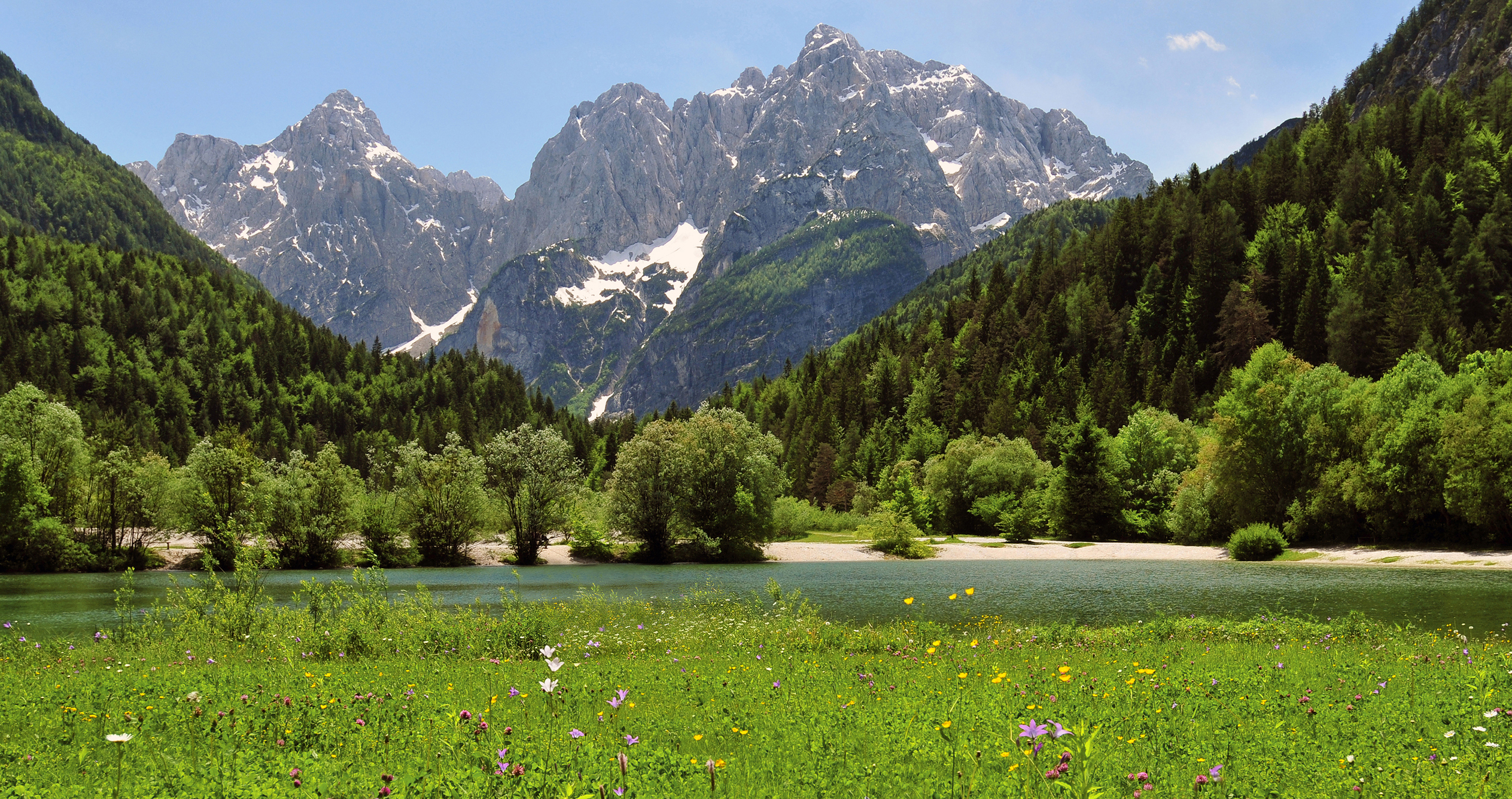
View from Kranjska Gora across Lake Jasna to the Julian Alps — CC BY 3
History of the Alps
The Making of the Mountains
The Alps began to form about 100 million years ago, when the African plate began to move north toward Europe and the sea between them began to close. The rocks of the sea floor were squeezed, folded and pushed upward in a slow collision that built the range over tens of millions of years, and the main phase of uplift took place about 30 to 40 million years ago. The fossils of ammonites and other sea creatures that are found on Alpine summits today are the proof of this origin, because those creatures lived in a warm sea long before the mountains existed.
The range is still rising today, by about one to two millimetres a year, and earthquakes remind the people of the Alps that the collision has not finished. The deep valleys and the sharp peaks are the work of ice as much as of rock, because the glaciers of the ice ages carved the valleys and sharpened the ridges, and the lakes and the waterfalls of today are the legacy of that carving.
The first people to live in the Alps were hunters who followed the herds of the valleys after the ice retreated, about 10,000 years ago. They left tools and bones in caves and rock shelters, and later farmers moved into the valleys and began to clear the forests and graze cattle on the high meadows. The most famous early Alpine person is Otzi the Iceman, whose body was found in 1991 in a glacier in the Otztal Alps on the border of Austria and Italy.
Otzi lived about 5,300 years ago, and his clothes, tools and weapons survived in the ice, giving archaeologists a rare picture of life in the Copper Age. The discovery showed that people crossed the high Alps long before the Romans, and that the passes were already routes of trade and travel in prehistory.
Romans and the Great Crossings
The Romans were the first to build roads through the Alps on a large scale, and their engineers cut routes over passes that are still used today. The Great Saint Bernard Pass and the Little Saint Bernard Pass joined Italy to Gaul, the Brenner Pass joined Italy to the Danube, and the Julier Pass and the Splugen Pass crossed the central Alps. The Romans built towns at the foot of the passes, and many Alpine cities, including Aosta, Grenoble and Augsburg, began as Roman settlements.
The roads carried soldiers, merchants and wine, and they joined the Mediterranean world to the peoples of the north. The most famous crossing of the Alps in the ancient world was made by Hannibal of Carthage in 218 BC, when he led his army, including war elephants, over the mountains to attack Rome, and modern travellers on an austrian alps vacation still cross the same passes. Historians still argue about which pass he used, and the crossing remains one of the great stories of the Alps, a reminder that the mountains were a barrier that determined the fate of empires.
After the fall of Rome, the passes were kept open by monasteries and by the hospices that sheltered travellers on the high routes. The hospice on the Great Saint Bernard Pass was founded in the eleventh century, and its monks bred the great dogs that rescued travellers lost in the snow. Pilgrims crossed the Alps on their way to Rome, merchants carried salt and wine over the passes, and the cities of the valleys grew rich on the trade.
The salt mines of Hallstatt and Hallein in Austria were among the oldest and richest in Europe, and salt from the Alps was traded across the continent for more than three thousand years. The name of Salzburg itself comes from salt, and the wealth of the salt trade built the churches and palaces of the city.
Medieval Valleys and Mountain Freedom
In the Middle Ages, the valleys of the Alps developed their own forms of government, because the mountains made it hard for kings to rule them directly. The Swiss cantons formed a confederation in 1291, when three valley communities swore an oath to defend each other, and the Swiss grew into a free state that defended its independence against the Habsburgs and the Burgundians. The Tyroleans of Austria kept their own laws and customs under the counts of Tyrol, and the valleys of the French Alps kept their own traditions under the dukes of Savoy.
The mountain communities were poor in grain and rich in cattle, cheese and timber, and they traded those goods with the cities of the plains. The transhumance of cattle, the movement of herds between valley and high meadow, shaped the calendar of Alpine life, and the festivals that mark the return of the herds in autumn are still held in many valleys today.
The castles and churches of the Alps tell this history in stone, from the fortress of Hohensalzburg above Salzburg to the abbey of Saint Gall in Switzerland. The town of Hallstatt grew around its salt mine and its lake, and its houses climb the steep slope above the water in a way that has made it one of the most photographed villages in Europe. The pilgrimage churches of the Alps, such as the Wieskirche in Bavaria, drew travellers from far away, and the monasteries of the valleys kept the learning and the art of the mountains alive through the centuries. The Reformation and the wars of religion divided the Alps, and the valleys of Switzerland and Austria became a patchwork of Catholic and Protestant communities that still shapes the region today.
The Birth of Alpine Tourism
Modern Alpine tourism began in the nineteenth century, when British travellers came to Switzerland for the air, the scenery and the challenge of the peaks. The first ascent of the Matterhorn in 1865 ended in tragedy, when four of the seven climbers fell to their deaths on the descent, and the event made the Alps famous around the world. Hotels were built in the valleys, railways were pushed into the mountains, and the winter season was invented in Saint Moritz in 1864, when a hotelier bet his English guests that they would enjoy the winter sun. The Jungfrau Railway, completed in 1912, carried visitors through the rock of the Eiger to the highest station in Europe, and the cable cars that followed opened the high slopes to skiers and walkers who had never climbed a mountain.
The twentieth century brought the Winter Olympics to the Alps again and again, with Chamonix hosting the first Winter Games in 1924 and Innsbruck hosting the Games in 1964 and again in 1976. The wars of the century scarred the Alps, because the mountains were a frontier and a refuge, and the passes were routes for soldiers and for people fleeing the fighting. After the Second World War, the Alps became the playground of a new Europe, with ski resorts, hiking trails and summer festivals drawing millions of visitors each year, and the modern austrian alps vacation was born in those years. The Alpine Convention, signed in 1991, joined the eight Alpine countries in a promise to protect the mountains, their nature and their culture, and it remains the framework for cooperation across the range today.

A wild Alpine ibex in the Swiss Alps at Creux du Van — CC BY-SA 4

The Matterhorn above Zermatt, Switzerland — CC BY-SA 4

The Jungfraujoch railway station in Switzerland — CC0
Travel to the Alps
Planning an austrian alps vacation starts with the season, because the Austrian mountains change completely between summer and winter. Summer is the season for hiking, climbing and lake swimming, and the trails of Tyrol and Salzburg are at their best from late June to early October. Winter is the season for skiing, and the resorts of the Arlberg, Kitzbuhel and the Zillertal are among the most reliable in the Alps, with snow from December to April.
Spring and autumn are the quiet seasons, when the hotels are cheaper and the trails are empty, yet many cable cars close for maintenance in those months, so travellers should check the operating dates before they book. A week is a good length for an austrian alps vacation, with two or three bases and day trips from each, while a longer stay allows a slower journey through several valleys.
The best bases for an austrian alps vacation are the cities and towns that sit where the valleys meet the mountains. Innsbruck, the capital of Tyrol, is a city of 130,000 people in the Inn Valley, with the Nordkette cable car climbing straight from the old town to the high peaks. Salzburg, the birthplace of Mozart, is a baroque city at the edge of the Alps, with the fortress of Hohensalzburg above the old town and the lakes of the Salzkammergut a short drive away.
Smaller bases like Hallstatt, Zell am See, Mayrhofen and Lech offer a quieter stay on an austrian alps vacation, with a lake or a ski area at the door and walking trails that start in the village. Travellers who plan an austrian alps vacation around the high Alps should look at the Arlberg and the Otztal, while travellers who want lakes and gentle walking should look at the Salzkammergut and the region around Lake Wolfgang.
Getting around the Alps is easiest by train, because the railways of Austria, Switzerland and Germany are frequent, comfortable and scenic. The Austrian railways run through the Inn Valley and over the Brenner Pass to Italy, and the Swiss railways climb to Zermatt, Saint Moritz and the Jungfrau region on narrow-gauge lines that are journeys in themselves. The Glacier Express runs from Zermatt to Saint Moritz through the Rhone Valley and over the Oberalp Pass, and the Bernina Express runs from Chur over the Bernina Pass to Tirano in Italy.
In Austria, the buses of the valleys connect the villages to the stations, and many regions offer a guest card that includes free bus and train travel. Driving gives more freedom, yet the mountain roads are slow and the passes close in winter, so the train is often the faster choice for an austrian alps vacation.
An austrian alps vacation can be shaped around a single theme, and the mountains reward travellers who choose one thing and do it well. Hikers on an austrian alps vacation can follow the long-distance trails that cross the range, such as the Eagle Walk in Tyrol, which runs for 24 stages through the mountains. Skiers on an austrian alps vacation can buy a pass that covers a whole valley, such as the Ski Arlberg pass, which joins the resorts of Lech, Zurs and Saint Anton.
Families on an austrian alps vacation can stay by a lake, with swimming, boating and easy walks, while climbers can hire a guide for the Grossglockner or the Dachstein. Food is part of the journey, because the valleys have their own cheeses, hams and dumplings, and the mountain huts serve simple meals to walkers who arrive on foot. The best days in the Alps are the slow ones, when a walk ends at a hut with a view and the evening is spent in a village square.
Practical planning matters as much as the route on an austrian alps vacation, because the mountains punish travellers who are unprepared. The weather changes fast, and a sunny morning can turn to rain or snow by the afternoon, so a waterproof jacket and warm layers belong in every bag. The sun is strong at altitude, and sunscreen and water are essential on every hike, even on a cloudy day.
Mountain rescue is a serious service in the Alps, and travellers should carry a charged phone, tell someone their route, and buy travel insurance that covers mountain rescue. The villages have shops, pharmacies and doctors, yet the high huts have little more than a bed and a meal, so walkers should carry what they need for the day. With those simple precautions, an austrian alps vacation is safe, comfortable and deeply rewarding.

The Grossglockner High Alpine Road in Austria — CC BY-SA 4

Hallstatt on its lake in Austria — CC0
Notable Places in the Alps
Mont Blanc and Chamonix stand at the western end of the range, where France meets Italy and Switzerland. Chamonix is a town of steep streets and mountain guides, and the cable car to the Aiguille du Midi climbs to 3,842 metres, where visitors can look across the glaciers to the summit of Mont Blanc. The town hosted the first Winter Olympics in 1924, and its guides have led climbers on the mountain for more than two centuries.
In summer, the Tour du Mont Blanc is one of the great long-distance walks of Europe, circling the massif through France, Italy and Switzerland in about ten days, and it is a demanding alternative to an austrian alps vacation. The glaciers of the Mont Blanc massif are among the most visited in the Alps, and the ice cave of the Mer de Glace draws travellers who want to walk inside a glacier.
Zermatt and the Matterhorn are the most famous pairing in the Alps, and the car-free village at the foot of the mountain has kept its quiet character. The Gornergrat railway climbs to 3,089 metres for a view of the Matterhorn and the glaciers around it, and the Klein Matterhorn cable car climbs higher still. The village is a base for climbers and skiers, yet it is also a place for gentle walks through larch forests and along the river.
The Matterhorn was first climbed in 1865, and the museum in the village tells the story of that climb and of the mountain guides who made Zermatt famous. An austrian alps vacation can be combined with a visit to Zermatt by train, because the railways join Austria to Switzerland through the Arlberg and the Rhine Valley.
The Jungfrau region of Switzerland holds the Eiger, the Monch and the Jungfrau, and the towns of Interlaken, Grindelwald and Lauterbrunnen are the bases for the high country. The Jungfrau Railway climbs from Kleine Scheidegg through the rock of the Eiger to the Jungfraujoch, the highest station in Europe, where visitors step out onto the ice of the Aletsch Glacier. The valleys below hold waterfalls, including the Staubbach Falls at Lauterbrunnen, and the lakes of Thun and Brienz are among the most beautiful in Switzerland. The region is also the home of the first mountain railways, and its old trains are a contrast to the quiet valleys of an austrian alps vacation.
The Grossglockner and the Hohe Tauern are the heart of the Austrian Alps, and the Grossglockner High Alpine Road is the most scenic drive in Austria. The road climbs from the Salzach Valley to 2,571 metres, with viewpoints over the Pasterze Glacier and the summit of the Grossglockner at 3,798 metres. The Hohe Tauern National Park protects the valleys and the peaks around the road, and its rangers lead walks to the waterfalls, the marmots and the ibex of the high country.
The Krimml Falls, the highest waterfalls in Austria, drop 380 metres in three stages through a forested gorge, and the trail beside them is one of the most popular walks in the country. The Grossglockner region is the place where an austrian alps vacation feels most like a journey into the high mountains.
Hallstatt and the Salzkammergut are the gentlest part of the Austrian Alps, and the village of Hallstatt is one of the most visited places in Austria. Its houses stand on a narrow strip of land between the lake and the mountain, and the salt mine above the village has been worked for more than three thousand years. Visitors can take the funicular to the mine and to the Skywalk viewpoint, which looks across the lake to the Dachstein massif.
For an austrian alps vacation built around lakes and gentle walking, the lakes of the Salzkammergut, including Wolfgangsee and Mondsee, are ringed by villages and by mountains that are easy to climb, and the region is a good base for travellers who want the Alps without the high-altitude walking. Salzburg, the city at the edge of the region, is a short drive away, with its fortress, its baroque old town and its festival in summer.
The Dolomites of Italy are the most distinctive mountains in the Alps, because their pale rock towers rise above green meadows in a way that no other part of the range can match. The Tre Cime di Lavaredo, the Seceda ridge and the Alpe di Siusi are the most famous sights, and the towns of Cortina d’Ampezzo and Ortisei are the bases for the region. The Dolomites were a front line in the First World War, and the tunnels and trenches of the high mountains can still be visited today. The region is a paradise for climbers and for walkers, and its via ferrata routes, the iron paths that climb the cliffs, are among the most popular in Europe, and it is a fine extension to an austrian alps vacation.

The Tre Cime di Lavaredo in the Dolomites, Italy — CC BY-SA 4

The Eiger north face above Grindelwald, Switzerland — CC BY 4
Frequently Asked Questions About the Alps
Where should I base an Austrian Alps vacation?
Innsbruck and Salzburg are the best bases for an austrian alps vacation, because they have railways, hotels and restaurants, and the mountains are close. Smaller towns like Hallstatt, Zell am See and Mayrhofen suit travellers who want a quieter stay by a lake or a ski area. Choose one base for a short trip and two or three for a week.
When is the best time for an Austrian Alps vacation?
Summer is best for hiking and lakes, from late June to early October, while winter is best for skiing, from December to April. May and September are quieter and often cheaper, yet some cable cars close for maintenance in those months. Check the operating dates of the lifts before you book.
How many days do I need in the Alps?
A week is a good length for an austrian alps vacation, with two or three bases and day trips from each. A long weekend can cover one valley, such as the Salzkammergut or the Zillertal, if you arrive by train and stay in one town. Two weeks allow a slower journey through several countries.
Can I travel through the Alps by train?
Yes, the railways of Austria, Switzerland and Germany are frequent and scenic, and they reach most valley towns. The Glacier Express and the Bernina Express are the most famous scenic trains, and they need advance booking. Mountain railways and cable cars connect the stations to the high villages.
Is the Alps a UNESCO World Heritage Site?
No, there is no single World Heritage listing for the whole Alps, because the range is shared by eight countries. Several Alpine places are listed separately, including the Swiss Alps Jungfrau-Aletsch, the Dolomites and the Rhaetian Railway. Each listing has its own reference number and its own year of inscription.
What should I pack for the Austrian Alps?
Pack layers, a waterproof jacket, strong walking shoes and sunscreen, because the weather changes fast at altitude on an austrian alps vacation. Bring a water bottle, a hat and a charged phone, and carry cash for mountain huts that do not take cards. Travel insurance that covers mountain rescue is worth buying before you go.
Verified
The numbers and names in this guide were checked against official and reference sources on 22 November 2026, and the list below records what each source confirms. Mont Blanc is 4,808 metres high and stands on the border of France and Italy, and the Grossglockner is 3,798 metres high and is the highest peak in Austria. The Aletsch Glacier is about 23 kilometres long, and the range runs for about 1,200 kilometres from the Mediterranean to the plains of Austria.
Otzi the Iceman was found in 1991 in the Otztal Alps, and his life dates to about 5,300 years ago. The first Winter Olympics were held in Chamonix in 1924, and Innsbruck hosted the Winter Games in 1964 and 1976. The Alpine Convention was signed in 1991 by the eight Alpine countries.
- Mont Blanc, 4,808 metres, highest peak in the Alps, on the border of France and Italy
- Grossglockner, 3,798 metres, highest peak in Austria
- Aletsch Glacier, about 23 kilometres, longest glacier in the Alps
- Range length about 1,200 kilometres, eight countries: France, Switzerland, Italy, Austria, Germany, Slovenia, Liechtenstein, Monaco
- Otzi the Iceman found in 1991, lived about 5,300 years ago
- Chamonix hosted the first Winter Olympics in 1924, and Innsbruck hosted the Winter Games in 1964 and 1976
- Alpine Convention signed in 1991
- Swiss Alps Jungfrau-Aletsch, UNESCO reference 1037, inscribed 2001, natural criteria (vii), (viii) and (ix)
- Monte San Giorgio, UNESCO reference 1090, inscribed 2003, natural criterion (viii)
- Swiss Tectonic Arena Sardona, UNESCO reference 1179, inscribed 2008, natural criterion (viii)
- Rhaetian Railway in the Albula and Bernina Landscapes, UNESCO reference 1276, inscribed 2008, cultural criteria (ii) and (iv)
- The Dolomites, UNESCO reference 1237, inscribed 2009, natural criteria (vii) and (viii)
- Switzerland has 13 World Heritage properties, 9 cultural and 4 natural, and Austria has 12, 11 cultural and 1 natural
- Italy has 62 World Heritage properties, 56 cultural and 6 natural, and France has 56, 47 cultural, 7 natural and 2 mixed
- Wikidata Q1286 for the Alps, instance of mountain range, coordinates 46.5781° N, 8.615° E, matching the registry
Sources and Verification Date
- UNESCO World Heritage Centre, World Heritage List for Switzerland, checked 22 November 2026: https://whc.unesco.org/en/list/?search_by_country=switzerland&mode=table
- UNESCO World Heritage Centre, Swiss Alps Jungfrau-Aletsch, reference 1037, checked 22 November 2026: https://whc.unesco.org/en/list/1037/
- UNESCO World Heritage Centre, Monte San Giorgio, reference 1090, checked 22 November 2026: https://whc.unesco.org/en/list/1090/
- UNESCO World Heritage Centre, Swiss Tectonic Arena Sardona, reference 1179, checked 22 November 2026: https://whc.unesco.org/en/list/1179/
- UNESCO World Heritage Centre, Rhaetian Railway in the Albula and Bernina Landscapes, reference 1276, checked 22 November 2026: https://whc.unesco.org/en/list/1276/
- UNESCO World Heritage Centre, The Dolomites, reference 1237, checked 22 November 2026: https://whc.unesco.org/en/list/1237/
- Wikidata, Q1286 Alps, instance of mountain range, coordinates 46.5781° N, 8.615° E, checked 22 November 2026: https://www.wikidata.org/wiki/Q1286
- Austria tourism, official site, checked 22 November 2026: https://www.austria.info/en
- Switzerland tourism, official site, checked 22 November 2026: https://www.myswitzerland.com/en/
Unverified
- The exact height of Mont Blanc is remeasured from time to time, and the figure used here is the commonly cited 4,808 metres, so readers who need the latest survey should check the official measurement before quoting it.
- Snow depths, lift opening dates and pass prices change every season, and they were not checked against the official resort sites for this guide.
- The number of peaks above 3,000 metres in Austria is an approximate figure from general references, and it was not confirmed against an official Austrian survey.
- Visitor numbers for individual resorts and valleys were not included, because they change every year and were not checked against official statistics.
Illustrations
- Hero: The Alps. Free image: https://upload.wikimedia.org/wikipedia/commons/2/2b/Cumulus_cloud_above_Lechtaler_Alps_at_tannheim%2C_Austria.jpg — CC BY-SA 2.0 de.
- In body, wild Alpine ibex: A wild Alpine ibex in the Swiss Alps at Creux du Van. Free image: https://upload.wikimedia.org/wikipedia/commons/e/ea/002_Wild_Alpine_Ibex_Swiss_Alps_and_Creux_du_Van_Photo_by_Giles_Laurent.jpg — CC BY-SA 4.
- In body, view: View from Kranjska Gora across Lake Jasna to the Julian Alps. Free image: https://upload.wikimedia.org/wikipedia/commons/a/a4/Julian_Alps_with_Prisojnik_and_Razor.jpg — CC BY 3.
- In body, Mont Blanc: The Chamonix valley below Mont Blanc. Free image: https://upload.wikimedia.org/wikipedia/commons/1/1f/Chamonix_valley_from_la_Fl%C3%A9g%C3%A8re%2C2010_07.JPG — CC BY-SA 3.
- In body, Aletsch Glacier: The Aletsch Glacier in Switzerland. Free image: https://upload.wikimedia.org/wikipedia/commons/8/8e/Aletsch_Glacier_by_Giles_Laurent.jpg — CC BY-SA 4.
- In body, Lake Bled: Bled Island and Bled Castle on Lake Bled, Slovenia. Free image: https://upload.wikimedia.org/wikipedia/commons/4/4a/Bled_Island_%26_Bled_Castle_%281%29.jpg — CC BY-SA 4.
- In body, Matterhorn: The Matterhorn above Zermatt, Switzerland. Free image: https://upload.wikimedia.org/wikipedia/commons/c/c9/CH.VS.Zermatt_2021-10-17_Matterhorn_8726.jpg — CC BY-SA 4.
- In body, Jungfraujoch: The Jungfraujoch railway station in Switzerland. Free image: https://upload.wikimedia.org/wikipedia/commons/f/f2/Jungfraujoch_railway_station_2022-10-02_01.jpg — CC0.
- In body, Grossglockner: The Grossglockner High Alpine Road in Austria. Free image: https://upload.wikimedia.org/wikipedia/commons/0/0a/Grossglockner_Alpine_Road.jpg — CC BY-SA 4.
- In body, Hallstatt: Hallstatt on its lake in Austria. Free image: https://upload.wikimedia.org/wikipedia/commons/2/23/Hallstatt_Austria_Bergsee_Lake_Alpine_Summer.jpg — CC0.
- In body, Tre Cime di Lavaredo: The Tre Cime di Lavaredo in the Dolomites, Italy. Free image: https://upload.wikimedia.org/wikipedia/commons/e/e4/Tre_Cime_di_Lavaredo%2C_2022_07_04.jpg — CC BY-SA 4.
- In body, Eiger: The Eiger north face above Grindelwald, Switzerland. Free image: https://upload.wikimedia.org/wikipedia/commons/5/5c/Eiger_North_face_from_Grindelwald_2016-09-02_n1.jpg — CC BY 4.