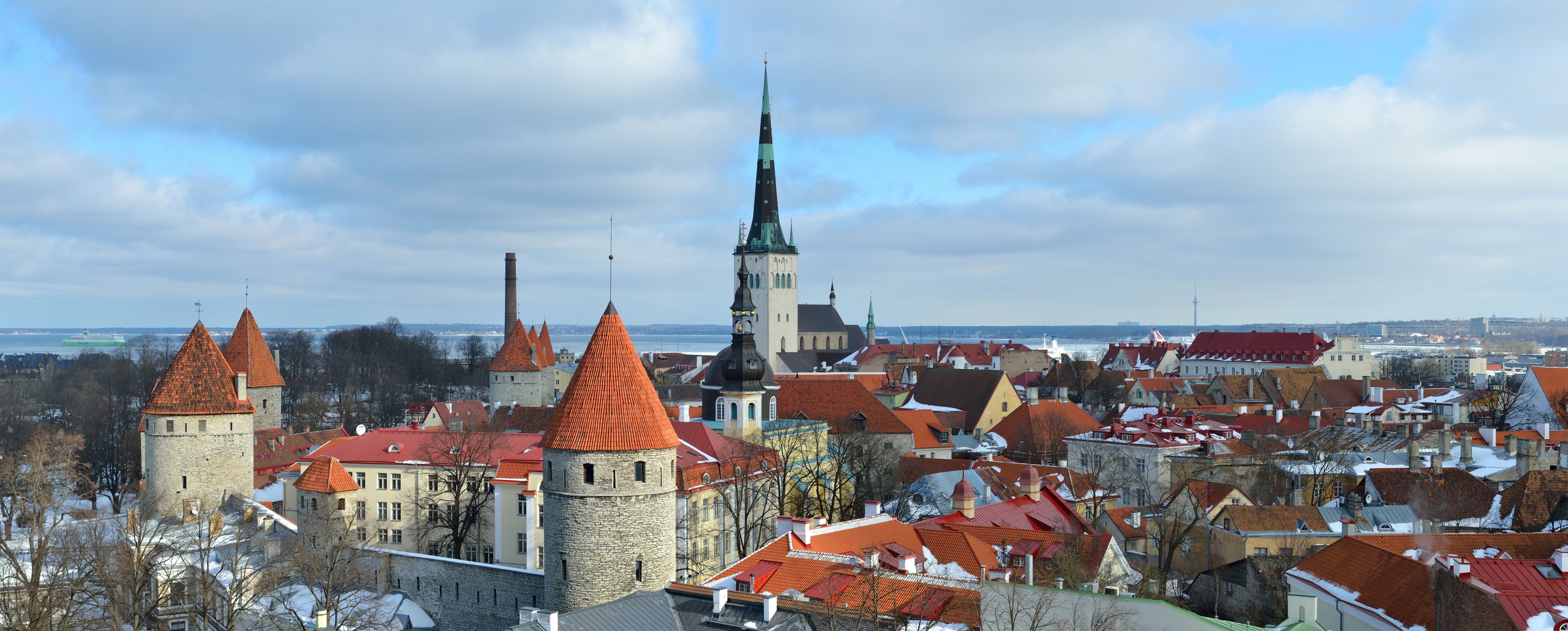
Old Town Tallinn: A Medieval Hanseatic City on the Baltic
Old Town Tallinn is a medieval walled city on the Baltic coast. Its towers, lanes and squares survive almost whole from the Hanseatic age.
Old Town Tallinn is the oldest part of Tallinn, the capital of Estonia, and it is one of the best-preserved medieval towns in northern Europe. The old town stands on the southern shore of the Gulf of Finland, on a limestone hill and the flat land below it, and it is divided into the upper town of Toompea and the lower town of merchants and craftsmen. Old Town Tallinn was inscribed by UNESCO in 1997 as the Historic Centre of Tallinn, property number 822, under criteria two and four. The walls, the towers, the churches and the merchant houses of the old town survive to a degree that is rare in Europe.
The old town began as a trading settlement in the thirteenth century, and it grew rich as a port of the Hanseatic League. Old Town Tallinn was a meeting point of east and west, where goods from Russia, Germany, Scandinavia and England changed hands. The town kept its medieval plan through centuries of Danish, German, Swedish and Russian rule, and it survived the wars of the twentieth century almost intact. A visitor to Old Town Tallinn walks through a city that still looks much as it did five hundred years ago.
Old Town Tallinn is compact, and its whole historic centre can be walked in a day. The Town Hall Square is the heart of the lower town, and the castle and cathedral of Toompea stand on the hill above it. Old Town Tallinn is a living place, not a museum, and its lanes hold cafes, shops, hotels and homes beside the medieval churches and guild houses.
Quick Facts About Old Town Tallinn
| Fact | Detail |
|---|---|
| Location | Central Tallinn, Estonia, on the Gulf of Finland |
| Coordinates | 59.4372° N, 24.7453° E |
| UNESCO | Historic Centre of Tallinn, 1997, number 822, criteria ii and iv |
| UNESCO area | Core area 113 hectares, buffer zone 2,253 hectares |
| Upper town | Toompea, the hill of the castle and the cathedral |
| Lower town | The medieval merchant town around the Town Hall Square |
| Town Hall | Completed in 1404, the oldest in northern Europe |
| Wikidata | Q726803 |
Geography of Old Town Tallinn
A Hill, a Bay and a Limestone Coast
Old Town Tallinn stands on the southern shore of the Gulf of Finland, on a coast of limestone cliffs and shallow bays. The old town is built on two levels, the high limestone hill of Toompea and the flat land of the lower town at its foot. The hill rises about 50 metres above the lower town, and its cliffs form a natural fortress on the southern and western sides. Old Town Tallinn owes its shape to this hill, and the division between the upper and lower towns has defined the city for eight centuries.
The lower town of the old town lies on a flat plain that slopes gently towards the sea, and its streets follow the medieval plan of a trading town. The Town Hall Square stands at the centre of the lower town, and the streets radiate from it towards the gates and the harbour. The walls of the old town enclose the lower town in a great curve, and the towers rise along the wall at regular intervals. Old Town Tallinn is a walled city in the fullest sense, and its walls are the first thing a visitor sees from the sea.
The sea is close to the old town, and the harbour of Tallinn lies a short walk to the north of the old town. The Gulf of Finland is shallow and brackish, and it freezes in cold winters. The harbour has been the life of the town since its founding, and its ships carried goods between east and west. Old Town Tallinn is a port city, and its wealth came from the sea.
The climate of the old town is the northern maritime climate of the Baltic, with cool summers, cold winters and long twilight in June. Snow covers the old town in winter, and the roofs and towers look their best under snow. Summer brings long days and warm evenings, and the squares and cafes of the old town fill with people. Old Town Tallinn is beautiful in every season, and its stone and timber look different under snow, rain and summer sun.
The Walls and Towers of the Old Town
The walls of the old town are among the finest medieval town walls in Europe, and nearly two kilometres of them still stand. The walls were built in the thirteenth and fourteenth centuries, and they were strengthened with towers over the following centuries. The towers of the old town have names that are known to every visitor, and they include the Fat Margaret tower at the harbour gate and the Kiek in de Kök tower at the south-western corner. Old Town Tallinn is a city of towers, and its skyline is a forest of spires and turrets.
The wall walk of the old town is open in places, and it gives a view over the rooftops of the lower town and the hill of Toompea. The towers were built for defence, and their thick walls and gun loops show the military technology of the medieval age. The Fat Margaret tower, a great round tower at the Great Coastal Gate, now holds the Estonian Maritime Museum. Old Town Tallinn keeps its defences as a living part of the city, and its towers are museums, cafes and viewpoints.
The gates of the old town are the old entrances to the city, and the Viru Gate is the most famous of them. The gate stands at the eastern end of the old town, where the road from the east entered the city. The towers of the Viru Gate are the symbol of Tallinn, and their conical roofs are the first sight of the old town for many visitors. Old Town Tallinn is entered through its gates, and the narrow streets beyond them are the streets of the medieval town.
The bastions of the old town, the great earthworks built in the seventeenth and eighteenth centuries, lie outside the medieval walls. The bastions were built to defend the town against cannon, and their tunnels are open to visitors. Old Town Tallinn is therefore a city of two ages of fortification, the medieval walls and the later bastions, and both survive in the heart of the modern capital.
Toompea Hill and the Lower Town
Toompea is the upper town of the old town, a limestone hill that has been the seat of power in Estonia for eight centuries. The castle of Toompea stands on the hill, and it is now the seat of the Estonian parliament. The cathedral of Saint Mary, the oldest church in Tallinn, stands beside the castle, and its tower looks over the whole old town. Old Town Tallinn is ruled from Toompea, and the hill has always been the place of the rulers, first Danish, then German, then Swedish, then Russian, and now Estonian.
The lower town of the old town is the town of the merchants, and its streets are lined with the tall narrow houses of the Hanseatic traders. The Town Hall Square is the centre of the lower town, and the Town Hall, completed in 1404, stands on its southern side. The square was the marketplace of the medieval town, and it is still the meeting place of the city. Old Town Tallinn is a town of two parts, and the contrast between the hill of the rulers and the square of the merchants is the key to its history.
The streets of the lower town of the old town are narrow and winding, and their names recall the trades of the medieval city. The streets of the shoemakers, the bakers and the smiths run between the square and the walls, and their houses are the gabled merchant houses of the Hanseatic age. The lanes are paved with stone, and their cellars and courtyards hold cafes, workshops and galleries. Old Town Tallinn is a town to walk slowly, because every lane turns and opens onto a new view.
The parks and gardens of the old town lie at the foot of Toompea hill, where the medieval moat once ran. The green belt around the old town follows the line of the old fortifications, and it is a favourite walk for the people of the city. Old Town Tallinn is surrounded by green, and its walls rise from trees and lawns rather than from streets. The old town is a green island in the middle of the modern city.

Arrival in Tallinn — CC BY-SA 2
History of Old Town Tallinn
A Castle, a Town and the Hanseatic League
Old Town Tallinn began in the thirteenth century, when a castle was built on Toompea hill by the crusading knights of the Teutonic Order. The castle was founded in 1219, when the Danish king Valdemar the Second took the hill, and the town grew at its foot. The name Tallinn is said to come from the Estonian words for Danish town, and the Danish period gave the city its first walls and its first churches. Old Town Tallinn was born as a Danish castle town, and its hill has been fortified ever since.
The town below the castle grew rich on trade, and in the fourteenth century it joined the Hanseatic League, the great trading alliance of the northern seas. Old Town Tallinn became one of the most important ports of the League, and its merchants traded furs, wax, honey and timber from Russia for salt, cloth and wine from the west. The wealth of the town is shown by its churches, its guild houses and its Town Hall, and the lower town still looks as it did in the Hanseatic age. Old Town Tallinn was a Hanseatic city for three centuries, and its plan, its buildings and its streets are the legacy of that age.
The German merchants of the old town ruled the lower town, and their guilds and brotherhoods built the great houses of the city. The Great Guild Hall, the House of the Brotherhood of Blackheads and the merchant houses of Pikk Street are the monuments of that rule. The town was a German town in language and law, and its Estonian population lived outside the walls. Old Town Tallinn was a city of two peoples, and its history is the story of their long coexistence.
The Reformation came to the old town in the sixteenth century, and the churches of the town became Lutheran. The town kept its medieval buildings, and its churches, its Town Hall and its guild houses survived the change of faith. Old Town Tallinn in the sixteenth century was a prosperous and well-ordered town, and its walls and towers were the strongest in the Baltic. The town was a prize for the powers of the north, and its history is a history of sieges and surrenders.
Swedish, Russian and the Long Centuries
In 1561 the old town passed to Sweden, and the town became a Swedish port on the Baltic. The Swedish period brought new fortifications, and the bastions and tunnels of the old town date from this age. The town grew beyond its walls, and its suburbs spread to the east and south.
Old Town Tallinn under Sweden was a quiet provincial town, and its trade declined as the Hanseatic League faded. The town kept its medieval centre, and its walls and towers survived because the town was too poor to rebuild them.
In 1710 the old town passed to Russia, and the town became a Russian port on the Gulf of Finland. The Russian period lasted for two centuries, and the town grew into a city of merchants, soldiers and officials. The old town was preserved, and its medieval buildings were kept because the new city grew outside the walls. Old Town Tallinn under Russia was a place of two worlds, the medieval town inside the walls and the modern city outside them.
The nineteenth century brought the railway to Tallinn, and the town became an industrial port. The old town of the old town was left behind by the new city, and its houses became homes for the poor. The medieval town survived because it was neglected, and its walls, its churches and its merchant houses were saved by the very poverty that emptied them. Old Town Tallinn in the nineteenth century was a forgotten town, and its preservation is the result of that forgetting.
The twentieth century brought war and occupation to the old town, and the town was bombed in the Second World War. The old town survived largely intact, and its Town Hall, its churches and its walls stood through the war. The Soviet period that followed kept the old town as a historic monument, and its buildings were restored. Old Town Tallinn in the twentieth century was a museum town, and its preservation was a policy of the state.
Independence and World Heritage
Estonia regained its independence in 1991, and the old town became the historic heart of a free capital. The old town was restored with new care, and its houses, its churches and its walls were repaired. The town became a place of cafes, shops, hotels and homes, and its squares filled with people again. Old Town Tallinn in the 1990s was a town reborn, and its medieval streets became the pride of the new republic.
In 1997 UNESCO inscribed the Historic Centre of Tallinn as a World Heritage property, number 822, under criteria two and four. The inscription recognised the old town as an exceptionally complete and well-preserved medieval northern European trading city, and it praised the combination of the upper town on its hill and the lower town at its foot. The property covers 113 hectares, with a buffer zone of 2,253 hectares, and it includes the castle of Toompea, the lower town and the bastions. Old Town Tallinn is now a World Heritage city, and its preservation is a duty of the state.
Today the old town is the most visited place in Estonia, and its squares, its churches and its walls draw travellers from all over the world. The old town is a living place, and its lanes hold homes, offices, schools and workshops beside the monuments. Old Town Tallinn is a city where the medieval and the modern live together, and its Town Hall Square is the meeting place of the whole country.
The story of the old town is a story of survival, and the town has kept its medieval plan through eight centuries of change. The walls, the towers, the churches and the merchant houses are the legacy of the Hanseatic age, and they are the reason the old town is a World Heritage property. Old Town Tallinn is a treasure of northern Europe, and its preservation is one of the great successes of the modern age.

Towers in Tallinn old town — Public domain
Travel to Old Town Tallinn
When to Go and How Long to Stay
The best months to visit Old Town Tallinn are May to September, when the days are long and the squares are warm. June brings the white nights of the north, and the old town is light until late in the evening. July and August are the busiest months, when the cruise ships bring crowds to the Town Hall Square. Old Town Tallinn in winter is a place of snow and Christmas markets, and the Town Hall Square holds one of the oldest Christmas markets in Europe.
Two days are enough for the highlights of Old Town Tallinn, and three days allow a slow visit with time for the museums and the wall walk. The old town is compact, and its whole historic centre can be walked in a day. A morning covers Toompea and the cathedral, and an afternoon covers the lower town, the Town Hall and the guild houses. Old Town Tallinn rewards a slow visit, and its lanes and cafes invite lingering.
Old Town Tallinn is at its quietest on weekday mornings, when the cruise crowds have not yet arrived. The best time to walk the walls is early in the morning, when the towers are empty and the light is soft. The old town is a place to visit in all seasons, and its stone and timber look different under snow, rain and summer sun. A visitor who stays overnight sees the old town at its best, when the day crowds have gone and the lanes are quiet.
Getting There and Getting Around
Old Town Tallinn is reached most easily on foot from the harbour, the bus station and the railway station, all of which lie a short walk from the old town. The airport of Tallinn is a short tram ride from the centre, and trams and buses link the airport with the old town. Old Town Tallinn is a pedestrian place, and its lanes are closed to most traffic. Walking is the best way to see the old town, and its whole historic centre is crossed on foot in half an hour.
The old town is divided into two levels, and the climb from the lower town to Toompea is made by the steep lanes of Pikk Jalg and Lühike Jalg. The hill is also reached by steps and by road, and the view from the viewing platforms of Toompea is the finest in the city. Old Town Tallinn is a town of steps and slopes, and its hill gives the best views over the lower town and the sea. A visitor who climbs to Toompea sees the whole old town laid out below.
Day trips from Old Town Tallinn are easy, and the most popular is the ferry to Helsinki, which takes about two hours across the Gulf of Finland. The towns of the Estonian coast and the islands of the west are reached by bus and ferry, and the national parks of the country are a day trip from the capital. Old Town Tallinn is a base for Estonia, and its harbour and its station are the gateways to the whole country. The city of Riga lies further south, and it is reached by bus or car in a long day trip.
Practical Notes
Old Town Tallinn is a safe and welcoming place, and English is widely spoken in the hotels, restaurants and museums. The currency is the euro, and cash machines are found in the Town Hall Square and the main streets. The old town is a good place for families, and its towers, its walls and its museums are a delight for children. Old Town Tallinn is also a good place for older travellers, because its centre is compact and its cafes are never far away.
Accommodation in Old Town Tallinn ranges from historic hotels in merchant houses to apartments in the lanes of the lower town. The old town holds many of the best hotels in the city, and booking ahead is wise in summer, when the town is full. Old Town Tallinn has restaurants in every lane, and its food is the food of the Baltic: fish, rye bread, pork and berries. The cafes of the Town Hall Square are the classic place to rest between sights.
The food of Old Town Tallinn is worth seeking out, and its specialities include the smoked fish of the Baltic, the black bread of Estonia, and the marzipan of the old town. The Town Hall Pharmacy, one of the oldest pharmacies in Europe, still sells marzipan and remedies in the square. Old Town Tallinn is a place to eat well, and its markets and shops sell the produce of the Estonian countryside.

Tallinn – Nunne Street — CC BY-SA 4
Notable Places in Old Town Tallinn
The Town Hall Square. The heart of Old Town Tallinn, a medieval marketplace with the Town Hall of 1404 on its southern side. The square is the meeting place of the city, and its cafes, its markets and its Christmas tree are the centre of old town life.
The Town Hall. Completed in 1404, the Town Hall of Old Town Tallinn is the oldest surviving town hall in northern Europe. Its tower gives a view over the lower town, and its halls hold the history of the medieval city.
Toompea Castle. The castle on the hill of Old Town Tallinn, founded in the thirteenth century and now the seat of the Estonian parliament. The castle is the symbol of Estonian statehood, and its pink walls look over the whole old town.
Saint Mary Cathedral. The oldest church in Tallinn, standing on Toompea hill in Old Town Tallinn, with a tower that looks over the city. The cathedral is the burial place of the great men of the Baltic, and its bells are the voice of the old town.
Saint Olaf Church. A great Gothic church of Old Town Tallinn, whose spire once made it one of the tallest buildings in the world. The church tower gives the finest view over the old town, and its spire is the landmark of the city.
The Great Coastal Gate and Fat Margaret. The harbour gate of Old Town Tallinn, guarded by the great round tower called Fat Margaret. The tower now holds the Estonian Maritime Museum, and it is the first sight of the old town from the sea.
The Viru Gate. The eastern gate of Old Town Tallinn, with its twin towers and conical roofs. The gate is the symbol of the city, and its towers are the first sight of the old town for many visitors.
The Great Guild Hall. The hall of the German merchants of Old Town Tallinn, now the Estonian History Museum. The hall is the monument of the Hanseatic age, and its great hall shows the wealth of the medieval traders.
The House of the Brotherhood of Blackheads. A guild house of Old Town Tallinn, with a fine Renaissance facade on Pikk Street. The house was the meeting place of the unmarried merchants of the city, and it is one of the most beautiful buildings in the old town.
Kiek in de Kök. A great artillery tower of Old Town Tallinn, built in the fifteenth century at the south-western corner of the walls. The tower now holds a museum of the fortifications, and its tunnels run under the bastions.

Tallinn Town Hall Square, 2013 — CC BY-SA 3

Toompea, the upper old town of Tallinn — CC BY-SA 3

Saint Mary Cathedral (Toomkirik), Tallinn — CC BY-SA 3

Saint Olaf Church, Tallinn — CC BY-SA 3

Viru Gate 2 — CC BY-SA 3

Fat Margaret tower, Tallinn — Public domain

Great Guild Hall – Tallinn 2018-01-08 10 — CC BY-SA 4

Kiek in de Kök, 2006 (01) — CC BY-SA 4
Frequently Asked Questions About Old Town Tallinn
Why is Old Town Tallinn a UNESCO World Heritage property?
UNESCO inscribed the Historic Centre of Tallinn in 1997, as property number 822, under criteria two and four. The inscription praises the town as an exceptionally complete and well-preserved medieval northern European trading city, with the upper town on its hill and the lower town at its foot.
How long does it take to walk around Old Town Tallinn?
The whole historic centre of Old Town Tallinn can be walked in a day, and its lanes are compact enough to cross on foot in half an hour. Two days allow a slow visit, with time for Toompea, the Town Hall, the guild houses and the wall walk.
What is the oldest building in Old Town Tallinn?
The Town Hall of Old Town Tallinn, completed in 1404, is the oldest surviving town hall in northern Europe. Saint Mary Cathedral on Toompea hill is older still, and it is the oldest church in the city, founded in the thirteenth century.
Can I walk on the walls of Old Town Tallinn?
Parts of the walls of Old Town Tallinn are open to visitors, and the wall walk gives a view over the rooftops of the lower town and the hill of Toompea. The towers of the wall hold museums and viewpoints, and the Fat Margaret tower at the harbour gate is the most famous of them.
What is Toompea in Old Town Tallinn?
Toompea is the limestone hill of Old Town Tallinn, and it has been the seat of power in Estonia for eight centuries. The castle on the hill is now the seat of the Estonian parliament, and the cathedral beside it is the oldest church in the city.
When is the best time to visit Old Town Tallinn?
May to September is the best season for Old Town Tallinn, with long days, warm squares and open towers. Winter brings snow and the Christmas market on the Town Hall Square, and the old town is at its most beautiful under snow.
Verified
The checks behind this guide are set out against the sources below, dated 22 November 2026. UNESCO inscribed the Historic Centre of Tallinn in 1997 as property number 822, under criteria two and four, with a core area of 113 hectares and a buffer zone of 2,253 hectares. The Town Hall was completed in 1404, the castle on Toompea was founded in the thirteenth century, and Estonia regained its independence in 1991. The old town is divided into the upper town of Toompea and the lower town of the merchants.
The registry entry for the old town carries Q726803 and the coordinates 59.4372 degrees north and 24.7453 degrees east, and the Wikidata record for that Q-ID confirms both. Wikidata describes the place with the types old town and urban area, and the coordinate pair in its record matches the registry pair exactly. The identity of the old town is therefore confirmed by two records that agree, and the Q-ID is correct.
The registry flag for the old town reads false, but the UNESCO list shows that reading is wrong. The Historic Centre of Tallinn is an inscribed property, number 822, and the old town is that property, so the flag should read true. This finding is recorded in the fix queue under number 211, and the article follows the UNESCO record rather than the flag. The history of the town, including the Danish founding of 1219 and the Hanseatic centuries, is drawn from the sources below.
Sources
- UNESCO World Heritage Centre, Historic Centre of Tallinn — https://whc.unesco.org/en/list/822/
- UNESCO World Heritage Centre, Estonia — https://whc.unesco.org/en/statesparties/ee/
- Wikipedia, Tallinn Old Town — https://en.wikipedia.org/wiki/Tallinn_Old_Town
- Wikidata, Tallinn Old Town Q726803 — https://www.wikidata.org/wiki/Q726803
Unverified
The current prices of the wall walk, the tower museums and the Town Hall tower change with the season, and they should be checked on the official sites before a visit. The exact opening hours of the museums and the viewing platforms vary by season, and the ferry timetable to Helsinki should be confirmed before travel. The figure of nearly two kilometres of surviving wall is the commonly given round number, and a newer survey should be checked for a precise length.
Illustrations
- Hero: Old town of Tallinn 06-03-2012. Free image: https://upload.wikimedia.org/wikipedia/commons/6/6e/Old_town_of_Tallinn_06-03-2012.jpg — CC BY-SA 3 ee.
- In body, A Hill, a Bay and a Limestone Coast: Tallinn – Nunne Street. Free image: https://upload.wikimedia.org/wikipedia/commons/6/63/Tallinn_-_Nunne_Street.jpg — CC BY-SA 4.
- In body, The Walls and Towers of the Old Town: Towers in Tallinn old town. Free image: https://upload.wikimedia.org/wikipedia/commons/5/52/Towers_in_Tallinn_old_town.JPG — Public domain.
- In body, Toompea Hill and the Lower Town: Arrival in Tallinn. Free image: https://upload.wikimedia.org/wikipedia/commons/c/c6/Arrival_in_Tallinn.jpg — CC BY-SA 2.
- In body, The Town Hall Square: Tallinn Town Hall Square, 2013. Free image: https://upload.wikimedia.org/wikipedia/commons/e/e4/Tallinn_Town_Hall_Square%2C_2013.jpg — CC BY-SA 3.
- In body, Toompea Castle: Toompea, the upper old town of Tallinn. Free image: https://upload.wikimedia.org/wikipedia/commons/9/9b/Tallinn_Toompea_Upper_Old_Town_2013.jpg — CC BY-SA 3.
- In body, Saint Mary Cathedral: Saint Mary Cathedral (Toomkirik), Tallinn. Free image: https://upload.wikimedia.org/wikipedia/commons/6/67/Catedral_de_Santa_Mar%C3%ADa_%28Toomkirik%29%2C_Tallin%2C_Estonia%2C_2012-08-05%2C_DD_08.JPG — CC BY-SA 3.
- In body, Saint Olaf Church: Saint Olaf Church, Tallinn. Free image: https://upload.wikimedia.org/wikipedia/commons/8/8a/Iglesia_de_San_Olaf%2C_Tallinn%2C_Estonia%2C_2012-08-05%2C_DD_01.JPG — CC BY-SA 3.
- In body, The Viru Gate: Viru Gate 2. Free image: https://upload.wikimedia.org/wikipedia/commons/6/6f/Viru_Gate_2.jpg — CC BY-SA 3.
- In body, The Great Coastal Gate and Fat Margaret: Fat Margaret tower, Tallinn. Free image: https://upload.wikimedia.org/wikipedia/commons/c/ce/Paks_Margareeta.jpg — Public domain.
- In body, The Great Guild Hall: Great Guild Hall – Tallinn 2018-01-08 10. Free image: https://upload.wikimedia.org/wikipedia/commons/0/0c/Great_Guild_Hall_-_Tallinn_2018-01-08_10.jpg — CC BY-SA 4.
- In body, Kiek in de Kök: Kiek in de Kök, 2006 (01). Free image: https://upload.wikimedia.org/wikipedia/commons/3/3a/Kiek_in_de_K%C3%B6k%2C_2006_%2801%29.jpg — CC BY-SA 4.